TCP Throughput under ON-OFF Model of Access Point
ANITHA S
Assistant ProfessorDepartment of Electronics and Communication Engineering PES INSTITUTE OF TECHNOLOGY
100-ft Ring Road, BSK III Stage, Bangalore 560085
ABSTRACT
In this paper, the TCP throughput has been modeled under an ON-OFF model of the access point. In the ON-OFF model, the access point spends a fixed amount of time in the ON and OFF states. Also these states appear in an alternating fashion. When a station is associated with an access point, this model of the access point helps the station to conserve battery power. Also, since many of the applications on the internet run TCP, it is of interest to model and understand the behavior of TCP in such a system. Since throughput plays a major role in determining how the user at the station evaluates the performance of the network, the same has been tried to be modeled. Also, this modeling has been validated using simulation.
.
KEYWORDS
The following are the notations which have been used throughout the paper.
Table 1: Notations used
Symbol Meaning
Attempt probability when n nodes are contending
Time required for transmission of STA packet
Time required for transmission of AP packet
Time taken by collision
Access point OFF duration
Access point ON duration
Time taken by an idle slot
Invariant probability vector
Transition probability matrix
INTRODUCTION
Consider a case wherein a station is associated with an access point, which alternates between ON and OFF state.
In each state, it spends a deterministic amount of time. The station starts downloading files from the internet through the access point. Assume that the time to traverse the wired link is negligible compared to the time to traverse the wireless network and the station to be using TCP for file transfer. Under these conditions, it is of interest to know the TCP throughput.
We have proposed here, a statistical equivalent model for the ON-OFF model of access point, where the ON and OFF times are chosen from exponential distribution with mean TON and TOFF respectively. The renewal instances and
the embedded discrete time Markov chain of the equivalent problem were identified. The results from Markov Regenerative Process were applied to get a closed form expression for TCP throughput with file downloads with only one station. Our analytical model matched quiet well with the simulated results, validating our assumptions and the equivalent model.
1. SYSTEM MODEL
Figure 1: An illustration of the system
Consider a system as illustrated in Figure1. In such a system, there’s a single STA, associated at a fixed rate with the access point. The access point is connected to a server via a local area network. Consider the scenario, wherein, the server is sending data as TCP packets to the STA via the access point and assume that the queue at STA contains ACK packets for the received TCP packets. Instead of keeping the AP always in ON state, it would be preferable to alternate the state between ON and OFF. The duration AP spends in ON and OFF state may be deterministic (as in Figure 2) or dynamically varied.
ON OFF ON OFF
0 T1 T2 T3 T4
Figure 2: AP state variation with time
In order to facilitate the analysis, the following assumptions are made:
The wireless access mechanism used is IEEE 802.11 The files are downloaded from AP to STA, while STA
just sends ACK packets. Hence the packets in STA
TCP
server
buffer are much smaller than the ones in the AP buffer. The data transfer happens via TCP.
Data packets flow from the server to the station via AP and the ACK packets flow in the reverse direction. When AP is OFF, the packets from the server are
buffered and will be delivered to the AP, when it turns back ON.
If a station transmits an ACK packet, when the AP is OFF, then the packet is recovered using fast recovery. The TCP operates in collision avoidance and no time-out
occurs at the server.
When STA and AP are contending, then both have equal probability of success.
The TCP to have reached steady state when the TCP window size is W.
2.
MATHEMATICAL
MODEL
AND
ANALYSIS
In this section, the problem being present is converted into a statistical equivalent model. By doing this transformation, it is possible to apply Markovian analysis.
Assume that AP timer takes a random time from an exponential distribution with mean TON and TOFF when in ON
and OFF states respectively. AP decrement the timer’s time and samples another time when the timer becomes zero.
Let St be the random variable which denotes whether the
AP is ON or OFF at time t. Let Nt be the queue length at the
AP at time t. The tuple (St, Nt) completely describe the system
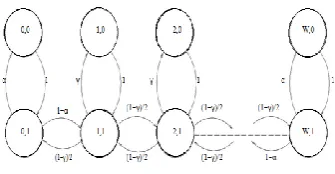
[image:2.595.309.542.69.471.2]at time t. Let { } be the time at which either the AP toggles between ON and OFF state or the instance of completion of a successful transmission. Then form a Markov Renewal sequence. The transition probabilities of the Markov chain are shown in Figure 3.
Figure 3: Embedded Markov chain
Assume that an idle slot is time-units (ms) long. A successful AP and STA packet transmission takes TS,AP and
TS,STA amount of time respectively. A collision takes place
and lasts for duration of TC. Note that the slots are of different
duration. Let be the number of packets in the AP buffer. And let . Now, at the end of a slot, exactly 1 of the 5 possible events will occur.
1. Off -transition; let the probability be
2. STA-success; let the probability be (
3. AP-success; let the probability be (
4. Idle-slot; let the probability be (
5. Collision-slot; let the probability be
Then, we can write
Let
Also
Now, rewriting the probabilities in term of :
If be the number of packets in the AP buffer (i.e, the AP buffer is empty). Then, at the end of a slot, exactly 1 of the 3 possible events will occur,
1. Off -transition; let the probability be
2. STA-success; let the probability be
3. Idle slot; let the probability be
Now, write the following transition probabilities as,
Let
Also
[image:2.595.66.234.485.572.2]Now, rewriting the probabilities in term of :
If be the number of packets in the AP buffer ( i.e, the STA buffer is empty). Then, at the end of a slot, exactly 1 of the 3 possible events will occur.
1. Off -transition; let the probability be
2. AP-success; let the probability be
3. Idle-slot; let the probability be
Now, write the following transition probabilities as
It is easy to see that
Also
Now, rewriting the probabilities in term of :
3.
AGGREGATE
DOWNLOAD
THROUGHPUT
Now that the DTMC and renewal process have been identified, in this section, let’s find a closed form expression for TCP throughput.
3.1 Computation of Invariant probability vector
Since the DTMC in figure 3 is a finite irreducible chain, according to Markovian property we know that there exists a vector , such that . Since the chain in figure 3 is a 2- dimensional Markov Chain, let denote the stationary probability, where denotes the number of packets in the AP buffer and denotes if the AP is OFF or ON respectively. From the chain in Figure 3, we have
(1.1)
(1.2)
(1.3)
Now,
Substituting Equation (1.2) and rearranging,
(1.4)
Now,
Substituting from Equations (1.1) and (1.4) and rearranging
(1.5)
Now writing
Thus we get
(1.6)
And for the rightmost state we get
(1.7)
We also know that
(1.8)
Rewriting the above equation as
Where
3.2 Computation of
The computation of the invariant probability vector requires the knowledge of and , which in turn needs In this section, lets derive an expression for in terms of known quantities. First lets find the average number of slots in an ON period, given that no success happens in this period. The number of slots has that following distribution
) 1 (k
Thus
If i = 0, there can be an idle slot or a success by the STA. Hence the expected slot length given that the buffer at the AP is empty, is given by
Or
E[T0] = 1.TSSTA + (1- 1).T1
Similary we get, E[TW] = 1.TSAP + (1- 1).T1
Similarly we have,
So we can write the expected slot length as
So now we impose the condition that
Thus, we get
(1.9)
The LHS of Equation (1.9) is an increasing function of where it can be shown that the RHS is a decreasing function
of Given that the equation can be solved numerically to obtain an
3.3 Mean Sojurn time in a state
Let us denote as the mean time spent in the state (i,j).
Let at first consider the left most state i.e, (0,0) and (0,1). Then we get,
Here represents the time required to move from state (0,1) to state (0,0) given that we just entered state (0,1). And E[X] denotes the expected time for an STA success to occur given that the AP does not switch off. In order to compute E[X] we identify another renewal equation given as
Rearranging the terms, we get
Now let us find an expression for Let M be a
random variable which denotes the number of slot till the AP goes to the OFF without having a success, given that, only the STA is non-empty. It is easy to see that such slots would be nothing but the idle slots. This M has the following distribution
So,
Now, the time spent would be mean number of slots into mean slot length. Thus, we would get
*
Substituting, we get,
And
Since the contention process of the AP and STA are same, we can write similar renewal equations for the rightmost states. These equations can be solved to obtain
Let us consider states (i,j) such that 1≤i≤W-1 . Then we can write
Here represents the time required to move from state (i, 1) to state (i,0) given that, we just entered state (i,1). And E[Y] denotes the expected time till success by either AP or STA. Now, we can write the following renewal equations for E[Y]
*
Rearranging the terms,
Now let us find an expression for . Let N be a random variable which denotes the number of slots till the AP goes to the OFF without having a success, given that, both STA and AP are non-empty. It is easy to see that such slots would be either idle or collision slots. This M has the following distribution
So E[M]
Now, we set the time spent which would be mean number of slots into mean slot length. Since only either idle or collision can occur thus the mean slot time is
Thus as before, we get
3.4 Throughput computation
Let H(t) denote the number of success till time t. We are interested to know the average throughput i.e,
By application of results for Markov regenerative process we can compute the throughput as
R(i,j) denotes the reward, given that we are in state (i,j). Since in our case the reward is successful transmission by an AP, R(i,j) simply corresponds to the probability of AP success. It is easy to see that
R(i,j)
Putting in the values of R(i,j) we can write the throughput as
We note that our model is valid under the assumption that If then our model reduces to the single
station case . And in such case we use to compute the aggregate TCP throughput.
4. RESULTS
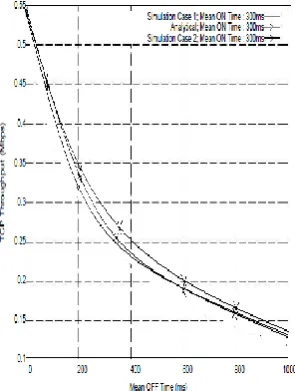
In this section, our analytical model has been compared with that of simulation. The simulations were done using Qualnet 4.5 a network simulator. For each case, 100 runs were conducted and the average results are presented here. The confidence interval was very small, hence the same is not plotted in the graphs. Figure 4 shows the variation of TCP Throughput with the OFF duration case, when the ON duration is held constant at 300 ms.
[image:5.595.321.469.491.687.2]It was observed that all our assumptions were reasonable and the analytical and simulated results were close to one another.
Figure 5 shows the variation of TCP throughput with the OFF duration case, when the ON duration is held constant at 600 ms
Figure 5: Comparison of TCP throughput with Mean OFF duration for a fixed ON duration of 600 ms
CONCLUSION
In this paper, we have proposed a statistical equivalent model for the ON-OFF model of access point. We have applied results from Markov analysis and have found a closed form expression for TCP throughput with file downloads when there is only one station. Our analytical model matched quiet well with the simulated results, validating our assumptions and the equivalent model. We would like to extend this for the case when there are multiple stations associated with an access point, in our future work. In the future work, we would like to incorporate different rates of association and file transfers in both the directions.
REFERENCES
[1] George Kuriakose, Sri Harsha, Anurag Kumar and Vinod Sharma, \Analytical models for capacity estimation of IEEE 802.11 WLANs using DCF for internet applications,” in Wirelwss Networks, 15(2). 259-277.
[2] G Bianchi, \Performance analysis of the IEEE 802.11 distributed co-ordinate function,” in JSAC Wireless Series, vol.18, no.3, 2000
[3] Anurag Kumar, \Discrete event stochastic processes, in lecture notes for Engineering Curriculum, 2008, IISc, Bangalore
[4] Wireless Networking Text Book by Joy Kuri, Anurag kumar and D Manjunath published by Morgan Kaufmann Publishers (an imprint of Elsevier), San Francisco, USA, April 2008