75:3 (2015) 95–101 | www.jurnalteknologi.utm.my | eISSN 2180–3722 |
Jurnal
Teknologi
Full Paper
A
F
RAMEWORK FOR
D
EVELOPING
C
ULTURE
-
BASED
M
ULTI
-
MODAL
M
IND
G
AMES
:
I
MPROVING
S
OCIAL
I
NTERACTION
S
KILLS OF
A
UTISTIC
C
HILDREN
Rafizah Mohd Hanifa
a*, Maizam Alias
b, Ida Aryanie Bahrudin
a,
Miswan Surip
a, Zuraida Ibrahim
a, Rosfuzah Roslan
aa
Centre for Diploma Studies Universiti Tun Hussein Onn Malaysia
Johor, Malaysia
b
Faculty of Technical and Vocational Education Universiti Tun
Hussein Onn Malaysia Johor, Malaysia
Article history Received 3 December 2013 Received in revised form
2 July 2014 Accepted 25 November 2014
*Corresponding author
[email protected]
Graphical abstract
Abstract
Cases of autism, a developmental disorder that disconnects individuals from their environment and people is on the rise with 30% increase being reported in Malaysia from 2008-2011. Early childhood intervention is essential in ensuring autistic children have the opportunity to develop their full potential and enabling them to contribute to society in later years. The intervention will also enhance education opportunities of such children, thus supporting the efforts of NASOM as well as the government’s “education for all aspirations”. One approach that has shown great potential in enhancing social interaction skills among autistic children is the multi-modal mind games approach. The purpose of this paper is to present a framework in designing a culture-based multimedia supported mind games for autistic children. Action research method will be adopted since the cyclic nature of the method will provide opportunity for improving existing educational practices for autistic children. Needs analysis will be conducted to determine weaknesses and strengths of the current practices in developing social interaction skills among autistic children. Parents and teachers will be interviewed and autistic children between the age of five and eight will be observed to get a comprehensive view of the existing situation. Based on the analysis, a set of culture-based mind games multimedia supported as well as face to face interactions will be designed and prescribed to selected autistic children.
Keywords: Special education, autism, culture-based multi-modal mind games, social interaction, action research
© 2015 Penerbit UTM Press. All rights reserved
1.0 INTRODUCTION
Autism, which is a lifelong neurobiological disorder that blocks a child’s communication, emotional and social development is on the increase in Malaysia. According to the National Autism Society of Malaysia (NASOM), there has been an increase of 30% in the number of children registered as autistic from 2008-2011 [1] as well as the number of children diagnosed with Autism Spectrum Disorder (ASD). Characteristics often associated with autism include quality impairment in social interaction such as eye-to-eye
gaze, facial expression, body postures or lack of social or emotional reciprocity; quality impairment in communication such as delay of development of spoken language or repetitive use of language and restricted repetitive and stereotyped patterns of behavior, interest and activities.
needs of autistic children [2]. According to a UNICEF report, severity of autism can be reduced with early childhood intervention that enhances the development of their social, behavioral and communication skills [3]. In the case of children with ASD, the considerable variation in the autistic characteristics across individuals poses additional challenges in determining appropriate interventions. Thus, the variations within the disorder have significant implications on choice of educational strategies. Among the many challenges faced by autistic individuals, social interaction is one of the most crucial elements lacking in their daily lives. The importance of social interaction cannot be overstated as it is a principle aspect of development that is influential throughout one’s life. The inability of individuals with autism to integrate comfortably in a social setting can be very taxing for family and friends during childhood and even through adulthood. Thus, improving social interaction skills is essential in improving the quality of life for autistic individuals and their family members. An early intervention can help individuals acquire the social interaction skills that they need to engage in typical interaction with others.
It is also recognized that there is no single method that can be universally applied and will be successful in enhancing social interaction skills for all children with ASD. However, increasing the involvement of a child with culture-based social games has been shown to have the potential to improve his/her social interactions skills. Thus the aim of this research is to design the culture-based multi-modal mind games that are expected to improve the social interaction skills of autistic children. The purpose of this paper is to discuss the framework that can be used to guide the development of the culture-based mind games.
2.0 RELATED WORK
Autism spectrum disorder (ASD) is a complex and heterogeneous neurological deficit which affects not only cognitive functioning but also emotional and social behavior as well as language development [4]. The right tools and environment are needed to create an engaging learning experience for students with ASD. The use of multimedia as educational aid for autistic children is not new and multimedia applications which involved the combination of text, graphics, videos and animation have been shown to be useful in providing autistic children with a suitable environment to play and learn at the same time [5]. For example, [6] developed a web-based educational aid for autistic children which were found to be helpful. However, the application was found to be constrained by accessibility since it requires the internet connection. Furthermore, there were maintenance and cost effectiveness to be dealt with. In the following paragraphs some of the interventions that have been carried out and tools that have been developed to address social interactions skills needs of autistic children will be discussed.
To address needs for social interaction skills, mind games have been identified as an essential part of the learning tools for these children [7, 8, 9, 10, 11, 12, 13]. In a study by [7] using an interactive toy, it was shown to be beneficial in improving social interaction skills indicators among autistic children. The toy which consists of an undefined number of cubes that express emergent behavior by communicating with each other and changing their colors as a result of how they have been positioned by the players was shown to stimulate motivation, explorative and social skills of autistic children as indicated by longer engagement duration with the toy in comparison with their usual play routines.
Instead of using a toy, [8] use virtual humans in her digital game called cMotion to teach emotion recognition and programming concepts to children. cMotion is designed to teach the intended users how to recognize facial expressions via an interactive virtual character using a visual drag-and-drop programming interface. The game has three stages; i) a playable introduction which focuses on social skills and emotion recognition, ii) an interactive interface which focuses on computer programming, and iii) a full game which combines the first two stages into one activity.
More complex system has been developed for more complicated goals. For example, [9] developed an interactive therapy system which has five types of social skills training scenarios and one type of visuomotor coordination ability assessment scenario. On the other hand, [10] developed a technology-supported interactive game for fostering collaboration skills in children with Autistic Spectrum Disorder called the Collaborative Puzzle Game (CPG). The study indicates that shaping interaction with a set of system-provided rules called “enforced collaboration” that makes interaction more complex has a positive impact on children’s collaboration skills. Past studies indicate that culture has a big influence on the development of children in general. A recent study by [12] found a set of nested relationships linking the use of culture-based educational strategies by teachers and by schools to student educational outcomes. They found that culture-based educational positively impacts students socio-emotional well-being such as identity, self-efficacy and also social relationship. According to [14], it is imperative to take culture into account when establishing a treatment plan for a devastating disability such as autism. She believed that cultural values play important roles in shaping thoughts and feelings, including how to deal with autism.
They proposed a method that could be a valuable tool for examining language, emotional and social interactions in clinical populations like ASD.
According to [16], it is important to understand the signs of communication that may appear in autistic child’s multimodal behavior, which encompasses speech, gesture, gaze, facial expression, etc. They described their methodology and developed the architecture of a system to analyze autistic multimodal behavior observed in videos of speech therapy sessions. They highlighted the benefits and limitations in the approach and prospects for the design of accessible education software.
One of the well established technology supported intervention is that of [17]. They proposed the ECHOES technology enhanced learning environment, which uses a virtual character (VC) to engage young children in social games. The VC is capable of performing a limited set of gestures and they suggested ways to enhance the system’s communication options with the addition of phrases in both British Sign Language and Sign Supported English, integrated with existing pointing gestures and gaze behavior. According to [18], the system targets both typically developing (TD) children and those with ASD. They briefly described the ECHOES TEL environment, whereby both developing children and those with autistic spectrum disorders can interact with a virtual character to perform cooperative tasks in a series of learning activities and social games, as a means to practice and develop social and communicative skills. They believed that the ECHOES system, with the additions they proposed, will bring new opportunities for studying the educational development of deaf children, both TD and ASD.
Instead of relying on technology, [11] on the other hand chose the more authentic method of developing social interaction skills, by exposing autistic children of all spectrums to those of typically developing children. In her research, she set up a play group that consisted of both typically developing children and other autistic children hoping that autistic children will learn from normal children. Her finding indicates that higher functioning autistic children only mimic the lower functioning autistic children. Although the finding was counter intuitive, the seemingly non-productive learning was later on found to lead to better learning for the higher functioning children as they receive feedback on their inappropriate behavior from teachers and normal children. Thus, this suggests that autistic children do under certain circumstances mimic other peoples behavior.
The complexity of learning social interaction skills by autistic children demand a multi-modal approach that integrates concrete and virtual experiences such as in technology assisted learning. Thus, this research will adopt the best practices from technology assisted interventions as well as face to face interventions in formulating a framework that would serve as a guideline for designing intervention materials for social interaction skills development.
3.0 PROPOSED FRAMEWORK
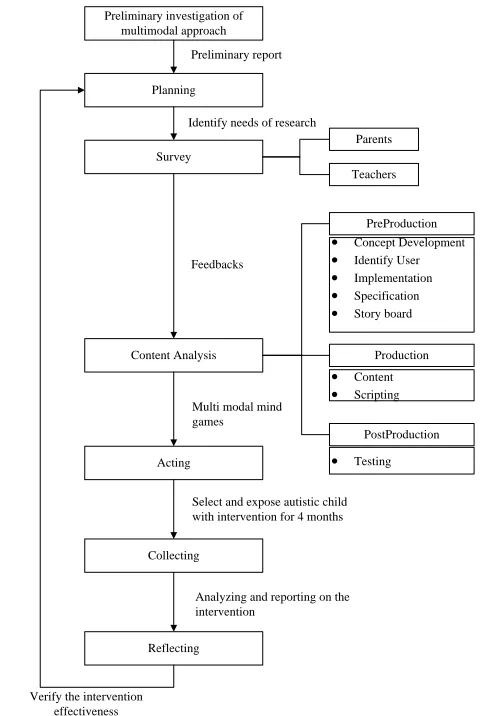
A framework for developing the culture-based multi-modal mind games is illustrated in Figure 1.
Figure 1 Framework for developing culture-based multi-modal mind games
3.1 Preliminary Investigation of Multi-modal Approach
Since the research is intended to teach social interaction using culture-based multi-modal mind games approach, the first step is to understand the concept of multi-modal approach. Multimodal learning is an ‘embodied learning situation which engages multiple sensory systems and action systems of the learner’ [19]. In other words, the more ways in which we learn something the better we genuinely understand, remember and actually learn it. [20] suggests that we normally learn through one mode, but multimodal learning suggests that learning is enhanced with the use of various modes, thus providing a possible improvement to the issue still apparent in todays’ education system. In addition, since schools are increasingly using technology, multimodal learning appears to be more beneficial when combined with the use of multimedia. Furthermore, [21] found that when using technology
Preliminary investigation of multimodal approach
Planning
Survey
Content Analysis
Acting
Reflecting Collecting
Preliminary report
Identify needs of research
Parents
Teachers
Feedbacks
PreProduction
Production
PostProduction
· Concept Development
· Identify User
· Implementation
· Specification
· Story board
· Content
· Scripting
Multi modal mind games
Select and expose autistic child with intervention for 4 months
Analyzing and reporting on the intervention
Verify the intervention effectiveness
[image:3.612.316.557.116.474.2]within multimodal learning, students engage and learn from all modes present on the screen, rather than being confined verbal or written words, as the traditional method suggests. She states that ‘new technologies provide new potentials’.
3.2 Planning
The Planning stage is a very important stage as this is where decisions are being made regarding the design for the study, the sample and the instruments for data collections during the needs analysis as well as the actual study. Action research method will be used for the purpose of improving the children social interaction skills. Action research is a suitable method as it involves an interactive process of research activities; acting, evaluating and reflecting that can be feasibly implemented by teachers in their own classrooms to seek improvements in their educational practices. Two types of action research; practical action research and participatory action research will be used in sequence. The former will be used to research the suitability of the culture-based multi-modal mind games in improving practice and this will involve one group of children. The participatory action research will be used to improve the quality of social interaction for autistic children in Malaysian culture.
The quasi-experimental design method with a control group will be used to test the efficacy of the proposed mind games in improving social interaction skills–as part of the participatory action research. The autistic children in the control group will be exposed to the existing approach in teaching and learning social interaction and the experimental group will be exposed to the culture-based multi-modal mind games approach. The samples will be selected from the group of autistic children who are attending programs in NASOM center located in Muar, Johor. The location is chosen for practical reasons to facilitate the data collection process such as short distance from UTHM and building upon existing working relationships with the organization.
3.3 Survey: Needs Analysis
Before the content of culture-based multi-modal could be developed, needs analysis via surveys will be conducted on parents and teachers who are in direct contact with the autistic children. Additionally, autistic children will be observed to study and identify the requirements to be included in the proposed games. The findings will be used to design the games.
3.4 Content Analysis: Developing Mind Games
During this phase, there are three main sub-modules that need to be considered: Pre-production, Production and Post Production. The first sub-module is concerned with the content, users, development, specification and story board. The second sub-module involves ensuring that the contents tally with the prepared scripting. The last sub-module focuses
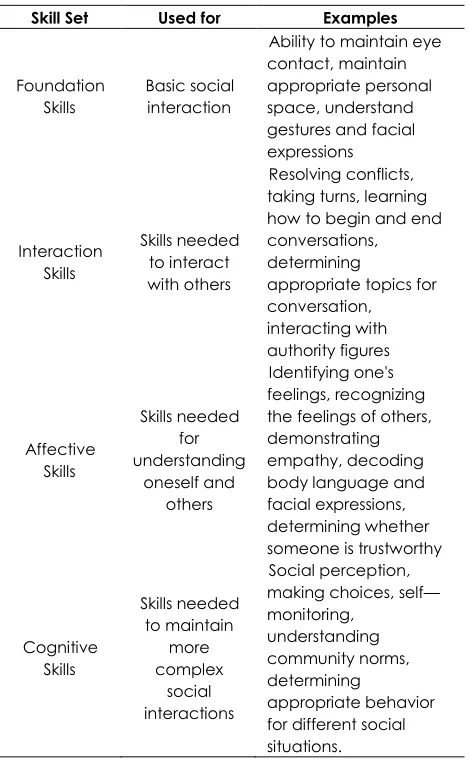
[image:4.612.325.560.144.525.2]on testing whereby the targeted users will test the games to ensure it is acceptable and fulfill the requirements stated before. Table 1 presents some of the skills needed to improve social interactions of autistic children [22].
Table 1 Categorization of social interactions
Skill Set Used for Examples
Foundation Skills
Basic social interaction
Ability to maintain eye contact, maintain appropriate personal space, understand gestures and facial expressions
Interaction Skills
Skills needed to interact with others
Resolving conflicts, taking turns, learning how to begin and end conversations, determining
appropriate topics for conversation, interacting with authority figures
Affective Skills
Skills needed for understanding
oneself and others
Identifying one's feelings, recognizing the feelings of others, demonstrating empathy, decoding body language and facial expressions, determining whether someone is trustworthy
Cognitive Skills
Skills needed to maintain
more complex
social interactions
Social perception, making choices, self— monitoring,
understanding community norms, determining
appropriate behavior for different social situations.
3.5 Acting: Implementing Mind Games
Selected children will be exposed to the culture-based multi-modal mind games framework for a period of four months. The multi-modal mind games will be a combination of technology assisted as well as face to face interactions.
3.6 Collecting
3.7 Reflecting
In the final stage, the adequacy of the multi-modal mind game as a support for early childhood education intervention focusing on social interaction for autistic children will be verified. Weaknesses and strengths of the intervention in terms of improving social interactions will be analyzed and further recommendations will be made.
4.0 GAMES PROTOTYPE
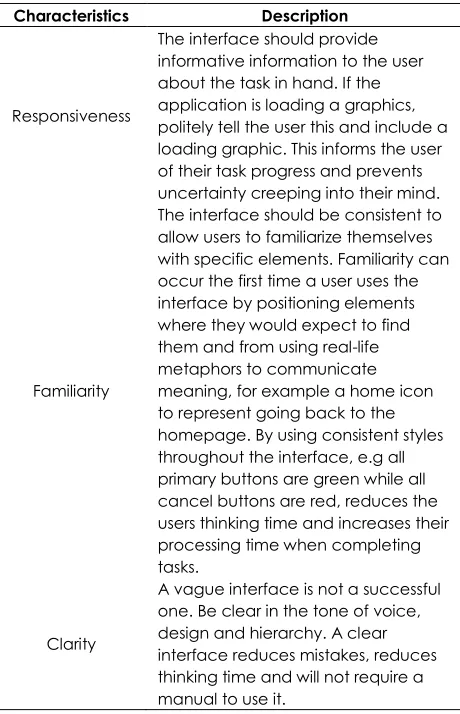
[image:5.612.57.287.387.744.2]Games prototype is an essential part of the games development where decisions on the final product such as the suitability in its user interface is being tested. User interface (UI) plays an important role in terms of visibility, design and precision for depicting the exact amount of information for the intended users. Every minor decision made for designing UI can positively and negatively contribute to the application. Since a good interface presents what is intended to be conveyed to the user, the characteristics of a good user interface need to be studied. According to [23], there are five characteristics that need to be considered as shown in Table 2 below.
Table 2 Five characteristics of good user interface
Characteristics Description
Responsiveness
The interface should provide informative information to the user about the task in hand. If the application is loading a graphics, politely tell the user this and include a loading graphic. This informs the user of their task progress and prevents uncertainty creeping into their mind.
Familiarity
The interface should be consistent to allow users to familiarize themselves with specific elements. Familiarity can occur the first time a user uses the interface by positioning elements where they would expect to find them and from using real-life metaphors to communicate meaning, for example a home icon to represent going back to the homepage. By using consistent styles throughout the interface, e.g all primary buttons are green while all cancel buttons are red, reduces the users thinking time and increases their processing time when completing tasks.
Clarity
A vague interface is not a successful one. Be clear in the tone of voice, design and hierarchy. A clear interface reduces mistakes, reduces thinking time and will not require a manual to use it.
Characteristics Description
Concision
Be clear and descriptive can often lead in over describing elements and visual overload. The interface becomes bloated, no clear path is defined and the user has difficulty finding what it is they’re looking for. The big challenge is to keep the interface clear and concise at the same time.
Forgiveness
If the user makes a mistake, ensure the interface is forgiving. Make it easy to undo actions. A good interface should not punish users for making a mistake and should not leave them feeling lost in an environment that has no solid ground.
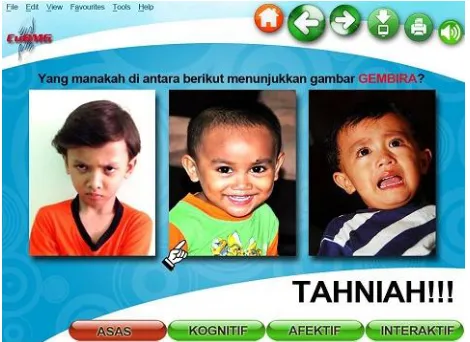
[image:5.612.325.558.436.611.2]Based on the above framework, the culture-based multi-modal mind games will be developed. Figure 2 shows a proposal for the main menu of the games which consists of 4 basic modules: Foundation Skills, Interaction Skills, Affective Skills and Cognitive Skills. If the user choose Foundation button, there will be submenu to choose: HAPPY, SAD, AFRAID and ANGRY. There is also an ACTIVITY option button to be chosen. Under this activity, random pictures will be shown to the child and they are expected to choose the correct picture as can be seen in Figure 3. The audio and text will notify them upon successful answer or ask the child to re-select the correct answer if the first attempt fails.
Figure 3 The sample game screen shot
5.0 CONCLUSION
This paper discusses a framework for the development of a multimedia supported culture-based multi modal mind games for enhancing social interaction skills among autistic children. The framework is part of a larger study that seeks to improve social interaction skills among these children. The findings from this research is expected to be useful in promoting equity in opportunities thus improving quality of life and social economic development for people with autism.
Acknowledgement
The authors would like to thank the Universiti Tun Hussein Onn Malaysia (UTHM) for funding this research.
References
[1] The National Autism Society of Malaysia (NASOM). 2013.
What is Autism? [Online] From:
http://www.nasom.com.my/index.php
option=com_content&view=article&id=52&Itemid=53& lang=en [ Accessed on, 27July 2013].
[2] Azizan, H. 2011. The Burden of Autism. [Online] From: http://www.ceritarasahati2.com/2011/10/01/the-burden-of-autism/ [Accessed on, 28July 2013].
[3] The United Nations Childrens Fund (UNICEF). 2013. Early
Action. [Online] From:
http://www.unicef.org/malaysia/campaigns_autism-early_action.html [Accessed on, 28July 2013].
[4] Crane, L., Lind, S.E., and Bowler, D.M. 2013. Remembering the Past and Imagining the Future in Autism Spectrum Disorder. Memory. 21(2):157-66.
[5] Venkatesh, S., S. Greenhill, D. Phung, B. Adams, and T. Duongy. 2012. Pervasive Multimedia for Autism Intervention. Journal Pervasive and Mobile Computing. 8(6): 863-882.
[6] Ibrahim, Z. 2010. The Effectiveness of Multimedia Approach in Early Childhood Education for Children with Autism in Malaysia. Publisher.
[7] Barakova, E., G. V. Wanrooij, R. V. Limpt, and M. Menting. 2007. Using an Emergent System Concept in Designing
Interactive Games for Autistic Children. In Proceedings of the 6th International Conference on Interaction Design
and Children: Creativity and Learning. Aalborg, Denmark.
6-8June 2007. 73-76.
[8] Finkelstein, S. L., A. Nickel, L. Harrison, E. A. Suma and T. Barnes. 2009. cMotion: A New Game Design to Teach Emotion Recognition and Programming Logic to Children using Virtual Humans. IEEE Virtual Reality Conference. Lafayette, LA. 14-18March 2009. 249-250.
[9] Choi, M. Y. and Y. L. Chang. 2010. Interactive Therapy System Design for Children with Autistic Spectrum Disorders. In International Conference On Kansei Engineering And
Emotion Research (KEER 2010). Paris, France. 2-4March
2010. 164.
[10] Battocchi, A., F. Pianesi, P. Venuti, A. Ben-Sasson, and E. Gal. 2009. Collaborative Puzzle Game: Fostering Collaboration in Children with Autistic Spectrum Disorder (ASD) and with Typical Development. In Proceedings of the International Conference on Interactive Tabletops and
Surfaces. Calgary, Canada. 23-25November 2009.
197-204.
[11] Holladay, H. 2010. Social Interactions of Autistic Children. [Online] From: http://www.wofford.edu/uploadedfiles/ communityscholars/2010_scholars/holladay_spread.pdf [Accessed on 28July 2013].
[12] Kana’iaupuni, S., B. Ledward and U. Jensen. 2010. Culture-Based Education and Its Relationship to Student Outcomes. Research & Evaluation. Honolulu: Kamehameha Schools. [13] Chabby, L., M. Chetouani, M. Plaza and D. Cohen. 2012.
Exploring Multimodal Social-Emotional Behaviors in Autism Spectrum Disorders. In International Conference on Social Computing (SocialCom) and International Conference on
Privacy, Security, Risk and Trust (PASSAT). Amsterdam, UK.
3-5September 2012. 950-954.
[14] Kathryn, P. 2008. How Cultural Values Influence Diagnosis, Treatment and the Welfare of Families with an Autistic Child. In Sight: Rivier Academic Journal. 4(1): 1-5.
[15] Catherine, R. G., Jones, A. Pickles, M. Falcaro, A. J. S. Marsden, F. Happe´, S. K. Scott, S. Sauter, J. Tregay, R. J. Phillips, G. Baird, E. Simonoff, and T. Charman. 2011. A Multimodal Approach to Emotion Recognition Ability in Autism Spectrum Disorders. Journal of Child Psychology
and Psychiatry. 52(3): 275-285.
[16] Grynszpan, O., J. C. Martin and N. Oudin. 2003.On the Annotation of Gestures in Multimodal Autistic Behaviour.
[Online] From:
http://perso.limsi.fr/Individu/martin/research/articles/gryns zpan-martin- oudinv11.pdf [Accessed on 29 July 2013]. [17] Farrow, E. and O. Lemon. 2011. Adding Sign Language
Animation to the ECHOES Multimodal Technology Enhanced Learning Environment. [Online] From: http://vhg.cmp.uea.ac.uk/demo/SLTAT2011Dundee/3.pd [Accessed 29July 2013].
[18] Guldberg, K., K. Porayska-Pomsta, Good J,. and W. Keay-Bright. 2010. ECHOES II: The Creation of a Technology Enhanced Learning Environment for Typically Developing Children and Children on the Autism Spectrum. Journal of
Assistive Technologies. 4(1): 49-53.
[19] Massaro . 2006. [Online] From:
http://mambo.ucsc.edu/wp- content/uploads/2012/01/10.1007978-1-4419-1428-6_273.pdf.
[20] Fleming. 2006. [Online] From:
http://www.lwtech.edu/Documents/Administrative/TRiO/ Workshop/ Learning %20Styles%20Workshop.pdf.
[21] Jewitt. 2006. Technology, Literacy and Learning: A
Multimodal Approach. [Online] From:
http://books.google.co.uk/books/about/Technology_ Literacy_Learning. Html ?id=weK1VgIk124C&redir_esc=y. [22] Canney, C., and A. Byrne. 2006. Evaluating Circle Time as a
Support to Social Skills Development-Reflections on aJourney in School-based Research. British Journal of