Journal
of
Managemen
t
Sc
ie
nces
Determinants of Tax-Compliance Behaviour
Explored by Slippery Slope Framework and
Theory of Planned Behaviour: An Evidence
from Small Business Owner
Affiliation:
Muhammad Shaukat Malik
Director Institute of Banking and Finance, Bahauddin Zakariya University, Multan, Pakistan. E-mail: [email protected]
Sabah Younus
PhD Scholar, Institute of Banking and Finance, Bahauddin Zakariya University, Multan, Pakistan.
Manuscript Information Submission Date: June 11, 2019 Acceptance Date: Sept 06, 2019
Citation in APA Style:
Malik, M. S., & Younus, S. (2019). Determinants of Tax-Compliance Behaviour Ex-plored by Slippery Slope Framework and Theory of Planned Behaviour: An Evidence from Small Business Owner,Journal of Management Sciences, 6(2), 33-47.
DOI:https://doi.org/10.20547/jms.2014.1906203
Determinants of Tax-Compliance Behaviour Explored by Slippery
Slope Framework and Theory of Planned Behaviour: An Evidence from
Small Business Owner
Muhammad Shaukat Malik∗ Sabah Younus†
Abstract:This research work addresses the issue of improving the tax-compliance behaviour of the small business owners. Theocratical framework of this paper is based on two theories, Slippery Slope framework and Theory of Planned Behaviour. With the help of these two theories the aim of this research is to explore the determinants of the tax-compliance behaviour and to improve the tax-payers behaviour specially of small business owners. Data was collected from 340 small business owners those were operative in major cities of Pakistan i.e. Karachi, Islamabad (Pindi), Lahore, Multan and Faisalabad. This study is significant as it can help the tax-authorities in exploring the antecedence of the tax-Compliance Intention and hence, Behaviour.
Keywords:Theory of planned behaviour, slippery slope framework, perceived fairness, power and trust in authorities, tax-compliance intention and tax-compliance behaviour.
Introduction
Tax-Compliance is one the major issues that needs proper attention of the authorities of the developing countries (Bayram, Aydemir, Yıldırım, & Tans ¨oker, 2017). There study was conducted in major cities of Pakistan and finding of their research work supports that in order to improve tax-compliance intentions in developing countries the authorities need to develop trust of the tax-payers on the tax system of the country (Ali & Hassan,
2019). The Current Finance Minister of Pakistan in a press release on 28th January 2019 emphasized that revenues of the Government of Pakistan can improve considerably if the trust of business owners is improved and also if the tax-filling procedure is made easy. FBR (Federal Board of Revenue) Pakistan, declares that it was unable to reach the targeted number of tax-filler in 2009.
Moreover, Pakistan has been ranked at 172th position by international tax Competitive Index, regulated by Organisation for Economic Cooperation and Development (OECD). Looking deeper into the matter and as per interviews conducted from the personnel work-ing at prominent position at Federal Board of Revenue (FBR), Circular No. 3 of 2016 was issued to improve voluntary tax compliance through Voluntary Tax-Compliance Scheme
∗Director Institute of Banking and Finance, Bahauddin Zakariya University, Multan, Pakistan.
E-mail: [email protected]
†PhD Scholar, Institute of Banking and Finance, Bahauddin Zakariya University, Multan, Pakistan.
(VTCS) on 10 February 2016. The motive of this circular was to devise out ways to pro-mote voluntary compliance of the tax-payers in Pakistan. Although FBR is trying to en-hance voluntary compliance yet there is evidence that much more is needed to be done to boost voluntary compliance.
A news in Dawn showed that according to the data represented in State Bank of Pak-istan (SBP) report showed that voluntary tax payment is only 22 percent of the total di-rect taxes (A behavioural insight into voluntary tax compliance, 2018). Moreover, as per study conducted byAkram, Ilyas, and Alam(2017) small business are showing most of tax-evasion. Small business owners tend to avoid pay taxes in developing countries like Pakistan , this compliance ratio of the small businesses towards tax-compliance is as low as 43% in 2013 and dropping gradually in coming years as per the report of Sustainable Development Policy Institute (SDPI) (Draft Study: Reforming Tax System in Pakistan, 2013). This fact has also been identified by the FBR. This background raises the concern to explore the determinants of the Tax-Compliance Behaviour. Only 1,075,000 people filed their income tax returns announced by the official of the Federal Board of Revenue as per the news published in The New, December 16, 2017 out of registered 4.3 million people, around 1.1 million filed their income taxes. This situation itself raise the concern to study tax-compliance behaviour of Pakistani individual (Arif, Khan, & Hussain,2017).
Researchers have addressed the issue of tax-compliance from variety of perspectives i.e. psychological perspective, social perspective and economic perspective (Kirchler,
2007; James, Murphy, & Reinhart, 2005). Slippery Slope framework was proposed by
Kirchler, Hoelzl, and Wahl(2008). The uniqueness of this model is that it combines all these factors and explain the behaviour of tax-payer as the outcome of multiple factors. These factors are discussed in detail in the literature review section. The theory of Planned behaviour suggests behaviour of any sort is an antecedent of intentions, and individual’s intentions are consequence of three factors (Ajzen,1991), these factors are also narrated in detail in literature review section. Thus, it can be assumed that tax-compliance behaviour is an outcome of tax-compliance intention, and hence tax-compliance intention can be explained by multiple factors as explained byKirchler et al.(2008).
Thus, it can be summarized as that this research work examines the mediating role of Tax-Compliance intention between Subjective Norms, Perceived Behavioural Control, Attitude, Perceived Fairness, Trust, Power of Authorities, Tax Knowledge and Tax-Compliance Behaviour.
Literature Review
Ho, Ho, and Young(2013) contributed through their research that individual will por-tray positive behaviour towards tax-paying if they perceive authorities to be honest to spend to spend it on state development. Tax-payers shows positive behaviour towards compliance and specifically voluntary compliance if the tax-payer presume the authori-ties to be transparent and fair (Puspitasari & Meiranto,2014).Benk, C¸ akmak, and Budak
(2011) proposed that if the citizen be afraid of legal penalties and if the judiciary system is powerful enough that it can enforce implementation of these penalties, then citizens of that particular society will be more determined to demonstrate compliance intention towards tax system, laws and regulations. If the tax system has prejudices and corrupt than there are more chances of non-compliances (Cummings, Martinez-Vazquez, McKee, & Torgler,2009).
A legitimate tax system reassures and encourage compliance (Banik,2009). If govern-ments can change the perception of the society ad increase the trust level by making its system legitimate and transparent, it can improve compliance (Morris & Klesner,2010).
Ajzen (1991) proposed Theory of Planned Behaviour, this theory suggests that be-haviour of any individual, in any situation are not sudden consequence of instances, rather every behaviour is backed by multiple factors. These factors shape up persons behaviours. Behaviours are followed by intentions and intentions are generated because of person’s attitude, subjective norms and perceived behavioural control (Ajzen, 1991).
Jimenez and Iyer(2016) establish that societal norms and personal belief system of indi-viduals strengthen the trust, and trust thus formed can make intention to comply to tax system stronger.
Slippery Slope framework presented byKirchler et al.(2008) argues that tax-compliance behaviour can either be enforced or voluntary, voluntary compliance means that individ-ual show self-motivation and commitment towards paying taxes (Kirchler,2007). Whereas, if a person pays taxes as he fears for fines and penalties imposed by the authorities than it is known as enforced compliance. Power exercised by the authorities is an important factor to determine encourage compliance towards taxes, governments can encourage the tax-payer by responsive and liable outcomes. Thus, in this way voluntary compliance can be enhanced, on the contrary by means of coercive power governments can ensure partic-ipation by the tax-payer in the form of enforced compliance (Tyler,2006;Kirchler,2007).
Jones(2009) stated that tax-knowledge of individual can make individuals more active participants of the tax-system, tax compliance can be improved if the tax-payers feels that system of paying taxes is easy to use. Murphy(2004) found positive association in pro-cedural justice, trust in authorities and compliance behaviour. Thus, fair treatment of the tax-authorities is known to the one of the important factors in finding the determinants of the compliance behaviour.
Research Model
As discussed earlier the research model is based on amalgamation of two theories, Slip-pery Slope Framework and Theory of Planned Behaviour. All the factors are discussed in this section one by one. Hartner, Rechberger, Kirchler, and Schabmann(2008) in their study found that procedural justice can be regarded as motivational factor towards en-couraging tax compliance, however non-compliance was escalated by distributive justice. Therefore, it can be assumed that non-compliance is higher in developing countries as citizen do not foresee the covenants to be just and honest rather corrupt and dishonest.
Murphy(2004) proposed that procedural fairness can determine tax compliance, so it can be hypothesized that:
H1: Perceived Fairness has significant relationship with tax-compliance behaviour.
H1a: compliance intention mediates the relationship between Perceived Fairness and
tax-compliance behaviour.
Abdul-Razak and Adafula(2013) in their study examine the mediating role of attitude in determining the strength of relationship among constructs burden of tax, knowledge of tax-laws and fairness of tax-authorities, they found a significant and positive relationship among tax-attitude and compliance of tax-payers. Thus, it can be formulated that:
H2: Attitude has significant relationship with tax-compliance behaviour.
H2a: tax-compliance intention mediates the relationship between Attitude and tax-compliance
behaviour.
Benk et al. (2011) used theory of planned behaviour to explain tax compliance be-haviour, but as per there study intention to compliance does not result in behaviour. However, another significant finding of their study is that equitable treatment by the tax-authorities foster compliance attitude. The norms setup by the societies build up level of normative expectation which can than further redress compliance intentions (Benk et al.,
2011).
An individual decision to pay tax or not is greatly prejudiced by his close relatives, society and friends (Palil,2010). Also, (Blanthorne & Kaplan,2008) found a significant relationship among subjective norms, ethical beliefs in structuring a person’s positive in-tention towards tax-compliance. Thus, it can be extracted that:
H3: Subjective Norms has significant relationship with tax-compliance behaviour.
H3a: Tax-compliance intention mediates the relationship between Subjective Norms and
tax-compliance behaviour.
H4a: Tax-compliance intention mediates the relationship between Perceived Behavioural
Con-trol and tax-compliance behaviour.
Damayanti, Subekti, Baridwan, et al. (2015) used theory of planned behaviour but used trust in tax-authorities, uncertainty avoidance as a moderator to explain compliance behaviour. Wu and Chen(2005) in their research model tested the relationship of trust and technology acceptance model on e-filling intention of the tax payer and found a sig-nificant relationship among trust in authorities and e-filling intentions. Torgler(2005) in their study found positive association between trust and tax compliance. Thus, it can be hypothesized that:
H5: Trust in tax-authorities has significant relationship with tax-compliance behaviour.
H5a: Tax-compliance intention mediates the relationship between trust in tax-authorities and
tax-compliance behaviour.
Kastlunger, Lozza, Kirchler, and Schabmann(2013), found by the use of coercive power the tax authorities can foster only enforced compliance, trust of the citizens is negatively associated with corrosive power exercise of which consequence in tax-evasion rather than compliance. However, if the authorities exercise legitimate power it can it promote com-pliance (Kastlunger et al.,2013). On the basis of these analysis it can be hypothesized that:
H6: Power of Authorities has significant relationship with tax-compliance behaviour.
H6a: Tax-compliance intention mediates the relationship between Power of Authorities and
tax-compliance behaviour.
Mei Tan and Chin-Fatt (2000) in their study concluded that by raising the level of tax-knowledge authorities cannot improve the perception about the authorities but the positive attitude can be developed.
H7: Tax-Knowledge has significant relationship with tax-compliance behaviour.
H7a: Tax-compliance intention mediates the relationship between Tax-Knowledge and
tax-compliance behaviour.
H8: Compliance intention has significant relationship with Compliance Behaviour.
Theory of planned behaviour has been used by many researchers to explain multiple be-haviours. Thus, this study employee TPB to explain the tax-compliance behaviour.
Research Methodology
The data was collected using a survey method from the small business owners. the busi-ness owners were selected by using convenient sampling technique. As complete list of small business owners is not available. These business owners were contacted person-ally, and self-administered questionnaire was utilized. The respondents were assured that their data would remain confidential. The questionnaire was based on 58 questions/items those were adopted from previous researches. All of the scales have tested and verified by pervious researches i.e. (Kirchler et al.,2008;Abdul-Razak & Adafula,2013;Damayanti et al.,2015).
Instruments
To measure the dependent variable tax-payers behaviour Tax compliance inventory TAX-I, developed byKirchler et al.(2008) is utilized. This scale has further four dimensions these dimensions are known as voluntary compliance, enforced compliance, tax avoid-ance and tax evasion. But as this study is based on the Slippery Slope Framework. Thus, only two behavioural outcomes will be used in this study. These are voluntary compli-ance and enforced complicompli-ance. Voluntary complicompli-ance has ten items, whereas, enforced compliance has eight items.
The Mediating variable is Tax-compliance Intention. Tax-compliance intention was adapted from the study done byBidin et al.(2007). Here tax-compliance intention is mea-sured with the help of fourteen items. It is a unidimensional scale. The scale of Subjective norms and Perceived behavioural control is adapted fromTaylor and Todd(1995) which is also used by many researchers i.e. (Bhattacherjee,2000). Both have three items and are uni-dimensional scale. Braithwaite(1997) trust scale it consists of seven items and is a unidimensional scale. It has been further validated by Morris and Klesner (2010). The scale of Attitude is adopted fromBhattacherjee(2000). The scale of Tax Knowledge has three dimensions each personal knowledge, legal knowledge and technical knowl-edge, each having two, three and four itmes respectivey, this scale was developed (Saad,
Analysis and Findings
For collection of data 400 questionnaire were printed. Out of which 340 questionnaires were found useable. Remaining 60 questionnaires were discarded because of too much missing information. Thus, only a sample of 340 useable questionnaire was retained for data analysis. The sample of 340 was them testing for missing value analysis and nor-mality analysis using SPSS. The descriptive analysis conducted is presented in Table 1. To assess the normality of the data Skewness and Kurtosis were calculated. All the values of skewness and kurtosis were below 1 that assures normality of data as explained by
Tabachnick, Fidell, and Ullman(2007). Also, to check the issues relating to multicollinear-ity VIF and Tolerance were determined. For data to be free from multicollinearmulticollinear-ity issue the values of tolerance must be greater than .1 and VIF must be less than 10 as explained byHair, Black, Babin, Anderson, and Tatham(2006). Table 1 shows that data qualifies the basic normality assumptions thus further analysis can be proceeded.
Table 1
Measure of Normality and Multicollinearity Statistics
Mean Std. Deviation Reliability T Sig. Collinearity Statistics Skewness Kurtosis Statistic Statistic Tolerance VIF Statistic Std. Error Statistic Std. Error FP comp 2.22 0.56 0.85 12.2 0.000 0.010 0.104 -0.356 0.208 AT comp 2.81 0.70 0.84 3.63 0.043 0.98 1.01 0.097 0.104 0.413 0.208 SN comp 2.93 0.50 0.92 2.55 0.012 0.97 1.02 0.041 0.104 -0.022 0.208 PBC comp 2.94 0.88 0.93 2.40 0.019 0.98 1.10 0.067 0.104 0.531 0.208 TA comp 2.67 0.43 0.79 3.43 0.003 0.97 1.03 0.087 0.104 0.249 0.208 PA comp 2.11 0.53 0.82 2.98 0.000 0.94 1.06 0.069 0.104 -0.258 0.208 TK comp 2.67 0.48 0.90 3.45 0.007 0.92 1.08 0.084 0.104 0.542 0.208 TCI comp 2.90 0.55 0.84 4.96 0.021 0.97 1.02 0.091 0.104 0.654 0.208
TCB comp 2.59 0.43 0.88
Valid N (listwise) 340 Dependent Variable: TCB COMP
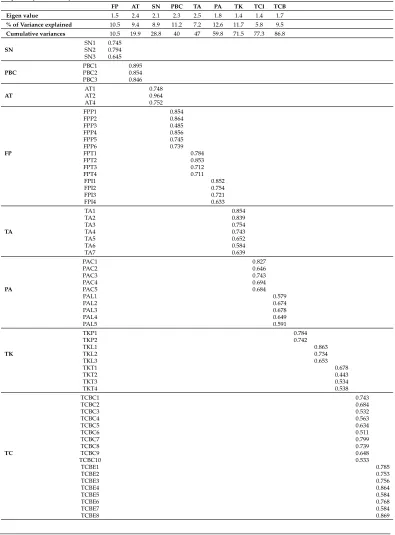
Reliability of the data was checked using SPSS. It was found the reliabilities of all the variables were more than cut-off value of 0.7 as verified byHair et al. (2006). The overall reliability of the full questionnaire was also more than .7. To further proceed with the analysis SPSS and AMOS were utilized. Reliability test and EFA was conducted in SPSS. EFA analysis was conducted as scales were adopted. Where after, CFA analysis was conducted using AMOS. Also, the Construct Validity were checked. To confirm the hypothesis path analysis was done through SEM technique (Hair et al.,2006).
To check the convergent validity correlation matrix was drawn and AVE (Average Variance Explained were calculated.Bagozzi and Yi(1991) suggested that if AVE is greater than individual loadings than there are no issues relating to data’s convergent validity. And all the values of AVE are above .5 (Bagozzi & Yi,1988). Table 3 represents the values of correlation and AVE.
After EFA analysis CFA analysis was conducted using SEM approach in AMOS. First order CFA was done for unidimensional constructs. The unidimensional construct for which CFA first order was conducted are Attitude towards Tax-Compliance, Subjective Norms, Trust in Authorities and Perceived Behavioural Control. Also, second order CFA for constructs having multiple dimensions. the constructs for which 2nd order CFA was conducted are Fairness Perception, Power of Authorities, Tax- Knowledge and Tax- Com-pliance Behaviour. the results are presented in table 3. Which shows that model fit values for all the variables. Also, the dimensions of the variables load significantly on the con-structs (Fairness Perception, Power of Authorities, Tax-Knowledge and Tax-Compliance Behaviour. Which shows that thee is no need to remove or add another dimension. The fit indices used are recommended byMcDonald and Ho(2002). The factor loadings of all the items were also above .5 for all the constructs. The values of model fit for individual construct are presented in Table 4. The table represents the values of AGFI, CFI, RMSEA, TLI and Chi-square.
To check the overall model fit with and without mediator analysis was run and it was found that the research was fit model with few modifications as per recommenda-tions ofKline(2005). After model fit analysis it was determined that either hypothesized relationship among variables hold. Path analysis was conducted using Amos as per rec-ommendations ofHair et al.(2006). The results of which are summarized in table 5.
The results presented in table 5 suggest that theory of planned can explain tax- compli-ance behaviour in the light of slippery slope framework.H1andH1awere supported with
B= .225, p<0.05 and B=.266, p<0.05. these results are consistent with the research work conducted byMurphy (2004). Which means that both direct and indirect relationship holds. Thus, it can be extracted that compliance intention partially mediates the relation between fairness perception and compliance behaviour (Baron & Kenny,1986). H2was not supported with values B=.047, p<0.17. the finding of this research work is contrary to the research work conducted byAbdul-Razak and Adafula(2013). But when mediator was added to the path-analysis the results were different andH2a was supported with
B=.268, p<0.01. thus, full mediation relationship holds between attitude and compli-ance behaviour. These results are consistent with finding ofLangham et al.(2012). H3 andH4 were not supported with B=.038, p<0.15 and B=.105, p<0.21. thus, no direct relationship was found between subjective norms, perceived behavioural control and tax-compliance behaviour. However, full mediation relationship was found, these results are also consistent with the findings ofLangham et al.(2012);Blanthorne and Kaplan(2008). H5 andH5a was supported with B=.64, p<0.01 and B=.733, p<0.01. these results are
Table 2
Exploratory Factor Analysis
FP AT SN PBC TA PA TK TCI TCB Eigen value 1.5 2.4 2.1 2.3 2.5 1.8 1.4 1.4 1.7 % of Variance explained 10.5 9.4 8.9 11.2 7.2 12.6 11.7 5.8 9.5 Cumulative variances 10.5 19.9 28.8 40 47 59.8 71.5 77.3 86.8
SN1 0.745
SN SN2 0.794
SN3 0.645 PBC1 0.895
PBC PBC2 0.854
PBC3 0.846
AT1 0.748
AT AT2 0.964
AT4 0.752 FPP1 0.854 FPP2 0.864 FPP3 0.485 FPP4 0.856 FPP5 0.745 FPP6 0.739
FP FPT1 0.784
FPT2 0.853 FPT3 0.712 FPT4 0.711 FPI1 0.852 FPI2 0.754 FPI3 0.721 FPI4 0.633 TA1 0.854 TA2 0.839 TA3 0.754
TA TA4 0.743
TA5 0.652 TA6 0.584 TA7 0.639 PAC1 0.827 PAC2 0.646 PAC3 0.743 PAC4 0.694
PA PAC5 0.684
PAL1 0.579 PAL2 0.674 PAL3 0.678 PAL4 0.649 PAL5 0.591 TKP1 0.784 TKP2 0.742 TKL1 0.863
TK TKL2 0.734
TKL3 0.653 TKT1 0.678 TKT2 0.443 TKT3 0.534 TKT4 0.538 TCBC1 0.743 TCBC2 0.684 TCBC3 0.532 TCBC4 0.563 TCBC5 0.634 TCBC6 0.511 TCBC7 0.799 TCBC8 0.739
TC TCBC9 0.648
Table 3
Correlation Matrix and AVE
Variables 1 2 3 4 5 6 7 8 9
FP 0.71
AT 0.45 0.66
SN 0.51 0.49 0.62
PBC 0.48 0.47 0.49 0.67
TA 0.33 0.38 0.32 0.28 0.73
PA 0.39 0.29 0.25 0.37 0.23 0.65
TK 0.45 0.43 0.42 0.39 0.43 0.33 0.68
TCI 0.53 0.57 0.53 0.46 0.39 0.41 0.34 0.70
TCB 0.40 0.56 0.56 0.54 0.55 0.29 0.35 0.22 0.73 Correlation is significant at the 0.01 level (2-tailed)
Table 4
Model Fit for all constructs and complete model
Sr.No. Variables Model Fit
X2 AGFI CFI TLI RMSEA
1 FP (2nd order CFA) 30.81 0.90 0.90 0.90 0.01 FPP 33.89 0.92 0.94 0.92 0.02 FPT 28.67 0.98 0.99 0.99 0.01 FPTL 32.45 0.93 0.93 0.92 0.01
2 AT 90.56 0.94 0.95 0.95 0.03
3 SN 132.5 0.94 0.94 0.92 0.02
4 PBC 28.51 0.91 0.90 0.90 0.03
5 TA 59.34 0.90 0.91 0.90 0.04
6 PA (2nd order CFA) 133.2 0.90 0.91 0.91 0.03 PALP 164.5 0.93 0.94 0.93 0.03 PACP 145.4 0.90 0.91 0.91 0.00
7 TK (2nd order CFA) 45.56 0.91 0.92 0.91 0.04 TKG 47.32 0.92 0.92 0.92 0.05 TKT 34.28 0.90 0.90 0.91 0.03 TKL 38.54 0.91 0.91 0.91 0.04
8 TCI 32.65 0.92 0.93 0.93 0.02
9 TCB (2nd order CFA) 122.4 0.93 0.94 0.94 0.03 TCBV 158.2 0.95 0.94 0.94 0.02 TCBE 117.8 0.90 0.90 0.90 0.03 Overall Model 36.22 0.90 0.90 0.90 0.03 Overall Model with mediator 30.21 0.90 0.90 0.90 0.04
H6was not supported with B=.053, p<0.31. these results are opposing to the findings ofKastlunger et al.(2013). But mediation relation holds. Thus, it can be inferred that in-tention towards tax-compliance mediates fully relation between power in authorities and compliance behaviour with B=.435, p<0.05. H7andH7a were supported with B=.532,
p<0.01 and B=.45, p<0.01. thus, intention partially mediates the relation between tax knowledge and compliance behaviour these results are supported byMei Tan and Chin-Fatt(2000). Furthermore, it can be observed that personal fairness, tax-rate fairness and income level fairness are significantly associated with Fairness Perception as described by
Table 5
Path Analysis-Hypothesis Testing
Hypothesis Path Modified Model
Std. Coefficient Critical Ratio Results Discussion
H1 FP—–TCB 0.425 2.98 Supported Both H1 and H1a
H1a FP—–TCI——TCB 0.266 3.62 Supported Supported (Partial Mediation) H2 AT—–TCB 0.047 1.12 Not Supported ”H2 not supported but H2a Supported H2a AT—–TCI——TCB 0.268 2.90 Supported Full Meditation”
H3 SN—–TCB 0.038 1.01 Not Supported ”H3 not supported but H3a Supported H3a SN—–TCI——TCB 0.645 3.11 Supported Full Meditation”
H4 PBC—–TCB 0.105 1.54 Not Supported ”H3 not supported but H3a Supported H4a PBC—–TCI——TCB 0.459 2.99 Supported Full Meditation”
H5 TA—–TCB 0.641 3.21 Supported ”Both H5 and H5a Supported H5a TA—–TCI——TCB 0.733 3.42 Supported Partial Mediation ”
H6 PA—–TCB 0.053 1.83 Not Supported ”H6 not supported but H6a Supported H6a PA—–TCI——TCB 2.51 Supported Full Meditation”
H7 TK—–TCB 0.532 3.23 Supported ”Both H7 and H7a Supported H7a TK—–TCI——TCB 0.451 3.01 Supported Partial Mediation” H8 TCI——TCB 0.433 3.58 Supported
Figure 1
Tax Knowledge dimensions personal knowledge, legal knowledge and technical knowl-edge also had significant values with good beta values with Tax-Knowlknowl-edge as narrated bySaad(2011) legitimate power and coercive power have significant relation with Power in authorities as prescribed byKastlunger et al.(2013).
Discussion and Conclusion
This research model was designed to know that does Tax Compliance Intention holds a mediational relationship between variables fairness perception, Subjective norms, per-ceived behavioural control, attitude, power of Authorities, trust in Authorities, tax knowl-edge and tax compliance behaviour. In our analysis we found that all the dimensions of Fairness perception, Power of Authorities, Tax-Knowledge and Tax-Compliance Be-haviour fully load on their respective variables. Tax compliance intention portray partial mediation between Perceived fairness, Tax Knowledge and trust in Tax-Authorities and tax compliance behaviour. Whereas, tax compliance intention depicts full mediation be-tween subjective norms, perceived behavioural control, attitude and Power of Authorities and tax compliance behaviour. Thus, it can be extracted that Slippery Slope framework can be explained with the use of theory of planned behaviour. Power of Authorities can develop intention but cannot determine compliance behaviour.
Theoretical/ Practical Implication and Limitation
References
Abdul-Razak, A., & Adafula, C. J. (2013). Evaluating taxpayers attitude and its influence on tax compliance decisions in Tamale, Ghana. Journal of Accounting and Taxation,
5(3), 48–57.
Ajzen, I. (1991). The theory of planned behavior. Organizational Behavior and Human
Decision Processes,50(2), 179–211.
Akram, M., Ilyas, M., & Alam, H. M. (2017). An investigation of ways of tax non-compliance: The case of small business sector in Pakistan. Journal of the Research
Society of Pakistan,54(2), 199-209.
Ali, M. Y., & Hassan, F. (2019). The study of potential shariah non-compliance risks in murabahah along with their risk management. Journal of Finance & Economics
Research,4(1), 44-58.
Arif, I., Khan, L., & Hussain, F. (2017). Impact of semi-autonomous revenue authority on tax revenue and buoyancy: Evidence from Pakistan. Journal of Finance & Economics
Research,2(2), 164-174.
Bagozzi, R. P., & Yi, Y. (1988). On the evaluation of structural equation models. Journal of
the Academy of Marketing Science,16(1), 74–94.
Bagozzi, R. P., & Yi, Y. (1991). Multitrait-multimethod matrices in consumer research.
Journal of Consumer Research,17(4), 426–439.
Banik, D. (2009). Legal empowerment as a conceptual and operational tool in poverty eradication. Hague Journal on the Rule of Law,1(1), 117–131.
Baron, R. M., & Kenny, D. A. (1986). The moderator–mediator variable distinction in social psychological research: Conceptual, strategic, and statistical considerations.
Journal of Personality and Social Psychology,51(6), 1173-1182.
Bayram, N., Aydemir, M., Yıldırım, Z., & Tans ¨oker, R. L. (2017). Confirmatory factor anal-ysis on tax compliance intentions, general fairness, procedural fairness and social norms. Business and Economics Research Journal,8(4), 749–758.
Benk, S., C¸ akmak, A. F., & Budak, T. (2011). An investigation of tax compliance intention: A theory of planned behavior approach. European Journal of Economics, Finance and
Administrative Sciences,28(28), 180–188.
Bhattacherjee, A. (2000). Acceptance of e-commerce services: The case of electronic bro-kerages. IEEE Transactions on Systems, Man, and Cybernetics-Part A: Systems and Hu-mans,30(4), 411–420.
Bidin, Z., et al. (2007). A confirmatory analysis of zakah compliance behavioural intention on employment income. Malaysian Management Journal,11(1 & 2), 103–114.
Blanthorne, C., & Kaplan, S. (2008). An egocentric model of the relations among the op-portunity to underreport, social norms, ethical beliefs, and underreporting behavior.
Accounting, Organizations and Society,33(7-8), 684–703.
Braithwaite, V. (1997). Trust in institutions. The International Social Survey Program, Research School of the Social Sciences, The Australian National University.
Cummings, R. G., Martinez-Vazquez, J., McKee, M., & Torgler, B. (2009). Tax morale affects tax compliance: Evidence from surveys and an artefactual field experiment.
Damayanti, T. W., Subekti, I., Baridwan, Z., et al. (2015). Trust and uncertainty orientation: An efforts to create tax compliance in social psychology framework. Procedia-Social
and Behavioral Sciences,211, 938–944.
Gangl, K., Kirchler, E., Lorenz, C., & Torgler, B. (2015). Wealthy tax non-filers in a devel-oping country: Taxpayer knowledge, perceived corruption and service orientation in Pakistan.Perceived Corruption and Service Orientation in Pakistan (August 13, 2015),
26, 1-26.
Hair, J. F., Black, W. C., Babin, B. J., Anderson, R. E., & Tatham, R. L. (2006). Multivariate
data analysis. New Jersey: Pearson Prentice Hall.
Hartner, M., Rechberger, S., Kirchler, E., & Schabmann, A. (2008). Procedural fairness and tax compliance. Economic Analysis and Policy,38(1), 137-152.
Ho, D., Ho, D. C., & Young, A. (2013). A study of the impact of culture on tax compliance in China. International Tax Journal,39, 33-44.
James, S., Murphy, K., & Reinhart, M. (2005). Taxpayer beliefs and views: Two new surveys. Journal of the American Taxation,20(2), 157-188.
Jimenez, P., & Iyer, G. S. (2016). Tax compliance in a social setting: The influence of social norms, trust in government, and perceived fairness on taxpayer compliance.
Advances in Accounting,34, 17–26.
Jones, C. R. (2009). Understanding and improving use-tax compliance: A theory of planned behavior approach. Retrieved fromhttp://scholarcommons.usf .edu/etd/2032
Kastlunger, B., Lozza, E., Kirchler, E., & Schabmann, A. (2013). Powerful authorities and trusting citizens: The slippery slope framework and tax compliance in Italy. Journal
of Economic Psychology,34, 36–45.
Kirchler, E. (2007). The economic psychology of tax behaviour. United Kingdom: Cambridge University Press.
Kirchler, E., Hoelzl, E., & Wahl, I. (2008). Enforced versus voluntary tax compliance: The “slippery slope” framework. Journal of Economic Psychology,29(2), 210–225.
Kline, R. B. (2005). Principles and practice of structural equation modeling. New York: Guil-ford.
Langham, J., Paulsen, N., & Hartel, C. E. (2012). Improving tax compliance strategies: Can the theory of planned behaviour predict business compliance. E-Journal of Tax
Research,10(2), 364-402.
Leech, N. L., Barrett, K. C., Morgan, G., & Stanley, J. (2005).SPSS for Intermediate Statistics:
Use and Interpretation. Psychology Press.
McDonald, R. P., & Ho, M.-H. R. (2002). Principles and practice in reporting structural equation analyses.Psychological Methods,7(1), 64-82.
McKee, T. C., & LaTour, M. S. (1992). Taxpayer perceptions of the fairness of the tax reform act of 1986: Do tax preparers and the irs need to segment their “market”?
Journal of Professional Services Marketing,8(1), 201–221.
Mei Tan, L., & Chin-Fatt, C. (2000). The impact of tax knowledge on the perceptions of tax fairness and attitudes towards compliance. Asian Review of Accounting,8(1), 44–58. Morris, S. D., & Klesner, J. L. (2010). Corruption and trust: Theoretical considerations and
Murphy, K. (2004). The role of trust in nurturing compliance: A study of accused tax avoiders.Law and Human Behavior,28(2), 187–209.
Palil, M. R. (2010).Tax knowledge and tax compliance determinants in self assessment system in
Malaysia(Unpublished doctoral dissertation). University of Birmingham.
Puspitasari, E., & Meiranto, W. (2014). Motivational postures in tax compliance decisions: An experimental studies. International Journal of Business, Economics and Law,5(1), 100–110.
Saad, N. (2011). Fairness perceptions and compliance behaviour: Taxpayers’ judgments in self-assessment environments. Retrieved from http://hdl.handle.net/ 10092/5065
Tabachnick, B. G., Fidell, L. S., & Ullman, J. B. (2007). Using multivariate statistics. New York: Harper Collins.
Taylor, S., & Todd, P. (1995). Understanding household garbage reduction behavior: A test of an integrated model. Journal of Public Policy & Marketing,14(2), 192–204. Torgler, B. (2005). Tax morale and direct democracy.European Journal of Political Economy,
21(2), 525–531.
Tyler, T. R. (2006). Psychological perspectives on legitimacy and legitimation. Annual
Review of Psychology,57, 375-400.
Waris, A. (2013). Growing tax-evasion a serious threat: Only 1.2m Pakistanis file tax
returns, which is even less than 1%. Daily Times Pakistan, December 29, 2013.
Re-trieved from http://www.dailytimes.com.pk/business/29-Dec-2013/ growing-tax-evasion-a-seriousthreat-only-1-2m-Pakistanis-file -tax-returns-which-is-even-less
Wu, L., & Chen, J.-L. (2005). An extension of trust and TAM model with TPB in the initial adoption of on-line tax: An empirical study.International Journal of Human-Computer