Journal of Chemical and Pharmaceutical Research, 2014, 6(7):302-309
Research Article
CODEN(USA) : JCPRC5
ISSN : 0975-7384
Scattered data fitting using least squares with interpolation method
Tianhe Zhou
Department of Mathematics, Zhejiang Sci-Tech University, Hangzhou, Zhejiang, China
_____________________________________________________________________________________________
ABSTRACT
Scattered data fitting is a big issue in numerical analysis. In many applications, some of the data are contaminated by noise and some are not. It is not appropriate to interpolate the noisy data, and the traditional least squares method may lose accuracy at the points which are not contaminated. In this paper, we present least squares with interpolation method to solve this problem. The existence and uniqueness of its solution are proved and an error bound is derived. Some numerical examples are also presented to demonstrate the effectiveness of our method.
Key words:Bivariate splines, least squares method, minimal energy method, least squares with interpolation. _____________________________________________________________________________________________
INTRODUCTION
Scattered data fitting is a big issue in numerical analysis. There are lots of literatures about this topic (e.g.,[6, 8, 10, 11, 16]). If the scattered data are contaminated by noise, we can use least squares method (e.g., [13, 9,15]) or other methods (e.g., [1, 2, 3, 12, 17]). If the scattered data are not contaminated, we can use interpolation methods (e.g., [4, 5, 7, 13, 14]). But in some circumstances, some of the data are contaminated, and others are not. It is not appropriate to interpolate the noisy data, and traditional least squares method may lose accuracy at the points which are not contaminated. To overcome this difficulty, we propose a new approach contained with two methods called least squares with interpolation.
Let
{
( ,
)}
1M N i i i i
V
=
v
=
x y
=+be a set of points lying in a domain
Ω ⊂
R
2 with polygonal boundary and{ ,
f i
i=
1,
L
,
M
+
N
}
be a corresponding set of real numbers. The data are assumed to be contaminated by noise
( ,
)
i i i i
f
=
f x y
+
ò
where
f
belongs to the standard Sobolev space2
( )
W
∞Ω
and
ò
i are noisy terms. In some circumstances, thedata can be divided into two groups by the size of noise. Suppose
0 0 0 0 1
{
i,
i,
i}
iMD
=
x
y
f
=be a group of data with
0
i
=
ò
and
1 1 1 1 1
{ ,
i i,
i}
iND
=
x y
f
=be another group of data with
ò
i≠
0
. We first construct a surface which minimize2 0 0 0 2 1 1 1 2
1 1 1
( ) :
| ( )
|
| (
,
)
|
| ( ,
)
|
M N M N
L L i i L i i i L i i i
i i i
L s
s v
f
s x
y
f
s x y
f
+
= = =
=
∑
−
=
∑
−
+
∑
−
(1.1)
where
(
)
r d LS
is a space of splines of degree
d
and smoothnessr
defined in next section. Next we modifysome of the data in two groups. Let
0 0 0 0 1
{
i,
i,
i}
iMD
=
x
y z
=and
1 1 1 1 1
{ ,
i i, }
i iND
=
x y z
=0 0 0 0
:
(
,
)
i i L i i
z
=
f
−
s x
y
and
1
: 0
i
z
=
. Define a set of all spline in
( )
r d IS
that interpolate the data at the pointsof
V
by0 0 0 1 1 1
: {
r( ) : (
,
)
, ( ,
)
,
1,
,
,
1,
, }.
f d I i i i j j j
I
= ∈
s
S
s x y
=
z s x y
=
z i
= …
M j
= …
N
(1.2)
where
I is a new triangulation of data locations. After that, we construct a spline function( )
r I d Is
∈
S
suchthat
( )
Imin{ ( ) :
f}
E s
=
E s
s
∈
I
(1.3)
where
E s
( )
is a energy function defined by2 2 2
( ) :
[
2
].
I
xx xy
T y
T
y
E
s
s
s
s
∈∆+
+
=
∑ ∫
Finally, we get a new spline function by
.
F L I
s
= +
s
s
(1.4)
From the above, we can see that it need to construct two splines with two triangulations in our approach. One is
s
Lfor least squares fit, another one is
s
I for data interpolation. We construct the splines
L base on triangulation
Land the
s
I base on
I.In this paper, we derive the following error bound for this approach,
2 2
,
(2
1| |
2| | ) |
|
2, ,,
F L I
f
−
s
∞ Ω≤
C
+
C
f
∞ Ω‖
‖
(1.5)
where
|
f
|
2, ,∞ Ω denotes the maximum norm of the second order derivatives off
overΩ
and‖ ‖
f
∞ Ω, is thestandard infinity norm of
f
overΩ
. Here| |
L and| |
I are the maximum of the diameters of the triangles inL
and
I and all the constants in the error bound will be introduced in following sections.The paper is organized as follows. In Section 2 we review some well-known Bernstein-Bezier notation. The result on error bounds of this approach is derived in Section 3 together with a discussion on existence and uniqueness. In Section 4 we present some numerical examples for our method.
PRELIMINARIES
Given a triangulation
and integers0
≤ <
r
d
, we write( ) : {
( ) : |
, for all
}
r r
d T d
S
= ∈
s
C
Ω
s
∈
P
T
∈
for the usual space of splines of degree
d
and smoothnessr
, whereP
d is the2
2
d
+
dimensional space ofbivariate polynomials of degree
d
. Throughout the paper we shall make extensive use of the well-knownBernstein-Bezier representation of splines. For each triangle
T
=
〈
v v v
1,
2,
3〉
in
with verticesv v v
1,
2, ,
3 thecorresponding polynomial piece
s
|
T is written in the form|
T Tijk ijkT,
i j k d
s
c B
+ + =
=
∑
where T ijkB
______________________________________________________________________________
are the barycentric coordinates of any point
u
∈
R
2 relative to the triangleT
, then1 2 3
!
( ) :
,
.
! ! !
T i j k
ijk
d
B
u
i
j
k
d
i j k
λ λ λ
=
+ + =
As usual, we associate the Bernstein-Bezier coefficients
{
}
Tijk i j k d
c
+ + =with the domain points
1 2 3
{
ξ
ijkT: (
=
iv
+
jv
+
kv
) / }
d
i j k d+ + =.
Definition 1. Let
β
< ∞
. A triangulation
is said to beβ
-quasi-uniform provided that| |
≤
βρ
,
whereρ
is the minimum of the radii of the incircles of triangles of
.We say the data locations are evenly distributed over each triangle of
, if there are enough data points for every triangle such that2 1/ 2 ,
(
( ) )
i
T i
v T
P
∞C
P v
∈≤
∑
‖
‖
for any polynomial
P
and some constantC
.ERROR ANALYSIS
In this section, we mainly discuss the error bounds for the spline function created by this approach. First, we show
the existence and uniqueness of this spline. Note that
s
L is a solution of least squares method ands
I is a solution of minimal energy interpolation.Theorem 3.1 (cf. [15] ) Suppose all the data locations are evenly distributed over each triangle of
L. Then thereexists a unique
(
)
r L d Ls
∈
S
satisfying (1.1).Theorem 3.2 (cf. [7] ) There exists a unique solution
( )
r I d I
s
∈
S
which satisfies (1.3).Note that
s
F= +
s
Ls
I, we can getTheorem 3.3 There exists a unique solution
s
F of this approach.Next we show the error bound for the spline function. Recall from [10], we can get
2
, 1
| | |
|
2, ,.
L L
f
−
s
∞ Ω≤
C
f
∞ Ω‖
‖
(3.1)
Theorem 3.4 Suppose that two triangulations
L and
I areβ
-quasi-uniform and2
( )
f
∈
W
∞Ω
. Then there
exists two constants
C
1 andC
2 depending ond
,β
,C
and the smallest angel in each triangulation suchthat the spline
s
F defined in (1.4) satisfies2 2
,
(2
1|
2| | ) |
|
2, ,.
F L I
f
−
s
∞ Ω≤
C
+
C
f
∞ Ω‖
‖
, , , ,
.
F L I L I
f
−
s
∞ Ω=
f
− −
s
s
∞ Ω≤
f
−
s
∞ Ω+
s
∞ Ω‖
‖
‖
‖
‖
‖
‖
‖
(3.2)
Note that
s
I is a minimal energy spline that interpolate the dataD
0 andD
1. We can assume that the datacomes from a function
2
( )
z
∈
W
∞Ω
. Recall from [11], we can get
2
, 2
| | |
|
2, ,.
I I
s
−
z
∞ Ω≤
C
f
∞ Ω‖
‖
(3.3)
Since
0 0 0 0
:
(
,
)
i i L i i
z
=
f
−
s x
y
and
1
: 0
i
z
=
, we have
, L ,
.
z
∞ Ω≤
f
−
s
∞ Ω‖ ‖
‖
‖
(3.4)
Then by (3.3) and (3.4), we have
2
, , , , 2
| | |
|
2, , ,.
I I I I L
s
∞ Ω=
s
− +
z
z
∞ Ω≤
s
−
z
∞ Ω+
z
∞ Ω≤
C
f
∞ Ω+
f
−
s
∞ Ω‖
‖
‖
‖
‖
‖
‖ ‖
‖
‖
(3.5)
Therefore, by substituting (3.1) and (3.5) into (3.2), we have
2 2
,
(2
1| |
2| | ) |
|
2, ,.
F L I
f
−
s
∞ Ω≤
C
+
C
f
∞ Ω‖
‖
This completes the proof.
NUMERICAL EXAMPLE
In this section, we present a numerical example to demonstrate the performance of our approach.
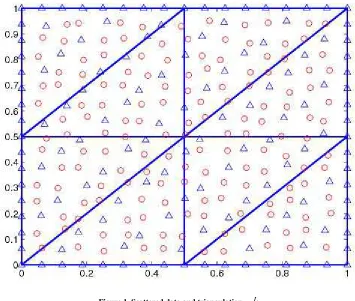
Example 4.1 Let
0 0 0 0 0
{(
i,
i, (
i,
i))}
D
=
x y
f x y
be a scattered data set which is marked with a triangle without
contaminated and
1 1 1 1 1
{( ,
i i, ( ,
i i)
)}
D
=
x y
f x y
+
ò
be a contaminated scattered data set which is marked with a
circle in Fig. 1, where
f x y
( , )
is a test function andò
i is a random number between−
0.01
to0.01
. We use the following test functions4 4
1
( , )
2
5
,
f x y
=
x
+
y
2
( , )
sin(2(
)),
f x y
=
x
−
y
2 2
3
( , )
0.75 exp( 0.25(9
2)
0.25(9
2) )
f x y
=
−
x
−
−
y
−
2
0.75 exp( (9
x
1) / 49 (9
y
1) / 10)
+
−
+
−
+
2 2
0.5exp( 0.25(9
x
7)
0.25(9
y
3) )
+
−
−
−
−
2 2
0.2 exp( (9
x
4)
(9
y
7) )
−
−
−
−
−
.to evaluate the scattered data set. First we use the spline space
1 5
(
L)
S
to find the the fitting surfacess
L, whereL
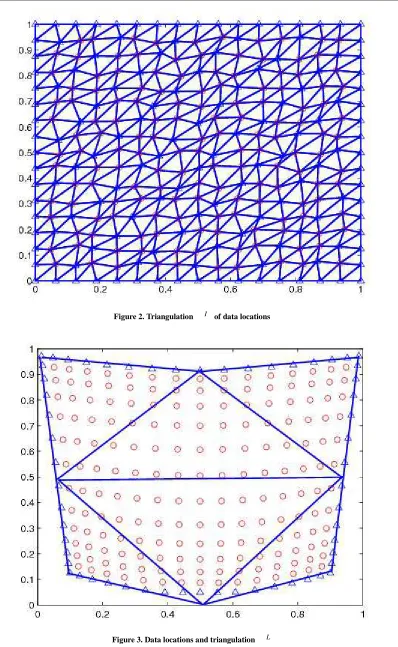
is the triangulation given in Fig. 1. Next we triangulate all data locations to get a new triangulation
I asshown in Fig. 2. We modify some of the data in two groups. Let
0 0 0 0 1
{
i,
i,
i}
MiD
=
x y z
=and
1 1 1 1 1
{ ,
i i, }
i iND
=
x y z
=be two new groups where
0 0 0 0 0
:
(
,
)
(
,
)
i i i L i i
z
=
f x y
−
s x y
and
1
: 0
i
z
=
. Then we construct a minimal energy
interpolatory spline
1 5
( )
I I
______________________________________________________________________________
least squares method (cf. [15]) in Table 1. Here in weighted least squares method, the weights are set to be
ω
i=
1
andω
i=
0.01
for the exact data and contaminated data, respectively. The maximum errors are measured using [image:5.595.127.482.305.606.2]101 101
×
equally-spaced points over[0,1] [0,1]
×
.Table 1: Approximation errors.
Test functions Our method Traditional l.s. method Weighted l.s. method
1
( , )
f x y
0.0342
0.4383
0.0965
2
( , )
f x y
0.0474
0.4778
0.0407
3
( , )
f x y
0.0441
0.2988
0.0216
Discussion: From Table 1, we can see that the error bounds of our approach is better than that of the traditional least
squares method. And compare to weighted least squares method, it is hard to say which method is better. But there is a one big difference between our method and weighted least squares method. That is the surface created by our method can pass through the exact data.
Figure 1. Scattered data and triangulation
LBelow, we present an example to illustrate an application of our method.
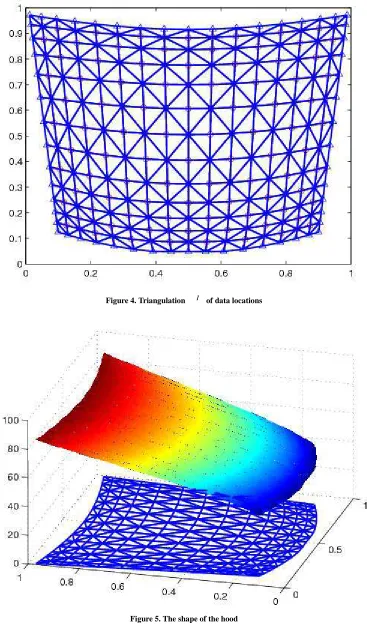
Example 4.2 We consider the shape design of a car. For example, the hood (a part of a car). A set of data are given
in Fig. 3 which are used to construct the hood. The data can be divided into two groups. One is marked with triangle which means the shape must go through the data (For instance, the edge of the hood). That means we need to interpolate these data. The other is marked with cycle which need to be least squares fit. We first use the spline space
1 5
(
L)
S
to find the the fitting surfacess
L, where
L is the triangulation given in Fig. 3. Next we modify twogroups of data from our method, then we construct a minimal energy interpolatory spline
1 5
( )
I I
s
∈
S
, where
IFigure 2. Triangulation
I of data locations______________________________________________________________________________
[image:7.595.132.476.84.375.2]Figure 4. Triangulation
I of data locationsFigure 5. The shape of the hood
Acknowledgments
REFERENCES
[1]D. L. Ragozin. J. Approx. Theory. v33, pp.335-355, 1983.
[2]M. C. Lopez de Silanes, R. Arcangeli,. Sur la convergence des Dm--splines d'ajustement pour des données exactes ou bruitées, Revista Matemática de la Universidad Complutence de Madrid. v4, pp 279-284, 1991.
[3]R.Arcangeli, B.Ycart, Almost sure convergence of smoothing Dm-spline functions. Numer. Math. v66, pp.281-294, 1993.
[4]M. J. Lai. Comput. Aided Geom. Design. v. 13, pp. 81-88, 1996.
[5]M. J. Lai, L. L. Schumaker, SIAM J. Numer. Anal. v.34, pp.905-921, 1997.
[6]M. J. Lai, L. L. Schumaker, On the approximation power of bivariate splines, Adv. in Comp. Math. v.9, pp251-279, 1998.
[7]K. Farmer, M. J. Lai. Scattered data interpolation by C2 quintic splines using energy minimization,
Approximation Theory IX, pp. 47-54, 1998.
[8]O. Davydov,L. L. Schumaker, On stable local bases for bivariate polynomial spline spaces, Constr. Approx. v 18, pp 87-116, 2001.
[9]M. von Golitschek, L. L. Schumaker,. Bounds on projections onto bivariate polynomial spline spaces with stable
local bases, Constr. Approx, v.18, pp 241-254, 2002.
[10]M. von Golitschek, M. J. Lai, L. L. Schumaker, , Numer. Math, pp.315-331, 2002.
[11]R. Arcangeli, M. C. Lopez de Silanes, J. J. Torrens, Multidimensional minimizing splines, Kluwer Academic
Publishers, 2004.
[12]G. Awanou, M. J. Lai, P. Wenston, Wavelets and Splines, pp 24-74, 2006. [13]T. Zhou, D. Han, M. J. Lai Appl. Numer. Math. v 58, pp 646-659, 2008. [14]T. Zhou, D. Han. J. Comput. Appl. Math. v 217, pp 56-63, 2008.
[15]M. J. Lai, L. L. Schumaker, Spline Functions on Triangulations, United Kingdom at the University Press,
Cambridge. 2007.