Applied Mechanics and Materials Vols. 465-466 (2014) pp 11 19-1123
O (2014) Trans Tech Publications, Switzerland doi: 10.4028/www.scientijic.net/AMM 465-466.1119
Study On Temperature, Force and Specific Energy of AlSl 1020 under
MQL Grinding Process
E.A. ~ a h i r n ' . ~ ,
R. lbrahim1.
b,Z.
oh id',
M.F. ~hmad'and
M.
shahrudinl
'~dvanced Machining Research Group, Faculty of Mechanical and Manufacturing Engineering,Universiti Tun Hussein Onn Malaysia, 86400 Parit Raja, Batu Pahat, Johor, MALAYSIA
Keywords: Grinding, temperature, force, specific energy, grinding power
Abstract. Grinding is one of the most difficult processes in machining operations. Normally, the flood coolant method was used as a cooling agent in the grinding process. The most common defects using flood coolant are higher grinding friction, higher heat generation, and thermal damage. Therefore, the minimum quality lubricant (MQL) was introduced to minimize the defects. The main objective of this project is to compare the performance of MQL and flood coolant techniques in terms of grinding temperature, grinding force and specific energy. Three levels of cutting speeds, three levels of feed rate and depth of cut are adopted in the evaluation. The experiments were conducted on a thin plate of mild steel AISI 1020. The result shows that the MQL technique was effectively supplied to the grinding contact zone. This research revealed that the MQL technique exhibited an advantages on the surface temperature compared to the flood coolant.
Introduction
Grinding is one of the manufacturing process and widely use in the industries for surface finishing. The proper application of grinding fluid has been found to be effective in reducing the thermal effect and surface roughness [I]. Grinding process uses a wheel made from an abrasive or synthetic minerals in a loose or bonded form. It comes with a variety of size, shape and types of abrasive. The grinding wheel composed of abrasive grains held together in a binder. The abrasive grains act as cutting tools by removing the unwanted material. As these abrasive grains wear, the added resistance leads to fracture of the grains or weakening of their bond. Using cutting fluids is a common strategy to reduce the temperature and lubricating effect. As a result, surface integrity, tool life, and also size accuracy can be improved [2]. On the other hand, cutting fluid will produces smoke, airborne mist and other particles in the shop floor air. These drawbacks will cause as environmental, safety concerns and health issues.
MQL has been established as an alternative for conventional flood coolant. Different with flood coolant, MQL uses only a few drops of lubricant. There are many advantages when using MQL. Effective lubrication reduces the cutting force and temperature, improves wheel life, good surface finish at high cutting speed, reduce or eliminate breathing and skin related problem and at the same time saving the lubricant cost [3,4]. The objective of this study is to investigate the grinding performance of MQL which compared with flood grinding in terms of temperature, grinding force, and specific energy.
Experimental Setup
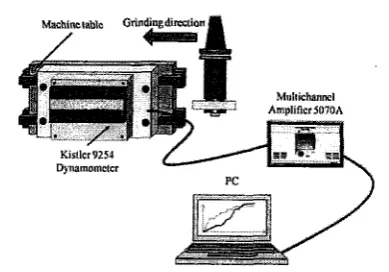
Up grinding tests were performed on AISI 1020 steel with a thickness of 3 mm for temperature measurement as shown in Fig. 1 using a thermal imager camera. The measurements were conducted on a Mazak vertical machining center (Model 41 0-A) and the temperature value is taken at the rear side of the workpiece. White alumina oxide which has a vitrified bond chosen as a grinding wheel material with dimensions of 100 mm, 20 mm and 25.4 mm for the outer diameter, thickness and hollow diameter, respectively. Summary of grinding conditions is given in Table 1. In addition, the surface roughness was measured using the Mitutoyo SJ-400 Surftest tester.
Kisllcr 9251 h-namomctcr
[image:2.599.57.512.147.511.2]Fig. 1 : Experimental setup Fig. 2: Grinding force measurement 1 setup
Table 1 : Parameter of grinding process
Fig. 3: Nozzle setup
Cutting speed, V, (mlmin) Feed rate, f, ( m d m i n ) Depth of cut, a, (rnm) Cutting type
Coolant type
Coolant flow rate (Ilmin)
Results and Discussion
900,1200,1500 400,500,600 0.2
AISI 1020 MQL (synthetic ester)
Water soluble Coolant
80 Ilhour (MQL) 30 Ilmin (Flood)
[image:2.599.308.503.156.292.2]Applied Mechanics and Materials Vols. 465-466
1 1121
(a> (b)
Fig. 4: Thermal image on the rear of the workpiece at (a) V, = 900 mlmin, f, = 400 mmlmin and
(b) V, = 1500 mlmin, f, = 600 mmlmin
Cutting speed. Vc (dmin)
AS1 1020 (MQL Coolant)
m 1000 im i4W lsDO
Cutting speed, Vc (mlmin)
(a) (b)
Fig. 5: Temperature for (a) MQL and (b) flood coolant condition of AISI 1020
AlSl 1020 [Flood Coolant)
Cutting Speed. Vc (mlmin)
8M i w o iiw 1m 1 m
Culling Speed. Vc (~lllmin)
(a) (b)
Fig. 6: Normal force for (a) MQL and (b) flood coolant condition of AISI 1020
[image:3.601.88.484.271.429.2]MI0 1WO 1200 1 m 1500
Culling Speed, Vc (mlmin) Cuning Speed. Vc (mlrnin)
(a) (b)
Fig. 7: Tangential force for (a) MQL and (b) flood coolant of AISI 1020
20
AlSl 1020 (Flood Coolant)
EZd b 400 rnmlrnin
rn fr 500 mmlmin
H fr 600 rnmlrnin
Cutting Speed, Vc (mlrnin)
AlSl 1020 (MQL Coolanl)
iu
fr 400 rnmlrnin
rn fr 500 mmlrnin
H fr 600 rndmin
I
e m , 1m I&
Cutting Speed. Vc (mlmin)
(a) (b)
Fig. 8: Specific energy for (a) MQL and (b) flood coolant condition of AISI 1020
AlSl 1020 (Flood Coolant)
liaa lim
Cutting Speed, Vc (mlmin)
AlSl 1020 (MQL Coolantl
9 w l i a 0 l i
Cutting Speed. Vc (mlmin)
(a) (b)
Applied Mechanics and Materials Vols. 465-466 1123
A s illustrated in Fig. 8, MQL condition recorded lower value of specific energy compared to flood coolant condition. Furthermore, the feed rate shows a significant effect of grinding power. As shown in Fig. 9, the grinding power for both conditions shows the growth due to the increasing of feed rate. These are obviously due to the increase of the volume removed per unit time. It can be expressed that flood coolant condition requires more power and energy. This occurs due to the relation between tangential force and heat where high tangential force will lead to higher heat generation and thermal damage. In addition, the increment value of specific energy may lead to the high grinding temperature. This is due to the conversion of energy into heat which is concentrated within the grinding zone.
Summary
This paper presents the result performance of flood coolant and compare the result with MQL at different cutting condition. The main result obtained in this study can be summarized as follows:
i. MQL condition gives an advantages on the surface temperature during the grinding process. It is due to the reduction of the temperature compared to the flood coolant supply.
ii. The grinding forces both for normal and tangential components decrease with the increasing of cutting speed while on the other hand it is increased with the increment of feed rates. iii. Increasing of cutting speed results in a specific energy increase while the grinding power
shows an increment due to the increasing of feed rates.
References
[I] E.A. Rahim, Z. Mohid, A.H.A. Rahman
,
M.F. Bahman, The effect of internal through coolant on grinding performance on AISI1020 Mildsteel, Journal Advanced Materials Research. 576 (2012) 87-90.[2] M.J. Hadad, T. Tawakoli, M.H. Sadeghi, B. Sadeghi, Temperature and energy partition in minimum quality lubrication-MQL grinding process, International Journal of Machine Tool and Manufacture. 54-55 (201 1) 10-17.
[3] T. Tawakoli, M.J. Hadad, M.H. Sadeghi, Influence of oil mist parameters in minimum quality lubricant-MQL grinding process, International Journal of Machine Tool and Manufacture. 50 (2010) 521-531.
[4] E.A. Rahim, H. Sasahara, A study of the effect of palm oil as MQL lubricant on high speed drilling of titanium alloys, Tribology International. 44 (3) 309-3 17.