Journal of Chemical and Pharmaceutical Research, 2015, 7(1):416-423
Research Article
CODEN(USA) : JCPRC5
ISSN : 0975-7384
Synthesis, spectral characterization and antimicrobial activity of bidentate
Schiff’s base (N
2) transition metal complexes
D. Sathis Kumar
1, S. Rajiv Gandhi
2and A. K. Ibrahim Sheriff
1*1PG and Research Department of Chemistry, C. Abdul Hakeem College (Autonomous), Melvisharam, Tamil Nadu,
India
2
Sri Balaji Chockalingam Engineering College, Arni, Tamil Nadu, India
_____________________________________________________________________________________________
ABSTRACT
The transition metal complexes of metals ions such as V(V), Fe(III), Co(II), Ni(II), Cu(II), Zn(II), Zr(IV) and Ru(III) have been synthesized from N,N’-Bis-(4-methylbenzylidene)-benzene-1,2-diamine. They have been characterized by elemental analyses, molar conductance, magnetic susceptibility, FT-IR, electronic spectra, NMR spectra, GC-MS and thermal studies. The electrochemical behaviour of metal complexes have been studied by cyclic voltammetry. The antimicrobial activity of the ligand and its metal complexes have been carried out on the bacteria Bacillus cereus, Escherichia coli, Pseudomonas aeureginosa and Staphylococcus aureus and fungi Aspergillus flavus, Aspergillus niger, Candida albicans and Penicillium by disc diffusion method.
Key words: Schiff base complexes; transition metals; Spectral characterization; bidentate (N2); antimicrobial activity.
_____________________________________________________________________________________________
INTRODUCTION
Schiff base in other words, is a nitrogen analog of an aldehyde or ketone in which the C=O group is replaced by a carbon – nitrogen double bond (C=N) with the nitrogen atom connected to an aryl or alkyl group. Schiff bases are of the general formula R1R2C=NR3, where R3 is an aryl or alkyl group that makes the Schiff base a stable imine. They act as chelating ligands with transition metals [1]. Much recent interest has been devoted to the synthesis of their complexes, elucidation their structure [2], theoretical studies like spectral, magnetic, electrochemical behaviour and thermal studies. Their role in catalysis [3-4],corrosion etc. is extensively studied. They act as a good evidence to advocate the presence of covalency in the metal-ligand bond [5]. The metal complexes show excellent biological activity which makes them as model compounds for biological processes [6]. The study of Fe(III) complexes throw a light into the insight of biologically important hememoieties. The Ru(III) complexes have been found to be alternatives for the existing anticancer cisplatins [7]. A similar study on these transition metal ions and their substituted derivatives is inprogress.
EXPERIMENTAL SECTION
______________________________________________________________________________
conductance of the complexes were made on a systronic conductivity meter type 304 in DMSO with a dip type cell having platinum electrode. The UV- visible spectra were run on a carry-5E Spectrometer (200-900nm) in nujol mull. TGA-DTA analyses were obtained by using NETZCH STA-409C/CD thermal analyzer. The electrochemical properties of the complexes have been studied by cyclic voltammetry obtained on a CHI-600A electrochemical analyzer under oxygen free condition using a three electrode cell in which glassy carbon acts as working electrode, Calomel acts as reference electrode and platinum wire as an auxiliary electrode and sodium perchlorate as back ground electrolyte. The 1H NMR, 13C NMR spectra were recorded on JKM-ECS 400 in chloroform-D solvent. The mass spectrum was recorded using WATERS-Q-T of premier-HAB213, electro spray ionization-MS.
Preparation of the Schiff base
A solution of 1,2-phenylenediamine (0.01mole) and p-methylbenzaldehyde (0.02mole) in 1:2 molar ratio in ethanol was mixed with constant stirring. The resulting mixture was refluxed for five hours in a water bath. The concentrated solution was filtered out, washed with ethanol and recrystallized using a solution of chloroform and ethanol mixture [8-10], its purity was checked by TLC (Fig-1).
Fig-1: Schiff base free ligand
Preparation of the [ VO(C22H20N2)2](ClO4)3 complex
A solution of vanadium oxy chlorate (1mmole) and Schiff base (2mmole) in1:2 molar ratio in ethanol was mixed with constant stirring. The resulting mixture was refluxed for two hours. The concentrated solution was filtered out, washed with ethanol and recrystallized using ethanol solution. The purity was checked by TLC. In a similar way the complexes of Fe(III), Co(II), Ni(II), Cu(II), Zn(II), Zr(IV) and Ru(III) were prepared from the respected metal salts ferric chloride, cobaltous nitrate, nickel chloride, cupric acetate, zinc sulphate, zirconium oxy chloride, and ruthenium chloride the ligand in 1:2 ratio respectively [11-15].
RESULTS AND DISCUSSION
Micro analysis
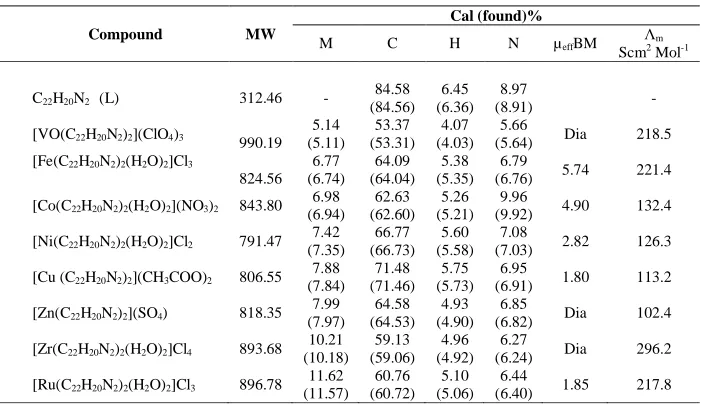
The elemental analyses (C, H and N) of the Schiff base and its complexes are listed in (Table 1). The obtained elemental analyses data were in good agreement with the calculated values and display the formation of 1:2 [M: L2] ratio.
Molar conductivity and magnetic susceptibility measurements
The molar conductance values of the complexes fall in the range 102-296 (Table 1) in DMF suggesting that the complexes Co(II), Ni(II), and were (1:2) and those of VO(V), Fe(III), Zr(IV) and Ru(III) 1:3 electrolyties [16]. The room temperature magnetic moment (µeff) values exhibit paramagnetic for Fe(III), Co(II), Ni(II), Cu(II) and Ru(III) complexes and exhibit diamagnetism for VO(V), Zn(II) and Zr(1V) complexes (Table 1). The Fe(III) complex exhibits a magnetic moment of 5.74 BM, suggesting octahedral geometry. The Co(II) complex shows a magnetic moment value of 4.90 BM indicating an octahedral geometry. The observed magnetic moments for the Cu(II) and Ru(III) complexes are 1.80 and 1.85 BM respectively suggesting an octahedral geometry [17-18].
Electronic Spectra
______________________________________________________________________________
transition could be found again in the complex combination spectra but shifts towards lower frequencies which indicates the coordination of the ligand with the metal ions.
Fig-2: 1H-NMR spectrum of the free Schiff base
Fig-3: 13C-NMR spectrum of the free Schiff base
The VO(V) complex exhibits electronic spectra in the region 21800 cm-1 due to the presence of charge transfer transitions [21]. The electronic spectrum of Fe(III) complex shows a band at 16949 cm-1due to charge transfer transition as expected for an octahedral environment. The ligand field parameter Dq and LFSE value for this complex are1694.9 cm-1 and 48.46 Kcal mol-1 respectively [22].
The electronic spectrum of Co(II) complex exhibits three bands at 11055cm-1 (ʋ1), 21400cm-1(ʋ2) and 22506cm-1(ʋ3) which are assigned to the transitions 4T1g (F)→4T2g(F), 4T1g (F)→4A2g(F) and 4T1g (F)→4T1g(P) respectively. The intense band around 29260 cm-1 may be charge transfer band. The ligand field splitting energy (Dq), inter electronic repulsion parameter (B′) and nephelauxetic ratio (β ) for Co(II) complex were calculated using the secular equations given by Koing [23] and their respective values are corresponds to 1343.2, 921.87, 0.95 and β%=5.06. The inter electronic repulsion parameter (B′) is less than free metal ion (971 cm-1) and the nephelauxetic ratio (β) is less than one which indicates a moderate covalent character of the metal-ligand bonds [24].
The electronic spectrum of Ni(II) complex exhibits two bands at 18518 cm-1(ʋ2) and 22727 cm-1(ʋ3) assignable to 3A
2g→1T1g(F) and 3A2g →3T1g(P) transitions respectively in an octahedral environment. The lowest band ʋ1≈ (10 Dq) was not observed due to limited range of the instrument used. The Racah parameter B′ is less than free ion value of (1014cm-1), indicating the covalent character of the complex. The β and β’ values further support the octahedral geometry around the Ni(II) ion [25].
The electronic spectrum of Cu(II) complex exhibits two bands observed in the region 18853 cm-1(ʋ1) and 14492 cm -1(ʋ
______________________________________________________________________________
are 1449.0 and 41.13 K cal mol-1 respectively.The experimental value of the magnetic moment 1.80 BM suggests a mono meric square planar geometry [26].
Fig-4: Mass spectra of the Schiff base
The electronic spectrum of Zn(II) complex exhibits a band at 17699cm-1 which may be of charge transfer transition. The ligand field parameter Dq and LFSE values are 1769.9 cm-1 and 50.60 Kcal mol-1 respectively which suggest a square planar environment. The electronic spectrum of Zr(IV) complex exhibits a band at 21739 cm-1due to charge transfer transition. The ligand field parameter Dq and LFSE values as 2173.9 cm-1 and 62.16 Kcal mol-1 respectively. The electronic spectrum of Ru(III) complex exhibits a band at 21978 cm-1 due to charge transfer transition. The ligand field parameter Dq and LFSE values are 2197.8 cm-1 and 62.84 K cal mol-1 respectively [27].
Infrared Spectra
The IR spectral data of Schiff base shows a band at 1643 cm-1due to the presence of azomethine moiety [28]. This band is shifted to lower frequency on complexation with metal ions (Table 3). New vibrations at 531 – 563 cm-1 and 474 – 516 cm-1 which are not present in the free Schiff base are attributed to the existence of υ(M-O) and υ(M-N). The appearance of these vibrations confirmed the involvement of nitrogen and oxygen atoms in chelation. A special feature of the IR spectra of Fe(III), Co(II), Ni(II), Zr(II) and Ru(III) complexes is the appearance of a broad band between the ranges 3490 – 3533 cm-1, which could be assigned to the stretching frequencies of the hydroxyl group of coordinated water molecules associated with the complex [29]. On the other hand for the VO(V) complex a high intensity band at 831 cm-1 is observed. This could be attributed to dimerisation via V=O which is reflected by shifting of the respective vibration [30].
1H NMR spectrum of Schiff base
1H NMR spectral data of the Schiff base was recorded in CDCl
3 (Fig-2), shows peaks at7.58-6.97 and 2.38-2.32 ppm due to aromatic protons and CH3 group respectively [31].
13C-NMR spectrum of Schiff base
13
______________________________________________________________________________
Table -1: Elemental analyses of Schiff base and its complexes
Compound MW
Cal (found)% M C H N µeffBM
Λm
Scm2 Mol-1
C22H20N2 (L) 312.46 -
84.58 (84.56)
6.45 (6.36)
8.97
(8.91) -
[VO(C22H20N2)2](ClO4)3
990.19 5.14 (5.11) 53.37 (53.31) 4.07 (4.03) 5.66
(5.64) Dia 218.5 [Fe(C22H20N2)2(H2O)2]Cl3
824.56 6.77 (6.74) 64.09 (64.04) 5.38 (5.35) 6.79
(6.76) 5.74 221.4 [Co(C22H20N2)2(H2O)2](NO3)2 843.80 (6.94) 6.98 (62.60) 62.63 (5.21) 5.26 (9.92) 9.96 4.90 132.4
[Ni(C22H20N2)2(H2O)2]Cl2 791.47 (7.35) 7.42 (66.73) 66.77 (5.58) 5.60 (7.03) 7.08 2.82 126.3
[Cu (C22H20N2)2](CH3COO)2 806.55 (7.84) 7.88 (71.46) 71.48 (5.73) 5.75 (6.91) 6.95 1.80 113.2
[Zn(C22H20N2)2](SO4) 818.35 (7.97) 7.99 (64.53) 64.58 (4.90) 4.93 (6.82) 6.85 Dia 102.4
[Zr(C22H20N2)2(H2O)2]Cl4 893.68
10.21 (10.18) 59.13 (59.06) 4.96 (4.92) 6.27
(6.24) Dia 296.2 [Ru(C22H20N2)2(H2O)2]Cl3 896.78 11.62
(11.57) 60.76 (60.72) 5.10 (5.06) 6.44
[image:5.595.120.474.358.468.2](6.40) 1.85 217.8
Table-2: UV-Vis spectra of Schiff base and its complexes
Compound Frequency
ʋ(cm-1) Dq
cm-1 B’ β β%
LFSE K cal mol-1
Schiff base 27375 - - - - -
V (V) 21800 2180.0 - - - 45.87
Fe (III) 16949 1694.9 - - - 48.46
Co (II) 11055(ʋ1) 21400(ʋ2) 22506(ʋ3) 1343.2 921.87 0.95 5.06 30.72
Ni (II) 18518 (ʋ2) 22727(ʋ3) 1303.62 824.75 0.792 20.77 37.27
Cu (II) 14490(ʋ1) 18853(ʋ2) 1449.0 - - - 41.43
Zn (II) 17399 1769.9 - - - 50.60
Zr (IV) 21739 2173.9 - - - 62.16
[image:5.595.209.387.496.610.2]Ru (III) 21978 2197.8 - - - 62.84
Table-3: Infrared spectra of Schiff base and its complexes
Compound υC=N υM-N υM-O υM-OH2 υM=O
Schiff base(L) 1643 - - - VO(V) 1632 483 - - 831 Fe(III) 1631 479 531 3498 - Co(II) 1630 474 534 3490 - Ni(II) 1634 477 553 3492 - Cu(II) 1628 477 - - - Zn(II) 1631 499 - - - Zr(IV) 1635 516 563 3533 - Ru(III) 1629 504 550 3529 -
Table -4: Electro chemical data of the metal complexes
Redox Complex Epc (V) Epa(V) E1/2 (V) ∆Ep (mV)
Fe(III)/Fe(II) -0.86 -0.6 -0.738 260 Ru(III)/Ru(II) -1.45 -0.762 -1.106 688
Mass spectral fragmentation of the Schiff base
______________________________________________________________________________
(L=C22H20N2).
Thermal studies
The TGA and DTA curves of the Fe(III), Co(II), Ni(II), Zr(IV) and Ru(III) complexes show an endothermic band at about 100 °C-145 °C with a loss of mass corresponding to coordinated water molecules in these complexes [32].
Electro chemical studies
The electrochemical behavior of the complexes was studied by the cyclic voltameter in the potential range 0 to -2.0 V. The CV data is given in the (Table 4). All the complexes show a quasi-reversible reduction wave at negative potential. increases with increasing scan rate and is always greater than 60 mV. The Fe(III) complex shows a well-defined quasi-reversible [33-34] reduction peak at -0.86 to -0.6V which corresponds to Fe(III) Fe(II). The Ru(III) system shows a similar peak at -0.76 to -1.45V which corresponds to Ru(III) Ru(II).
Antimicrobial activity
The antibacterial screening of the compounds was carried out against the bacteria Bacillus cereus (Gram +ve),
Staphylococcus aureus (Gram +ve), Pseudomonas aeruginosa (Gram -ve) and Escherichia coli (Gram -ve) by
cup-plate method using the nutrient agar as medium [36]. In a typical procedure, molten nutrient agar kept at 115°C – 120 °C was poured into a Petri dish and allowed to solidify. The small wells (10 mm diameter with 1cm distance) were made in the agar medium by carefully using a sterile cork and these were completely filled with test solutions. The plates were incubated for 24 hours at 37 °C. The diameters of the zones of inhibition for all the test compounds were measured and the results were compared with that of standard ciprofloxacin at the same condition (Table 5).
The antifungal activity of the compounds was studied against the fungi Aspergillus flavus, Aspergillus niger,
Candida albicans and Penicillium by cup-plate method and cultured on Sabouraud’s agar medium adopting similar
procedure as described above [37]. The plates were incubated for 24 hours at 37 °C. The diameters of the zone of inhibition for all the test compounds were measured with that of the standard amphoterecin-B at the same condition (Table 6).
Since the entire test compounds and standards were prepared freshly in sterile water, its zone of inhibition was found to be very negligible and taken as zero mm. The antibacterial activity results reveal that Schiff base and its complexes exhibit weak to good activity. The antimicrobial activity of metal complexes is higher than that of the Schiff base. The Cu(II) complex shows more activity [38].
______________________________________________________________________________
Table-6: Anti-fungal activity of Schiff base and its complexes
CONCLUSION
The Schiff base formed acts as a bidendate (N2) ligand. It forms square planar complexes with Cu(II) and Zn(II), square pyramidal complex with VO(V) and octahedral complexes with Fe(III), Co(II), Ni(II), Zr(IV) and Ru(III). The octahedral complexes contain coordinated aqua ligands. The quasi-reversible redox behavior is proved by cyclo voltammetry studies. They show fairly good antimicrobial activity.
Acknowledgements
The authors express their sincere thanks to the Management, PG and Research department of Chemistry, C. Abdul Hakeem College, Melvisharam. We also thank SAIF, IIT Kanpur for providing TGA-DTA analyzer, magnetic susceptibility data, FT-IR and electronic spectral studies. We also thank University of Madras, Chennai for providing cyclic voltammetry studies.
REFERENCES
[1]GholamhosseinGrivani, AilakbarDehnoKhalaji, Vida Tahmasebi, KazumaGotoh, Hiroyuki Ishida, Polyhedron.,
2012, 31, 265-271.
[2]N. Chantarasiri, V. Ruangpornvisuti, N. Muangsin, H. Detsen, T. Manaunsap, C. Batiya, N. Chaichit, J. Mol.
Struct., 2004, 701, 93 .
[3]S. Rayati, N. Torabi, A. Ghaemi, S. Mohebbi, A. Wojtczak, A. Kozakiewicz, Inorg. Chim. Acta., 2008, 361, 1239.
[4]R. Ando, H. Ono, T. Yagyu, M. Maeda, Inorg. Chim. Acta., 2004, 357, 2237.
[5]C. Wikete, P. Wu, G. Zampetlla, L.D. Gioia, G. Licini, D. Rehder, Inorg. Chem., 2007, 46, 196. [6]D.C. Crans, J.J. Smee, E. Gaidamauskas, L.Q. Yang, Chem. Rev., 2004, 104, 849.
[7]S. Leininger, B. Olenyuk, P. J. Stang, Chem. Rev., 2000, 100, 853.
[8]M. R. Mauyra, S. Agarwal, C. Bader, M. Ebel, D. Rehder, DaltonTrans., 2005, 537. [9]S. Zhu, W. W. Brennessel, R.G. Harrison, Jr.L.Que, Inorg chim Acta., 2002, 32, 337. [10]J. M. Rowland, M. M. Olmstead,P. K. Mascharak, Inorg chem., 2001, 40, 2810. [11]R. Ramesh, Inorg ChemCommun., 2004, 7, 274.
[12]N. Daneshvar, A. A. Entezami, A. A. Khandar, L. A. Saghaforough, Polyhedron., 2003, 22, 1437. [13]J.C. Noveron, M. M. Olmstead, P. K. Mascharak, J. Am. Chem. Soc., 2001, 123, 3247.
______________________________________________________________________________
[15]J. S .M. Samec, A. H. Ell, J. E. Backvall, Chem. Commun., 2004, 2748. [16]G. Venkatachalam, R. Ramesh, Tetrahedron Lett., 2005, 40, 5215. [17]G. Venkatachalam, R. Ramesh, Inorg. Chem. Comm., 2006, 9, 703. [18]R. V. Singh, Indian J Chem., 2004, 43A, 2536.
[19]M. Dey, J. P. Chinta, G. J. Long, C. P. Rao, Indian J Chem., 2009, 48A, 1484. [20]S. Sarkar, K. Dey, Spectrochim. Acta., Part A, 2005, 62, 383.
[21] A. Muller, E. Diemann, C. K. Jorgonsen, Struct. Bond., 1973, 14, 23. [22]S. Pal, Eur. J. Inorg Chem., 2003, 4244.
[23]E. Kӧnig, Struct Bond., 1971, 9, 175.
[24]L. Mitu, N. Raman, A. Kriza, N. Stanica, M. Dianu, Asian J Chem., 2009, 21, 5749. [25]A B. P. Lever, Inorganic Electronic Spectroscopy; Elsevier, London, 1968.
[26]B. P. Lever, J. Lewis, R. S. Nyholam, J. Chem. Soc., 1963, 2552.
[27]M. M. Taquikhan, D. Sirinivas, R. I. Kureshy, N. H .Khan, Inorg Chem., 1990, 29, 2320. [28]S. Sarkar, K. Dey, Spectrochim Acta., Part A, 2005, 62, 383.
[29]L.J. Bellamy, The Infrared spectra of the Complex Molecules, second ed., Wiley Interscience, New York, 1970. [30]M.S. Yadawe et al., Elixir Appl. Chem., 2012, 42, 6213.
[31]S. Sukdolak, N. Vukovi, S. Soluji, M. Miloev, N. Manojlovi, J. Krsti, J. Serb. Chem. Soc., 2006, 71(6), 581-585.
[32]D. H. Williams, I. Fleming, ''Spectroscopic Methods Inorganic Chemistry״, 4thed, Mc Graw. Hill, London,
1989.
[33]K. K. MohammudYusuff, R. Sreekala, Thermo. Chem. Acta, 1989, 155, 247. [34]S. Yi, Z. He, L. A. Guzei, Organometallics., 2001, 20, 364 .
[35]P. T. Manoharan, P. K. Mehrotra, K. M. T. Khan, R. K. Ardar, Inorg Chem., 1973, 12, 2753. [36]KrishnaPriya, K. R. Kandaswamy, Polyhedron., 2005, 24, 113.
[37]G. Tweedy, Phytopathology., 1964, 55, 910.