
Munich Personal RePEc Archive
The Poisson quasi-maximum likelihood
estimator: A solution to the “adding up”
problem in gravity models
Arvis, Jean-Francois and Shepherd, Ben
World Bank, Developing Trade Consultants Ltd.
25 October 2011
Online at
https://mpra.ub.uni-muenchen.de/34334/
1
The Poisson Quasi-Maximum Likelihood Estimator: A Solution to the
“Adding Up” Problem in Gravity Models
Jean-François Arvisa and Ben Shepherdb
a. Senior Economist, the World Bank, 1818 H. St. N.W., Washington, D.C. 20433.
b. (Corresponding Author) Principal, Developing Trade Consultants Ltd., 260 W. 52nd St. #22B, New
York, NY 10019. [email protected]. Phone +1-646-845-9702. Fax +1-646-350-0583.
The findings, interpretations, and conclusions expressed in this paper are entirely those of the authors.
They do not represent the view of the World Bank, its Executive Directors, or the countries they
represent.
Abstract: This paper shows that the Poisson quasi-maximum likelihood estimator applied to the gravity
model produces estimates in which, summing across all partners, actual and estimated total trade flows
are identical. Other methods such as OLS do not have this desirable property. Indeed, Poisson is the only
quasi-maximum likelihood estimator that preserves total trade flows. This result is an additional reason
for preferring Poisson as a workhorse gravity model estimator.
Key Words: International Trade; Gravity Model; Poisson; Quasi-Maximum Likelihood Estimator.
JEL Codes: F10; C10.
2
1
Introduction
The gravity model is ubiquitous in the applied international trade literature. Recent contributions have
highlighted a number of shortcomings with the traditional approach of log linearization and OLS
estimation. In particular, Santos Silva and Tenreyro (2006) provide strong arguments for preferring the
Poisson quasi-maximum likelihood estimator. This paper extends their findings by highlighting another
desirable property of Poisson: it preserves total trade flows between the actual and estimated bilateral
trade matrices in a way that no other quasi-maximum likelihood estimator can. Poisson thus solves the
“adding up” problem faced by other gravity model estimators.
The paper proceeds as follows. Section 2 presents a generalized gravity model. Section 3 outlines a
simple demonstration of our proposition. Section 4 provides supporting empirical evidence, and Section
5 concludes.
2
The Gravity Model
The CES-based model of Anderson and Van Wincoop (2003) has replaced more traditional formulations
to become the benchmark gravity model in the applied international trade literature:
models exports from country i to country j to be regressed against the actual values . is
expenditure; is production; is world GDP; is bilateral trade costs specified in terms of
observables, such as geographical distance, i.e. ; and is the intra-sectoral
elasticity of substitution. Inward multilateral resistance
3
multilateral resistance captures the dependence of economy
i’s exports on trade costs across all destination markets. The w terms are weights equivalent to each
economy’s share in global output or expenditure.
To estimate the model, it is common to use exporter and importer fixed effects to control for GDP and
multilateral resistance. Thus, in all generality, the standard gravity model takes the following form:
where is a constant, is shorthand for a full set of exporter fixed effects, represents importer fixed
effects, and is a random error term that is statistically independent of the regressors, with
. This setup is very close to the more general formulations of gravity
found in the regional science literature (e.g., Roy, 2004), in which the fixed effects are interpreted
generally as capturing the “repulsive” and “attractive” forces of the exporter and the importer, and a
variety of specifications for the trade costs term are considered.
To implement equation (2) empirically, the traditional approach is to use the great circle distance
between countries as a proxy for trade costs, and then to obtain OLS estimates of the log-linearized
model :
However, Santos Silva and Tenreyro (2006) highlight two problems with this approach. First, taking the
logarithm automatically drops observations for which the reported trade value is zero. This is a
significant issue empirically, because zeros are very common.
The second problem is that OLS gives inconsistent parameter estimates if the disturbance in (2) is
4
that trade data empirically exhibit more variation (standard variation over mean) for smaller trade
values resulting in a higher variance for .
Santos Silva and Tenreyro (2006) propose the Poisson quasi-maximum likelihood estimator as a
pragmatic solution to both problems. The Poisson regression model is defined in general terms by the
discrete distribution:
The expected value and variance are the modeled exports:
The log likelihood associated with the distribution is
Zero observations can be incorporated straightforwardly in the Poisson maximum likelihood (ML)
regression. It also naturally accounts for the observed dispersion (according to (5) the coefficient of
variation goes as
.) Heteroskedasticity can be handled with a robust covariance matrix, and this
approach gives consistent estimates regardless of how the data are in fact distributed, i.e. they do not
need to be Poisson at all, nor even count data. Recent simulation evidence shows that Poisson performs
well compared with other candidate estimators from the literature (Santos Silva and Tenreyro, 2011).
The quasi maximum likelihood (QML) applicable to continuous values derives from (6) and the large
5
3
Poisson and the “Adding Up” Problem
The early gravity literature recognized an additional problem with OLS estimates of the log-linearized
model in equation (3) (Tinbergen, 1962; Linnemann, 1966): Jensen’ s inequality means that total
predicted trade exceeds total actual trade. We refer to this as the “adding up” problem, in the sense
that the sum of estimated trade flows for each exporter or importer—i.e., summing across all trading
partners in the original bilateral trade matrix —systematically exceeds the total of each country’s actual
exports or imports. In Section 4, we show that this effect is quantitatively important. An additional
desirable, and unique, property of the Poisson QML is that it solves this “adding up” problem.
We proceed as follows. First, we show that the Poisson QML implies a series of equalities between
actual and estimated total trade flows for gravity models with the classical log-linear specification. Then,
we prove the following:1
THEOREM “The Poisson quasi-maximum likelihood is the only one that equalizes the totals of actual
and modeled values for any scale invariant model.”
Scale invariant models are those for which the econometric specification includes, as in (2) and (3), a
multiplicative constant to be estimated. Models that describe additive quantities, such as trade,
production, or population, which are measured in specific arbitrary units (e.g., dollars or tons)
necessarily have this property to allow for changes of units, and furthermore “adding up” makes sense
for such variables (as opposed to ratios or ordinal variables). Linear dependence in means:
1
6
Maximizing the Poisson QML (7) on the scale yields the equalizations of total values:
The empirical literature primarily uses log linear models for which the predicted values take the form:
where is the set of independent variables and the set of regression parameters. Their QML
estimate is derived by maximizing (9) given (7), which yields the first order condition (10).
Hence not only the total flow but the weighted total (or average) of each independent variable is
preserved by the Poisson QML for any log-linear model:
For dummy variables, equation (11) means that the predicted total flow for the pair ij where a dummy is
true equals the actual one for the same subset. This yields a large set of desirable equalities. For
instance, taking exporter and importer dummies as in (2) and (3), total exports and imports by country
are preserved. If the model includes regional integration variables, regional trade is conserved as well.
The surprising and important result that actual and predicted total trade flows are exactly equivalent
7
To show that Poisson is the only (quasi-) maximum likelihood estimator that preserves total flows, we
consider a general log likelihood function of the form:
The are parameters independent of the country pairs, which we can omit without loss of generality.
Maximizing the Poisson QML (7) on the scale , yields the generalization of (7) for any pairs of actual
and predicted flow values.2 At the maximum of the likelihood function:
where
Totally differentiating (13) yields:
Since the totals are conserved for the same pair , we also have:
For these two conditions to impose no further restrictions on the model, they must be proportional (two
functional forms with the same kernel are proportional). Hence:
Integration yields:
2
8
Since is QML it should have a local maximum when the two variables are identical, thus
, and , which means that:
Integrating again yields:
That is QML again implies . Therefore:
which means that . Equation 19 therefore becomes the Poisson QML:
QED
4
Empirical Implementation
In this section, we use a simple empirical example to show that the “adding up” problem we have
identified is quantitatively important, and that Poisson indeed provides an effective solution. To do this,
we set up a gravity model using aggregate trade data for 134 importers and 227 exporters for 2009,
sourced from UN-Comtrade. We include common trade cost proxies, such as geodesic distance, and
dummies for common language, geographical contiguity, colonial links, and a common colonizer. All
geographical and historical data are sourced from the CEPII distance dataset. We also include full sets of
9
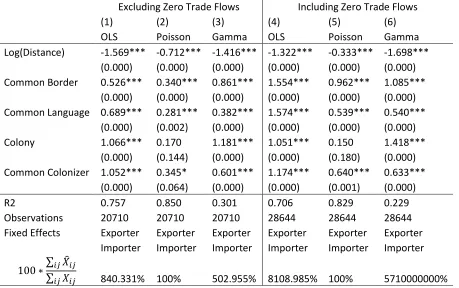
Table 1 presents results using OLS (column 1), Poisson (column 2), and Gamma (column 3), as in Santos
Silva and Tenreyro (2006). We initially consider only non-zero trade flows. In line with previous work, all
estimators provide parameter estimates that are economically meaningful and generally highly
statistically significant. However, the bottom line of the table shows that the divergence between actual
and estimated total trade flows is substantial in all cases except for Poisson, where—in line with our
theorem—the two are identical.
The same finding is apparent when we include zero trade flows in the estimation sample (columns 4-6).
(For OLS, we include zero trade flows by using as the dependent variable.) Although
parameter estimates are sensible in all four cases, the divergence between actual and estimated total
trade flows is very large for OLS, and particularly for Gamma. Again, the Poisson estimates do not suffer
from this problem, and reproduce total trade flows exactly.
5
Conclusion
This paper has demonstrated a new and desirable property of the Poisson quasi-maximum likelihood
estimator applied to the standard gravity model. In addition to dealing with heteroskedasticity and zero
trade flows, the Poisson estimator also solves what we have termed the “adding up” problem. It is the
only quasi-maximum likelihood estimator that preserves total flows between the actual and estimated
bilateral trade matrices. Our theoretical and empirical findings strengthen the case for using Poisson as
the workhorse gravity model estimator.
References
Anderson, J.E., and E. Van Wincoop. 2003. “Gravity with Gravitas: A Solution to the Border Puzzle.”
10
Linnemann, H. 1966. An Econometric Study of International Trade Flows. Amsterdam: North Holland.
Roy, J.R. 2004. Spatial Interaction Modeling: A Regional Science Context. Berlin: Springer-Verlag.
Santos Silva, J.M.C., and S. Tenreyro. 2006. “The Log of Gravity.” Review of Economics and Statistics,
88(4): 641-658.
Santos Silva, J.M.C., and S. Tenreyro. 2011. “Further Simulation Evidence on the Performance of the
Poisson Pseudo-Maximum Likelihood Estimator.” Economics Letters, 112(2): 220-222.
Tinbergen, J. 1962. Shaping the World Economy: Suggestions for an International Economic Policy. New
11
[image:12.792.73.532.152.440.2]Tables
Table 1: Regression results.
Note: Prob. values based on robust standard errors adjusted for clustering by country-pair appear in parentheses. Statistical significance is indicated by * (10%), ** (5%), and *** (1%). Estimation method is indicated at the top of each column. The dependent variable is exports, except for column 1 where it is log(exports), and column 5 where it is log(1+exports).
Excluding Zero Trade Flows Including Zero Trade Flows (1) (2) (3) (4) (5) (6) OLS Poisson Gamma OLS Poisson Gamma Log(Distance) -1.569*** -0.712*** -1.416*** -1.322*** -0.333*** -1.698***
(0.000) (0.000) (0.000) (0.000) (0.000) (0.000) Common Border 0.526*** 0.340*** 0.861*** 1.554*** 0.962*** 1.085***
(0.000) (0.000) (0.000) (0.000) (0.000) (0.000) Common Language 0.689*** 0.281*** 0.382*** 1.574*** 0.539*** 0.540***
(0.000) (0.002) (0.000) (0.000) (0.000) (0.000) Colony 1.066*** 0.170 1.181*** 1.051*** 0.150 1.418***
(0.000) (0.144) (0.000) (0.000) (0.180) (0.000) Common Colonizer 1.052*** 0.345* 0.601*** 1.174*** 0.640*** 0.633***
(0.000) (0.064) (0.000) (0.000) (0.001) (0.000) R2 0.757 0.850 0.301 0.706 0.829 0.229 Observations 20710 20710 20710 28644 28644 28644 Fixed Effects Exporter Exporter Exporter Exporter Exporter Exporter
Importer Importer Importer Importer Importer Importer
![整合邊際資訊於鑑別式聲學模型訓練方法之比較研究 (A Comparative Study on Margin-Based Discriminative Training of Acoustic Models) [In Chinese]](data:image/gif;base64,R0lGODlhAQABAIAAAP///wAAACH5BAEAAAAALAAAAAABAAEAAAICRAEAOw==)