The Forward Exchange Rate Unbiasedness Hypothesis: A
Single Break Unit Root and Cointegration Analysis
Michael E. Mazur, Miguel D. Ramirez
Department of Economics, Trinity College, Hartford, USA
Email: [email protected], [email protected]
Received July 20, 2013; revised August 20, 2013; accepted August 31, 2013
Copyright © 2013 Michael E. Mazur, Miguel D. Ramirez. This is an open access article distributed under the Creative Commons
Attribution License, which permits unrestricted use, distribution, and reproduction in any medium, provided the original work is
properly cited.
ABSTRACT
In an age of globalized finance, Forex market efficiency is particularly relevant as agents engage in arbitrage opportuni-
ties across international markets. This study tests the forward exchange rate unbiasedness hypothesis using more pow-
erful tests such as the Zivot-Andrews single-break unit root and the KPSS stationarity (no unit root) tests to confirm that
the USD/EUR spot and three-month forward rates are I(1) in nature. The study successfully employs the Engle-Granger
cointegration analysis which identifies a stable long-run relationship between the spot and forward rates and generates
an ECM model that is used to forecast the in-sample (historical) data. The study’s findings refute past conclusions that
fail to identify the data’s I(1) nature and suggest that market efficiency is present in the long run but not necessarily in
the short run.
Keywords:
Cointegration Analysis; Error-Correction Model (ECM); Forward Exchange Rate Unbiasedness Hypothesis
(FRUH); KPSS No Unit Root Test; Unexploited Profits; Zivot-Andrews Single Break Unit Root Test
1. Introduction
This paper investigates the validity of the forward ex-
change rate unbiasedness hypothesis (FRUH) which is
indicative of efficiency in the foreign exchange market
using more powerful unit root and no unit root tests. The
study employs the single break unit root and cointegra-
tion analysis to determine whether a stable long-run rela-
tionship between the USD/EUR spot and forward ex-
change rates exits, and generates an error correction
model to examine further the dynamics of market effi-
ciency. The paper is organized as follows. First, a brief
discussion of the relevant literature and a conceptual
framework of analyses are presented. Next, the nature of
the data and variables is discussed. The third section pre-
sents and analyzes the results, while the last section sum-
marizes the main findings in the paper.
2. Conceptual Framework
A multitude of econometric studies have explored the
FRUH which suggests that the forward foreign exchange
rate serves as an unbiased predictor of the future spot rate.
A review of the economic literature surrounding foreign
exchange market efficiency yields largely contradictory
results with both rejections and confirmations of the hy-
pothesis. By and large, methodological and empirical
challenges are at the root of the contradictory results
surrounding this important topic in international finance.
While early studies disproportionately accepted the
FRUH, the findings are increasingly passé for failure to
consider the non-stationary nature of the economic data
(see [1,2]). Recent studies that use unit-root and cointe-
gration analysis increasingly reject the null hypothesis
that the forward rate is an unbiased predictor of future
spot rate (see [3-6]).
Given the equation
s
t
f
t3
e
t, confirmation
of the FRUH requires that the future spot and forward
rates are cointegrated with a vector of (1,
−
1) and the
coefficient
α
= 0 and
β
= 0. Under market efficiency, the
expected mean of the error term should equal zero and be
independently identically distributed as a white-noise
error term. Using the spot and three month forward rates,
the same criteria must be met to satisfy the efficiency
hypothesis. Although studies since Hakkio and Rush [7]
generally consider the cointegrating relationship between
cointegrating vector. Zivot argues that the latter model of
cointegration more effectively captures the stylized facts
of the exchange rate data and may supplement cointegra-
tion findings. However, the relationship between the spot
and lagged forward rate is most important for this study.
Related articles examining efficiency in the foreign ex-
change market look at changes in the future spot rate
influenced by the forward risk premium. These cases
primarily concern deficiencies in the rational expecta-
tions hypothesis, which are assumed when investigating
the FRUH. Additionally, cointegration analysis warrants
the exclusion of the risk premium from the model (see
[9]).
The market efficiency hypothesis is based on the idea
that participants in the FX market have rational expecta-
tions and are risk neutral. Expected returns on specula-
tive currency investments should be zero in the long run
(see [6]). With much of the growth in global finance dri-
ven by the acceleration and integration of short-term
capital flows, market participants are significantly more
exposed to foreign markets. Increasing engagement in
foreign markets and the resulting financial growth are
spurred by market liberalization, technological advances,
and financial engineering (see [10]). Foreign exchange is
an unavoidable facet of transacting in the global market-
place and the rejection of FRHU suggests there are op-
portunities to realize incremental returns on investments
by engaging in FX market arbitrage. In an inefficient
market, agents must exert caution in carefully imple-
menting strategies to yield positive profits from
specula-tive bubbles. The prospect of realizing gains in the FX
market is equally valid to that of incurring losses (see
[11]). By contrast, a failure to reject the null hypothesis
in the long run suggests agents have rational expectations
and are risk neutral, thus foreign currency holdings are
only useful insofar as simplifying the process of pur-
chasing securities abroad. If the market is efficient and
all subjects have complete information, foreign exchange
transactions should only yield a normal profit.
This study uses single break unit root and
cointegra-tion analysis to determine whether there is a stable
un-derlying relationship between the future spot and forward
exchange rates. Following the Engel-Granger
cointegra-tion framework, an error correccointegra-tion model is used to
examine adjustment speed and efficiency in the presence
of systemic shocks. The model takes the general form of
3
t t t
s
f
e
with the $/€ spot and 3-month
for-ward rates as the economic variables under investigation.
Given the first order integration identified in section III,
s
trefers to the log of the spot rate and
f
t3enotes the
log of the three-month forward exchange rate. The
USD/EUR rate is ideal for this study since the euro is the
second most traded currency behind the US dollar. Addi-
tionally, the launch of the euro common currency on
January 1, 1999 marked one of the most monumental
economic and political endeavors of the century. Eleven
national currencies merged overnight to transform the
world’s currency market and the process of broadening
the euro area continues to this day [10]. The eurozone
comprises seventeen member states and there is a rea-
sonable amount of data available to study the common
currency. The euro spot and three-month forward rates
are from the Haver data base which, in turn, obtained the
data from the European Central Banks’ Eurostat and
London’s Financial Times’ collection. The spot and 3-
month forward $/€ exchange rates are measured as
monthly averages for the period January 2000 to March
2013.
3. Data
The US dollar per euro spot rate is the model’s depend-
ent variable. For ease of interpretation, the variables are
expressed in logarithmic form, so the estimated results
reveal the spot rate’s adjustment to systemic shocks as an
elasticity. The log of the spot rate (dependent variable) is
named USD_EUR and is measured as a monthly average
and its first difference is referred to as d
s
t.
The independent variable is the three-month forward
USD/EUR exchange rate measured as a monthly average
for the period 2000M01 to 2013M03. The variable
re-quires a logarithmic transformation for the error
correc-tion model. The log of the forward rate is called
USD_EUR_3MO and its difference is referred to as d
f
t.
The variable is lagged three periods in the model to
ex-plore its causal relationship. The expected coefficient
assuming satisfaction of the FRUH is one. Most recent
studies, however, have failed to find support for the
FRUH (see [5]).
Dummy variables D1 and D2 are used in the error co-
rrection model to incorporate the structural breaks found
in the data respectively for June of 2003 and September
and October of 2008. Essentially, D1 and D2 account for
periods of macro-instability that disrupt the currency
markets.
4. Estimation Results
The log of the spot rate in level form and first differences
is plotted, respectively, in
Figures 1(a)
and
(b)
to pro-
-.2 -.1 .0 .1 .2 .3 .4 .5
00 01 02 03 04 05 06 07 08 09 10 11 12 13
USD_EUR (a) -.08 -.06 -.04 -.02 .00 .02 .04 .06 .08
00 01 02 03 04 05 06 07 08 09 10 11 12 13
S
(b)
Figure 1. (a) Level Data; (b) Differenced Data.
Similar to the spot rate series, the level and first dif-
ference plots of the three-month forward rate series visu-
ally reveal the integrated nature of the data. Positive
drifts in level form are corrected through differencing
and the series are rendered more stationary in
Figures
2(a)
and
(b)
.
The admittedly low-powered Augmented Dickey-
Fuller test is the first test used to identify a unit root in
the spot rate series. The Doldado-Sosvilla methodology
suggests an initial test including both a trend and
inter-cept and subsequent tests eliminating insignificant
ex-ogenous regressors. The ADF t-statistic for a unit root is
(
−
0.596397) as shown in
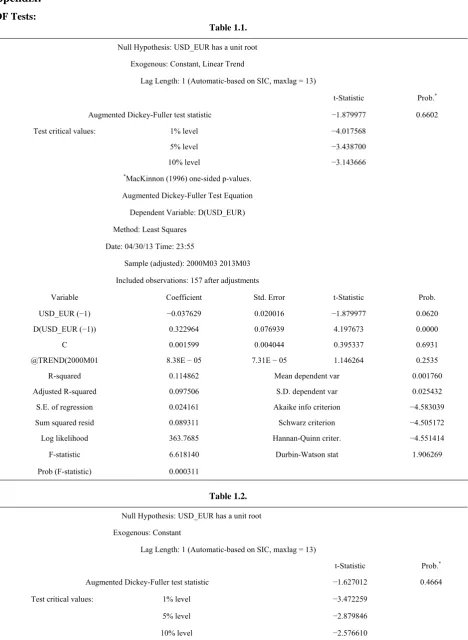
Table 1
below. Since the t-stat
is insignificant at all levels, the null hypothesis of a unit
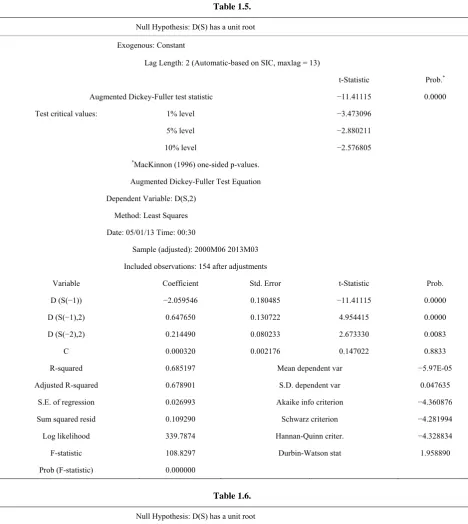
root cannot be rejected. ADF tests for d
s
t, the differenced
spot rate, reveal that the ADF
t
-stat (
−
11.44760) is
sig-nificantly beyond the 1% level. This permits rejection of
the unit root null hypothesis for the differenced series
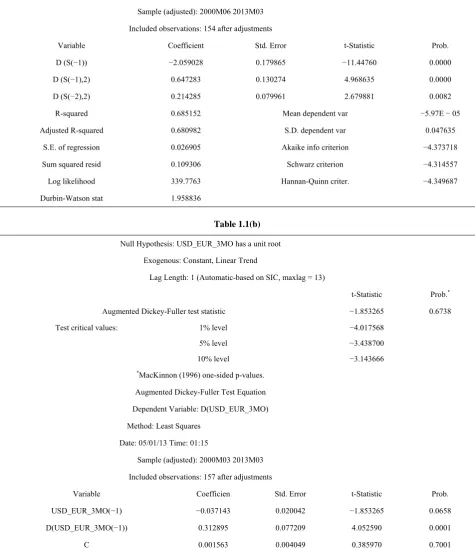
and conclusion that USD_EUR is an I(1) process.
An Augmented Dickey Fuller test for the three-month
forward rate shows that the series has a unit root and is
non-stationary in level form without a significant trend or
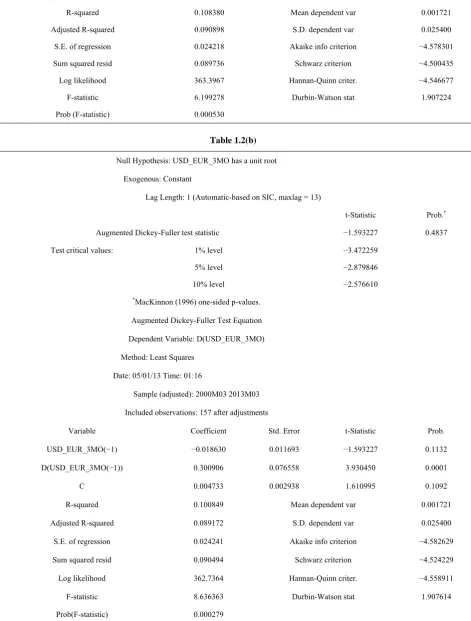
intercept. The ADF test statistic of (
−
1.593227) in
Table
-.2 -.1 .0 .1 .2 .3 .4 .5
00 01 02 03 04 05 06 07 08 09 10 11 12 13
USD_EUR_3MO (a) -.08 -.06 -.04 -.02 .00 .02 .04 .06 .08
00 01 02 03 04 05 06 07 08 09 10 11 12 13
F
(b)
[image:3.595.306.539.82.429.2]Figure 2. (a) Level Data; (b) Difference Data.
Table 1. USD/EUR: Augmented Dickey Fuller unit root
tests for stationarity, sample period 2000-2013.
Variables Levels First Difference 5% Critical Value 1% Critical Value
S −0.596 −11.448 −1.943 −2.580
F −1.593 −9.200 −2.880 −3.472
1
is insignificant and we cannot reject null hypothesis.
The differenced series’ significant t-statistic of (
−
9.200284)
is significantly beyond the 1% level. Thus, the results
reported reject the null hypothesis and suggest the level
series is an I(1) process that must be differenced to achi-
eve the stationarity required for modeling.
The Kwiatkowski-Phillips-Schmidt-Shin [13]
La-grange Multiplier unit root test is a more powerful test
designed to confirm the finding that the spot rate is an I(1)
process. The KPSS test on the level data reports a
test-statistic of (0.294096). As shown in
Table 2
. Since
[image:3.595.57.287.84.430.2] [image:3.595.308.538.488.532.2]Table 2. USD/EUR: Kwiatkowski-Phillips-Schmidt-Shin
Lagrange Multiplier unit root test, sample period 2000-
2013.
Variables Levels First Difference 5% Critical Value 1% Critical Value
S 0.294 0.0798 0.146 0.216
F 0.296 0.0831 0.146 0.216
dence to reject the null of stationarity. Again, these
find-ings confirm the ADF results with greater power.
The same high power test is used to confirm that the
logged three-month forward exchange rate is an I(1)
process as suggested by the ADF. The null hypothesis of
stationary in level form can be rejected at the 1%
sig-nificance level based on the LM-test results represented
in
Table 2
and 2.1(b) of the appendix. This finding
pro-vides further credibility to support the conclusion from
the ADF test that the series has a unit root. A KPSS test
of the first difference reveals that d
f
tis a stationary
proc-ess. The null hypothesis of stationarity cannot be rejected
for the series’ first difference, therefore USD_EUR_
3MO is an integrated order one process.
The Zivot-Andrew single breakpoint test is another
method for detecting unit roots in the presence of a single
structural break in the data series. Conventional unit root
tests have relatively low power when the stationary al-
ternative is true and a structural break in the data is ig-
nored. In other words, investigators are more likely to
conclude incorrectly that the series is non-stationary
when a structural break is ignored (see [14]). Following
the lead of Perron, most investigators report estimates for
either models A and C, but in a relatively recent study
Seton [15] has shown that the loss in test power (1-
β
) is
considerable when the correct model is C and researchers
erroneously assume that the break-point occurs according
to model A. On the other hand, the loss of power is mi-
nimal if the break date is correctly characterized by mo-
del A but investigators erroneously use model C.
Performing the test on the spot and forward rates using
model C reveals significant results. The first tests in
Ta-ble 3
and 3.1 of the appendix are significant and do not
allow for the rejection of the null hypothesis. This
sug-gests that the series contains both a unit root and a
struc-tural break at 2008M08. A break at that point makes
log-ical sense given the start of the US subprime mortgage
crisis. The use of model C also provides highly
signifi-cant results with a failure to reject the presence of a unit
root. When using the differenced series for the spot and
forward rates, a structural break is also detected at
2003M06 using model C, which coincides with the peak
in unemployment following the early 2000’s recession
and escalating conflict in Iraq. The unexpected cost of
rebuilding a stable government capable of self-rule from
the rubble of Saddam Hussein’s regime was not an out
Table 3. Zivot-Andrews unit root test.
-4.0 -3.6 -3.2 -2.8 -2.4 -2.0 -1.6
00 01 02 03 04 05 06 07 08 09 10 11 12 13
Zivot-Andrew Breakpoints
Date: 05/01/13 Time: 02:05
Sample: 2000M01 2013M03
Included observations: 159
Null Hypothesis: USD_EUR has a unit root with a structural break in both the intercept and trend
Chosen lag length: 2 (maximum lags: 4)
Chosen break point: 2008M08
t-Statistic Prob. *
Zivot-Andrews test statistic −3.964702 0.019974
1% critical value: −5.57
5% critical value: −5.08
10% critical value: −4.82
come or obligation the US foresaw.
Dummy variables are therefore incorporated into the
model for both of these breaks. Although the financial
crisis was already mounting for some time, the unex-
pected declaration of bankruptcy by Lehman Brothers in
September of 2008 marked both the intensification of the
U.S. recession and the crisis in world financial markets.
Additionally President Bush gave his “Mission Accom-
plished” speech on the May 1
stbut by June insurgent
attacks were intensifying and it was becoming clear that
the mission in Iraq would be far more difficult and costly
than ever imagined.
Given that both the dependent and independent vari-
ables are I(1), the Engle-Granger cointegration test pro-
cedure requires an ADF test of the residuals(without in-
tercept and trend) of the Forex equation in level form. An
ordinary least squares regression is generated using the
log of level series for the equation
s
t
f
t3
e
tin
[image:4.595.56.287.138.174.2]of residuals in Tables 4.1(b) and 4.2(b) of the appendix.
The results for the residuals including the lagged term
overwhelmingly support the rejection of the null
hy-pothesis of a unit root for all significance levels. The test
in simple form is less significant but the t-statistics are
still strong enough to reject the null of a unit root at the
5% level of significance. The stationary nature of the
residuals in level form suggests that
s
tis cointegrated
with both
f
t3and
f
. The identification of a
cointe-grating vector is important in that it identifies a stable
long-run relationship that keeps the variables in
propor-tion over time, and suggests that the market is efficient in
the long run. Following the Engle-Granger representation
theorem, an error correction model that includes the
re-siduals is generated to reconcile the short and long-run
behavior of the underlying relationship between the for-
ward and spot exchange rates.
The final model shown in
Model 1
is significant and
with a high degree of explanatory and forecasting power.
The error correction model incorporates the forward va-
able, error correction term, and two dummy variables:
D1 for 2003M06 and D2 for 2008M09-M10 described
above. The HAC Newey-West [16] procedure was util-
ed in estimating the ECM, thus correcting the OLS stan-
rd errors for both autocorrelation and heteroscedasticity.
The Durbin Watson test statistic is 2.1 and suggests that
the final model does not suffer from first order serial
correlation. All of the terms except for the constant gen-
Model 1. USD/EUR: Error Correction Model; dependent
variable is: (S), 2000-2013.
OLS Regressions
Variable Coefficient Std. Error t-Statistic Prob.
C 5.87E-05 6.93E-05 0.846956 0.3984
F 1.001182 0.003877 258.2166 0.0000
EC1(−1) −0.046752 0.021973 −2.127676 0.0350
D1 −0.001047 0.000250 −4.182255 0.0000
D2 −0.001122 0.000310 −3.619541 0.0004
AR(1) −0.288958 0.092038 −3.139549 0.0020
R-squared 0.998 Mean dependent var 0.002
Adjusted R-squared 0.998 S.D. dependent var 0.025
S.E. of regression 0.001 Akaike info criterion −10.611
Sum squared resid 0.000 Schwarz criterion −10.495
Log likelihood 838.994 Hannan-Quinn criter. −10.564
F-statistic 14495.59 Durbin-Watson stat 2.100
Prob(F-statistic) 0.000
ate high t-statistics and are significant at the 5% signi-
ficance level. The EC1(
−
1) term is significant at the 5%
level and suggests that a deviation of 10 percent from the
long run equilibrium during the current period is cor-
rected in the subsequent period by approximately 0.5
percent. The addition of the D2 term, given that its
inclu-sion makes theoretical sense, increases the Adjusted R
squared and enhances the degree of accuracy for the final
model.
The fact that the constant is not significantly different
from zero supports the efficiency hypothesis.
The estimated coefficient for the forward rate is
1.001182 with a
t
-stat of 258.2166. This result is highly
significant and since it is close to 1, the model fulfills the
FRUH criteria. The failure to reject the null hypothesis
serves to support the use of the forward rate as an
unbi-ased estimator of the future spot rate. The evidence for
the dollar-euro rate suggests support for market
effi-ciency in the long run but not necessarily in the short run
because a disequilibrium exists between the two
vari-ables, suggesting that expected returns to speculators are
not zero in the short run (see [7]). In general, the results
suggest that participants in the foreign exchange market
are risk neutral and have little to gain from speculation in
the long run.
EC models were also used to track the historical data
on the percentage change in the spot rate for the period
under review.
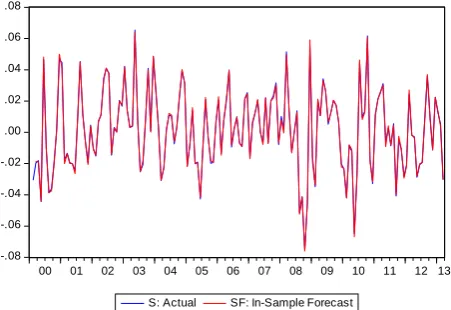
Figure 3
below shows that the model was
able to track the turning points in the actual series quite
well.
s
refers to the actual series and (sf) denotes the
in-sample forecast. In addition,
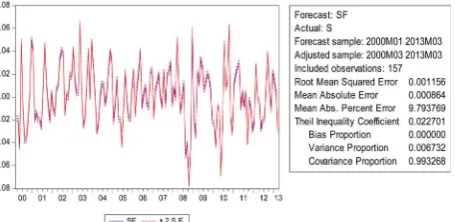
Figure 4
below shows
that the Theil inequality coefficient for this model is
0.02270, which is well below the threshold value of 0.3,
and suggests that the predictive power of the model is
quite good (see [17]). The Theil coefficients can be de-
composed into three major components: the bias, vari-
ance, and covariance terms. Ideally, the bias and variance
components should equal zero, while the covariance
-.08 -.06 -.04 -.02 .00 .02 .04 .06 .08
00 01 02 03 04 05 06 07 08 09 10 11 12 13
[image:5.595.58.286.463.735.2]S: Actual SF: In-Sample Forecast
[image:5.595.310.536.551.706.2]Figure 4. Theil inequality coefficient for in-sample forecast.
proportion should equal one. The reported estimates su-
ggest that all of these ratios are close to their optimum
values (bias = 0.0000, variance = 0.0067, and covariance
= 0.9932). Sensitivity analysis on the coefficients also
revealed that changes in the initial or ending period did
not alter the predictive power of the selected models (re-
sults are available upon request).
5. Conclusion
Efficiency in the foreign exchange market is especially
relevant in the world of globalized finance since market
agents are frequently and increasingly transacting both at
home and abroad. This study shows that the spot and
three-month forward exchange rates are I(1) processes
using the more powerful KPPS stationarity test and the
Zivot Andrews single break unit root test. Following the
Engle-Granger cointegration analysis framework, a long-
run stable relationship between the three-month forward
exchange rate and the future spot rate is identified which
suggests that the forward rate contains useful information
about the spot rate; in other words, it supports market
efficiency in the long run. Insofar as the error correction
model is concerned, it provided further support for the
forward exchange rate unbiasedness hypothesis. With a
high degree of power, the results of the model fulfill the
final two criteria for market efficiency, viz., a constant
equal to 0 and a coefficient of 1. However, the results
also suggest that there is a disequilibrium in the short run
that is only partially corrected in subsequent periods,
suggesting that, in the short run, there might be unex-
ploited profit opportunities for speculators and/or a time-
varying risk premium. Needless to say, economists have
debated the issue of exchange market efficiency since the
70’s and this study, although supportive of market effi-
ciency in the long run, will by no means settle the con-
troversy. Finally, the endogenously determined structural
breaks in the data indicate that, since the common
cur-rency’s inception, volatility and disruption of the Forex
market have been generated by both the un-expected
costs associated with the war in Iraq and the 2008 global
financial crisis.
REFERENCES
[1]
R. M. Levich, “Empirical Studies of Exchange Rates,
Price Behavior, Rate Determination, and Market Effi-
ciency,” In: R. W. Jones and P. B. Kennen, Eds.,
Hand-
book of International Economics
, Vol. II, Elsevier, Am-
sterdam, 1978, pp. 979-1040.
[2]
J. A. Frenkel, “Flexible Exchange Rates, Prices, and the
Role of News: Lessons from the 1970s,” In: R. A. Bat-
chelor and G. E. Wood, Eds.,
Exchange Rate Policy
, Ma-
cmillan, London, 1982.
[3]
R. E. Cumby and M. Obstfeld, “International Interest
Rate and Price Level Linkages under Flexible Exchange
Rates: A Review of the Evidence,” 1984.
[4]
C. Engel, “The Forward Discount Anomaly and the Risk
Premium: A Survey of Recent Evidence,”
Journal of Em-
pirical Finance
, Vol. 3, No. 2, 1996, pp. 123-192.
[5]
J. Olmo and K. Pilbeam, “Uncovered Interest Parity and
the Efficiency of the Foreign Exchange Market: A Re-
examination of the Evidence,”
International Journal of
Finance and Economics
, Vol. 16, No. 2, 2011, pp. 189-
204.
doi:10.1002/ijfe.429
[6]
V. Ukpolo, “Exchange Rate Market Efficiency; Further
Evidence from Cointegration Tests,”
Applied Economics
Letters
, Vol. 2, No. 6, 1995, pp. 196-198.
doi:10.1080/135048595357438
[7]
C. S. Hakkio and M. Rush, “Cointegration: How Short Is
the Long Run?”
Journal of International Money and
Fi-nance
, Vol. 10, No. 4, 1991, pp. 571-581
.
doi:10.1016/0261-5606(91)90008-8
[8]
E. Zivot, “Cointegration and Forward and Spot Exchange
Rate Regressions,” 1998.
http://128.118.178.162/eps/em/papers/9812/9812001.pdf
[9]
M. Kuhl, “Cointegration in the Foreign Exchange Market
and Market Efficiency since the Introduction of the Euro:
Evidence Based on bivariate Cointegration Analyses,”
2007.
[10]
D. W. Duisenberg, “Recent Developments and Trends in
World Financial Market,” 2000.
http://www.ecb.int/press/key/date/2000/html/sp001114.en
.html
[11]
A. C. Jung and V. Wieland, “Forward Rates and Spot
Rates in the European Monetary System-Forward Market
Efficiency,”
Weltwirtschaftliches Archiv
, Vol. 126, No. 4,
1990, pp. 615-629. doi:10.1007/BF02707471
[12]
E. Zivot and D. Andrews, “Further Evidence of Great
Crash, the Oil Price Shock, and Unit Root Hypothesis,”
Journal of Business and Economic Statistics
, Vol. 10, No.
3, 1992, pp. 251-270.
doi:10.1080/07350015.1992.10509904
[13]
D. Kwaitkowski, P. C. B. Phillips, P. Schmidt and Y.
Shin, “Testing the Null Hypothesis of Stationarity against
the Alternative of a Unit Root,”
Journal of Econometrics
,
Vol. 54, No. 1-3, 1992, pp. 159-178.
doi:10.1016/0304-4076(92)90104-Y
[14]
P. Perron, “The Great Crash, the Oil Price Shock and the
Unit Root Hypothesis,”
Econometrica
, Vol. 57, No. 6,
1989, pp. 1361-1401.
doi:10.2307/1913712
Trend Break Stationary Process,”
Journal Of Business
and Economic Statistics
, Vol. 21, No. 1, 2003, pp. 174-
184. doi:10.1198/073500102288618874
[16]
W. K. Newey and K. West, “A Simple Positive Semi-
Definite Heteroscedasticity and Autocorrelation Consis-
tent Covariance Matrix,”
Econometrica
, Vol. 55, No. 3,
1987, pp. 703-708.
doi:10.2307/1913610
Appendix:
[image:8.595.69.538.93.734.2]ADF Tests:
Table 1.1.
Null Hypothesis: USD_EUR has a unit root
Exogenous: Constant, Linear Trend
Lag Length: 1 (Automatic-based on SIC, maxlag = 13)
t-Statistic Prob.*
Augmented Dickey-Fuller test statistic −1.879977 0.6602
Test critical values: 1% level −4.017568
5% level −3.438700
10% level −3.143666
*MacKinnon (1996) one-sided p-values.
Augmented Dickey-Fuller Test Equation
Dependent Variable: D(USD_EUR)
Method: Least Squares
Date: 04/30/13 Time: 23:55
Sample (adjusted): 2000M03 2013M03
Included observations: 157 after adjustments
Variable Coefficient Std. Error t-Statistic Prob.
USD_EUR (−1) −0.037629 0.020016 −1.879977 0.0620
D(USD_EUR (−1)) 0.322964 0.076939 4.197673 0.0000
C 0.001599 0.004044 0.395337 0.6931
@TREND(2000M01 8.38E − 05 7.31E − 05 1.146264 0.2535
R-squared 0.114862 Mean dependent var 0.001760
Adjusted R-squared 0.097506 S.D. dependent var 0.025432
S.E. of regression 0.024161 Akaike info criterion −4.583039
Sum squared resid 0.089311 Schwarz criterion −4.505172
Log likelihood 363.7685 Hannan-Quinn criter. −4.551414
F-statistic 6.618140 Durbin-Watson stat 1.906269
Prob (F-statistic) 0.000311
Table 1.2.
Null Hypothesis: USD_EUR has a unit root
Exogenous: Constant
Lag Length: 1 (Automatic-based on SIC, maxlag = 13)
t-Statistic Prob.*
Augmented Dickey-Fuller test statistic −1.627012 0.4664
Test critical values: 1% level −3.472259
5% level −2.879846
Continued
*MacKinnon (1996) one-sided p-values.
Augmented Dickey-Fuller Test Equation
Dependent Variable: D(USD_EUR)
Method: Least Squares
Date: 05/01/13 Time: 00:03
Sample (adjusted): 2000M03 2013M03
Included observations: 157 after adjustments
Variable Coefficient Std. Error t-Statistic Prob.
USD_EUR (−1) −0.018971 0.011660 −1.627012 0.1058
D(USD_EUR (−1)) 0.310732 0.076273 4.073951 0.0001
C 0.004800 0.002927 1.640082 0.1030
R-squared 0.107261 Mean dependent var 0.001760
Adjusted R-squared 0.095667 S.D. dependent var 0.025432
S.E. of regression 0.024185 Akaike info criterion −4.587226
Sum squared resid 0.090078 Schwarz criterion −4.528827
Log likelihood 363.0973 Hannan-Quinn criter. −4.563508
F-statistic 9.251392 Durbin-Watson stat 1.906204
Prob (F-statistic) 0.000161
Table 1.3.
Null Hypothesis: USD_EUR has a unit root
Exogenous: None
Lag Length: 1 (Automatic-based on SIC, maxlag = 13)
t-Statistic Prob.*
Augmented Dickey-Fuller test statistic −0.596397 0.4576
Test critical values: 1% level −2.579774
5% level −1.942869
10% level −1.615359
*MacKinnon (1996) one-sided p-values.
Augmented Dickey-Fuller Test Equation
Dependent Variable: D(USD_EUR)
Method: Least Squares
Date: 04/30/13 Time: 23:56
Sample (adjusted): 2000M03 2013M03
Included observations: 157 after adjustments
Variable Coefficient Std. Error t-Statistic Prob.
USD_EUR (−1) -0.004622 0.007750 −0.596397 0.5518
Continued
R-squared 0.091668 Mean dependent var 0.001760
Adjusted R-squared 0.085807 S.D. dependent var 0.025432
S.E. of regression 0.024317 Akaike info criterion −4.582649
Sum squared resid 0.091652 Schwarz criterion −4.543716
Log likelihood 361.7380 Hannan-Quinn criter. −4.566837
Durbin-Watson stat 1.901715
Table 1.4.
Null Hypothesis: S has a unit root
Exogenous: Constant, Linear Trend
Lag Length: 0 (Automatic-based on SIC, maxlag = 13)
t-Statistic Prob.*
Augmented Dickey-Fuller test statistic −9.104497 0.0000
Test critical values: 1% level −4.017568
5% level −3.438700
10% level −3.143666
*MacKinnon (1996) one-sided p-values.
Augmented Dickey-Fuller Test Equation
Dependent Variable: D(S)
Method: Least Squares
Date: 05/01/13 Time: 00:19
Sample (adjusted): 2000M03 2013M03
Included observations: 157 after adjustments
Variable Coefficient Std. Error t-Statistic Prob.
S (−1) −0.698449 0.076715 −9.104497 0.0000
C 0.003469 0.003952 0.877802 0.3814
@TREND(2000M01) −2.80E − 05 4.29E − 05 −0.652052 0.5153
R-squared 0.350275 Mean dependent var 2.12E-06
Adjusted R-squared 0.341837 S.D. dependent var 0.030025
S.E. of regression 0.024359 Akaike info criterion −4.572940
Sum squared resid 0.091375 Schwarz criterion −4.514540
Log likelihood 361.9758 Hannan-Quinn criter. −4.549222
F-statistic 41.51164 Durbin-Watson stat 1.901343
Table 1.5.
Null Hypothesis: D(S) has a unit root
Exogenous: Constant
Lag Length: 2 (Automatic-based on SIC, maxlag = 13)
t-Statistic Prob.*
Augmented Dickey-Fuller test statistic −11.41115 0.0000
Test critical values: 1% level −3.473096
5% level −2.880211
10% level −2.576805
*MacKinnon (1996) one-sided p-values.
Augmented Dickey-Fuller Test Equation
Dependent Variable: D(S,2)
Method: Least Squares
Date: 05/01/13 Time: 00:30
Sample (adjusted): 2000M06 2013M03
Included observations: 154 after adjustments
Variable Coefficient Std. Error t-Statistic Prob.
D (S(−1)) −2.059546 0.180485 −11.41115 0.0000
D (S(−1),2) 0.647650 0.130722 4.954415 0.0000
D (S(−2),2) 0.214490 0.080233 2.673330 0.0083
C 0.000320 0.002176 0.147022 0.8833
R-squared 0.685197 Mean dependent var −5.97E-05
Adjusted R-squared 0.678901 S.D. dependent var 0.047635
S.E. of regression 0.026993 Akaike info criterion −4.360876
Sum squared resid 0.109290 Schwarz criterion −4.281994
Log likelihood 339.7874 Hannan-Quinn criter. −4.328834
F-statistic 108.8297 Durbin-Watson stat 1.958890
Prob (F-statistic) 0.000000
Table 1.6.
Null Hypothesis: D(S) has a unit root
Exogenous: None
Lag Length: 2 (Automatic-based on SIC, maxlag = 13)
t-Statistic Prob.*
Augmented Dickey-Fuller test statistic −11.44760 0.0000
Test critical values: 1% level −2.580065
5% level −1.942910
Continued
*MacKinnon (1996) one-sided p-values.
Augmented Dickey-Fuller Test Equation
Dependent Variable: D(S,2)
Method: Least Squares
Date: 05/01/13 Time: 00:31
Sample (adjusted): 2000M06 2013M03
Included observations: 154 after adjustments
Variable Coefficient Std. Error t-Statistic Prob.
D (S(−1)) −2.059028 0.179865 −11.44760 0.0000
D (S(−1),2) 0.647283 0.130274 4.968635 0.0000
D (S(−2),2) 0.214285 0.079961 2.679881 0.0082
R-squared 0.685152 Mean dependent var −5.97E − 05
Adjusted R-squared 0.680982 S.D. dependent var 0.047635
S.E. of regression 0.026905 Akaike info criterion −4.373718
Sum squared resid 0.109306 Schwarz criterion −4.314557
Log likelihood 339.7763 Hannan-Quinn criter. −4.349687
Durbin-Watson stat 1.958836
Table 1.1(b)
Null Hypothesis: USD_EUR_3MO has a unit root
Exogenous: Constant, Linear Trend
Lag Length: 1 (Automatic-based on SIC, maxlag = 13)
t-Statistic Prob.*
Augmented Dickey-Fuller test statistic −1.853265 0.6738
Test critical values: 1% level −4.017568
5% level −3.438700
10% level −3.143666
*MacKinnon (1996) one-sided p-values.
Augmented Dickey-Fuller Test Equation
Dependent Variable: D(USD_EUR_3MO)
Method: Least Squares
Date: 05/01/13 Time: 01:15
Sample (adjusted): 2000M03 2013M03
Included observations: 157 after adjustments
Variable Coefficien Std. Error t-Statistic Prob.
USD_EUR_3MO(−1) −0.037143 0.020042 −1.853265 0.0658
D(USD_EUR_3MO(−1)) 0.312895 0.077209 4.052590 0.0001
[image:12.595.60.536.181.731.2]Continued
@TREND(2000M01) 8.32E − 05 7.32E − 05 1.136803 0.2574
R-squared 0.108380 Mean dependent var 0.001721
Adjusted R-squared 0.090898 S.D. dependent var 0.025400
S.E. of regression 0.024218 Akaike info criterion −4.578301
Sum squared resid 0.089736 Schwarz criterion −4.500435
Log likelihood 363.3967 Hannan-Quinn criter. −4.546677
F-statistic 6.199278 Durbin-Watson stat 1.907224
Prob (F-statistic) 0.000530
Table 1.2(b)
Null Hypothesis: USD_EUR_3MO has a unit root
Exogenous: Constant
Lag Length: 1 (Automatic-based on SIC, maxlag = 13)
t-Statistic Prob.*
Augmented Dickey-Fuller test statistic −1.593227 0.4837
Test critical values: 1% level −3.472259
5% level −2.879846
10% level −2.576610
*MacKinnon (1996) one-sided p-values.
Augmented Dickey-Fuller Test Equation
Dependent Variable: D(USD_EUR_3MO)
Method: Least Squares
Date: 05/01/13 Time: 01:16
Sample (adjusted): 2000M03 2013M03
Included observations: 157 after adjustments
Variable Coefficient Std. Error t-Statistic Prob.
USD_EUR_3MO(−1) −0.018630 0.011693 −1.593227 0.1132
D(USD_EUR_3MO(−1)) 0.300906 0.076558 3.930450 0.0001
C 0.004733 0.002938 1.610995 0.1092
R-squared 0.100849 Mean dependent var 0.001721
Adjusted R-squared 0.089172 S.D. dependent var 0.025400
S.E. of regression 0.024241 Akaike info criterion −4.582629
Sum squared resid 0.090494 Schwarz criterion −4.524229
Log likelihood 362.7364 Hannan-Quinn criter. −4.558911
F-statistic 8.636363 Durbin-Watson stat 1.907614
[image:13.595.64.536.112.734.2]Table 1.3(b)
Null Hypothesis: USD_EUR_3MO has a unit root
Exogenous: Constant
Lag Length: 1 (Automatic-based on SIC, maxlag = 13)
t-Statistic Prob.*
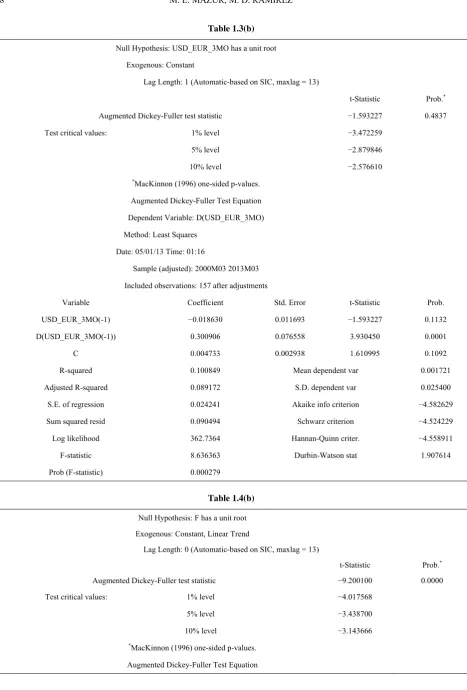
Augmented Dickey-Fuller test statistic −1.593227 0.4837
Test critical values: 1% level −3.472259
5% level −2.879846
10% level −2.576610
*MacKinnon (1996) one-sided p-values.
Augmented Dickey-Fuller Test Equation
Dependent Variable: D(USD_EUR_3MO)
Method: Least Squares
Date: 05/01/13 Time: 01:16
Sample (adjusted): 2000M03 2013M03
Included observations: 157 after adjustments
Variable Coefficient Std. Error t-Statistic Prob.
USD_EUR_3MO(-1) −0.018630 0.011693 −1.593227 0.1132
D(USD_EUR_3MO(-1)) 0.300906 0.076558 3.930450 0.0001
C 0.004733 0.002938 1.610995 0.1092
R-squared 0.100849 Mean dependent var 0.001721
Adjusted R-squared 0.089172 S.D. dependent var 0.025400
S.E. of regression 0.024241 Akaike info criterion −4.582629
Sum squared resid 0.090494 Schwarz criterion −4.524229
Log likelihood 362.7364 Hannan-Quinn criter. −4.558911
F-statistic 8.636363 Durbin-Watson stat 1.907614
Prob (F-statistic) 0.000279
Table 1.4(b)
Null Hypothesis: F has a unit root
Exogenous: Constant, Linear Trend
Lag Length: 0 (Automatic-based on SIC, maxlag = 13)
t-Statistic Prob.*
Augmented Dickey-Fuller test statistic −9.200100 0.0000
Test critical values: 1% level −4.017568
5% level −3.438700
10% level −3.143666
*MacKinnon (1996) one-sided p-values.
[image:14.595.66.534.62.753.2]Continued
Dependent Variable: D(F) Method: Least Squares Date: 05/01/13 Time: 01:24
Sample (adjusted): 2000M03 2013M03
Included observations: 157 after adjustments
Variable Coefficient Std. Error t-Statistic Prob. F(-1) −0.708141 0.076971 −9.200100 0.0000
C 0.003380 0.003959 0.853816 0.3945
@TREND(2000M01) −2.70E − 05 4.30E − 05 −0.628238 0.5308 R-squared 0.355022 Mean dependent var 6.96E-07
Adjusted R-squared 0.346645 S.D. dependent var 0.030197 S.E. of regression 0.024409 Akaike info criterion −4.568840 Sum squared resid 0.091750 Schwarz criterion −4.510441 Log likelihood 361.6539 Hannan-Quinn criter. −4.545122
F-statistic 42.38388 Durbin-Watson stat 1.903271 Prob (F-statistic) 0.000000
Table 1.5(b)
Null Hypothesis: F has a unit root
Exogenous: Constant
Lag Length: 0 (Automatic-based on SIC, maxlag = 13)
t-Statistic Prob.*
Augmented Dickey-Fuller test statistic −9.203471 0.0000
Test critical values: 1% level −3.472259
5% level −2.879846
10% level −2.576610
*MacKinnon (1996) one-sided p-values.
Augmented Dickey-Fuller Test Equation
Dependent Variable: D(F)
Method: Least Squares
Date: 05/01/13 Time: 01:27
Sample (adjusted): 2000M03 2013M03
Included observations: 157 after adjustments
Variable Coefficient Std. Error t-Statistic Prob.
F(−1) −0.706704 0.076787 −9.203471 0.0000
C 0.001217 0.001949 0.624309 0.5333
R-squared 0.353369 Mean dependent var 6.96E-07
Adjusted R-squared 0.349197 S.D. dependent var 0.030197
S.E. of regression 0.024361 Akaike info criterion −4.579019
Sum squared resid 0.091985 Schwarz criterion −4.540086
Log likelihood 361.4530 Hannan-Quinn criter. −4.563207
F-statistic 84.70387 Durbin-Watson stat 1.900803
[image:15.595.63.533.303.729.2]Table 1.6(b)
Null Hypothesis: F has a unit root
Exogenous: None
Lag Length: 0 (Automatic-based on SIC, maxlag = 13)
t-Statistic Prob.*
Augmented Dickey-Fuller test statistic −9.200284 0.0000
Test critical values: 1% level −2.579774
5% level −1.942869
10% level −1.615359
*MacKinnon (1996) one-sided p-values.
Augmented Dickey-Fuller Test Equation
Dependent Variable: D(F)
Method: Least Squares
Date: 05/01/13 Time: 01:28
Sample (adjusted): 2000M03 2013M03
Included observations: 157 after adjustments
Variable Coefficient Std. Error t-Statistic Prob.
F(−1) −0.703454 0.076460 −9.200284 0.0000
R-squared 0.351743 Mean dependent var 6.96E − 07
Adjusted R-squared 0.351743 S.D. dependent var 0.030197
S.E. of regression 0.024313 Akaike info criterion −4.589247
Sum squared resid 0.092216 Schwarz criterion −4.569780
Log likelihood 361.2559 Hannan-Quinn criter. −4.581341
Durbin-Watson stat 1.901439
[image:16.595.74.530.95.708.2]KPSS tests:
Table 2.1.
Null Hypothesis: USD_EUR is stationary
Exogenous: Constant, Linear Trend
Bandwidth: 10 (Newey-West automatic) using Bartlett kernel
LM-Stat.
Kwiatkowski-Phillips-Schmidt-Shin test statistic 0.294096
Asymptotic critical values*: 1% level 0.216000
5% level 0.146000
10% level 0.119000
*Kwiatkowski-Phillips-Schmidt-Shin (1992,
Table 1)
Residual variance (no correction) 0.009552
HAC corrected variance (Bartlett kernel) 0.085235
Continued
Dependent Variable: USD_EUR
Method: Least Squares
Date: 05/01/13 Time: 01:33
Sample: 2000M01 2013M03
Included observations: 159
Variable Coefficient Std. Error t-Statistic Prob. C −0.041448 0.015527 −2.669403 0.0084
@TREND(2000M01) 0.002909 0.000170 17.11939 0.0000 R-squared 0.651168 Mean dependent var 0.188391
Adjusted R-squared 0.648946 S.D. dependent var 0.166004 S.E. of regression 0.098357 Akaike info criterion −1.787927 Sum squared resid 1.518834 Schwarz criterion −1.749324
Log likelihood 144.1402 Hannan-Quinn criter. −1.772251
F-statistic 293.0734 Durbin-Watson stat 0.067298
[image:17.595.59.537.123.729.2]Prob (F-statistic) 0.000000
Table 2.2.
Null Hypothesis: S is stationary Exogenous: Constant, Linear Trend
Bandwidth: 1 (Newey-West automatic) using Bartlett kernel
LM-Stat.
Kwiatkowski-Phillips-Schmidt-Shin test statistic 0.079840
Asymptotic critical values*: 1% level 0.216000
5% level 0.146000
10% level 0.119000
*Kwiatkowski-Phillips-Schmidt-Shin (1992,
Table 1)
Residual variance (no correction) 0.000644 HAC corrected variance (Bartlett kernel) 0.000836
KPSS Test Equation Dependent Variable: S Method: Least Squares Date: 05/01/13 Time: 01:51
Sample (adjusted): 2000M02 2013M03 Included observations: 158 after adjustments
Variable Coefficient Std. Error t-Statistic Prob.
C 0.003549 0.004082 0.869288 0.3860
@TREND(2000M01) −2.51E-05 4.45E-05 −0.562515 0.5746 R-squared 0.002024 Mean dependent var 0.001557
Adjusted R-squared −0.004373 S.D. dependent var 0.025480 S.E. of regression 0.025535 Akaike info criterion −4.484941 Sum squared resid 0.101719 Schwarz criterion −4.446174 Log likelihood 356.3103 Hannan-Quinn criter. −4.469197
Table 2.3.
Null Hypothesis: S is stationary
Exogenous: Constant
Bandwidth: 2 (Newey-West automatic) using Bartlett kernel
LM-Stat.
Kwiatkowski-Phillips-Schmidt-Shin test statistic 0.116265
Asymptotic critical values*: 1% level 0.739000
5% level 0.463000
10% level 0.347000
*Kwiatkowski-Phillips-Schmidt-Shin (1992, Table 1)
Residual variance (no correction) 0.000645
HAC corrected variance (Bartlett kernel) 0.000881
KPSS Test Equation
Dependent Variable: S
Method: Least Squares
Date: 05/01/13 Time: 01:52
Sample (adjusted): 2000M02 2013M03
Included observations: 158 after adjustments
Variable Coefficient Std. Error t-Statistic Prob.
C 0.001557 0.002027 0.768046 0.4436
R-squared 0.000000 Mean dependent var 0.001557
Adjusted R-squared 0.000000 S.D. dependent var 0.025480
S.E. of regression 0.025480 Akaike info criterion −4.495573
Sum squared resid 0.101926 Schwarz criterion −4.476189
Log likelihood 356.1503 Hannan-Quinn criter. −4.487701
Durbin-Watson stat 1.379790
Table 2.1(b)
Null Hypothesis: USD_EUR_3MO is stationary
Exogenous: Constant, Linear Trend
Bandwidth: 10 (Newey-West automatic) using Bartlett kernel
LM-Stat.
Kwiatkowski-Phillips-Schmidt-Shin test statistic 0.295846
Asymptotic critical values*: 1% level 0.216000
5% level 0.146000
10% level 0.119000
*Kwiatkowski-Phillips-Schmidt-Shin (1992, Table 1)
Residual variance (no correction) 0.009573
Continued
KPSS Test Equation
Dependent Variable: USD_EUR_3MO Method: Least Squares
Date: 05/01/13 Time: 02:02
Sample: 2000M01 2013M03 Included observations: 159
Variable Coefficient Std. Error t-Statistic Prob.
C −0.040650 0.015544 −2.615208 0.0098 @TREND(2000M01) 0.002905 0.000170 17.07396 0.0000
R-squared 0.649960 Mean dependent var 0.188823
Adjusted R-squared 0.647730 S. D. dependent var 0.165893 S.E. of regression 0.098461 Akaike info criterion −1.785808 Sum squared resid 1.522056 Schwarz criterion −1.747205 Log likelihood 143.9717 Hannan-Quinn criter. −1.770132
F-statistic 291.5201 Durbin-Watson stat 0.066965
Prob (F-statistic) 0.000000
Table 2.2(b)
Null Hypothesis: F is stationary Exogenous: Constant, Linear Trend
Bandwidth: 1 (Newey-West automatic) using Bartlett kernel
LM-Stat.
Kwiatkowski-Phillips-Schmidt-Shin test statistic 0.083098
Asymptotic critical values*: 1% level 0.216000
5% level 0.146000
10% level 0.119000
*Kwiatkowski-Phillips-Schmidt-Shin (1992, Table 1)
Residual variance (no correction) 0.000642 HAC corrected variance (Bartlett kernel) 0.000828
KPSS Test Equation Dependent Variable: F Method: Least Squares
Date: 05/01/13 Time: 02:10
Sample (adjusted): 2000M02 2013M03 Included observations: 158 after adjustments
Variable Coefficient Std. Error t-Statistic Prob.
C 0.003412 0.004077 0.836966 0.4039
@TREND(2000M01) −2.38E-05 4.45E-05 −0.534336 0.5939 R-squared 0.001827 Mean dependent var 0.001523
Adjusted R-squared −0.004572 S. D. dependent var 0.025442 S.E. of regression 0.025500 Akaike info criterion −4.487725 Sum squared resid 0.101436 Schwarz criterion −4.448958
Log likelihood 356.5303 Hannan-Quinn criter. −4.471981
[image:19.595.60.534.255.735.2]Table 2.3(b)
Null Hypothesis: F is stationary
Exogenous: Constant
Bandwidth: 1 (Newey-West automatic) using Bartlett kernel
LM-Stat.
Kwiatkowski-Phillips-Schmidt-Shin test statistic 0.122854
Asymptotic critical values*: 1% level 0.739000
5% level 0.463000
10% level 0.347000
*Kwiatkowski-Phillips-Schmidt-Shin (1992,
Table 1)
Residual variance (no correction) 0.000643
HAC corrected variance (Bartlett kernel) 0.000830
KPSS Test Equation
Dependent Variable: F
Method: Least Squares
Date: 05/01/13 Time: 02:12
Sample (adjusted): 2000M02 2013M03
Included observations: 158 after adjustments
Variable Coefficient Std. Error t-Statistic Prob.
C 0.001523 0.002024 0.752250 0.4530
R-squared 0.000000 Mean dependent var 0.001523
Adjusted R-squared 0.000000 S.D. dependent var 0.025442 S.E. of regression 0.025442 Akaike info criterion −4.498554 Sum squared resid 0.101622 Schwarz criterion −4.479171
Log likelihood 356.3858 Hannan-Quinn criter. −4.490683 Durbin-Watson stat 1.399823
Zivot-Andrews Break Point Tests:
Table 3.1.
Zivot-Andrews Unit Root Test
Date: 05/01/13 Time: 03:05
Sample: 2000M01 2013M03
Included observations: 159
Null Hypothesis: USD_EUR has a unit root with a structural break in both the intercept and trend
Chosen lag length: 2 (maximum lags: 4)
Chosen break point: 2008M08
t-Statistic Prob.*
Zivot-Andrews test statistic −3.991058 0.016963
1% critical value: −5.57
5% critical value: −5.08
10% critical value: −4.82
[image:20.595.77.530.104.483.2]Engel Granger Cointegration Test:
Table 4.1.
Dependent Variable: USD_EUR Method: Least Squares Date: 05/01/13 Time: 03:14
Sample (adjusted): 2000M04 2013M03
Included observations: 156 after adjustments
Variable Coefficient Std. Error t-Statistic Prob.
C 0.016163 0.006128 2.637689 0.0092
USD_EUR_3MO(-3) 0.941235 0.024469 38.46685 0.0000
R-squared 0.905735 Mean dependent var 0.192267 Adjusted R-squared 0.905123 S.D. dependent var 0.165170 S.E. of regression 0.050876 Akaike info criterion −3.106122
Sum squared resid 0.398605 Schwarz criterion −3.067022 Log likelihood 244.2775 Hannan-Quinn criter. −3.090241
F-statistic 1479.699 Durbin-Watson stat 0.482103
Prob (F-statistic) 0.000000
Table 4.1(b)
Null Hypothesis: EC has a unit root Exogenous: None
Lag Length: 4 (Automatic-based on SIC, maxlag = 13)
t-Statistic Prob.*
Augmented Dickey-Fuller test statistic −5.650002 0.0000
Test critical values: 1% level −2.580366
5% level −1.942952
10% level −1.615307
*MacKinnon (1996) one-sided p-values.
Augmented Dickey-Fuller Test Equation Dependent Variable: D(EC)
Method: Least Squares
Date: 05/01/13 Time: 03:18
Sample (adjusted): 2000M09 2013M03 Included observations: 151 after adjustments
Variable Coefficient Std. Error t-Statistic Prob. EC(-1) −0.344118 0.060906 −5.650002 0.0000 D(EC(-1)) 0.599784 0.082439 7.275472 0.0000
D(EC(-2)) 0.062442 0.079378 0.786637 0.4328 D(EC(-3)) −0.317191 0.074719 −4.245099 0.0000 D(EC(-4)) 0.351241 0.076499 4.591427 0.0000 R-squared 0.479342 Mean dependent var 0.000108
Adjusted R-squared 0.465077 S.D. dependent var 0.035368 S.E. of regression 0.025868 Akaike info criterion −4.439101 Sum squared resid 0.097693 Schwarz criterion −4.339191
[image:21.595.63.534.264.729.2]Table 4.2.
Dependent Variable: USD_EUR
Method: Least Squares
Date: 05/01/13 Time: 03:12
Sample (adjusted): 2000M04 2013M03
Included observations: 159
Variable Coefficient Std. Error t-Statistic Prob.
C 0.000525 0.000377 −1.391272 0.1661
USD_EUR_3MO 1.000492 0.001502 666.1035 0.0000
R-squared 0.999646 Mean dependent var 0.188391
Adjusted R-squared 0.999644 S.D. dependent var 0.166004
S.E. of regression 0.003132 Akaike info criterion −8.681760
Sum squared resid 0.001540 Schwarz criterion −8.643158
Log likelihood 692.1999 Hannan-Quinn criter. −8.666084
F-statistic 443693.9 Durbin-Watson stat 0.157920
Prob (F-statistic) 0.000000
Table 4.2(b)
Null Hypothesis: EC2 has a unit root
Exogenous: None
Lag Length: 1 (Automatic-based on SIC, maxlag = 13)
t-Statistic Prob.*
Augmented Dickey-Fuller test statistic −2.402287 0.0162
Test critical values: 1% level −2.579774
5% level −1.942869
10% level −1.615359
*MacKinnon (1996) one-sided p-values.
Augmented Dickey-Fuller Test Equation
Dependent Variable: D(EC2)
Method: Least Squares
Date: 05/01/13 Time: 03:21
Sample (adjusted): 2000M03 2013M03
Included observations: 157 after adjustments
Variable Coefficient Std. Error t-Statistic Prob.
EC2(−1) −0.073882 0.030755 −2.402287 0.0175 D(EC2(−1)) −0.254660 0.076717 −3.319472 0.0011
R-squared 0.114773 Mean dependent var 3.80E − 05
Adjusted R-squared 0.109062 S.D. dependent var 0.001247
S.E. of regression 0.001177 Akaike info criterion −10.63914
Sum squared resid 0.000215 Schwarz criterion −10.60020
Log likelihood 837.1723 Hannan-Quinn criter. −10.62332
[image:22.595.60.534.162.731.2]