ScholarWorks @ Georgia State University
ScholarWorks @ Georgia State University
Art and Design Theses Ernest G. Welch School of Art and Design
Summer 8-12-2012
New Ways of Seeing: Examining Musuem Accessibility for
New Ways of Seeing: Examining Musuem Accessibility for
Visitors with Vision Impairments
Visitors with Vision Impairments
Wendy M. Sbarra
Follow this and additional works at: https://scholarworks.gsu.edu/art_design_theses
Recommended Citation Recommended Citation
Sbarra, Wendy M., "New Ways of Seeing: Examining Musuem Accessibility for Visitors with Vision Impairments." Thesis, Georgia State University, 2012.
https://scholarworks.gsu.edu/art_design_theses/121
EXAMINING MUSUEMS ACCESSIBILITY FOR VISITORS WITH VISION IMPAIRMENTS
by
WENDY SBARRA
Under the Direction of Dr. Kevin Hsieh
ABSTRACT
While I have always loved to go to the art museum I have often found it difficult to convince friends and
family to go with me. It seems to be a particularly daunting task for visitors with disabilities and specifi-‐
cally those with vision impairments. This study surveys the accessibility of the programming for visitors
with visual impairments at 25 art museums in the United States of America and how they communicate
that information to potential visitors. It highlights museums that go beyond what is required by the
Americans with Disabilities Act and create programming that is enjoyable for all. This study will be a ref-‐
erence to create a more enjoyable experience for all.
NEW WAYS OF SEEING:
EXAMINING MUSUEMS ACCESSIBILITY FOR VISITORS WITH VISION IMPAIRMENTS
by
WENDY SBARRA
A Thesis Submitted in Partial Fulfillment of the Requirements for the Degree of
Master of Art Education
in the College of Arts and Sciences
Georgia State University
Copyright by Wendy Sbarra
EXAMINING MUSUEMS ACCESSIBILITY FOR VISITORS WITH VISION IMPAIRMENTS
by
WENDY SBARRA
Committee Chair: Dr. Kevin Hsieh
Committee: Dr. Melanie Davenport
Dr. Melody Milbrandt
Electronic Version Approved:
Office of Graduate Studies
College of Arts and Sciences
Georgia State University
DEDICATION
I dedicate this thesis to my loving family. Without their love and support I would not be the per-‐
son I am today. Thank you for always being by my side and enduring my constant instance that we visit
every museum I could find. Thank you Mom and Dad for always encouraging me to do my best, and to
ACKNOWLEDGEMENTS
Thank you to all of the teachers I have had along the way. You have all shaped me into the per-‐
son I am and you are the reason I want to be a teacher. A special thank you to my committee Dr. Mela-‐
nie Davenport, Dr. Melody Milbrandt, and last but not least a huge thank you to my chair Dr. Kevin
Hsieh. Thank you for all of your guidance and support. I could not have done any of this without all of
TABLE OF CONTENTS
ACKNOWLEDGEMENTS ... v
LIST OF FIGURES ... viii
1 INTRODUCTION ...1
1.1 Personal Statement of the Research ...1
1.2 Purpose of the Study and Research Questions ...6
1.3 Methodology ...7
1.4 Limitations of the study ...8
1.5 Definition of Key Terms ...9
2 LITERATURE REVIEW ... 12
2.1 Museum Function ... 12
2.2 Visitor Expectations ... 12
2.3 Accessibility ... 13
2.4 Accessibility and Technology ... 15
2.5 The Tour ... 17
3 ANALYSIS AND RESULTS ... 20
3.1 Museum overview ... 20
3.2 Museum Compliance with the ADA ... 23
3.3 The Nature of The Tour ... 25
4 RECOMMENDATIONS ... 31
4.1 Introduction ... 31
4.2 Communication ... 31
4.3 Adapted Maps ... 34
4.4 Assistive Devices ... 35
4.5 Compliance with the ADA ... 36
4.6 Large Print/Braille ... 37
4.7 The Tour ... 38
5 CONCLUSIONS ... 41
REFERENCES ... 45
APPENDICES ... 48
Appendix A ... 48
Appendix B ... 50
LIST OF FIGURES
Figure 1: Public TransportaƚŝŽŶ͙͙͙͙͙͙͙͙͙͙͙͙͙͙͙͙͙͙͙͙͙͙͙͙͙͙͙͙͙͙͙͙͙͙͙͘͘Ϯϭ
1 INTRODUCTION
1.1 Personal Statement of the Research
͞WĞŽƉůĞƐŽŽŶƌĞĂůŝnjĞƚŚĂƚĂŶLJĚŝǀŝƐŝŽŶďĞƚǁĞĞŶĚŝƐĂďůĞĚĂŶĚĂďůĞ-‐bodied is of their own imagin-‐
ŝŶŐďĞĐĂƵƐĞƚŚĞLJĂƌĞĂůůĚŝƐĂďůĞĚŝŶƐŽŵĞǁĂLJ͟;,ŽŽƉĞƌ-‐Greenhill, P. 287).
As long as I can remember I have always loved to go to the art museum. Some times it feels like I
spend more time convincing some one to go with me than I actually spend at the exhibit. I am not en-‐
tirely sure why this is the case, but I know that this is a particularly daunting experience for those like my
childhood friend who is blind, and my aging parents. Identification labels are so small that they must get
very close to read them. However, museum staff strongly discourages getting that close to the work,
and depending on the institution and the artwork, sometimes-‐actual alarms go off when you move close
ĞŶŽƵŐŚƚŽƌĞĂĚƚŚĞŵ͘/ĐĂŶ͛ƚƚĞůůLJŽƵŚŽǁĞŵďĂƌƌĂƐƐŝŶŐƚŚŝƐĐĂŶďĞ͕ĂŶĚŚŽǁŵƵĐŚŝƚĐĂŶĐŽŶƚƌŝbute to
the list of reasons I have to convince people to come with me to a museum. This tease of information
that will be given, but remains some how just out of reach, can really leave a visitor frustrated. I have
also had experiences where galleries were over crowded and there was no flow of traffic, the visitors
ŚĂĚŶŽŝĚĞĂŚŽǁƚŽŵŽǀĞĂďŽƵƚƚŚĞƐƉĂĐĞĂŶĚũƵƐƚŐŽƚŝŶĞĂĐŚŽƚŚĞƌ͛Ɛǁay. This made it very difficult to
see the work and did not lead to a positive experience for me, or my low vision companion.
Maps of the museum often have small writing and have low contrast colors, making it difficult
for visitors with vision impairments to find their way around with out help. Some labels are hard to find
because there is no consistency on where they are placed, something which is not difficult to see, but
can be very frustrating to those who cannot find them. It can lead to more frustration if a visitor has to
feel around to find the Braille plate in a different location on each piece, as it is generally frowned upon
at a museum to touch the art on the walls or the walls around the work. There are, however, several
cessible to all of its visitors. It will help all visitors to be able to figure out which labels belong to each
work of art if they are all placed in a consistent manner.
I was reminded of how good universal design works when I was walking through the streets of
New York City on a recent trip. I had to drag my luggage behind me as I raced through the city trying to
make it to my lecture on time. At every crosswalk there was a ramp that allowed me to simply drag my
suitcase up on to the curb. This ramp was not designed to increase my ease of dragging this suitcase, but
yet it still served that function. To a person in a wheel chair it makes using the sidewalk possible, but it
also helped me make it to my presentation at a conference on that particular afternoon. This demon-‐
strates that increased access will benefit everyone and not just those for whom it is designed. I am sure
that there are plenty of parents out there that are very happily using these same sidewalk ramps to roll
their strollers around the city.
I remember watching children in art museums. They are always so excited about the work that
they want to run around and touch the artwork. Some times I feel this way too when I am standing be-‐
fore a great work of art. There is a sense that I would gain a greater understanding if I were allowed to
reach out and touch the surface of the painting. I think that tactile experiences can add a new level of
understanding and enjoyment to viewing a work of art. While for some a tactile tour may be the only
way that they can directly interact with the work, for other if the tactile experience is paired with both
historical and descriptive information it may yield a more enriching result.
The nature of a museum is changing from a space where objects are stored to a space where we
go to learn. It is important that if they are to instruct the public they are able to instruct all of the public.
So what is it that these museums are doing to create an environment that is accessible to everyone?
How are they using the things that they learn to benefit all who visit the museum? Can this move
environment that will allow people with vision impairments and blindness enjoy the museum expe-‐
rience the way that I do? Can making these adjustments lead to a better experience for all?
There is a stigma associated with asking for special services. I can remember being made to wait
in a special area under a big sign for a wheel chair on a recent trip to a museum with a friend that had a
broken leg. Standing there waiting for our mobility aide, I felt as if we were singled out and segregated
right from the start. It was wonderful that the museum could offer us the help in moving throughout the
galleries, but it was a strange feeling to wait by that sign. Having large print or labels that are auditory
can help a wide range of visitors from young children that are still learning to read, to aging adults that
can no longer see quite as clearly. I want to take a look at the museums that have been successfully
making these adjustments and providing services that make a visit more accessible for everyone and see
what commonalities can be found.
I remember touring an installation in Atlanta called Dialog in the Dark were the visitors were
made to see what it is like to go through life without sight. You are lead through a dark space by a tour
guide who is blind. There are many obstacles and opportunities to see how something you do everyday
can become a new challenge when your sense of sight is taken away. In the exhibit, you are brought
through a grocery store and you not only must figure out which fruit is a lemon and which is a lime, but
which box contains your favorite cereal. It was difficult to feel comfortable in this new environment and
I found myself moving through much slower than I normally would. I was running my fingers along sur-‐
faces to guide me and was worried about running into the back of the person that was walking in front
of me. Knowing that the railing to guide you through would always be on your right was very helpful, but
it made me consider how you would design a gallery space that would allow for that kind of direction.
Museums have walls that can be rearranged depending on what work is displayed and there are po-‐
diums and display cases out in the middle of the space. I think that it would be a difficult place to navi-‐
the museum the design of the exhibition may create new obstacles. This can be confusing for all visitors,
regardless of whether or not they have a disability and can sometimes lead to unnecessary crowding
and congestion. It can make it difficult for everyone to enjoy the exhibit.
Too often it seems that museums have the reputation of being a place only for an elite few. This
tells me that people perhaps feel like they are not intellectually prepared to visit the museum. From
what I have experienced in museums, many of the tours for the blind have descriptors of what is seen,
and that may work for those that once had sight and then lost it, but what about those that have never
had the sense of sight? How would telling them that a painting is blue enrich their experience if they
have never seen the color blue? I wonder if there is a way to grant them intellectual access without hav-‐
ing to actually visualize the work. One of my greatest joys in looking at art comes from solving the little
problems that the artist has created, such as reading the meaning behind the marks or symbols. There is
this wonderful and amazing visual communication that can happen across cultures and it breaks down
language barriers and allows us to feel another human beings emotions. This expression is communicat-‐
ing with us, and I can remember having discussions in museums about works and what they mean.
These conversations went far beyond the colors used and into the choices that artists made and what
they were trying to make us feel with those choices. Visitors who do not have the ability to see still have
the ability to feel, and can enrich their experience by being engaged in the meanings behind the work.
The artworks thĂƚŚĂǀĞƐƚŽŽĚƚŚĞƚĞƐƚŽĨƚŝŵĞĂŶĚĂƌĞƚŚŽƵŐŚƚŽĨƚŽďĞƌĞůĞǀĂŶƚĂŶĚŝŵƉŽƌƚĂŶƚŝŶƚŽĚĂLJ͛Ɛ
society are the ones that have struck an emotional connection to their viewers.
As a little girl, I had a good friend with whom I loved to watch adventure stories. Our favorite
thing to do was to imagine our own adventures after watching the films. When we were pretty young
ƐŚĞďĞĐĂŵĞǀĞƌLJƐŝĐŬ͘/ĐŽƵůĚŶ͛ƚƐĞĞŚĞƌĨŽƌĂǁŚŝůĞďĞĐĂƵƐĞƚŚĞĚŽĐƚŽƌƐǁĞƌĞǁŽƌƌŝĞĚ/ǁŽƵůĚƉĂƐƐŵLJ
germs to her already struggling body, and I had no idea what to expect. My mother did the best she
ĐŽƵůĚƉŽƐƐŝďůLJŚĂǀĞďĞĞŶƚŚĞĨƌŝĞŶĚĨƌŽŵďĞĨŽƌĞ͘^ŚĞƐƚŝůůŚĂĚŚĞƌƌĞĚĐƵƌůƐ͕ďƵƚ/ĚŝĚŶ͛ƚƌĞĂůůLJďelieve it
was her, until she spoke to me. We loved having the freedom that our imaginations afforded us, acting
out adventures with our dolls, knowing that we could no longer physically have the same kind of adven-‐
tures.
A favorite game of ours involved mice and the way that some one so small would experience our
world. This may have had something to do with the fact that my friend was losing her sight. She could
only see the things that were held a few inches from her face, and working on creating these small crea-‐
tures allowed her to work comfortably with the low vision field that she had. She loved books, and we
would often take the stories we were reading and act them out from the perspective of the mice. We
could not quite find the things we wanted and so we spent hours making our own dolls and clothes for
them. Thimbles became mugs and spools of thread chairs. My mouse lived in a wicker basket I found
that had a lid, but we had boxes of dresses and friends or discarded bits reworked into furniture. In our
play we had freedom from all of our ailments. No one judged us, and anything was possible. Even a
mouse could be hired by the United Nations to rescue a little girl (Rescuers, 1977).
Through my memories of my interactions with this old friend, I am just blown away by the im-‐
pact that imagination can have on opening doors, and making the impossible possible. Our child-‐like
renditions of mice we had seen in the movies, opened up a whole new endless vat of possibilities. My
ĨƌŝĞŶĚ͛ƐǁŽƌůĚďĞĐĂŵĞŵŽƌĞĂďŽƵƚƚhe imagined than the seen, and her ability to see within her mind
became one of the most valuable gifts she had. My memories of her are not that she could no longer
see, but of the tremendous gift for creativity and artistic talent that she displayed. We had lengthy dis-‐
cussions about all kinds of things, including art, and the meanings that they held. We were able to dis-‐
cuss countless topics through the guise of our play, and our creative projects. It seemed as though she
problems in the world. As she lost her sight we spent more and more time creating these small art
projects.
Things were always good when we were at home (either hers or mine) playing with the mice
and creating our own rules and reality. Leaving the house and attending various institutions proved to
be more difficult. It was difficult to navigate in an environment that was so visually based, signs telling
you where to go, and information being presented in a written format. She would have to be very close
to any text to even begin to read it, and I often read menus and signage aloud to her. She would also use
the mouse as an excuse to be so close, dancing it across the menu to try to see it. We did not spend
much time out, but she loved to go to the circus every year, and I loved to go to the museum. We would
always attend both together. Now that she is an adult and no longer carrying a toy mouse in her pocket,
I hope that she is still attending and enjoying both.
It is important that we begin to see beyond the disability and see the person. I ask myself what I
enjoy most about going to the museum and I always come up with answers pertaining to intellectual
stimulation and inspiration. There is something magnificent about being close to great works and being
around original objects. It is a testament to the human spirit. It is a record of our history that reads dee-‐
per than the history books because it allows us to interact and find our own conclusions and interpreta-‐
tions. I get so much pleasure and enjoyment out of my outings to the great museums, and I want every-‐
one to have the ability to experience and enjoy them the way that I do.
1.2 Purpose of the Study and Research Questions
Art museums have become institutions of learning; places people can go for social interaction
while enjoying learning about something new. It is important that we do not limit who is allowed to
learn in such places. Studies have shown that many visitors come to museums in groups (Falk, 2009).
They might come with their families or friends, but they are coming to view the works and be able to
wide variety of abilities. If I wished to go to the museum with my legally blind childhood friend we
should be able to tour the museum together. People should not be denied the chance to learn in these
institutions simply because they are not able to see. This is the reason I think it is very important to take
a look at how museums are handling accessibility and specifically how they are addressing the needs of
those with visual impairments. I have seen many museums offer alternative programming for those with
vision impairments, such as touch tours and alternate descriptive tours, but it is also important that they
are not excluded from enjoying the rest of the exhibits as well. While touch tours offer access to the
work in a new way, these tours can be limited in scope and sighted visitors are generally not invited to
participate due to the conservation restrictions on the works.
As I have been reading through the literature on this topic, I have seen that there are some re-‐
gions that seem to have a higher concentration of museums with well-‐publicized accessible program-‐
ming. I started looking around at museums in different parts of the country to see how they approached
making their programs accessible for visually impaired visitors. In looking at the accessibility of museums
I hope that one day it will not be so difficult for me to convince someone to visit the museum with me. I
hope that it will be a place where people feel comfortable and have access not only to the works but
also to the meanings behind them.
My Research questions are:
What efforts do art museums currently take to ensure accessibility to visitors with vision impairments?
What kind of accessible programs, if any, do the museums offer?
In what ways do museums communicate the accessibility of their programs to those that might benefit
from them?
1.3 Methodology
For the purpose of this study, I examined the programming of 25 art museums in the United
people with visual ŝŵƉĂŝƌŵĞŶƚƐĂƌĞŵŽƌĞůŝŬĞůLJƚŽůŝǀĞ͘/ĞdžĂŵŝŶĞĚƚŚĞĞĂĐŚŵƵƐĞƵŵ͛ƐǁĞďƐŝƚĞƐĂŶĚĂd-‐
vertising materials to see what they are doing to make their programs accessible to visitors with vision
impairments and compiled the data into a chart so that the information is easy to see all at once. This
way I could compare the programs offered at the various museums and see what the trends are in the
programming and to see if there was any programming that seemed to be especially comprehensive.
I also look to see how they are communicating with the potential visitors to make them feel like
they are welcome and let them know that their programs are accessible to them. I wanted to see how
easy it was to find the information on their websites and if they had any other methods of getting the
information out to the people who would be interested in it.
By examining the documents that these museums publish, I have compiled a list of the types of
programs that are offered and which museums are offering them. I have taken a more in-‐depth look at a
few of the museums that had remarkable programs that were personally interesting to me. I looked for
common threads to see if they have similarities in the programs that they offer and the way that they
handle communicating information to those that are looking for it. By compiling this information I hope
to help improve the access for all by sharing what different programs are doing across the board and to
see if there are any deficits.
I was excited to see these programs in use and how different museums have interpreted the
ADA to create an environment that is welcoming to all.
1.4 Limitations of the study
I wanted to approach this study as if I was planning a trip with a vision impaired companion. My
study was limited to published infoƌŵĂƚŝŽŶĨƌŽŵƚŚĞŵƵƐĞƵŵƐ͛ǁĞďƐŝƚĞƐ͕ďƌŽĐŚƵƌĞƐ͕ŽƌŽƚŚĞƌĂĚǀĞƌƚŝs-‐
ing materials. I was interested not only in the efforts that the museums had made to make their pro-‐
wanted to know what adaptations were made to their websites to allow access to the information with
out visual information.
I limited my study to museums in the United States of America. I investigated their websites to
see which programming was accessible to the visually impaired, and if that information itself was access-‐
ible to someone with visual impairments. For this reason I limited my study to the resources that the
museum published. In this way I felt that I was able to get an accurate account of what it would be like
to plan a trip with a friend with vision impairments, or to be a vision impaired visitor looking for infor-‐
mation on programming and museum access.
By limiting my study to the information that the museums have published I hope to have a more
authentic experience. I want to see how difficult it is for someone to acquire information on the services
and programs that are being provided by the museums in this study. I am looking to see if the informa-‐
tion is difficult to find and if it is located in the same place on each of the websites.
1.5 Definition of Key Terms
When reading through the literature and websites I found that the same words were often used
to describe a variety of different things. I have defined below some of the words used in this study to
clarify what specifically I am referring to when I use them.
Americans with Disabilities Act (ADA) ʹ a piece of civil rights legislation prohibiting the discrimination against people with disabilities any place where there is public access
Art Beyond Sight -‐ A collaborative project to create a forum for interdisciplinary exchange to incorpo-‐ rate the visual arts into the lives of individuals who have vision impairments.
Art Education for the Blind ʹ An organization, based in New York, whose mission is to make art, art his-‐
Assistive Technology ʹ Devices that are used to help a person perform a task that would otherwise be difficult or impossible. An example of this is a software application that reads text on a computer al-‐
lowed.
Blind ʹ only those individuals that have no vision or only light perception
Braille ʹ A form of tactile communication where raised dots represent letters and parts of words. There
are three grades of Braille; each one is a little more detailed. Most museums use grade 2.
Docent ʹ A person in museum that leads tours. They are usually a volunteer but may also be a member of the education department staff.
Intellectual Access ʹ having multiple entry points for material and information so that everyone can un-‐
derstand the information. This allows learners to operate at different levels. It will help the viewer dis-‐
cover and manage information. It is access to the information about the work of art, and not just to the
visual image of the work.
Legally Blind ʹ a vision acuity of 20/200 or less or a visual field that is no greater than 20 degrees Low Vision ʹ also known as partially sighted or partial vision. These individuals have significant visual impairments even with the best correction.
Low Vision Devices ʹ Magnifiers, telescopes, and anything used to enlarge what the viewer is looking at.
Mobility Aids ʹ These are devices that help some one with vision impairments get around. Some people may use a cane to clear a safe place for their next step, while others may use a Seeing Eye dog, or a
sighted guide.
Multiple Entry Points ʹ Providing multiple tracks to the information so that everyone from the first time art museum visitor, to the professor of art history can get something out of the experience.
Tactile Representation -‐ Museums employ a technique where they raise the lines in an image so that a
Touch Tours ʹ Tours led by docents in the museum where visitors are allowed to touch some of the ob-‐ jects from the collection. This is done for sculptural objects, but also can be done with any work that
has texture.
Universal Design ʹ The design of a physical space that enables it to be more accessible for everyone. This includes but is not limited to people with disabilities.
Vision Impaired ʹ covers a wide range of vision loss and can include any vision problems.
WAI ʹ Web Accessibility Initiative. They provide resources to make websites more accessible. They provide guidelines and support materials.
By defining these words I hope to make my meaning for this study more clear. It is through the
use of a common definition that we will begin to open the doors to understanding and be able to better
assess what each of these programs truly has to offer.
2 LITERATURE REVIEW
2.1 Museum Function
How the term museum is defined is as various as the institutions represented by that name, but
there has been a general change in the definition from a place that protects artifacts to a place one
might visit to learn about the artifacts. It is because of this evolution that the education departments
have become more valuable assets to the institutions that house them. Museums have become about
education, interpretation, and communication (Hooper-‐Greenhill, 1999). Learning can take place
through our experiences; it can be self directed and non-‐linear. In a museum environment, learners are
given the opportunity to move through the space at their own pace and they do not have to follow a
prescribed curriculum. It is in this way that they are able to make decisions about what they learn and
feel a connection to the information they are receiving since it was their choice to learn it (Hein, 2005).
2.2 Visitor Expectations
People visit museums for a variety of different reasons. Some visitors are art historians doing
high level research from the original works, while another visit might be there to spend a pleasant after-‐
noon with their family. Some visitors come with significant amounts of prior knowledge and some come
with very little knowledge of art or the artists. Many different studies have been done on the motiva-‐
tions and reasons for visiting an art museum. Interestingly, there always seem to be a few common
themes when it comes to the reasons why people visit art museums. While they might come to see the
rare original piece or for some kind of self-‐fulfillment, most people come to museums for socialization,
or to broaden their knowledge base. Some like to have introspective time, while others enjoy a lively
intellectual conversation with their companions. The biggest reason why visitors come to the museum
whether or not they remember to state it is because they are hoping to learn something (Falk, 2009). All
ing new things that are constructed from things that they already know. This means that they will
choose a variety of different things to look at in an exhibition, and these things may not always align
with what those who have designed the exhibit are expecting them to look at. In this way the museum
becomes a choice-‐based learning environment (Falk, 2009).
Sometimes people attend museums by themselves, but more often friends and or family ac-‐
company them. People enjoy sharing the experience of looking at the artwork and discussing what they
ƐĞĞ͘/ŶƚŚŝƐǁĂLJƚŚĞLJĐĂŶŝŶĨůƵĞŶĐĞĞĂĐŚŽƚŚĞƌ͛ƐŵƵƐĞƵŵĞdžƉĞƌŝĞŶĐĞ͘͞>ĞĂƌŶŝŶŐŝƐďŽƚŚĂŶŝŶĚŝǀŝĚƵĂůĂŶĚ
ĂŐƌŽƵƉĞŶĚĞĂǀŽƌĂŶĚ͕ĂƐĂƌĞƐƵůƚ͕ŝƐŵĞĚŝĂƚĞĚƐŽĐŝĂůůLJĂŶĚĐƵůƚƵƌĂůůLJ͟;,ĞŶƌLJ͕ϮϬϭϬ͕ƉϭϲͿ͘WƌŝŽƌŬŶŽw-‐
ledge and familiarity can lead to a feeling of comfort for the visitor. Some novelty is interesting, but too
much can become overwhelming (Falk, 2009; Henry, 2010).
2.3 Accessibility
Visitors that have disabilities can be faced with additional challenges beyond those described
above. They too are looking for that familiar link that can help them realize the relevance of what they
are learning in the museum. Visitors with vision impairments are trying to synthesize partial impressions
to create the whole (Wexler, 2009). This can make it difficult to understand things like distance and size.
Using multiple senses can help a variety of visitors learn in the museum. Bodily sensations, such as
touch, are the key to motivation because it enables the student to remember the sensory experience,
and help them to remember what they have learned about the artwork (Wexler, 2009).
Well-‐designed access can be built into the design of the museum at little additional cost to elim-‐
inate the stigma of special services and thus allowing all visitors feel welcome regardless of what disabil-‐
ities they have. These accommodations can be integrated into the design so that they remain aestheti-‐
ĐĂůůLJƉůĞĂƐŝŶŐĂƐǁĞůůĂƐƉƌĂĐƚŝĐĂů;^ĂůŵĞŶ͕ϭϵϵϴͿ͘tŚĞŶǁĞƐĂLJ͚ĞƐŝŐŶĨŽƌĂůů͛ǁĞŵĞĂŶƚŚĂƚƚŚĞĚĞǀŝĐĞƐ
used in the exhibition can be accessed by all users, this is independent of their sensory abilities or their
should allow all visitors to move around the space together, meaning that all exhibits must be accessible
to everyone. It is not enough to simply offer an alternative program. The visitor with vision impairments
should have a choice between regular programming and specialized programming. A museum is not al-‐
lowed by law to exclude a person from a particular activity based on their disabilitie(s) (Salmen, 1998).
There are of course extreme exceptions to this rule. When an adaptation could cause a direct threat of
harm, or will change the very nature of the exhibit, an alternative experience might not be possible.
However, the reason for denying the adaptation cannot simply be because it limited by the liability in-‐
surance. Compliance with the law is an on-‐going process that needs constant updating as both the tech-‐
nology available and the needs of the public change and evolve. If the museum is located in a historic
building there may be some additional exceptions. There must be a compromise between accessibility
and maintaining the historical significance of the building.
According to Salmen (1998), there are nine building blocks to creating an accessible museum: 1)
There must be a commitment to accessibility in the general mission statement of the institution. 2) A
coordinator of accessibility should be designated (this could be more than one person if it is a large mu-‐
seum). 3) The institution should obtain information from people with disabilities, and they should organ-‐
ize an Accessibility Advisory Council. 4) Staff and volunteers should be trained on accessibility. 5) The
museum should periodically conduct reviews on their facilities and programs. 6) Implement short and
long-‐term accessibility goals such as barrier removal, effective communication, and new construction. 7)
Promote accessible programs. Make sure that people know which programs are accessible and to whom
they are accessible. 8) There should be some kind of grievance policy so that the museum is able to get
feedback and see what still needs to be done. 9) Conduct and ongoing review of accessibility efforts to
make sure they are adequately and effectively meeting the needs of your visitors.
Museum program staff should ask themselves questions like: What is offered? Where is the
look at the physical barriers and see what can be done so that the visitors can have access to the build-‐
ing. This includes making sure that there are no protruding objects that might get in the way of a visitor
with vision impairments. Wall hanging objects should not protrude more than four inches unless the
bottom edge is below 27 inches (and therefore detectable by a cane) or over 80 inches (so that they can
safely walk underneath it). Freestanding objects should also be detectable. Signage should always be
placed on the latch side of the door and should be about 60 inches above the floor so that visitors al-‐
ways know where to look for the information. High contrast letters on a non-‐glare surface will help
those with Low Vision, and tactile letters or grade two Braille will help those who are blind. Stanchions
and ropes such as those commonly found containing crowds of people into a line when entering an
event or a special exhibition can be a real problem for visitors that use a cane to find their way around
because they are very difficult to detect.
Having information delivered in multiple ways can help a great number of visitors. Labels with
large print or those that are presented audibly can help a wide variety of visitors, from those that simply
do not want to get that close to view the work, to elderly visitors that have a little trouble seeing with-‐
out their reading glasses, to even the young children that are still learning how to read (Salmen, 1998).
2.4 Accessibility and Technology
Technology has a lot to offer when it comes to accessibility. From websites and audio guides to
other communications aids, there is a lot of potential for technology to really help create access for all.
Some museums are using programs with hand held devices that provide audio tours to allow visitors to
move through the museum at their own pace but still have an audio tour (Howell & Porter, 2003). Many
of these types of devices can easily be adapted to aid a visually impaired guest throughout their tour of
the museum. While the tours for visitors with vision impairments often have more description, they are
also able to give a little information about the work and thus can lead to a more well rounded educa-‐
use of metaphor, but that docents and museum staff should be careful because the metaphor may alter
the meaning of the artwork constructed by the viewer.
Websites are another great resource for accessibility. There are some simple modifications that
can be done to a website to allow screen readers to deliver information to the blind and they offer easi-‐
er access to a broad range of people for whom travel to the museum would be difficult. It allows these
individuals to move through the information at their own pace (Nevile & McCathieNevile, 2002). All
learners can benefit from having the information delivered through several modalities, that is to have
the words delivered in both written and auditory form. By providing equivalent alternatives you are pro-‐
viding access to a wider variety of people but also enhancing the experience for everyone. This can also
help to provide multiple entry points so that all users feel like they can understand what is being taught
(Anbel & Alonso 2001).
There are many things that websites can do to help increase their accessibility for users with
visual impairments. They should make sure that all images have alternative text. Assistive technology
software, like screen readers, will be able to pick up the text and read it allowed to the user. This is also
helpful for users that have turned off images in order to increase download speed. Alternative text can
also be read by search engines and will help all users locate the page (Henry, 2005). It is also important
to make sure that the website still makes sense when images are turned off and when text is enlarged.
In the museum, multi-‐media guides can be used to provide multiple entry points for visitors of a
variety of different experience levels and ability levels. They can allow visitors to move through the ex-‐
hibit at their own pace. While these guides are no substitute for human interaction, they do have a few
advantages. Museums are able to track statistics and see which programs are utilized the most. This can
help with event planning and developing guides for new exhibitions. It also allows visitors the opportuni-‐
ty to contribute to the contents and can be adapted to the individual visitors needs (Ruiz, Pajare, Utray,
2.5 The Tour
While media guides are a good way to learn at your own pace in a museum, there is no substi-‐
tute for a guided tour with a docent that can interact with the visitors and answer any question asked on
a real-‐time basis. Tours for visitors with visual impairments often include items that can be touched.
Sometimes they are actual artifacts and sometimes they are reproductions. Visitors can feel the surface
of a sculpture, but paintings may not give as much information. Sometimes tactile maps of two-‐
dimensional images are created to allow visitors to feel the shapes and colors through the use of differ-‐
ent textures. Drawings can be recreated by embossing the contours of shapes (Majewski, 1987). Touch
tours, while allowing the visitor to feel the surface of the object, can leave a visitor with more questions
(Howell & Porter, 2003). All items in the museum may not be able to be touched and so it can limit the
tour. Also by touching the work the visitor is only able to have access to a small part of the whole art-‐
work. They collect a bunch of small pieces and use their minds to construct the whole piece. The sighted
museum visitor often moves back and forth when looking at an artwork. They are looking for changes
that happen as they step back, or walking up closer to get a better look at a detail. Visitors with visual
impairments are not able to step back from the work (Coster & Loots, 2004). These tactile experiences
ĂƌĞǀĂůƵĂďůĞďƵƚƚŚĞLJĚŽŶŽƚŽĨĨĞƌƚŚĞǁŚŽůĞƉŝĐƚƵƌĞ͘tŚLJĚŽĞƐ͚ĂƌƚĨŽƌƚŚĞďůŝŶĚ͛ŚĂǀĞƚŽďĞƐĞƉĂƌĂƚĞĚ
ĨƌŽŵ͚ĂƌƚĨŽƌƚŚĞƐŝŐŚƚĞĚ͍͛DĂŶLJǀŝƐŝƚŽƌƐĐŽŵĞƚŽŐĞƚŚĞƌĂŶĚǁŽƵůĚůŝŬĞƚŽƌemain together as they move
through their tours and not be separated into one group that can see and one that cannot. It is impor-‐
tant that no one is excluded from the museums programming because of their abilities or disabilities.
Separate but equal programming should be a thing of the past. Visitors should be able to enjoy their
time together in the museum regardless of their abilities.
Tours work best when they are tailored to the individual person. Some visitors will have limited
it to ensure that the visitor gets the best possible experience. Many people with visually impairments
can still see light and it can be more difficult for them to use what sight they have if the lights are too
bright, too dim, uneven or flickering (Majewski, 1987).
Providing a verbal description of the work can enhance tactile tours. Descriptions should be ob-‐
jective because visitors should be encouraged to form their own opinions. The descriptions should also
be brief, but accurate. The description should embody a wide variety of vocabulary, but remain succinct
because if the descriptions go on for too long, they could become boring for the visitor. It is easier to
follow a logical and consistent sequence like starting at the top and working down to the bottom. De-‐
scriptions must be accurate because they may be the only way that the visitor gets to experience the
art. It is important that the description does not reference other works that visitors may not be familiar
with (Anbel & Alonso, 2005). Although metaphor is a powerful tool when describing a work, care must
be taken not to alter the meaning of the work or to add in a personal interpretation because it is impor-‐
tant that the visitor engages with the work to create their own personal interpretation (Howell & Porter,
2003).
Blind visitors may visit the museum with their sighted companions. The tour can be enriched for
both of them if they are both allowed to touch the items on the tactile tour. This will allow their guest to
help describe the work, and since they are having a shared experience they will be able to discuss the
work for effectively. Guides should also be encouraged to touch the works as well. This will help them to
be able to give a better verbal description because the work may feel different than it looks and there
may be new sensations that they can link to visual connections for their tour (vom Lehn, 2010).
Blind visitors expect to have embossed copies of the artwork, explanations in Braille and some
attendants to offer them some information about the museum, while Low Vision visitors expect to find
well-‐lit and spacious interiors, and large print with high contrast lettering (Buyurgan, 2009). These are all
Good tours are like good exhibitions -‐ they provide for ease of access and understand but also
include the ability to take the experience to a higher level. They allow for the visitor to enjoy the mu-‐
seum no matter what their starting point when they walk in. In other words they are as accessible for
those with no knowledge of art, and still challenging to those who have a strong background of looking
at art (Nevile, & McCathieNevile, 2002).
As museums are becoming institutions of learning first and foremost, it is becoming increasingly
important to make sure that they are accessible to all. Even though a person may not be able to see
they are still able to enjoy art. Researchers have helped museums come a long way in developing ways
to give access to visitors with vision impairments, but it is important to see if these theories are put into
action.
3 ANALYSIS AND RESULTS
3.1 Museum overview
Museums all seem to approach accessibility in different ways. While some remain focused on
creating a physically accessible space, others are interested in creating an intellectually accessible space.
This can be seen in the way that they approach their accessible programming. I have always had a love
for museums, but I often have difficulty finding a companion that is willing to visit with me. When I have
ĂƐŬĞĚƚŚĞŵǁŚLJƚŚĞLJĚŽŶŽƚǁĂŶƚƚŽǀŝƐŝƚǁŝƚŚŵĞ͕ƚŚĞLJŽĨƚĞŶƐĂLJƚŚĂƚƚŚĞLJĚŽŶ͛ƚƵŶĚĞƌƐƚĂŶĚŝƚ͕ĂŶĚƚŚĂƚ
ŵƵƐĞƵŵƐĂƌĞŶ͛ƚĨŽƌƚŚĞŵ͘/ǁĂŶƚĞǀĞƌLJŽŶĞƚŽĨĞel welcome in the museum. I completed this study in
order to try to show that museums are welcoming to everyone, and to show in what ways they are de-‐
veloping programming to provide intellectual access to those with limited or no sight.
For this study I examined the websites of 25 American museums. I conducted a preliminary re-‐
view of what they said that they offered and recorded the data in a chart so that it would be easy to see
the trends in accessible programming for visitors with vision impairments. The Appendix B shows several
categories of services provided by museums such as public transportation, audio tours, adapted maps,
escorts, tactile kits, touch tours, touch galleries, private tour, service animals, large print/Braille tran-‐
scripts, assistive devices, large print/Braille label books, and hands-‐on workshops. I looked at the com-‐
mon adaptations that were made both in physical space and in programming. I was looking for some
consistency across museums to see what similarities I could find and also what areas had deficits. I was
also looking for museums that went above and beyond the others so I could take a closer look at what
made them so successful. This includes not only the programming but also the way that the museum
communicated about the program.
It was my hope that by organizing this information it would be easier for a potential visitor with
it. A visitor who is interested in having a guided touch tour would be able to look at the museums on my
list and find out in one glace which ones were offering that program.
I took a closer look at the programming offered at a few of the museums that seemed to have
more programming. I was interested in seeing what it would be like to be planning a visit to the museum
with a companion that was visually impaired. For the purpose of this study I was interested in making
sure that my companion and I would be able to participate in the programming together.
I found that many of the museums had programming it was just difficult to find information
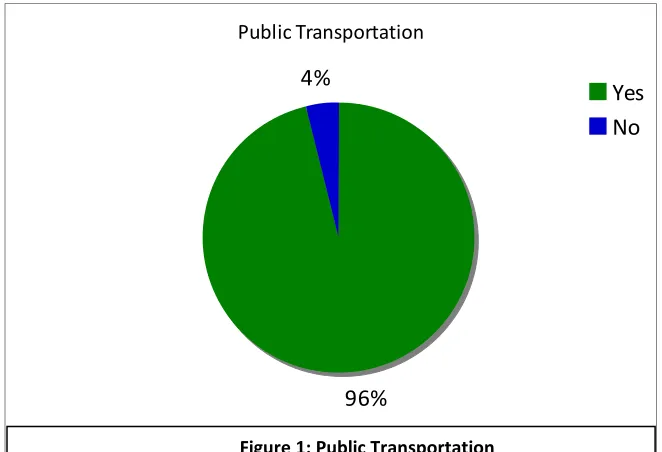
about their programming. As you can see in Appendix B, 96% of the museums were accessible by public
transportation; 36% offered an audio tour; 16% had some kind of adapted maps; 16% offered an escort;
16% had tactile representations of some of the artwork from their collection; 48% offered a touch tour;
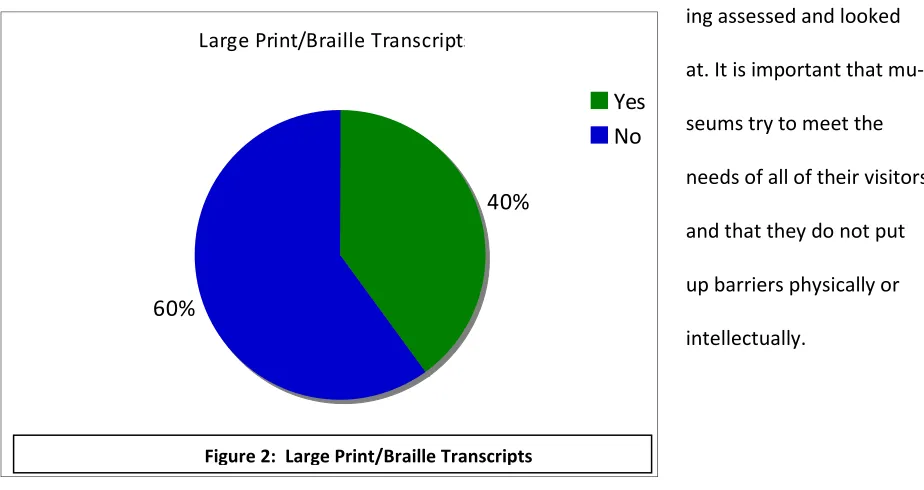
24% had a touch gallery; 64% offered a private tour; 52% welcomed service animals; 40% offered large
print/Braille transcripts of tours; 8% assistive devices such as magnifying glasses; 20% offered large
print/Braille label books; and 8% offered hands on workshops.
Most of the museums I looked at, were located near public transportation. This allows a wider
variety of visitors to
come to the museum.
Visitors with vision im-‐
pairments might not be
able to drive and would
have to rely on another
way to get to the mu-‐
seum. All but one of the
museums I looked at
had public transporta-‐
Public Transportation
96% 4%
[image:31.612.195.526.470.696.2]Yes No
tion. The Massachusetts Museum of Contemporary Art recommends that visitors take a cab from the
closest station. Housed in a former factory, this museum is located in a more rural environment than
the others. I noticed that they also had a much more limited offering in terms of accessibility. Since visi-‐
tors with vision impairments would have a more difficult time getting to the museum I was not surprised
to find that they had such a limited offering.
Several museums stated that they have a special services desk where visitors with special
needs can check in to receive adapted materials. Many of the museums offered some kind of adapted
tour, usually utilizing either touch or oral description. Surprisingly there were a wide variety of different
kinds of programming ranging from descriptive tours, to individualized tours and even hands-‐on art
making workshops. Many museums varied in their definition of what was actually offered for example:
while the website of two different museums both claimed that they offered private tours, the Baltimore
Museum of Art might offer a private tour and be able to accommodate with verbal descriptions, while
the Cincinnati Art Museum has some objects for touch during their private tour.
Most of the programming provided a museum staff member or volunteer to help guide the visi-‐
tor through the museum, but four of the museums I looked at created adapted maps to allow the visitor
to have the most independence and be able to choose their own path through the museum. The Mu-‐
seum of Fine Arts, Boston offers a large print map. Both the Museum of Modern Art and the Philadel-‐
phia Museum of Art offer maps in large print and Braille. The Art Institute of Chicago offers the Path
Finder Floor plan, an online tool that can help you plan your path through the galleries from home.
There are filters on the map allowing you to find the most accessible route for your individual needs. It is
an interactive tool used to help visitors pick their way through the objects they are most interested in
seeing. This is a great tool to be used in conjunction with the escort service because it allows the visitor
a head of time the visitor can be sure that they will not miss any of the works that they wanted to see.
This also allows the visitor to feel more independent and in control of their visit.
The Denver Art Museum was the only museum in my study to provide visitors with an assistive
device that magnifies what the viewer is looking at. This allows the visitor to examine any of the items
in the museum at their own pace. It does not limit them to only see the works that have been chosen by
someone else and therefore provides less limiting access to the exhibit in a way that a tour cannot. It
helps provide a sense of independence that may lead to a more enjoyable museum experience. It is im-‐
portant that visitors are able to enjoy the museum with their companions. Having a magnification device
such as this will allow more freedom to stay with their companions and look at the same pieces.
3.2 Museum Compliance with the ADA
The Americans with Disabilities Act (ADA) was signed into action on July 26, 1990. It serves to
protect the rights of individuals by ensuring that there are no barriers to employment, transportation,
public accommodations, public services, or telecommunications. The ADA is in place to guarantee equal
opportunities for individuals with disabilities. This extends to all public spaces. Museums fall under title
III: Public Accommodations, which prohibits exclusion, segregation, and unequal treatment in all public
and non-‐profit spaces. It is important that museums are continuously updating their programming to
meet the needs of the visitors that come to their institution.
The most recent amendment to the ADA redefined access, and thus challenged museums to
provide not only physical access but intellectual access as well. This posed an interesting puzzle when it
comes to visitors with vision impairments. What could a person who cannot see possibly get out of a
visit to the art museum? It raises questions about how we can provide intellectual access to a person
with little or no visual reference. By creating new entry points for intellectual access it is likely that more