ScholarWorks @ Georgia State University
English Dissertations Department of English
5-11-2015
1890-1969—Early History of the Advanced
Placement Program: an Argument for Reform of
the AP Language & Composition Exam
Elizabeth Jamison
Follow this and additional works at:https://scholarworks.gsu.edu/english_diss
This Dissertation is brought to you for free and open access by the Department of English at ScholarWorks @ Georgia State University. It has been accepted for inclusion in English Dissertations by an authorized administrator of ScholarWorks @ Georgia State University. For more information, please [email protected].
Recommended Citation
Jamison, Elizabeth, "1890-1969—Early History of the Advanced Placement Program: an Argument for Reform of the AP Language & Composition Exam." Dissertation, Georgia State University, 2015.
ARGUMENT FOR REFORM OF THE AP LANGUAGE & COMPOSITION EXAM
by
ELIZABETH B. JAMISON
Under the Direction of Lynée Lewis Gaillet, Ph.D.
ABSTRACT
This dissertation identifies the need for change concerning standardized assessment and
Advanced Placement testing. Although society continues to advance technologically, the area of
homogenous assessments – specifically Advanced Placement tests – has become stagnant, with
the AP English exam remaining nearly the same as it was over fifty years ago. Although the last
sixty years of scholarship suggests that our present systems of standardized assessment do not
reflect real-world application, the populace becomes more dependent on test scores each year.
This work also examines the pivotal nature of education during the late nineteenth and early
twentieth centuries, the shift in a national demand for increased literacy, World War II and the
argument prompts. This dissertation examines several key points in history, including the
Committee of Ten, Harvard’s influence on educational practices, and the relationship to our recent, ever-changing national standards. Throughout the dissertation, I compare the needs of
contemporary American students to students a hundred years ago, and I draw parallels from
existing educational issues to those from a century past. I then posit reasons why we developed
into such a standardized society and became dependent on the Advanced Placement testing
system. I use archival research from the Educational Testing Service headquarters to analyze the
AP Language prompts from 1980 to the present, and I evaluate them for purpose, context, and
appropriateness of complexity considering the time limit. My results demonstrate that several of
the prompts are culturally and socio-economically biased, are too complex to be answered in 40
minutes, and do not provide students with an authentic context. These findings lead to my
conclusion, that AP tests should not carry the weight that they currently do.
INDEX WORDS: History of the Advanced Placement program, AP Language Exam,
ARGUMENT FOR REFORM OF THE AP LANGUAGE & COMPOSITION EXAM
by
ELIZABETH B. JAMISON
A Dissertation Submitted in Partial Fulfillment of the Requirements for the Degree of
Doctor of Philosophy
in the College of Arts and Sciences
Georgia State University
Copyright by Elizabeth B. Jamison
ARGUMENT FOR REFORM OF THE AP LANGUAGE & COMPOSITION EXAM
by
ELIZABETH B. JAMISON
Committee Chair:
Lynée Lewis Gaillet
Committee: Mary Hocks
George Pullman
Electronic Version Approved:
Office of Graduate Studies
College of Arts and Sciences
Georgia State University
DEDICATION
I would like to dedicate the last seven years of work to my husband, Todd, who never
ACKNOWLEDGEMENTS
There are so many people who have played a part in the creation of this dissertation and
in my completion of the program, and I want to give each of them special recognition here.
First and foremost, I must say thank you to Dr. Lynée Gaillet, whose composition class inspired
me back in 2005 and who welcomed me with open arms into Georgia State’s doctorate program
in 2008. Throughout heartache, stress, countless lunches at Marlow’s Tavern, coffees at
Starbuck’s, and too many emails and texts to recall, Dr. Gaillet has helped keep me on the right
path. She once told me to “just write the damn thing” and I am so grateful that she did! She has
taught me so much throughout the years, and I consider her an incredible mentor and friend.
Dr. Mary Hocks introduced me to the world of Computers and Writing, and I am so
thankful that I was able to take her course because she helped me to realize that there was an
entire world of study out there that I wanted to explore. Dr. George Pullman taught me my first
course on rhetoric, and I will always be grateful to him for the honest words of insight that he
offered. All three of my committee members have been so incredibly supportive throughout this
journey, and I couldn’t be more thankful.
Without my faithful family and friends, I don’t think I could have kept my sanity during
this time. My best friend Lani Stringer looked me in the eyes one day when I had veered from
the path of the dissertation. She told me, “Elizabeth, you’ll always regret it if you don’t finish.
Just do it!” Thank you Lani, for believing in me! Tracy, you’ve been with me, supporting me
constantly and believing in me. Thank you! Kristi, I feel like you have endured this entire
process with me, and I am so grateful for your friendship. Rachael, Stephanie, and Jasenda, thank
you for listening to me throughout the years. You’ve never once turned away when I needed an
My Dad told me several years ago, when I called him on a particularly trying day, that I
would “wake up one morning and be finished.” Well, Dad, that day is here! Thanks for
believing in me. To my mom, I love you so much! Thank you for all you’ve done for me over
the years. To my son Jake, who has practically lived at the Sparkles roller rink while I have
written these pages – thank you for being the best son in the world. You never complained about
my working and I am so thankful for you. You have grown into a wonderful young man, and I
am so very proud of you. To my brother David “Davis” Ballance, thank you for being such a
strong support system throughout my life. You’ve been there for me ever since we were kids.
You always take the time to listen, and somehow you seem to know just the right thing to say to
make me feel better – no matter what the topic. Thanks as well for your invaluable help on the
portion of my dissertation that dealt with economics and numbers. I am so lucky to have you for
my brother.
Most of all, thank you to my husband. Ever since we met so many years ago, you have
supported whatever I wanted to do, without question. You have had an unshakeable faith in me
and without you, without your love and patience and support, I could never have finished this
TABLE OF CONTENTS
ACKNOWLEDGEMENTS ... v
LIST OF TABLES ... x
LIST OF FIGURES ... xi
PREFACE ... xii
1 THE CULTURAL SHIFT AND THE NEED FOR CHANGE ... 1
1.1 Abstract ... 1
1.2 Introduction: Background of the College Board and the Educational Testing Service ... 1
1.3 The Need for Change ... 19
1.4 Technological Deterministic Theory and the Social Construction of Technologies ... 21
1.5 Composition Theory as a Social Construct ... 24
1.6 Defining Finished... 26
2 LITERACY ON A NATIONAL SCALE ... 33
2.1 Abstract ... 33
2.2 Literacy on a National Scale: Americans Value Reading and Writing ... 34
2.3 The Ability to Synthesize ... 39
2.4 Educational Issues: Now and Then... 41
2.6 Looking Back: How Influential was the Committee? ... 61
2.7 AP Language Writing Prompts from 1981- 2014 ... 64
2.7.1 A Critical Look at the AP Language Test Prompts from 1981-2014 (Misc. Box/AP Reports and Files/ETS Archives). ... 66
2.7.2 Analysis of AP Language Argument Prompts ... 76
2.7.3 Suggestions for Changes on the AP Language Essay Section ... 77
3 STANDARDIZED TESTING AS A POLITICAL NECESSITY ... 79
3.1 Abstract ... 79
3.2 Education: A Matter of Public Interest... 79
3.3 NEA Committee Report: Education for All American Youth ... 80
3.3.1 Five Objectives for Educational Reform ... 81
3.3.2 Eight Primary Differences in Youth ... 83
3.4 Conformity and Educational Achievement... 86
3.4.1 Achievement Testing and Academic Pressure ... 88
3.4.2 A Dichotomy between Standardization and Curriculum ... 89
3.5 Problems in Composition Curriculum ... 90
3.6 Programs Designed to Enhance Literacy ... 101
3.7 1950s Correspondence from the College Board to Participating Colleges 103 3.8 Fiscal Issues in Advanced Placement ... 107
4.1 Abstract ... 117
4.2 Mounting Pressure to Perform ... 117
4.3 Differentiation, Remediation, and Standardization ... 118
4.4 The “Ideal” AP Student, the “Waive” Process, and Worried Parents... 125
4.5 The Evolution of AP Grading ... 131
4.6 Alternative Grading Systems ... 136
4.7 Traits Looked for in AP Readers ... 139
4.8 Change in the Late 1960s ... 140
4.9 Conclusion ... 145
5 IMPLICATIONS ... 147
REFERENCES ... 150
APPENDICES ... 159
Appendix A: Jamison Writing Notes during Prompt Analysis... 159
Appendix B: Additional AP Language Argument Prompts... 171
LIST OF TABLES
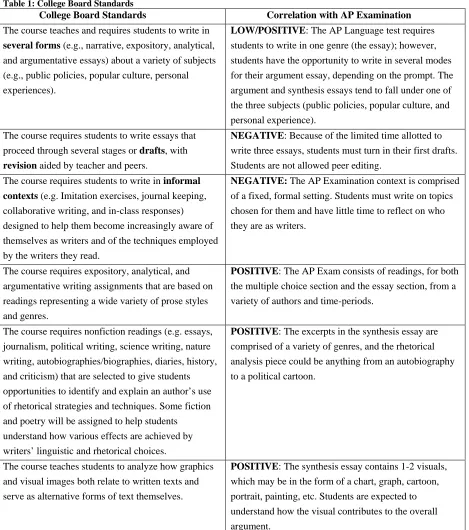
Table 1: College Board Standards ... 32
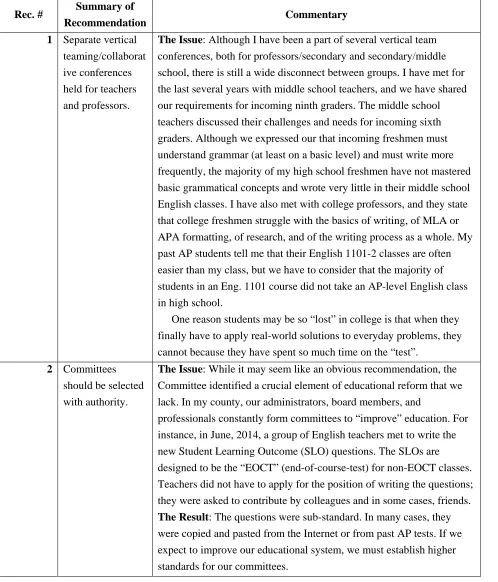
Table 2 Committee Recommendations and Commentary ... 56
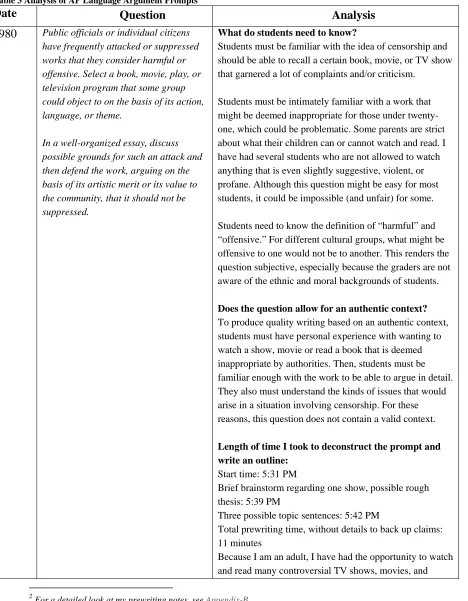
Table 3 Analysis of AP Language Argument Prompts ... 66
Table 4 Common Core Standards ... 93
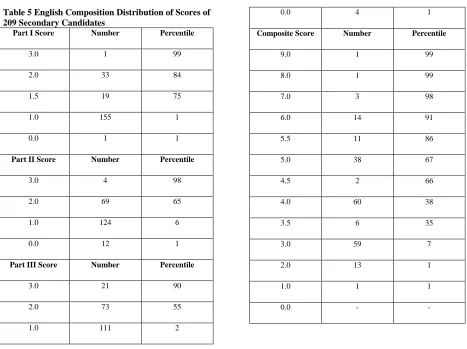
Table 5 English Composition Distribution of Scores of 209 Secondary Candidates ... 98
Table 6 1957 Candidate Form ... 106
Table 7 AP English Standards ... 114
Table 8 Growth of AP Program ... 130
LIST OF FIGURES
Figure 1 College Enrollment Costs ... 121
PREFACE
I am a secondary English teacher specializing in Advanced Placement Language &
Composition, a challenging course focusing on non-fiction, the rhetorical situation, argument,
and rhetorical analysis. I appreciate the challenge of teaching a class that parallels the College
English 1101-2 curricula, and I enjoy interacting with honors and gifted students. During my
decade as a teacher, I have noticed a sharp increase in the stress levels of my students, due in part
to standardized testing. Throughout my graduate studies in rhetoric and composition, and in my
own publication experiences, never once did I write a timed essay. Most importantly, not one of
my textbooks claimed that writing quickly was a necessary aspect of the writing process; in fact,
all the scholarship in composition studies clearly states that writing well involves time, effort,
revision, and critical thought.
Throughout the years, I have proctored many Advanced Placement assessments and have
witnessed the frenetic atmosphere of the tests: hundreds of students, often tired from previous
AP tests, forced to endure an hour of grueling multiple-choice questions followed by three essays
that they must write in just two hours. Students have fifteen minutes of prewriting time to
prepare for the essays. In my classes, I emphasize the writing process just as the scholarship
suggests. I reward students who come to writing conferences and who take the time to rework
their prose. Nevertheless, when the time comes to prepare my AP students for their College
Board assessment, I feel like a hypocrite when I disregard sound composition theory and
research and instead teach strategies for quick, and often formulaic, writing.
In the past few years, I have lost patience with the timed writing genre. I feel
uncomfortable forcing my students to write an essay on an arbitrary topic, with one draft, in
not from random prompts. I chose to focus my dissertation on the early history of the AP
program to discover the origins of the program, how our educational system became so
standardized, and whether our current AP Language tests reflect a fair context for all students.
In this dissertation, I take a critical look at the history of Advance Placement testing,
beginning with the 1890s cry for educational reform, continuing with the need for increased
literacy after WWII, and concluding through the end of the 1960s. I examine the initial purpose
behind the program, the details of its administration, the nuances of the AP Language argument
prompts, and the overall efficacy of the AP testing system. The majority of my archival research
comes from the headquarters of the Educational Testing Service (ETS), based in Princeton, New
Jersey. Because ETS manages testing administration of the Advanced Placement exams, I
needed documentation that would give me a clear picture of the AP Program’s development.
I include a study of the argument test questions from the AP Language & Composition
exam prompts from 1980 to the present, the correlation between standardized testing and the
scholarship about composition theory, and the subsequent current state of our “standardized
nation.” I offer several suggestions for a modified AP assessment, one that better aligns with our
shifting culture. Because my dissertation focuses on the early years (1890-1969) of Advanced
Placement and the relationship to current education, my Implications section suggests avenues for further study that are not included within the individual chapters.
In the Introduction and Chapter 1, I identify the need for change in our standardized
assessments and in our educational system as a whole. Although society continues to advance
technologically, the area of homogenous assessments – especially concerning Advanced
Placement tests – has become stagnant, with the AP English exam remaining nearly the same as
adapted enough to serve the needs of our contemporary students, many of whom are digital
natives. Although scholarship in the last sixty years strongly suggests that our present systems of
standardized assessment neither reflect the curricula taught in schools nor real-world application,
the populace becomes more dependent on test scores each year. Overworked students
increasingly suffer from anxiety, and teachers must simultaneously “teach to the test” and
provide differentiated, rigorous instruction as per the Common Core Standards. Even state
universities, traditionally accessible to most learners, now require a resume that boasts AP
courses, a 4.0, community service, and high AP, SAT, and ACT test scores.
My research focuses on Advanced Placement testing and the history of the AP Program.
If the educational community wants to find alternatives to the now outdated standardized test, we
must understand circumstances that gave rise to the AP program, why the test does not
correspond to technological shifts, and how high-stakes testing will need to be adapted if we are
to adjust to the Web culture.
Chapter 2 examines the pivotal nature of education during the late nineteenth- and early
twentieth-centuries. With the influx of immigrants, post-war veterans, and increase in
population, secondary and post-secondary schools witnessed burgeoning enrollment. As more
people sought to further their education, teachers and professors recognized deficiencies in
literacy that threatened to cripple our nation and put us behind other world powers. In response
to the call for improved reading and writing skills, educators focused on replacing oral
assessments with written tests. Accordingly, the need for standardized writing assessments grew
alongside enrollment in both high schools and colleges. This chapter examines the educational
system during the turn of the twentieth century and scholars’ responses to the needs of a growing
Harvard’s influence on educational practices, and the relationship to our recent, ever-changing
national standards. Throughout the chapter, I compare the needs of contemporary American
students to students a hundred years ago, and I draw parallels from existing educational issues to
those from a century past. I then posit possible reasons why we developed into such a
standardized society and became dependent on the Advanced Placement testing system. At the
end of the chapter, I analyze the AP Language prompts from 1980 to the present and evaluate
them for purpose, context and appropriateness of complexity considering the time limit of the
test. My findings demonstrate that several of the prompts are culturally and socio-economically
biased and are too complex to be answered in 40 minutes or less. I also show that most prompts
do not provide students with an authentic context, and thus do not allow for quality writing.
These findings lead to my conclusion, that AP tests should not carry the weight that they
currently do.
Chapter three transitions from the shift in a national and cultural need for increased
literacy to World War II and the mounting competition between the United States and other
leading nations for dominance in all matters – including education. Based on documents from the
Educational Testing Service and College Board archives, this chapter demonstrates how
education became a matter of public and political interest, and how the spotlight on student
growth and conformity necessitated the development of standardized achievement tests.
Subsequently, scholars developed the Advanced Placement Program with several end-goals: to
help motivated students reach a higher level of scholarship than had previously been possible, to
give high school students an opportunity to prepare for college, and to raise the rigor of our
The final chapter examines the 1960s and the growing pressure for testing administrators
to demonstrate a positive correlation between standardized test scores and collegiate success, a
task which proved difficult then and still does today. As student scoring and measurement
became more important, teachers worried about the focus of their lessons: should they create
curricula for the high performing students, hoping everyone else could keep up, or should they
cater to the lower performing students, to help them “meet” standards? Today, administrators
evaluate teachers in part on their ability to differentiate in the classroom, or to design different
lessons, activities, and assessments depending on students’ learning styles and abilities. To show
the weight of testing and the roll that economics plays in education, I provide a snapshot of
trends in university enrollment and costs from the 1960s to the present. I then cite issues that the
Conference on College Composition & Communication (CCCC), recognized with timed essays
and objective testing. Throughout the chapter, I identify similarities between the problems in the
1960s and issues still inherent in our educational system today. The rapid growth of the AP
Program in the ‘60s also brought about logistical and financial concerns for ETS and the College
Board, and I demonstrate how those issues in part led to the student “waive” process and the
apprehension that both students and parents feel when they consider college admissions. Finally,
I explore the AP reading process as it developed in the 1960s, and I make suggestions for current
change in our AP program (as it pertains to AP English Language & Composition). In the
Implications section that follows the chapter, I suggest the need for future study of the 1970s-1990s in the Advanced Placement program. I also recommend that future scholars research facets
of standardized testing, timed writing philosophy, and Advanced Placement reform. The AP
Program began with a specific goal: to allow students the opportunity to improve their education
opportunities for advanced scholarship in college. Now, AP serves as a way for students to opt
out of college classes, enhance their resume, and save money. If we continue with the Advanced
Placement program in the future, we must consider the original goals of the program and rethink
the current purpose of Advanced Placement.
As educators, we have to remember that through our students, we have an opportunity to
shape the future. We must create a world in which our students have the opportunity for true
enrichment and life-long, authentic learning and creativity. Right now, testing takes precedence
over creativity, and if we expect current students to become the innovators of tomorrow, we must
1 THE CULTURAL SHIFT AND THE NEED FOR CHANGE
1.1 Abstract
In the Introduction and Chapter 1, I identify the need for change in our standardized assessments and in our
educational system as a whole. Although society continues to advance technologically, the area of homogenous
assessments – especially concerning Advanced Placement tests – has become stagnant, with the AP English exam
remaining nearly the same as it was over fifty years ago. America has embraced technology; however, education has
not adapted enough to serve the needs of our contemporary students, most of whom are digital natives. Although
scholarship in the last sixty years strongly suggests that our present systems of standardized assessment neither
reflect the curricula taught in schools nor real-world application, the populace becomes more dependent on test
scores each year. Overworked students increasingly suffer from anxiety, and teachers must simultaneously “teach to
the test” and provide differentiated, rigorous instruction as per the Common Core Standards. Even state universities,
traditionally accessible to most learners, now require a resume that boasts AP courses, a 4.0, community service, and
high AP, SAT, and ACT test scores.
My research focuses on Advanced Placement testing and the history of the AP Program. If the educational
community wants to find alternatives to the now outdated standardized test, we must understand circumstances that
gave rise to the AP program, why the test does not correspond to technological shifts, and how high-stakes testing
will need to be adapted if we are to adjust to the Web culture.
1.2 Introduction: Background of the College Board and the Educational Testing Service
Headquartered in New York, the College Board (CB), a privately owned, not-for-profit
company formed in 1900, develops tests, provides financial assistance, and offers educational
programs for students and teachers. The primary intention of the CB was to help high school
pupils prepare for a rigorous college education and to give gifted students the opportunity to take
college-level classes in high school. The CB contains over 6,000 two and four-year institutions
committees: Academic, College Scholarship, and Guidance and Admission. The CB Advocacy
Board mission statement claims that members are “Guided by the College Board’s principles of
excellence and equity in education, and [they] work to ensure that all students have the
opportunity to succeed in college and beyond”. The CB also trains members to “make critical
connections between policy, research and real-world practice to develop innovative solutions to
the most pressing challenges in education today” (Collegeboard.com). I contend that those
connections between real-world practice and research are not apparent in the tests administered
each year. Although the CB has begun redesigning several of their tests, the AP English
Language and Literature tests remain the same. Considering how much our youth’s
communicative skills have altered because of the Internet, it makes sense that tests of reading
and writing would change. The English tests should have been among the first group of exams to
be reexamined.
On its website, the CB claims that the AP Language course is “equivalent to a
two-semester introductory college course in rhetoric and composition”; therefore, students who get a
high passing score (4-5) are able to exempt either one or both of their English 1101-2 courses. Of
course, parents and students appreciate the money and time saved, but the power of one test to
allow students to bypass an entire year of college English creates misguided educational values.
Students should want to take AP courses for the learning experience and for the opportunity to
take advanced college courses, not to avoid work. Although I teach AP Language, I do not agree
with the claim that one AP class parallels a two-semester college course. I am not saying that my
class is not “college level” – I assign as much or more writing than many English 1101
professors do and I teach from college textbooks. However, my classes, with the emphasis on the
1101-2, students continue to learn a true writing and editing process in which drafting, rewriting, and
editing are central to the course. Most importantly, the research paper serves as the final
assessment of most college English courses, not a timed essay or multiple-choice test. The AP
English standards require a complex drafting process that teachers must forgo for the timed essay
well before the AP exams in May.
Ironically, many of the writing objectives of the AP Language course and the college
board standards require students to “move effectively through the stages of the writing process,
with careful attention to inquiry and research, drafting, revising, editing and review” ("AP In
Higher Ed"). In my dissertation, I hope to answer why (if leading educators and creators of
assessments stress the process of writing) we insist on making our students write timed essays. How can anyone – student or adult – write well on a random topic in forty minutes? Nowhere in
the Common Core or College Board standards does it state that students should be able to write
quickly and produce a finished product after just one draft, but secondary teachers expect their
students to do so.
Since 1980, the College Board has administered two AP English tests: AP Language &
Composition, and AP Literature & Composition. My dissertation focuses on the AP Language
exam, because I teach AP Language at the secondary level. In my course, I emphasize the
researched argument paper, and we read many works of non-fiction from a period spanning the
last five-hundred years. The AP Literature course centers on literature and poetry. Therefore, the
AP Literature test requires students to write a clear literary analysis using terms and concepts
from the course; the AP Language test emphasizes the argument and rhetorical analysis of
The College Entrance Examination Board, the Carnegie Foundation, and the American
Council on Education founded the Educational Testing Service (ETS) in 1947. Each group
provided money, employees, and resources to ETS for research and testing. Since its launch,
ETS has managed the logistics of AP Testing, SAT, ACT, and other standardized, national tests.
The majority of my archival research comes from the headquarters of the Educational Testing
Service, based in Princeton, New Jersey. Because ETS manages testing administration of the
Advanced Placement exams, I wanted to find documentation that would give me a clear picture
of the development and growth of the program.
Originally, I had hoped to find AP Language essay prompts for every year since the
beginning of the program, but unfortunately, I was unable to access those materials. According
to personnel at ETS headquarters, thirty years ago, a fire destroyed several boxes of key archival
materials that I needed (boxes that included records of all prompts). I contacted NCTE, the WPA
list serve, and many other avenues, all of which informed me that there were no records – soft or
hard copy – of the prompts I sought. Consequently, my dissertation provides an analysis of a
selection of prompts from the last thirty years but lacks examples before 1980. I still want to find
that collection – I believe it exists somewhere.
My ETS research was still fruitful. I found a rich store of documents – from memos,
reports, and essays, to conference proceedings and studies – which tell a compelling story about
the Advanced Placement program and the students, teachers, and administrators who were
involved over the years. This dissertation encompasses a recounting of those documents, along
with secondary sources, composition theory, my own classroom experiences, and my personal
I chose to tackle this topic because as an AP Language teacher and as a mother, I often
feel divided and hypocritical. I embrace the AP Language curriculum, with its focus on
non-fiction, argument, rhetorical analysis, and research. I regret that I must force my students to
practice timed writing and multiple-choice in a high-stress environment to prepare them for the
end-of-year AP exam. As a mother, I want my son to have every opportunity to succeed. I know
that if his teachers do not recommend him for AP courses, I will attempt to “waive” him in.
Today, if students do not have a certain number of AP courses on their resumes, then they will
not be considered for college acceptance. As a teacher, I wish my students could NOT waive into
my AP Language class; instead of teaching the “college class” that I want to teach, I have had to
lower my expectations to accommodate the half of my class that was unprepared for an
Advanced Placement class.
The College Board’s Equity and Access Initiative, originally implemented to encourage
diversity in AP courses, has “driven the inclusion of lower ability students. That initiative,
coupled with the fact that public schools are now being rated by Newsweek and USN&WR
based on their AP participation (and little else), and a resulting push for more AP participation at
every school for possible financial incentives, has created a situation where we have students in
AP courses who have no business being there (League, Joseph). The Equity and Access Initiative
states the following:
AP® Access and Equity Initiatives The College Board and the Advanced Placement
Program® encourage teachers, AP Coordinators, and school administrators to make
equitable access a guiding principle for their AP programs. The College Board is
committed to the principle that all students deserve an opportunity to participate in
rigorous and academically challenging courses and programs. All students who are
willing to accept the challenge of a rigorous academic curriculum should be
barriers that restrict access to AP courses for students from ethnic, racial, and
socioeconomic groups that have been traditionally underrepresented in the AP
Program. Schools should make every effort to ensure that their AP classes reflect the
diversity of their student population. ("Equity Policy Statement.")
At my school, we do not have an official “waive” rule, but instead, parents may simply
sign a form and place their children in the AP course of their choice. Our administrators allow
most students to waive in, because ultimately, money drives the program. More AP students
equal more AP test fees for the College Board and higher prestige for individual schools. At my
school, we even have an incentive that allows students to exempt a final exam if they sign up for
the AP test. Ten years ago, students who knew they would not pass the test did not pay the
money for it. Today, everyone signs up. Despite the current revolving doorway in AP, the actual
exam remains the same, so test scores vary according to learning style. Whereas one student may
write well, he or she might not have a knowledge base on the particular subject given. Likewise,
another student may be a good writer with the knowledge, but may take longer to process
information and transform thoughts into a coherent essay. Unfortunately, many parents are
paying hundreds of dollars for tests that their child cannot hope to pass. Our AP classes continue
to degrade year by year, and it gets harder to maintain my course standards. The gifted,
motivated students are also frustrated, because those who do not meet AP standards hold back
the progress of the class. What can we, as an educational system, do to try to turn around this
seemingly impossible cycle? I hope that my dissertation will uncover some answers.
Our culture has experienced a pivotal shift in literacy. Younger generations who have
grown up with the Internet, iPhones, Smartphones, iPads, Tablets, Apps, and Social Media
process information differently than those who are a decade older. These contemporary
Instagram, and have rarely navigated a dictionary or a newspaper. They expect data to appear instantaneously and cannot fathom a time when one had to wait for information. Patricia
Edwards highlighted the shift on educational practices in her 2010 essay, Re-conceptualizing Literacy: “The transformation of our culture from an Industrial Age to an Information Age is why a new kind of literacy, coupled with a new way of learning, is critical for today’s classroom
teacher, who need[s] to be culturally responsive to our diverse learning population…and [should
be] connected to new forms of literacy” (1). Unfortunately, the need for a “new way of learning”
has already occurred and many educators have a lot of catching up to do.
Students need to feel connected to a topic in order to do their best writing. Extensive
research identifies the key components necessary to “engage students in debates that echo the
controversies and discussions in their daily lives” (Newell et al 271), and yet children must take
high stakes tests that require them to answer questions – often abstract concepts – that mean very
little to them. Composition scholars claim that “educators do not work with abstractions; they
work with students. Teachers need an interactive vision of the reading and writing arguments
that can address the hurdles that students often face…that [are] adequately fine-grained and
situated in that experience” (Newell et al 278). Teachers work with students who have concrete,
tangible needs, and so each semester, teaching writing makes more sense if we shape each
assignment to match contemporary contexts. For instance, during election years, I design part of
my semester’s writing assignments around the campaign speeches, so that students can bring
their real-world knowledge into their conversations and writing. For instance, during the 2012
presidential debates, I based a unit on the rhetoric of politics. Students watched and evaluated
speeches and debates, comparing the argument and delivery of several candidates. They engaged
When my students write a researched argument paper, they must determine a problem
within their community that they would like to solve. Thus, the research they conduct will be for
a reason, not just for a grade. My students write much better if there is a “social context” and
“task-specific knowledge” that “frame[s] the argument” (Newell et al 278). When they do not
have the context, they are writing from nothing but a hypothetical, meaningless idea.
Politicians and parents may think that a high score on an SAT or AP exam (another
“abstract” number that does not reflect real-world skills like work-ethic) equals proficient
writing, but although today’s “Net Gen, Google Gen, or Digital residents” (Yakel et al 23) have
grown up with the Internet, many lack communication skills necessary to make a cogent
argument. Of course, every classroom contains students who find a way, through their own
volition, to discover how to best navigate the vast sea of information available. Nonetheless,
many students do not know how use the resources available to them and cannot conduct deep
and meaningful research – not because they lack the motivation to, but because technology has
progressed at a faster rate than has student Internet proficiency: “Even though technology is
intertwined in our students’ lives, many do not possess the information literacy skillsor
strategies for learning with technology or learning how to learn new technologies” (Yakel 23).
For this dissertation, I use a definition of information literacy skills created by Plattsburgh State University and developed by the Suny Council of Library Directors: “Information literacy is the
ability to recognize the extent and nature of an information need, then to locate, evaluate, and
effectively use the needed information” (Heller-Ross). Currently, because of the unfathomable
amounts of data available to students via the Internet, research is much more complex than even
ten years ago. The researchers of today will become the entrepreneurs and scholars of tomorrow,
capable of managing media-neutral information throughout its lifecycle” (Yakel 23). To prepare
students for a challenging digital workplace, teachers must create technological lessons that
reflect how businesses use technology. Likewise, national assessments should mirror our
complex, technological ethnicity. Teachers must also encourage collaborative writing – both
online and in class – that supports students’ need for an authentic purpose and encourages
process writing and reflection. Finally, they must help students develop necessary literacy skills
needed for success in the workplace. Educators should not consider technology a “supplemental
teaching tool” and should instead realize that incorporating technological lessons in everyday
curricula “is essential to successful performance outcomes” (Ertmer, Peggy and Anne
Ottenbreit-Leftwich 256). Standardized tests like the AP exam and the SAT fulfill only a fraction, if any, of
these contemporary requirements.
Political leaders, test administrators, and educators might ask whether standardized tests
should fulfill the contemporary demands of technologically savvy pupils. Edward White, a
leading authority on testing, aptly discusses the purpose of assessment:
Any assessment is, in one sense, a means of gathering information. That suggests we
should be clear about what information we need and how we will use it before we
decide about the means of gathering it. Another way to conceptualize the issue is to
think of an assessment as providing answers to questions; the questions need to be
well formulated before we seek the answers. These ways of thinking about any
assessment seem obvious enough, but very few assessment programs of any kind
actually follow them. In most cases, the method of testing is the first issue decided
instead of the last; the answer is sought before the question has become clear. (White
32-33)
A national test which has the power to alter a student’s future should reflect real life, real
values, and real expectations that echo the “well-formulated questions” that White mentions. The
predict a student’s ability to succeed in college. For this dissertation I offer my own definition of
“real life, real values, and real expectations” as the terms relate to composition pedagogy. Real Life stands for what students will encounter after high school. In college, they will take many courses offering a wide array of project-based assessments that combine the portfolio, group
presentation, the Internet, and collaborative writing. Rarely, if ever, will students write a timed
essay. Real Life also indicates life in the corporate arena. In most jobs, employees are given time to flesh out ideas, to work together, to make mistakes, and to rethink. Even in the fast-paced
world of digital publishing, freelance writers have editors who check their work, make changes,
and want an improved product before publication. The timed essay format does not represent real
life; therefore, standardized tests should not rely on the timed essay.
Real Values and expectations signify what the public deems important and what it wants out of its professionals. Most corporations appreciate employees who work towards goals, ask
smart questions, and refine and perfect until they produce a superior product. A good supervisor
knows that the key to success involves employees who are willing to learn from their mistakes.
No one expects perfection the first time; corporations allow new employees months of training
before they demand results. For instance, in most sales and marketing positions, new hires do not
have to bring in customers for at least three-six months. Why? They must learn the language of
the job, the customers, and the product. Telling a student to write a decent essay on a random
topic in 40 minutes is like demanding new sales associates to close a deal before they understand
their product and customer base.
Teachers teach process writing, in which students go through several steps before they turn in the final draft. In my class, I encourage discovering the right question to answer before
discussing pros, cons, and relevance and context of the issue. After they have conducted
significant preliminary research, my students choose a subject. Next, we complete each stage of
the essay, including several drafts, until the end product reflects the student’s best writing. If it
were not for the demands of standardized testing, I would never ask my students to read a
random prompt, think of an argument, and write an essay in forty minutes. And yet, our students
are often expected to write quickly, on demand. Their academic future depends on it.
Standardized tests assess certain skill sets and do not mirror real life expectations. There is
nothing wrong with testing separate skill sets, but the test should not have the power to limit a
student’s future or to label a student as proficient in an entire area of study.
The vast amounts of free knowledge available online has transformed the nature of
research. Scholars recognize a new kind of learner, one who doesn’t mind sharing and expects to
give as well as take: “In the web 2.0 era, learners are regarded as cooperative and altruistic actors
who refuse to take on the role of a passive consumer and are transformed into active
contributors, authors with a disposition to innovate, share, and form communities of interest,
communities of practice, and networks (Palaigeorgiou et al 146). How students get, perceive, and
share data has changed dramatically in the twenty-first century. For instance, many people blog
(I am one of those people) and gladly share resources online. Most bloggers do not mind if they
get re-blogged, because that means that more people read their posts. Our students have grown
up in a society where people get and share knowledge with the click of a button. In the past,
documents were carefully guarded – even teachers locked their files inside gray cabinets so
colleagues could not “steal” their lessons. Today, many secondary teachers post their materials
And yet, the massive array of “open source” websites, blogs, and other social media has
not eradicated the need for writers to protect their work. On the contrary. Blogs, websites, and
online resources gain credibility every day and are becoming possible sources for researchers,
journalists, and students to incorporate into their work; thus, the blogger or web editor must be
cited. As a blogger, I have spent countless hours writing for my blog on WordPress, which
focuses on the field of composition and rhetoric, writing, teaching, and my dissertation process. I
own my material and consider the Internet one big arena for publication, and although my blog is
free to read, I expect people to give me credit if they re-blog or quote from my posts. On
www.wordpress.com, users often re-blog posts that they like, but they always give credit to the
original author.
In the last two decades, teachers have been encouraged to incorporate in their
composition classrooms new technologies such as Smart Boards, doc-cams, online databases,
word-processing, web-design, blogging, I-Respond systems, automated essay scoring software,
Edmodo, and other online platforms for instruction. Many teachers have embraced technology,
but others have been more hesitant to accept the “pervasiveness of computers in everyday life
…and the increasing role of digital technology in defining and assessing writing" (Chen et al 50).
Although most teachers are willing to learn new technologies, what many in the world of
education have failed to see is the effect of technology on the way that students process
information. Because students know that they can access whatever fact, figure, statistic, image,
or video that they need in an instant, their memorization skills have declined, making the
recollection of data for timed essays and multiple-choice questions very difficult. The following
Over the past few years I’ve had an uncomfortable sense that someone, or something,
has been tinkering with my brain, remapping the neural circuitry, reprogramming the
memory. My mind isn’t going—so far as I can tell—but it’s changing. I’m not
thinking the way I used to think. I can feel it most strongly when I’m reading.
Immersing myself in a book or a lengthy article used to be easy. My mind would get
caught up in the narrative or the turns of the argument, and I’d spend hours strolling
through long stretches of prose. That’s rarely the case anymore. Now my
concentration often starts to drift after two or three pages. I get fidgety, lose the
thread, begin looking for something else to do. I feel as if I’m always dragging my
wayward brain back to the text. The deep reading that used to come naturally has
become a struggle. (Carr 1)
While scholars have been predicting the ramifications of an Internet culture for years, the
speed that our students have progressed far surpasses existing teaching and assessment
processes. Many freshmen enter the English classroom (in both secondary and post-secondary
institutions) unprepared to read texts longer than a paragraph, and they have little experience
reading nonfiction. Our “text-message generation” views reading and writing in a context unlike
the one their parents and teachers did as teens. Moreover, if a scholar has more trouble (because of
the Internet) concentrating on long prose passages and keeping his attention focused, then what
challenges do contemporary students face?
In an attempt to keep up with technological growth, the Department of Education
mandated through state and national standards that teachers incorporate more technology within
the classroom. For the first few years of the 2000s, “incorporating technology” was no more than
simply using a computer, overhead projector, Smart Board, or the Internet to teach the same
concepts that had been taught for years. When the Quality Core Curriculum (QCC’s) became the
Georgia Performance Standards (GPS) and the GPS morphed into the Common Core Standards
of technology within assignment and projects, which meant combining computers and writing.
Even today, teachers struggle with some students who do not have access to the Internet, a
computer that is compatible with those at school, or sufficient knowledge of computers to work
with new programs. In my classes, I often have to teach the rudiments of Microsoft Word,
PowerPoint, MovieMaker, and other programs before my students can complete their
assignments. Despite the challenges, most school systems have answered the call to incorporate
technology within their everyday curriculum; and yet, the standardized testing industry has not
developed at a rate to match the advances in technology. To borrow from Martin Luther King,
standardized assessments have “[crept] at a horse and buggy pace” while technology has
“move[d] with jet-like speed”. Although research demonstrates the many flaws in an educational
system in which learners must conform while assessments remain virtually static, national testing
systems appear to have ignored that educational scholarship.
So what does all this have to do with AP and the history of AP testing?
If the educational community wants to create a less-standardized, more authentic system
of assessment, we need to know how, when and why the AP program began, why it is not
reacting to the shift, and how high stakes testing needs to change if we are to adapt to our
ever-increasing Internet culture.
I am not writing this dissertation to condemn our children, the Internet, the AP Program,
ETS, teachers, or standardized testing. I am writing to incite change so that our educational
system can adapt to the shift that has already occurred. We must consider the ethics behind
forcing our students to take such mechanical, worn-out tests, which create, according to Carol
surpassed. People with fixed mindsets fear that they will become “found out,” or that people will
discover that they are not really that smart. Thus, they do not feel comfortable with challenges
that take them out of their comfort zones. Society claims to want its students to be critical
thinkers so they can become the leaders of tomorrow, but we continue to force students to take
assessments that reinforce a fixed mindset – a belief in a one-size-fits-all mentality – which does
not encourage students or teachers to try new strategies and engage in unique ways of learning.
For years, teachers lamented students’ apathetic attitudes and their aversion to reading and
writing. I imagine that one of the main reasons for students’ overall lack of motivation is the
inherent futility of our systematized assessments. Why force labels, the very quintessence of a
“fixed” mindset, onto our students?
This dissertation focuses on the Advanced Placement program, with its antiquated writing
tests that are essentially the same today as they were thirty years ago. I teach AP Language, and I
love the curriculum. However, I dislike the format of the AP test that comes in May, and I
question whether the AP program is in the best interest of young learners. We cannot expect
contemporary students to think in the same way that they did in the fifties, sixties, seventies, or
eighties; likewise, we should not test them in the same manner that we did so many years ago.
College admissions value Advanced Placement courses. With several AP classes on their
transcript (six-eight for most universities), students have a much better chance of gaining
admission to most universities. In the past ten years, the standards for secondary education have
changed three times, each change calling for increased rigor in the classroom and more
accountability for the teacher. As a result, students must have at least two Advanced Placement
classes on their transcript to enroll into average state universities, but most students on the
University of Georgia’s Admissions department, “A student with a 4.0 GPA in a superior
curriculum of Advanced Placement (AP) or International Baccalaureate (IB) courses might be
admitted with an SAT score at or below 1000. Yet, another student with a 3.0 GPA and an SAT
score of 1400 might not be admitted, if the student opts for no more than a standard college prep
curriculum with few if any Honors, AP or IB courses” (1). Other state schools similar to The
University of Georgia, (which now requires seven-eight AP courses for acceptance), have the
same belief about AP classes. Students who take the courses and complete the AP tests are more
likely to get accepted than applicants who got straight A’s without taking AP classes. I have no
argument with the AP Language curriculum, with its rich mix of process writing and critical
reading, but the final test, which fails to encompass the breadth of the class, must change.
The AP English Language & Composition test consists of two elements: a 54-question
multiple-choice exercise on several diverse prose passages and a three-essay written response
(essays include rhetorical analysis, argument, and synthesis). The exam lasts three hours and
fifteen minutes (one hour for the multiple choice, two hours & fifteen minutes for the writing).
Both the argument and the synthesis require students to write on a topic unfamiliar to most,
resulting in an inequitable system in which some students might be experts on a random question
while the majority flounders. For instance, the Synthesis question (argument with sources) from
2008 required students to decide whether the government should cease production of the penny
coin, since so many people have stopped using physical currency. Most students were
flummoxed by this question. One student, however, had a distinct advantage: her father, a
lawyer, had clients who dealt with that very question. In fact, the student’s family had discussed
the “penny coin” issue several times, which gave her a great advantage over other students who
assess? Is it a true test of intelligence, reading, and writing prowess, or is it a test of quick
thinking and luck? We have a serious discrepancy: the Common Core standards require
challenging lessons, process writing, researching, and critical reading; the AP test in Language
and Composition requires students to write three short, one-draft essays in one hundred and
thirty-five minutes on random topics in a sterile environment.
While contemporary composition textbooks claim to align with current writing
philosophies, many of these new texts are based on older theories and obsolete goals. Often, the Classical argument that Aristotle imparted translates into formulaic writing (even when teachers
think they are avoiding the “formula”). Aristotle’s culture was primarily oral, so the goals of rhetors 2000 years ago varied from those of today’s writers. Older theories often inform
contemporary ones, and knowledge of the history of teaching composition can composition
teachers know what drives their philosophies, curricula, and assessments.
Flower and Hayes recognized that a good writing process looks different for each
individual. In their 1981 study, they emphasize the importance of being honest with ourselves
about our true writing process instead of teaching writing according to a prescription. They
define the writing process as one of making decisions based on “one’s purpose” which “guides
these choices [in writing]” (365). People set goals for their writing, which can change with each
project, depending on the scope of the writing assignment.
In my classes, I have heard students say that unless they care about the topic, they cannot effectively write about it. They struggle finding the motivation to explore hypothetical topics that
have no basis in their world. In her 2008 qualitative study about the process of writing, Julia
Colyar delves into the “whys” behind writing and how knowing the answer to the “why” can
by which writers write in order to solidify what they know and discover what they need to find
out. If “writing is a learning tool that enables what we know about our research topics and
ourselves” (Colyar 423-424), how can students learn through their writing if the prompt they
answer is one created by a corporate entity and not one that connects with their current
curriculum and cultural context?
It does no good to force students to write without giving them a backdrop for a complete
writing process. Imagine telling a math student to solve complex equations without going
through the steps, or telling a science class to hypothesize without conducting an experiment.
Invention requires time and thought, and professional writers carve out time in their schedule to
think, to process, to understand. In his 1972 essay Teach Writing as a Process Not a Product, Donald Murray implores teachers to teach “the process of discovery through language” (4). He
further claims that “instead of teaching finished writing, [teachers] should teach unfinished
writing, and glory in its unfinishedness” (4). He divides writing into three sections: prewriting,
writing, and rewriting. He claims that pre-writing, when a writer does the majority of his or her
discovery and learning, should take the longest amount of time for a student. He further asserts
that the writing itself is the quickest process, followed by the arduous rewriting. For Murray, the
prewriting and rewriting should take almost ninety-nine percent of the time spent in the writing
process. The actual writing takes one percent of the total time (4). AP tests do not allow sufficienttime for pre-writing, thinking, processing, and redrafting. How can such a test
determine whether or not a student should exempt two years of college English? And more
importantly, why should a test limit a hard-working, good writer’s college choices?
Many creators of the Advanced Placement tests are not a part of the “text-message”
tests have never taught a high school class. ETS is trying to remedy the situation, however, and is
constantly on the lookout for teachers who want to move into the research and assessment field.
And yet, there is still a dearth of people educated in research, validity, and testing who also have
teaching experience (especially in Advanced Placement courses). Thus, testing engineers, often
unfamiliar with high school students, might not have recognized the educational shift in culture.
In this dissertation, I take a critical look at the history of Advance Placement testing,
beginning with the 1890s cry for educational reform, continuing with the need for increased
literacy after WWII, and concluding through the end of the 1960s. Using archival research from
the Educational Testing Service headquarters, I examine the initial purpose behind the program,
the details of its administration, and the reaction from the public. Included is a study of the
argument test questions from the AP Language & Composition exam from 1980 to the present,
the correlation between standardized testing and the scholarship about composition theory, and
the subsequent current state of our “standardized nation”. I then offer several suggestions for a
modified AP assessment, one that better aligns with our current shifting culture. Because my
dissertation focuses on the early years of Advanced Placement and the relationship to
present-day, my Implications section suggests avenues for further study that are not included here.
1.3 The Need for Change
What makes some writing “good” while other pieces fall flat? I believe that when we
remove the obvious elements of effective writing (clarity, correct grammar, relevant evidence,
etc.) we find that readers tend to enjoy a piece more if they detect authentic, or genuine voice, in
the prose. Secondary composition teachers face the daunting challenge of helping their students
find their voice while simultaneously training them to take standardized, formulaic writing tests.
struggle to write in class, and standardized writing assessments are not helping them become
better writers. Society must find a way to reconsider the existing paradigm of high stakes testing;
our educational system places too much emphasis on timed essay tests, the antithesis of a true
writing process. In any writing situation that is timed or forced, writers must stifle their natural
flair in “compliance [to specific] criteria to be met” (Elbow 18, 2000). In his book Everyone Can Write, Elbow examines this coerced “compliance” and the subsequent “pressure to give in” when writing begins. He also acknowledges the less-common “release from that pressure when we
don’t have to give in” (19). When I read blogs, I often notice a common element that I rarely encounter in classroom writing. I get to see authentic voice and passion. For instance, I subscribe
to Shannon Thompson’s blog, which focuses on both the creative writing process and her
journey as a novelist. Thompson’s blog intrigues me because the author, a college student, writes
with such love for the craft that her posts are always engaging and useful for other writers.
Thompson has a passion for writing, and she enjoys helping other aspiring writers avoid
common pitfalls in their own publishing process. Shannon focuses on one theme: writing.
Therefore, she creates an authentic tone in each blog post, which helps to develop her ethos as a
serious, professional writer.
Another blog I enjoy reading belongs to a photographer, Seth Snap. Snap has a day job,
but whenever he can, he hikes and takes pictures of elements of nature, whether an old barn, a
series of birds or clouds, the night sky, or a gnarled tree. He also offers unique and witty captions
with creative titles that tell possible stories behind the pictures. I admire that he combines writing
and photography. My students engage in a similar variation of the exercise in class when they
write stories and poems inspired by famous art. In their final portfolios, they often recount that
Seth Snap is not a “writer,” but his blog shows creativity and enthusiasm that our assessments do
not encourage and that most students’ writings subsequently lack.
1.4 Technological Deterministic Theory and the Social Construction of Technologies
Primary theories related to the influence the Internet has on adolescent culture include
Technological Deterministic (TD) and The Social Construction of Technologies (SCT).
Proponents of TD believe that technology – especially the Internet – constantly changes how
people act, think, develop, work, and communicate. TD theorists “view technology as an
independent force that drives social change” and that “exercises causal influence on social
practices…regardless of the social desirability of the change” (Mesch 51). SCT scholars believe
that “social groups differ in the extent of their access to technology” and that certain groups will
use technology differently than others. Therefore, technology itself cannot be an all-powerful
entity that changes society as a whole; technology serves as a resource that people use according
to their beliefs, careers, social status, and education (Mesch 53). For the purpose of this
dissertation I take a stance somewhere in the middle of the two extremes. Internet technology has
affected everyone to a certain degree, but the extent of change on individuals depends on many
social, economic, environmental, and biological factors. However, the majority of my students
(Advanced and Honors level, upper-middle class) fall into the technological deterministic
category. Each day, I observe the way that my students interact with each other. I see how they
solve problems, read, research, and react to the world. On any given day in my AP Language
class, students, when finished with an assignment, will choose to look at their smart phones to
check Instagram, Twitter, Facebook, Reddit, Tumblr, Vine, email, texts, and Google. Then, they
either play games on their phones or start the social media cycle all over again. Every semester,
only one of my students (out of 110) opened a book when he had time. The others chose to look
at their phones and occasionally talk with friends (usually about something they were looking at
on the phone). Another of my AP students did a self-case study for her research paper in which
she did not use her smart phone (except to make calls) for one week. Her findings were eye
opening. Although *Megan is a high-achieving student with several extra-curricular
responsibilities, she averaged about four hours a day on her phone. When she took the phone
away, she completed homework expeditiously, spent more time with family, and even read
books for pleasure.
Proponents of TD assert that technology affects the way that people work and
communicate. My students are addicted to technology: the girl who researched her use of the
smart phone failed to enlist others to participate because her peers were unwilling to relinquish
their phones for a week. Other students feel uncomfortable if their phone is not in view, and of
course, learners today “Google” their questions instead of using a book. They would rather
communicate via their phones than in a face-to-face encounter. Students even engage in “text”
relationships. These are the students who must take the same tests given before personal
computers were invented. And, what about the workplace? My students will be in the workforce
in less than ten years. How productive are they going to be? How has the corporate world had to
adapt to meet the needs of younger personnel? That is a different topic, one that begs to be
explored.
Students are not the only ones who face challenges adapting to the technological shift.
Teachers have trouble as well, because they have one point of reference: their own high school
experience that took place before the shift or in the middle of it. A new teacher, fresh out of
gained popularity, Facebook had just taken off, and Twitter, Vine, Reddit, and Instagram did not exist. Students had some distractions through social media, but nothing like they do now.
In Writing New Media (2004), Johnson-Eilola pinpoints a problem many current teachers encounter at their schools and inside their classrooms: “[Teachers] tend, despite all of our
sophisticated theorizing, to teach writing much as [they] have long taught it: the creative
production of original words in linear streams” (200). Most of America’s standardized
assessments contain timed essays, which students must write from beginning to end. As a result,
many high school classrooms continue to use the five-paragraph method as their primary
assessment in order to prepare students for testing. In fact, the SAT test-prep course teaches
students to use the formula so they can finish the essay.
Students do not read or write on their own in a linear fashion nearly as much as they used to before the Internet. When they click on a URL, they may read a few lines of text and then
explore another link that brings them to an external website. Later, they may find that they have
read parts of a dozen web sites and blogs before they find what they wanted. Additionally, while
students are searching, they multitask: checking email, social media sites, and texts. Rarely does
today’s student find an article or essay online and read it in its entirety. Many children still read
books, of course, but in their everyday lives, their thinking, reading, and writing is primarily
non-linear. It makes little sense that standardized writing assessments require students to write with a
formula with none of the fluidity of the Internet. What must concern test writers is that by the
time current students become teachers, they will find linearity a foreign concept – uncomfortable
and wrong.
While testing certainly plays an important part in students’ lives, what about the real life