ScholarWorks @ Georgia State University
ScholarWorks @ Georgia State University
Art and Design Theses Ernest G. Welch School of Art and Design
5-10-2014
Releasing The Power Within: Exploring The Magical Girl
Releasing The Power Within: Exploring The Magical Girl
Transformation Sequence With Flash Animation
Transformation Sequence With Flash Animation
Danielle Z. Yarbrough
Follow this and additional works at: https://scholarworks.gsu.edu/art_design_theses
Recommended Citation Recommended Citation
Yarbrough, Danielle Z., "Releasing The Power Within: Exploring The Magical Girl Transformation Sequence With Flash Animation." Thesis, Georgia State University, 2014.
https://scholarworks.gsu.edu/art_design_theses/158
This Thesis is brought to you for free and open access by the Ernest G. Welch School of Art and Design at ScholarWorks @ Georgia State University. It has been accepted for inclusion in Art and Design Theses by an authorized administrator of ScholarWorks @ Georgia State University. For more information, please contact
RELEASING THE POWER WITHIN: EXPLORING THE MAGICAL GIRL TRANSFORMATION SEQUENCE WITH
FLASH ANIMATION
by
DANIELLE Z. YARBROUGH
Under the Direction of Dr. Melanie Davenport
ABSTRACT
This studio-based thesis explores the universal theme of transformation within the Magical Girl genre of
Animation. My research incorporates the viewing and analysis of Japanese animations and discusses the
symbolism behind transformation sequences. In addition, this study discusses how this theme can be
created using Flash software for animation and discusses its value as a teaching resource in the art
classroom.
RELEASING THE POWER WITHIN: EXPLORING THE MAGICAL GIRL TRANSFORMATION SEQUENCE WITH
FLASH ANIMATION
by
DANIELLE Z. YARBROUGH
A Thesis Submitted in Partial Fulfillment of the Requirements for the Degree of
Master of Art Education
In the College of Arts and Sciences
Georgia State University
Copyright by Danielle Z. Yarbrough
RELEASING THE POWER WITHIN: EXPLORING THE MAGICAL GIRL TRANSFORMATION SEQUENCE WITH
FLASH ANIMATION
by
DANIELLE Z. YARBROUGH
Committee Chair: Melanie Davenport
Committee: Kevin Hsieh
Melody Milbrandt
Electronic Version Approved
Office of Graduate Studies
College of Arts and Sciences
Georgia State University
DEDICATION
I dedicate my thesis to my grandfather, Dean S. Yarbrough II, because he taught me to treat young
people like rock stars and to have high expectations so that they will feel empowered to achieve their
own dreams. Thank you for everything and I love you, Grampy. I would also like to thank my family
because they have always supported me throughout all of my academic endeavors and helped to pave
the way for my success. Finally, I thank God for giving me the gift of persistence, resiliency, and tenacity
ACKNOWLEDGEMENTS
I would like to thank Dr. Davenport, Dr. Hsieh, and Dr. Milbrandt for helping me on my journey into the
world of Art Education. I appreciate all of your advice and knowledge and I will use all that I have
learned from my program in the classroom. I also would like to thank my professors from Clark Atlanta,
for teaching me the skills that I needed in order to obtain my Master’s degree. Finally, I would like to
thank Jai Husband for teaching me how to create animations with Adobe Flash and for sharing his
TABLE OF CONTENTS
LIST OF FIGURES………....vi
INTRODUCTION……….………1
Magical Girl Genre……….……….8
Purpose of Study……….10
Need for Study………..…..…11
Key Terms………..…....13
LITERATURE REVIEW……….……….15
The History of Animation.………..………....15
Cel Animation……….………..…18
Adobe Flash………..……….20
Thematic Instruction………...23
Animated Visions Program………..……25
Cut-Paper Animation Project……….………..….27
Magical Girl Themes……….………..28
Analysis……….……….…..31
Summary………..………33
METHODOLOGY………..……….……34
Timetables and Outcomes……….……….…..….35
Limitations…..……….………..35
Analysis of Films……….………36
Sailor Moon……….……….36
Revolutionary Girl Utena……….………37
Dragonball Z……….………38
Visual Elements………..……….………....39
Creation of Work………..………45
Reflection of Process………..51
Visual Symbolism………...…...53
CLASSROOM IMPLEMENTATION AND CONCLUSION……..……….……….…….56
Implementation……….………56
Conclusion……….…59
LIST OF FIGURES
Figure 1. Danielle Z. Yarbrough, Volcanic Eruption I, panel 1, 2013, Acrylic on Paper, 18 by 24 in….…….1
Figure 2. Danielle Z. Yarbrough, Volcanic Eruption I, panel 2, 2013, Acrylic on Paper, 18 by 24 in.……….2
Figure 3. Danielle Z. Yarbrough, Volcanic Eruption I, panel 3, 2013, Acrylic on Paper, 18 by 24 in………..2
Figure 4. Danielle Z. Yarbrough, Volcanic Eruption I, panel 4, 2013, Acrylic on Paper, 18 by 24 in……..…3
Figure 5. Danielle Z. Yarbrough, Volcanic Eruption I, panel 5, 2013, Acrylic on Paper, 18 by 24 in……....3
Figure 6. Danielle Z. Yarbrough, Volcanic Eruption II, panel 1, 2012, crayons, 3 by 5 ft.……….…4
Figure 7. Danielle Z. Yarbrough, Volcanic Eruption II, panel 2, 2012, crayons, 3 by 5 ft.……….…..…4
Figure 8. Danielle Z. Yarbrough, Volcanic Eruption II, panel 3, 2012, crayons, 3 by 5 ft.………..…...4
Figure 9. Danielle Z. Yarbrough, Volcanic Eruption II, panel 4, 2012, crayons, 5 by 3 ft.………..….5
Figure 10. Danielle Z. Yarbrough, Volcanic Eruption II, panel 5, 2012, crayons, 5 by 3 ft. ……...5
Figure 11. Danielle Z. Yarbrough, Volcanic Eruption II, panel 6, 2012, crayons, 5 by 3 ft. ……….6
Figure 12. Jai Husband, Kasha and the Zulu King, 2012, movie poster. ………...8
Figure 13. Monster High, 2010, movie poster. ………..22
Figure 14. Metalocalypse, 2006, movie poster. ………22
Figure 15. Sailor Moon, 1992, movie poster. ……….29
Figure 16. Revolutionary Girl Utena, 1997, movie poster……….….30
Figure 17. Dragonball Z, 1997, movie poster………..31
Figure 18. Sailor Moon, 1992, screenshot. ………..40
Figure 19. Sailor Moon, 1992, screenshot……….………40
Figure 20. Sailor Moon, 1992, screenshot. ………..………41
Figure 21. Sailor Moon, 1992, screenshot. ……….………….41
Figure 22. Sailor Moon, 1992, screenshot……….41
Figure 24. Revolutionary Girl Utena, 1997, screenshot………43
Figure 25. Revolutionary Girl Utena, 1997, screenshot………43
Figure 26. Dragonball Z, 1997, illustration………44
Figure 27. Dragonball Z, 1997, illustration………44
Figure 28. Danielle Z. Yarbrough, Research Sketchbook Page, 2014, graphite on paper…….………46
Figure 29. Danielle Z. Yarbrough, POWER, screenshot 1, 2014, Flash Animation……….….47
Figure 30. Danielle Z. Yarbrough, POWER, screenshot 2, 2014, Flash Animation………..48
Figure 31. Danielle Z. Yarbrough, POWER, screenshot 3, 2014, Flash Animation………..48
Figure 32. Danielle Z. Yarbrough, POWER, screenshot 4, 2014, Flash Animation………..49
Figure 33. Danielle Z. Yarbrough, POWER, screenshot 5, 2014, Flash Animation………..49
Figure 34. Danielle Z. Yarbrough, POWER, screenshot 6, 2014, Flash Animation………..50
CHAPTER ONE
Introduction
The theme of my studio-based thesis is a dialogue about transformation illustrated through
Adobe Flash animation. My desire to create a short digital animation was inspired by a body of work
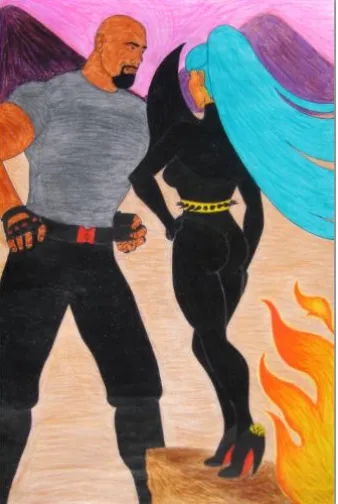
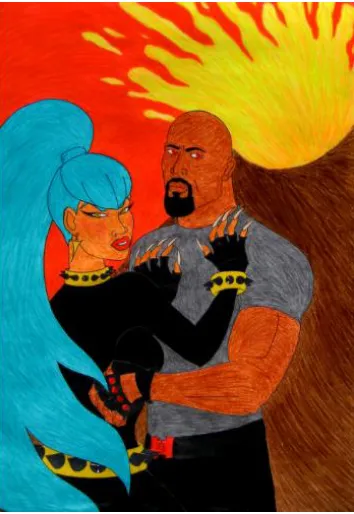
that I created in my studio classes called, Volcanic Eruption. The Volcanic Eruption series consists of two
parts about a warrior named Sulfur who was an amalgamation of many of my original characters from
childhood.
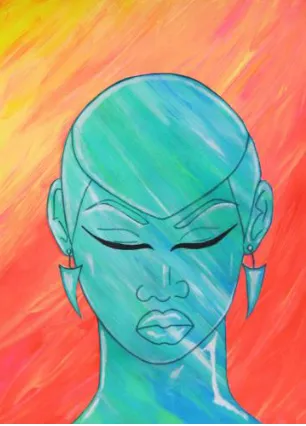
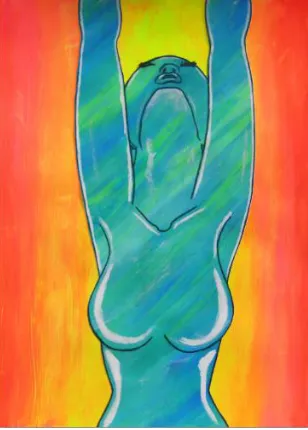
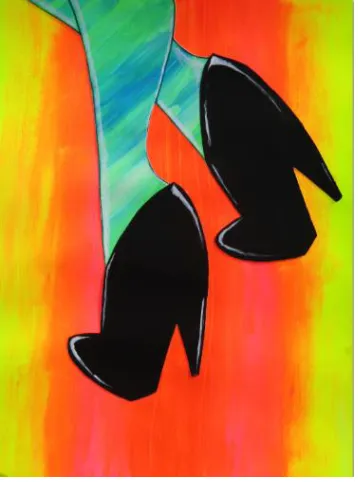
Volcanic Eruption I was a short study on the visual composition within the Magical Girl
transformation sequence. I referenced the popular visual style of Sailor Moon to create five cut-paper
collages that illustrate Sulfur’s powerful transformation. Although Volcanic Eruption I was created after
part II, it was meant to act as a creation story. In this short series, while Sulfur is gestating in the fiery
womb of a volcano, her magical transformation occurs. I chose to paint the background with warm
[image:12.612.74.227.428.641.2]colors to represent the searing hot magma that surrounded the magical being as she transformed.
Figure 2. Danielle Z. Yarbrough, Volcanic Eruption I, panel 2, 2013 Acrylic on Paper, 18 by 24 in.
[image:13.612.75.229.322.533.2]Figure 4. Danielle Z. Yarbrough, Volcanic Eruption I, panel 4, 2013, Acrylic on Paper, 18 by 24 in.
Figure 5. Danielle Z. Yarbrough, Volcanic Eruption I, panel 5, 2013, Acrylic on Paper, 18 by 24 in.
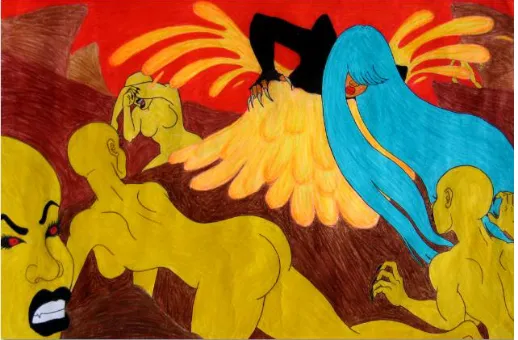
Volcanic Eruption II illustrates Sulfur’s struggles as she defends herself from dark forces, called
relics that were trying to attack her while she was being born from a volcano. She defeats all of her
opponents, and meets another warrior, named LEAD and they fall in love. I created this series to be a
[image:14.612.73.252.342.587.2]Figure 6. Danielle Z. Yarbrough, Volcanic Eruption II, panel 1, 2012, crayons, 3 by 5 ft.
Figure 7. Danielle Z. Yarbrough, Volcanic Eruption II, panel 2, 2012, crayons, 3 by 5 ft.
[image:15.612.73.329.476.648.2]Figure 9. Danielle Z. Yarbrough, Volcanic Eruption II, panel 4, 2012, crayons, 5 by 3 ft.
[image:16.612.73.241.359.612.2]Figure 11. Danielle Z. Yarbrough, Volcanic Eruption II, panel 6, 2012, crayons, 5 by 3 ft.
Part of my inspiration for this project springs from the fact that I experienced personal
transformation after a visit to Paris. During my junior year at Clark Atlanta University, I had the
opportunity to study abroad in Paris for a semester. At the time, I was a French major, but halfway
during the semester, I found myself reaching out to Paris’ art community more and more. I have always
had a love for the Visual Arts, but my fear to pursue an art degree after high school kept me from
applying to art schools. I was afraid that I would become a “starving artist” and struggle through life.
While visiting the Rodin Museum, I remember having an epiphany after looking at the iconic Thinker
sculpture for a long time. I had to change my major to Art, because I felt like I would be denying a huge
part of myself that longed to be immersed in the world of the Visual Arts. It was that stifling fear of not
living my dreams that caused me to make the decision to change my major from French to Art. I am very
grateful for the self-actualizations that I experienced while I lived in Europe and I would like to think that
it was the catalyst for my personal transformation from a directionless French major to a motivated Art
When I became an Art major at Clark Atlanta, I felt like I was transforming! My time was very
brief and I only had one year and a half to complete my degree. I dove into my work, taking advantage
of every opportunity that came my way. One of the opportunities that I am most grateful for was the
Kasha and the Zulu King animated film internship at Turner Studios. This experience helped to shape my
life as an artist, because I learned what it meant to be in a creative environment and work with
professional artists. Even my interview for one of the animator positions had a profound effect on me. I
was advised by one of my art professors at Clark Atlanta to show the director my best figurative work—
which consisted of art from my high school portfolio. I was a little unsure if my portfolio was strong
enough to show the extent of my drawing skills, but during my interview, the director, Jai Husband, was
very impressed with my figurative work. I was hired as an animator and taught the technical skills that
were required to animate Jai Husband’s movie characters. My strong drawing skills allowed me to be
promoted to one of the supervising animators for one of the lead characters, Thedlewe, who was voiced
by Shirley Franklin. Kasha and the Zulu King premiered on BET on September 8 and Centric on
September 15, 2012, and recently won the 44th annual NAACP Image Awards for Best Children’s
Figure 12. Jai Husband, Kasha and the Zulu King, 2012, movie poster.
This internship was an affirmation for me that I needed to continue to follow my passion and
create a life for myself in the Visual Arts. Becoming an art major and interning at Turner Studios gave me
direction and ultimately inspired me to become an Art Educator, because I wanted to use my diverse
experiences to impact the lives of young people. In this thesis project, I decided to apply the skills that I
learned in college, my internship, and my graduate art courses to create a Flash animation that explores
the importance of transformation. POWER is a study of my interpretation of the magical girl
transformation sequence that is commonly found in Japanese animation. I hope to use my animation as
a valuable resource to teach Flash Animation in the classroom.
Magical Girl Genre
I have always been fascinated with the theme of transformation, and I was first introduced to
this theme through the Magical Girl genre found within Japanese cartoons, or anime. This genre
Magical Girl anime, Sally the Witch, premiered in Japan in 1966. When this sub-genre first developed in
the 60’s, the heroines were mostly magical beings such as witches, mermaids, and princesses. During
the 70’s, magical girls evolved into more mature roles and the most popular archetypes were cyborg
heroines. In the 80’s and 90’s, following the influence of cyborgs, magical girls evolved into warriors and
frequently used their powers to fight evil. Some popular examples are Sailor Moon and Revolutionary
Girl Utena. Sailor Moon, by far, is one of the most well-known Magical Girl animations. It premiered in
Japan in 1992. This anime has had a huge commercial success all around the world, and has been
translated into 15 different languages. Even today, it is still a very popular series, and has celebrated its
20th anniversary this year, (Sailormoon-official.com).
Sailor Moon has left such a huge legacy, that many other Magical Girl series continue to use
many of its ideas and concepts such as: fighting monsters and evil opponents, transformation activation
words, and stylized transformation sequences.
[The] heroine usually utters a key phrase, accompanied by certain gestures and/or using some
sort of magical device, and then hovers into the air over a magical background, then has her
clothes disappear as her hero costume glows into existence over her, (tvtropes.com, 2004, para.
2).
Magical girls are protectors and use their magical abilities to defend themselves and others.
They typically started off as ordinary and not very confident, but after their transformations, they
develop a stronger sense of self-assurance in their own abilities. Below, I discuss the popular animated
series, Dragonball Z, because transformation played a vital role in the show during action scenes that
involved conflict and adversity. In Dragonball Z’s Sixth Season, one of the main characters displayed
‘magical girl’ characteristics because he held a hidden power within, and it was only during the final
I believe that transformation is a culturally relevant theme to teach to young people, because it
can be used as an empowering metaphor to encourage students to rise to their greatest potential. Sailor
Moon, Revolutionary Girl Utena, and Dragonball Z were my favorite series to watch in my youth. I was
inspired by the characters’ metamorphoses into strong warriors, and this is reflected in my artwork.
These animations have had a positive impact on my life, and I believe that teaching children how to
create their own digital narratives that include transformation sequences will inspire them as well. For
my studio-thesis project, I created a short animation that I will use as a teacher sample to teach students
how to use Adobe Flash. During this study, I analyzed and deconstructed the visual elements and
symbolism within these three animated series in order to help me create my own animation. While I
created my transformation sequence, I documented my production process and provided implications
on how Adobe Flash can be used in the art classroom.
Purpose of Study
The purpose of my studio-based thesis was to interpret the significant themes within the
transformation sequence in the Magical Girl genre, document the process of creating a Flash animation,
and discuss how thematic instruction can be used to teach Flash Animation in the classroom. According
to the book, Art for Life, creating thematic projects can encourage students to become more actively
engaged and use higher cognitive thinking skills.
Through investigating meaningful themes, students weigh and synthesize new information in
relation to their own personal experience and so can create or construct new knowledge… [and]
this will give them a sense of their place in the larger world and of the many possibilities for
choosing and making meanings in that world, (Anderson and Milbrandt, 2002 p. 33).
Art educators should understand how to teach digital narratives in the classroom. Animation is a
relevant subject and many young people are interested in the medium. However, many students are
stories. They also may not have been taught to appreciate the discipline and effort professional
animators must have in order to create animated sequences and digital compositions. When I was a part
of the animation internship at Turner Studios, my creative director taught me skills that were relatively
easy to understand and implement. I feel that this would be an excellent project for students, because
one of my fellow interns was a high school student, and he was a very talented animator.
When I worked on my internship at Turner Studios, I had the pleasure of working with many
interesting and talented interns. Although my director, Jai Husband, primarily selected interns from
Clark Atlanta, Morehouse, and Spelman, he also selected a few other talented art majors from other
colleges like SCAD and the Art Institute, as well as one high school student. I was very impressed by this
young man’s technical skills and excellent draftsmanship. His presence made me realize that animation
is not a difficult skill to learn and young people can be just as skilled as adults if they are properly
trained. I appreciated his presence on the team, because he brought along the energetic freshness of
youth. After completing the internship, I decided that I wanted to teach young people animation skills. I
also feel that animation classroom projects would be an excellent way to encourage more collaborative
assignments because in the industry, animators work in teams to complete projects.
Need for Study
The art classroom is often a place of self-discovery and self-actualization. I believe Flash
animation is an excellent medium to help students articulate their feelings about themselves. “ Art
educators today need to become more sophisticated in their use of newer digital technologies,
acknowledging that opportunities for image-making must extend beyond clay, crayons and paint,”
(Stankiewicz, 2004, p. 90). Mayo (2007) suggested that art educators teach students the value of the
conceptualization process: “Spending lesson time on planning the project is worthwhile. The
preconception process is the most vital phase of any art and design project,” (p.49). The conceptual
storyboards, and production. As an animation intern, these processes were the most important steps,
and I could not create engaging sequences without utilizing these invaluable skills.
Mayo (2007) also emphasized presentation and critique, because these are real-world skills that
professional animators demonstrate in the workplace. Before animators can create their scenes, they
must create their characters, storyboard the actions, and present their ideas to their director for review.
Animators that are hired by large companies like Turner and Disney, work together in teams to complete
projects. Kundu and Bain (2006) explain that learners benefit substantially from working in
collaborations. “By working as a team with the same goal yet individual tasks, children experience how
it is in a real workplace—people, with differing jobs, working toward one goal,” (p.10).
Animation is also an excellent tool to tell stories and narratives can be used as a way to
document and explain the human experience. Delacruz and Bales (2010) wrote that narrations result
from, “the human need to collect, recontextualize, and confer meanings on objects as a means of
seeking permanence in the world,” (p. 33). There is so much structure within school systems that art
educators must provide young people the opportunity to voice how they feel through mediums that
they can relate to. “[Their] insights and renderings captured in fleeting moments may each serve as a
means of making special and strengthen student identities that are in the process of developing,”
(Delacruz and Bales, 2010 p.39). I saw this strength and confidence blossom in my fellow high school
intern, and I feel that the same confidence could be cultivated teaching other students how to create
their own Flash animations.
In conclusion, I believe that it is important for art educators to teach the process of Flash
Animation to learners. It is also important that students learn the value of research and preparation
during the conceptualization process. There are intellectual and collaborative advantages to thinking
and engaging in the systematic process of animation. Finally, because of my internship experiences
will have a thematic focus on the Magical Girl transformation sequence, and will also act as a teaching
resource. By teaching students to use Adobe Flash, learners will be able to construct their own thematic
animated narratives.
Key Terms:
Throughout my research, I will use the following terms:
Adobe Flash: a software graphic program that uses a vector system to create graphics, (Jackson 2010).
Animatic: a storyboard that has audio and/or dialogue, (Laybourne 1998).
Bitmap: a digital image composed of a matrix of dots, (Techterms.com).
Cel Animation: A traditional animation process that consisted of using transparent acetate sheets to create animation, (Laybourne 1998).
Cut-Paper Animation: a simplified form of traditional animation that consists of animating figures made from paper, cloth, and other materials, (Laybourne 1988).
In-Betweens: the drawings between the key frames which help to create the illusion of motion, (Laybourne 1998).
Key Frames: markers of precise moments when a selected image will be manipulated in one way or another, (Laybourne 1998).
Magical Girl Genre: a Japanese animation genre about young heroines that have magical powers (Tvtropes.org).
Motion-Tweening: a feature available in Adobe Flash that allows you to easily animate the motion of an object, (Techterms.com).
Optical Toys: toys that gained popularity in the early 1900’s that used basic optical illusions to simulate movement, (Laybourne 1998).
Persistence of Vision: a theory that stated that the human eye can retain an image for a fraction of a second, before the image disappears, (Laybourne 1998).
Thematic Instruction: an instructional method of teaching that uses theme to construct knowledge, (Anderson and Milbrandt 2002).
Tradigital Animation: A Flash animation technique that requires the usage of traditional animation and digital processes, (Georgenes 2007).
Vector: graphics that can be scaled larger or smaller without losing quality, (Techterms.com).
Wacom Tablet: a device that allows animators to draw graphics directly on to the computer and omits the paper production process, (Georgenes 2007).
These terms appear throughout my literature review in Chapter Two and in the description of
my process in Chapter Four. In Chapter Two, I will elaborate more on the history of animation, discuss
how thematic pedagogy can be used to teach the animation production process, and analyze the
CHAPTER TWO
Literature Review
Flash animation is a powerful tool to use in the classroom, because it is a process-oriented
medium that is an excellent platform for thematic narratives. Animating with Flash can also allow
students to build computer literacy skills and learn traditional animation production techniques. Flash’s
hybrid nature has led it to be deemed a tradigital medium, because it blends traditional animation
processes with digital media. Exploring Flash animation in the art classroom is ideal because the entire
history of animation is rich and delightful. Animation has brought joy to people of all ages all around the
world, but many are unaware that the earliest forms of animation began as simple optical illusion toys
made during the early 19th century (Laybourne, 1998, p. 18). These toys are very simple to create and
many art educators have used them to help teach students the fundamentals of animation. As
mentioned earlier, the process-oriented nature of Flash software can be enhanced with thematic
pedagogy and can also cultivate 21st-century skills. This dynamic medium allows students to tell stories
about their life experiences, builds personal relevancy, and can motivate learners to pursue Arts-related
fields. In this chapter, I will discuss the history of animation, examine how thematic pedagogy can be
used to teach animation effectively, and interpret the transformation themes within the Magical Girl
genre.
The History of Animation
During the early 1900’s, there was a line of toys that used basic optical illusions to simulate
movement. Although some of these toys seem very basic in their design, they utilized a sophisticated
scientific theory called the persistence of vision to create the illusion. The persistence of vision theory
stated that human eyes can retain an image for a fraction of a second after the image has disappeared.
When a single image is flashed at the eye, the brain retains that image longer than it is actually
images themselves are only slightly changed…the effect is that of continuous motion,
(Laybourne, 1998, p. 26).
During the 1900’s, there was great public interest in using technology and art to create illusions of
continuous motion, because of the invention of the camera.
Thaumatrope. The first optical toy was the Thaumatrope, and it had a very simple design. This device
was a flat paper disc, with two designs on each string. It had two long strings attached evenly on
opposite sides of the disc. To successfully manipulate this toy, the user had to pull the two strings
simultaneously in order for the disc to spin and meld the two images into one whole image. Although
this toy did not show the illusion of motion, it did utilize the persistence of vision to trick the eye into
seeing an uninterrupted figure. The most popular design was the bird in the cage, which depicted a bird
on one side and a metal cage on the other. When spun, the bird appeared in its cage. This device was a
charming little toy, but it fell out of popularity with the invention of the phenakistoscope in 1832.
Phenakistoscope. The phenakistoscope was invented by a Belgium physicist named Joseph Plateau in
1832 (courses.ncssm.edu, 1996, para. 1) and it was the first optical toy to create the illusion of implied
movement using a series of successive images. This device consisted of two paper discs that were
attached to a metal axis. The two discs had an even number of slits that were cut near the side of its
entire circumference. The second wheel had a series of still images in between each of its slots. In order
for the toy to create the desired illusion, each frame had to show a progression in movement and
stance. The Phenakistoscope’s two discs had to be spun in the same direction and viewed through a
mirror. “When viewed in a mirror through the first disc’s slots, the pictures on the second disc will
appear to move,” (courses.ncssm.edu, 1996, para.3). This toy had a huge commercial success for
several years until the invention of the zoetrope in 1867.
Zoetrope. Another optical toy, the zoetrope was named after the ‘wheel of life.’ Unlike the
experience of watching brief animations together. The zoetrope looked like a small up-side down drum
that was held together by a turntable base. A series of sequential drawings on strips of paper could be
placed inside the Zoetrope’s inner walls. Like its predecessor, the phenakistoscope, it had slits that were
distributed evenly around its entire diameter. The slots were used to line up with the paper reel and
allow the viewer to watch the animations created when spun. “…The faster the rate of the spin, the
smoother the progression of images. A viewer can look through the wall of the zoetrope from any point
around it, and see a rapid progression of images,” (courses.ncssm.edu, para 3).
Praxinoscope. The arrival of the Praxinoscope in 1877 caused consumers to lose interest in the
Zoetrope. This new device can be described to be the “High Definition” optical device of its day, because
it projected better quality animations. It also held more film so it could show longer animations and
could be used to project imagery on to a screen. This device originated in France, and was invented by a
man named Charles Reynaud (courses.ncssm.edu, 1996, para. 1). It had the same drum-like silhouette of
the zoetrope, but its internal design differed dramatically. Unlike the zoetrope, which had one large
cylinder that was used to support its animation reels, the Praxinoscope had a leaner cylinder placed
inside its center. The smaller cylinder had a small set of mirrors that were glued to its walls and were
equal to the number of frames on the reel stills. The outer cylinder also was designed to rotate, and
once spun, the viewer could watch the animation from the mirror’s reflections. (courses.ncssm.edu)
Flipbook. Another optical toy that played a pivotal role in the advancement of animation was the
invention of the flipbook during the beginning of the 20th century. This stream-lined optical toy was
made by binding a number of successive drawings together to thumb through quickly to view the brief
animated sequence. This toy used a technique called the registration system to achieve the illusion of
motion. The registration system was a simple way of keeping all the pages aligned properly, so that the
animation could transition evenly. The flipbook is also credited to have had a direct influence on Cel
with the technique of Cel animation, one of the most sophisticated of all animation techniques,”
(Laybourne, 1998, p. 22).
In conclusion, optical toys have had a tremendous influence on the evolution of animation.
Using persistence of vision and the registration system technique, these optical devices delighted the
imaginations of consumers of the past, similar to how contemporary animation continues to entertain
us in the present day. All of these devices are fairly simple to make and can be excellent art projects to
help students learn more about the origins of animation. The Thaumatrope, Phenakistoscope, Zoetrope,
Praxinoscope, and the Flipbook have all provided basic techniques for the advent of cartoon animation.
Over a hundred year period, inventor after inventor further refined these optical devices. Along
the way, machines combined with the emerging technology of photography to create yet
another entertainment, the movies. Mechanical toys were wedded to celluloid and gave birth to
cartoons, (Laybourne, 1998, p. 18).
Cel Animation
The most popular style of animation that is used to create cartoons is cel animation. This
process consists of using transparent acetate sheets to create animations. Although producing cel
animations is a lengthy process, this technique has a great advantage: cels could be layered on top of
one another so that animators did not have to draw every single detail in every frame.
For example, if a character is motionless on the screen for a few moments, except for his mouth,
cel techniques allow the animator to use one cel to show the body and head, and another set of
cels to animate the various positions of the moving mouth. (Laybourne, 1998, p. 172)
Walt Disney is credited with refining and elevating Cel animation. The Disney animation studios
took cel animation to a whole new level by de-compartmentalizing the production process and creating
an assembly-line hierarchy in the 40’s and 50’s. In fact, this hierarchy is still implemented in
creating an animation, a storyboard must be created to visually narrate the storyline. “[A storyboard is]
a collected series of single pictures, each of which represents a distinct visual sequence or narrative
element within the project being developed,” (Laybourne, 1998, p. 100). During this time, the
production team will record the voices of the voice actors, sound effects, and musical scores before the
animation process begins. After the sound has been recorded, the storyboard and the dialogue are
fused together to create an animatic.
Animatics are beneficial because they allow the animation team to determine if the dialogue
connects with the storyboard illustrations and identifies any technical issues. With the help of the
animatic, the animation director is able to make important decisions on the timing of movement, layout
and design, and the art direction of the film. Once all of these conceptual ideas have been approved, the
animation process can begin. Background painters are assigned to paint all of the sets in the entire film,
and they generally use paint mediums such as watercolor and gouache. Often times, backgrounds in
animation are painted with light muted colors and favor color pallets that complement the main
characters bolder tones. According to Laybourne (1998), character animators are usually assigned to
each character in the film, and are led by one lead animator.
The lead animator’s role is to draw their character’s major points of movement or key frames in
pencil and paper. Then the assistant animator uses a process called, motion-tweening, which consists of
drawing in-betweens in pencil to connect all the frames together. Once the pencil animations are
completed, the drawings are inked and painted on to cel sheets and a film editor prepares the film reel
to the matching soundtrack, before sending it off for duplication and distribution. Cel animation became
a dominant force in the animation industry, but over time computer animation has overtaken some of
the processes within traditional animation. For example, the ink and paint process has been replaced by
computer graphics, and pencil drawings are now being inked and planned digitally before being
have gone completely digital and have omitted the entire pencil and paper process altogether. There are
many two-dimensional digital programs used presently, but for the sake of this study, I will focus on the
industry’s usage of Flash.
Adobe Flash
Flash was originally designed to create two-dimensional computer generated animations for the
web in the 90’s. Over time, this program has evolved into a sophisticated two-dimensional animation
tool that has merged the best of traditional cel animation’s golden techniques with state-of-the-art
digital tools to create delightful animations for the web, television, and movies. “Today, Adobe Flash is
packaged with automated computerized versions of traditional animation techniques. Its format and
workspace allows you to save a considerable amount of time and therefore reduce a project’s budget,“
(Jackson, 2010, p. 12). This program has many advantages, such as: it uses a vector system to create
media. Unlike bitmap files, which can become pixilated if enlarged beyond their resolution width, vector
image files can be scaled up and down as much as possible. Vector files are generally smaller than
bitmap files and advantageous for posting online. Art that is made in Adobe Flash is often called vector
art.
Flash is well known for its inherent visual look which is vector-based. Vector art uses math to
store and create an image [and] can be scaled without losing any detail. As a result,
vector-based artwork produces rather small file sizes that are ideal for web delivery, (Jackson, 2010, p.
12).
It is important to know that bitmap files can be used in Flash to produce animations that are
reminiscent of Cut-out animation. Cut-out animation is a simplified form of traditional animation that
independent animators created in an effort to reduce labor and production time. Cut-out animators
to digital programs. South Park by Trey Parker and Matt Stone is an example of a digital cut-out
animation.
Flash animators can also draw and paint directly onto this program with a mouse or with graphic
tablets. When I worked on my scenes in Turner Studios, I noticed that all of the Flash animators used
Wacom tablets and Cintiqs, while they worked. Graphic Tablets are also a mark of the contemporary
movement of tradigital animation, because they omit the need for unnecessary paper animation
production and save time. As mentioned earlier, the two most popular graphic tablets used are
Wacom’s Bamboo tablets and Cintiqs. Bamboo tablets vary in size, and come with a stylus pen. It
connects to the computer and the animator draws on to the tablet’s surface while the design appears on
the computer screen. The Cintiq tablet is very large and far more sophisticated than Bamboo tablets,
and allows animators to draw directly on to the screen. They also connect to the computer like a mouse,
and come with a drawing stylus. This device completely omits the paper process that traditional
animation is known for, and I saw many professional animators using Cintiqs while I interned at Turner
Studios. “With the Cintiq you work directly on the screen. This allows you to take advantage of your
natural hand-eye coordination since you are actually looking where you are working, “(Georgenes, 2007,
p. 149).
Lastly, Flash is ideal for publishing animated series online (often called webisodes) for
commercial entertainment and advertising. One popular web series that I have enjoyed watching is
Mattel’s Monster High fashion doll series. This successful toy franchise has released three volumes of
brief animated episodes. This web series is an advertising tool to educate consumers about the brand
Figure 13. Monster High, 2010, movie poster.
As mentioned earlier, Flash animations are also very common for television productions and one
of my favorite animated shows is the popular Adult swim series, Metalocalypse. This series uses Flash
Animation to illustrate the comedic lifestyle of a successful heavy-metal rock band. Recently, the show
aired its first TV movie special called Doom Star Requiem, which was a rock opera made entirely in Flash.
Monster High and Metalocalypse are just two examples of incredible Flash Animations that reflect how
many talented professional animators are taking this medium to the next level.
Figure 14. Metalocalypse, 2006, movie poster.
In conclusion, Flash has come a long way, and has evolved into a sophisticated medium that
uses traditional processes to create digital animations for the internet, television, and movies. My
experiences working with Flash during my internship taught me that this tool is fairly easy to learn, and
[image:33.612.76.319.416.571.2]many of the processes of traditional techniques, which could help teach students to appreciate the
process-oriented nature of animation. In general, Flash animators use the following production
hierarchy: story, art direction, storyboard, dialogue, animatic, final animation, publishing, and
distribution (Jackson, 2010).
Even with its simplified production process, teaching students how to use Flash requires
considerable knowledge of effective teaching strategies. Animation is a very technical-based medium
and can be viewed as irrelevant to some students if they cannot make personal connections to the art
form. While many young people do find animations entertaining, there are some who may not be
actively engaged if the technique was taught purely as a technical skill. Rather, incorporating
fundamental themes into Flash projects can build meaning and relevancy. The pedagogical strategy of
Thematic Instruction is an ideal method to teach Flash Animation projects, because of its focus on
themes to narrate and investigate topics. This pedagogy also incorporates teaching strategies such as
collaborative group work, hands-on activities, and documentation to construct knowledge. “Researchers
have found that students learn better and more deeply when they take up powerful ideas, with units
and lessons organized around key supporting concepts, then when they learn merely facts or
techniques,” (Anderson and Milbrandt, 2002, p. 9). In the next section, I will discuss the benefits of
thematic instruction and provide two examples of Art Education programs that have used
thematic-based learning successfully.
Thematic Instruction
Thematic Instruction is a teaching strategy that uses themes to construct knowledge. “Themes
arise from…personal relationships to topics…when we make a topic human and personal through such
connections,“ (Anderson and Milbrandt, 2002, p. 237). According to Art for Life (Anderson and
Milbrandt, 2002), thematic instruction in art education should focus on universal human themes so that
also has an interdisciplinary approach, because it fuses art and non-art disciplines such as math and
science together. “Exploring a topic through art lets students become intimately acquainted with art as
form…Themes are the conceptual center. Making and studying art are the means of addressing the
concepts involved. Themes steer. Art drives,“ (Anderson and Milbrandt, 2002, p.170). Flash animation is
an excellent medium to investigate themes and illustrate personal narratives.
Themes should be selected that expand on personal relationships to certain topics, in order to
set the groundwork for exploring new knowledge. “Themes give students an intellectual framework for
connecting otherwise unrelated bits of information and modes of inquiry so as to find relevance and
meaning,” (Anderson and Milbrandt, 2002, p.32). This pedagogy also fosters thematic inquiry, because
students have multiple ways to investigate and collect new information through art-making activities.
Such discipline approaches include: informed reading, historical examinations, observational drawing
and painting, and critiques, (Anderson and Milbrandt, 2002, p.32). Critiques are very important tools to
construct new knowledge because it involves the usage of substantial conversation. Through dialogue
and collaborative assignments, higher levels of thinking can be stimulated and build stronger communal
bonds within the art classroom.
Research sketchbooks are also a great tool to use to aid in the process of thematic inquiry.
Research sketchbooks are the perfect mediums for self-discovery and problem-solving. They allow
students to visually express incubated ideas and draw connections to their personal lives. “When
students address themes in this way, their understanding increases: they connect their personal
experience with universal themes found not only in art but in daily life” (Anderson and Milbrandt, 2002,
p.33). Animators use research sketch books all the time to help them solve conceptual problems. When I
was an animation intern, I created a pose booklet to help me determine how I wanted my characters to
future animation curriculum. I feel that students will also appreciate using research sketchbooks
because it is a real world skill that is utilized by professionals in creative industries.
Lastly, using thematic instruction to teach animation helps to develop essential 21st-century
skills, such as creativity and collaborative work. Thematic Inquiry helps to stimulate important thought
processing strategies, such as brainstorming and webbing to create a multitude of new ideas.
Collaborations allow students to stretch their cognitive abilities, by communicating with each other and
incorporating different perspectives to make impressive group projects. In the next section, I will
provide two examples of art education programs that used different types of animation techniques to
encourage higher-level thinking, collaboration, and thematic inquiry.
Animated Visions Program
In the article, “Teaching Animation in an Interdisciplinary Context,” Hayes (2007) provides an
excellent example of how thematic-based animation projects can cultivate high cognitive-thinking and
encourage real world connections. Hayes (2007) shares why embedding animation education within an
interdisciplinary curriculum is important: “Animation is one of the most interdisciplinary art forms. It
makes sense to teach animation in a way that connects it to the other disciplines that inform it and that
attempts to address,” (p. 25). Hayes (2007) used a thematic approach to implement different animation
workshops that incorporated non-art disciplines to enhance her curriculum. Her program Animated
Vision explored 20th century Russian history and she created several animated exercises to prepare her
students for the main assignment at the end of the semester.
Hayes (2007) screened multiple Russian films and engaged the students in critical analysis and
discussions. Students were tasked with documenting their thoughts in research sketchbooks and film
journals. While watching each film, the students had to record their thoughts in their journals and write
brief summaries about each film. Her students were instructed to use their sketchbooks to take visual
compositions. This exercise helped the students to examine the aesthetical stylizations within movie
scenes, so they could utilize those techniques in their own film projects. The students were also assigned
to present a brief presentation on assigned films and talked about the various themes and techniques
within their assigned movie selections.
For the animation projects, Hayes (2007) assigned her students to design a character from one
of their assigned readings and animate them in a walk cycle. A walk cycle is an animation term, to
describe a succession of figure drawings that imply that the character is walking. Since many of her
students had different knowledge bases on animation, Hayes (2007) assigned an introductory exercise
to create zoetrope strips of bouncing balls and walking sequences. When students accomplished this,
they were required to have their characters transform into each other’s character, elongating the
animation and adding brevity to the assignment. “The result was “Russian Character,” an Exquisite
Corpse composed of a sequence of walking characters who suffer abrupt and frequently hilarious
transformations” (Hayes, 2007, p. 35). Students had the option of creating a two-dimension animation
(using pencil, cut-out, or paints-on-glass techniques) or three-dimensional (stop-motion, Claymation,
and puppetry).
The projects were a success and Hayes (2007) wrote that she was pleased by the students’
thematic stories and the level of creativity they brought to their projects. “[One] project involved
beautifully designed articulated puppets and drawn backgrounds used to explore the desire for spiritual
connections in the context of state enforced atheism,” (Hayes, 2007, p. 36). Animated Visions was a
successful course because it used the cross-pollination of animation and non-art disciplines to enhance
learning. Overall, it seemed to teach students that animation is a powerful visual communication tool
that can be used to express important human themes. “Issues of representation, negative stereotypes,
cultural blindness, appropriation or exploitation can be more easily addressed in animation” (Hayes,
Cut-Paper Animation Project
The article, Animation Education in an Indigenous Context, illustrates another example of a
successful animation project. The two teachers, Davenport and Gunn (2007), wrote about a cut-paper
animation project that they implemented in a Mexican school called CRES Estipac. The school was
founded in 1980, and its main mission was to provide vocational and entrepreneurial education
programs to indigenous and rural students. Davenport and Gunn’s (2007) main goal for this project was
to teach students and teachers how to use visual communication tools for thematic and narrative
projects.
Our primary objective in designing workshops for CRES Estipac was to promote the development
of skills and understandings in visual communication, in order that these teachers and students
might engage more critically with media to which they are exposed, utilize the tools of visual
media to produce their own stories, and share their vision with others toward greater
intercultural understanding, (Davenport & Gunn, 2007, p. 50).
Davenport and Gunn’s (2007) animation program lasted only two weeks, but in that short
period of time, they helped to facilitate three animations and three videos in different mediums.
However, for the sake of this study, I will discuss the cut-paper animation, because it has a thematic
focus on the CRES students’ relationship with their school community. Davenport and Gunn (2007)
began the cut-paper project by teaching the pre-conceptualization of creating an animation first. They
taught the students how to use the equipment and assigned them into teams to do fieldwork outside
the classroom. “We sent teams of students out with equipment to record the myriad entrepreneurial
activities and facilities throughout their campus,” (Davenport & Gunn’s 2007, p. 52). Many of Disney’s
animated films in the 90’s, featured documentaries about how art direction teams investigated different
locations in order to incorporate authenticity to the films’ backgrounds. In the Making of documentary
traveled to Paris to study the magnificent Notre Dame Cathedral in order to paint the film’s gorgeous
scenic backgrounds, (www.youtube.com).
Once all the information had been gathered, Davenport and Gunn (2007) helped to facilitate a
cut-paper production called, A Day in the Life of CRES Estipac. The teachers began the project by
teaching the students about cut-paper animation and presented several examples of other student’s
previous lessons. Then the students were instructed to use the photos they had taken as a reference to
paint a large mural as the background painting for their animation. While one group painted the mural,
other students were assigned to be the character animators and were taught how to make paper
characters with movable joints. When both of these processes were completed, the students took turns
animating the figures on the mural.
To film the animation, participants hung the mural on a classroom wall and used tape to attach
and position the paper figures in various places. They then took turns animating the figures,
using a video camera, laptop computer, and iStopmotion software to record them frame by
frame, (Davenport & Gunn, 2007, p. 52).
To further enhance the student’s experience working on the project, Davenport and Gunn
(2007) invited students to document the production process through video recordings and photographs.
They complied all of the extra footage together and created a short “making of” documentary as a
teaching resource to educate viewers on the student’s hard work to create an animated film. This
project was very effective because it taught students how to use visual language to illustrate thematic
narratives about their lives. Animation is a thematic tool that can benefit and empower youth and
should be taught in the art classroom.
Magical Girl Themes
Finally, for the last section of this chapter I would like to identify and interpret the two central
Sailor Moon, Revolutionary Girl Utena, and Dragonball Z. Sailor Moon and Revolutionary Girl Utena are
both classified under the Magical Girl genre, but Dragonball Z is an action cartoon. However, Dragonball
Z has an important magical girl-like transformation in its Sixth Season’s finale episodes. In all three TV
shows, the main character’s transformation symbolizes the occurrence of two universal themes: rite of
passage and slaying the dragon alone. Referencing Joseph Campbell’s (1988) book, The Power of Myth, I
will examine both themes' meanings and how they relate to each of the animated series. However, I will
begin by providing a brief synopsis of each animated series.
Sailor Moon. Sailor Moon was a Japanese animation that aired in Japan in 1992, and it is known to be
the most iconic Magical Girl series. The story is about a young girl, named Serena, who discovers that
she is the reincarnation of the Moon Princess Serenity. Her mother, the Moon Queen, sent Serenity and
her personal soldiers to Earth, to keep them safe from an evil ruler. The series follows Serena’s
transformation from a flighty and air-headed girl into a warrior woman strong enough to defeat the
powerful villain at the end of the series (tvtropes.org).
Figure 15. Sailor Moon, 1992, movie poster.
Revolutionary Girl Utena. Revolutionary Girl Utena was created in 1997 and can be described as a
post-modern fairytale. This show is about a young girl named, Utena Tenjou, and her adventures at a
Himemiya, and became involved in a series of fencing duels to protect Anthy from other duelists. Utena
labeled herself as a prince, and every time she dueled, she transformed into a prince-like uniform. At the
end of the series, Utena defeats the main villain and sacrifices herself to save Anthy (tvtropes.org).
Figure 16. Revolutionary Girl Utena, 1997, movie poster.
Dragonball Z. Dragonball Z was also created in 1997, and is one of the most popular Japanese
animations of all time. This iconic show is about a group of martial arts fighters that protect the Earth
from evil forces. In Season Six, the fighters had to face a powerful super villain, named Cell. The only
warrior that was strong enough to defeat the monstrous antagonist was Gohan, the young son of one of
the main characters. Gohan was a young boy, that had a hidden power inside of him, and it could only
be awakened when he needed to protect his loved ones. After Cell killed one of his friends and his
father, Gohan flies into a rage and transforms into a powerful being and defeats the evil villain
Figure 17. Dragonball Z, 1997, movie poster.
Analysis
In all of these animations that I have described, there are the reoccurring themes of rite of
passage and slaying the dragon alone. In The Power of Myth, Campbell (1988) describes rite of passage
as a ritual that everyone must go through in order to transition from childhood to adulthood.
This adventure can be seen already anticipated in the puberty or initiation rituals of early tribal
societies, through which a child is compelled to give up its childhood and become and
adult…This is a fundamental psychological transformation that everyone has to undergo,
(Campbell, 1988, p. 152).
In the Magical Girl genre, the main characters are usually young people who are still trying to
understand themselves and the world around them. When they discover their transformation gifts, it
helps them to overcome obstacles and endure dangerous tests. Oftentimes, when the magical girl or
boy transforms, they appear to look physically older and display more adult-like demeanors. I interpret
this visual change as a brief rite of passage, because the transformation allows them to challenge adult
their prime, and could easily defeat the magical girl or boy in their non-magical state. The hero and
heroine’s transformations gave them the strength to take on their more experienced opponents and
win. The magical girl or boy’s final confrontation with the villain is always alone, which leads me to the
second theme: slaying the dragon alone. Commonly associated with fairytales, this theme signifies the
hero’s final battle to overcome a monstrous dragon. According to Campbell (1988), slaying the dragon
represents facing one’s ego and inner fears. The Dragon represents a great fear that must be overcome
in order for one to be liberated. “Ultimately, the last deed has to be done by oneself. Psychologically,
the dragon is one’s own binding of oneself to one’s ego…The ultimate dragon is within you, it is your ego
clamping down,” (Campbell, 1988, p. 184).
In the last episodes of Season One of Sailor Moon, Serena’s Sailor Scouts died protecting her
from the evil ruler and Sailor Moon had to stand up against the villain alone. In a David and Goliath-like
motif, the evil ruler used her magic to make herself into a towering giant, and the two characters faced
off in an energy beam standoff, until Sailor Moon used all of her will to destroy the evil tyrant. In
Revolutionary Girl Utena, Utena fought all the other duelists until she was the last to fight against the
mysterious villain, named End of the World. She discovered that the antagonist was actually a love
interest that sought to betray her and take her soul. Utena was able to defeat him in an intense sword
fight and sacrificed herself to save her friend, Anthy, from End of the World’s control. By sacrificing
herself, Utena demonstrated a separation from her ego which allowed her to place Anthy’s needs
before her own. Finally in Dragonball Z, Gohan had to fight Cell alone, when all of his fellow warriors
were unable to do so. In the final standoff, Gohan found the will within himself to unleash his amazing
powers to defeat the seemly unstoppable villain and avenge his fallen father.
I believe that slaying the dragon alone is a very relevant theme that students of all ages can
relate to because everyone has to face challenges alone in their lives. Dragonball Z, Sailor Moon, and
create engaging and inspirational narratives. They talked about how each hero and heroine had to
transition from immaturity to maturity and remind us that we all have challenges that we must face
alone. Transformations helped to illustrate these universal themes and can also help to inspire us to go
out and take on the world. Campbell (1988) mentions that the rite of passage and slaying the dragon
themes can be found in ancient myths and help to provide insight on our lives. “Myths inspire the
realization of the possibility of your perfection, the fullness of your strength, and the bringing of solar
light into the world. Slaying monsters is slaying the dark things. Myths grab you somewhere down
inside,” (Campbell, 1988, p. 184).
Summary
In conclusion, I believe that Flash animation is an engaging and relevant medium that should be
taught in the art classroom. Teaching students how to use this medium to create their own thematic
narratives could help to encourage higher-levels of thinking and utilize 21st-century skills.
Transformation is a relevant theme that can be found in the popular Magical Girl genre. Transformation
sequences symbolize the young heroine’s rite of passage and strength to slay the dragon alone. These
themes are relevant to young people, especially high school students, because they are about to
transition to college or work and will face new challenges alone without the support of their parents. In
my opinion, we all go through personal transformations and creating thematic animations to illustrate
these defining periods of our lives can be an empowering form of expression.
In the next chapter, I will discuss my research questions and the methods I will use to document the
CHAPTER THREE
Methodology
For my study, I created a brief Flash animation about a Magical Girl transformation sequence.
Although there are many wonderful variations of Magical Girl transformations, most follow a certain
conceptual plot as explained above. My specific research questions guiding my work are:
What is the significance of the visual elements and symbolism of the transformation sequences
within the three animations I referenced in creating my transformation short?
What are the steps in creating a flash animation and what insights can I gain through creating
and documenting my process?
What implications might I derive for the classroom setting from this process?
I began my investigation by watching several Magical Girl transformations clips on YouTube,
especially the scenes from Sailor Moon, Revolutionary Girl Utena, and Dragonball Z. I took visual notes
of my favorite poses and character designs in my research sketchbook. I also studied the background
paintings in the transformation sequences, so I could create my own backgrounds in Flash. Once I
gathered enough information, I created a storyboard of my character engaging in a magical
transformation.
Once the storyboard was completed, I created the magical backgrounds for my animation and
created vector art from my original character Sulfur, the heroine in my Volcanic Eruption series. I
created this series in my graduate studio classes, because I knew I wanted to use this character design
for my studio-thesis animation project. I traced and digitally painted the character in Flash to be
animated. I chose an instrumental techno song that had a stylish and fashionable sounding composition
to complement the vibrant visuals of my short film. Finally when the animation was completed, I
Timetables and Outcomes
My research and art production took place during a twelve-month period. When my work was
completed, I created a brief twenty-five second animation about a Magical Girl transformation
sequence. Throughout my investigation, I engaged in an intensive inquiry about the significance of the
Magical Girl transformation. I recorded visual studies of film techniques, so I could replicate those
elements into my own animation in Adobe Flash. At the conclusion of this study, I had created a
beautiful, well-crafted film that I hope will inspire students to create their own transformation
sequences in the art classroom.
Limitations
A potential limitation to my study was that I had chosen to focus my studio process on Flash
animation instead of trying to cover the complete range of animation techniques, in order to derive
potential classroom applications for that program. This means that teachers who do not have access to
this program may find this study to be of limited utility.
Another limitation is that the Magical Girl animations that I have referenced (Sailor Moon,
Revolutionary Girl Utena, and Dragonball Z) were all made in the 90’s, and there are many more recent
animated series that I could have referenced instead of these three TV shows. However, for the sake of
this study, I analyzed these older animations, because of their iconic legacy, contributions to the Magical
CHAPTER FOUR
Analysis, Creation, and Reflection
Analysis of Films
I began my research by viewing the three animations I have referenced throughout this paper:
Sailor Moon, Revolutionary Girl Utena, and Dragonball Z. While I watched each anime, I paid close
attention to the visual compositions of each hero and heroine’s physical transformation in order to draw
inspiration for my own animation project. As mentioned earlier, most of these shows were created in
the late 80’s and early 90’s, and I did not have any difficulty watching entire episodes on YouTube. While
I watched each show online, I also took the opportunity to gather screenshots of the transformation
sequences, so I could study the frames individually. I adopted this habit of gathering screenshots when I
was an animation intern, and this practice has helped me to deconstruct scenes, learn how to draw
strong poses, and study cinematic techniques. In all of the three shows, each transformation sequence is
aesthetically pleasing and effectively illustrates the release of the magical girl and boy’s hidden power.
These sequences were animated so beautifully, that they also contribute to each show’s iconic legacy
and international success. Throughout this chapter, I will provide screenshots and visuals from each
anime, and elaborate more on the visual significance of the scene.
Sailor Moon
The character, Sailor Moon has several transformations throughout the entire series, but for the
sake of this study, I will only discuss her first transformation in Episode One. As mentioned in Chapter
Two, Sailor Moon transforms into a warrior princess to defend the Earth from evil. As the leader of her
group of soldiers, she has the longest and most aesthetically-pleasing transformation sequence. In order
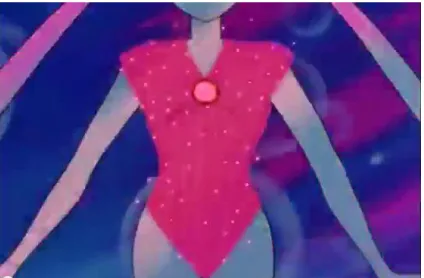
to activate her metamorphosis, she carries a magical make-up case and calls out a magical phrase. She
raises one outstretched hand into the air, and the background melts into a serene cool blue setting with