Research Schedule
Name : Titik Oktavia
SRN : 1013042068
Place of Research : SMA Negeri 1 Kalirejo, Lampung Tengah Script Title : Comparing Students’ Achievement in Learning
Vocabulary Through Clustering Technique and
Derivational Exercises at the Second Grade of SMAN 1 Kalirejo.
NO Day Date Activity Class
1 Monday February 10th 2014 Try Out Test XI IPS 3
2 Tuesday February 11th 2014 Pre-test XI IPS 2
3. Friday February 14th 2014 Pre-test XI IPS 1 4. Monday March 10th 2014 Treatment 1 XI IPS 2 5. Tuesday March 11th 2014 Treatment 1 XI IPS 1
6 Tuesday March 11th 2014 Treatment 2 XI IPS 2
7 Friday March 14th 2014 Treatment 2 XI IPS 1
8 Monday March 24th 2014 Treatment 3 XI IPS 2
9 Tuesday March 25th 2014 Treatment 3 XI IPS 1
10 Tuesday March 25th 2014 Treatment 4 XI IPS 2
11 Friday March 28th 2014 Treatment 4 XI IPS 1
12 Tuesday April 1st2014 Post Test XI IPS 1
Name : Class : No. :
Choose the appropriate word to complete the sentences!
1. Speaking is the way people with other people. 2. to speak English is very interesting.
3. The students make some groups to start the . 4. The teacher teaches English using an technique. 5. Reading habit can give an for students’
reading speed.
6. Students have different after they finish from school.
7. newspaper is a useful activity.
8. By reading newspaper, people will get many . 9. Teacher gives the for the students to do the test. 10. Narrative text is a text which has a function to the
reader.
11. Speaking English as much as can make the students easily learn the language.
12. The teacher provide some theories to support his 13. Every nation has different .
14. If you learn English, you can communicate with people from other countries.
15. Every Indonesian civilization should have identity card.
16. I need your help to do my homework.
17. The government always increase the of education. 18. Reading can give many information and . 19. Many students can not that learning English is
important.
20. Many students do not the difference between hortatory exposition and analytical exposition.
21. Mastering vocabulary can help the students to their language skills.
22. Music and song can make the students to learn English.
23. The government should make the campaign of reading 24. Reading can help the students to increase their vocabulary 25. Song can also help the students learn English
Key Answer 1. Communicate 2. Learning 3. Discussion 4. Interesting 5. Improvement 6. Activities 7. Reading 8. Information 9. Direction 10. Entertain 11. Possible 12. Argument 13. Culture 14. Easily 15. Personal 16. Really 17. Quality 18. Knowledge 19. Realize 20. Understand 21. Develope 22. Enjoy 23. Habit
LESSON PLAN
Institution : SMAN 1 Kalirejo
Subject : English
Class/Semester : XI / 2 Aspect/skill : Reading
Standard of Competence
11. understanding the idea of short fungsional text and essay in form of narrative, spoof, and hortatory exposition in daily life context and to access knowledge.
Basic Competence
11.2 Responding the idea and rhetorical steps in essay using written language style accurately, fluently, and acceptably in daily life context and to access knowledge in form of narrative, spoof, and hortatory exposition text.
Indicators
1. The students are able to identify the main topic of the text 2. The students are able to give comment about the topic 3. The students are able to give a solution related to the topic.
4. The students are able to find the keyword and related words from the text. 5. The students are able to produce a new sentence from the words.
6. The students are able to identify the generic structure of the text. Time allocation : 4 x 45 minutes
Objectives
1. Cognitive :
The students are able to understand the topic and generic structure of hortatory text.
2. Psychomotor:
The students can write the related words from the core-word which has been written on the white board.
3. Afective:
Character
The students can understand the importance of reading, culturulize reading behavior and criticize the information from an article.
Social skill
The students can give and express the solution of the problem related to the topic based on their own words.
Material : Hortatory exposition text and vocabulary
Method/technique : Communicative language teaching/clustering technique
Scenario
Pre-teaching
Teacher asks some questions to the students related to the topic “The importance of speaking English”.
Teacher asks the students to answer the questions based on their own knowledge.
While teaching
Teacher gives a text to the students about the importance of speaking English Teacher asks the students to read the text to get the point of the article
Teacher asks the students to find gneric structure of the text.
After someword related to the word “learning English” have been written, teacher related the words to the article and asks the students to understand a meaningful sentence.
Then, the students are asked some question similar to the questions in pre-teaching activity.
The teacher asks the students to answer the questions based on the article. The teacher asks the students opinion related to the topic “The importance of
speaking English”.
The teacher asks the students to give some solutions about the problem related to the topic.
Post teaching Evaluation
Teacher asks the students to make the sentences based on the words they have written.
Teacher gives a message about and motivate “The importance of speaking English”
Sources
Authentic material/hortatory expositition text
LESSON PLAN
Institution : SMAN 1 Kalirejo
Subject : English
Class/Semester : XI / 2 Aspect/skill : Reading
Standard of Competence
11. understanding the idea of short fungsional text and essay in form of narrative, spoof, and hortatory exposition in daily life context and to access knowledge.
Basic Competence
11.2 Responding the idea and rhetorical steps in essay using written language style accurately, fluently, and acceptably in daily life context and to access knowledge in form of narrative, spoof, and hortatory exposition text.
Indicators
1. The students are able to identify the main topic of the text 2. The students are able to give comment about the topic 3. The students are able to give a solution related to the topic. 4. The students are able to find the important word from the text. 5. The students are able to do the exercise.
6. The students are able to identify the generic structure of the text. Time allocation : 4 x 45 minutes
Objectives
1. Cognitive :
The students are able to understand the topic and generic structure of hortatory text.
The students can do the exercise provide with the text.
3. Afective:
Character
The students can understand the importance of learning English and criticize the information from an article.
Social skill
The students can give and express the solution of the problem related to the topic based on their own words.
Material : Hortatory exposition text and vocabulary
Method/technique : Communicative language teaching/derivational excercises
Scenario
Pre-teaching
Teacher asks some questions to the students related to the topic “The importance of speaking English”.
Teacher asks the students to answer the questions based on their own knowledge.
While teaching
Teacher gives a text to the students about the importance of speaking English Teacher asks the students to read the text to get the point of the article
Teacher asks the students to find the generic structure of the text
Teacher explains to the students about the rules of Derivational Exercises. Teacher ask the students to find some important words from the text based on
their own idea.
After some words have been written on the white board, the teacher eliminate the words into the word using in the exercise.
After the students finish the excercises, they match it together.
After getting the right answer, the teacher relates the excercise to the text and discuss the text deeper.
Then, the students are asked some question similar to the questions in pre-teaching activity.
The teacher asks the students to answer the questions based on the article. The teacher asks the students opinion related to the topic “The importance of
speaking English”.
The teacher asks the students to give some solutions about the problem related to the topic.
Post teaching Evaluation
Teacher gives a message about and motivate “The importance of speaking English”
Sources
Authentic material/Hortatory expositition text
LESSON PLAN
Institution : SMAN 1 Kalirejo
Subject : English
Class/Semester : XI / 2 Aspect/skill : Reading
Standard of Competence
11. understanding the idea of short fungsional text and essay in form of narrative, spoof, and hortatory exposition in daily life context and to access knowledge.
Basic Competence
11.2 Responding the idea and rhetorical steps in essay using written language style accurately, fluently, and acceptably in daily life context and to access knowledge in form of narrative, spoof, and hortatory exposition text.
Indicators
1. The students are able to identify the main topic of the text 2. The students are able to give comment about the topic 3. The students are able to give a solution related to the topic. 4. The students are able to find the keyword from the text.
5. The students are able to produce a new sentence from the word. 6. The students are able to identify the generic structure of the text. Time allocation : 4 x 45 minutes
Objectives
1. Cognitive :
The students are able to understand the topic and generic structure of hortatory text.
2. Psychomotor:
The students can write the related words from the core-word which has been written on the white board.
3. Afective:
Character
The students can understand the importance of reading, culturulize reading behavior and criticize the information from an article.
Social skill
The students can give and express the solution of the problem related to the topic based on their own words.
Material : Narrative text and vocabulary
Method/technique : Communicative language teaching/clustering technique
Scenario
Pre-teaching
Teacher asks some questions to the students related to the topic “Rapunzel”. Teacher asks the students to answer the questions based on their own
knowledge.
While teaching
Teacher gives a text to the students about narrative text and Rapunzel. Teacher asks the students to read the text to get the point of the article. Teacher asks the students to find the generic structure of the text.
Teacher write the word “Rapunzel” on the whiteboard and asks the students to write some words related to the word “Rapunzel” as the branches of the core-word.
After someword related to the word “Rapunzel” have been written, teacher related the words to the article and asks the students to understand a
Then, the students are asked some question similar to the questions in pre-teaching activity.
The teacher asks the students to answer the questions based on the article. The teacher asks the students opinion related to the topic “Rapunzel”. Post teaching
Evaluation
Teacher asks the students to make the sentences based on the words they have written.
Teacher asks the students to find the moral value from the story of “Rapunzel”
Sources
LESSON PLAN
Institution : SMAN 1 Kalirejo
Subject : English
Class/Semester : XI / 2 Aspect/skill : Reading
Standard of Competence
11. understanding the idea of short fungsional text and essay in form of narrative, spoof, and hortatory exposition in daily life context and to access knowledge.
Basic Competence
11.2 Responding the idea and rhetorical steps in essay using written language style accurately, fluently, and acceptably in daily life context and to access knowledge in form of narrative, spoof, and hortatory exposition text.
Indicators
1. The students are able to identify the main topic of the text 2. The students are able to give comment about the topic 3. The students are able to give a solution related to the topic. 4. The students are able to find the important word from the text. 5. The students are able to do the exercise.
6. The students are able to identify the generic structure of the text. Time allocation : 4 x 45 minutes
Objectives
1. Cognitive :
The students are able to understand the topic and generic structure of hortatory text.
2. Psychomotor:
The students can do the exercise provide with the text. 3. Afective:
Character
The students can understand the importance of learning English and criticize the information from an article.
Social skill
The students can give and express the solution of the problem related to the topic based on their own words.
Material : narrative text and vocabulary
Method/technique : Communicative language teaching/derivational excercises
Scenario
Pre-teaching
Teacher asks some questions to the students related to the topic “Rapunzel”. Teacher asks the students to answer the questions based on their own
knowledge.
While teaching
Teacher gives a text to the students about Rapunzel.
Teacher asks the students to read the text to get the point of the article. Teacher asks the students to find the generic structure of the text.
Teacher explains to the students about the rules of Derivational Exercises. Teacher ask the students to find some important words from the text based on
their own idea.
After some words have been written on the white board, the teacher eliminate the words into the word using in the exercise.
After getting the right answer, the teacher relates the excercise to the text and discuss the text deeper.
Then, the students are asked some question similar to the questions in pre-teaching activity.
The teacher asks the students to answer the questions based on the article. The teacher asks the students opinion related to the topic “Rapunzel”.
Post teaching Evaluation
Teacher asks the students to find the moral value from the story of “Rapunzel”
Sources
Excercises!
The Importance of Speaking English
English nowadays has an important role in our daily life. It is the massive means of communication. Is there a strong argument which says that English will not give any benefit?
Learning to speak English well may be the best way to improve our life. It seems all the people in the world have agreed to use English to talk to each other. About 1,500,000,000 people in the world speak English. While another 1,000,000,000 are still learning English.
If we can communicate in English, we can contact people from all over the world. We can talk about our ideas and opinions on Internet discussion groups. We can chat with other interesting people to learn about their life and culture.
If we can communicate in English, we can travel more easily. English is spoken in more than 100 countries. If we lost, we can ask directions or ask for help. Who knows, English will save our life somewhere someday.
That is why we should make every effort possible to find somebody to speak with. Where can we find people who can speak English with us? We can find them at school, shopping mall, tourist destination, etc
Above all, don't be afraid to speak English. We must try to speak, even if we make mistakes. We cannot learn without mistakes. So, speak English as much as possible!
Choose the correct word form to fit into each sentence!
Communicate, communicative, communication
1. It means that language is learn as a purpose. 2. People learn a language to each other.
3. Can be done both on spoken and written.
Argument, argue, agumentative
1. The teacher asks the students to make an essay. 2. The data are needed to support his .
3. Rio that extraculiculer activities are important to the students.
Learn, learning, learners
1. English are suggested to practice the skills. 2. The students how to read a poem.
Improve, improving, improvement
1. The teacher should choose a good technique in students’ vocabulary achievement.
2. This technique can give a better . 3. Vocabulary achievement also can language skill.
Discuss, discussing, discussion
1. The students make a group to the importance of speaking English
2. The is guided by the teacher. 3. They are the material in a group.
Interest, interesting, interested
1. Speking English is one of the students’ .
2. Some students are in learning to speak through story telling. 3. The teacher should find an theme to get students attention.
Culture, cultural, culturalize
1. The government makes a campaign to reading habit. 2. Indonesia has many differences with other countries. 3. By learning English, we can also learn its .
Easily, ease, easy
1. Some interesting media can help the students to learn English . 2. The teacher gives some steps to improve vocabulary.
3. He passed the exam with .
Possible, possibility, possibly
1. There is a that I can continue my study to university. 2. It is not to go there on time.
3. You can not carry all those things.
Effective, effectively, effect
Key answer
1. A. Communicative B. Communicate C. Communication
2. A. Argumentative B. Argument C. Argue
3. A. Learners B. Learn C. Learning
4. A. Improving B. Improvement C. Improve
5. A. Discuss B. Discussion C. Discussing
6. A. Interest B. Interested C. Interesting
7. A. Culturalize B. Cultural C. Culture
8. A. Easily B. Easy C. Ease
9. A. Possibility B. Possible C. Possibly
RAPUNZEL
Long, long ago in a house that overlooked a beautiful garden lived a childless couple. They prayed to God every day to bless them with a child. One day they found that God had answered their prayer. They were at long last going to have a baby!
Their days passed in happiness but alas! the wife fell ill. She would eat nothing and the husband was worried that she would waste away. He tried to tempt her with many good things but she refused everything. “But you must eat something, my dear,” he begged her. “There is a herb called Rapunzel in the garden next door. I will feel better if I can eat that,” she said. The husband’s heart sank when he heard her. This garden was owned by a wicked witch who would let no one enter. But he loved his wife very much and so with a pounding heart, he decided to go into the garden at a time when the witch was away. One day, finding an appropriate time he went into the gar den. He had managed to pluck the herb but as he was about to leave, the wicked witch came back. “You thief! How dare you enter my garden?” she screamed. She threatened to put a curse on him. He fell at her feet and begged, “Please don’t curse me. If my wife doesn’t eat this herb, she will die. She is going to have a baby and is very ill.” The witch stopped to think awhile. “I will let you go on one condition. You will give me the baby after it’s born.” The poor man had no other way out but to agree.
He took the herb to his wife and miraculously she soon recovered and gave birth to a beautiful girl. But as per the agreement the witch came to take the baby away. She took Rapunzel—for that’s what she named her—far away and locked her in a high tower. The tower had no doors or stairs. There was only a window on top.
The only person whom Rapunzel ever saw was the wicked witch. Rapunzel grew up to become beautiful with pretty eyes, a beautiful voice, and her golden hair grew very, very long. All day long, when Rapunzel was alone, she would sing and weep. Every day, the wicked witch came to the tower with food. She stood at the bottom of the tower and shouted. “Rapunzel! Rapunzel! Let your hair down!” Rapunzel would drop her long, braided hair through the window. The witch used the hair as a rope to climb into the tower.
One day, a handsome prince was passing by and heard her sing. He fell in love with her voice and unknown to all came to the tower every day to hear her sing. One day, the prince saw the witch climbing up the tower using Rapunzel’s hair.
The next day, the prince too called out to Rapunzel. “Let down your hair,” he said. The prince climbed to the top of the tower. After that, the prince came to meet Rapunzel every night.
Alas! the witch soon discovered the prince with Rapunzel. She pushed him from the tower onto a thorny bush, making him blind. She banished Rapunzel into the desert far away.
Many years passed. The blind prince wandered alone and finally reached the same desert. One day, he heard familiar voice singing. Following the sound he found her. They hugged each other in joy. Tears of happiness rolled down Rapuzel’s cheek. As the tears fell on the prince’s eyes, he regained his vision.
Choose the correct word form to fit into each sentence!
1. Happy, happiness, happily
a. They celebrated their because of the graduation.
b. Cinderela and the prince were married and live in the palace. c. She looks very after going to the zoo.
2. Decided, decision
a. They are difficult to make a .
b. Jack to change his cow with some magic beans.
3. Beauty, beutiful, beautifully, beautify
a. My mother and I decorated our new house . b. My mother has a shop near our house.
c. I tried to my own room by giving some ornaments. d. There is a girl lives in front of our house.
4. Asleep, sleeping, sleepy
a. Snow white felt tired. She laid down on the bed and soon . b. I feel very because I can’t sleep last night.
c. Jack was in the night when the giant beanstalk grew up.
5. Discovered, discovery
a. The Queen that Snow White was still alive in the forest. b. The researcher found a new for science.
6. Inspired, inspiration, inspiring
a. Jokowi becomes the most leader in this year. b. His novel many people who had read it. c. I go to many places to find for my story.
7. Motivate, motivation, motivated
a. The teacher always gives some words after studying. b. My friends me to do the best in the competition. c. My father give me a to be better.
8. Competed, competition, competitive
a. Jack watched a big match in television. b. My brother to get a prize in the match.
c. The young boy will be a candidate for me to get this job.
9. Real, really, realize
a. The picture made by my friend is good. b. I will make make dream to be .
c. Snow white didn’t if she ate the poisoned apple.
10. Built, building
Key answers
1. A. Happiness B. Happily C. Happy
2. A. Decision B. Decided
3. A. Beautifully B. Beauty C. Beautify D. Beautiful
4. A. Asleep B. Sleepy C. Slepping
5. A. Discovered B. Discovery
6. A. Inspiring B. Inspired C. Inspiration
7. A. Motivated B. Motivate C. Motivation
8. A. Competition B. Competed C. Competitive
9. A. Really B. Real C. Realize
Post test of Vocabulary
Subject : English
Class : XI
Time allocation : 90 minutes Direction!
Choose an appropriate words below to complete the aticle!
Text 1
Reading is important to transform (1) and technology. By reading, one knows the world. He or she will (2) what he doesn’t see by himself or herself. The lines of the paragraphs in an (3) contain pieces of knowledge. The knowledge is needed to (4) the (5) of human’s life. Technology transformation from other country can (6) be done by reading a lot various sources of literature. (7) books in libraries and bookstores mean nothing if they are not read.
(8) the importance of reading will make someone being (9) to read. When we know that something is very important because it can give us valuable (10) , we will try to get or do the thing. For example, a businessman who always follows latest information or news, will know what to do in his/ her business. He will make a good (11) to make a transaction. Most people in all
(12) countries have realized the importance of reading and they have good reading (13) . In bus and train stations, vehicles, waiting rooms, parks, people like reading. They (14) reading which gives them valuable
knowledge and (15) .
A good understanding toward the (16) of reading can be (17) by well organized and effective campaign. To plant an understanding in a generation’s minds is not an (18) job. It needs a hard work from all components of the nation, (19) the government. An (20)
campaign which is (21) by the central and local government can help common people wake up and stand to face the real (22) .
Therefore, a nation-wide effective campaign of the importance of (23)
habit by all components of the nation should be done, facilitated by the government, to face the tighter competition.To speed up the (24) change in this country, a good reading habit is (25) important.
a. Achieved f. Developed k. Habits p. Knowledge u. reading
b. Article g. Easy l. Importance q. Motivated v. really
c. Better h. Effective m. Improve r. Only w. realizing
Text 2
A long time ago, a child was born to a queen and king and she was called Snow White. When the queen died, (26) married again. This new queen was (27)
and hated Snow white. The queen gave orders that Snow White was to be (28) as a servant.
Snow White grew very (29) and one day a Prince riding by, saw her at work and fell in love with her.
The queen was beautiful too, and every day she asked her (30) Mirror, "Who is the fairest in the land?" and the mirror always answered, "You are the fairest one of all".
But one day (31) answered Snow White was the fairest in the land, and in a rage the queen gave orders to one of her (32) to take Snow White into
(33) and kill her.
The Huntsman had a (34) heart and couldn't do the deed so told her to run away. She fled into the forest where Seven (35) dwarfs lived. Their house was small and strange.
Snow White (36) the little house and finding it very untidy, she started to clean up. In the Upstairs she found seven little beds. She was very tired and stretching out on
one of the beds, was soon (37) .
When (38) came home they were (39) to find Snow
White and after some (40) , they decided to let her stay. She (41) to cook and look after them.
The Queen (42) where Snow White was living and disguising herself as a (43) , took a (44) apple and set out for the Dwarfs’ (45) . She gave Snow White the poisoned apple to eat and as (46) as she bit the apple, she sank into unconsciousness.
Thinking she was dead, the Dwarfs built a glass coffin and put her in it. For days she lay in the forest in her glass coffin. One day, (47) was riding through the forest looking for Snow White and found her. He leaned over and kissed her. She (48) her eyes and sat up with a smile. Everyone was happy. The Prince took Snow White to his
(49) where they were married and lived (50) ever after.
E
a. Palace f. Entered k. Magic p. The forest u. Wicked
b. Argument g. Happily l. Poisoned q. The king v. House
c. Asleep h. Huntsman m. Soon r. The mirror w. promised
d. Beautiful i. Kind n. Surprised s. The prince x. Treated
Key Answer 1. Knowledge 2. Understand 3. Article 4. Improve 5. Quality 6. Only 7. Valueable 8. Realizing 9. Motivated 10. Information 11. Decision 12. Developed 13. Habit 14. Enjoy 15. Inspiration 16. Importance 17. Achieved 18. Easy 19. Especially 20. Effective 21. Organized 22. Competition 23. Reading 24. Better 25. Really 26. The King 27. Wicked 28. Treated 29. Beautiful 30. Magic 31. The Mirror 32. Huntsman 33. The Forest 34. Kind 35. Little 36. Entered 37. Asleep 38. The Dwarfs 39. Surprised 40. Arguments 41. Promised 42. Discovered 43. Witch 44. Poisoned 45. House 46. Soon
Distribution of Test Tabulation in Try Out Items.
No Name Group 1 2 3 4 5 6 7 8 9 10 11 12 13 14 15 16 17 18 19 20 21 22 23 24 25
1 LS U 1 1 1 1 1 0 1 1 1 1 0 1 1 1 1 1 1 0 1 1 1 1 1 1 1
2 DN U 1 1 1 0 0 1 1 1 1 1 1 1 1 1 1 1 1 1 1 1 0 1 1 1 0
3 IL U 1 1 1 0 0 1 1 1 1 1 1 1 1 1 1 1 1 1 1 1 0 1 1 1 0
4 AM U 1 1 1 0 0 1 1 1 0 1 1 1 1 0 1 1 1 1 1 1 1 1 1 1 0
5 AG U 1 1 1 0 1 1 1 1 0 1 1 1 1 1 1 1 1 1 1 1 0 0 1 0 1
6 DB U 1 1 1 0 1 1 1 1 1 1 1 1 1 0 1 1 1 1 1 1 0 0 1 1 0
7 HK U 1 1 1 1 0 1 1 1 1 1 1 0 1 1 1 1 1 1 1 1 0 0 1 0 1
8 MA U 1 1 0 1 1 1 1 1 1 1 1 0 1 1 1 1 1 1 0 0 1 1 0 1 1
9 RR U 1 1 1 0 1 1 1 1 1 1 1 1 1 0 1 1 1 1 1 1 1 1 0 0 0
10 RN U 1 1 1 0 0 1 1 1 1 1 1 1 1 0 1 1 1 1 1 1 1 1 0 1 0
11 TA U 1 1 1 0 1 1 1 1 0 1 1 0 1 1 1 1 1 1 0 0 1 1 1 1 1
12 CA U 1 1 1 1 0 0 1 1 1 1 1 0 1 0 1 1 1 1 1 1 0 1 1 1 0
13 DA U 1 1 1 0 0 1 1 1 1 1 1 1 1 0 1 1 0 1 1 1 1 1 0 1 0
14 DF U 1 1 0 0 0 1 1 1 1 1 1 1 1 0 1 1 1 1 1 1 1 1 0 1 0
15 DW U 1 1 1 1 1 0 1 0 1 0 1 0 1 1 1 1 1 0 1 1 1 0 1 1 1
16 RM U 1 1 1 1 1 1 1 1 1 1 1 1 1 0 1 1 0 1 0 0 1 1 0 1 0
17 AL L 1 1 1 0 0 1 1 1 1 1 1 1 1 0 1 1 1 1 0 0 1 0 1 1 0
18 DS L 1 1 1 1 0 1 1 1 0 1 1 0 1 0 1 1 0 1 1 1 1 1 0 1 0
19 ED L 1 1 0 0 1 0 1 0 1 1 1 0 1 0 1 1 1 1 1 1 1 1 1 1 0
20 HA L 1 1 0 0 1 1 1 0 1 1 1 1 1 1 1 1 0 1 0 0 1 1 1 0 1
21 LS L 1 1 0 1 0 0 1 1 1 1 1 0 1 1 1 1 1 1 1 1 0 1 0 0 1
23 ND L 1 1 1 0 0 1 1 1 0 1 1 1 1 0 1 1 0 1 1 1 0 1 1 1 0
24 NK L 1 1 0 0 0 1 1 1 1 0 1 0 1 0 1 1 1 1 1 1 1 1 1 1 0
25 PR L 1 1 1 1 0 0 1 1 1 1 1 0 1 1 1 1 0 1 1 1 0 1 0 0 1
26 RS L 1 1 1 0 1 1 1 1 0 1 0 0 1 1 1 1 0 1 0 0 1 1 1 1 1
27 RE L 1 1 1 0 0 1 1 1 0 0 1 0 1 0 1 1 1 1 1 1 1 1 1 0 0
28 PI L 1 1 0 0 1 1 1 1 0 0 1 0 1 1 1 1 0 1 1 1 1 0 1 1 0
29 SW L 1 1 0 1 0 0 1 1 0 1 0 1 1 0 1 1 0 1 1 1 0 1 1 1 1
30 SD L 1 1 1 0 0 1 1 1 1 0 0 0 1 0 1 1 1 1 1 1 0 1 0 1 0
31 TA L 1 1 1 0 0 1 1 1 1 1 1 1 1 0 1 1 0 1 0 0 1 1 0 1 0
HOMOGEINITY TEST
Runs Test
pre
Test Valuea 60.00
Cases < Test Value 21
Cases >= Test Value 42
Total Cases 63
Number of Runs 24
Z -1.432
Asymp. Sig. (2-tailed) .152
a. Median
Runs Test 2
pre
Test Valuea 63.1746
Cases < Test Value 32
Cases >= Test Value 31
Total Cases 63
Number of Runs 22
Z -2.666
Asymp. Sig. (2-tailed) .008
NORMALITY TEST
One-Sample Kolmogorov-Smirnov Test
pre
N 63
Normal Parametersa Mean 63.1746
Std. Deviation 1.06355E1
Most Extreme Differences Absolute .125
Positive .125
Negative -.114
Kolmogorov-Smirnov Z .994
Asymp. Sig. (2-tailed) .276
The Result of Pre-test and Post Test
NO ClusteringTechnique Class Derivational Exercises Class Pre-test Post Test Pre-test Post Test
1 48 72 56 50
2 72 80 56 76
3 72 82 60 74
4 60 88 40 44
5 76 82 64 58
6 76 70 48 74
7 68 70 48 66
8 48 86 60 64
9 40 72 60 50
10 56 72 72 60
11 60 66 60 62
12 76 88 56 78
13 76 70 60 60
14 76 82 72 62
15 68 78 52 56
16 76 72 52 66
17 68 72 80 82
18 76 82 60 44
19 84 70 56 74
20 52 78 56 62
21 76 66 48 66
22 68 80 56 68
23 68 72 64 66
24 76 86 56 58
25 72 78 64 66
26 72 68 48 64
27 76 82 52 72
28 56 86 60 46
29 60 78 68 58
30 60 78 72 58
31 64 42
32 84 82
33 64 64
ave 67.07 76.87 59.64 62.79
The increase of students’ vocabulary achievement
Group Statistics
kelas N Mean Std. Deviation Std. Error Mean pre 1 29 67.7241 10.25008 1.90339
2 33 59.6364 9.40019 1.63636 post 1 29 76.5517 6.58779 1.22332 2 33 62.7879 10.59409 1.84420
Independent Samples Test
Levene's Test for Equality
of Variances t-test for Equality of Means
F Sig. t df
Sig.
(2-tailed) Mean Difference Std. Error Difference
95% Confidence Interval of the
Difference
Lower Upper pre Equal variances
assumed .550 .461 3.240 60 .002 8.08777 2.49592 3.09519 13.08036 Equal variances not
assumed 3.222 57.298 .002 8.08777 2.51010 3.06196 13.11359 post Equal variances
assumed 3.280 .075 6.042 60 .000 13.76385 2.27818 9.20682 18.32088 Equal variances not
TABLE OF PRE-TEST AND POST TEST ANALYSIS
Clustering Technique Class
Word frequency
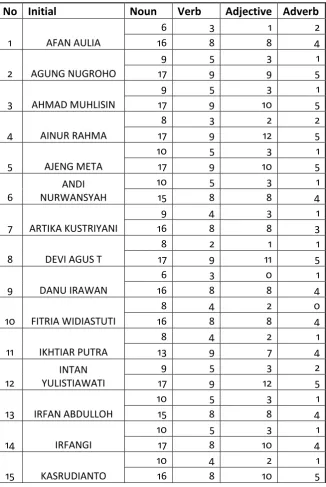
Pre-test : noun = 13, verb = 6, adjective = 3, adverb 3. Post Test : noun = 20, verb = 13, adjective = 12, adverb = 5.
No Initial Noun Verb Adjective Adverb
1 AFAN AULIA
6 3 1 2
16 8 8 4
2 AGUNG NUGROHO
9 5 3 1
17 9 9 5
3 AHMAD MUHLISIN
9 5 3 1
17 9 10 5
4 AINUR RAHMA
8 3 2 2
17 9 12 5
5 AJENG META
10 5 3 1
17 9 10 5
6 NURWANSYAH ANDI
10 5 3 1
15 8 8 4
7 ARTIKA KUSTRIYANI
9 4 3 1
16 8 8 3
8 DEVI AGUS T
8 2 1 1
17 9 11 5
9 DANU IRAWAN
6 3 0 1
16 8 8 4
10 FITRIA WIDIASTUTI
8 4 2 0
16 8 8 4
11 IKHTIAR PUTRA
8 4 2 1
13 9 7 4
12 YULISTIAWATI INTAN
9 5 3 2
17 9 12 5
13 IRFAN ABDULLOH
10 5 3 1
15 8 8 4
14 IRFANGI
10 5 3 1
17 8 10 4
15 KASRUDIANTO
10 4 2 1
16 LESTIAN YOGI
9 5 3 2
16 8 8 4
17 M. AMRI
8 5 2 2
16 8 8 4
18 MASRIFAH
10 5 3 1
17 9 10 5
19 NADIA NARDA
11 5 3 2
15 8 9 3
20 NAFA PURNAMA
8 3 1 1
16 8 10 5
21 NOVI PENIATI
10 6 2 1
14 5 10 4
22 NURUL SAPUTRA
9 5 1 2
17 9 9 5
23 SUHARYANTO
8 5 2 2
17 8 7 4
24 SUSILOWATI
10 5 3 1
18 9 11 5
25 TIAR RAKA SIWI
9 5 3 1
17 9 9 4
26 TINE ARIN
8 6 3 1
14 5 11 4
27 UYUN CAHYANI
10 5 3 1
17 9 10 5
28 VINDA MU'ALIFAH
9 3 0 2
18 9 11 5
29 ANGGRAENI WENNY
8 4 1 2
18 8 9 4
30 YOFANDA DWI SANG
8 4 1 2
17 8 10 4
Formula of word increase
TABLE OF SCORE OF WORD CLASSES IN PERCENTAGE
N
o Initial Noun (%) Verb (%) Adjective (%) Adverb (%) word increase
1 AFAN AULIA
46 50 33 67 noun/adj
80 61 67 80
2 AGUNG NUGROHO
69 83 100 33 adverb/noun
85 69 75 100
3 AHMAD MUHLISIN
69 83 100 33 adverb/noun
85 69 83 100
4 AINUR RAHMA
61 50 67 67 adj/adv
85 69 100 100
5 AJENG META
76 83 100 33 adverb/noun
85 69 83 100
6 NURWANSYAH ANDI
76 83 100 33 adverb
75 61 67 80
7 ARTIKA KUSTRIYANI
69 67 100 33 adv/noun
80 61 67 60
8 DEVI AGUS T
61 33 33 33 adv/adj
85 69 92 100
9 DANU IRAWAN
46 50 0 33 adj/adv
80 61 67 80
10 FITRIA WIDIASTUTI
61 67 67 0 adverb/noun
80 61 67 80
11 IKHTIAR PUTRA
61 67 67 33 adverb
65 69 58 80
12 YULISTIAWATI INTAN
69 83 100 67 adverb/noun
85 69 100 100
13 IRFAN ABDULLOH
76 83 100 33 adverb
75 61 67 80
14 IRFANGI
76 83 100 33 adverb
85 61 83 80
15 KASRUDIANTO
76 67 67 33 adverb
80 61 83 100
16 LESTIAN YOGI
69 83 100 67 adverb/noun
80 61 67 80
17 M. AMRI
61 83 67 67 noun/adverb
80 61 67 80
18 MASRIFAH
76 83 100 33 adverb/noun
85 69 83 100
75 61 75 60
20 NAFA PURNAMA
61 50 33 33 adverb/adj
80 61 83 100
21 NOVI PENIATI
76 100 67 33 adv/adj
70 38 83 80
22 NURUL SAPUTRA
69 83 33 67 adj/adv
85 69 75 100
23 SUHARYANTO
61 83 67 67 noun
85 61 58 80
24 SUSILOWATI
76 83 100 33 adv/noun
90 69 91 100
25 TIAR RAKA SIWI
69 83 100 33 adv/noun
85 69 75 80
26 TINE ARIN
61 100 100 33 adv/noun
70 38 91 80
27 UYUN CAHYANI
76 83 100 33 adv/noun
85 69 83 100
28 VINDA MU'ALIFAH
69 50 0 67 adj/adv
90 69 91 100
29 ANGGRAENI WENNY
61 67 33 67 adj/noun
90 61 75 80
30 YOFANDA DWI SANG
61 67 33 67 adj/noun
TABLE OF PRE-TEST AND POST TEST ANALYSIS
Derivational Exercises Class
Word frequency
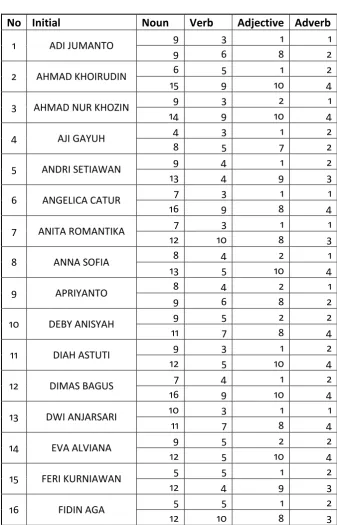
Pre-test : noun = 13, verb = 6, adjective = 3, adverb 3. Post Test : noun = 20, verb = 13, adjective = 12, adverb = 5.
No Initial Noun Verb Adjective Adverb
1 ADI JUMANTO 9 3 1 1
9 6 8 2
2 AHMAD KHOIRUDIN 6 5 1 2
15 9 10 4
3 AHMAD NUR KHOZIN 9 3 2 1
14 9 10 4
4 AJI GAYUH 4 3 1 2
8 5 7 2
5 ANDRI SETIAWAN 9 4 1 2
13 4 9 3
6 ANGELICA CATUR 7 3 1 1
16 9 8 4
7 ANITA ROMANTIKA 7 3 1 1
12 10 8 3
8 ANNA SOFIA 8 4 2 1
13 5 10 4
9 APRIYANTO 8 4 2 1
9 6 8 2
10 DEBY ANISYAH 9 5 2 2
11 7 8 4
11 DIAH ASTUTI 9 3 1 2
12 5 10 4
12 DIMAS BAGUS 7 4 1 2
16 9 10 4
13 DWI ANJARSARI 10 3 1 1
11 7 8 4
14 EVA ALVIANA 9 5 2 2
12 5 10 4
15 FERI KURNIAWAN 5 5 1 2
12 4 9 3
16 FIDIN AGA 5 5 1 2
17 FLORIDA TRI 8 6 3 3
19 8 10 4
18 GISKA INTAN 6 5 2 2
8 5 7 2
19 HARUN ISKANDAR 7 4 1 2
14 9 10 4
20 HERU A. SAPUTRA 7 4 2 1
12 5 10 4
21 IDA OCTAVIA 7 3 1 1
12 10 8 3
22 LAELATUL HASANAH 6 5 1 2
14 5 11 4
23 LULU INDAH 8 4 3 2
12 10 8 3
24 MELIANA 6 4 2 1
13 4 9 3
25 MUH. SUBHAN 8 4 2 2
12 10 8 3
26 NOVITA ANGGRAENI 7 3 1 1
12 9 7 3
27 PRIO RIADI 5 5 1 2
14 9 10 3
28 RAHMAT RAMADHAN 8 4 2 1
9 5 7 2
29 RESTU JULIAN 8 5 2 2
13 4 9 3
30 RIKI PRIATMOKO 10 4 2 2
13 4 9 3
31 RUDI SETIAWAN 8 5 2 1
9 6 4 2
32 TIA AVIOLITA 9 6 3 3
17 10 10 4
33 YUSTINA ERLIN 7 4 3 1
14 6 10 2
Formula of word increase
TABLE OF SCORE OF WORD CLASSES IN PERCENTAGE
No Initial Noun (%) Verb (%) Adjective (%) Adverb (%) word increase
1 ADI JUMANTO 69 42 33 33 adjective/ adverb
45 46 67 40
2 KHOIRUDIN AHMAD 46 83 33 67 adjective/ noun
75 69 83 80
3 AHMAD NUR KHOZIN 69 50 67 33 adverb/ verb
70 69 83 80
4 AJI GAYUH 30 42 33 67 adjective/ noun
40 38 58 40
5 ANDRI SETIAWAN 69 67 33 67 adjective
65 31 75 60
6 ANGELICA CATUR 53 42 33 33 adverb/ adjective
80 69 67 80
7 ANITA ROMANTIKA 53 42 33 33 verb/ adjective
60 77 67 60
8 ANNA SOFIA 61 57 67 33 adverb/ noun
65 31 83 80
9 APRIYANTO 61 67 67 33 adverb
45 46 67 40
10 DEBY ANISYAH 69 83 67 67 adverb
55 54 67 80
11 DIAH ASTUTI 69 50 33 67 adjective/ adverb
60 31 83 80
12 DIMAS BAGUS 53 67 33 67 adjective/ noun
80 69 83 80
13 DWI ANJARSARI 76 42 33 33 adverb/ adjective
55 54 67 80
14 EVA ALVIANA 69 83 67 67 adjective/ adverb
60 31 83 80
15 FERI KURNIAWAN 38 83 33 67 adjective/ noun
60 31 75 60
16 FIDIN AGA 38 83 33 67 adjective/ noun
60 77 67 60
17 FLORIDA TRI 61 85 100 100 noun
95 62 83 80
18 GISKA INTAN 46 71 67 67
40 38 58 40
70 69 83 80
20 HERU A. SAPUTRA 53 67 67 33 adjective/ adverb
60 31 83 80
21 IDA OCTAVIA 53 42 33 33 verb/ adjective
60 77 67 60
22 LAELATUL HASANAH
46 71 33 67 adjective/ noun
70 38 92 80
23 LULU INDAH 61 67 100 67 verb
60 77 67 60
24 MELIANA 46 57 67 33 adverb/ noun
65 31 75 60
25 MUH. SUBHAN 61 67 67 67 verb
60 77 67 60
26 ANGGRAENI NOVITA 53 42 33 33 adverb/ verb
60 69 58 60
27 PRIO RIADI 38 83 33 67 adjective/ noun
70 69 83 60
28 RAHMAT
RAMADHAN
61 67 67 67
45 38 58 40
29 RESTU JULIAN 61 83 67 67 adjective/ noun
65 31 75 60
30 RIKI PRIATMOKO 76 67 67 67 adjective
65 31 75 60
31 RUDI SETIAWAN 61 71 67 33 adverb
45 46 33 40
32 TIA AVIOLITA 69 85 100 100 noun
85 77 83 80
33 YUSTINA ERLIN 53 71 100 33 noun/adverb
GAIN OF EACH CLASS WORD (CLUSTERING TECHNIQUE CLASS)
NO NAMA NOUN VERB ADJECTIVE ADVERB
Pre Post Pre Post Pre Post Pre Post
1 AFAN AULIA 46 80 50 61 33 67 67 80
2 AGUNG N. 69 85 83 69 100 75 33 100
3 AHMAD M. 69 85 83 69 100 83 33 100
4 AINUR RAHMA 61 85 50 69 67 100 67 100
5 AJENG META 76 85 83 69 100 83 33 100
6 ANDI N. 76 75 83 61 100 67 33 80
7 ARTIKA K. 69 80 67 61 100 67 33 60
8 DEVI AGUS 61 85 33 69 33 92 33 100
9 DANU IRAWAN 46 80 50 61 0 67 33 80
10 FITRIA W. 61 80 67 61 67 67 0 80
11 IKHTIAR PUTRA 61 65 67 69 67 58 33 80
12 INTAN Y. 69 85 83 69 100 100 67 100
13 IRFAN ABDULLOH 76 75 83 61 100 67 33 80
14 IRFANGI 76 85 83 61 100 83 33 80
15 KASRUDIANTO 76 80 67 61 67 83 33 100
16 LESTIAN YOGI 69 80 83 61 100 67 67 80
17 M. AMRI 61 80 83 61 67 67 67 80
18 MASRIFAH 76 85 83 69 100 83 33 100
19 NADIA NARDA 84 75 83 61 100 75 67 60
20 NAFA PURNAMA 61 80 50 61 33 83 33 100
21 NOVI PENIATI 76 70 100 38 67 83 33 80
22 NURUL SAPUTRA 69 85 83 69 33 75 67 100
23 SUHARYANTO 61 85 83 61 67 58 67 80
24 SUSILOWATI 76 90 83 69 100 91 33 100
25 TIAR RAKA SIWI 69 85 83 69 100 75 33 80
26 TINE ARIN 61 70 100 38 100 91 33 80
27 UYUN CAHYANI 76 85 83 69 100 83 33 80
28 VINDA M. 69 90 50 69 0 91 67 100
29 WENNY A. 61 90 67 61 33 75 67 80
30 YOFANDA DWI S. 61 85 67 61 33 83 67 80
Average 67,4 81,5 73,77 62,93 72,23 77,97 44,37 86,67
GAIN OF EACH CLASS WORD (DERIVATIONAL EXERCISES CLASS)
NO NAMA NOUN VERB ADJECTIVE ADVERB
Pre Post Pre Post Pre Post Pre Post
1 ADI JUMANTO 69 45 42 46 33 67 33 40
2 AHMAD Kh. 46 75 83 69 33 83 67 80
3 AHMAD NUR Kh. 69 70 50 69 67 83 33 80
4 AJI GAYUH 30 40 42 38 33 58 67 40
5 ANDRI S. 69 65 67 31 33 75 67 60
6 ANGELICA C. 53 80 42 69 33 67 33 80
7 ANITA R. 53 60 42 77 33 67 33 60
8 ANNA SOFIA 61 65 57 31 67 83 33 80
9 APRIYANTO 61 45 67 46 67 67 33 40
10 DEBY ANISYAH 69 55 83 54 67 67 67 80
11 DIAH ASTUTI 69 60 50 31 33 83 67 80
12 DIMAS BAGUS 53 80 67 69 33 83 67 80
13 DWI ANJARSARI 76 55 42 54 33 67 33 80
14 EVA ALVIANA 69 60 83 31 67 83 67 80
15 FERI K. 38 60 83 31 33 75 67 60
16 FIDIN AGA 38 60 83 77 33 67 67 60
17 FLORIDA TRI 61 95 85 62 100 83 100 80
18 GISKA INTAN 46 40 71 83 67 58 67 40
19 HARUN I. 53 70 67 69 33 83 67 80
20 HERU A. S. 53 60 67 31 67 83 33 80
21 IDA OCTAVIA 53 60 42 77 33 67 33 60
22 LAELATUL H. 46 70 71 38 33 92 67 80
23 LULU INDAH 61 60 67 77 100 67 67 60
24 MELIANA 46 65 57 31 67 75 33 60
25 MUH. SUBHAN 61 60 67 77 67 67 67 60
26 NOVITA A. 53 60 42 69 33 58 33 60
27 PRIO RIADI 38 70 83 69 33 83 67 60
28 RAHMAT R. 61 45 67 38 67 58 67 40
29 RESTU JULIAN 61 65 83 31 67 75 67 60
30 RIKI PRIATMOKO 76 65 67 31 67 75 67 60
31 RUDI SETIAWAN 61 45 71 46 67 33 33 40
32 TIA AVIOLITA 69 85 85 77 100 83 100 80
33 YUSTINA ERLIN 53 70 71 46 100 83 33 40
Average 56,82 62,42 65,03 53,79 54,52 72,67 55,61 64,24