III. RESEARCH METHOD
In order to answer the research problems, this chapter elaborates some important
points, such as : research design, material development in educational research
and development, model of development, tipe of data, technique of data analysis,
validity, and research procedure.
3.1 Research Design
This research is a developmental research. To conduct it, the writer tries to apply a
developmental research that yields a product, such as modules, learning program,
learning designs, learning aids, evaluation or learning media which are acceptable
to solve the problem (Soenarto, 2005).
The steps of this process are usually referred to as the R & D cycle, which consists
of studying research findings pertinent to the product to be developed, developing
the products based on these findings, field testing it in the setting where it will be
used eventually and revising it to correct the deficiencies found in the field-testing
stage. In more rigorous program of R & D, this cycle is repeated until the
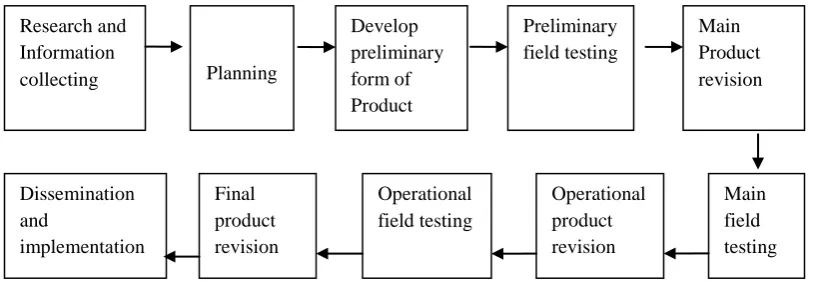
These following are the steps of Research and Development cycle taken from
Borg & Gall, which are research and information collecting, planning, develop
preliminary form of product, preliminary field testing, main product revision,
main field testing, operational product revision, operational field testing, final
product revision, dissemination and implementation.The process of the R & D
cycle in this research will however be helpful for the researcher. In the other
words, R & D cycle can be catagorized into three main stages which are research
and information collecting, developing preliminary product and evaluating. This
design is going to use one class. The class that has been chosen will be observed
in classroom. After observing as the first step, the researcher will conduct the
document analysis and interview to get the more detail data that is usefull to have
some overview of what basically learning materials given for young learners and
interviews the English teachers. Then, materials design will be conducted in
teaching and learning english for EFL young learner contexts. There will be the
[image:2.595.114.521.512.658.2]try out in the classroom to find out how the materials work well.
Figure 3.1 R&D cycle from Borg&Gall (Eny, 2012: 24) Research and
Information
collecting Planning
3.2 Material Development in Educational Research and Development
Research and Deveopment that is proposed one by Borg and Gall has been a
crucial issue in educational research. It is not merely contributing to the education
world, due to the educational research and development is kind of way and
process in researching and developing some products, process, methods and so on
in which are planning, developing, validating and revising. Furthermore, the
learning materials, which is one of most important components in teaching and
learning, need to be developed while the educational system is always trying to
find the best way to achieve the goal of the education itself.
Borg and Gall (1983: 772) says that educational research and development (R &
D) is a process used to develop and validate educational products. Learning
materials is going to be the product of this educational research and development.
There are some main steps in R & D cycle D (Borg, & Gall, 1983: 775) :
1. Research and information collecting.
2. Planning.
3. Developing preliminary form of product.
4. Preliminary field testing.
5. Main product revision.
6. Main field testing.
7. Operational product revision.
8. Operational field testing.
9. Final product revision.
According to the R & D cycle, the process of developing takes more the
presentation of this process. The process doesn’t end to the developing steps.
Further more, it will be continued to the validating and revising steps.
3.3 Model of Development
Since this research uses a development design, the principle used is modified
based on the development model of Borg and Gall. The model of Borg and Gall is
modified in term of limiting the try out to a limited classroom because the product
thai is developed is only intented to specific class. Furthermore, another
modification of this development model is that having some experts to conduct
the validation of the product. The adaption model of development still carries out
the essential of research and development; the coverage of needs assessment, the
involvement of experts to validate the product, and the try-out to find out the
acceptability, usability, and utility.
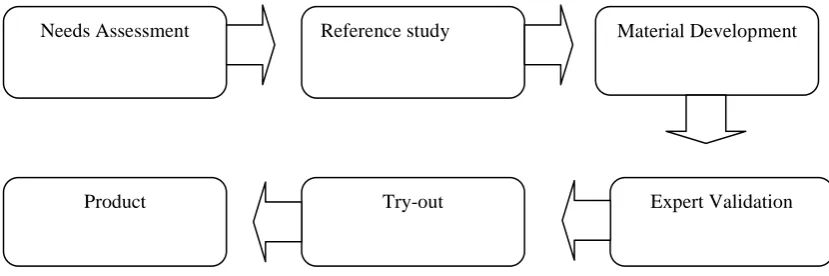
[image:4.595.110.525.509.647.2]The whole procedure is described in Figure 3.2 as the follows
Figure 3.2 Design of Current Study (in Hermaniar 2013, adapted from Borg and Gall)
Needs Assessment Reference study Material Development
Expert Validation Try-out
In developing the supplementary material for EFL young learners, the model
proposed by Borg and Gall is adapted. The model involves the following steps:
needs assessment, reference study, material development, expert validation,
try-out, and final product, as follows:
Needs assessment
Need assessment is planned at the first stage of development to be made in
order to get information in terms of topic and kinds of exercises related to
the proportion of the supplementary materials. The subjects of the need
analysis are the English teacher of fourth grade students. The English
teacher is the one who has information of the situation in learning and
teaching process and students are the one who use the developed
workbook. There are some activities should be carried out in this step;
first, an informal observation is conducted in order to see the teaching
English in SD Al-Kautsar, what kind of source materials used by students,
and what kind of workbook or worksheet used by students as supported
tools. These activities are done by observing the teaching English in the
classroom and having questions and answer session with the students to
get the information related to the implementation and instrument in the
classroom. This activity is also intended to get information about the
learning situation and a relevant workbook for the students.
The next activity in this stage is having an interview session with the
English teacher. Interview with the English teacher is intended to gather
workbook. The interview hold to get information in terms of the aspects of
the course description, course outline, current textbook, and the expected
workbook. Another step in this need assessment stage is that collecting the
documents that are used in teaching learning process including the
competences. The competences here mean competences that should be
achieved through the process of teaching and learning. The competences
are standard and basic competences. To find out the starting point of
students’ needs toward vocabulary material, the researcher concerns on
basic competence determining what the students have known toward what
they have learned. In addition, the test of vocabulary is in terms of certain
vocabulary based on basic competence they have to achieve or the test
itself is that they have already got in the other word is achievement score
obtained from the English teacher. Besides that, students will be given
written vocabulary test consisting of several topic and students will write
the vocabulary under each topics with the correct spelling.
Reference Study
Some references which are intended to give theoretical bases of the
workbook development are studied in this stage. This stage is aimed at
deciding the objectives, topics discussed in the supplementary materials
and develop the supplementary materials for the topics available. The
following step of this research is reviewing the existing material used in
the classroom, the instructional goal based on syllabus, and the course
outline. The existing English materials of fourth grade in SD AL-Kautsar
that should be achieved in the teaching and learning. The basic
competence is very considered toward whether throughout the exist
materials used in the classroom help student in learning vocabulary or not
and what the supplementary vocabulary materials need to develop.
Supplementary Material Development
At this stage, the content is developed. As the supplementary material
contains exercises, the activities in this stage will deal with them.After the
general instructional objectives are formulated from reference study stage
previously, the specific instructional objectives are formulated. The
specific instructional objectives are elaborated into indicators that are used
to develop the workbook. Relating to the task, material should lead to
communicative and contextual aspects. Therefore, the task will cover the
demand of course outline.
Expert Validation
Validating the product is needed to evaluate whether or not the materials
are rationally effective and applicable to facilitate certain activities for
students in the class. The developed workbook is given to the expert to be
validated to get valuable input from the feedback given. The feedback
given by the expert is used to revise the workbook.
The experts who are involved in this stage are the expert in teaching
English to young learners’ material and the second is the expert in
education or lecturer. For the expert in teaching english to young learners
materials, the expert should have taught it in university for at least 5 years,
education, the expert should teach in primary school for at least 5 years
and has expertise in English education. All of the experts validate the
content of the workbook, including the design, layout, competence
coverage, and other criteria as they are presented in the checklist for expert
validation on appendix. Through the expert judgment, some consideration
related to strength and weaknesses of the workbook are dentified and the
content is improved. The criteria of the expert’s validation include cover
design, letter, typing, spacing, lay-out, organization of content,
instructional objectives, topics, grammar review, tasks, instruction and
language.
Try-out
At this stage, the supplementary material developed is going to try out to
the students, within the purpose to know whether the supplementary
material acceptable and useable or not in teaching and learning English
process. The supplementary material that is going to try out has been
validated by the experts and revised based on the suggestion and
correction from those experts. In try out process, the fourth grade students
in SD Al-Kautsar are going to be interviewed toward the supplementary
vocabulary material in learning. The data from try-out will be analyzed
and used to revise the product.
Product
The product is the supplementary material for fourth grade students in SD
Al-Kautsar. It is in the form of a workbook which consists of practice and
3.4 Type of Data
The data collected based on the procedure of development are in the three forms.
The data are collected through needs assessment, expert validation and try out of
the product.
In the needs assessment, the data are in the quantitative and qualitative form. The
quantitative data are resulted from analyzing the achievement score and the
qualitative data are resulted from observing and interviewing the English teacher.
In the expert validation, the data are also in qualitative and quantitative form. The
quantitative data are the result of expert validation checklist and the qualitative
data are in form of suggestion, comments and revisions from the expert.
The checklist from experts is scored by following the rating scale as following in
Hermaniar (2013)
Tables 3.1 Rating scale for result of checklist
Response Point Description
Yes 5 The aspect is definitely
fulfilled
Partially 3 The aspect is only fulfill
basic description and
need revision
no 1 The aspect is definitely
3.5 Technique of Data Analysis
In the needs assessment, the data resulted from achievement score are
presented in form of percentage. In the other word, this shows and tells about
how many students answer the item correctly. In case if 50% students or more
than it who answer the item correctly it can be meant that there are 50% students
or more who have known the item well. As the result, the aspect that will be
involved in the supplementary vocabulary material is that the item answered under
50% students and it can be consider to be put into the consideration of
supplementary materials development. For the result of the interview, it is
reported descriptively by concluding the data under several points of conclusions
as goals of the course, the approaches, design, type of exercises, and workbook
organization. However, the result of the achievement score analyzing and
interview is used as the foundation of the need of supplementary material
development for the students.
In the expert validation stage, the data gathered from the experts are analyzed
quantitatively by using the percentage as can be seen in the following formula
proposed by Sugiyono (2008) in Hermaniar (2013)
∑ (responses x weighting on each response) x 100%
Percentage =
N x weighting the highest response
Discussion:
N = The total number of all the items
To give decision on product’s quality, the researcher uses achievement level
conversion as 5 for yes, 3 for partially, and 1 for no as in rating scale. The score is
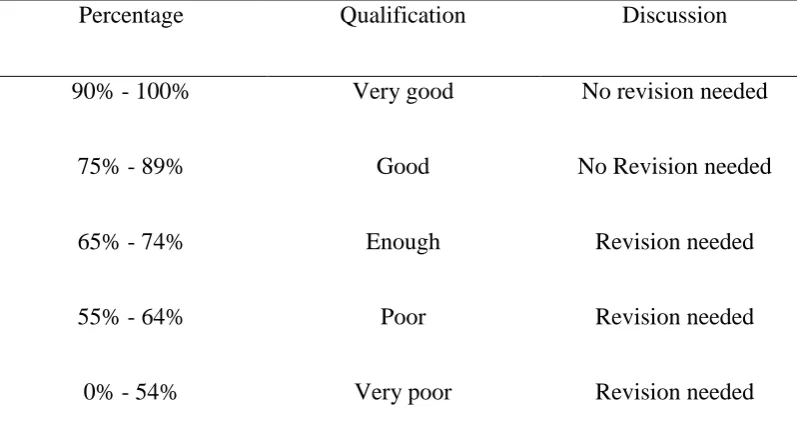
converted into description by following the range of 5-Scales criterion proposed
[image:11.595.110.509.295.516.2]by Kuswandi (2001) in Batunan (2011) in Hermaniar (2013) as follows.
Table 3.2 The Range of 5-Scales Criterion
Percentage Qualification Discussion
90% - 100% Very good No revision needed
75% - 89% Good No Revision needed
65% - 74% Enough Revision needed
55% - 64% Poor Revision needed
0% - 54% Very poor Revision needed
The comments from the experts are also taken as additional information. The
product which is developed will be evaluated and revised for many times based on
the data gathered from questionnaire and consultation with the expert. The final
comments and suggestion from both experts are used as guidance for revising the
product. There are 13 aspects. The data is presented by showing the aspect, score,
In the try-out stage, the researcher will interview students. The interview will be
in small groups. Interview contains of some points that will be asks to the students
and the list of the interview points presented in the appendix.
3.6 Validity
The researcher uses some methods in collecting the data which is commonly
said as triangulation. Triangulation is the most common term of this collecting
data method. Triangulation means the combination two or more in collecting
data toward the same phenomenon. Triangulation is very important to enhance the
authenticity and credibility of the data result (Setiyadi, 2006).
Altrichter et al. (1996: 117) says that Triangulation gives a more detailed and
balanced picture of the situation. In this research, the researcher uses the
methodological triangulation that involves some ways in collecting data : the
observation, document analysis, interviews and validation sheet.
The crosscheck between the data obtained from observation, document analysis,
interviews and validation sheet will be applied. This will be done to get the
credibility of the different instruments.
3.7 Research Procedure
Reference Study Need assessment
Material Development
Expert Validation
Try-out
Product Research and Information
Collecting
1. Determining the object of the research
The researcher focuses on the English teaching materials used by the
English teacher in SD Al-Kautsar. The English materials such English
texbook that are used by the teachers in teaching young learners in SD
Al-Kautsar. The English materials are learned by the fourth grade students in
SD Al-Kautsar. The English materials include textbook, lesson plan,
workbook, or anythings related to the teaching and learning process. The
researcher concerns on the printed materials that are used by the teachers
and students.
2. Observation and document analysis
To have the needs assessment, the researcher has an observation of EFL
young learners classroom process as the base principle to find out the
problem occured in the classroom within their learning materials. The
document analysis will help the researcher to find out every written
documents which relates to the learning process of the learners. The
purpose of conducting the observation is to find out what the teaching and
learning process in the classroom basically occurs through the English
materials that they are have been using and how the students participate
during the classroom process. Furthermore, the document analysis has the
purpose to analyze the English materials documents whether the those
things have already fulfilled the students’ need so that the researcher can
3. Preparing the interviews and conducting it
The interviews are conducted in the beginning to take the data of teachers
who teach English and the students in order to find out their needs through
interview. The researcher conducts the interviews before developing
materials. The interviews are presented in the semi-structured interviews.
While doing this, the researcher will use the same questions for each
interviewing of the teachers to acquire their teaching experiences and the
common activities occured in the classroom .
4. Designing and developing materials
The supplementary vocabulary material is developed based on the needs
assessment. The data from needs assessment such observation,
interviewing of English teacher and tests for the students are going to be
used for the consideration of developing supplementary materials.
Developing supplementary vocabulary material is based on the topics,
target of words and vocabulary exercises.
5. Expert validation
In this step, the researcher have to validate the product through some
experts. Each experts can fill the checklist based on the supplementary
material that has been developed and is going to try-out to the students.
Experts validation result will be the consideration of product revision
6. Try-out
In this stage, after developing and validating the product, the researcher is
going to have try out of product. Researcher will get the feedback from the
students toward the supplementary material that they use in the learning
process through interviews the students in small groups.
7. Product
The supplementary material has been validated and tried out. The product
is revised based on the result of try-out. The final product is in form of
workbook of supplementary vocabulary material for fourth grade
elementary students.
We have talked about several points in this chapter. This chapter has elaborated
some important points, such as : research design, material development in
educational research and development, model of development, tipe of data,