Sage on the Stage in the Digital Age: The Role of
Online Lecture in Distance Learning
Q B. Chung
Villanova University, Pennsylvania, USA
[email protected]
Abstract: The Internet can be a useful tool that can enhance interactivity in classes. Accordingly, offering distance learning courses using the Web, especially in the asynchronous mode for the additional flexibility of time, is becoming an established practice in higher education. Web-based distance learning comes with numerous benefits, but not without worries for potentials deficiencies. One such deficiency in the current distance learning framework is the lack of lecture, the most relied-upon and proven means of instruction in the traditional classroom settings. This paper raises an issue of the lack of lectures in Web-based distance learning, and proposes that streaming video take the role of online lecture in that setting. Described in this paper are the rationale to put the lecture back into e-learning in higher education, two case studies in which the steps were taken to implement the proposed method, and the feedback from the students who took such courses in the undergraduate business curriculum and the MBA program.
Keywords: Web-based education, Asynchronous learning, e-Learning in Higher Education, Sage on the Stage, Guide on the Side, Online Lecture
†
This project was funded by VITAL (Villanova Institute of Teaching And Learning) of Villanova University.
1. Introduction
The supportive role of information technology in higher education is a well-established concept. Before the advent of the Internet, numerous studies were undertaken to ascertain the positive impact of instructional information technologies such as electronic classrooms (Leidner & Jarvenpaa, 1993), group decision support systems or GDSS (Alavi, 1994; Briggs, Ramesh, Romano & Latimer, 1994), and a collaborative inter-school electronic linkage (Alavi, Yoo & Vogel, 1997), which can be viewed as a precursor to the Web-based distance learning environment.
Educators today can take advantage of the Internet, especially the Web, to enhance interactivity of courses. Provision of robust network infrastructure is a prerequisite to this new excitement, but such requirement is often readily satisfied in most developed regions of the world. In the context of education, Plous (2000) points out that the Web is convenient, time-saving, suitable for assignments, appealing to students, and able to reach larger audience. Accordingly, offering distance learning courses using the Web is becoming an established practice in higher education, which is literally a global phenomenon. (See Academic Conferences International, 2004, for the
diverse geographical representation as well as the commonality of e-learning issues.)
Along with the ubiquity of the Web and its applications in learning, there has been a steep growth of interest in designing and deploying distance learning courses in universities and colleges in various disciplines (Cody, 1999), with increasing degrees of sophistication over time (Reisman, Dear & Edge, 2001). The Web-based distance learning comes with numerous benefits, but not without worries for potential deficiencies in learning. One such deficiency in the current distance learning framework is the lack of lecture, the most relied-upon and proven means to teaching in classrooms in the traditional face-to-face learning.
This paper raises an issue of the lack of lecture in Web-based distance learning courses, and proposes that streaming video take the role of lecture in distance learning, which can be produced from lecture slides of presentation software such as Microsoft PowerPoint. Described in this paper is the rationale to put the lecture back into distance learning, the steps taken to implement the proposed approach, and the feedback from the students who took Web-based courses in the undergraduate business curriculum
ISSN 1479-4403 ©Academic Conferences Ltd
Reference this paper as:
Chung Q. B. (2005) “Sage on the Stage in the Digital Age: The Role of Online Lecture in Distance Learning” The Electronic Journal of e-Learning Volume 3 Issue 1, pp 1-14, available online at www.ejel.org
and in the MBA level at Villanova University.
2. Background
It must be noted that distance learning is not a new phenomenon that came into being as a result of recent progress in network technologies and the advent of the Internet. As early as 1980s, synchronous distance learning courses were offered in universities (such as Rensselaer Polytechnic Institute, Troy, New York) to geographically dispersed and distant off-campus students via real-time satellite communication. In addition to seats for students and the podium and chalkboard for the instructor, the classrooms were equipped with cameras and microphones, and a recording and broadcasting system that could be found in typical TV studios. Monitors were also embedded in the lectern for the instructor to view and interact with the students in remote sites. Likewise, each of the remote sites was equipped with a TV monitor and a camera capable of communicating in real time with the broadcasting system in the classroom where the instructor and in-class students were having a in-class. The scene resembled today’s teleconferencing. Such synchronous distance learning infrastructure was not widespread due to the prohibitive cost of installation and maintenance of the technology. The platform for distance learning today is drastically different from what is described above. Distance learning courses usually use the Web as the medium, and therefore Web site design and management becomes a necessary component of course development. There are various commercially available distance learning platforms (e.g., WebCT and Blackboard) that can save the instructor’s time and energy. They come with standard support features such as course content organizer, on-line quiz, text-based synchronous discussion (or chat), collaborative on-line calendar, threaded discussion board, and the like. To be more appealing to the instructors, publishers of popular textbooks even create (and sometimes host) the course content by providing the ‘Webified’ version of the textbook, which can be made available on the course Web site or linked to it. However, the most crucial enabling factor for today’s distance learning is the widespread penetration of
the Internet (the Web, to be more specific), and the most pronounced difference between the pro-Internet and post-Internet distance learning is that, for the most part, now learning can take place asynchronously. The implication is immense in that not only the barrier of space (distance learning) but also that of time (asynchronous) has been eliminated. The disciplines that offer Web-based distance learning courses can be found practically all over college campuses, ranging from business (e.g., Goodwin, Graham & Scarborough, 2001; DeLacey and Leonard, 2002) to education (e.g., Hunt, 1998; Moallem, 2001) to nursing (e.g., Irons, Jung & Keel, 2002). Many ‘success stories’ can be named that reported various successful features of their distance learning courses, such as threaded discussion board (Lawson, 2000; Ellenchild Pinch & Graves, 2000) and collaborative projects (Matthews, 1999; Pychyl, Clarke & Abarbanel, 1999).
Although the Web is an excellent vehicle to convey data in various forms, it has been found that the Web is not necessarily a good replacement of printed content when it comes to textual data. Hypermedia, the technology behind the point-and-click user interface to access difference Web content, has become a target of controversy due to the possibility that it can support different beliefs about its role in learning. On the one hand, the Web can be viewed as a superior medium of learning to the traditional, rigid, printed form. On the other hand, the unstructured and fluid nature of the Web can support a view that it can be an inhibitor to learning, which was not a concern when the materials were presented only in the printed form. One of the findings of Everland and Dunwoody (2001) is that learning, measured by recognition of the organization and structure of the presented information, from printed materials is better than learning from the linear and non-linear information presented in Web pages. The implication is that the Web-based distance learning might be better off by leaving the reading assignment to the textbook rather than converting the textbook to HTML documents.
3 Q. B. Chung
3. Rationale for distance
learning lecture
Although many reports pride their successes in Web-based distance learning, it is not for everyone. Certain courses do not lend themselves easily to distance learning, having to be ‘taught’ only in the face-to-face mode. They are the ones that need the ‘teachings’ of the ‘sage on the stage’ or the ones where learning takes place by ‘observation over the shoulder,’ or the ones where acquisition of certain physical, motor, and voice skills by supervised practices is a critical part of learning, or the ones that involve hands-on laboratory works. In other words, courses like drama, water color paining, or chemistry labs would pose a challenge if offered as Web-based distance learning courses.
A related issue about Web-based distance learning is the potential, and apparent to a certain degree, lack of lecture. Bourne (1998) divides the content of Web-based learning (or Net-Learning, according to his terminology) into two components: 50% self learning and 50% learning with others. The self-learning component again is made up of on-line materials (e.g., reading, browsing, and taking tests) and computer-based training (e.g., simulation, visualization, and data access). The component of learning with others is comprised of on-line conferencing (e.g., electronic mail, listservs, and threaded discussion) and synchronous interactions (e.g., on-line chat and telephone conversations). Surprisingly, there is no mention of ‘lecture’ in the context of Web-based distance learning.
Similar views are shared by a number of ‘theorists’ and ‘experts’ of learning. It seems that, according to these opinions, learning can happen primarily by the effort of students while the teaching function of the instructor stops at developing Web-based course materials, and only to point where to look, and testing if the students ‘got it.’ (For a typical set of roles of instructors in student-centered teaching, see Motschnig-Pitrik & Holzinger, 2002, p.165.) They argue that the traditional role of face-to-face lectures is a thing of the past, when today’s technology was unavailable, and that the new mode of learning has emerged where the teacher is like a coach who facilitates mutual learning
and participates in the process of discovery of knowledge (Wildman, 1998; Langford & Hardin, 1999).
While the traditional mode of teaching is sometimes referred to as the ‘sage on the stage’ method with a slightly negative connotation in that circle, lecturing is an indispensable part of teaching in most undergraduate courses whether they are offered as a traditional classroom course or as a Web-based distance learning course. The view described above, in which lecture is regarded as a thing of the past, is often called the ‘guide on the side’ approach, and may be applicable only to some high-level graduate courses where discovery or synthesis of new concepts is the primary goal. This reasoning is supported by the fact that they tend to refer to the students as adult learners. Another plausible explanation of such a defensive posture of ‘not including lecture’ in the Web-based distance learning courses might simply be the difficulty of delivering lectures over the Internet, which is a medium of communication for digital contents. In fact, it is impossible to deliver as good a lecture in the distance learning mode as in classrooms where teaching and learning takes place in real time and in the fully interactive mode. No distance learning platforms today provide a vehicle to deliver a classroom-like lecture except text-based chats. While a few best-seller textbooks come with the Web content comparable to the textbook, such provision is not only a luxury available only to limited courses but also is far from being sufficient to replace the lecture of the instructor no matter how much of the pre-packaged Web content is customizable. Therefore, if lecture is to be included in a Web-based distance learning course, the instructor will have to provide more than what is currently available on the Web, on the commercial platforms, and on the campus network servers.
4. A potential solution for
reclaiming lecture in distance
learning
PowerPoint slides are used in a growing number of courses as a vehicle to deliver lectures. While the efficacy of PowerPoint slides for student performance is inconclusive (Szabo & Hastings, 2000), if made available in advance, they can help
students take notes during the lecture instead of copying the contents of the slides. The utility of PowerPoint slides goes farther in distance learning environment. A good portion of distance learning courses use PowerPoint slides, which serve practically as a replacement of lecture. Easily transported via the Internet and with the popularity of the software, PowerPoint files are becoming the mode of content delivery for e-learning. However, since the slides are merely teaching aids but not meant to substitute the lecture, instructors of distance learning courses try to make up for the missing lecture in various ways, such as annotating the slides as much as possible or including the lecture scripts as part of the file.
Adopting simple multimedia authoring software such as RealPresenter®—or its subsequent evolutions (e.g., PresenterONE®) and its competitions (e.g., Macromedia’s PowerPRESENTER® that produces flash content out of PowerPoint slides)—in Web-based distance learning courses seems to shed light on the feasibility of taking this trend a step further by turning still PowerPoint slides into a streaming video. (See Tiedemann, 2002, for alternatives.) This involves a fairly simple procedure of recording and mixing the sound of lecture with the slides (loosely termed voice-over). This can be a fine emulation of a classroom lecture applicable to a distance learning course, in which the lecture can be equated to the explanations of the slides for the most part, although the mode of lecture is still not fully interactive.
However, there are courses like an introductory undergraduate information systems (IS) course where there are other elements in the lecture than explaining the content of slides. For instance, after a certain concept has been introduced (e.g., role of software in managerial decision making), students learn how to apply the introduced concept using software (e.g., spreadsheet modeling in Excel, querying a database using Access, or programming in Visual Basic). Therefore, demonstration of software application is often an essential part of the lecture, and switching between the lecture slides and the software demonstration is commonplace. In addition, it is often necessary to write on the board impromptu in order to work on
additional examples. Figure 1 shows a typical lecture scene of such courses. Explanation using voice is the dominant part of the lecture, and is denoted by . The ceiling-mounted projection unit is used to show the slides () and software demonstration (). Since there is only one projection unit and one projection screen in a typical classroom, they need to be alternated during the lecture. Denoted by is the writing on the board for additional discussion topics that is not part of the prepared slides.
Figure 1: Lecture components of a typical
introductory information systems course
5. Distance learning without
lecture
From the students’ point of view, the above four lecture components are only a part of a larger learning process. Shown below is a simple chart (Figure 2) depicting what activities should take place before, during, and after the class, in the traditional classroom setting. Without a proper mechanism to compensate the missing lectures, distance learning classes could result in serious compromise. More specifically, if distance classes were to use PowerPoint slides only, but without lecture, the following misgivings are expected.
Figure 2: Activities in traditional class learning
As shown in Figure 3, the primary deficiencies indicate the direct effect of inadequate lecture (or no lecture at all, other than providing slides) in a distance learning class, while the secondary deficiencies are the ripple effects resulting
5 Q. B. Chung
from the primary deficiencies. Both types of deficiencies are inevitable unless the class meets in the regular classroom (i.e.,
face-to-face) and takes the burden of making up for what should have been done in the distance classes.
Figure 3: Potential deficiencies in a distance learning class without lecture
6. Implementation of distance
learning lectures
The Business School at Villanova University decided to offer a small number of distance learning sections from each discipline. It was also decided that such distance learning sections were to be offered as a mixture of face-to-face and online classes, so-called ‘50/50 DL.’ The campus-wide distance learning platform was WebCT, which was used for organizing course materials (e.g., syllabus, lecture slides, additional reading materials, etc.), communications (e.g., chat, threaded discussion, etc.), and evaluations (quizzes and exams). Since WebCT was synchronized with the Registrar’s database of courses and students, the instructor’s extra burden to manage student records was fairly light. Another added benefit of using WebCT was that it created a password-protected environment. Therefore, only the students who were officially enrolled in the course could access the particular distance learning section’s Web site. By virtue of being a Web-based platform, WebCT was accessible from both on-campus locations through local area networks and off-campus locations through students’ own ISPs.
Production of streaming video lecture was done with RealPresenter®, a multimedia authoring software package, whose primary function was to turn PowerPoint
slides into voice-over streaming video content. In addition, a low-end PC video camera was also used to capture any other live images. With this fairly inexpensive setup, the voiced-over online lectures (for and in Figure 1) integrated with computer “screens shots” (for ) and ordinary video (for ) could be produced. By designing and delivering lectures this way, distance learning classes could emulate much of in-class lectures, while maintaining the benefits of the online distance learning format—i.e., remote and asynchronous access to lectures—along with the ability to “replay” the lectures.
In implementing distance learning with lecture, three physically separate servers were used. The first server housed WebCT and its contents, available only to those who were enrolled in the distance learning sections. The second one was a general Web server, open to the public, holding the course syllabus, announcements, and lecture slides. Typically, students downloaded the lecture slide files a few days before class whether they were distance learning or regular in-class students. Finally, the third server was equipped with the RMServer® operating system, which was necessary for streaming the lecture content (in the form of so-called Real media) to the student’s computer either via the Internet (for off-campus) or through the campus LAN.
6.1 Case Study I
Two sections of the introductory information systems course were selected to be offered as 50/50 DL. The classes met face-to-face in the classroom every other week, and when they did not meet in the classroom, they ‘met’ on-line in “DL” weeks. On-line lectures were recorded over the weekend before the distance week, and uploaded using FTP from the instructor’s computer to the RMServer server. During the distance week, students were expected to download the lecture slides, play (or view, listen to) the lecture, and take a quiz which was based on the lecture materials of the distance week. During the distance week, office hours were held on-line using the ‘chat’ facility of WebCT. Often times, students were “sent” to breakout chat rooms to meet in small
groups and come up with answers to the discussion questions.
A survey instrument consisting of ten questions (See Table 1.) was developed to evaluate the efficacy of the streaming lectures for distance learning. The first nine questions were in the form of a statement, and the students were asked to specify the extent to which they agreed with them. The last one was an open-ended question asking for suggestions for improvement. Two weeks prior to the end of the semester, the survey was taken via the anonymous on-line survey facility available on WebCT. In short, the survey was intended to measure the benefits of the 50/50 DL approach from the perspective of the students.
Table 1: Case Study I - Survey questions This course is my first experience in distance learning.
Due to the lack of actual contacts, the distance learning classes are less effective than face-to-face classes.
Flexibility of schedule is the most significant attraction of distance classes.
I tend to procrastinate with the distance learning classes since I can catch up with the missed class later when I have more time.
Full-scale distance learning (rather than 50/50) can work well during regular semesters.
In a distance learning week, reading the textbook and viewing PowerPoint slides alone (without streaming video lectures) does not make me learn much.
Listening to streaming video lectures that are longer than 50 minutes reduces effectiveness.
I want the streaming video lectures available for both regular and distance classes so I can review the lecture materials later.
Unless different distance classes were scheduled back-to-back, isolated distance classes do not add much to my schedule convenience.
Please comment on the distance learning format, streaming video lectures, and this course in general.
Question (A) could simply be answered either by ‘True’ or ‘False,’ but used the same answer categories as in Questions (B) through (I), for which students were asked to select one of the follow alternatives:
Strongly disagree [SD] Disagree [D]
Neutral [N] Agree [A]
Strongly agree [SA]
The survey result from the two sections of 50/50 DL classes is summarized as Table 2. From the answers to Question (A), it
was clear that distance learning was a new experience to the majority of students. (Forty-four out of fifty-five respondents said this was their first distance course.) Regarding the comparative effectiveness between distance learning and face-to-face classes, 20% of the students felt that distance learning classes were less effective than face-to-face classes. Three students strongly agreed, and eight agreed with the statement, “Due to the lack of actual contacts, the distance learning classes are less effective than face-to-face classes.”
Table 2. Case Study I - Summary of result
Section 01 Section 02 n mean s.d. n mean s.d. (A) 27 4.48 1.31 28 4.04 1.71 (B) 27 2.33 1.04 28 2.71 1.12
7 Q. B. Chung
Section 01 Section 02 n mean s.d. n mean s.d. (C) 27 4.52 0.85 28 4.39 0.74 (D) 27 2.59 1.25 28 2.93 1.15 (E) 27 3.00 1.24 28 2.36 1.03 (F) 27 2.89 1.09 28 2.54 1.26 (G) 26 4.27 0.83 28 4.32 0.82 (H) 26 3.92 0.93 28 4.14 0.93 (I) 26 2.38 1.06 28 2.43 1.20 (Strongly disagree [SD] = 1; Strongly agree [SA] = 5)
Students had been informed of the format (50/50 DL) of the sections they were enrolled in, and the next question was intended to see how true it was that they took the distance learning section of the course to enjoy time flexibility, which was a common answer obtained in informal conversations in the hallways. The survey result confirms that flexibility was the biggest attraction to distance learning. By common sense we can hypothesize that time flexibility could develop a tendency to procrastinate, and the next question was to gauge how distance learning affects the student’s behavior in time management. Opinions about distance learning being a source of potential procrastination were fairly evenly distributed. The next question, “Full scale distance learning, rather than 50%, can work well during regular semesters,” was to asked because some 100% distance learning courses were offered during the summer session, and was to test out the feasibility of such distance learning format in undergraduate courses during the spring or fall semesters. The survey finds that most students felt that full-scale distance learning may not work outside the summer session, at least from the undergraduate students’ perspectives. The next was the very question designed to verify the validity of the idea that lecture is indispensable even in distance learning courses: “In a distance week, reading the textbook and viewing PowerPoint slides alone (without the streaming video lecture) does not make me learn much.” More students disagreed with the statement than agreed. This can be rephrased as “Without the on-line lecture during the distance week, I can learn as much,” and can be possibly interpreted as a rejection to the working hypothesis of the current
project. However, with the last question of open-ended comments and suggestions, it became clear that it did not indicate the reverse of the necessity of on-line lectures for distance learning. Unlike what the number says (means 2.89 and 2.54 out of 5 with standard deviations of 1.09 and 1.26), twenty-eight students (out of fifty-five) indicated in their comments that the on-line lectures in distance weeks were as effective as, or sometimes even more effective than, in-class lectures. They named a few common reasons as below:
Ability to pace oneself listening to the lecture
Ability to replay parts of the lecture Finding the most effective time to
listen to the lecture for better concentration
Here are a few representative comments from those twenty-eight students, supporting the on-line lecture idea:
“I find the streaming video lectures very helpful, and I would not learn as much without them.” — Student #8, Section 1
“I like distance learning a lot, but it definitely needs some kind of online lecture to make it worthwhile.” — Student #13, Section 1
“Personally I feel that with the streaming videos and powerpoint slides, the distance portion of the course was just as effective, if not more effective, than the weeks in class.” — Student #17, Section 1
“I found that I benefited very much from the online
lectures. It made studying so much easier and the examples helped me to understand the information better. I noticed a big difference between taking the test after listening to it and after not listening to it. I think that should be stressed more.” — Student #19, Section 1
“I wouldn’t have learned as much from the distance classes without the streaming video lectures.” — Student #6, Section 2
“The streaming video lectures were as effective, if not more than face-to-face because you could replay them to review the material.” — Student #15, Section 2
On the other hand, there were voices quite critical about distance learning lectures. Six out of the fifty-five students showed their disappointment toward distance learning lectures. The two main reasons for their disapproval were:
Web congestion while the lecture was being accessed from an off-campus location
Preference to the more natural,
face-to-face, interactive environment
Here are the comments from the six students:
“The streaming video lectures are difficult to access off camps considering some of us do not have the fastest internet connections Often the lectures would cause the internet connection to be lost. Then the entire lecture needed to be listened to all over.” — Student #3, Section 2
“It’s easier to miss something from a streaming video lecture than from an in class lecture.” — Student #10, Section 2
“[The professor] is a great teacher, so I think the distance learning hurts this course because it takes away the time from [the professor]
in the classroom.” — Student #19, Section 2
“Sometimes I felt that I had not enough interaction with the class. It is the ‘modern’ way to of doing things, but I am not quite sure it is better.” — Student #20, Section 2 “I enjoyed the convenience to my schedule but, personally, I learn better in a face-to-face environment.” — Student #25, Section 2
“I do feel that a lack of face-to-face contact does make learning the material more difficult.” — Student #26, Section 2
As for the remaining three questions, which were meant to probe the student preference about certain aspects of distance learning lectures, it was found that the majority of students felt that online lecture kept under 50 minutes would be preferable to longer lectures, and that most students desired to have an access to the online lectures in the archive whether they were from a distance lecture or in-class lecture, and that coordination of distance courses (so that distance learning courses are scheduled consecutively to maximize scheduling convenience) was not particularly desired. The students’ opinion advocating lecture archives speaks volume for the positive aspect of the digital medium, which lends itself to convenient storage and retrieval using the network.
6.2 Case Study II
Along with the maturity of distance learning technology and practice on campus, an opportunity was arose to offer Telecommunications, an advanced information systems topic, as 100% online courses at undergraduate and MBA levels during the same semester. (Prior to that time, the course had been offered as 50/50 DL.) Although they were designated as “100% DL,” the first and the last classes of the semester were to meet face-to-face. The technology, infrastructure, online lectures, online quizzes and exams, number and frequency of homework assignments, etc. remained the same as 50/50 DL. The size of the undergraduate class was 14, and the size of the MBA class was 24. All 14
9 Q. B. Chung
undergraduate students were physically on campus throughout the semester. However, the majority of the MBA students were full-time employees, taking classes in the evening.
By design, evening MBA students can take only one class on a given day, and therefore, the number of courses they take in a semester usually determines the number of commutes to campus per week. Since the MBA students tend to juggle multiple objectives and responsibilities— career, graduate degree, family, etc.—any opportunity to reduce the number of commutes to campus seems considered a plus. In that particular semester, a number of students in the MBA class were traveling extensively, and one student in particular was literally taking a distance
course, from over seven hours’ driving distance away in a different state.
As done before, a survey was administered toward the end of the semester, with the questions listed in Table 3. Unlike the questions shown in Table 1 (for 50/50 DL), there were nine questions. The first six questions required responses on a 7-point Likert scale—’1’ being “Strongly Disagree”, ‘4’ “Neutral”, and ‘7’ “Strongly agree”—plus one more possible choice of “Not applicable” or “Cannot answer.” The remaining three questions were open-ended.
Findings from Case Study II are presented below. The summary is geared to comparing the responses of the undergraduate students to those of MBA students. Instead of aggregating the data, the full detail of the response frequencies is presented.
Table 3. Case Study II – Survey questions
(A) Compared to other distance learning courses without online lecture, this course offers better learning opportunity because of the lecture component.
(B) Weekly synchronous chat sessions are effective. (C) Weekly synchronous chat sessions are desired.
(D) If the technology were available, I would prefer voice chat to text chat. (E) It is better to eliminate weekly quizzes for the sake of flexibility of time. (F) Posting the chat log every week is helpful.
(G) What do you think is an appropriate length of each online lecture? (H) What are your opinions on distance learning in general?
(I) What are your opinions on this particular distance learning course? Provide comments for improvement.
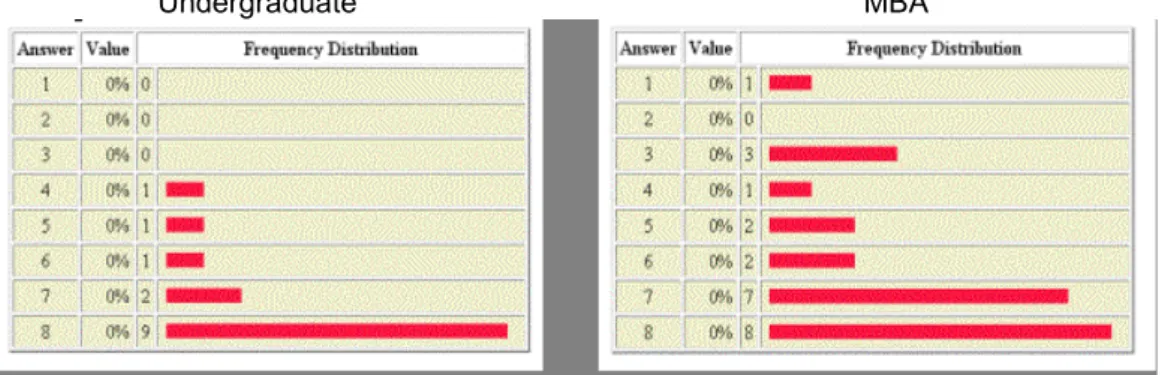
For Question (A), which sought to ascertain the necessity of online lectures, both undergraduate and MBA students showed positive attitude toward online lecture. Of the 14 undergraduate students, only five took other distance learning courses. None of them viewed the lack of online lectures favorably. The MBA students exhibited a wider range of
opinions. Two thirds of the MBA students had taken some other distance learning courses. Although there was a predominant support for online lecture, 25% of MBA students found the lack of lecture in distance learning to be not so objectionable. This observation is summarized as Figure 4.
Undergraduate MBA
Figure 4: Efficacy of online lectures in distance learning
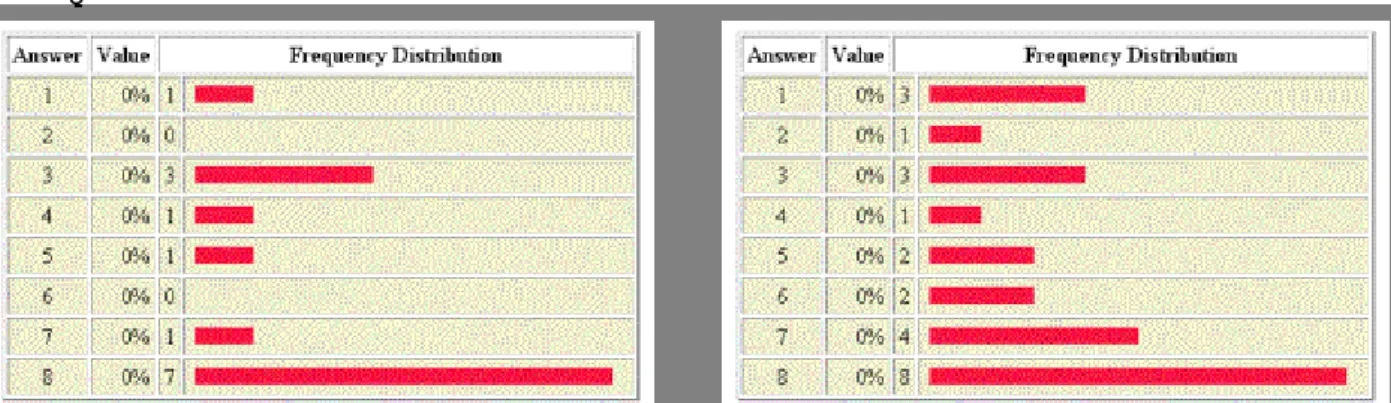
Both undergraduate and MBA classes were rather indifferent or negative about the effectiveness of the synchronous element of the distance learning. As sown in Figures 5 and 6, more students seemed to be uncommitted to an opinion as to the effectiveness of online chat sessions, but clearly against the practice of having regular chat sessions. This strong resistance to online chat is an indication of
the students’ desire for the freedom from regularity so that they could maximize time flexibility. Since these were 100% distance learning courses, it could have been almost “self-paced” learning had the regular (i.e., weekly) synchronous sessions been eliminated. As for the preference of voice chat to text chat, no clear pattern was visible.
Undergraduate MBA
Figure 5. Effectiveness of online chat in distance learning
Undergraduate
MBA
Figure 6. Desirability of regular chat sessions The next question—Is it better to eliminate weekly quizzes for the sake of additional flexibility of time?—was to gauge how much time flexibility was desired. This item is somewhat different from the previous issue of the desirability of chat sessions. Chat was the only element of real-time communication requiring physical presence (regardless of actual locations) of the whole class (thus synchronous). Weekly quizzes, however, were much less stringent in terms of synchroneity and regularity, since they were designed primarily to serve as a safeguard against procrastination as students were allowed to listen to the lecture practically any time of the week they chose.
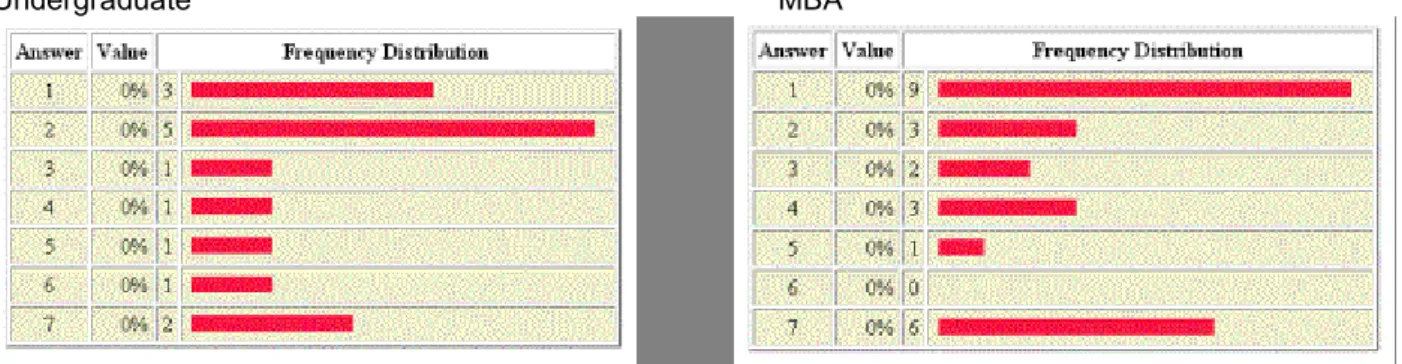
The responses show that, contrary to the desire to break away from the rigidity of synchronous requirements (i.e., the chat sessions), the majority of students, both the undergraduate and MBA, wanted to keep weekly quizzes, which they saw as a “pacemaker” to keep the regularity of the distance learning mechanism. As Figure 7 indicates, there is a hint of skewed bimodality in both responses. That is, much less students are found in the middle than those at the extremes who have strong opinions. An overwhelming majority was against the idea of eliminating weekly quizzes, and approximately 14% of the undergraduate and 25% of the MBA class strongly supported eliminating weekly quizzes. The follow-up correspondence revealed that
11 Q. B. Chung
the desire to keep the weekly quizzes stemmed from the fear of procrastination,
which was precisely the suspicion that had led to pose the question.
Error!
Undergraduate MBA
Figure 7: Desirability of eliminating weekly quiz As for the opinions about the effectiveness of chat logs, virtually no one disagreed. With regard to the opinions about the appropriate length of online lectures, which was asked as an open-ended question, a similar pattern is observed
between the two groups. The raw data is shown in Figure 8, but the responses can be re-grouped into three categories, i.e., (i) 30 minutes or less, (ii) between 30 and 45 minutes, and (iii) 45 to 60 minutes.
Undergraduate MBA
Figure 8: Length of online lecture
The undergraduate students’ responses can be summarized as: (i) 14% supported 30 minutes, (ii) 7% for 30-45 minutes, and (iii) 79% for 45-60 minutes. The MBA students responded: (i) 25% supporting 30 minutes or less, (ii) 8% for 30-45 minutes, and (iii) 67% for 45-60 minutes. Interestingly, one hour was the ceiling for the length of online lectures in both groups. This finding suggests that it would be wise to break up long lectures into a few smaller segments so that a needed level of concentration can be maintained. The remaining two questions were also open-ended, soliciting comments about distance learning in general—Question
(I)—and about the current course in particular—Question (J). Responses reveal a tendency of reservation towards distance learning in general, and specifically toward the distance learning courses without online lectures. This tendency stands out among the responses from the undergraduate students, while the MBA students who take evening classes seem to find distance learning a relief mechanism from their busy schedule. The following remarks represent the student feedback about distance learning in general.
“I feel that the online lectures and the chats were very important for the course, and
I would never want to take a distance learning class that did not include these components.” — Student #2, Undergraduate
“I think there should be some kind of tuition discount for taking distance courses. And as they become more popular, a limit on the number each student can take.” — Student #5, Undergraduate “For undergraduate work it is not a good idea.” — Student #6, Undergraduate
“I am not a huge fan of distance learning classes.” — Student #8, Undergraduate “To someone who is working full-time and balancing other demands, I find the added flexibility DL offers is a big plus.” — Student #1, MBA “The more asynchronous the better the DL class.” — Student #10, MBA
“Student only gets out of the class what he or she puts into the class. If Villanova is going to establish itself as a higher tier MBA program, it must be careful how it approaches distance learning. I don't want Villanova's MBA program to be associated with some ‘mail-order degree’ program because of its strategy regarding distance learning.” — Student #14, MBA
The following sample represents the students’ opinions about the current course. The positive nature of the feedback is by and large attributed to the online lecture.
“This was the first distance learning class I ever took. And while I did learn much of the material, I felt like I would have learned more if I had to go to a class every week.” — Student #4, Undergraduate “I really enjoyed this course, and liked the flexibility of completing things on my own time. This course would not work well with all professors, but your weekly sessions
were focused and helpful.” — Student #9, Undergraduate “This course was a perfect example of what a distance course should be like.” — Student #14, MBA
“I have had several distance learning courses at this point, and this one was far and away the best, meaning I learned more in this distance learning class than any of the others.” — Student #16, MBA “I felt that the recorded lectures were extremely helpful in making sure that I was really understanding the material. I've had 50%/50% classes in which we did not have the online lectures just chats instead and I felt that I was forced to learn on my own in those situations.” — Student #21, MBA
Obviously these comments reinforce the original claim of this paper that online lecture should be considered an indispensable part of distance learning courses.
7. Summary and conclusion
The key point of this paper was to suggest that Web-based distance learning courses without the lecture component diminishes the various benefits of asynchronous distance learning. It first provided a cursory review of the current state of distance learning in the current higher education settings, and then presented two competing views about the role of instructors in distance learning: the ‘sage on the stage’ versus the ‘guide on the side.”The remainder of the paper described two cases of Villanova experience that involved designing and implementing distance learning courses. The reasoning behind the argument for the indispensability of lectures in distance learning was presented first. Then, the details of the two case studies were presented—the courses, delivery format of instruction which included the online lectures, student surveys, and the summary of the feedback from the students.
13 Q. B. Chung
In conclusion, Web-based distance learning courses will benefit from providing the students with on-line lectures using multimedia contents such as streaming video. According to the findings from the cases at Villanova University, a good majority of those who took distance learning courses indicated that a distance learning course without on-line lecture would compromise learning. Again, that was the main point of this paper.
References
Academic Conferences International (2004), Proceedings of the Third European Conference on e-Learning, November 25-26, 2004,
http://www.academic- conferences.org/ecel2005/2-proceedings-ecel2004.htm (accessed on April 20, 2005). Alavi, M. (1994). Computer-Mediated
Collaborative Learning: An Empirical Evaluation. MIS Quarterly, 18:2, 159-174. Alavi, M., Yoo, Y. & Vogel, D. R. (1997).
Using Information Technology to Add Value to Management Education. Academy of
Management Journal, 40:6, 1310-1333.
Bourne, J. R. (1998). Net-learning: Strategies for on-campus and off-campus network-enabled learning. Journal of Asynchronous Learning Networks, 2:2, 70-88.
Briggs, R. O., Ramesh, V., Romano, N. C. & Latimer, J. (1994). The
Exemplar Project: Using Group Support Systems to Improve the Learning Environment. Journal of Educational Technology Systems, 23:3, 277-291.
Cody, W. K. (1999). Theoretical Concerns: Distance learning and the extant paradigm. Nursing Science Quarterly, 12:3, 190.
DeLacey, B. J. & Leonard, D. A. (2002), Case study on technology and distance in education at the Harvard Business School. Educational Technology & Society, 5:2, 13-28.
Ellenchild Pinch, W. J. & Graves, J. K. (2000). Using web-based
discussion as a teaching strategy: Bioethics as an exemplar. Journal of Advanced Nursing, 32:3, 704-712.
Everland, W. P. & Dunwoody, S. (2001). User control and structural isomorphism or disorientation and cognitive load? Learning from the Web versus Print. Communication Research, 28:1, 48-78.
Goodwin, C., Graham, M. & Scarborough, H. (2001). Developing an
Asynchronous Learning Network. Educational Technology & Society, 4:4, 39-47.
Hunt, C. (1998). Distance learning: Short-term gain, long-Short-term commitment — A case study. The International Journal of Educational
Management, 12:6, 270-276. Irons, L. R., Jung, D. J. & Keel, R. O.
(2002). Interactivity in Distance Learning: The Digital Divide and Student Satisfaction. Educational Technology & Society, 5:3, 175-188.
Langford, D. R. & Hardin, S. (1999). Distance learning: Issues emerging as the paradigm shifts. Nursing Science Quarterly, 12:3, 191-196.
Lawson, T. J. (2000). Computers in teaching: Teaching a social psychology course on the Web. Teaching Psychology, 27:4, 285-289.
Leidner, D. E. & Jarvenpaa, S. L. (1993). The Information Age Confronts Education: Case Studies on Electronic Classrooms and Learning. Information Systems Research, 4:1, 24-54.
Matthews, T. D. (2000). A World Wide Web-based research project. Teaching Psychology, 26:3, 227-230.
Moallem, M. (2001). Applying
Constructivist and Objectivist Learning Theories in the Design of A Web-Based Course:
Implications for Practice. Educational Technology & Society, 4:3, 113-125. Motschnig-Pitrik, R. & Holzinger, A.
(2002). Student-Centered Teaching Meets New Media: Concepts nd Case Study. Educational Technology & Society, 5:4, 160-172.
Plous, S. (2000). Tips on creating and maintaining an educational World Wide Web site. Teaching of Psychology, 27:1, 63-70.
Pychyl, T. A., Clarke, D. & Abarbanel, T. (1999). Computer-mediated group projects: Facilitating collaborative learning with the World Wide Web. Teaching Psychology, 26:2, 138-141.
Reisman, S., Dear, R. G., and Edge, D. (2001), Evolution of Web-based distance learning strategies. The International Journal of
Educational Management, 15:5, 245-251.
Szabo, A. & Hastings, N. (2000). Using IT in the undergraduate classrooms:
Should we replace the blackboard with PowerPoint? Computers & Education, 35:3, 175-187. Tiedemann, D. A. (2002). Distance
Learning Development and Delivery Applications. Educational Technology & Society, 5:1, 172-178.
Wildman, P. (1998). Future Praxis: Consulting and teaching futures studies through the World Wide Web. American Behavioral Scientist, 42:3, 505-513.
Project Learning and Virtual Collaboration
- A Master
Program in ICT and Learning
Bo Fibiger
1, Janni Nielsen
2, Elsebeth Korsgaaard Sorensen
3, Marianne Riis
3,
Lone Dirckinck-Holmfeld
3, Oluf Danielsen
4, Birgitte Holm Sørensen
51
Aarhus University, Denmark
2Copenhagen Business School, Denmark
3Aalborg University, Denmark
4Roskilde University, Denmark
5The Danish University of Education, Denmark
[email protected]
[email protected]
[email protected]
[email protected]
[email protected]
[email protected]
[email protected]
Abstract: This paper will introduce a master program in ICT and Learning (MIL) and present some of the experiences we have gained so far. MIL is a result of a collaborative initiative taken by five Danish universities, and it is an accredited part-time 2-year master program. It is unique in the sense that it builds on the pedagogical framework of project pedagogy and is based on online collaboration.
The paper will describe MIL, the universities involved, the administrative organization, and the profile of the students. We will discuss the pedagogical framework and the project collaboration in relation to the modularity and flexibility that characterize the study and allow admission of part-time students, full-time students and students who only sign up for one accredited module. The methodology will be illustrated through empirical snapshots from selected modules in the start-up phase, and the focus will be directed towards problems experienced by the students. From an analytical perspective, the paper will identify and discuss fundamental problems related to the organization, flexibility, and implementation of project pedagogy online.
MIL is organized around ICT and Learning and the study theme focuses on ICT and Learning. In addition, MIL provides a learning space where practice is under constant negotiation and reconstruction as an inherent, integrated part of the learning process. Consequently, we argue that MIL may be seen as an example of best practice in blended learning.
Keywords: Virtual learning, mixed mode, project pedagogy, student profile, methodology.
1. MIL
–
a Danish master
program on ICT and Learning
In Denmark, master degrees were established in the late nineties, partly as a result of a European initiative to coordinate and create correspondence between university study programs, and partly as an attempt to enhance cooperation between universities and business to provide people with an opportunity to pursue continued education and develop competencies in a knowledge-based society.
A national initiative was taken to secure continued education within information technology: 1) a new IT University was built in Copenhagen and 2) a networked IT university was established building on the
existing universities in the western part of Denmark in 2000 (figure 1).
Although the political decision resulted in two regional IT universities, the master program in ICT and Learning (MIL) ignored this national division and established collaborative bridges between five Danish Universities: Aalborg University, Aarhus University, Roskilde University Center, Copenhagen Business School and the Danish University of Education in Copenhagen. The research communities have contributed with different but complementary competencies and form a unique background for the master degree in ICT and Learning. Thus, MIL has been established as a national master degree under the auspices of the IT University West, but also in cooperation
ISSN 1479-4403 ©Academic Conferences Ltd
Reference this paper as:
Fibiger B, Nielsen J, Sorensen E.K, et al (2005) “Project Learning and Virtual Collaboration - A Master Program in ICT and Learning” The Electronic Journal of e-Learning Volume 3 Issue 1, pp 15-22, available online at www.ejel.org
with three universities outside the IT University West (fig 1).
Figure 1: The dotted line shows the division of Denmark between the IT University West and the IT University of Copenhagen. The map also shows the geographical location of universities in Denmark. The universities written in italics are partners in MIL. MIL was established for a four-year
experience period. Based on the positive experiences from the first period, the Ministry of Science and Technology extended the cooperation for an additional four years. The administration and the legal protection is located at Aalborg University, but the responsibility for developing and running the curriculum is placed in a steering committee with representatives from the five universities involved.
MIL may be viewed as a forerunner of the virtual university concept in Denmark. The first challenge was to build the organizational collaborative framework, which turned out to be a major challenge.
MIL was placed “in the middle of nowhere” without any relations to existing legal, financial or administrative systems. A steering committee constituted by senior researchers from the five universities was established. The researchers had a long tradition for cooperating on research in ICT and Learning and a common language related to the research area. Thus, they already constituted a research community with a holistic and coherent foundation for designing the MIL master program.
2. Profile of the students
MIL aims to offer educational opportunities to people working in the public and/or
Bo Fibiger, Janni Nielsen and Elsebeth Korsgaaard Sorensen et al 17
private sector. We think of the potential students as teachers, publishers, project or human resource managers, etc.
Since the program started in 2000, we have had 209 students. 60% of the students came from the public sector and the rest from the private sector. The fact that the course fee for attending MIL is generally lower than for master degrees addressing the private sector more directly may account for the high number of students from the public sector. Approx. 50 % of the students’ basic competencies related to education, and approx. 25% of the students had high level skills related to IT. Nearly all the students had a leadership background in organization or in various projects.
Apart from the challenge of making five universities’ organizations collaborate, the wide gap in competencies was one of the basic problems in planning the curriculum. An interdisciplinary master program may attract students with expert knowledge of IT, but only little knowledge of learning, students with a general knowledge of both learning and IT, or students with a learning background, but only little knowledge of IT. Besides, some students returned to school for the first time after spending more than ten years working. The curriculum had to capture all these profiles in addition to diversity in age and study culture. In other words, it had to support the development of “reflective practitioners”(Schön 1987). The drop out rate has been close to 25%, the main reasons being work pressure (most of the students study part-time combined with full-time jobs) and the high number of on-line activities. Typically, the students do not study to make an academic career. They are very engaged in their professional work, and advancement within their organization or getting a new job are the main factors in their motivation for studying. From our evaluations, we know that dropping out also is related to the students’ equal ambitions in terms of both studies and work.
Participating in a master degree program on ICT and Learning with the use of ICT calls for a different kind of engagement from the students. They bring actual problems from their professional life and organizations into the study and
collaborate with fellow students working on similar problems. The context of the study transforms them into a group of experienced practitioners in a shared reflective endeavor.
3. Study program
To plan a curriculum for students with full or part-time work from different parts of the country requires a focus on flexibility in time and space. In Denmark, a master degree has a value of 60 ECTS (European Credit Transfer System) in a normal year of study. The MIL curriculum is organized as a part-time study covering 30 ECTS annually (part-time).
To secure flexibility, the study program has been developed in mixed mode combining face-to-face seminars and on line activities. It is organized with four seminars of two days’ duration per year of study (two in the eastern part of Denmark and two in the western part of Denmark). In between the seminars, the students collaborate virtually.
As mentioned previously, MIL is based on collaboration between five Danish universities, each of which has brought different study cultures into the master program. Some of the universities have a strong tradition for lecturing, case-based learning and well-defined curricula. Other universities are fundamentally based on the notion of projects and actually identified as project universities. The basic principle in MIL is project learning, which integrates the best from the two cultures in a combination of course modules and projects. The course modules integrate the two cultures in mini projects or case studies to secure the integration of theory and practice (Dirckinck-Holmfeld 2002, Dirckinck-Holmfeld et al. 2004). Only few other programs of similar curricula share this approach (McConnel 2002).
For people with a full-time job in addition to their online studies, a clear structure with well-defined goals for every part of the curriculum is vital. MIL is structured as a modular system divided into smaller courses. Every course module typically contains 2 or 3 sub-courses. It is possible to finish a course in a relatively limited span of time. However, it is a challenge to establish a subtle balance between flexibility in time on the one hand, and to
ensure learning, i.e. knowledge acquisition, reflections and integration in practice, on the other.
The modular structure is also a result of many different needs for further and continued education. Basically, the curriculum is planned as a part-time study, but full-time students and students who only sign up for one accredited module are also accepted. It is anticipated that more and more students want to combine modules from different master programs to construct their own “flexible master” curriculum. This vision is supported by the Ministry of Science and Technology.
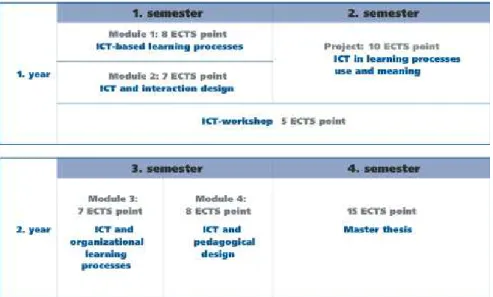
The basic course modules reflect the epistemology of the curriculum. In the first year, the students attend two basic modules. ICT based learning processes
covers intra psychological and mediated interpersonal learning processes and learning in communities of practice. ICT and Interaction Design focuses on analysis, design, test and evaluation of human-computer interaction. It takes its point of departure in theories on human beings/users and the mental processes. Interaction is understood as taking place in the interface, which is multimodal (text, images, sound, etc.). The two modules form the foundation of a project work
within the thematic frame ICT and learning processes: use and meaning.
Figure 2: study program
In the second year, the students also attend two basic modules. The main theme of ICT and organizational learning
is knowledge sharing and knowledge management in the learning organization. The module focuses on intra and inter-organizational learning processes and ICT in communication and continuous learning.
ICT and didactic design takes its point of departure in pedagogical theories and works with graphics and scenographic design in addition to dramatic and narrative dimensions as a basis for design of virtual learning resources.
Both in the first and second year, the students are offered different courses in ICT tools and workshops in epistemology, research methods and writing of academic reports.
Based on the first year of project work and the four course modules, the students write their final master thesis. The master thesis may be theoretical, analytical or based on product development (from prototype to final application). Normally, however, the thesis will include elements from all three dimensions.
4. Pedagogical framework
To secure flexibility in relation to time and space, MIL is organized as blended learning with online studies and four annual face-to-face seminars.
The ideology of MIL is based on the notion of “communities of practice” (Wenger 1998), and MIL students come from different enterprises and organizations. From the perspective that learning is an authentic and social process, the study
Bo Fibiger, Janni Nielsen and Elsebeth Korsgaaard Sorensen et al 19
program is fundamentally based on collaboration in projects. This approach is not only valid for the first year project and the master thesis; it also penetrates the pedagogical thinking behind the four course modules. With this approach, we attempt to facilitate an integration of theory with the students’ work experiences. In the educational context of MIL, the students are encouraged to use their diversities as sources of inspiration and turn them into strengths in the collaborative work. Furthermore, we encourage students to establish groups across their specific experiences and interests. This is a challenge for both group members and facilitators, as it requires a high degree of awareness and knowledge in the constitution of groups, the organization of groups and the group process.
5. Methodology
In the following, we will present empirical snapshots from MIL. The aim is to give an impression of the work in MIL and highlight some of the problems related to the virtual organization.
The different cultures at the different universities may be illustrated by the two course modules in the first year: ICT based learning processes and ICT and Interaction Design. Both modules take their starting point in introductions and lectures at the first seminar, and the course work continues online. The module on ICT-based learning processes is based on and experiments with the features of collaborative online dialogue, while the module on ICT and interaction design is based on collaboration in groups designing a product online. The difference between the two modules is reflected in the structure of the online forums, the role of the teacher, and the evaluation criteria (Sorensen 2003). Both modules operate with a forum for meta-discussions.
An extensive evaluation carried out in 2003 showed that this difference caused some confusion among the students. When promoting such pedagogical diversity, it is important to communicate the differences and illustrate what we are preaching in practice. But there is also a need for introducing more virtual tools to handle different types of collaboration and
more appropriate tools to help students manage their portfolios.
The first project work enhances the students’ competencies in project management. The students learn to carry out the basic planning on face-to-face seminars, use chat to handle specific problems (making decisions etc,), and use asynchronous written forums for collaborative discussions and reflection. In addition, they employ other types of communication software for synchronous communication (visual, audio and text-based).
Pedagogical design is the module involving experiments on learning objects and learning resources. One of the experiments related to the university library where the traditional course book was replaced by an electronic version. In collaboration with the university library, both copyrights and payment for use were negotiated for the experiment. The library uploaded the literature in a resource portal on the web. However, a questionnaire showed that only 35% of the students perceived this as an improvement.
It is important to make the electronic library more attractive to the students. This may be done by implementing added value to the course materials and resources. One of the advantages of web resources is that they may be supplemented with tools for annotations (e.g. guidelines from the teacher, reflections from the students, etc.). At the moment, we are collaborating with a software producer to explore the possibilities of group-based annotations. Another experiment has been the development of video based course material. MIL has produced resources in the shape of online lectures using streaming videos stored in the course archives. Furthermore, video-based interactive lessons for courses on PhotoShop and Dreamweaver have been developed. Also, the streamed lectures and screen shots have been manipulated into small segments representing a single problem, which can be accessed from a menu and combined with tasks (Fibiger 2003). The responses from the students
are positive, and the exploration of the potentials will continue.1
In a number of ways, videoconferences are also represented in the curriculum: at face-to-face seminars to include researchers from abroad as guest lecturers and as a tool for specialized activities bridging three regional sites. In our experience, videoconferences require extended preparations related to both the set up and the content. Videoconferences are not tools for presentation, but tools for discussions. Taking these preconditions into account, videoconferences may represent an excellent way to expand the classroom.
6. Studying in virtual
environments
MIL has now existed for 4 years and served 200 students. The students have been between 30 and 60 years old, studied on a part-time basis while holding a full-time job, and have had a background in pedagogy or ICT.
The way in which the students interact and collaborate falls into patterns that may be characterized by three profiles: the enthusiast, the main-streamer, and the pragmatist. They differ basically in their relation to information in the virtual learning environment.
The Enthusiasts make up 15 % of the students. They are interested in all items of information and very active in forums on a nice-to-know basis. They are on the web daily, often more than once, and also during the weekends. They read all contributions to the forums in which they participate, and they are very active in meta-forums and social activities on the web.
The pragmatists also make up approx. 15% of the students. The pragmatists go for need-to-know information, and they are only on the web once or twice a week. They focus on the obligatory scientific forums and participate only in debates as part of the curriculum.
1
We are collaborating on a project supported by the board of universities on the use of video resources in higher education. The project will result in a web portal on the use of video in education.
The rest of the students: the main
streamers make up approx. 60-70%. They are online nearly every day, depending on their need for information and their activities in their private and professional lives. They are involved in the scientific forums and the meta-forums, and from time to time they are active in forums with nice-to-know information.
7. Best practice and
pedagogical design
In our experience, virtual learning is not a simple matter. It suggests a diversity of pedagogical approaches. Different scientific disciplines and interdisciplinary approaches call for different learning cultures, which in turn must be seen in relation to several parameters: different students with different aims and with different plans in time and space. Different students with different learning and communication styles, different social behaviors and different needs for information and collaboration.
We argue that MIL may be seen as an example of best practice2 in blended learning. In addition, MIL is a learning space where best practice is under constant negotiation and reconstruction as an inherent, integrated part of the learning process.
References
Dirckinck-Holmfeld, Lone (2002).
Designing Virtual Learning Environments Based on Problem Oriented Project Pedagogy. In: Dirckinck-Holmfeld, L. & Fibiger, B.: Learning in Virtual
Environments. Samfundslitteratur 2002, p. 31-54.
Dirckinck-Holmfeld, L., Sorensen, E.K., Ryberg, T., Buus, L. (2004): A Theoretical Framework for Designing Online Master Communities of Practice.
Presented at the EQUEL symposium, SIG 3, at The networked Learning Conference (NLC2004), held April 5-7, at Lancaster University, UK. Fibiger, Bo (2004): Streaming video –
Grundlæggende genrer i
2
The Ministry of Science in Denmark have nominated MIL as an example of best practice, see http://www.e-kompetencer.dk/rapport_03.html#3.2.3
Bo Fibiger, Janni Nielsen and Elsebeth Korsgaaard Sorensen et al 21
læringsomgivelser. In:
Undervisningsformer på nettet. Universiteternes portal for efter- og videreuddannelse, november 2003. English edition 2004 (forthcoming) at www.unev.dk:
Streaming Video - Fundamental Genres in Learning Environments
McConnell, D. (2002): Action Research and Distributed Problem Based Learning in Continuing
Professional Education. Distance Education, 23(1), 59-83
Schön, Donald A. (1987) Educating the reflective practitioner: toward a
new design for teaching and learning in the professions.
Jossey-Bass 1987.
Sorensen, E. K. (2003). Designing for Online Dialogue and Discussion in Collaborative Knowledge Building Networks (SOFF report No. 1). Tromsoe, Norway: SOFF – Centralorganet for fleksibel laering i Hoegre utdanning, pp. 21-34. Wenger, Etienne (1998). Communities of
Practice - Learning, Meaning, and Identity. New York, Cambridge University Press 1998.