R E S E A R C H A R T I C L E
Open Access
Identification of three new
cis
-regulatory
IRF5
polymorphisms:
in vitro
studies
Elisa Alonso-Perez
1, Romina Fernandez-Poceiro
1, Emilie Lalonde
2, Tony Kwan
2, Manuel Calaza
1,
Juan J Gomez-Reino
1,3, Jacek Majewski
2and Antonio Gonzalez
1*Abstract
Background:Polymorphisms in the interferon regulatory factor 5 (IRF5) gene are associated with susceptibility to systemic lupus erythematosus, rheumatoid arthritis and other diseases through independent risk and protective haplotypes. Several functional polymorphisms are already known, but they do not account for the protective haplotypes that are tagged by the minor allele of rs729302.
Methods:Polymorphisms in linkage disequilibrium (LD) with rs729302 or particularly associated withIRF5
expression were selected for functional screening, which involved electrophoretic mobility shift assays (EMSAs) and reporter gene assays.
Results:A total of 54 single-nucleotide polymorphisms in the 5’region of IRF5were genotyped. Twenty-four of them were selected for functional screening because of their high LD with rs729302 or protective haplotypes. In addition, two polymorphisms were selected for their prominent association withIRF5expression. Seven of these twenty-six polymorphisms showed reproducible allele differences in EMSA. The seven were subsequently analyzed in gene reporter assays, and three of them showed significant differences between their two alleles: rs729302, rs13245639 and rs11269962. Haplotypes including thecis-regulatory polymorphisms correlated very well withIRF5 mRNA expression in an analysis based on previous data.
Conclusion:We have found that three polymorphisms in LD with the protective haplotypes ofIRF5 have differential allele effects in EMSA and in reporter gene assays. Identification of thesecis-regulatory polymorphisms will allow more accurate analysis of transcriptional regulation ofIRF5expression, more powerful genetic association studies and deeper insight into the role ofIRF5in disease susceptibility.
Keywords:Genetic susceptibility,IRF5, Polymorphism, Systemic lupus erythematosus, Transcriptional regulation
Introduction
The interferon regulatory factor 5 (IRF5) gene occupies a prominent place among the genetic factors involved in susceptibility to rheumatic and autoimmune diseases [1]. It is associated with a large series of diseases, either defini-tively, as with systemic lupus erythematosus (SLE) [2-7], Sjögren’s syndrome, systemic sclerosis, primary biliary cir-rhosis and rheumatoid arthritis; or more tentatively, as with granulomatosis with vasculitis, multiple sclerosis, inflammatory bowel disease and atherosclerosis [1].
Discovery of these associations has contributed to increased interest in the role of type I interferon in auto-immune diseases and to progress in understanding of dis-ease pathogenesis, particularly regarding SLE [8,9]. However, advances could be made faster if we understood the molecular and cellular mechanisms involved. A variety of functional polymorphisms have already been identified in theIRF5locus, but their relationship with disease sus-ceptibility is still unclear.
Four polymorphisms with a putative functional role have been described [2-4,7,10,11]. The first identified is rs2004640, in which the T allele introduces a donor splice site for alternative first exons [3]. However, its
in vivo relevance has been questioned [7]. Another, rs10954213, creates an early polyadenylation site that * Correspondence: [email protected]
1Laboratorio Investigacion 10 and Rheumatology Unit, Instituto de
Investigacion Sanitaria, Hospital Clinico Universitario de Santiago, Travesia Choupana, s/n. Santiago de Compostela 15706, Spain
Full list of author information is available at the end of the article
leads to shorterIRF5 mRNA isoforms with longer half-lives [4]. This single-nucleotide polymorphism (SNP) has the strongest evidence for a role incis-regulatory element
ofIRF5[12,13]. The remaining two functional
poly-morphisms are of the insertion-deletion (indel) type. One
of them, with 3x or 4x copies of CGGGG in the IRF5
promoter, affects transcription levels by differential bind-ing of the specificity protein 1 (Sp1) transcription factor [10,11]. The other changes 10 amino acids encoded in exon 6, but experimental evidence of any effect of this change in the IRF5 protein is still lacking [7].
Various models have been proposed to account for the association with disease in this locus, including combi-nations of the functional polymorphisms [4-7,11], but none is completely satisfactory. In particular, haplotypes with two opposed effects have consistently been observed in the association ofIRF5 with SLE [4-7] and with other diseases [14-17]. However, we still do not know the causes of the two effects. Most studies have focused on the risk haplotype (designated as haplotype 6 in [5,12,15] and described in Additional file 1: Note S1), which has a frequency of about 10% in controls and nearly 20% in SLE patients. This haplotype includes alleles that determine increased expression of the gene (the 4x allele of the CGGGG indel in the promoter) and longer half-life of the mRNA (the A allele of rs10954213 in the 3’ untranslated region). However, it is unclear whether increased expression is the only mechanism involved, because there are other haplotypes that include combinations of the same alleles but are not associated with increased SLE risk (for example, haplotypes 4 and 5, which include alleles 4x and A but are neutral). It has been proposed that the difference between the risk and the neutral haplotypes resides in interactions with other functional polymorphisms, such as the indel in exon 6, but this hypothesis lacks experimental support. Less effort has been put into investigating the protective effect of IRF5 variants. In multiple studies, disease protection is associated with the minor allele of rs729302 [4-6], which is a SNP of unapparent functionality located 5’ to the gene, and with two haplotypes (designated as haplotypes 1 and 2 in our studies; see Additional file 1: Note S1). This protective effect does not correlate with the known functional polymorphisms. Therefore, we currently lack any explanation for disease protection to account forcis polymorphisms in theIRF5locus.
Our aim in the present study has been to identify new functional polymorphisms that could contribute to the protective effect ofIRF5haplotypes. Given the location of rs729302 and its linkage disequilibrium (LD) pattern,
our focus has been to study polymorphisms 5’toIRF5
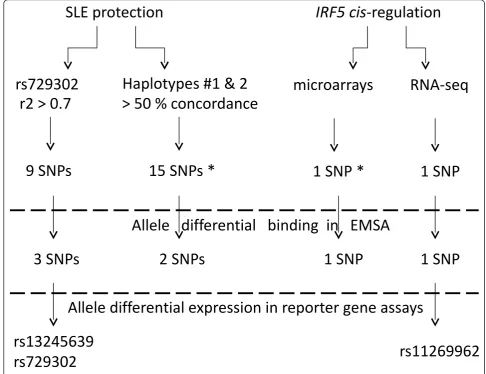
and in its first intron that could affect transcription through differential binding of nuclear proteins. Our exploration followed an experimental process (Figure 1)
initiated by selecting polymorphisms based on tight LD with rs729302 or the protective haplotypes as well as on the basis of their prominent association withIRF5 tran-scription levels. This approach led to the selection of 26 polymorphisms for functional screening. First screening was done by searching allele differential patterns in elec-trophoretic mobility shift assays (EMSAs) with B cell line nuclear extracts. Seven polymorphisms showed dif-ferential binding in these assays and were brought to luciferase reporter gene assays. Three of the seven poly-morphisms showed differential luciferase expression with their two alleles. These three new cis-regulatory polymorphisms, rs729302, rs13245639 and rs11269962,
will allow more accurate understanding of IRF5
tran-scriptional variation and its role in disease susceptibility, as suggested already by our preliminary analysis of their haplotype assignments.
Materials and methods
Genotypes, linkage disequilibrium map and haplotype analysis
The region extending from chr7:128,343,695-128,393,203 of the Human March 2006 genome assembly (NCBI36/ hg18) that includes the coding sequence ofIRF5, 21.5 kb of its promoter region (from the start of exon 1, variant A) and part of the transportin 3 (TNPO3) locus, which is 3’to
IRF5, was screened for polymorphisms. Only tag SNPs
Bayesian algorithm [20]. Two haplotype distribution ana-lyses were done, the first to select SNPs for functional studies, including all SNPs of potential interest and the second to put the new functional polymorphisms in con-text, including only the functional and tag SNPs. Func-tional screening was conducted on three addiFunc-tional polymorphisms selected on the basis of their relationship withIRF5expression or their knowncis-regulatory effect. This information is detailed in Additional file 2: Table S3.
Cell culture and nuclear extracts
The B-lymphocyte cell line WIL2 NS [21,22], which con-stitutively expresses IRF5 (Additional file 3: Figure S1), was obtained from the European Collection of Cell Cul-tures (catalogue no. 90112121). It was maintained in RMPI 1640 medium supplemented with 10% fetal
bovine serum, 2 mM L-glutamine, 1 U/ml penicillin and 0.1 mg/ml streptomycin. For the preparation of nuclear extracts, 107 cells were washed in 1 ml of phosphate-buffered saline and incubated at 4°C for 15 min with 200μl of a lysis buffer containing 10 mM 2-[4-(2-hydro-xyethyl)piperazin-1-yl]ethanesulfonic acid (HEPES), pH 7.9, 1 mM ethylenediaminetetraacetic acid (EDTA), 1 mM ethylene glycol tetraacetic acid, 10 mM KCl, 1 mM dithiothreitol (DTT), 1 mM phenylmethylsulfonyl fluoride, 10μg/ml aprotinin and 10μg/ml of leupeptin. The freed nuclei were incubated at 4°C for 30 min with 0.1% Triton X-100 and collected by centrifugation at
800 ×gduring 15 min at 4°C. Subsequently, they were
incubated at 4°C for 30 min with rotation in 200μl of the previously specified lysis buffer supplemented with 20% glycerol and 0.4 M KCl. Insoluble material was
"
#
$ %&
'
()$ *
#
) "++ ,"%-)
) "++ . %
//
1/
[image:3.595.53.540.90.464.2]Figure 1Experimental design of the search for new functional polymorphisms inIRF5. Polymorphisms for functional screening were
selected on the basis of correlation with systemic lupus erythematosus (SLE) protection or prominent role isIRF5 cis-regulation models. A first
precipitated by centrifugation for 15 min at 13,000 rpm and 4°C. All the mentioned reagents were obtained from Sigma-Aldrich (St Louis, MO, USA). Nuclear pro-teins in the supernatant were quantified using the Quant-iT Protein Assay Kit (Molecular Probes, Eugene, OR, USA) in a Qubit fluorometer (Invitrogen, Carlsbad, CA, USA). Quantified nuclear extracts were stored at -80°C until use.
Electrophoretic mobility shift assay
Oligonucleotides for each allele and strand centered in the 25 selected polymorphisms plus the CGGGG indel used as a positive control were synthesized by Sigma-Genosys (Haverhill, UK) (Additional file 2: Table S4). Complementary oligonucleotides were annealed at 37°C for 1 h to form the double-stranded probes used in EMSA. The LightShift Chemiluminescent EMSA Kit (Pierce Biotechnology, Rockford, IL, USA) was used with some modifications. Briefly, the binding reaction was performed with 0.5 nM of double-stranded, biotin-labeled oligonucleotides and 0.5 to 4.0 μg of nuclear extract proteins from WIL2 NS cells. This reaction was brought to a final volume of 20 μl with binding buffer (10 mM Tris·HCl, pH 7.5, 10 mM KCl, 0.6 mM DTT,
50 ng/μl poly(deoxyinosinic-deoxycytidylic) acid,
1.5 mM EDTA, 2 mM HEPES, pH 7.9, 25 mM NaCl,
0.1 mM ZnSO4, 15% glycerol and 0.25 mg/ml bovine
serum albumin) and incubated at room temperature for 20 min. Cold competition was done with a 200-fold molar excess (0.1 μM) of the unlabeled oligonucleotide. DNA-protein complexes were analyzed by electrophor-esis in 5% polyacrylamide nondenaturing gels and 0.5 × Tris/borate/EDTA buffer at 11 V/cm and 4°C for 3 h. Subsequently, they were transferred to nylon membranes according to a semidry transfer protocol for 45 min at 12 V. The complexes were cross-linked to the nylon mem-brane with ultraviolet (UV) light at 7.2 J/cm2. Detection was done with the LightShift Chemiluminescent EMSA Detection Module (Pierce Biotechnology) followed by exposure to UV light using the UVP EC3 Imaging System (UVP, Upland, CA, USA). A minimum of three indepen-dent replicate experiments were done for each EMSA showing differential binding.
Luciferase reporter assays
Fourteen different constructs were made, one for each of the alleles of the seven polymorphisms with differen-tial EMSA results. TheIRF5sequence (148 to 245 bp in length) of each of these polymorphisms was obtained from heterozygous subjects by polymerase chain reac-tion (PCR) with the same primers used for genotyping (Additional file 2: Table S5). None of them included additional polymorphisms. The amplicons were first inserted into the EcoRV site of a pBlueScript (pBK SK-)
vector by TA cloning. Briefly, the EcoRV cut vector was treated with Taq DNA polymerase in the presence of 2 mM deoxythymidine triphosphate and PCR buffer, and 50μg of this 3’T-vector were ligated to 25μg of the PCR amplicon in a 10-μl reaction with 1μl of T4 DNA ligase reaction buffer (New England Biolabs, Ipswich, MA, USA) and 1× ligase buffer at 16°C overnight. The clonedIRF5 sequences were subcloned into the KpnI/SmaI sites of a
fos-pGL3-basic vector, which are just upstream of the minimalfospromoter regulating expression of theFirefly luciferase gene. The sequence and orientation of each insert were verified by DNA sequencing. These verified reporter vectors were transfected in WIL2 NS cells. Speci-fically, each experiment included five conditions: blank, positive control, empty vector, allele 1 and allele 2. The
experiments were carried out by transfecting 2 × 10⁶
WIL2 NS cells with 400 ng of the adenovirus E1 region RSV-Luc vector plus 2,800 ng of the pBK SK- vector for the positive control, 3,200 ng of thefos-pGL3 basic vector for the empty vector, 3,200 ng of the allele 1fos-pGL3 vec-tor construct, and 3,200 ng of the allele 2fos-pGL3 vector construct for each of the two alleles. All transfections also included 800 ng of the pRL-TKRenillaluciferase vector (Promega, Madison, WI, USA) for normalization. Trans-fections were done by microporation in 100μl of Resus-pension Buffer R at 1,100 V for 30 ms and a single-pulse program in the Neon Transfection System (Invitrogen). After microporation, the transfected cells were left in cul-ture for 24 h (basal) or left for 20 h. The luciferase activity was measured using theFireflyLuciferase and theRenilla Luciferase Assay systems (both from Promega). The results forFireflyluciferase were expressed as relative luci-ferase units after normalization with theRenillaluciferase activity and with the empty vector for the respective experiments. At least five independent experiments were performed for each of the seven analyzed polymorphisms. Comparison of the log-transformed mean normalized
Fireflyluciferase luminescence ratios was done using the Wilcoxon matched-pairs test.
Results
Selection of promoter polymorphisms on the basis of linkage disequilibrium and haplotypes
The experimental design involved selection of SNPs on the basis of three criteria (Figure 1): high r2 values with rs729302, high correlation with the protective
haplo-types and prominent association with IRF5 expression.
and those showing changes in expression between the constructs with the two alleles were considered to be functional (Figure 1).
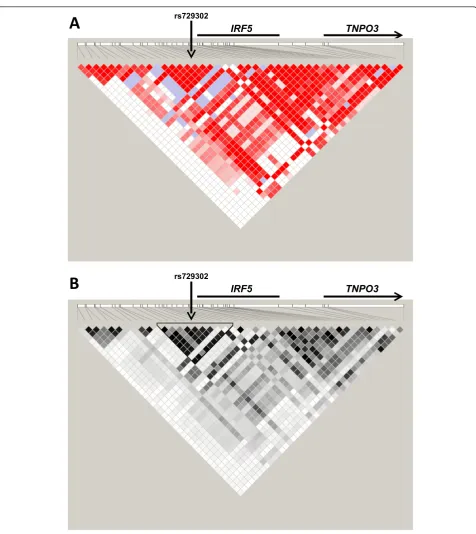
To identify SNPs strongly correlated with rs729302 or with the protective haplotypes, we genotyped 54 poly-morphisms located predominantly within 21.5 kb of the 5’ region ofIRF5(Additional file 2: Table S1) in 95 Spanish controls. The D’andr2pairwise values were calculated for 44 polymorphisms (Additional file 2: Table S6), which excluded eight SNPs with minor allele frequencies less than 2% (rs12536195, rs6951615, rs11773414, rs11983607, rs11763323, rs754280, rs41298401 and rs11767834) and two SNPs that were completely redundant with rs3778753 (rs3778752 and rs3778751). This analysis showed a block of LD extending over 43 kb fromTPNO3to the 5’region ofIRF5further from the gene than rs729302 (Figure 2A). This block included 37 of the analyzed SNPs. A second block of LD with seven SNPs was even further 5’toIRF5 than the first. In the largest block of LD, there were two areas of stronger correlation between SNPs (Figure 3B), one of them (8 kb) included rs729302 and other eight
SNPs (r2 ≥ 0.7 with rs729302). These nine SNPs were
selected for functional screening (Table 1). The pattern of LD was very similar in the 379 samples of European ancestry in phase 1 of the 1000 Genomes project (Addi-tional file 3: Figure S2) [23].
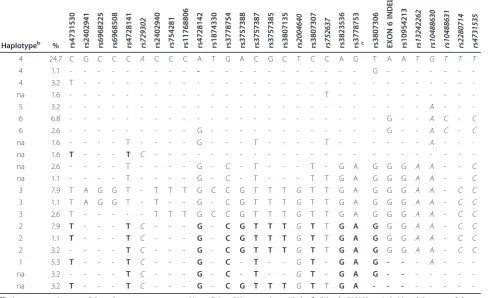
Next, we studied the haplotypes of the 37 SNPs in the large LD block. There were 20 haplotypes with frequen-cies over 1% that represented 85.3% of the chromo-somes in the studied samples (Table 2). Thirteen of the twenty common haplotypes could be traced back as sub-haplotypes of the six sub-haplotypes defined with tag SNPs in our previous studies (and described in Additional file 1: Note S1) [5,12,15]. The other seven haplotypes were new. On the basis of these data, we selected for func-tional analysis the 15 SNPs with minor alleles in the haplotypes that generally (>50%) carried the minor allele of rs729302 (Table 2).
Selection of polymorphisms on the basis of their
association withIRF5expression
A recent analysis by our group, in which we combined data from multiple microarray experiments in lymphoblas-toid cell lines, highlighted fourIRF5polymorphisms in the
best models accounting forIRF5 expression [12]. We
selected three of them for the current study. One of them is the CGGGG indel, which is already known to influence
IRF5expression [10,11]. It was selected as a sort of posi-tive control (Table 1). The second is rs3807306, which had already been selected on the basis of our haplotype analy-sis. The third is rs17424179, which was not included in our LD analysis because it is 68 kb 3’toIRF5 and we selected it at this stage. The fourth SNP in the
microarray-derived model, rs10954213, was not selected because it is in theIRF5coding sequence and affects mRNA stability.
We selected an additional polymorphism on the basis
ofIRF5 expression data obtained using the RNA-seq
approach (E Alonso-Perez, unpublished data). More details are available in Additional file 1: Note S2. Briefly, the transcriptome of the 60 cell lines of the HapMap CEPH (Utah residents with ancestry from northern and western Europe: CEU) collection was obtained from a published study [24]. After alignment of the RNA-derived sequences, reads corresponding to exons were counted together with the junction reads, and the total was nor-malized and used as a measure of the expression level. This measure for each cell line was used as the variable
to explain the genotypes of 264 IRF5 polymorphisms
from the 1000 Genomes project. The most significantly associated polymorphism in this analysis was rs11269962
(P = 0.002), which is a 14-bp indel placed 2.2 kb
upstream of theIRF5gene (Table 1).
Screening of functional polymorphisms with electrophoretic mobility shift assay
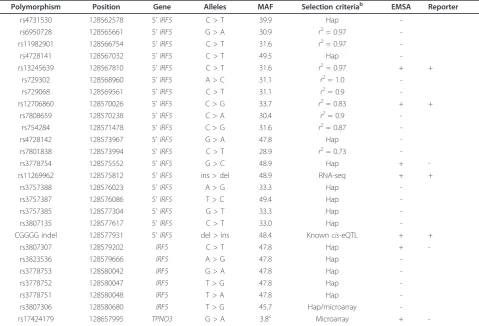
We considered it likely that the SNPs of interest could have a functional effect dependent on the differential allele binding of nuclear proteins. EMSA was used as a screening tool for these differences. We used nuclear extracts from a lymphoblastoid cell line in basal condi-tions. A total of 26 polymorphisms were subjected to this screening (Figure 1): 9 in the rs729302 high-correla-tion group, 15 from the haplotype selechigh-correla-tion and 2 on
the basis of their association with IRF5 expression
(Table 1). In addition, we analyzed the CGGGG indel as a positive control (Additional file 3: Figure S3A).
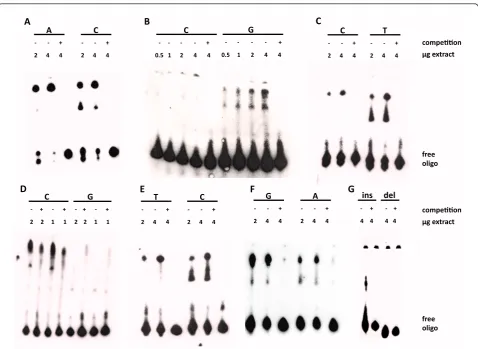
Only 7 of the 26 polymorphism showed differential allele patterns in EMSA. The first was rs729302 itself, which showed additional binding with the C allele rela-tive to the A allele (Figure 3A). Two others were from the group in tight LD with rs729302. The minor G allele of rs12706860 showed a specific pattern of additional bands with delayed migration when it was compared with the major C allele (Figure 3B). The other SNP of this group, rs13245639, showed specific band slowdown with its minor T allele in comparison with the major C allele (Figure 3C). Also, two of the SNPs selected on the
basis of IRF5 protective haplotypes, rs3778754 and
differences between EMSAs with the two alleles led us to select this SNP for further study. The next SNP, rs3807307, showed an additional and specific band shift
with the major C allele that migrated faster than the band that was common to the two alleles (Figure 3E). The two polymorphisms selected on the basis of their
[image:6.595.60.537.83.618.2]
Figure 2IRF5linkage disequilibrium maps. Pairwise D’(A)andr2(B)between 44 polymorphisms in theIRF5locus obtained in 95 Spanish healthy controls are represented. Ten additional single-nucleotide polymorphisms (SNPs) were excluded because of low minor allele frequency
(<2%) or complete redundancy with other SNPs (see Results). Color scale from white to red indicates D’values from 0 to 1 in (A) and that from
white to black indicatesr2values from 0 to 1 in (B). The triangle in (B) surrounds the block containing SNPs in tight linkage disequilibrium with
prominent association withIRF5expression also showed differential EMSA results. For rs17424179, there were two shifted bands with the two alleles; however, the slowest band was much more intense than the fastest one with the G allele, and this difference was not as marked for the A allele (Figure 3F). For the major allele of rs11269962, the 14-bp insertion, a specific delayed band was observed that was absent with its minor allele (Figure 3G).
These differential patterns of binding with nuclear extracts of the B cell line WIL2 NS were obtained in three or more concordant experiments. None of the other 19 analyzed polymorphisms showed differential results in EMSA. Among them was rs4728142, which has been reported to show differential allele intensity of the delayed band [25]. We analyzed this SNP with particular attention, but we did not detect any difference between the two alleles (Additional file 3: Figure S4).
Luciferase gene reporter assays
To further assess the functionality of the seven poly-morphisms that had shown differential EMSA results (Table 1), we performed luciferase gene reporter assays. Each polymorphism was tested with a pair of vectors: one for each allele (148 to 245 bp in length; see Additional file 2: Table S5). They did not contain any other SNP. Inserts for the seven polymorphisms plus those used as positive controls (CGGGG indel) were introduced upstream of thefosminimal promoter infos-pGL3 vec-tors. These constructs were transiently transfected into the B-lymphocyte cell line WIL2 NS. The CGGGG indel showed higher expression with the 4x allele than with the 3x allele (Wilcoxon test;P= 0.043), as described pre-viously [11] (Additional file 3: Figure S3B).
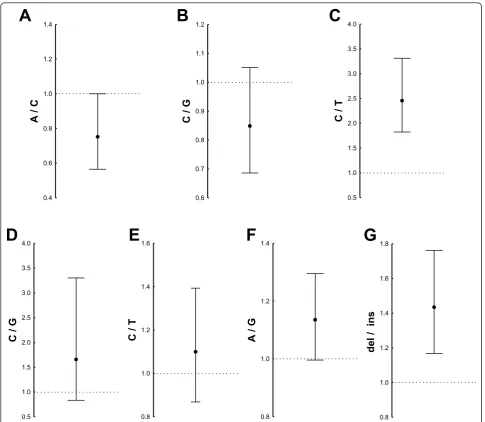
Three of the seven newly studied polymorphisms showed differential luciferase expression: (1) rs729302
&
" # # %
" # # %
" # #
%
" # # %
" # # %
" # # %
% # #
% # #
% $!"##
% $!"##
%% ""!!
%% ""!!
" # # %
" # # %
[image:7.595.59.538.86.435.2]
&
Figure 3SevenIRF5polymorphisms showing differential electrophoretic mobility shift assay results. Seven of the twenty-six polymorphisms analyzed by electrophoretic mobility shift assay (EMSA) showed differential patterns of delayed migration with their two alleles.
(A)rs729302.(B)rs12706860.(C)rs13245639.(D)rs3778754.(E)rs3807307.(F)rs17424179.(G)rs11269962. They were analyzed with WIL2 NS cell
itself (Figure 4A), (2) rs13245639 (Figure 4C), both from the group of SNPs in tight LD with rs729302, and (3) the 14-bp indel rs11269962 (Figure 4G). The minor C allele of rs729302 showed increased expression relative to the major A allele, but the difference was only borderline (Figure 4A). Constructs with the major C allele of rs13245639 showed a significant increase in luciferase expression compared with the minor T allele (Figure 4C). The construct with the 14-bp indel of rs11269962 showed a significant decrease in luciferase expression relative to the construct with the deletion allele (Figure 4G). These latter results were consistent with the RNA-seq analysis, which showed higher expression with the deletion allele. The remaining four SNPs with differential EMSA results did not show significant differences in the reporter gene assays (Figures 4B, D, E and 4F).
Haplotype assignments of the new functional polymorphisms
We performed an estimation of haplotypes to facilitate interpretation of the newly identified functional
polymorphisms. The three new functional
polymorph-isms, comprising the two known cis-regulatory
poly-morphisms (CGGGG indel and rs10954213) and the eight tag SNPs used in our previous studies (total of thirteen polymorphisms), were included in this analysis. In this way, it was possible to explore retrospectively correspondences between the functional polymorphisms
andIRF5mRNA expression or association with SLE, as
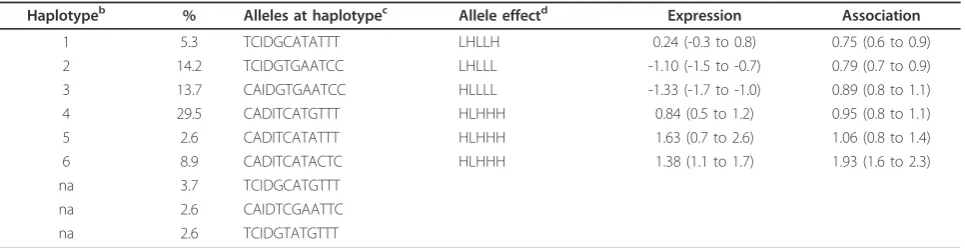
[image:8.595.57.537.100.426.2]observed in previous studies [5,12]. We obtained nine haplotypes of relative high frequency that accounted for 83.2% of the total (Table 3). They included the six pre-viously studied (described in Additional file 1: Note S1) and three new ones, which were excluded from further analysis because of lack of information. The remaining six haplotypes still accounted for 74.2% of the total, allowing for meaningful analysis. We computed a sum score of the alleles of the five functional polymorphisms assigned to each haplotype in function of the increased (H) or decreased (L) regulation associated with them (Table 3). These sum scores were correlated with the correspondingIRF5 expression or association with SLE.
Table 1 Polymorphisms in theIRF5locus screened by functional tests.a
Polymorphism Position Gene Alleles MAF Selection criteriab EMSA Reporter
rs4731530 128562578 5’IRF5 C > T 39.9 Hap
-rs6950728 128565661 5’IRF5 G > A 30.9 r2= 0.97
-rs11982901 128566754 5’IRF5 C > T 31.6 r2= 0.97
-rs4728141 128567032 5’IRF5 C > T 49.5 Hap
-rs13245639 128567810 5’IRF5 C > T 31.6 r2= 0.97 + +
rs729302 128568960 5’IRF5 A > C 31.1 r2= 1.0
-rs729068 128569561 5’IRF5 C > T 31.1 r2= 0.9
-rs12706860 128570026 5’IRF5 C > G 33.7 r2= 0.83 + +
rs7808659 128570238 5’IRF5 C > A 30.4 r2= 0.9
-rs754284 128571478 5’IRF5 C > G 31.6 r2= 0.87
-rs4728142 128573967 5’IRF5 G > A 47.8 Hap
-rs7801838 128573994 5’IRF5 C > T 28.9 r2= 0.73
-rs3778754 128575552 5’IRF5 G > C 48.9 Hap +
-rs11269962 128575812 5’IRF5 ins > del 48.9 RNA-seq + +
rs3757388 128576023 5’IRF5 A > G 33.3 Hap
-rs3757387 128576086 5’IRF5 T > C 49.4 Hap
-rs3757385 128577304 5’IRF5 G > T 33.3 Hap
-rs3807135 128577617 5’IRF5 C > T 33.0 Hap
-CGGGG indel 128577931 5’IRF5 del > ins 48.4 Knowncis-eQTL + +
rs3807307 128579202 IRF5 C > T 47.8 Hap +
-rs3823536 128579666 IRF5 A > G 47.8 Hap
-rs3778753 128580042 IRF5 G > A 47.8 Hap
-rs3778752 128580047 IRF5 T > G 47.8 Hap
-rs3778751 128580048 IRF5 T > A 47.8 Hap
-rs3807306 128580680 IRF5 T > G 45.7 Hap/microarray
-rs17424179 128657995 TPNO3 G > A 3.8c Microarray +
-a
The polymorphisms’genomic position, relation to genes, alleles, minor allele frequency (MAF), criteria of selection and results of the electrophoretic mobility shift assay (EMSA) and reporter gene assays are shown.b
Selection criteria were hap = concordance of the minor allele with the minor allele of rs729302 in most haplotypes;r2= level of genotype correlation with rs729302; RNA-seq = polymorphism most associated with RNA-seq data; microarray = specially associated single-nucleotide polymorphisms in microarray expression analysis.c
For expression, we used the weighted means of the hap-lotype-specific regression coefficients in four microarray experiments with lymphoblastoid cell lines [12]. Correla-tion between the expression levels and the sum score of the cis-regulatory polymorphisms was very good (rs =
0.93,P = 0.008). In contrast, correlation of these sum scores with the effect size (odds ratio) of each haplotype in SLE association [5] was high but not significant (rs=
0.74,P= 0.09).
Discussion
We have identified three new functional polymorphisms in the 5’region ofIRF5that contribute to the complex sce-nario ofcis-regulation of this gene. These polymorphisms have been identified by concordant results in EMSA and gene reporter assays with a B cell line, which is a relevant cell type for SLE pathogenesis. Therefore, it is likely that the three polymorphisms affectIRF5levels by the differen-tial binding of transcription factors or other regulatory proteins. Their identification opens new possibilities for research to obtain a more accurate understanding ofIRF5 transcriptional variation between subjects, as well as the identification of transcription factors with criticalin vivo roles. In addition, this type of knowledge will allow refined
understanding of the participation ofIRF5in disease sus-ceptibility. First evidence of the future possibilities was obtained with the retrospective analysis of the assigned
haplotype associations with IRF5expression and SLE
susceptibility.
Identification of the three new functional polymorph-isms was based on differences in EMSA and reporter gene assays. All these assays have been replicated, and therefore we are confident in the results. However, these assays and their interpretation can be problematic in some situations. For example, there were two EMSAs with difficult inter-pretation: for rs3778754 due to lack of specificity of a band and for rs1742417 because only differences in inten-sity were found. In these two cases, reporter gene assays were negative, allowing us to concentrate on the most consistent results. Further confidence in the positive find-ings could be gained from studying additional cell lines. We did not check other cells, but one of the newly identi-fied functional SNPs, the 14-bp indel rs11269962, is in a region identified as a strong enhancer in another lympho-blastoid cell line (GM12878) by the Encyclopedia of DNA
Elements (ENCODE) Consortium’s ENCODE project [26],
[image:9.595.57.549.105.403.2]which has analyzed the whole genome for regulatory sequences.
Table 2 Haplotypes ofIRF5used to select polymorphisms.a
Haplotypeb % rs4731
530 rs2402 941 rs6968 225 rs6968 508 rs4728 141 rs729 302 rs2402 940 rs7542 81 rs1176 880 6 rs4728 142 rs1874 330 rs3778 754 rs3757 388 rs3757 387 rs3757 385 rs3807 135 rs200 4640 rs3807 307 rs752 637 rs3823 536 rs3778 753 c rs3807 306 EXON 6 INDEL rs1095 421 3 rs132 42262 rs104 88630 rs104 88631 rs228 0714 rs473 1535
4 24.7 C G C C C A C C C A T G A C G C T C C A G T A A T G T T T
4 1.1 - - - G - - -
-4 3.2 T - - -
-na 1.6 - - - T - - -
-5 3.2 - - - A - -
-6 6.8 - - - G - - A C - C
6 2.6 - - - G - - - G - - A C - C
na 1.6 - - - - T - - - - G - - - T - - - - T - - - A - -
-na 1.6 T - - - T C - - -
-na 2.6 - - - - T - - - - G - C - T - - - T - G A G G G A A - - C
na 1.1 - - - - T - - - - G - C - T - - - T T G A G G G A A - - C
3 7.9 T A G G T - T T T G C C G T T T G T T G A G G G A A - C C
3 1.1 T A G G T - T - - G - C G T T T G T T G A G G G A A - C C
3 2.6 T - - - T T T G C C G T T T G T T G A G G G A A - C C
2 7.9 T - - - T C - - - G - C G T T T G T T G A G G G A A - C C
2 1.1 T - - - T C - - - G - C G T T T G T T G A G G G A A - C C
2 3.2 - - - - T C - - - G - C G T T T G T T G A G G G A A - C C
1 5.3 T - - - T C - - - G - C - T - - G T - G A G - - - A - -
-na 3.2 - - - - T C - - - G - C - T - - G T - G A G - - -
-na 3.2 T - - - T C - - - G - C G T T T G T T G A - - -
-a
Dashes represent the same allele as the uppermost sequence. Minor alleles >50% concordant with the C allele of rs729302 are in bold, and the name of the polymorphism is also in bold.IRF5tag single-nucleotide polymorphisms (SNPs) are in italics. The eight SNPs with high correlation with rs729302 are not represented.b
Haplotype numbers are as previously described. na = not applicable for lack of correspondence.c
We used sensitive techniques, both in EMSA and in the reporter gene assay. In this respect, the use of a weak promoter in the reporter gene assays, as well as the use of normalization of transfection efficiency with the cotransfectedRenillaluciferase signal, is of particular relevance. In addition to these general procedures, we analyzed EMSA for rs4728142 with special attention, given the previously reported differences [25], but we found no differences. Our results do not exclude other
IRF5 cis-regulatory polymorphisms in response to stimuli or those specific to other cell types, but cell-specific regu-latory polymorphisms are a small minority [27,28]. Also,
our study did not address specific effects ofIRF5 alterna-tive splicing isoforms and avoided expression data from exons with multiple isoforms, such as exon 1. In addition, it did not address many other polymorphisms in the locus. In addition, the known differences inIRF5 haplo-types, as well as their SLE association andcis-regulation between Europeans, Asians and Africans [29-32], do not allow extension of our findings to other ethnic groups without studying them (Additional file 1: Note S1). In spite of this caution, we noted that the functional SNP rs13245639 showedr2values over 0.94 with rs729302 in East Asian and African samples from phase 1 of the 1000
[image:10.595.56.542.87.509.2]
Figure 4Reporter gene assays of the sevenIRF5polymorphisms with differential electrophoretic mobility shift assays. Each graph represents the geometric mean and the 95% confidence interval of ratios between the luciferase signals of the WIL2 NS cells transfected with
the two alleles of(A)rs729302,(B)rs12706860,(C)rs13245639,(D)rs3778754,(E)rs3707307,(F)rs17424179 and(G)rs11269962. The dotted
horizontal line corresponds to a ratio of 1.0 or identical expression with the two alleles. *P< 0.05 by Wilcoxon matched-pairs test of five
Genomes project [23]. This result suggests that rs13245639 could play a similar role in SLE susceptibility in these ethnic groups. In contrast, the third functional SNP, rs11269962, showedr2= 0.36 with rs729302 in our samples and below 0.05 in both Asians and Africans.
The three new cis-regulatory polymorphisms complete
the two that were already known. This number ofcis
-regulatory polymorphisms is large but not surprising. A high number is consistent with the findings of experi-ments looking forIRF5expression quantitative trait loci in lymphoblastoid cell lines [33-36]. These studies found
that most SNPs inIRF5were associated with its mRNA
levels. This result cannot be explained with one or two
cis-regulatory SNPs. Also, previous analyses have shown
that the best models accounting for variation in IRF5
expression require combinations of severalcis-regulatory SNPs [12]. In addition, multiple functionalcis-regulatory polymorphisms in the same gene have already been found in loci associated with other complex diseases [37-39]. The complex structure of gene regulation that has been uncovered in recent years, involving multiple molecular interactions, specifically the binding with DNA of multiple transcription factors [40], makes it likely that this type of finding will become more com-mon with progress in the identification of causal polymorphisms.
A limitation of our study is that it did not assess the dis-ease significance of the findings in patients and controls. However, it should be noted that this type of analysis has many difficulties. The number of cis-regulatory poly-morphisms and the presence of LD between them makes it very difficult to discern their specific contributions in epidemiological orex vivostudies. Only a small fraction of the many possible combinations ofcis-regulatory poly-morphisms are present in the population at a significant frequency. Therefore, the observable expression levels
do not allow the distinction of individual effects of each polymorphism. In this way, thein vivorelevance of the
cis-regulatory polymorphisms is only inferred, because it is very difficult to replicate the results demonstrated in
in vitro analysis. These difficulties have already been encountered in previous studies that failed to replicate the
IRF5 in vitroresults in studies done in PBMCs from SLE patients and healthy controls [13,41]. These analyses will be much more difficult to perform with the addition of the three functional SNPs described herein that show LD between them and with the CGGGG indel (as shown in the haplotype analysis in Table 3). An alternative will be to demonstrate that the polymorphisms are in transcription factor-binding sites (TFBSs) that are functionalin vivoand that these TFBSs are disrupted by one of the two alleles. These experiments can be doneex vivowith cells taken from patients or healthy controls using techniques such as chromatin immunoprecipitation [42]. To do these ana-lyses, we need to identify the relevant transcription factors. Our repeated attempts were unsuccessful (data not shown). They were based on supershift assays with specific antibodies against the most likely transcription factors according to the known TFBSs. These negative results are not surprising, because detection of TFBSs with available bioinformatics tools is notoriously inefficient [43]. How-ever, we plan to pursue the search by taking advantage of a new approach based on proteomic analysis [39] that is more accurate, although very complex to set up.
The phenotypes in cells or in patients are the sum of the functional alleles present. Therefore, the relevant units of ascertainment of the expression levels are the haplotypes containing the various functional polymorph-isms, which we have applied in our current study. For this analysis, we took advantage of previously defined
haplotypes and their association with IRF5expression
[image:11.595.58.541.110.234.2]and with SLE susceptibility. Correlation of the sum
Table 3 Assignment ofcis-regulatory polymorphisms to haplotypes with associated mRNA expression and systemic lupus erythematosus susceptibility.a
Haplotypeb % Alleles at haplotypec Allele effectd Expression Association
1 5.3 TCIDGCATATTT LHLLH 0.24 (-0.3 to 0.8) 0.75 (0.6 to 0.9)
2 14.2 TCIDGTGAATCC LHLLL -1.10 (-1.5 to -0.7) 0.79 (0.7 to 0.9)
3 13.7 CAIDGTGAATCC HLLLL -1.33 (-1.7 to -1.0) 0.89 (0.8 to 1.1)
4 29.5 CADITCATGTTT HLHHH 0.84 (0.5 to 1.2) 0.95 (0.8 to 1.1)
5 2.6 CADITCATATTT HLHHH 1.63 (0.7 to 2.6) 1.06 (0.8 to 1.4)
6 8.9 CADITCATACTC HLHHH 1.38 (1.1 to 1.7) 1.93 (1.6 to 2.3)
na 3.7 TCIDGCATGTTT
na 2.6 CAIDTCGAATTC
na 2.6 TCIDGTATGTTT
a
Fivecis-regulatory polymorphisms and seven tag SNPs are represented. Allele effects to increased (H) or decreased (L) expression are signaled. Combinations of these effects were retrospectively correlated with the mean specific expression in unstimulated lymphoblastoid cells (95% C.I.)[12] and OR (95% C.I.) of the association with SLE[5].b
Haplotype numbers as previously described. na = not applicable for lack of correspondence.c
Order of polymorphisms is: rs13245639, rs729302, rs11269962, CGGGG indel, rs2004640, rs752637, rs10954213, rs13242262, rs10488630, rs10488631, rs2280714 and rs4731535.d
scores ofcis-regulatory polymorphisms in each haplotype
withIRF5expression in lymphoblastoid cells was very
good. This result is only preliminary, but it is promising. We expect that direct assessment of haplotypes defined by the functional polymorphisms will be even more corre-lated with the expression levels. It is also likely that the modest correlation of the sum scores observed in our cur-rent study will improve in case-control association studies that include all the functional polymorphisms. However, it has already been signaled that SLE’s association withIRF5 is unlikely to be fully explained bycis-regulatory
poly-morphisms [12,41]. Other changes in IRF5 function
beyond mRNA expression levels seem to be needed.
Conclusions
We have identified three new functionalcis-regulatory
IRF5polymorphisms. Together with the two that were
already known, they correlate very well with previously defined haplotype effects onIRF5expression. Knowledge of theseIRF5functional polymorphisms will increase the power of association and expression quantitative trait loci studies because power is always greater for causal poly-morphisms than for markers in imperfect LD with them. They will also increase our capacity to understand the role ofIRF5in disease pathogenesis.
Additional material
Additional file 1: Note S1:IRF5haplotypes defined in previous studies and their relationship with systemic lupus erythematosus susceptibility andIRF5expression. Note S2: RNA-seq study of theIRF5
transcriptome and detection of potentialcis-regulatory polymorphisms.
Additional file 2: Table S1 Polymorphisms included in our analysis with indication of their genomic position, relationship with known genes, alleles and minor allele frequency (MAF) and whether they were present in HapMap and in the 1000 Genomes database. Table S2 Oligonucleotides used for genotyping. Table S3: Three polymorphisms
included in the study for their association withIRF5expression level or
knowncis-regulatory effect. Table S4: Polymorphisms analyzed by
electrophoretic mobility shift assay with indication of the oligonucleotides used as probes. Table S5: Primers used to generate the inserts included in the plasmid vectors for reporter gene assays. Table S6: Pairwise linkage disequilibrium relationship between the analyzed polymorphisms.
Additional file 3: Figure S1 Western blot showing expression of IRF5in WIL2 NS cells. Figure S2 Relationship of ther2values between rs729302 and the other single-nucleotide polymorphisms included in our study obtained in our samples and in phase 1 of the 1000 Genomes projec. Figure S3 Functional analysis of the positive control: the CGGGG indel. Figure S4 Lack of difference between the two alleles of rs4728142 in electrophoretic mobility shift assay.
Abbreviations
CEU: CEPH (Utah residents with ancestry from northern and western Europe) from the International HapMap Project; EMSA: Electrophoretic mobility shift
assay;IRF5: Interferon regulatory factor 5; LD: Linkage disequilibrium; MAF:
Minor allele frequency; OR: Odds ratio; PBMC: Peripheral blood mononuclear
cell; PCR: Polymerase chain reaction; RNA-seq: RNA sequencing;rs: Spearman
rank-order coefficient; Sp1: Specificity protein 1; TFBS: Transcription factor
binding site;TNPO3: Transportin 3
Competing interests
The authors declare that they have no competing interests.
Authors’contributions
EAP performed the EMSA and gene reporter experiments and also participated in interpretation of the results and writing the manuscript. RFP participated in the EMSA and gene reporter experiments. MC participated in analysis of the results. EL, TK and JM provided the RNA-seq data and participated in data analysis and interpretation. JJGR participated in the analysis of the results. AG designed the study, supervised its execution and participated in writing the manuscript. All authors participated in
interpretation of the data and results, revised the manuscript with important intellectual content and read and approved the final manuscript.
Acknowledgements
We thank Carmen Pena-Pena for her expert technical assistance. EAP has been the recipient of an Instituto de Salud Carlos III predoctoral bursary. This project was supported by grants PI08/0744 and PI11/01048 and by a RETICS Program grant (RD08/0075 (RIER)) from the Instituto de Salud Carlos III (Spain), which are partially financed by the European Regional Development Fund program of the European Union.
Authors’details
1Laboratorio Investigacion 10 and Rheumatology Unit, Instituto de
Investigacion Sanitaria, Hospital Clinico Universitario de Santiago, Travesia
Choupana, s/n. Santiago de Compostela 15706, Spain.2Department of
Human Genetics, McGill University, Stewart Biology Building, 1205 Dr
Penfield Avenue, Montreal, QC, H3A 1B1, Canada.3Department of Medicine,
University of Santiago de Compostela, Rúa de San Francisco, s/n. Santiago de Compostela 15782, Spain.
Received: 23 November 2012 Accepted: 13 August 2013 Published: 13 August 2013
References
1. HuGE Navigator: Genopedia.[http://hugenavigator.net/HuGENavigator/ startPagePedia.do].
2. Sigurdsson S, Nordmark G, Göring HH, Lindroos K, Wiman AC, Sturfelt G,
Jönsen A, Rantapää-Dahlqvist S, Möller B, Kere J, Koskenmies S, Widén E, Eloranta ML, Julkunen H, Kristjansdottir H, Steinsson K, Alm G, Rönnblom L,
Syvänen AC:Polymorphisms in the tyrosine kinase 2 and interferon
regulatory factor 5 genes are associated with systemic lupus erythematosus.Am J Hum Genet2005,76:528-537.
3. Graham RR, Kozyrev SV, Baechler EC, Reddy MV, Plenge RM, Bauer JW,
Ortmann WA, Koeuth T, González Escribano MF, Argentine and Spanish Collaborative Groups, Pons-Estel B, Petri M, Daly M, Gregersen PK, Martín J,
Altshuler D, Behrens TW, Alarcón-Riquelme ME:A common haplotype of
interferon regulatory factor 5 (IRF5) regulates splicing and expression and is associated with increased risk of systemic lupus erythematosus.
Nat Genet2006,38:550-555.
4. Cunninghame Graham DS, Manku H, Wagner S, Reid J, Timms K, Gutin A,
Lanchbury JS, Vyse TJ:Association ofIRF5in UK SLE families identifies a
variant involved in polyadenylation.Hum Mol Genet2007,16:579-591.
5. Ferreiro-Neira I, Calaza M, Alonso-Perez E, Marchini M, Scorza R,
Sebastiani GD, Blanco FJ, Rego I, Pullmann R Jr, Pullmann R, Kallenberg CG, Bijl M, Skopouli FN, Mavromati M, Migliaresi S, Barizzone N, Ruzickova S, Dostal C, Schmidt RE, Witte T, Papasteriades C, Kappou-Rigatou I, Endreffy E, Kovacs A, Ordi-Ros J, Balada E, Carreira P, Gomez-Reino JJ, Gonzalez A: Opposed independent effects and epistasis in the complex association ofIRF5to SLE.Genes Immun2007,8:429-438.
6. Graham RR, Kyogoku C, Sigurdsson S, Vlasova IA, Davies LR, Baechler EC,
Plenge RM, Koeuth T, Ortmann WA, Hom G, Bauer JW, Gillett C, Burtt N, Cunninghame Graham DS, Onofrio R, Petri M, Gunnarsson I, Svenungsson E, Rönnblom L, Nordmark G, Gregersen PK, Moser K, Gaffney PM, Criswell LA,
Vyse TJ, Syvänen AC, Bohjanen PR, Daly MJ, Behrens TW, Altshuler D:Three
functional variants of IFN regulatory factor 5 (IRF5) define risk and protective haplotypes for human lupus.Proc Natl Acad Sci USA2007,
104:6758-6763.
7. Kozyrev SV, Lewén S, Reddy PM, Pons-Estel B, Argentine Collaborative
Group, Alarcón-Riquelme ME:Structural insertion/deletion variation in
IRF5is associated with a risk haplotype and defines the preciseIRF5 isoforms expressed in systemic lupus erythematosus.Arthritis Rheum
2007,56:1234-1241.
8. Niewold TB, Kelly JA, Flesch MH, Espinoza LR, Harley JB, Crow MK:
Association of theIRF5risk haplotype with high serum interferon-α activity in systemic lupus erythematosus patients.Arthritis Rheum2008,
58:2481-2487.
9. Niewold TB, Kelly JA, Kariuki SN, Franek BS, Kumar AA, Kaufman KM,
Thomas K, Walker D, Kamp S, Frost JM, Wong AK, Merrill JT, Alarcón-Riquelme ME, Tikly M, Ramsey-Goldman R, Reveille JD, Petri MA, Edberg JC, Kimberly RP, Alarcón GS, Kamen DL, Gilkeson GS, Vyse TJ, James JA,
Gaffney PM, Moser KL, Crow MK, Harley JB:IRF5haplotypes demonstrate
diverse serological associations which predict serum interferonαactivity and explain the majority of the genetic association with systemic lupus erythematosus.Ann Rheum Dis2012,71:463-468.
10. Dideberg V, Kristjansdottir G, Milani L, Libioulle C, Sigurdsson S, Louis E,
Wiman AC, Vermeire S, Rutgeerts P, Belaiche J, Franchimont D, Van
Gossum A, Bours V, Syvänen AC:An insertion-deletion polymorphism in
the interferon regulatory Factor 5 (IRF5) gene confers risk of inflammatory bowel diseases.Hum Mol Genet2007,16:3008-3016.
11. Sigurdsson S, Göring HH, Kristjansdottir G, Milani L, Nordmark G,
Sandling JK, Eloranta ML, Feng D, Sangster-Guity N, Gunnarsson I, Svenungsson E, Sturfelt G, Jönsen A, Truedsson L, Barnes BJ, Alm G,
Rönnblom L, Syvänen AC:Comprehensive evaluation of the genetic
variants of interferon regulatory factor 5 (IRF5) reveals a novel 5 bp length polymorphism as strong risk factor for systemic lupus erythematosus.Hum Mol Genet2008,17:872-881.
12. Alonso-Perez E, Suarez-Gestal M, Calaza M, Kwan T, Majewski J,
Gomez-Reino JJ, Gonzalez A:Cis-regulation ofIRF5expression is unable to fully
account for systemic lupus erythematosus association: analysis of multiple experiments with lymphoblastoid cell lines.Arthritis Res Ther
2011,13:R80.
13. Löfgren SE, Yin H, Delgado-Vega AM, Sanchez E, Lewén S, Pons-Estel BA,
Witte T, D’Alfonso S, Ortego-Centeno N, Martin J, Alarcón-Riquelme ME,
Kozyrev SV:Promoter insertion/deletion in theIRF5gene is highly
associated with susceptibility to systemic lupus erythematosus in distinct populations, but exerts a modest effect on gene expression in peripheral blood mononuclear cells.J Rheumatol2010,37:574-578.
14. Dawidowicz K, Allanore Y, Guedj M, Pierlot C, Bombardieri S, Balsa A,
Westhovens R, Barrera P, Alves H, Teixeira VH, Petit-Teixeira E, van de Putte L, van
Riel P, Prum B, Bardin T, Meyer O, Cornélis F, Dieudé P, ECRAF:The interferon
regulatory factor 5 gene confers susceptibility to rheumatoid arthritis and influences its erosive phenotype.Ann Rheum Dis2011,70:117-121.
15. Dieguez-Gonzalez R, Calaza M, Perez-Pampin E, de la Serna AR,
Fernandez-Gutierrez B, Castaneda S, Largo R, Joven B, Narvaez J, Navarro F, Marenco JL, Vicario JL, Blanco FJ, Fernandez-Lopez JC, Caliz R, Collado-Escobar MD, Carreño L, Lopez-Longo J, Cañete JD, Gomez-Reino JJ,
Gonzalez A:Association of interferon regulatory factor 5 haplotypes,
similar to that found in systemic lupus erythematosus, in a large subgroup of patients with rheumatoid arthritis.Arthritis Rheum2008,
58:1264-1274.
16. Dieude P, Dawidowicz K, Guedj M, Legrain Y, Wipff J, Hachulla E, Diot E,
Sibilia J, Mouthon L, Cabane J, Amoura Z, Crakowski JL, Carpentier P,
Avouac J, Meyer O, Kahan A, Boileau C, Allanore Y:Phenotype-haplotype
correlation ofIRF5in systemic sclerosis: role of 2 haplotypes in disease severity.J Rheumatol2010,37:987-992.
17. Miceli-Richard C, Comets E, Loiseau P, Puechal X, Hachulla E, Mariette X:
Association of anIRF5gene functional polymorphism with Sjögren’s syndrome.Arthritis Rheum2007,56:3989-3994.
18. NCBI dbSNP Build 128.[http://www.ncbi.nlm.nih.gov/projects/SNP/ snp_summary.cgi?build_id = 128].
19. Barrett JC, Fry B, Maller J, Daly MJ:Haploview: analysis and visualization of
LD and haplotype maps.Bioinformatics2005,21:263-265.
20. Stephens M, Smith NJ, Donnelly P:A new statistical method for haplotype
reconstruction from population data.Am J Hum Genet2001,68:978-989.
21. Levy JA, Buell DN, Creech C, Hirshaut Y, Silverberg H:Further
characterization of the WI-L1 and WI-L2 lymphoblastoid lines.J Natl Cancer Inst1971,46:647-654.
22. Levy JA, Virolainen M, Defendi V:Human lymphoblastoid lines from
lymph node and spleen.Cancer1968,22:517-524.
23. The 1000 Genomes Project Consortium, Abecasis GR, Auton A, Brooks LD,
DePristo MA, Durbin RM, Handsaker RE, Kang HM, Marth GT, McVean GA: An integrated map of genetic variation from 1,092 human genomes.
Nature2012,491:56-65.
24. Montgomery SB, Sammeth M, Gutierrez-Arcelus M, Lach RP, Ingle C,
Nisbett J, Guigo R, Dermitzakis ET:Transcriptome genetics using second
generation sequencing in a Caucasian population.Nature2010,
464:773-777.
25. Kristjansdottir G, Sandling JK, Bonetti A, Roos IM, Milani L, Wang C,
Gustafsdottir SM, Sigurdsson S, Lundmark A, Tienari PJ, Koivisto K, Elovaara I, Pirttilä T, Reunanen M, Peltonen L, Saarela J, Hillert J, Olsson T,
Landegren U, Alcina A, Fernández O, Leyva L, Guerrero M, Lucas M,
Izquierdo G, Matesanz F, Syvänen AC:Interferon regulatory factor 5 (IRF5)
gene variants are associated with multiple sclerosis in three distinct populations.J Med Genet2008,45:362-369.
26. ENCODE project.[http://genome.ucsc.edu/ENCODE/].
27. Lee JH, Park IH, Gao Y, Li JB, Li Z, Daley GQ, Zhang K, Church GM:A robust
approach to identifying tissue-specific gene expression regulatory variants using personalized human induced pluripotent stem cells.PLoS Genet2009,5:e1000718.
28. Dimas AS, Deutsch S, Stranger BE, Montgomery SB, Borel C, Attar-Cohen H,
Ingle C, Beazley C, Gutierrez Arcelus M, Sekowska M, Gagnebin M, Nisbett J,
Deloukas P, Dermitzakis ET, Antonarakis SE:Common regulatory variation
impacts gene expression in a cell type-dependent manner.Science2009,
325:1246-1250.
29. Rullo OJ, Woo JM, Wu H, Hoftman AD, Maranian P, Brahn BA, McCurdy D,
Cantor RM, Tsao BP:Association ofIRF5polymorphisms with activation of
the interferonαpathway.Ann Rheum Dis2010,69:611-617.
30. Siu HO, Yang W, Lau CS, Chan TM, Wong RW, Wong WH, Lau YL,
Alarcon-Riquelme ME:Association of a haplotype ofIRF5gene with systemic
lupus erythematosus in Chinese.J Rheumatol2008,35:360-362.
31. Kawasaki A, Kyogoku C, Ohashi J, Miyashita R, Hikami K, Kusaoi M,
Tokunaga K, Takasaki Y, Hashimoto H, Behrens TW, Tsuchiya N:Association
of IRF5 polymorphisms with systemic lupus erythematosus in a Japanese population: support for a crucial role of intron 1 polymorphisms.Arthritis Rheum2008,58:826-834.
32. Kelly JA, Kelley JM, Kaufman KM, Kilpatrick J, Bruner GR, Merrill JT, James JA,
Frank SG, Reams E, Brown EE, Gibson AW, Marion MC, Langefeld CD, Li QZ, Karp DR, Wakeland EK, Petri M, Ramsey-Goldman R, Reveille JD, Vilá LM,
Alarcón GS, Kimberly RP, Harley JB, Edberg JC:Interferon regulatory
factor-5 is genetically associated with systemic lupus erythematosus in African Americans.Genes Immun2008,9:187-194.
33. Cheung VG, Conlin LK, Weber TM, Arcaro M, Jen KY, Morley M, Spielman RS:
Natural variation in human gene expression assessed in lymphoblastoid cells.Nat Genet2003,33:422-425.
34. Dixon AL, Liang L, Moffatt MF, Chen W, Heath S, Wong KC, Taylor J,
Burnett E, Gut I, Farrall M, Lathrop GM, Abecasis GR, Cookson WO:A
genome-wide association study of global gene expression.Nat Genet
2007,39:1202-1207.
35. Kwan T, Benovoy D, Dias C, Gurd S, Provencher C, Beaulieu P, Hudson TJ,
Sladek R, Majewski J:Genome-wide analysis of transcript isoform
variation in humans.Nat Genet2008,40:225-231.
36. Stranger BE, Nica AC, Forrest MS, Dimas A, Bird CP, Beazley C, Ingle CE,
Dunning M, Flicek P, Koller D, Montgomery S, Tavaré S, Deloukas P,
Dermitzakis ET:Population genomics of human gene expression.Nat
Genet2007,39:1217-1224.
37. Meyer KB, Maia AT, O’Reilly M, Teschendorff AE, Chin SF, Caldas C,
Ponder BA:Allele-specific up-regulation ofFGFR2increases susceptibility
to breast cancer.PLoS Biol2008,6:e108.
38. Egli RJ, Southam L, Wilkins JM, Lorenzen I, Pombo-Suarez M, Gonzalez A,
Carr A, Chapman K, Loughlin J:Functional analysis of the osteoarthritis
susceptibility-associatedGDF5regulatory polymorphism.Arthritis Rheum
2009,60:2055-2064.
39. Butter F, Davison L, Viturawong T, Scheibe M, Vermeulen M, Todd JA,
Mann M:Proteome-Wide Analysis of Disease-Associated SNPs That Show
Allele-Specific Transcription Factor Binding.PLoS Genet2012,8:e1002982.
40. Hardison RC, Taylor J:Genomic approaches towards finding cis-regulatory
modules in animals.Nat Rev Genet2012,13:469-483.
41. Feng D, Stone RC, Eloranta ML, Sangster-Guity N, Nordmark G, Sigurdsson S,
Wang C, Alm G, Syvanen AC, Ronnblom L, Barnes BJ:Genetic variants and
factor 5 expression in blood cells of patients with systemic lupus erythematosus.Arthritis Rheum2010,62:562-573.
42. Collas P:The current state of chromatin immunoprecipitation.Mol
Biotechnol2010,45:87-100.
43. Whitfield TW, Wang J, Collins PJ, Partridge EC, Aldred SF, Trinklein ND,
Myers RM, Weng Z:Functional analysis of transcription factor binding
sites in human promoters.Genome Biol2012,13:R50.
doi:10.1186/ar4262
Cite this article as:Alonso-Perezet al.:Identification of three newcis -regulatoryIRF5polymorphisms:in vitrostudies.Arthritis Research & Therapy201315:R82.
Submit your next manuscript to BioMed Central and take full advantage of:
• Convenient online submission
• Thorough peer review
• No space constraints or color figure charges
• Immediate publication on acceptance
• Inclusion in PubMed, CAS, Scopus and Google Scholar
• Research which is freely available for redistribution