BIROn - Birkbeck Institutional Research Online
Hart, Sarah and Anabanti, Chimere (2016) Groups containing small locally
maximal product-free sets.
International Journal of Combinatorics , p.
8939182. ISSN 1687-9163.
Downloaded from:
Usage Guidelines:
Please refer to usage guidelines at or alternatively
Groups containing small locally maximal product-free
sets
Chimere S. Anabanti
∗Birkbeck, University of London
[email protected]
Sarah B. Hart
Birkbeck, University of London
[email protected]
Abstract
Let G be a group, and S a non-empty subset of G. Then S is product-free if ab /∈ S
for all a, b∈S. We sayS is locally maximal product-free if S is product-free and not properly contained in any other product-free set. A natural question is to determine the smallest possible size of a locally maximal product-free set in G. Alternatively, given a positive integer k, one can ask: what is the largest integernk such that there
is a group of order nk with a locally maximal product-free set of size k? The groups
containing locally maximal product-free sets of sizes 1 and 2 are known, and it has been conjectured that n3 = 24. The purpose of this paper is to prove this conjecture
and hence show that the list of known locally maximal product-free sets of size 3 is complete. We also report some experimental observations about the sequencenk.
1
Introduction
Let G be a group, and S a non-empty subset of G. Then S is product-free if ab /∈ S for all a, b ∈ S. For example, if H is a subgroup of G then Hg is a product-free set for any
g /∈ H. Traditionally these sets have been studied in abelian groups, and have therefore been called sum-free sets (see, for example [3] and [14]). Since we are working with arbitrary groups it makes more sense to say ‘product-free’ in this context. We sayS islocally maximal product-free if S is product-free and not properly contained in any other product-free set. We use the termlocally maximal rather than maximal because the majority of the literature in this area uses maximalto mean maximal by cardinality (for example [13], [15]).
There are some obvious questions from the definition: given a groupG, what is the maximum cardinality of a product-free set in G, and what are the maximal (by cardinality) product-free sets? How many product-product-free sets are there in G? Given that each product-free set is contained in a locally maximal product-free set, what are the locally maximal product-free
sets? What are the possible sizes of locally maximal product-free sets? Most of the work on product-free sets has been done in the abelian group case, particularly for Z and Zn. The
number of sum-free sets in the integers has been studied by, for example, Cameron and Erd˝os [3] and Green [7], who with Ruzsa also studied the density and number of sum-free sets in abelian groups [8]. The number of sum-free sets of {1,2, . . . , n} is 2(12+o(1))n. The number
of sum-free sets of an arbitrary abelian group is 2(µ(G)+o(1))n. See [1] for further work in this
direction. Petrosyan [12] determined the asymptotic behaviour of the number of product-free sets in groups of even order. Green and Rusza in [8] also determined the maximal size of a sum-free set in an arbitrary abelian group. For the nonabelian case Kedlaya [9] showed that there exists a constant c such that the largest product-free set in a group of order n
has size at least cn11/14. See also [10]. Gowers in his work on quasirandom groups proved that if the smallest nontrivial representation of a groupG is of dimensionk then the largest product-free set in G has size at mostk−1/3n (Theorem 3.3 and commentary at the start of
Section 5 of [6]). Much less is known about the minimum sizes of locally maximal product-free sets. This question was first asked in [13] and later in [2], where the authors ask what is the minimum size of a locally maximal product-free set in a group of order n? A good bound is still not known. Small locally-maximal product-free sets when G is an elementary abelian 2-group are of interest in finite geometry, because they correspond to complete caps in PG(n−1,2). Locally maximal sum-free sets for elementary abelian 2-groups of order up to 64 were classified in [11]. In [5], all groups containing locally maximal product-free sets of sizes 1 and 2 were classified. Some general results were also obtained. Furthermore, there was a classification (Theorem 5.6) of groups containing locally maximal product-free sets S
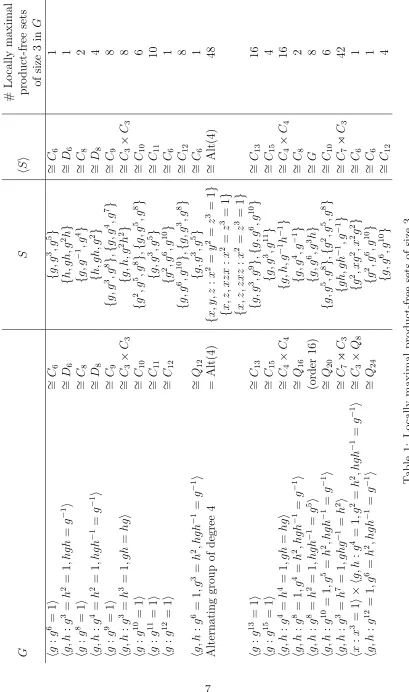
of size 3 for which not every subset of size 2 in S generates hSi. Each of these groups has order at most 24. Conjecture 5.7 of [5] was that if G is a group of order greater than 24, then G does not contain a locally maximal product-free set of size 3. A list was given of all locally maximal product-free sets in groups of orders up to 24. So the conjecture asserts that this list is the complete list of all such sets. (This list is given in the current paper as Table 1; we include it both for ease of reference and because information from it is needed in the proofs of our results.) The main result of this paper is the following and its immediate corollary.
Theorem 1.1. Suppose S is a locally maximal product-free set of size 3 in a group G, such that every two element subset of S generates hSi. Then |G| ≤24.
Corollary 1.2. If a group G contains a locally maximal product-free set S of size 3, then |G| ≤24 and the only possibilities for G and S are listed in Table 1.
Proof. If not every two-element subset of S generates hSi, then by Theorem 5.6 of [5],
|G| ≤24. We may therefore assume that every two-element subset ofS generateshSi. Then
More generally, given a positive integer k, one can ask: what is the largest integer nk such
that there is a group of order nk with a locally maximal product-free set of size k? Using
GAP [4] we have tested all groups of order up to 100 when k ≤ 5, and the results suggest that the sequencenkbegins 8,16,24,40,64, which means the sequence 18nkbegins 1,2,3,5,8.
This is rather intriguing and it would be interesting to know what the sequence actually is.
We finish this section by establishing the notation to be used in the rest of the paper, and giving some basic results from [5]. For subsets A, B of a group G, we use the standard notation AB for the product ofAand B. That is, AB={ab:a∈A, b∈B}. By definition, a nonempty set S ⊆ G is product-free if and only if S∩SS = ∅. In order to investigate locally maximal product-free sets, we introduce some further notations. For a set S ⊆ G, we define the following sets:
S2 = {a2 :a∈S};
S−1 = {a−1 :a ∈S};
√
S = {x∈G:x2 ∈S};
T(S) = S∪SS∪SS−1∪S−1S; ˆ
S = {s ∈S:p{s} 6⊂ hSi}.
For a singleton set {a}, we usually write√a instead of p{a}.
For a positive integer n, we will denote by Alt(n) the alternating group of degree n, by Cn
the cyclic group of order n, by D2n the dihedral group of order 2n, and byQ4n the dicyclic
group of order 4n given by Q4n :=hx, y :x2n = 1, xn=y2, yx=x−1yi.
We now state the results from [5] that we will use.
Lemma 1.3. [5, Lemma 3.1] Suppose S is a product-free set in the group G. Then S is locally maximal product-free if and only if G=T(S)∪√S.
The next result lists, in order, Proposition 3.2, Theorem 3.4, Propositions 3.6, 3.7, 3.8 and Corollary 3.10 of [5].
Theorem 1.4. Let S be a locally maximal product-free set in a group G. Then
(i) hSi is normal in G and G/hSi is either trivial or an elementary abelian 2-group;
(ii) |G| ≤2|T(S)| · |hSi|;
(iii) if hSi is not an elementary abelian 2-group and |Sˆ|= 1, then |G|= 2|hSi|;
(iv) every element s of Sˆ has even order, and all odd powers of s lie in S;
(v) if there exists s∈ S and integers m1, . . . , mt such that Sˆ={s, sm1, . . . , smt}, then |G|
(vi) if S∩S−1 =
∅, then |G| ≤4|S|2+ 1.
We require one final fact.
Theorem 1.5. [5, Theorem 5.1] Up to isomorphism, the only instances of locally maximal product-free sets S of size 3 of a group G where |G| ≤37are given in Table 1.
2
Proof of Theorem 1.1
Proposition 2.1. Suppose S is locally maximal product-free of size 3 in G. If hSi is cyclic, then |G| ≤24.
Proof. Write S = {a, b, c}. First note that since hSi is abelian, SS−1 = S−1S; moreover
aa−1 =bb−1 =cc−1 = 1; so|SS−1| ≤7. Also SS ⊆ {a2, b2, c2, ab, ac, bc}. Thus
|T(S)|=|S∪SS∪SS−1| ≤3 + 6 + 7 = 16.
By Lemma 1.3, G = T(S)∪√S; so hSi = T(S)∪(hSi ∩√S). Elements of cyclic groups have at most two square roots. Therefore |hSi| ≤ 16 + 6 = 22. By Table 1, hSi must now be one of C6,C8, C9, C10, C11,C12, C13 orC15. Theorem 1.4(iv) tells us that every element
s of ˆS has even order and all odd powers of s lie in S. This means that for C9, C11, C13 or
C15, we have ˆS =∅and so G=hSi. In particular, |G| ≤24.
It remains to consider C6, C8, C10 and C12. For C6 = hg : g6 = 1i, the unique locally
maximal product-free set of size 3 is S ={g, g3, g5}. Now if g or g5 is contained in ˆS, then
ˆ
S consists of powers of a single element; so by Theorem 1.4(v), |G| divides 24. If neither g
norg5 is in ˆS, then |Sˆ| ≤1, and so by Theorem 1.4(iii) therefore,|G|divides 12. In C8 there
is a unique (up to group automorphisms) locally maximal product-free set of size 3, and it is {g, g−1, g4}, where g is any element of order 8. If ˆS contains g or g−1, then S contains
all odd powers of that element by Theorem 1.4(iv), and hence S contains {g, g3, g5, g7}, a contradiction. Therefore |Sˆ| ≤1 and so |G| divides 16. Next, we consider hSi=C10. Recall
that elements of ˆS must have even order. If ˆS contains any element of order 10, then S
contains all five odd powers of this element, which is impossible by Theorem 1.4(iv). This leaves only the involution of C10 as a possible element of ˆS. Hence again |Sˆ| ≤ 1 and |G|
divides 20. Finally we look at C12. If ˆS contains any element of order 12, then |S| ≥ 6,
a contradiction. If ˆS contains an element x of order 6 then S contains all three of its odd powers, soS ={x, x3, x5}. But thenhSi ∼=C
6, contradicting the assumption thathSi=C12.
Therefore, ˆS can only contain elements of order 2 or 4. Up to group automorphism, we see from Table 1 that every locally maximal product-free set S of size 3 in C12 with hSi= C12
is one of {g, g6, g10} or {g, g3, g8} for some generator g of C
12. Each of these sets contains
exactly one element of order 2 or 4. Therefore in every case, |Sˆ| ≤ 1 and so |G| divides 24. This completes the proof.
Note that the bound on |G| in Proposition 2.1 is attainable. For example in Q24 there is a
Proposition 2.2. SupposeS is locally maximal product-free of size3in Gsuch that every2 -element subset ofSgenerateshSi. Then either|G| ≤24orS contains exactly one involution.
Proof. First suppose S contains no involutions. If S∩S−1 =∅, then Theorem 1.4(vi) tells us that G has order at most 37, and then by Theorem 1.5, (G, S) is one of the possibilities listed in Table 1. In particular |G| ≤24. If S∩S−1 6=
∅, then S={a, a−1, b}for some a, b.
But then hSi = ha, a−1i = hai, so hSi is cyclic. Now by Proposition 2.1 we get |G| ≤ 24. Next, suppose thatS contains at least two involutions,aandb, with the third element being
c. Then, since every 2-element subset of S generates hSi, we have that H = hSi = ha, bi
is dihedral and S is locally maximal product-free in H. Let o(ab) = m, so H ∼=D2m. The
non-trivial coset of the subgroup habi is product-free of size m. So if c lies in this coset, then we have m = 3 and H ∼= D6. If c does not lie in this coset then c = (ab)i for some i,
and from the relations in a dihedral group ac−1 =ca, c−1a = ac, bc−1 = cb and c−1b = bc. The coset habia consists of m involutions, which cannot lie in √S. Thus habia ⊆ T(S) by Lemma 1.3. A straightforward calculation shows that
habia=T(S)∩ habia={a, b, ac, ca, bc, cb, ac−1, c−1a, bc−1, c−1b}={a, b, ac, ca, bc, cb}.
This means m ≤ 6, and S consists of two generating involutions a, b plus a power of their productab, with the property that any two-element subset ofS generatesha, bi. A glance at Table 1 shows there are no locally maximal product-free sets of this form in D2m for m≤6.
Therefore the only possibility is that hSi ∼= D6, with S consisting of the three reflections
in hSi. By Theorem 1.4(i), the index of hSi in G is a power of 2. By Theorem 1.4(ii),
|G| ≤ 2|T(S)| · |hSi|. Thus |G| ∈ {6,12,24,48}. Suppose for contradiction that |G| = 48. NowG=T(S)∪√S, and sinceSconsists of involutions, the elements of√S have order 4. So
Gcontains two elements of order 3, three elements of order 2 and the remaining non-identity elements have order 4. Then the 46 elements of G whose order is a power of 2 must lie in three Sylow 2-subgroups of order 16, with trivial pairwise intersection. Each of these groups therefore has a unique involution and 14 elements of order 4, all of which square to the given involution. But no group of order 16 has fourteen elements of order 4. Hence |G| 6= 48, and so |G| ≤24. Therefore either |G| ≤24 or G contains exactly one involution.
Before we establish the next result, we first make a useful observation. SupposeS ={a, b, c}
where a, b, c∈Gand c is an involution. Then a straightforward calculation shows that
T(S)⊆
1, a, b, c, a2, b2, ab, ba, ac, ca, bc, cb,
ab−1, ba−1, ca−1, cb−1, a−1b, a−1c, b−1a, b−1c
. (1)
Lemma 2.3. SupposeS is a locally maximal product-free set of size 3in G, every 2-element subset of S generates hSi, and S contains exactly one involution. Then either |G| ≤ 24 or S ={a, b, c}, where a and b have order 3 and cis an involution.
Proof. Suppose S ={a, b, c} wherec is an involution and a, bare not. Consider a−1. Recall
that G=T(S)∪√S. Ifa−1 ∈√S thena−2 ∈ {a, b, c} which implies that eithera has order
implies that eitherahas order 3 or (by Lemma 2.1)|G| ≤24. Suppose then thata−1 ∈T(S).
The elements of T(S) are given in Equation 1. If a−1 ∈ {b, b2, ab, ba, ab−1, ba−1, a−1b, b−1a}
then by remembering thathSi=ha, bi, we deduce thathSiis cyclic, generated by eitheraor
b. For example,a−1 =baimpliesb ∈ hai. Similarly, ifa−1 ∈ {c, ac, ca, a−1c, c−1a}, thenhSiis
cyclic. Sinceahas order at least 3, we cannot have a−1 ∈ {1, a}. Ifa−1 ∈ {bc, cb, b−1c, c−1b},
then S would not be product-free. For instance a−1 = b−1c implies that b−1ca = 1, and hence ac=b. The only remaining possibility is a−1 =a2, meaning thata has order 3. The
same argument with b−1 shows thatb also has order 3.
We can now prove Theorem 1.1, which states that if S is a locally maximal product-free set of size 3 in a groupG, such that every two element subset ofS generateshSi, then|G| ≤24.
Proof of Theorem 1.1 Suppose S is a locally maximal product-free set of size 3 in G
such that every two element subset of S generateshSi. Then by Lemma 2.3, either|G| ≤24 or S = {a, b, c} where a and b have order 3 and c is an involution. In the latter case, we observe thataca−1is an involution, so must be contained inT(S). Using Equation 1 we work
through the possibilities. Obviously it is impossible foraca−1 to be equal to any of 1, a, b, a2
or b2 because these elements are not of order 2. If any of ac, ca, a−1c, c−1a, bc, cb, b−1c or
cb−1 were involutions, then it would imply that hSi was generated by two involutions whose product has order 3. For example if acwere an involution then hc, aci=ha, ci=hSi. That is, hSi would be dihedral of order 6. But there is no product-free set in D6 containing
two elements of order 3, because if x, y are the elements of order 3 in D6 then x2 = y and
y2 =x. So the remaining possibilities for aca−1 are c, ab, ba, ab−1, ba−1, a−1b and b−1a. Now
aca−1 =ab implies c= ba, whereas aca−1 =ab−1 implies bc = a and aca−1 = ba−1 implies
b =ac, each of which contradicts the fact that S is product-free. We are now left with the cases aca−1 = c, aca−1 = ba and aca−1 = a−1b (which, if it is an involution, equals b−1a).
If aca−1 =c, then hSi= ha, ci = C6, but the only product-free set of size 3 in C6 contains
no elements of order 3, so this is impossible. Therefore aca−1 ∈ {ba, a−1b}. If aca−1 = ba, then a−1ba= ca−1, so ac= a−1b−1a, which has order 3. If aca−1 =a−1b, then ac= a−1ba,
again of order 3. So we see that hSi = ha, c : a3 = 1, c2 = 1,(ac)3 = 1i. This is a well
known presentation of the alternating group Alt(4). As c is the only element of S whose order is even, we see that |Sˆ| ≤ 1, and hence |G| ≤ 2|Alt(4)| = 24. Therefore in all cases
|G| ≤24.
3
A table of all locally maximal product-free sets of
size 3
References
[1] Noga Alon, J´ozsef Balogh, Robert Morris and Wojciech Samotij,Counting sum-free sets in abelian groups. Israel J. Math. 199 (2014), no. 1, 309–344.
[2] L´aszl´o Babai and Vera T. S´os, Sidon sets in groups and induced subgraphs of Cayley graphs, European J. Combin. 6 (1985), 101–114.
[3] P. J. Cameron, P. Erd¨os, P., On the number of sets of integers with various properties, Number theory (Banff, AB, 1988), 61–79, de Gruyter, Berlin, 1990.
[4] The GAP Group, GAP – Groups, Algorithms, and Programming, Version 4.7.7; 2015,
(http://www.gap-system.org).
[5] Michael Giudici and Sarah Hart, Small maximal sum-free sets, Elect. J. Comb. 16 (2009), 1–17.
[6] W. T. Gowers, Quasirandom groups, Combin. Probab. Comput. 17 (2008), no. 3, 363– 387.
[7] Ben Green, The Cameron-Erd¨os conjecture, Bull. London Math. Soc. 36 (2004), 769– 778.
[8] Ben Green and Imre Z. Ruzsa, Sum-free sets in abelian groups, Israel J. Math. 147 (2005), 157–188.
[9] Kiran S. Kedlaya, Large product-free subsets of finite groups, J. Combin. Theory Ser. A 77 (1997), 339–343.
[10] Kiran S. Kedlaya, Product-free subsets of groups, Amer. Math. Monthly 105 (1998), 900–906
[11] M. Khatirinejad and P. Lisonˇek, Classification and constructions of complete caps in binary spaces. Des. Codes Cryptogr. 39 (2006), no. 1, 17–31.
[12] T. G. Petrosyan, On the number of product-free sets in groups of even order, (Russian) Diskret. Mat. 17 (2005), no. 1, 89–101; Translation in Discrete Math. Appl. 15 (2005), no. 1, 47–58.
[13] A. P. Street and E. G. Whitehead Jr., Group Ramsey theory, J. Combinatorial Theory Ser. A 17 (1974), 219–226.
[14] W. D. Wallis, A. P. Street and J. Seberry Wallis, Combinatorics: Room squares, sum-free sets, Hadamard matrices, Lecture Notes in Mathematics, Vol. 292. Springer-Verlag, Berlin-New York, 1972.