N A N O E X P R E S S
Open Access
Modification of the Interface
Nanostructure and Magnetic Properties in
Nd-Fe-B Thin Films
Kunihiro Koike
1*, Takanao Kusano
1, Daisuke Ogawa
1, Keisuke Kobayashi
1, Hiroaki Kato
1, Mikihiko Oogane
2,
Takamichi Miyazaki
2, Yasuo Ando
2and Masaru Itakura
3Abstract
The effects of Nd2Fe14B grain size and Nd coating on the coercivity in sputter-deposited Nd-Fe-B/Nd thin films have
been investigated in order to gain an insight into the coercivity mechanism of Nd-Fe-B magnets. Highly textured Nd2Fe14B particles were grown successfully on the MgO(100) single-crystal substrate with the Mo underlayer. As the
Nd-Fe-B layer thicknesstNFBwas decreased from 70 to 5 nm, the coercivityHcincreased gradually from 6.5 to 16 kOe. By depositing the Nd overlayer onto these films and post-annealing at 500 °C, theHcvalue further increased from 17.5 kOe (tNFB=70 nm) to 26.2 kOe (tNFB=5 nm). The amount ofHcincrease by the combination of the Nd coating and post-annealing was about 10 kOe irrespective of thetNFBvalue. These results therefore suggest an independence of
size and interface effects on the coercivity of Nd-Fe-B magnets.
Keywords: Nd2Fe14B thin film, Nd overlayer effect, Interface, Coercivity
Background
Achieving higher coercivity in sintered Nd-Fe-B magnets without using rare elements such as Dy and Tb is one of the most crucial and urgent subjects [1–3], in view of the rapidly growing demand for high-power motors such as those in electric vehicles. At least two approaches have been reported so far to increase coercivityHcin sin-tered Nd-Fe-B magnets. First one is the grain size refine-ment. TheHcvalue is known to increase gradually with decreasing average grain sizedgrain[4, 5]. Une and Sagawa
recently reported [6] the record value ofHc ∼20 kOe for the sample withdgrain ∼1 μm. The second approach is
the interface control [7–9], in which the appropriate heat treatment at 500∼600 °C gives rise to a smoother core-shell structure between the Nd2Fe14B core and Nd-rich
shell, resulting in an optimum coercivity value. Recent study of the polished surface of sintered Nd-Fe-B mag-nets [10, 11] claims that an existence of the fcc-type Nd oxide is crucial for theHcrecovery. In order to investigate
*Correspondence: [email protected]
1Department of Applied Mathematics and Physics, Yamagata University, 992-8510 Yonezawa, Japan
Full list of author information is available at the end of the article
the relation between such interface state and the coerciv-ity in sintered Nd-Fe-B magnets, we chose to construct a model system by a thin-film technique. We reported that theHcincreases from 11 to 14 kOe when the highly ori-ented Nd2Fe14B grains with the lateral dimension of about
2∼3μm were coated by the Nd overlayer and annealed at 500 °C [12]. Transmission electron microscopy (TEM) and X-ray investigations indicate the existence of the Nd oxide also in this sample. The important geometric dif-ference between our model system and the real sintered Nd-Fe-B magnets is that the Nd2Fe14B core is not fully
wrapped by the Nd-rich shell, but only the top and side surfaces are in contact with the Nd-rich phase in the former. This suggests the importance of side surfaces of Nd2Fe14B structure which is parallel to the c-axis [13].
However, it is difficult to evaluate such an interface contri-bution to the coercivity in the previous report [12], since the finalHcvalue and the amount ofHcincrease are not so large enough. There is another question as to whether the size and interface effects on the coercivity are inde-pendent or not. In this work, we fabricated higher quality Nd-Fe-B/Nd films by using single-crystal substrates with different grain sizes and investigated the size and interface dependence of the coercivity systematically.
Methods
Nd2Fe14B/Nd films were deposited by using the UHV
helicon sputtering system onto MgO(100) single-crystal substrate. The base pressure of the sputtering cham-ber was less than 5×10⁻⁸ Pa. The films have the forms of MgO(100)/Mo(20 nm)/Nd-Fe-B(5 nm ≤ tNFB ≤ 70 nm)/Nd(tNd = 0 or 60 nm)/Mo(10 nm). As the
sputtering targets, we used the 3N-purity ternary alloy of Nd17Fe70B13, Nd metal with 2.5N purity, and Mo metal
with 4N purity. The cosputtering of the Nd17Fe70B13and
Nd targets was done in order to adjust a composition of the Nd-Fe-B layer. The Ar gas pressure during the depo-sition of the Mo, Nd, and Nd-Fe-B layers was 0.07, 0.07, and 0.2 Pa, respectively. We heated the substrate during the deposition of the Mo underlayer at TsMo = 300 °C, and then post-deposition annealing was done atTaMo = 700 °C. The Nd-Fe-B main layer and overlayers of Nd and Mo were deposited successively at substrate temperatures ofTsNFB =600 °C andTsNd = TsMo =50 °C, respectively. In some films, the post-annealing was done in situ atTa=
500 °C for 40 min before depositing the Mo overlayer. Above conditions for the Mo underlayer are the ones optimized according to the several reports on the high coercivity of Nd-Fe-B films [14–16]. As for the post-annealing procedure for the Mo underlayer deposited on the heated substrate, we already published it in separate papers [17, 18].
Magnetization curves at room temperature were mea-sured by using SQUID magnetometer in fields of up to 50 kOe. Crystal structure and orientation of the films were evaluated by using X-ray diffraction (XRD) and pole-figure apparatus with the Cu-Kα radiation. X-ray reflec-tivity (XRR) measurements were done to evaluate the film
thickness. Atomic force microscopy (AFM) and scanning electron microscopy (SEM) systems were used to observe the surface morphology of the films, in which the aver-age diameter of Nd2Fe14B grains in lateral direction was
estimated by using particle analysis software, ImageJ. The microstructure and composition of films were charac-terized by using TEM, nano-beam electron diffraction (NBD), and energy-dispersive spectroscopy (EDS) tech-niques.
Results and Discussion
Cross-sectional TEM images with the NBD pattern for the film withtNFB = 70 nm andtNd = 0 are shown in
Fig. 1. Both the lattice fringe of Nd2Fe14B structure in the
magnified scale image and the multiple scattering spots in the NBD pattern indicate the preferential texturing of thec-axis of the Nd2Fe14B crystallites normal to the film
plane.
Figure 2 shows the φ-scan representations of X-ray pole-figure measurements for the (200) plane of the MgO single-crystal substrate, (110) plane of the Mo underlayer, and (105) plane of the Nd2Fe14B layer. Clear fourfold
symmetry peaks were observed for MgO and Mo layer in which the peak positions are shifted each other by 45°. Although weak, we did find the fourfold symmetry peaks also for the Nd2Fe14B layer in the same positions as
those for the Mo underlayer. These results thus suggest that the Nd2Fe14B(001) crystallites are epitaxially grown
with the relationships of MgO(100)[ 110]Mo(100)[ 100], and Mo(100)[ 100]Nd2Fe14B(001)[100], as shown
schematically in Fig. 2b. These relationships are in accordance with those for MgO(100)/Cr/Ta(100)/ Nd2Fe14B [19].
[image:2.595.57.539.503.695.2]Fig. 2φ-scan representations of X-ray pole-figure measurements for the as-deposited Nd-Fe-B(tNFB=70 nm) film.aφ-scan representations of X-ray pole-figure measurements for MgO, Mo, and Nd2Fe14B layers in as-deposited MgO/Mo/Nd-Fe-B(tNFB=70 nm)/Mo film.bEstimated epitaxial relationships between the layers
Figure 3 shows the XRD patterns for the four films with tNFB = 70 nm fabricated by changing a combination
of the two parameters; the presence/absence of the Nd overlayer and with/without the post-deposition annealing atTa=500 °C. In addition to the strong peaks from MgO
substrate and Mo layers, we do observe in all the films the diffraction peaks from the (004), (006), (008), and (0010) planes of the tetragonal Nd2Fe14B phase, which indicate
that thec-axis of the Nd2Fe14B crystallites aligns
perpen-dicular to the film plane. This result is inconsistent with
Intensity
I
(a.u.)
80 70
60 50
40 30
2 (deg)
(a) (b) (c) (d)
(0010)
(008)
(004)
Nd2Fe14B
dhcp-Nd fcc-Nd2O3 hcp-Nd2O3
Nd1.11Fe4B4
bcc-Mo MgO substrate
(006)
[image:3.595.59.540.86.306.2] [image:3.595.57.539.444.702.2]800
600
400
200
0
-200
-400
Magnetization
M
(emu/cc)
-25 -20 -15 -10 -5 0
Magnetic field H (kOe)
(a) (b) (c) (d)
Fig. 4Demagnetization curves for the Nd-Fe-B(tNFB=70 nm) films. Demagnetization curves for the four filmsa∼dgiven in Fig. 4 with
tNFB=70 nm. External magnetic fields were applied normal to the film plane. No correction for the demagnetizing field has been made
the TEM and pole-figure data shown in Figs. 1 and 2. In the case of the post-annealed film with the Nd overlayer, as shown in Fig. 4d, we observe extra peaks from not only the dhcp-Nd metal phase but also the Nd oxide phase such as metastable fcc-Nd2O3(space group:Th7-Ia3) and the stable hcp-Nd2O3(D3d3-P3m1). Considering that no such extra peaks were observed in the as-deposited film with the Nd overlayer shown in Fig. 3c, these Nd oxide phases were formed during the post-annealing in which the oxygen would originate mainly in the Nd targets.
Figure 4 shows the demagnetization curves for the four 70-nm-thick films given in Fig. 3. While the Hc values for the three films (a)∼ (c) fall within the range from 6 to 7 kOe, much largerHc of 17.5 kOe was recorded for the film (d) in which we have deposited the Nd overlayer and made the post-annealing. This result clearly indicates that both the Nd overlayer and the post-annealing are indispensable for the high coercivity in the present system. It should be noted that the magnetization val-ues for the three films (b), (c), and (d) are slightly smaller than that for the as-deposited Nd-Fe-B film (a). However, owing to the difficulty in precise estima-tion of the sample volume, it is not easy to discuss whether these changes in magnetization are significant or not.
Fig. 5AFM images for the Nd-Fe-B films with various Nd-Fe-B layer thicknesstNFB. AFM images for the as-deposited Nd-Fe-B films withtNd=0 and
[image:4.595.57.291.86.303.2] [image:4.595.59.538.412.703.2]Figure 5 shows the surface images observed by AFM for the MgO(100)/Mo/Fe-B/Mo films with various Nd-Fe-B layer thicknesstNFB. Surface morphology suggesting
an assembly of particles is seen in which the typical lateral dimension varies from about 300 nm to less than 10 nm, with decreasingtNFBvalues.
Although we should keep in mind that these val-ues of lateral dimension do not always correspond to grain size, these data suggest that the lateral grain size decreases with decreasing nominal thick-ness. We have also performed the SEM measure-ments to evaluate the microstructure in these films and found the results which support the speculation above.
When the value of tNFB is less than 10 nm, we can
notice the dark color region surrounding each particle, which suggests that the Nd2Fe14B particles are separated
with each other. Such island-like surface morphology is similar to that reported for the MgO(100)/Cr/Mo/Nd-Fe-B/Mo films [20]. Cross-sectional TEM images for two
films with tNFB = 5 nm, one for the as-deposited
Nd-Fe-B and another for the post-annealed Nd-Nd-Fe-B/Nd, are shown in Fig. 6. These cross-sectional images exhibited the island-like structure of the Nd2Fe14B grains with the
lateral dimension of about 60 nm.
In the case of post-annealed Nd-Fe-B/Nd film, the Nd and/or Nd-O locate mainly in a valley among isolated Nd2Fe14B grains. This morphology is in marked contrast
to that reported in [21], in which Nd-O particles locate within the Nd2Fe14B grains.
Demagnetization curves for the 5-nm-thick films shown in Fig. 6 are given in Fig. 7. We observed the highestHc value of 26.2 kOe in the post-annealed Nd-Fe-B/Nd film, which is about 10 kOe larger than that of the as-deposited Nd-Fe-B films. Although not given in this figure, simi-lar dependence ofHc on the two parameters was found in 5-nm-thick films. Namely, theHc values for the films without the Nd overlayer and the film with Nd over-layer but without annealing were in the range from 15 to 17 kOe.
[image:5.595.61.540.346.695.2]800
600
400
200
0
-200
-400
Magnetization
M
(emu/cc)
-35 -30 -25 -20 -15 -10 -5 0 Magnetic field H (kOe)
(a) (b)
Fig. 7Demagnetization curves for the Nd-Fe-B films withtNFB=5 nm. Demagnetization curves for theaas-deposited Nd-Fe-B (tNFB=5 nm) andbannealed Nd-Fe-B (tNFB=5 nm)/Nd(tNd=60 nm) films given in Fig. 6. External magnetic fields were applied normal to the film plane. No correction for the demagnetizing field has been made
We then plotted in Fig. 8 theHcvalue as a function of Nd-Fe-B layer thicknesstNFB, for the two series of films.
Also labelled in the top axis is the average lateral grain size DNFBAFM, which we estimated from the AFM images given in Fig. 5, assuming that each particle-like roughness rep-resents the single Nd2Fe14B grain. In the case of the films
without the Nd overlayer and without the post-annealing, the coercivity exhibited a gradual increase behavior from 6.5 to 16 kOe, as thetNFBwas decreased from 70 to 4 nm.
It is well known that the coercivity increases with decreasing grain size in sintered Nd-Fe-B magnets [22, 23]. Although the shape of Nd2Fe14B grains are not
spherical but oblate in the present films, it is no wonder that we observed a similar size dependence of coercivity in our films. Recent experimental report for the hot-deformed magnets [24] also exhibited the similar behavior to the present results.
In a series of films with the Nd overlayer after the post-annealing, theHcvalue also increased monotonically with decreasing tNFB and exhibited the maximum of Hc = 26.2 kOe for tNFB = 5 nm. It should be noted that the
amount ofHcincrease by the Nd coating is about 10 kOe irrespective oftNFBvalue.
30
25
20
15
10
5
Coercivity
Hc
(kOe)
4 5 6 7 8 9
10 2 3 4 5 6 7 8 9100 Nd-Fe-B layer thickness tNFB (nm)
100 200 300
Avarage Nd-Fe-B grain size DNFBAFM (nm)
Fig. 8CoercivityHcof the Nd-Fe-B films as a function of the Nd-Fe-B layer thicknesstNFB.Hcas a function of Nd-Fe-B layer thicknesstNFBand the average grain size along the lateral directionDNFBAFM, for the Nd-Fe-B/Nd films after post-annealing (filled circle) and the as-deposited Nd-Fe-B films
[image:6.595.58.290.86.300.2] [image:6.595.60.539.368.691.2]1.0 0.8 0.6 0.4 0.2 0.0 Normalized magnetization M / Ms 5 4 3 2 1 0
Magnetic field H (T) (b) (a)
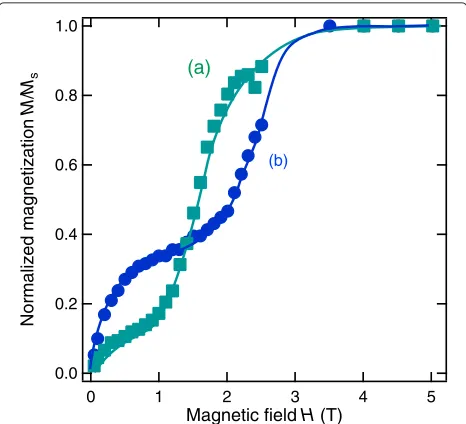
Fig. 9Initial magnetization curves for the Nd-Fe-B (tNFB=5 nm) and Nd-Fe-B (tNFB=5 nm)/NdtNd=60 nm) films. Initial magnetization curves for theaas-deposited Nd-Fe-B (tNFB=5 nm) andbannealed Nd-Fe-B (tNFB=5 nm)/NdtNd=60 nm) films given in Fig. 7
This fact therefore suggests that the grain size and the Nd coating have an independent influence on the coer-civity, since the AFM images shown in Fig. 3 suggest that the average Nd-Fe-B grain size DNFBAFM decreases with decreasing tNFB. Of course, we need to take account of
the shape of the Nd-Fe-B grain in the present films which would be far from isotropic, in order to discuss the size dependence ofHcmore precisely.
It is interesting to note that theHc value continues to increase with decreasing size, although even the largest dimensions in the films in Fig. 8 are already smaller than the critical size for the single domain in the Nd2Fe14B
phase.
In order to obtain further information of the coerciv-ity mechanism, we performed the initial magnetization curve measurements. The results for the twotNFB=5 nm
films given in Fig. 7 are shown in Fig. 9. We observed the double-step behavior of initial curve for both films. But, the post-annealed Nd-Fe-B/Nd film has a much higher field for the second step occurrence. It is interesting to note that the field of inflection point for the second step is nearly equal to the coercivity value in both films. Sim-ilar behavior was reported for Nd-Fe-B/FeCo multilayer system [25].
Results given in Fig. 8 suggest that a proper inter-face state is extremely important to achieve highHcnot only in larger grain system but also in smaller particle one. Preliminary TEM observations for films with the Nd overlayer after the post-annealing as shown in Fig. 6b showed isolated Nd2Fe14B grains between the Nd oxide
grains. This fact would be related to the microstructure of the Nd-Fe-B/Nd system in previous reports [11, 26], in which the coercivity change was discussed in relation to the presence of the fcc-type Nd oxide phase within the Nd overlayer in the close proximity of the Nd2Fe14B
grains.
Conclusions
We fabricated highly textured Nd2Fe14B films with and
without the Nd overlayer and investigated their magnetic properties systematically. As shown in Fig. 8, the paral-lel behavior of the twoHcvstNFB lines for as-deposited
Nd-Fe-B and post-annealed Nd-Fe-B/Nd films enabled us to suggest that the grain size and the interface state are independent parameters for the coercivity. This work will thus give an insight into the approaches [27] to the fabri-cation of higher coercivity Nd-Fe-B magnets by reducing the grain size. High-resolution TEM studies are now in progress in order to investigate the interface state and to check whether there is a structural difference between the side and top interfaces of the Nd2Fe14B grains or not.
Competing interests
The authors declare that they have no competing interests.
Authors’ contributions
KK and TK prepared all the samples, participated in all the measurements and data analysis, and drafted the manuscript. DO, MO, YA, and KK participated in the XRD, pole figure, and SQUID measurements and data analysis. KK and HK conceived and designed the manuscript. TM, DO, and MI participated in the TEM and EBD observation and data analysis and interpretation of the results. All authors have been involved in revising the manuscript. All authors read and approved the final manuscript.
Acknowledgements
This work was supported partly by the Industry-Academia Collaborative R&D Programs, from Japan Science and Technology Agency (JST), Japan; and by the Rare Metal Substitute Materials Development Project on Development of Technology for reducing dysprosium usage in a rare-earth magnet, from METI and NEDO, Japan.
Author details
1Department of Applied Mathematics and Physics, Yamagata University,
992-8510 Yonezawa, Japan.2Department of Applied Physics, Tohoku University, 980-8579 Sendai, Japan.3Department of Applied Science for
Electronics and Materials, Kyushu University, 816-8580 Kasuga, Japan.
Received: 22 August 2015 Accepted: 5 January 2016
References
1. Sugimoto S (2011) Current status and recent topics of rare-earth permanent magnets. J Phys D Appl Phys 44:0604001–06040011 2. Gutfleisch O, Willard M, Chen EBC, Sankar S, Liu J (2011) Magnetic
materials and devices for the 21st century:stronger, lighter, and more energy efficient. Adv Mater 44:821–842
3. Hirosawa S (2015) Current status of research and development toward permanent magnets free from critical elements. J Magn Soc Jpn 39:85–95 4. Muller KH, Eckert D, Handstein A, Nothnagel P, Schneider J (1991) Material structure and coercivity of sintered Nd-Fe-B type magnets. J Magn Magn Mater 83:195–199
[image:7.595.58.291.86.298.2]6. Une Y, Sagawa M (2012) Enhancement of coercivity of Nd-Fe-B sintered magnets by grain size reduction. J Japan Inst Metals 76(1):12–16 7. Zhou G, Fu S, Sun X, Chuang Y (1990) Influence of annealing on the
magnetic properties and microstructure of nd-fe-b based magnets. J Appl Phys 121(16):257–264
8. Vial F, Joly F, Nevalainen E, Sagawa M, Hiraga K, Park K (2002) Improvement of coercivity of sintered NdFeB permanent magnets by heat treatment. J Magn Magn Mater 242-245:1329–1332
9. Liu M, Jin T, Hao L, Cao J, Wang Y, Wu D, Bai J, Wei F (2015) Effects of Ru and Ag cap layers on microstructure and magnetic properties of FePt ultrathin films. Nanoscale Res Lett 10(161):1–8
10. Hirosawa S, Tokuhara K, Sagawa M (1987) Coercivity of Surface Grains of Nd-Fe-B Sintered Magnet. J J Appl Phys 26:1359–1362
11. Fukagawa T, Hirosawa S (2008) Influence of Nd/Nd2Fe14B interface microstructure on the coercivity of surface Nd2Fe14B grains in Nd-sputtered Nd–Fe–B sintered magnets. Scripta Mater 59.2:183–186 12. Koike K, Igarashi S, Yamaguchi K, Kusano T, Miyazaki T, Ogawa D, Akiya T,
Adachi Y, Kato H (2010) Effect of rare-earth overlayer on the coercivity in sputter-deposited Nd-Fe-B films Effect of rare-earth overlayer on the coercivity in sputter-deposited Nd-Fe-B films. J Phys Conf Series 200:0820151–3
13. Makita K, Yamashita O, Kato H (2002) Boundary Structure and the Local Crystalline Electric Field of Nd-Fe-B Sintered Magnets. J Mag Soc Jpn 26:1060–1063
14. Keavney D, Fullerton E, Pearson J, Bader S (1997) High-coercivity, c-axis oriented Nd2Fe14B films grown by molecular beam epitaxy. J Appl Phys 81:4441–4443
15. Chen S, Liu W, Chen C, Zhang Z (2005) Effects of buffer layer and substrate temperature on the surface morphology, the domain structure and magnetic properties of c-axis-oriented Nd2Fe14B films. J Appl Phys 98:033907-6
16. Cui W, Zhang S, Liu W, Ma X, Yao Q, Zhang Z, Zhang X (2008) Anisotropic behavior of exchange coupling in textured Nd2Fe14B/a-Fe multilayer films. J Appl Phys 104:053903–4
17. Koike K, Umezawa J, Ishikawa H, Ogawa D, Mizuno Y, Kato H, Miyazaki T, Ando Y (2014) Effect of Dy/Nd double layer on coercivity in Nd-Fe-B thin films. J Appl Phys 115:17735–3
18. Koike K, Ishikawa H, Ogawa D, Kato H, Miyazaki T, Ando Y, Itakura M (2015) Coercivity enhancement in La coated Nd-Fe-B thin films. Phys Procedia 75:1294–1299
19. Kwon A, Hannemann U, Neu V, Fähler S, Schultz L (2005) Microstructure and magnetic properties of highly textured Nd–Fe–B films grown on Ta(100). J Magn Magn Mater 290-291(2):1247–1250
20. Sato T, Oka N, Ohsuna T, Kaneko Y, Suzuki S, Shima T (2011) Enhancement of coercivity for Nd-Fe-B thin films by the infiltration of Nd-Cu alloy cap layer. J Appl Phys 110:0239031–3
21. Chen S, Zheng J-G, Liu W, Zhang Z (2007) Structure and magnetic properties of high-energy product Nd-Fe-B/Nd-O thin films. J Phys D: Appl Phys 40:1816–1820
22. Ramesh R, Srikrishna K (1988) Magnetization Reversal in Nucleation Controlled Magnets Part 1 : Theory. J Appl Phys 64:6406–6415 23. Hono K, Sepehri-Amin H (2012) Strategy for high-coercivity Nd–Fe–B
magnets. Scripta Mater 67:530–535
24. Liu J, Sepehri-Amin H, Ohkubo T, Hioki K, Hattori A, Schrefl T, Hono K (2015) Grain size dependence of coercivity of hot-deformed Nd–Fe–B anisotropic magnets. Acta Mater 82:336–343
25. Cui W, Takahashi Y-K, Hono K (2012) Nd2Fe14B/FeCo Anisotropic Nanocomposite Films with a Large Maximum Energy Product. Adv Mat 24:6530–6535
26. Matsuura M, Sugimoto S, Goto R, Tezuka N (2009) Interfacial state and magnetic properties of Nd-Fe-B/Nd thin films. J Appl Phys 105:07A7411–3 27. Nakamura M, Matsuura M, Tezuka N, Sugimoto S, Une Y, Kubo H, Sagawa
M (2013) Preparation of ultrafine jet-milled powders for Nd-Fe-B sintered magnets using hydrogenation–disproportionation–desorption– recombination and hydrogen decrepitation processes. Appl Phys Lett 103:0224041–3
Submit your manuscript to a
journal and benefi t from:
7Convenient online submission
7 Rigorous peer review
7Immediate publication on acceptance
7 Open access: articles freely available online
7High visibility within the fi eld
7 Retaining the copyright to your article