© 2018, IRJET | Impact Factor value: 6.171 | ISO 9001:2008 Certified Journal | Page 472
E-Waste Management Using Robotics
P. SHINY ESTHER
1, K. NARMATHA
2, K. SARANYA
31,2,3Department of Electronics and Communication, Jeppiaar SRR Engineering College, Padur, Chennai, Tamil Nadu ---****---Abstract: Electronic waste or e-waste describes discarded
electrical or electronic devices. Robotics deals with the design, construction, operation, and use of robots, as well as
computer systems for their control, sensory feedback, and
information processing. Combing these two (i.e.,) using robotics to eliminate E-waste from our environment paves greater scope to an healthier world without harmful E-wastes.
1. Introduction:
E-waste or electronic waste is created when an electronic product is discarded after the end of its useful life. The rapid expansion of technology means we are creating a very large amount of e-waste every passing minute. It may be defined as discarded computers, office electronic equipment, entertainment device electronics, mobile phones, television sets, and refrigerators.
Robotics is an interdisciplinary branch of engineering and science that includes mechanical engineering, electrical engineering, computer science, and others. Robotics deals with the design, construction, operation, and use of robots, as well as computer systems for their control, sensory feedback, and information processing. These technologies are used to develop machines that can substitute for humans and replicate human actions. Robots can be used in any situation and for any purpose, but today many are used in dangerous environments (including bomb detection and de-activation), manufacturing processes, or where humans cannot survive. Robots can take on any form but some are made to resemble humans in appearance.
Combining the ideas mentioned above we can eliminate the E-waste using Robotics.
2.E-Waste
2.1 E-Waste and their effects:
E-wastes are made of a multitude of components, some containing toxic substances that have an adverse impact on human health and the environment if not handled properly. Often, these hazards arise due to the improper recycling and disposal processes used. It can have serious repercussions for those in proximity to places where e-waste is recycled or burnt. A computer contains highly
toxic chemicals like lead, cadmium, mercury, beryllium, BFR, polyvinyl chloride and phosphor compounds.
Lead exerts toxic effects on various systems in the body such as the central (organic affective syndrome) and peripheral nervous systems (motor neuropathy), the hemopoietic system (anemia), the genitourinary system (capable of causing damage to all parts of nephron) and the reproductive systems (male and female).
Mercury causes damage to the genitourinary system (tubular dysfunction), the central and peripheral nervous systems as well as the fetus. When inorganic mercury spreads out in the water, it is transformed into methylated mercury, which bio-accumulates in living organisms and concentrates through the food chain, particularly by fish.
Cadmium is a potentially long-term cumulative poison. Toxic cadmium compounds accumulate in the human body, especially in the kidneys. There is evidence of the role of cadmium and beryllium in carcinogenicity.
A polycyclic aromatic hydrocarbon (PAH) affects lung, skin and bladder. Epidemiological studies in the past on occupational exposure to PAH provide sufficient evidence of the role of PAH in the induction of skin and lung cancers.
��������������
2.2 Elimination of E-wastes:
2.2.1 Recycling:
© 2018, IRJET | Impact Factor value: 6.171 | ISO 9001:2008 Certified Journal | Page 473 Recycling is the only way to dispose the E-wastes. The
process involved during recycling includes human work for segregation and dismantling which is highly dangerous for human health.
2.2.2 Incineration:
Burning the E-wastes on open fields. This options is not advisable and cannot be implemented anywhere.
2.3 Advantages:
Keeps the environment clean and fresh.
Saves the earth and conserves energy.
Creates pollution-free environment.
2.4 Disadvantages:
The process is not always cost efficient.
The sites are dangerous.
Human beings are affected.
3. Robotics:
3.1 Robotics and their effect:
People need robots for dangerous, repetitive and high-precision work. Robots perform tasks in hostile environments that are impossible for humans, while also carrying out repetitious tasks with speed and accuracy. Without robots, our modern industrialized world would not be possible. The world needs robots for a countless number of reasons, including hazardous jobs and automated manufacturing. Robots work without breaks or the need to rest, allowing manufactures to streamline processes and improve output.
3.2 Characteristic of robots:
Sensing: First of all robot would have to be able to sense its surroundings. Giving your robot sensors: light sensors (eyes), touch and pressure sensors (hands), chemical sensors (nose), hearing and sonar sensors (ears), and taste sensors (tongue) will give your robot awareness of its environment.
Movement: A robot needs to be able to move around its environment. to count as a robot either the whole robot moves, like the sojourner or just parts of the robot moves, like the Canada arm.
Energy: A robot needs to be able to power itself. The way your robot gets its energy will depend on what your robot needs to do.
Intelligence: A robot needs some kind of "smarts." this is where programming enters. A programmer is the person who gives the robot its ‘intelligence’. The robot will have to have some way to receive the program so that it knows what it is to do. All these characteristics are just an outline of how the robot has to be designed. Basic designing contains simple processing and multiple scientific and of course some engineering disciplines.
3.3 Advantages:
Mass Reproduction
Mind/Data Sharing
Advanced Intelligence
Physically Tough
Reduced Energy Needs
3.4 Disadvantages:
Installation is not cheap
Power supply needed ( but solar energy can be made better use of instead of electricity)
4. Solution to E-waste disposal:
Robots can be employed to dispose the E-wastes instead of using old methods of disposing.
© 2018, IRJET | Impact Factor value: 6.171 | ISO 9001:2008 Certified Journal | Page 474
4.1 Independent robot:
Highly automated robots may in turn cause injuries to human and their control is highly tedious. A problem arises when dealing with bigger electronic appliances, such as washing machines, fridges, TV sets, etc. Their composition often includes cables, flexible parts or components difficult to identify. A skilled human operator could do this job but the task is tedious and often dangerous if there are operations involving cutting or handling of hazardous materials.
4.2 Collaborative robots:
Given the impossibility of full automation, and taking into account the importance of experience and skills of human operators, we propose the introduction of collaborative robots into the recycling lines. Traditional industrial robots perform their tasks in cages and are heavily dependent on hard automation that requires specified fixtures and time consuming
programming, performed by experienced
programmers.
In order to solve this problem, the collaborative robot should be able to learn the task from the operator. The worker will show the robot where to cut a cable or fixing, unscrew or manipulate a component, and where to discard it. The human operator may use hand and fingers to show specific reference points in the components, so the robot will use them to cut or take the part. Additional spoken instructions can be provided by the worker to instruct the robot with certain parameters. Therefore the robot will be able to recognize hand gestures such as “stop”, “go ahead”, “go to this point”, etc. For special cases where the reference points or sections inside the electronic device, where the visual clues are not clear enough for the robot, there is also the possibility of the operator taking the robot arm (in a passive mode), and leading it to these points to teach the tasks. Augmenting the robot with cutting-edge sensory and cognitive abilities as well as reasoning abilities will allow the execution of the disassembly task in close co-operation with the human worker. To reach this objective, visual tracking of the worker is required, directing attention to the relative positioning of the electronic device, its components, the worker´s body, arms and fingers.
4.3 Examples of collaborative robots in the field of E-waste management:
4.3.1 Re-use of glass from CRT:
Unlike iron, copper and aluminum, glass and plastics are difficult to extract, and reuse is not yet well resolved in
new applications. Seeking a new application, a manufacturer of glazed tiles was identified as a potential user of the obtained glass. Regarding the electronic components of the printed circuit boards, the aim was to recover and reuse the elements of high value (memories, transistors, condensers, etc), and to extract the hazardous components (batteries, etc). A robotized disassembling cell was set up, where a 6 axis industrial collaborative robot shares the workplace with a human operator. Operation in this cell is as follows: a transportation belt is used to enter CRTs into this cell. A vision-based system identifies the presence of lead in the panel glass, which determines further treatment of the CRT, sending appropriated commands to the robot and other machines. If the panel is lead free, the CRT must be separated in two parts: funnel and panel; otherwise it can be shredded without previous separation. The robot cooperates with humans in performing the first steps of separation. The worker shows the robot where to cut cables or take out small components, etc. After that, the robot uses a vacuum gripper to handle the CRT and transport it to next workstations, where a rotating saw cuts the CRT along the joining line between panel and funnel. Funnel glass and mixed parts (metal, silicone) fall in a container. Then, the robot moves to next station, only with panel part and metallic band
4.3.2 Zen Robotics Recycler:
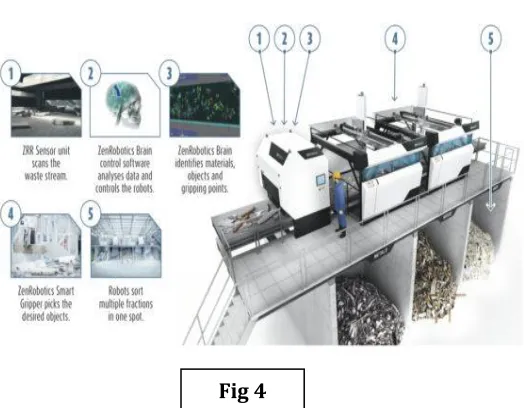
Zen Robotics Recycler relies on the unique combination of their company’s own smart software and standard industrial robots. Various sensors continuously monitor the waste stream. Smart and self-learning software, which is called as Zen Robotics Brain, analyzes the sensor data in real-time. High-grade, durable industrial robots pick waste fractions of various shapes and sizes quickly and accurately.
© 2018, IRJET | Impact Factor value: 6.171 | ISO 9001:2008 Certified Journal | Page 475
system works this way:
ZRR Sensor unit continuously scans the waste stream.
Zen Robotics Brain control software analyzes the data in real-time and controls the robots. And identifies individual materials, objects, and gripping points from the waste streams.
Robots can sort multiple fractions in one spot and adjust their work as needed. The ZRR is capable of sorting metals, different grades of wood or minerals, rigid plastics and cardboard.4.3.3 Apple’s recycling robot LIAM:
In response to criticism that Apple's products are difficult to recycle, the company has unveiled a prototype robot that can take apart old iPhones and harvest valuable materials for reuse. The robot, known as Liam, is really 29 separate robotic modules that work together on a single site near Apple's headquarters in Cupertino, Calif. Initially, Liam is used to deconstruct the iPhone 6 and recover a wide range of precious metal including, aluminum, copper, tin, tungsten, cobalt, gold, and silver parts. The company has plans to modify and expand the system to handle other devices and to recover additional resources.
Liam started to operate at full capacity and can take apart one iPhone 6 every 11 seconds. Uninterrupted, the destructive robot can handle a few million iPhones per year, which is just a small fraction of the total number of phone sold.
4.4 Advantages:
Saves manual power and minimizes labor time.
Accurate and highly fast.
Requires less space.
Keep environment pollution-free.
5. Conclusion:
Therefore, the above mentioned ideas and techniques will boost us to build robots to eliminate E-wastes from our Earth. Although recycling is considered to be effective way, human life is threatened at some cost. To avoid, it robots can be employed in the place of humans. And eradicating e-waste is at high alarm due to its harmful effects, so it’s our time to remove them completely and create a pollution-free environment.
6. References:
Bascis of robotics and their technology.
1. https://www.google.co.in/search?q=liam+robot& source=lnms&tbm=isch&sa=X&ved=0ahUKEwjDj o_w35rZAhVFO48KHXGOCzUQ_AUIDCgD&biw=16 00&bih=794#imgrc=ag-W6ZZmWQMygM:
2. https://content.wisestep.com/advantages-disadvantages-waste-management/
3. https://www.google.co.in/search?biw=1600&bih =794&tbm=isch&sa=1&ei=zod-WqD4PInuvASi27-YBg&q=e+waste+disposal+methods&oq=e+waste
+disposal+&gs_l=psy-ab.3.0.0l7j0i30k1l2j0i8i30k1.55273.56618.0.5849 0.5.5.0.0.0.0.154.642.0j5.5.0....0...1c.1.64.psy-ab..0.3.336...0i24k1.0.4ZE08xl2DQc#imgrc=jPNUr 9yax6PCZM:
Fig 4
Fig 5
[image:4.612.42.304.93.297.2]© 2018, IRJET | Impact Factor value: 6.171 | ISO 9001:2008 Certified Journal | Page 476 4.
http://vikaspedia.in/energy/environment/waste- management/e-waste-management/e-waste-hazard
5. https://www.csmonitor.com/Technology/2016/0 322/Can-Apple-s-recycling-robot-Liam-put-a-dent-in-e-waste
6. https://cleantechnica.com/2016/07/27/welcome -robotics-waste-recycling-management/
7. https://www.sciencedirect.com/science/article/p ii/S2351978917303372/pdf?md5=6b92474859d
be705e87029855a24c569&pid=1-s2.0-S2351978917303372-main.pdf
8. https://en.wikipedia.org/wiki/Electronic_waste# E-waste_management