Improving the Viscosity Index of Used Lubricating Oil by Solvent
Extraction
E. I. Epelle
1, A. J. Otaru
1, Y. O. Zubair
1, J. A. Okolie
21
Department of Chemical Engineering, Federal University of Technology Minna Nigeria
2Michael Okpara University of Agriculture, Umudike Nigeria
---***---
Abstract - This study analyses the solvent powers of
Phenol, Furfural and N-Methyl Pyrrolidone-NMP for the selective absorption of the residual aromatics and contaminants present in a used oil sample in order to improve its viscosity index (VI). The solvents were systematically varied with temperatures in the range of 40 – 100oC and solvent to oil ratios of 1:1, 2:1, 3:1 and 4:1
respectively. The performances of these solvents were accessed based on the VI improvement and raffinate yield obtained. NMP outperformed Furfural and Phenol when using VI as the performance index. Conversely, Furfural gave the best performance over NMP and Phenol in terms of the raffinate yield.
Key Words: Solvent Extraction, Raffinate, Phenol,
Furfural, N-Methyl Pyrrolidone - NMP and Viscosity Index - VI.
1. INTRODUCTION
Lubricating oils which fall under the category of liquid lubricants possess great abilities in reducing friction and wear in close fitting contact surfaces of machinery [1]. Other secondary functions include reducing overheating and removing products of wear from machine parts. Lube oils are one of the most valuable components in a barrel of crude oil; while other components such as gasoline, jet, and diesel fuel are lost after combustion, lube base oils can be recovered and regenerated to a quality equal or even better than its original virgin form by using various re-refining processes [2]. Thermal degradation, contamination, and oxidation constitute the main mechanisms through which a lube oil’s effectiveness is grossly reduced in internal combustion engines [3]. Some of these contaminations arise from the presence of water, salts, dirt, metal scrapings, and incomplete products of combustion and even breakdown of lube oil additives under use. The resultant effect of the existence of these contaminants is accelerated ageing and degraded the performance of these oils.
One of the main characteristics of a lube oil is its ability to maintain its viscosity at engine operating temperatures. The VI (viscosity index) is used to measure this characteristic; a number that characterises the variation in kinematic viscosity of a petroleum cut versus the temperature on a conventional scale [4]. The higher the VI, the less the viscosity varies with temperature. The increasing demand for good quality lube oil
capable of withstanding the severe operating conditions of contemporary diesel and gasoline engines warrants more innovative methods of separating a desirable (paraffin) from undesirable (mainly aromatics) components [5]. Thus, the solvent extraction technique which takes advantage of the differences in solubility between the components of a homogeneous liquid mixture in an appropriate solvent [5] has over the past decade proven to be a reliable method for waste oil re-refining. Although other technologies such as hydrotreating, vacuum distillation, and hydro finishing exist, they are generally energy demanding and not economical for small-scale operations. The use of solvent extraction processes as low energy-consuming alternatives ought to be given more attention.
The relative distribution of the high VI paraffinic and the low VI naphthenic and aromatic components in a lube oil determines to a large extent its final performance characteristics [6]. Thus, the reliability of the solvent extraction technique is also affected by the selective power of the solvent used to effect a separation between these categories of components. In this work, solvent extraction, a simple but yet groundbreaking technique for used oil re-refining is being investigated for its potentials in improving the viscosity index of used oils from automobiles using extraction solvents; Furfural, Phenol, and N-methyl-2-Pyrrolidone (NMP).
2. METHODOLOGY
The used oil which served as the major material for this study was supplied by garages and mechanic workshops within the city of Minna, Nigeria. The experimental procedure involved a preliminary characterisation of the used oil sample as a basis for judging any improvements in oil properties after carrying out the extraction procedure. The extraction solvents properties were also verified against published standards to ensure originality. The purities of the three solvents ranged from 99%-99.2%. With the preliminary properties determined, the solvent extraction technique was subsequently carried out by applying the following steps:
2.1 Dehydration
Fig - 1: Experimental Setup
2.2 Solvent Extraction
A measured volume of the dehydrated oil was mixed with an appropriate volume of the solvent. The solvent-oil mixture was heated to the desired temperature and stirred afterwards with the aid of a magnetic stirrer coupled with a hot plate. Temperature measurement was done with a thermometer dipped into the mixture during stirring. The stirring which took place for a period of 30 minutes ensured an even temperature distribution around the fluid as well as good selective absorption of residual aromatic compounds and contaminants by the solvent.
2.3 Separation
The resulting mixture was separated by means of a separating funnel. A clear interface was observed after leaving the mixture undisturbed for a period of 3-4 hours. The upper less dense liquid phase being the raffinate and the bottom denser phase, the extract. The raffinate phase was collected and heated mildly to further remove any residual solvents after which it was analysed for different physical properties. The extract phase was however weighed and discarded. Considering the volumes of solvents used, and the degree of contamination observed, solvent recovery by distillation was not a viable option. It is important to note that the large density difference observed between both phases justified the separation technique adopted.
Table 1: Physical Properties of NMP, Furfural and Phenol [5].
Specification NMP Furfural Phenol
Boiling point, (oC) Freezing point (oC) Viscosity, (cP) @25oC Density (d425), g/cm3 COC flash point, (oC) Refractive Index Stability
Biodegradability Toxicity
Relative Cost
202 -24 1.65 1.027 95 1.4690 Excellent Good Low 1.5
161 -36.5 1.49 1.1563 68 1.5235 Good Good Moderate 1.0
182 - 1.58 1.08 79 1.5425 V. Good Good Severe 0.36
2.4 Characterisation
Table 2 summarises the properties of the used oil sample as
compared to a fresh lube oil.
Table 2: Physical Properties of Used and Fresh Lube Oil
Physical Properties Used Lube Oil
(current work) Fresh Lube Oil [6] Viscosity at 40oC (cSt)
Viscosity at 100oC (cSt) Viscosity Index
Specific Gravity @ 25(oC) Refractive Index
Pour Point (oC) Boiling Point (oC) Flash Point (oC) Colour
163.2 14.67 85 0.915 1.432 -3 310-350 210 >5
22-248 18.5-22 95 0.899 1.4886 -12 - 246 >5 * Both oils are derived from the base stock of refined Nigerian crude oil.
3. RESULTS AND DISCUSSION
The higher specific gravity as seen in the characterization results of the used lube oil is most likely due to contaminants (such as metals and degraded products) present before extraction was done. Aromatic compounds are also known to be major contributors to the net density and viscosity of a lube oil [7]; hence the relatively high specific gravity may also be attributed to the presence of residual aromatic compounds. Similarly, the viscosity reduction obtained after extraction (Fig 2 & 3) signifies a considerable removal of contaminants initially present. Furthermore, the refractive index of the used oil, which is a good measure of the oil’s composition indicates that light travels only 1.432 times faster in a vacuum compared to its speed in the oil. On the contrary, a higher refractive index for a fresh lube (1.487) indicates a lower resistance to the speed of light travelling through it. This is yet another numerical proof of the presence of contaminants in the waste lube oil. The lower flash point of the used oil compared to that of the fresh lube is an indication of possible dilution with unburned fuel during engine operations. Chemical oxidation also results in the formation of volatile compounds which in turn causes a reduction in the flash point. The contamination level of the used oil is observed to have a less impact on the pour point. The value of -3oC indicates good flow characteristics even at lower temperatures.
A systematic variation of the temperature and solvent to oil ratio for the different solvents was carried out, as a means of re-establishing the optimum chemical composition of the used oil.
Fig 2 and Fig 3 show the effects of temperature and solvent to oil
ratio on the kinematic viscosities at 100oC for Furfural, Phenol, and NMP respectively. It was generally observed that the viscosities of the raffinate phases decreased with increasing temperature as well as a solvent to oil ratio. The decrease in viscosity was due to increased temperature thus complying with the molecular theory of reduction in the time of interaction Phase separation using a
simple separating funnel Thermometer
Magnetic stirrer with temperature and rotation
between neighbouring molecules of the liquid as a result of the increased velocities of the individual molecules [8]. A decrease in viscosity due to increased solvent to oil ratio is attributed to the fact that high molecular weight contaminants and residual aromatic compounds have been removed, leaving behind the more paraffinic compounds which have a relatively lower viscosity than those of the aromatics.
Fig - 2: Effect of SOR on raffinate viscosity at 70oC.
Fig - 3: Effect of temperature on raffinate viscosity at 100oC and 1:1 SOR.
Significant separation difficulty is an inherent attribute of applying high solvent to oil ratios (SOR). This is because the increased volume of solvent would result in its existence in the raffinate phase especially when simple separation such as that of a separating funnel is employed. The overall effect of this is a slightly reduced viscosity of the raffinate phase which is not significant enough as to affect a computed viscosity index. Fig 2 and Fig 3 reflect a milder impact on the viscosity reduction by temperature compared to the solvent to oil ratio. While it is quite tempting to think that this is as a result of the remnant solvent in the raffinate phase due to increased solvent used, a more pragmatic and applicable explanation to this, is the increased removal of the high-viscosity aromatic compounds from the lube oil. It was essential that adequate solvent removal from the raffinate phase was ensured before measurements were made.
One of the main factors affecting the overall performance of the solvent extraction process is the raffinate yield (lubricating oil yield). The effect of solvent to oil ratio and temperature on the yield of raffinate using the three solvents are shown in Fig 4 and
Fig 5 respectively. Aside from high-selectivity, another
imperative attribute that a solvent should possess for aromatic compounds and its associated contaminants is good solvent power. The solvent power characterises the solvent’s ability to perform extractions with a relatively low volume. The solvent power is most likely to increase with temperature. This is usually to the detriment of the selectivity, as even target aromatic compounds similarly develop a better solubility in the lube oil with increasing temperature. Also, the probability of dissolving the target unwanted compounds in any of the three solvents at low temperatures is quite low because these contaminants and heavy residual aromatics do not fully separate out.
Fig - 4: Effect of temperature on raffinate yield at 1:1 SOR.
Fig - 5: Effect of SOR on raffinate yield at 70oC. Fig 4 shows that the percentage yield decreases with increasing
temperature, but a more significant decrease is observed with the effect of solvent to oil ratio (Fig 5). This trend was observed for the three solvents with lowest yields obtained at the highest solvent to oil ratios (SOR). This best explained by the fact that an increased solvent volume causes greater dissolution of the raffinate phase in the extraction solvent which constitutes the
8.566
7.031
6.016
5.173 8.132
6.141
5.713
3.173 8.32
6.183
5.000
4.514
2 3 4 5 6 7 8 9
1:1 2:1 3:1 4:1
V
isco
si
ty
@
1
00
oC
(c
St
)
Solvent - oil ratio
NMP FURFURAL PHENOL
12.913
11.133
10.162
8.570 12.143
10.213
9.112
8.003 12.713
11.000
9.313
8.001
7 8 9 10 11 12 13 14
40 60 80 100
V
isco
sit
y @
1
00
oC
(cSt)
Temperature (oC)
NMP FURFURAL PHENOL
87
85
72
68 90
82
76
71 86
82
74
72
65 70 75 80 85 90 95
40 60 80 100
Ra
ff
in
at
e
Y
ie
ld
(
%)
Temperature (oC)
NMP FURFURAL PHENOL
69
63
54
48 70
67
61
54
72 70
64
58
45 50 55 60 65 70 75
1:1 2:1 3:1 4:1
R
af
fi
na
te
Y
ie
ld
(
%)
Solvent - oil ratio
extract, compared to when a smaller solvent volume is used. While it is clear that an increased temperature results in better solubility of aromatic compounds in the solvent, it is worthy of note that a temperature exists beyond which aromatic compounds simultaneously dissolve back into the raffinate thus resulting in a drop in extraction efficiency. This temperature is heavily dependent on the type of oil used [5]. Determination of this minimum miscibility temperature requires some specialised analysis which is unfortunately beyond the scope of this work.
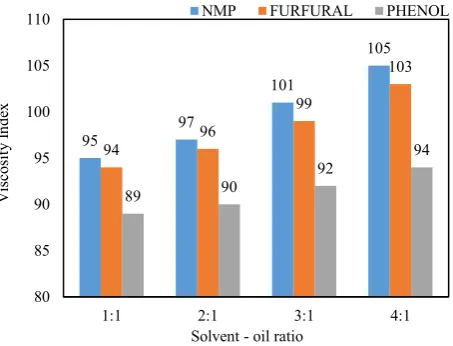
[image:4.595.313.545.115.291.2]The effects of SOR and temperature on the viscosity index of the lube oil are shown in Fig 6 and Fig 7. All viscosity indexes obtained after treatment with each solvent reflected an increase with respect to the VI of the spent oil prior to solvent treatment. As reflected in the results, the increase in extraction temperature caused an increased solubility of the target undesired compounds and contaminants in the extraction solvent which in turn increases the viscosity index of the lubricating oil. It is also indicated in Fig 7 that the solvent to oil ratio (SOR) had more impact on increasing the oils viscosity index compared to the temperature, for all the three solvents. This implies that running an economically viable lube oil re-refining plant, requires a compromise to be made, taking into consideration the costs involved when operating at a high solvent to oil ratio and the energy requirements of operating at high temperatures. NMP showed a greater ability to increase the oil’s viscosity index than Furfural which in turn gave better results than Phenol. A solvent to oil ratio of 1:1 for the NMP extraction (VI = 95) as seen from the Fig 6 results in a higher VI compared to Phenol (VI = 94) at a high SOR of 4:1. Also, Low solvent to oil ratios of Furfural extraction can be used to produce the same raffinate as 4:1 solvent to oil ratio of Phenol, thus ranking Phenol as the least powerful solvent. Furfural and NMP had close performance characteristics, however, NMP displayed a slightly higher extraction efficiency than furfural with the highest VI of 105 compared to Furfural with a value of VI at 103. A performance evaluation of these solvents based on the yield of extraction shows that the raffinate yield obtained using Furfural was highest compared to NMP and Phenol (Fig 8). This could, however, be attributed to the wider density difference between Furfural and used oil as compared to other two solvents, thus enabling better separation.
[image:4.595.317.547.336.511.2]Fig - 6: Effect of SOR on raffinate viscosity index at 70oC.
Fig - 7: Effect of temperature on raffinate viscosity index at 1:1 SOR
Fig - 8: Comparison of solvents performance.
4. CONCLUSIONS
The ability of the solvent extraction technique in separating the general group of offensive materials and hydrocarbons from used oil was demonstrated in this research work by improving the viscosity/temperature characteristics of the used lubricating oil. The three solvents employed (phenol, furfural and NMP), also showed to different degrees, their capacities not only in dissolving the residual aromatic content but also the contaminants present.
Best solvent performance (at solvent to oil ratio of 4:1 and 100°C) during the extraction process were 94, 103 and 105 for phenol, furfural and NMP respectively. From the results obtained, the solvent to oil ratio had more impact on the yield and viscosity indexes of the raffinate phase compared to temperature. Although, the highest solvent to oil ratio used in this work (4:1) is within limits of economic feasibility as reported from diverse literature, a compromise would have to be made in operating the extraction process at a higher temperature and at some lower solvent to oil ratio to save cost, if the results
95
97
101
105
94 96
99
103
89 90
92
94
80 85 90 95 100 105 110
1:1 2:1 3:1 4:1
V
isco
si
ty
In
de
x
Solvent - oil ratio
NMP FURFURAL PHENOL
90
92
94
96
91
92
94
95
88
90
91
93
84 86 88 90 92 94 96 98
40 60 80 100
V
isco
si
ty
In
de
x
Temperature (oC)
NMP FURFURAL PHENOL
87 86 90
105 103
94
0 20 40 60 80 100 120
NMP FURFURAL PHENOL
R
af
fi
na
te
Y
ie
ld
(%)
an
d
V
I
[image:4.595.42.269.584.757.2]from this work would be extrapolated to an industrial scale for a wider range of application. This usually requires specialized optimisation studies.
Furfural performed better than NMP in terms of the yield of raffinate obtained but at the expense of lower values of viscosity index. Although Phenol improved the Viscosity index of the used lube oil, in all cases, it gave the worst performance and was rather too problematic in its physical handling due to its level of toxicity; hence it may not be considered for further applications in this area of used oil re-refining. NMP gave the best VI improvement and may be regarded as the best among the three selected solvents for used oil treatment as far as this work is concerned.
REFERENCES
[1] I.L. Onyeji, A.A. Aboje, THE Effect of Additive on the Viscosity Index of Lubricating Oil (Engine Oil), Int. J. Eng. Sci. Technol. 3 (2011) 1864–1869.
[2] A.M. Emam E.A. and Shoaib, Re-refining of Used Lube Oil , II- by Solvent/Clay and Acid/Clay-Percolation Processes, ARPN J. Sci. Technol. 2 (2012) 1034–1041.
[3] F. Dalla Giovanna, O. Khlebinskaia, A. Lodolo, S. Miertus, Compendium of Used Oil Regeneration Technologies, (2003).
[4] R.M. Mortier, M.F. Fox, S.T. Orszulik, eds., Chemistry and Technology of Lubricants, Springer Netherlands, Dordrecht, 2010.
[5] J.P. Wauquier, P. Trambouze, J.P. Favennec, Petroleum refining., Editions Technip, 1995.
[6] O.A. Olugboji and O.O.A. Ogunwole, Use of Spent Engine Oil, Au J.T. 12 (2008) 67–71.
[7] I. Hamawand, T. Yusaf, S. Rafat, Recycling of waste engine oils using a new washing agent, Energies. 6 (2013) 1023–1049.
[8] C.J.A. Roelands, Correlational Aspects of the Viscoity-Temperature-Pressure Relationship of Lubricating Oils, 1966.