1. Introduction
Behavioural impairments found in developmental disor-ders and in cases of acquired brain damage provide a source of information about the structure of the cognitive system. Historically, the logic of deriving implications about cogni-tive structure from behavioural impairments was formu-lated in the domain of acquired disorders in adults (see, e.g., Shallice 1988). It was argued that under some circum-stances, highly selective patterns of impairment after dam-age could de-monstrate the relative independence of differ-ent cognitive processes, predicated on an a priori assumption of modular structure within the cognitive system. Ultimately, this was thought to lead to the identification of the compo-nents of cognition.
Recently, behavioural impairments found in developmen-tal disorders have often been interpreted within the same
cognitive neuropsychology framework (see, e.g., Baron-Cohen 1998; Leslie 1992; Temple 1997). In this case, there is an inference that selective behavioural impairments reveal discrete components of the cognitive system that have not developed properly, for example, the purported defective “theory of mind” processor in autism (Leslie 1992), or the de-fective phonological processor in dyslexia (Frith 1995). How-ever, the extension of the cognitive neuropsychology frame-work to interpret developmental disorders has proved controversial. Indeed, some researchers (Bishop 1997a; Karmiloff-Smith 1997; 1998) have argued that the process of development itself violates key assumptions of the static cog-nitive neuropsychology model and thus invalidates the direct inference from impairment to cognitive structure.
Our aim in this article is to evaluate this debate from the perspective of connectionist modelling of cognitive pro-cesses. This is a useful perspective because such models
Printed in the United States of America
Are developmental disorders like
cases of adult brain damage?
Implications from connectionist
modelling
Michael Thomas
Neurocognitive Development Unit, Institute of Child Health and School of Psychology, Birkbeck College, University of London, London WC1E 7HX, United Kingdom
Annette Karmiloff-Smith
Neurocognitive Development Unit, Institute of Child Health, London WC1N 1EH, United Kingdom
http://www.ich.ucl.ac.uk/units/ncdu/NDU_homepage.htm
Abstract:It is often assumed that similar domain-specific behavioural impairments found in cases of adult brain damage and develop-mental disorders correspond to similar underlying causes, and can serve as convergent evidence for the modular structure of the normal adult cognitive system. We argue that this correspondence is contingent on an unsupported assumption that atypical development can produce selective deficits while the rest of the system develops normally (Residual Normality), and that this assumption tends to bias data collection in the field. Based on a review of connectionist models of acquired and developmental disorders in the domains of read-ing and past tense, as well as on new simulations, we explore the computational viability of Residual Normality and the potential role of development in producing behavioural deficits. Simulations demonstrate that damage to a developmental model can produce very dif-ferent effects depending on whether it occurs prior to or following the training process. Because developmental disorders typically in-volve damage prior to learning, we conclude that the developmental process is a key component of the explanation of endstate impair-ments in such disorders. Further simulations demonstrate that in simple connectionist learning systems, the assumption of Residual Normality is undermined by processes of compensation or alteration elsewhere in the system. We outline the precise computational con-ditions required for Residual Normality to hold in development, and suggest that in many cases it is an unlikely hypothesis. We conclude that in developmental disorders, inferences from behavioural deficits to underlying structure crucially depend on developmental condi-tions, and that the process of ontogenetic development cannot be ignored in constructing models of developmental disorders.
have been employed to capture both acquired deficits (when models of adult performance are damaged) and developmental deficits (when initial computational con-straints are altered in models of typical development). Connectionist models therefore provide a concrete com-putational basis on which to anchor a debate on the poten-tial causes of each type of deficit.
From the stance of the behavioural outcome, the impair-ments found in cases of acquired and developmental disor-ders can look very similar. For example, in relation to types of dysgraphia, dyslexia, and dyscalculia, Temple (1997, p. 324) comments that “were one to give the data from adult and child cases to a cognitive neuropsychologist and ask the question, which are the adults and which the children, there are no apparent criteria by which to distinguish them.”
One might take this similarity in behaviour as an indica-tion that the two types of disorder are linked at a deeper level, namely, that they share a similar underlying cause. For example, where one can appeal to a static information-processing model of the adult system, one might charac-terise an impairment in the adult case as corresponding to selective damage to one (or more) processing components, and an impairment in the developmental case as a failure of one (or more) components to be properly acquired. Tem-ple (1997) offers just such a characterisation for cases of de-velopmental prosopagnosia (pp. 139 and 141), as well as two subtypes of developmental dyslexia (pp. 192 and 206), velopmental disorders of spelling (pp. 238 and 244), and de-velopmental dyscalculia (pp. 285–86).
In this target article, we argue that such a causal link between acquired and developmental disorders can only occur if, for a given domain, a very particular kind of de-velopmental account holds true. In most cases where re-searchers have linked acquired and developmental disor-ders, the required developmental account has not been argued for, but merely assumed.
Our aim in the computational part of this article (sect. 5)
is to characterise the conditions that must hold in a devel-oping cognitive system for acquired and developmental dis-orders to be linked at a causal level. We demonstrate by simulation that, in the absence of a precise developmental account of a cognitive system, behavioural data alone may be insufficient to infer underlying functional structure from a pattern of impairments. As a result, we argue that re-searchers working with developmental disorders must com-pare their data against developmental rather than static models, even though those static models may be appropri-ate for explaining patterns of acquired deficits in normal adults.
First, however, we introduce two concrete examples of domains in which explicit links have been drawn between acquired and developmental impairments. These are the domains of dyslexia and English past tense formation. For current purposes, these areas are important not only be-cause they illustrate how explicit the claims have been about the relation between acquired and developmental impairments, but also because both areas have been the fo-cus of substantial computational modelling work exploring the possible underlying causes of those impairments.
2. Comparisons of acquired and developmental deficits in two domains
2.1. Dyslexia
When adults experience difficulty in reading following brain damage, their patterns of behavioural impairments can be described according to several subtypes. Two sub-types are of particular relevance. In acquired phonological dyslexia, patients demonstrate particular difficulty in read-ing nonwords. In acquired surface dyslexia, they show a deficit in reading exceptionwords, where the pronunciation cannot be predicted from the usual letter-to-sound corre-spondence. For these exception words, patients tend to display errors of regularisation, for example, gauge pro-nounced as “gorge,”trough as “truff,” come as “kome,” and quay as “kway” (Shallice et al. 1983).
Cognitive neuropsychologists have interpreted these two patterns as reflecting specific damage to independent sub-components of the skilled reading system. The traditional information-processing model of the skilled reading system proposes that three processing routes link print to sound (see, e.g., Patterson & Shewell 1987; Temple 1997). One route decomposes written words into their component graphemes and constructs a pronunciation via a system of grapheme-to-phoneme correspondences. This is called the nonlexicalor phonologicalroute. A second director lexical route recognises the whole written word form and uses this representation to recover the whole-word pronunciation. A third, semantic,route uses the written word form to recover the word’s meaning, and this semantic representation is then used to recover the word’s pronunciation.
Assuming this model, acquired phonological dyslexia can be interpreted as a normal adult reading system that has ex-perienced damage to the grapheme-to-phoneme process-ing route; existprocess-ing words can be read via the whole-word recognition routes, but reading of nonwords is impaired. Acquired surface dyslexia, however, can be interpreted as an adult system that has experienced damage to both whole-word recognition routes. Words can only be read via decomposition into component graphemes and the appli-Michael Thomascompleted his D. Phil at
Universi-tiy of Oxford on bilingual language processing and con-nectionist modelling. Previously a Senior Research Fel-low at the Neurocognitive Development Unit, Institute of Child Health, London, he has recently accepted a lectureship in Cognitive Neuropsychology at Birkbeck College, University of London. His research focuses on typical and atypical language development, combining empirical and computational approaches to mecha-nisms of learning.
cation of grapheme-phoneme correspondences, resulting in the regularisation of exception words.
The patterns of errors defining these two subtypes of dyslexia have been reported in children, both in single case studies and in group studies (see, e.g., Castles & Coltheart 1993; Manis et al. 1996). Researchers have employed sim-ilar explanations in the developmental case – once more ap-pealing to the structure of the adult reading system, but now replacing the notion of “specific damage” with the no-tion of “a specific failure to develop.” Therefore, in devel-opmental phonological dyslexia, children may be “having difficulty with [acquiring] one or more components of the nonlexical route” (Coltheart et al. 2001) or they may exhibit an overall system with “relatively normal development of semantic, lexical, and direct reading systems but with im-pairment in the acquisition of the phonological reading route” (Temple 1997, p. 206). In developmental surface dyslexia, children may be having difficulty acquiring “one or more components of the lexical route” (Coltheart et al. 2001), or they may exhibit a reading system in which the “direct and semantic reading routes have failed to become established properly” (Temple 1997, p. 192).
2.2. Past tense formation
Our second example comes from the domain of inflectional morphology, and in particular the formation of the English past tense. Once again, a model has been proposed for the functional structure of the adult system in which separate subcomponents tackle different aspects of the task (Pinker 1991; 1999). One component is claimed to be responsible for forming the majority of past tenses that conform to a rule (“add -ed”) and for generating past tenses for novel verbs (wug-wugged). A second component memorises in-dividual past tense forms, particularly those that are excep-tions to the rule (e.g., go-went, sleep-slept, hit-hit, etc.).
In cases of acquired aphasia and in neurodegenerative dis-eases, adults can exhibit dissociations between performance on regular and exception past tense formation. Patients with nonfluent aphasia can be worse at producing and reading regular past tense forms than exception forms, whereas pa-tients with fluent aphasia can be worse at producing and reading exception forms than regular forms (e.g., Tyler et al. 2002a; 2002b; Ullman et al. 1997; in press; though, see Bird et al. 2002). Similarly, patients with Parkinson’s disease can make more errors producing regular and novel -ed forms than exception forms, whereas patients with Alzheimer’s dis-ease can make more errors producing exception past tense forms than regular past tense forms (Ullman et al. 1997; Ull-man, in press). Assuming the dual-mechanism model of the adult system, these patterns of acquired deficit are taken to reflect selective damage to either the rule-processing com-ponent or the exception memorisation comcom-ponent.
Once again, parallel impairments have been reported in the developmental domain, in this case in two develop-mental disorders with a genetic origin, Specific Language Impairment (SLI) and Williams syndrome (WS). Ullman and Gopnik (1999) and van der Lely and Ullman (2001) re-ported that children with SLI perform poorly on past tense formation tasks and show a much smaller advantage of reg-ular past tense formation over exception past tense forma-tion – interpreted as a relative impairment in regular past formation. However, Clahsen and Almazan (1998) reported that children with WS exhibit a specific difficulty with
gen-erating exception past tense forms.1Pinker (1999) offered an interpretation of these respective findings in terms of the adult model: SLI represents a case where the mutation of certain genes interferes with the development of the abil-ity to inflect new and uncommon regular verbs. WS repre-sents a case where the rule-based computational mecha-nism is intact but the memory mechamecha-nism for storing exception verbs is specifically impaired. Together these dis-orders are argued to represent a “genetic double dissocia-tion . . . the first group of children rarely generalise the regular pattern; the second group of children generalise it freely” (Pinker 1999, p. 262).
Both the examples of dyslexia and past tense formation illustrate the way in which developmental impairments are often interpreted by appealing to the structure of adult models. They show, too, how the central double dissocia-tion logic of adult cognitive neuropsychology has been ex-tended to developmental cases. Dissociable behavioural impairments are taken as evidence of independent under-lying mechanisms, by virtue of the claimed independent failure of those mechanisms to develop properly. We turn now to consider why the validity of this extension is ques-tionable, before examining specific computational imple-mentations of deficits in these target domains.
3. Is the cognitive neuropsychology framework appropriate for the interpretation of
developmental disorders?
3.1. Development in a “static” framework
When acquired damage causes selective cognitive deficits in normal adults, these deficits occur against a background of hitherto normal function. (This is also the case for ac-quired deficits in children, at least at the time of insult.) Such cognitive systems are hence discussed in terms of the cognitive mechanisms or processes that have become im-pairedcompared to those that have remained intact.
When selective behavioural deficits are identified in de-velopmental disorders, they are frequently characterised in the same way, in terms of developmental impairments against a background of normal development. We will refer to the second half of this characterisation as the assumption of Residual Normality.This is the assumption that, in the face of a selective developmental deficit, the rest of the sys-tem can nevertheless develop normally and independently of the deficit. It is this developmental assumption that al-lows researchers to relate patterns of deficits in develop-mental disorders to static models of the normal cognitive system. Because patterns of deficits are usually identified in older children, adolescents, or adults with the develop-mental disorder, static models of the normal adult system are often deemed an appropriate point of reference. In principle, however, deficits identified in the younger child could be compared against a static model of the normal sys-tem for the appropriate stage in development, were such a model to exist. In either case, the essential point here is that the assumption of Residual Normality permits develop-mental deficits to be compared against functional models that themselves have no developmental component.
develop-mental prosopagnosia. The following quotes illustrate three explicit renditions of the claim for Residual Normality in developmental disorders:
I suggest that the study of mental retardation would profit from the application of the framework of cognitive neuropsychology (e.g., McCarthy & Warrington 1990; Shallice 1988). In cogni-tive neuropsychology, one key question running through the in-vestigator’s mind is “Is this process or mechanism intact or im-paired in this person?” . . . In fact researchers in mental retardation have been searching for intactversus impaired cog-nitive processes for quite some time without discussing this in terms of modularity. (Baron-Cohen 1998, p. 335, emphasis added; and Footnote 1)
The analysis of the developmental dyslexias offered by the dual-route model is that, just as each of the two dual-routes can be selec-tively affected by brain damage with the other remaining intact, it is possible for a child to have difficulty acquiring one of the routes, with the other being acquired at a normal rate. (Colt-heart et al. 1993, p. 591, emphasis added)
Within modular theories, the linguistic performance of subjects with [developmental] language impairments may reflect the ar-chitecture of the normal system but with selective components of this system under- or over-developed. (Clahsen & Temple 2002, emphasis added)
It is interesting that Residual Normality (henceforth RN) is less frequently deployed as a developmental hypothesis in pediatric neuropsychology. For children with acquired brain damage, the clinically driven focus is usually on re-covery. Researchers tend to eschew static models and ex-plore the effect of cerebral insult on the potentially plastic process of development. Because structural damage is seen in the context of a dynamic and interactive developmental process, there is recognition of the possible influences of compensation within the cognitive system and of disruption to the acquisition of further cognitive skills, as well as fam-ily and social factors (Anderson et al. 2001b; see Thomas 2003, for discussion). If the undamaged part of the cogni-tive system compensates or alters across development in re-sponse to the part that has suffered a selective deficit, the undamaged part may not follow the normal path of devel-opment, in which case RN would not hold.2
However, researchers in developmental disorders of a ge-netic origin routinely deploy RN in their explanations, as we have seen in the cases of SLI, WS, and dyslexia. This is prob-ably because of the fact that such disorders are used (in part) for theoretical purposes within the cognitive neuropsychol-ogy framework, as a source of evidence about the structure of the normal cognitive system (and because of the genetic origins, about the potential innateness of that structure). RN is an assumption (often implicit) about how development takes place. But, is it likely to be correct? In section 3.2, we consider two opposite claims. First, we examine the claim that no answer to the preceding question is necessary:From the perspective of cognitive neuropsychology, development can be ignored in the study of behavioural deficits in devel-opmental disorders. Second, we consider the claim that, not only must development be incorporated, but that when it is, the assumptions required to use the cognitive neuropsy-chology framework are fatally undermined. We then pro-pose a resolution of these two opposing positions.
3.2. Development and modularity
Jackson and Coltheart (2001) have recently defended the use of the cognitive neuropsychology framework for
study-ing developmental disorders. They have argued that the process of development is not relevant to identifying intact and impaired processes in a cognitive system, so long as modularity can be assumed for that system. In their view, the framework is equally suitable in both acquired and de-velopmental cases for establishing what they call the prox-imal cause of the behavioural impairment. By this they mean “what is wrong with the cognitive system right now,” irrespective of whether the original cause was brain dam-age, atypical development caused by a genetic abnormality, or even poor schooling. These latter causes are what Jack-son and Coltheart term distal.They maintain that the dis-tal causes of an impairment are potentially independentof the common proximal cause, allowing one to consider ac-quired and developmental deficits within the same frame-work. Although Jackson and Coltheart agree that a full ex-planation will involve both proximal and distal causes, they defend the cognitive neuropsychology framework as the ap-propriate way to reveal the proximal cause of any behav-ioural impairment, independent of distal causes.
Jackson and Coltheart discuss the case of phonological dyslexia, which, as we saw earlier, is defined by a difficulty in reading novel words. They argue that, in relation to the traditional cognitive model of reading, both acquired and developmental phonological dyslexia can be assigned the same proximal cause, namely, a problem with the process-ing route that maps graphemes to their respective pho-nemes (the “GPC” route). What differs in the acquired and developmental cases is the distal cause, respectively, brain damage and some developmental (perhaps genetic) anom-aly. In short, these authors argue strongly that synchronic similarities in behavioural deficits between acquired and developmental cases can be linked by a common underly-ing cause at a cognitive level of description,and that this cognitive cause can be established by the methods of cog-nitive neuropsychology.
The extension of the cognitive neuropsychology frame-work to developmental disorders has, however, been criti-cised on three main grounds (Bishop 1997a; Karmiloff-Smith 1997; 1998). The first criticism is that the framework unnecessarily warps the types of data that are collected in the developmental case by focusing on the search for spe-cific deficits, only superficially examining areas of pre-sumed intactness. The second criticism is that the frame-work is unable to comment on one of the key contributory causes of the patterns of behavioural impairments found in developmental disorders, namely, the process of develop-ment itself. Where different developdevelop-mental hypotheses ex-ist for a given impairment, the cognitive neuropsychology framework cannot distinguish between them. The third criticism is that the assumption of a universal modular structure in the cognitive system on which the framework relies may not hold in the developmental case. We briefly look at each claim in turn.
group studies.Karmiloff-Smith (1997; 1998) argues that, particularly for disorders of a genetic origin, behavioural impairments at the end of development are likely to be the outcome of an extended atypical developmental trajectory, determined in part by the initial structural anomalies in the cognitive system and in part by the interactions of that sys-tem with its environment. She argues that, methodologi-cally, researchers should not search exclusively for selective deficits at the end of the developmental process but should also seek differences in infancy, where the origins of the atypical trajectory may be revealed.
Second, both Bishop and Karmiloff-Smith claim that the cognitive neuropsychology framework is impoverished in the developmental domain by its exclusion of the develop-mental process as an explanation of patterns of behavioural impairments in the adult state. For Bishop (1997a), these processes include top-down as well as bottom-up interac-tions between cognitive subsystems during development, compensatory processes, and timing differences that may lead to changes in the patterns of impairment over time. As an example of the latter, she points to the hypothesis that in children with SLI, early problems in auditory discrimina-tion that occur at a crucial stage in language development cause a lasting legacy of language impairment, even if the auditory problems subsequently resolve themselves and are undetectable. Karmiloff-Smith (1997; 1998) argues that the causes of behavioural impairments in developmental disor-ders are likely to be found in the low-level computational properties of the neonate brain, such as atypical neuronal firing levels or local connectivity. Such low-level differences can only lead to behavioural impairments via the develop-mental process, a process that may exaggerate some initial computational differences but attenuate others, depending on the nature of the domain. In the former case, the devel-opmental process itself must be considered a key cause of the subsequent impairments.
In response to this criticism, it is worth noting Jackson and Coltheart’s (2001) position that the cognitive neu-ropsychology framework is not designed to comment on distal causes of deficits such as development, merely on the proximal causes, that is, the functional deficits shown in the current state. As such, the cognitive neuropsychology frame-work simply does not have the power to address the ques-tions of concern to Bishop and Karmiloff-Smith.
The third criticism of the extension of the cognitive neu-ropsychology framework to developmental disorders is po-tentially the most serious. The only necessary a priori as-sumption required to employ that framework is that in many domains the cognitive system is modular, so that se-lective deficits in behaviour may be traced to independent functional components. Bishop (1997a) has suggested that two of the defining properties of modules – innateness and imperviousness to top-down feedback – are clearly chal-lenged by processes of development. Some cognitive abili-ties acquired by children are not innate, and top-down pro-cessing is used a great deal by children when they are performing cognitive tasks. There are problems with this criticism that concern the precise definition of what consti-tutes a module. Fodor (1983) identified several possible characteristics of modules (that they be domain specific, in-nately specified, informationally encapsulated, fast, hard-wired, autonomous, and not assembled). However, none of these was stipulated as a necessary property, rather, those likely to be associated with modular processing (Coltheart
1999). There has been significant disagreement concerning the key properties of a module, if indeed modularity is to remain a single explanatory concept (Thomas & Karmiloff-Smith 1999). For example, for Fodor (2000), the most impor-tant property is encapsulation; for Coltheart, it is domain specificity. Until there is agreement on what constitutes a functional module, it will prove difficult to demonstrate whether development violates the necessary conditions and so clearly undermines the use of the cognitive neuropsy-chology framework to explain developmental disorders.
However, a more grave criticism lies in wait. Even if we accept a (loose) notion of modularity, it may be that in some types of developmental disorders, individuals do not share the same set of functional modules as in the normal cogni-tive system. Karmiloff-Smith (1998) argues that neuro-biological evidence of the development of neocortex in infants strongly suggests that genes do not code directly for high-level cognitive modules, but that processing struc-ture is emergent and experience-dependent, the outcome of a developmental process. The implication is twofold. First, if modular structure is the product of development (Karmiloff-Smith 1992), in cases of atypical development, the resultant modular structure may not be the same as in the normal adult case. Second, even if early damage is lim-ited to a specific cognitive component, if the modular struc-ture of the cognitive system is sensitive to experience, com-pensation may occur elsewhere in the system, altering the function of the initially intact components.
We can illustrate this idea with reference to Jackson and Coltheart’s own example, phonological dyslexia. Recall that these authors attribute the impairment in nonword reading in the developmental and acquired cases of this disorder to a common proximal cause, an impairment to the GPC route in the traditional model of adult performance. However, in the pure case of the disorder, this common proximal cause is ac-tually shorthand for “the GPC route is impaired and the lex-ical routes are functioning normally.” In cases of adult brain damage, this seems possible. But in the developmental case, Bishop and Karmiloff-Smith’s position is that problems with the GPC route may also lead to differences in the way in which the lexical routes themselves develop. According to this view, the developmentally disordered system could com-prise a GPC route and two lexical routes,3allof which are functioning atypically. Together, however, these routes would then manifest a behavioural impairment in nonword reading. The extent to which modular structure can vary in cases of atypical development is currently an open question (see Tager-Flusberg 2000 for discussion). Indeed, the degree of plasticity across different cognitive systems and their un-derlying neural substrates is an area of active investigation (Thomas 2003). For example, it remains to be seen whether limits to plasticity are different in cases of acquired damage in early childhood than in individuals with genetic devel-opmental disorders. Nevertheless, if a common modular structure cannot be assumed, it is evident that develop-mental disorders cannot be straightforwardly related to sta-tic models of the normal cognitive system. It is therefore of key importance to understand how modular structure emerges and to what extent this process can be disrupted.
3.3. A reconciliation
dis-order (proximal cause) and the developmental process by which it was reached (distal cause) must be considered carefully. Although it may be possible to studythem inde-pendently, they are not in fact independent but are mutu-ally constraining. It would be unwise to characterise the endstate of a cognitive system in a form that could not be reached by a feasible developmental process (Piaget 1971). This point does not just apply to the study of developmen-tal disorders. In the same way, theories within normal cog-nitive psychology and normal developmental psychology must be mutually constraining, despite existing as separate fields of inquiry.
Is Residual Normality a feasible type of developmental ac-count? Is it realistic to expect developmental patterns of spe-cific deficits to stand against a background of normal modu-lar function? Karmiloff-Smith and colleagues have argued that a priori, the effects of genetic abnormalities are likely to be widespread throughout the brain and unlikely to be iso-lated to single high-level cognitive modules (Karmiloff-Smith 1998; Karmiloff-(Karmiloff-Smith et al. 2002). When marked be-havioural deficits arise in a single domain, it is likely that the cognitive processes underlying apparently intact perfor-mance in other domains are also atypical in subtle ways – which may go undetected without the sensitive testing of abilities outside of the main behavioural impairment. Such investigations are prompted only by a realistic developmen-tal hypothesis. In support, Karmiloff-Smith cites examples such as Williams syndrome, where ostensibly intact face recognition was subsequently shown to be achieved by atyp-ical cognitive processes (see below), and developmental dyslexia, where motor deficits have been found in children previously thought only to have a highly selective problem in reading (e.g., Bishop 1990; Fawcett et al. 1996; Hill 1998). Despite a priori leanings, one might view the issue as one to be determined merely on empirical grounds. Are there or are there not selective cognitive deficits in developmen-tal disorders? Unlike modularity, RN is not an assumption that is a priori required to employ the cognitive neuropsy-chology framework. Instead, it is a hypothesis invoked to ex-plain a particular set of empirical data. In this sense, Jack-son and Coltheart are right that the characterisation of the current deficit in a disorder could be blind to the causes of that disorder. Should RN, therefore, be seen as a neutral hypothesis, simply “calling the data”? The answer is no. The reason is that theory and data collection are clearly not in-dependent. Disorders are typically first investigated by ap-plication of a range of standardised tests to establish which areas show behavioural deficits and which show behaviour in the normal range. If one has a predilection to believe that RN is true, the risk is that scores in the normal range will be accepted as final evidence of normal underlying processes, and data collection cut short prematurely. If, however, one is more suspicious of RN, as developmental-ists usually are given the interactive nature of the develop-mental process, then there is a motivation to perform more fine-grained analyses to establish whether apparently nor-mal behaviour is actually being achieved by atypical under-lying processes. If so, then deficits are not specific.
An example illustrates the point. Despite deficits in visuospatial processing, face recognition in Williams syn-drome was initially reported as a “spared” ability, on the ba-sis that scores on standardised tests fell within the normal range (Bellugi et al. 1994; Udwin & Yule 1991). This prompted claims that the development of systems
underly-ing spatial reasonunderly-ing is disrupted in WS, but the systems un-derlying face perception develop normally (Pinker 1999). If one were happy to invoke RN, one would stop at this point and perhaps use WS in combination with developmental prosopagnosia as a double dissociation implying the inde-pendence of face processing structures from general visu-ospatial processing.
However, suspicion of RN in genetic developmental dis-orders actually led to further investigation of this apparently intact ability. Closer examination of the items within the stan-dardised tests on which individuals with WS performed well, and those on which they performed poorly, suggested that their recognition of faces proceeded atypically. Specifically, individuals with WS were better at recognising faces that could be identified by single features than those that required computation of configurations of features; control partici-pants showed no such distinction (Karmiloff-Smith 1997).
Subsequent research with specially designed face stimuli and geometrical patterns supported the hypothesis that face processing follows an abnormal developmental course in WS (Deruelle et al. 1999; Humphreys et al. 2002). Electro-physiological brain imaging studies also indicate anomalous underlying processing in WS, including reduced sensitivity to inverted faces compared to normal faces, and an absence of the progressive developmental pattern of right hemi-sphere localisation found in typically developing controls (Grice et al. 2001; Mills et al. 2000). In short, when exam-ined in detail, a superficially intact ability turned out to be associated with quite atypical cognitive and brain processes. In reconciling the two opposing positions, a subtler pic-ture emerges. The static cognitive neuropsychology frame-work is not in principle inappropriate for the study of developmental disorders. For example, there is nothing in-trinsic to the nondevelopmental approach espoused by Jackson, Coltheart, and others that would prevent it from verifying whether RN is true in a particular child, domain, or disorder. Empirical data will eventually reveal if there are selective cognitive deficits in a given case. If there are, it will be necessary to construct and test a developmental account in which RN holds. However, a tendency simply to assume RN – conditioned by research in adult cognitive neuropsy-chology where a background of normal function can often indeed be assumed – leads to inadequate data collection. These data are then insufficient to establish beyond rea-sonable doubt that normal processes underlie behavioural scores that fall within the normal range. This bias has im-peded progress in the study of developmental disorders, and particularly in building links to developmental cogni-tive neuroscience, developmental neurobiology, and, ulti-mately, the genetic anomalies that underlie many disorders. This state of affairs has arisen because insufficient atten-tion has been paid to the process of development itself in the study of developmental disorders. In particular, be-cause RN is typically implicitly assumed, there has been no elucidation of the necessary conditions under which it would actually hold.
4. Under what developmental conditions would we expect to see similarities between
developmental and acquired disorders?
com-ponent that can be damaged in the endstate can also fail to develop in isolation of the entire developing cognitive sys-tem. This will occur under the following conditions: • The process of development does not contribute to the pattern of behavioural deficits, so damage produces an identical effect at any stage.
• There are pre-existing modules that develop indepen-dently; so damage to one does not affect development of the others.
• If it is the case that modules emerge through a develop-mental process (modularisation), this process can be dis-rupted in such a way that some modules emerge normally and some develop atypically.
By contrast, similarities between developmental and ac-quired disorders will notoccur under the following condi-tions:
• The process of development always contributes to the precise pattern of deficits in developmental disorders (ei-ther attenuating or exaggerating the effects of early dam-age) and produces patterns not found in acquired damage. • The system has sufficient plasticity that compensation occurs; undamaged systems take on the function of dam-aged systems, perhaps suboptimally, perhaps also at some expense to their normal function.
• Module emergence is disrupted to produce a different functional structure that shows a behavioural pattern not found in acquired damage.
Similarities may occur between developmental and ac-quired disorders that cannotbe related to the same model of the normal cognitive system under the following condi-tions:
• Module emergence is disrupted to produce a different functional structure that nevertheless shows a similar be-havioural pattern to that found in acquired damage. • The patterns of behavioural breakdown are specified not by the structure of the cognitive system but by features of the problem domain (e.g., in all suboptimal systems, per-formance degrades on the hard parts of the problem before it degrades on the easy parts).
What conditions actually hold in cognitive development? To address this issue, we need to know the answer to several further questions. First, how does the process of develop-ment interact with damage to a cognitive system to produce endstate behavioural impairments? Second, does the process of development always play a central role in producing the impairments – and if so, does development tend to produce a different pattern of endstate impairments to acquired dam-age in the endstate? Third, what is the origin of the spe-cialised functional components stipulated in adult models? If components are not innately specified, how do they emerge through a process of development, as in Karmiloff-Smith’s (1992) theoretical notion of emergent modularisation? Fi-nally, how can such a process of emergent specialisation be affected or unaffected by disruption to the computational conditions existing in the early cognitive system?
These are difficult questions, and the field of develop-mental cognitive neuroscience is some way from having an-swers to all of them. In what follows, we explore potential answers to these questions by examining computational models of cognitive development. To retain a focus, we re-strict our investigation to computational models applied to our two target domains, reading and past tense formation, and to research based on a single, influential class of com-putational learning systems, that is, connectionist networks.
5. Computer modelling
The modelling section comprises three parts. In the first, we compare the methods that researchers have used to ex-tend connectionist models of normal development and adult function to cases of developmental and acquired im-pairments in reading and past tense formation. In the sec-ond, we introduce new simulations to gauge the contri-bution of the developmental process to producing patterns of endstate impairments, within the framework offered by those models. Specifically, we investigate the extent to which the process of development itself is a causal factor of the specific pattern of impairments shown in a develop-mental disorder. In the third, we use new simulations to ex-amine the assumption of Residual Normality. In a system with emergent specialisation of function (i.e., one exhibit-ing modularisation), how viable is RN? Specifically, when one component of the system is prevented from developing normally, does the rest of the system nevertheless develop independently and normally? If not, what are the condi-tions under which learning systems wouldshow RN, so that developmental impairments could be interpreted in terms of selective deficits to an adult model? From a behavioural perspective, how does assuming RN affect the inferences we can make from dissociations in behaviour to underlying structures?
6. Connectionist models of acquired and developmental deficits
Connectionist networks have been widely used in recent years to construct models of cognitive processing in adults (see, e.g., McLeod et al. 1998; Rumelhart et al. 1986). Be-cause one of the main strengths of these networks is their ability to learn input-output functions, they have increas-ingly been used to model the development of cognitive processes (Elman et al. 1996; Thomas & Karmiloff-Smith 2002).4
When there exists a working model of a normal adult sys-tem, the validity of the model can be further tested by in-vestigating its ability to capture patterns of acquired deficits when the model is damaged in various ways. Connectionist models have been used to capture deficits in a number of acquired disorders, including dyslexia, aphasia, alexia, pro-sopagnosia, epilepsy, phantom limbs, stroke, frontal lobe damage, unipolar depression, Parkinson’s disease, Alzhei-mer’s disease, and schizophrenia (see, e.g., Reggia et al. 1996b; Stein & Ludik 1998). Where knowledge is encoded in the connectionist network through a training process, ac-quired deficits are modelled by damaging the network af-ter that training process is complete.
changes in models of atypical development are made to the network or to the way it learns prior to the training process. These changes in the computational constraints of the learn-ing system lead to atypical trajectories of development and an endstate performance that may exhibit behavioural im-pairments.
The contrast between connectionist models of acquired and developmental disorders is a fairly clear one. In the ac-quired case, damage of some sort is applied to the model at the end of a training process. In the developmental case, it is applied prior to the training process.5Immediately one might ask, do modellers use the same kind of damage in each case, and does this damage cause the same behav-ioural impairment? If the answer to both is yes, one might conclude that the developmental process plays a limited causal role in generating the pattern of behavioural impair-ments.6However, if the answer is no, and different impair-ments result from the same damage in the two cases, then the implication would be that the developmental process is an important component in determining the pattern of im-pairments in developmental disorders. In sections 6.1 and 6.2, we consider this question in relation to connectionist models of reading and past tense formation.
6.1. Connectionist models of reading
Connectionist models of reading assume that the computa-tional problem in this domain is to learn to map between representational codes of the written form of a word, the spoken form of a word, and the word’s meaning (Plaut et al. 1996; Seidenberg & McClelland 1989). Typically, this in-volves three connectionist networks, one to map from or-thography to phonology, one to map from oror-thography to semantics, and one to map from semantics to phonology (al-though in many models only the first of these networks is implemented; see Harm & Seidenberg 2001 for an excep-tion). Each network has a three-layered structure, com-prising an input layer, an output layer, and a layer of hidden units in between. Some models employ recurrent connec-tions that allow cycling activation patterns so that the model will settle into a stable output state. Sometimes a layer of “clean-up” units is connected to the output layer to aid this settling process (see, e.g., Harm & Seidenberg 1999; 2001). Within these models, acquired dyslexia is produced by different kinds of damage to the trained model. Acquired surface dyslexia, a deficit in reading exception words, has been modelled by damaging the network that maps or-thography to phonology, via the removal of hidden units or the severing of connections (Patterson 1990; Patterson et al. 1989). Such damage produces a greater impairment on reading exception words than regular words. However, fail-ures of this approach to fit more extreme patterns of sur-face dyslexia subsequently led to the claim that exception word reading might be achieved via an indirect semantic route, particularly in the case of low-frequency words. Ac-quired surface dyslexia might represent damage to this in-direct route, so naming must proceed via the orthography-to-phonology route alone, a route that has not learned to name low-frequency exception words and, as a result, reg-ularises them (Patterson et al. 1996; Plaut et al. 1996; see Coltheart et al. 2001 for discussion).
Previously, acquired phonological dyslexia was not ex-plicitly simulated within these learning models because, in theoretical terms, it corresponded to selective damage to
the entire orthography-to-phonology network; because most models only implemented the orthography-to-phonology network itself, such a lesion was outside their scope. Theo-retically, lesioning the direct orthography-phonology route would mean that reading must be accomplished primarily or exclusively via the semantic route, so that novel words without a stored meaning would be severely impaired. However, recently Harm and Seidenberg (2001) have im-plemented the full connectionist reading model, including pathways between phonology, orthography, and semantics. The authors report a manipulation intended to simulate acquired phonological dyslexia, whereby noise is added to processing within the phonological component of the model (i.e., the phonological output units and associated clean-up units). Harm and Seidenberg demonstrate how this impairs the nonword reading of the model much more severely than its reading of words in the training set (Harm, personal communication, June 2001). It also accounts for several effects found in the nonword reading of acquired phonological dyslexics that were previously taken as sup-port for the traditional model of reading.
Doubts have been raised as to the full developmental validity of several of these connectionist reading models. Nevertheless, we consider them here for their insight into systems that acquire representations appropriate for a cog-nitive domain through a learning process. Patterns of de-velopmental dyslexia have been simulated by applying the relevant damage prior to this learning process. Thus surface dyslexia has been simulated in a number of models by re-moving units from the hidden layer in the orthography-to-phonology network prior to training (Harm & Seidenberg 1999; Plaut et al. 1996; Seidenberg & McClelland 1989). This damage produces a greater impairment in exception word reading than regular word reading or nonword read-ing, particularly for low-frequency exception words. Be-cause exception word performance generally lags behind regular word performance during training, some authors have also simulated poorer performance in reading excep-tion words simply by giving the network less training or less efficient training (Bullinaria 1997; Harm & Seidenberg 1999).
Developmental phonological dyslexia has been simu-lated in two main ways. The first approach reflects a prior claim that developmental phonological dyslexia may corre-spond to phonological representations (and perhaps ortho-graphic representations as well) that have insufficient com-ponentiality (Manis et al. 1996; Plaut et al. 1996). Harm and Seidenberg (1999) implemented this proposal by restrict-ing the computational properties of the phonological component of their model (the phonological output layer, its recurrent connections, and its clean-up units). Their ma-nipulations included the removal of the clean-up units and severing half the recurrent connections between the phonological units, or restricting the size of the weights in the recurrent connections, or making computations within the phonological component more noisy. All of these re-sulted in poorer nonword reading, and some impacted on exception word reading as well. Brown (1997) also demon-strated that when both orthographic representations and phonological representations are deliberately constructed with reduced componentiality, reduced nonword reading is found at the end of training.
orthog-raphy and phonology. For example, Zorzi et al. (1998) have argued that the reading system is better conceived of as in-cluding a network in which orthographic representations are directly connected to phonological representations. Lack of these direct connections in the initial architecture, and the presence only of a route mediated by hidden units, pre-vented their network from learning a simple function relat-ing orthography and phonology, and so generalisation was reduced. Brown (1997) used another constraint on the com-putational function by employing several three-layer net-works with progressively reduced numbers of hidden units and comparing them when their performance on regular and exception words was matched. (By necessity, this meant that the networks with fewer hidden units had experienced more training.) Networks with fewer hidden units were unable to learn a robust function linking orthography and phonology and so showed poorer nonword reading.
In summary, both surface and phonological dyslexia per-mit a direct comparison between simulations of the ac-quired and developmental forms. In the case of surface dyslexia, initial approaches used the same method, the re-moval of hidden units and/or connections, to simulate the same impairment, namely, a deficit in exception word read-ing. Recently, acquired accounts have appealed to the en-tire lesion of unimplemented routes. In the case of phono-logical dyslexia, several methods have been used to simulate the developmental impairment, including either altering phonological and/or orthographic representations, or con-straining the computational function that the network can use to link orthographic and phonological codes. One method used by Harm and Seidenberg (1999), the addition of noise to processing within the phonological component of the model during training, was also used by Harm and Sei-denberg (2001) to simulate acquired phonological dyslexia, where such noise was added to a normally trained model. In-deed, Harm and Seidenberg (2001) specifically comment that the “form of impairment is identical” in the two cases (p. 80). In short, on the basis of connectionist models of reading, one might conclude that the same form of damage before and after training creates the same behavioural deficit – as if the developmental process itself contributed nothing to the nature of that behavioural deficit.
6.2. Connectionist models of past tense formation
Connectionist models of past tense formation assume that the computational problem in this domain is to learn to map between representational codes of the phonological form of the stem of a verb and a phonological form of that verb’s past tense (Plunkett & Marchman 1993; 1996; Rumelhart & McClelland 1986), sometimes in the presence of the verb’s semantic representation (Hoeffner 1992; Joanisse & Seidenberg 1999), and sometimes in the presence of more restricted semantic information (MacWhinney & Leinbach 1991; Plunkett & Juola 1999).
Joanisse and Seidenberg (1999) sought to simulate two kinds of acquired deficits in their model of past tense for-mation, either an impairment in producing regular past tense forms (found in cases of nonfluent aphasia and Parkin-son’s disease), or an impairment in producing exception past tense forms (found in cases of fluent aphasia and Alzhei-mer’s disease). Impairment to the formation of regular past tenses was achieved by randomly severing connections be-tween the phonological output layer and that layer’s bank of
clean-up units in the trained network. However, the fit to pa-tient data was not ideal here, because the model showed a much larger decrement in extending the past tense rule to novel items (e.g., wug-wugged) than on the formation of ex-isting regular past tenses (e.g., talk-talked). Patients, how-ever, can show similar decrements to both (e.g., Ullman et al. 1997).7It is possible that formation of existing regular past tenses was driven too much by word-specific informa-tion because the model was trained only on a single inflec-tional paradigm. In a larger model in which individual words can be inflected in several different ways, regularities may be pushed further into the phonological part of the network, such that regular verbs would also be amenable to selective damage. Impairment to the formation of exception past tenses, however, was achieved by randomly severing con-nections between the semantic representations and their clean-up units in the trained model, while adding noise to the semantic activation level. This gave a good fit to patient data (though, see Tyler et al. 2002a).
In Williams syndrome, it was initially reported that there was a selective deficit in forming the past tense of exception verbs (Clahsen & Almazan 1998). However, a larger study suggested that this apparent deficit was actually a con-sequence of language delay, because performance on ex-ception verbs lags behind that on regular verbs in normal development, and language is typically delayed in WS (Thomas et al. 2001). When language delay was controlled for in this latter study, the greater deficit on exception verbs in WS disappeared. The Thomas et al. study did, how-ever, reveal reduced generalisation of the past tense rule to novel forms in WS, a pattern which persisted even when language delay was controlled for. Using a past tense net-work that mapped from verb stem to past tense form in the presence of semantic information, Thomas and Karmiloff-Smith (in press) explored the manipulations to the normal model that could reproduce this pattern of developmen-tal data. Various claims have been made that there are sub-tle deficits to the language system in Williams syndrome. These include the proposals that language development may be “hyper-phonological,” relying to a greater extent on phonological than lexical-semantic information (Grant et al. 1997; Vicari et al. 1996a; 1996b; Volterra et al. 2001), that the phonological representations themselves may be atyp-ical and perhaps rely on sensitive auditory processing (Kar-miloff-Smith et al. 1997; Majerus et al. 2001; Neville et al. 1994), that lexical-semantic representations may be atypi-cal (Clahsen & Almazan 1998; Rossen et al. 1996; Temple et al. 2002), or that lexical-semantics may be poorly inte-grated with phonology (Frawley 2002; Karmiloff-Smith et al. 1998).
Thomas and Karmiloff-Smith found that a manipulation of the phonological representations that reduced their sim-ilarity and redundancy was sufficient to reproduce the de-lay for regular and exception past tense forms as well as the reduction in generalisation. However, the pattern could also be reproduced when noise was added to the informa-tion coming from the lexical-semantic system. By contrast, slowed learning failed to produce a reduction in generali-sation, suggesting that delay alone was insufficient to ex-plain the data. Although elimination or weakening of the lexical-semantic contribution produced a selective delay (but no final impairment) for exception verbs, it also failed to show the reduction in generalisation. In short, manipu-lations to phonology or to the integration of phonology and lexical-semantics could simulate the WS data, but a manip-ulation to lexical-semantics alone could not.
What if the WS data had shown a selective deficit in ex-ceptions as initially reported in the syndrome – could the model have shown this pattern? Performance on exception verbs could be preferentially delayed under at least two conditions: by attenuating lexical-semantic input, or by re-stricting the computational complexity of the representa-tions the system could learn (e.g., by employing a two-layer network or by reducing the numbers of hidden units by a certain calibrated amount). However, in both cases, the de-lay was not associated with an endstate impairment. The only way to achieve such a final deficit in exception verbs was to combine manipulations (e.g., attenuating lexical-se-mantic information and slowing down learning/terminating training at a point where regulars had reached ceiling but exceptions had not, or attenuating lexical-semantic input while restricting computational complexity).
In summary, for inflectional morphology, we have direct
comparisons of attempts to simulate acquired and develop-mental deficits to both regular and exception verbs. Im-pairments to regular verbs were simulated by damage to phonology either prior to or following training. It is worth noting that in the Hoeffner and McClelland model, a spe-cific regular deficit in the developmental case was achieved by effectively targeting information that encoded the regu-lar rule. However, a deficit to reguregu-lar performance in the acquired case was achieved with more general damage (putting aside, for a moment, the fact that acquired damage impaired generalisation of the rule rather than its applica-tion to existing verbs). For excepapplica-tion verbs, an acquired im-pairment was simulated by damaging the input from se-mantics. Similar damage in a developmental model delayed the learning of exception past tense forms but, importantly, failed to produce an impairment at the end of training. Broadly, then, phonological damage targeted regular inflec-tion/generalisation, whereas semantic damage targeted ex-ception inflections.
6.3. Summary
What can we conclude from the detailed comparison of models of acquired and developmental deficits in these two domains? The results are somewhat contradictory. For both surface and phonological dyslexia, acquired and develop-mental approaches employed the same kind of damage to produce the same impairment – the intervention of the de-velopmental process did not appear to contribute to the pattern of impairments. For impairments to regular past tense formation, however, more specific damage was re-quired prior to training than at the end of training to gen-erate a specific impairment in regular past tense formation – as if the developmental process risked changing the na-ture of the impairment. And, indeed, for the impairment of exception past tense forms, damage to semantic input only produced a delay in acquiring these forms, whereas dam-age at the end of training produced a marked behavioural deficit. In other words, in this case the developmental process overcame initial damage to produce a successful outcome via an altered developmental trajectory.
Our ability to gauge the contribution of the develop-mental process to the final impairments is compromised by the fact that in each of the preceding cases, the comparisons have involved separate models whose implementations have differed in detail. No models have afforded a direct comparison of the outcome of the same damage carried out prior to versus following the training process. For this rea-son, in section 7 we describe a simulation designed specif-ically to make such a direct comparison, something never hitherto undertaken in the literature.
7. Simulation one: Comparing startstate and endstate damage
7.1. Introduction
must arise from the contribution of the training process, that is, from development.
Three forms of damage are reported: (1) removal of a proportion of connections from the network; (2) addition of noise to the activation levels in the network; and (3) alter-ation of the discriminability of the processing units, that is, the ability of a unit to produce large changes in its activation state in response to small changes in the input it receives. All manipulations have been widely used in modelling both acquired and developmental deficits. For example, lesion-ing of network structure has been used to model dyslexia (e.g., Hinton & Shallice 1991; Patterson et al. 1996; Plaut et al. 1996; Plaut & Shallice, 1993), alexia (Mayall & Hum-phreys 1996), phantom limbs (Spitzer 1996), stroke (Reg-gia et al. 1996a), Alzheimer’s disease (Ruppin et al. 1996), prosopagnosia (Farah et al. 1993), schizophrenia (Hoffman 1996), and autism (Cohen 1998). Addition of noise to pro-cessing has been used to model dyslexia (Harm & Seiden-berg 1999; 2001), SLI (Joanisse 2000), language in Wil-liams syndrome (Thomas & Karmiloff-Smith, in press), and Alzheimer’s disease (Joanisse & Seidenberg 1999). Alter-ation of unit discriminability has been used to model schizo-phrenia (Cohen & Servan-Schreiber 1992), executive dys-function (Levine 1996) and the effects of ageing (Li & Lindenberger 1999).
For comparison with the preceding discussion, we test the contribution of the training process in a domain analo-gous to past tense formation.
7.2. Simulation details
Architecture: A three-layered feedforward network was used, with the architecture as shown in Figure 1a.
Training set:The training set was taken from Plunkett and Marchman (1993) and comprises an artificial language set constructed to reflect the most important structural fea-tures of English past tense formation. There were 500 monosyllabic verbs, constructed using consonant-vowel templates and the phoneme set of English. Phonemes were represented over six articulatory features, and separate banks of units were used to represent the initial, middle, and final phonemes of each monosyllable. The output layer incorporated an additional two features to represent the af-fix for regular verbs. This corresponds to a network with 18 input units and 20 output units. However, the current sim-ulations involved removing connection weights, and Bulli-naria and Chater (1995) have argued that when network models are lesioned, resulting patterns of impairments can be artefactual if very small networks are used. In an attempt to avoid this, the representational scheme was duplicated five times, with the addition of a small amount of noise (whereby the binary features in each duplication had a 20% chance of flipping their state). This preserved the nature of the computational problem faced by the network, but in-creased the network’s size to 90 input units and 100 output units. Fifty hidden units were used in the hidden layer.
There were four types of verbs in the training set: (1) reg-ular verbs that formed their past tense by adding one of the three allomorphs of the 1ed rule, conditioned by the final phoneme of the verb stem (e.g., tame-tamed, wrap-wrapped, chat-chatted); (2) exception verbs whose past tense form was identical to the verb stem (e.g., hit-hit); (3) exception verbs that formed their past tenses by chang-ing an internal vowel (e.g., hide-hid); (4) exception verbs
whose past tense form bore no relation to its verb stem (e.g., go-went). The token frequency of this last type of exception verb had to be higher for the network to learn them suc-cessfully (see Plunkett & Marchman 1991), as is the case in real languages. As a result, this verb type experienced three times as much training as the other types. There were 410 regular verbs, and 20, 68, and 2, respectively, of each ex-ception verb type.
A separate set of novel verbs was constructed to evaluate the generalisation performance of the network. These verbs could differ depending on their similarity to items in the training set. For simplicity, 410 novel verbs were used, each of which shared two phonemes with one of the regular verbs in the training set. Generalisation was evaluated de-pending on the proportion of these novel verbs, which were assigned the correct allomorph of the regular past tense rule.
Learning algorithm:The network was trained with the backpropagation learning algorithm, using cross-entropy between the output and target as the error signal (Hinton 1989). The learning rate was 0.01, and momentum was 0. The entire corpus was presented on each epoch, and pat-tern update was used. Networks were trained for 5,000 epochs.
Figure 1. Architectures of the models used in Simulations One and Two. (a) Three-layer pattern associator. (b) Dual-route pat-tern associator.
(a)
[image:11.612.304.547.46.428.2]Performance measure:A nearest-neighbour method was used to evaluate network performance, using a Euclidean distance metric. For each position in the output, the pho-neme that the set of activation values most resembled was taken as the intended output for that position. If the re-sulting output string was the target output, it was marked as correct. Scores were therefore percentage correct for each verb type.
7.3. Implementation of damage
Lesioning: Weights were probabilistically set to zero throughout the network. The probability level determined the severity of the lesion. A probability of 0.3 would on av-erage lesion 30% of the connection weights. Because of dif-ferences in sensitivity, probability levels of .01, .025, .05, .1, .2, and .3 were used for lesions applied at the end of train-ing (with no retraintrain-ing after damage), whereas probability levels of .5, .6, .7, .8, .9, and .95 were used for lesions ap-plied at the beginning of training.
Noise:Noise was added to the activation levels of the units in the hidden layer, with a Gaussian distribution with mean zero and a standard deviation that determined the severity of the damage. Standard deviations of .025, .05, .0625, .075, .0875, .1, .2, .3, .4, .5, .6, and .7 were used. The baseline con-dition included no noise. Units had a maximum activation level of 1 and a minimum of 0, and noise could not take the activation state of a unit outside of these limits.
Discriminability:The activation of each processing unit in the hidden and output layers was determined by the fol-lowing equation:
where net inputis the summed activation arriving at the unit including its bias, and where the Temperature param-eter controls the steepness of this sigmoid function (see e.g., Hinton & Sejnowski 1986). High temperatures corre-spond to low discriminability, whereas low temperatures correspond to high discriminability. Values of 4 and .25 were used.
Replications. For the baseline model and for cases of damage prior to training, results were averaged over six runs of each network using different random seeds. Initial weights were randomised within the range ±0.5 and pattern presentation during training was random without replace-ment. For cases of damage at the end of training, results were averaged over damage to each of the six baseline net-works. For the addition of noise and the probabilistic le-sioning of connection weights at the end of training, results were averaged over 10 repetitions of the damage for each of the six baseline networks. Graphs include standard error bars across the network replications as an indication of vari-ability.
7.4. Results
The following graphs show performance on regular verbs, performance on the vowel-change exception verbs, and performance on generalisation of the regular rule. Results for the other two exception types were similar, and so are omitted. Baseline performance on the regular, exception, and rule pattern types was 100%, 100%, and 77%,
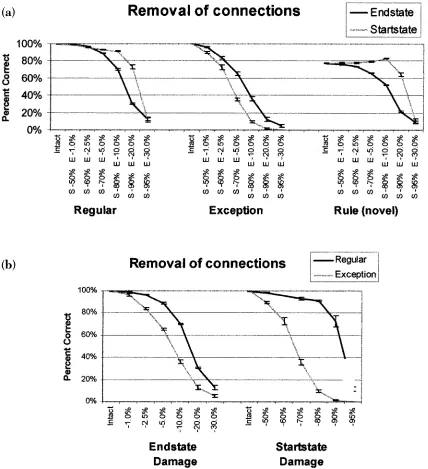
respec-tively. Figure 2a shows the effect of lesioning weights be-fore training (“startstate” damage) and after training (“end-state” damage). For each pattern type, Figure 2 shows the relative performance of the startstate and endstate condi-tions for increasing levels of damage.
The results here indicate a similar pattern of impairment for both startstate and endstate damage on regular and ex-ception verbs. Figure 2b demonstrates that in both cases, exception patterns suffer a greater impairment than regu-lar patterns, echoing the surface dyslexia simulations. For novel items, startstate lesioning initially improves generali-sation of the rule, whereas endstate lesioning is only dele-terious. At higher levels of startstate lesioning, however, generalisation declines here, also. There are two major points to note from this simulation. First, very much greater damage is required in the startstate than in the endstate to produce an equivalent amount of behavioural impairment. Therefore a lesion of 2.5% of network connections in the endstate reduces performance on regular patterns to ap-proximately 90%, whereas a lesion of 80% of the connec-tions in the startstate is required to produce an equivalent deficit. Despite the fact that the same damage produces a similar behavioural impairment here, the training process creates a huge difference in sensitivity to damage between the startstate and endstate conditions. This is because the trained network is losing connections that have already stored specific knowledge, whereas the untrained network is reduced in its potential to learn and uses the remaining potential to acquire the domain as best it can.
The second finding is that the relationship among regu-lar, exception, and rule performance in the startstate and endstate differs. For example, for a given level of perfor-mance on regular patterns in the damaged networks, the startstate network will show lower exception performance and higher generalisation performance. Despite broadly equivalent behavioural impairments, in detail the patterns of deficit are different in the acquired and developmental case.
Figure 3 illustrates the effect of adding noise to activa-tion levels within the network, either once training is com-plete or throughout training. The results once more show a differential pattern of sensitivity, but now in the reverse di-rection to the lesioning condition. The network is much more sensitive to noise occurring in the startstate than it is to noise occurring in the endstate. In the endstate, the net-work has established its knowledge and, as a result of the nonlinear processing units, is able to tolerate noise in pro-cessing. As a result, performance has not yet reached floor when noise is added with a standard deviation (SD) of .7. However, when damage occurs in the startstate, the net-work is never provided with a reliable rendition of the knowledge it must learn. When noise is added with an SD of as little as .2, no learning is possible at all. Although the acquired and developmental phonological dyslexia models of Harm and Seidenberg (1999; 2001) are not directly com-parable to each other, it is interesting to note that the ac-quired impairment was simulated by the addition of noise an order of magnitude greater than that used to simulate the developmental impairment, in line with the current findings. And a similar indirect comparison of Joanisse’s (2000) model of SLI and Joanisse and Seidenberg’s (1999) model of aphasia in the past tense domain indicates a com-parable requirement for greater noise in the endstate than the startstate to produce an equivalent level of deficit. Output
e netinput Temperature
=
+ −
1
Noise added to the endstate led to a roughly uniform decrement across regular, exception, and novel patterns (e.g., from SD levels of .3 onwards). However, noise added to the startstate led to greater impairments to exception patterns than regular patterns. As an indication of this ef-fect, when regular pattern performance was roughly com-parable in the two conditions (startstate 90% with SD 5 .075, endstate 87% with SD 5.25), exception patterns had fallen to 69% in the startstate against 79% in the endstate. The similarity of the mapping between regular patterns as well as their majority in the training set allows them to bet-ter overcome the addition of noise in training than the unique and minority exception patterns. In contrast, the ability of the network to deal with noise in the trained state
depends on the nonlinear functions within the hidden units – units that, broadly speaking, are shared by all patterns. Based on the relation of these different components of per-formance, once more one must conclude that the detailed pattern of impairments in the acquired and developmental cases was different.
In sum, the addition of noise could produce effects that were uniform and global in effect (across regulars, excep-tions, and generalisation), as in the endstate, or that were differential,as in the startstate; but, most clearly, effects were much stronger when the damage occurred in the startstatethan when it occurred in the endstate.
Figure 4 shows the effect of changing the discriminabil-ity of the processing units within the network. Reduced
dis-Figure 2. (a) The effect of removing connections from the network either prior to (startstate) or following (endstate) the training process for regular, exception, and novel patterns. The x-axis plots increasing levels of damage, with much greater startstate damage (S) required to produced an equivalent impairment than endstate (E). (b) Direct comparison of impairments on regular and exception patterns fol-lowing startstate and endstate damage.