International Journal of Emerging Technology and Advanced Engineering
Website: www.ijetae.com (ISSN 2250-2459, UGC Approved List of Recommended Journal, Volume 8, Issue 3, March 2018)231
IOT Based Automatic Garbage Tracking and Collection System
Shafee Vunnisa Sayyad 1
,
Pramodkuma2,
L.Srivnai3 , K, Shailaja41Associate Professor, 2,3,4Students, SNIST, Hyderabad, India.
Abstract—. The traditional way of collecting the garbage is so tedious, causes diseases effect human and environment etc..so we come up with solution for this by IOT based garbage collection system. Here we are tackling the issue for waste management and the first step towards it should be proper collection of waste. And as this problem continues to increase day by day, we need to develop more efficient management methods and techniques. Thus we are proposing iot based an automated garbage collection system
In this system a path is placed where the bot follows the path called line tracker and collects the garbage from door to door and sends a message to the municipal people. Officer in the main office continuously monitor the main garbage bin in the webpage from time to time and observe the level of garbage(data). This data can be analyses for the purpose of how much amount of garbage being produced from each area. the area producing more garbage will be taken more and hence this project can be used for SWACHH BHARAT MISSION.
I.
INTRODUCTION
The automatic garbage tracking and collection system consists of a line tracker in which the bot follows the line path. In this project we set a time for alarm. The bot goes to door to door in an apartment when it reaches the first door it gives a alarm and then open its top plate, the garbage is poured into the bin. Similarly the bot goes to at least five doors and collect the garbage from them. After collecting the garbage it then goes through the path followed by the line tracker to the main garbage system in an apartment. Now according to the detection of the garbage level a message is sent to main garbage system indicating the garbage is full. A continuous message is
sent until unless the people from GHMC comes and collect the garbage.
The traditional way of collecting the garbage is so tedious, causes diseases effect human and environment etc..so we come up with solution for this by IOT based garbage collection system. In this project we do mainly three things.
1. Making an autonomous robot.
2. Making a smart bin.
3. Creating a webpage.
Here for developing this system we are using Nodemcu which is a combination of wifi and arduino and two IR obstacle sensors one sensor is used to detect the status that is the level of the garbage in bin and other sensor is used to send a sms to the main office.
The system over all helps us to maintain the cleanliness, of the environment with the help of automation garbage tracking and collecting system. This is an IOT based project.
II. HARDWARE&SOFTWAREDESCRIPTION
A. ARDUINOIDE
International Journal of Emerging Technology and Advanced Engineering
Website: www.ijetae.com (ISSN 2250-2459, UGC Approved List of Recommended Journal, Volume 8, Issue 3, March 2018)232
B. NODEMCU
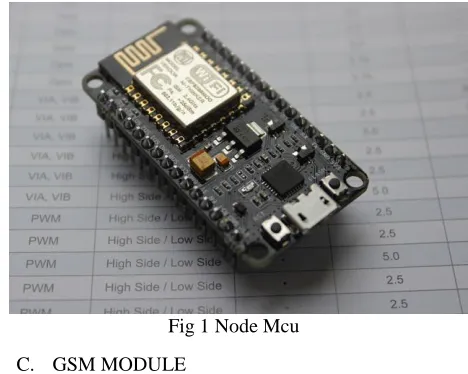
Nodemcu is an open source iot platform which is used to develop iot based projects. It was created shortly after the ESP8266 and able to support MQTT protocol. Purpose of nodemcu in this project is to read the data from the sensor and process it. After processing it send processed data to thinspeak.com. it has 12 general purpose i/o pins and one analog pins(A0). It operates on 3.3v dc. We have used analog pin connected to data pin of ir sensor.
Program for arduino may be written in any programming languages for compiler that produces binary machine code for the target processor. A program written with ide is called sketch and saved on the development computer as text file with extension .
Fig 1 Node Mcu
C. GSM MODULE
GSM is globally accepted standard for digital communication. It uses narrowband time division multiple access for providing text and voice based services over mobile phone networks. It is a circuit switched system that divides each 200khz channel into 25khz time slots. It is most widely accepted standard in telecommunication and it is implemented globally. It was developed using digital technology. It has ability to carry to 64kbps to 12kbps of data rates. Presently gsm supports more than 1 billion mobile subscribers in more than 210 contries throughout the world. It digitize and cmpress data send down through the a channel with two other streams of user data each in its own time slots.
D.IR SENSOR
It is device consist of an infrared transmitter and infrared detector and circuitry. It only require three connection. When it detects obstacle within the range it will send output low. Infrared radiation is electromagnetic radiation with large wavelength than those of visible light and therefore invisible. Infrared radiation is emitted by molecules when they change their vibration rotational movements. It excites a vibration modal in molecule through a charge in a model movement making it is useful frequency range for study of their energy states for molecular of the proper symmetry.
SOFTWARE DESCRIPTION
D. TUNIOT
[image:2.612.58.292.348.535.2]Tuniot is a block code generator for NODMCU. For the iot based application developments. It does not need any programming skills to program
International Journal of Emerging Technology and Advanced Engineering
Website: www.ijetae.com (ISSN 2250-2459, UGC Approved List of Recommended Journal, Volume 8, Issue 3, March 2018)233
III. IMPLEMENTATION
The iot based garbage collecting system is very innovative system which is useful for “SWACHH BHARATH MISSION" and keep the cities clean. In this project there is a automated garbage collector vehicle which comes to every house and make buzzer sounds alerting people to through their garbage in the bin. AGC vehicle can be implemented using a line follower technique which means a separate path is to be made for the AGC vehicle. It moves along the path in the society and collect the garbage. This AGC vehicle consist of arduino, IR sensor, buzzer, and garbage bin placed over it. It is programmed in such a way that whenever it find white surface it give buzzer sound and garbage bin will be open for certain time and people through their garbage and bin automatically get closed and moved to next house.
The traditional way of collecting the garbage is so tedious, causes diseases effect human and environment etc..so we come up with solution for this by IOT based garbage collection system. In this project we do mainly three things.
Making an autonomous robot.
Making a smart bin.
Creating a webpage.
In the first part we would be making a autonomous robot which comes to our house or in the apartment door to door and collect the garbage. It consists of a Arduino uno, IR sensor for detection of path, a buzzer for alaram when robot come in front of house. Arduino can be programmed using Arduino ide .
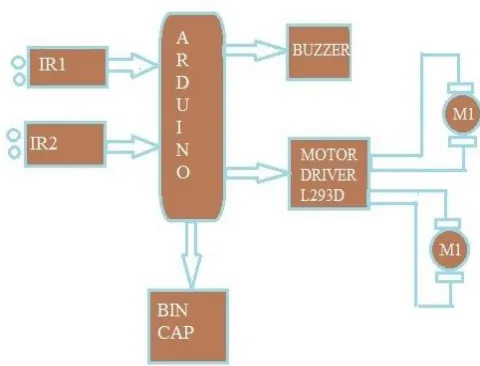
Second part of the project is making a smart bin. When smart bin get filled it will automatically intimate the ghmc people by texting a message “garbage is full” so the ghmc term will come and collect the garbage. Smart bin consists of Arduino uno, NodeMcu, GSM module and two IRsensors. GSM module is used for texting a message when it gets a command from Arduino through serial communication port. It works on At commands when Arduino reads the sensor value. It executes the instruction accordingly and give text message to ghmc department through GSM module. Other IR sensor in smart bin takes the data from smart din and gives to NodeMcu . According that program wil be executed in NodeMcu and this data is uploaded to webpage.
Third part of this project would be creating a webpage. For creating a webpage we are using a thing speak cloud. NodeMcu communicate with webpage through HTTP protocol, in the webpage level of garbage is displayed from time to time. Officers in the GHMC office will analaze the data and area producing garbage can be taken care more. According to analysis the area producing more garbage can be taken car1e more. Thus this project can help the SWACHH BHARAT MISSION and keep the cities clean. It can be implemented in school. Hospital, public place, organization etc..
[image:3.612.318.558.494.677.2]BLOCKdiagram
International Journal of Emerging Technology and Advanced Engineering
Website: www.ijetae.com (ISSN 2250-2459, UGC Approved List of Recommended Journal, Volume 8, Issue 3, March 2018)234
[image:4.612.67.580.146.583.2]Block diagram
Fig 5.block diagram smart bin
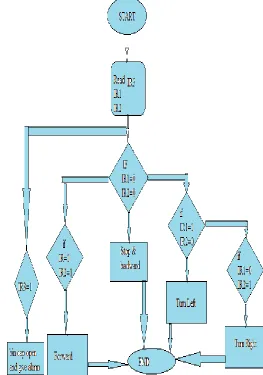
Flowchart
[image:4.612.311.574.155.530.2]International Journal of Emerging Technology and Advanced Engineering
Website: www.ijetae.com (ISSN 2250-2459, UGC Approved List of Recommended Journal, Volume 8, Issue 3, March 2018)235
flowchart
Fig 6. Algoritham for smart bin
[image:5.612.62.284.488.635.2]IV.PROJECT OUTPUTUT
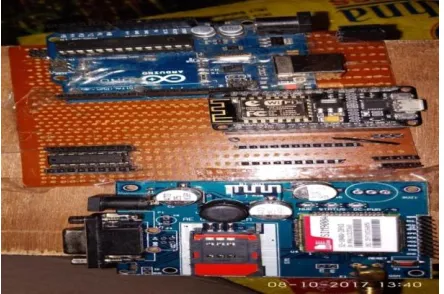
Fig 7.Circuit Schematic
Fig 8. line tracker
webpage
Fig 9.garbage level in webpage
Above diagram is the circuit schematic of smart bin. The line tracker following the path and coming to collect the garbage door to door is shown in the figure. The garbage value which is to be stored in webpage is shown in fig. In the above graph x-axis is the garbage level of an area and y – axis is the time. X-axis has three level 0, 50 and 100. When we place garbage in smart bin the level of garbage is increases. When garbage reaches to 90% of its maximum value it text message showing garbage is full in this areas and alerting municipal authority to collect the garbage and they come and collect the garbage. So in this way area producing more garbage in less time will be more polluted hence this particular area can be taken more. Thus it help in SWACHH BHARAT MISSION
International Journal of Emerging Technology and Advanced Engineering
Website: www.ijetae.com (ISSN 2250-2459, UGC Approved List of Recommended Journal, Volume 8, Issue 3, March 2018)236
REFERENCES
[1] Prof R.M.Sahu, Akshay Godase,Reshma Shinde, “Garbage and
Street Light Monitoring System Using Internet of Things”
International Journal Of Innovative Research In Electrical,
Electronics, Instrumentation And Control Engineering, ISSN
(Online) – 2004, Vol. 4, Issue 4, April 2016.
[2] Kanchan Mahajan, Prof.J.S.Chitode,“Waste Bin Monitoring System Using Integrated Technologies”, International Journal of Innovative Research in Science, Engineering and Technology (An ISO 3297: 2007 Certified Organization) Vol. 3, Issue 7, July 2014.
[3] Parkash, Prabu ,pramod shinde, IoT Based Waste Management for Smart City, International Journal of Innovative Research in Computer and Communication Engineering 4(2) (2016).
[4] Sandeep M. Chaware, Shriram Dighe, Akshay Joshi, Namrata Bajare, Rohini Korke, Smart Garbage Monitoring System using Internet of Things (IOT), International Journal of Innovative Research in Electrical, Electronics, Instrumentation and Control Engineering 5(1) (2017)
[5] Gaikwad Prajakta,narsis starbell, Jadhav Kalyani, Machale Snehal ,‖ SMART GARBAGE COLLECTION SYSTEM IN RESIDENTIAL AREA‖, IJRET: International Journal of Research in Engineering and Technology eISSN: 2319- 1163 ISSN: 2321-7308.
[6] KanchanMahajan, “garbage Monitoring System Using Integrated Technologies”, International Journal of Innovative Research in Science, Engineering and Technology, Issue 3 ,Issue 7 , July 2014.
[7] Arkady Zaslavsky, Dimi” Internet of Things: Challenges and State-of-the-art solutions in Internet-scale Sensor Information Management and Mobile Analytics” 2015 16th IEEE International Conference on Mobile Data Managemen
[8] k.mugesh Kumar, p.saisharan, “SMART bin”, International Journal of Industrial Electronics and Electrical Engineering, ISSN: 2347-6982 Volume-3, Issue-5, May2015.
[8] R Narciss Starbell, “Energy Efficient Intelligent Street Lighting System Using ZIGBEE and Sensors”, International Journal of Engineering and Advanced Technology (IJEAT) ISSN: 2249 – 8958, Volume-3, Issue-4, April 2014.
[9] Narendra Kumar G., Chandrika Swami, and KN. Nagadarshini, “Efficient Garbage Disposal Management in Metropolitan”, Cities Using VANETs Journal of Clean Energy Technologies, Vol. 2, No. 3, July 2014.
[10] Emily Gertz, Patrick Di Justo,”Environmental Monitoringwith Arduino”Copyright © 2012 Emily Gertz and Patrick Di Justo. All rights reserved. Printed in the United States of America,ISBN: 978- 1-449-3
www.easycoding.tn/tuniot/demos/code/
https://en.wikipedia.org/wiki/ThingSpeak.
https://www.arduino.cc
https://www.elprocus.com/infrared-ir-sensor-circuit-and-working
https://en.wikipedia.org/wiki/NodeMCU