2014. Vol.5, No.2, 127-133
Published Online February 2014 in SciRes (http://www.scirp.org/journal/psych) http://dx.doi.org/10.4236/psych.2014.52020
From Marbles to Numbers—Estimation Influences Looking
Patterns on Arithmetic Problems
Claudia Godau
*, Maria Wirth, Sonja Hansen, Hilde Haider, Robert Gaschler
Department of Psychology, Humboldt Universität zu Berlin, Berlin, GermanyEmail: *[email protected]
Received December 19th, 2013; revised January 18th, 2014; accepted February 16th, 2014
Copyright © 2014 Claudia Godau et al. This is an open access article distributed under the Creative Commons Attribution License, which permits unrestricted use, distribution, and reproduction in any medium, provided the original work is properly cited. In accordance of the Creative Commons Attribution License all Copyrights © 2014 are reserved for SCIRP and the owner of the intellectual property Claudia Godau et al. All Copyright © 2014 are guarded by law and by SCIRP as a guardian.
Flexibly spotting and applying shortcut options in arithmetic is often a major challenge for children as well as adults. Recent work has suggests that children benefit in terms of such flexibility from tasks re-quiring estimation or other operations with quantities that they cannot easily enumerate. Such tasks often require comparison of quantities by fixation and as such necessitate long-range eye movements, e.g. across the whole screen. We tested whether fixation patterns account for transfer from estimation to arithmetic tasks. Conceivably, participants who first solve estimation tasks are more flexible in spotting and applying shortcuts on later arithmetic tasks, because they stick to scanning the screen with long-range eye movements (which were necessary for solving the estimation task). To test this account, we mani- pulated the location of the marbles in an estimation task so that one group of participants had to make long-range eye movement, whereas another group did not need long-range eye movements to solve the task. Afterwards participants of both groups solved addition problems that contained a shortcut option based on the commutativity principle. We tested whether shortcut usage and fixation patterns in the arith- metic problems were influenced by the variant of the estimation task provided beforehand. The experi- ment allowed us to explore whether flexibility in spotting and using arithmetic shortcuts can be fostered by applying a prior task that induces flexible looking patterns. The results suggest that estimation tasks can indeed influence fixation patterns in a later arithmetic task. While shortcut search and application is reflected in fixation patterns, we did not obtain evidence for the reverse influence. Changed fixation pat-terns did not lead to higher shortcut usage. Thus, the results are in line with top-down accounts of strategy change: fixation patterns reflect rather than elicit strategy change.
Keywords: Mental Arithmetic; Estimation; Fixation Pattern; Transfer; Commutativity Principle
Introduction
For some elementary school children, arithmetic seems to be a tremendous challenge while for others it’s a child’s play. For all children it includes the discovery and use of general as well as abstract principles, which allow them to solve (apparently) hard problems easily and fast. Unfortunately the connection between understanding, identifying and applying shortcut op- tions is at best moderate. Many researchers found large interin- dividual variability in the children’s solution times and their use of shortcut strategies. For example, Dubé and Robinson (2010) found that 1/4 of the children did not use any shortcut at all. Robinson and Dubé (2012) later argued that children have dif- ferent attitudes toward accepting strategies that are highly effi- cient but novel. For instance, from grade three onwards com- mutativity-based shortcuts are used spontaneously (Gaschler, Vaterrodt, Frensch, Eichler, & Haider, 2013). Children used a shortcut when subsequent addition problems contained the same addends in different order (e.g., 6 + 2 + 3 = ? followed by 2 + 6 + 3 = ?). Furthermore, spontaneous application of two
different commutativity-based shortcuts correlated positively. However, while it could be documented that commutativity- based shortcuts were used spontaneously, the rate of usage was rather low. Apart from difficulties in spontaneously using shortcuts, past research has documented overgeneralization (e.g. Siegler & Stern, 1998). Once children started to use one short- cut, some tended to apply it irrespective of whether the under- lying mathematical principle was applicable to the current arithmetic problem or not. This research showed that during elementary school the flexible use of shortcut strategies is not very balanced yet.
One potential way to foster adaptive flexibility in strategy usage (Verschaffel, Luwel, Torbeyns, & Dooren, 2009) might be to employ estimation tasks. By this, the mathematical prin- ciples and the corresponding shortcuts might be conveyed at early age. This might provide a head start for tackling the re- spective shortcuts in mental arithmetic. Several studies on com- mutativity have shown that children have at least some under- standing of the concept of commutativity before entering school (Canobi, Reeve, & Pattison, 2003; Cowan & Renton, 1996; Resnick, 1992; Wilkins, Baroody, & Tiilikainen, 2001). Fur-
thermore, there is evidence for that toddlers develop an infor- mal understanding of relations between objects in the real world before entering school (Baroody & Gannon, 1984; Ba- roody, Ginsburg, & Waxman, 1983; Canobi, Reeve, & Pattison, 2002; Gallistel & Gelman, 1992; Gilmore, McCarthy, & Spelke, 2010; Resnick, 1992; Siegler & Jenkins, 1989; Sophian, Harley, & Martin, 1995). This idea is based on Resnick’s (1992) model of mathematical thinking, in which on the first level, the level of protoquantities, mathematical thinking is strictly object- bound.
Moreover, Sherman & Bisanz (2009) showed that working with non-symbolic material can encourage subsequent strategy use in symbolic equivalence problems. In this context, research hints at that estimation might positively influence exact calcu- lation. Gilmore, McCarthy and Spelke (2007) found that even preschoolers were able to solve symbolic problems as long as they were instructed to just estimate the results, rather than to calculate the exact result. Along these lines, Hansen and col- leagues (submitted) tested whether children would profit from an estimation task involving commutative arithmetic problems on later arithmetic problems. They confirmed the assumption that symbolic estimation increased the spontaneous spotting and applying of commutativity-based shortcuts in a later arith- metic task. Surprisingly, the positive effect seemed to be con- fined to actual usage of commutativity-based shortcuts (proce- dural knowledge). In a task measuring conceptual understand- ing of the commutativity principle, children showed liberaliza- tion in the response criterion rather than improved or main- tained performance when before confronted with a commuta- tivity-based estimation task.
Apparently, symbolic as well as non-symbolic estimation tasks support the use of commutativity-based shortcuts—but not by activating conceptual knowledge of the mathematical principle. This suggests to explore potential ways of transfer between the task formats that side-track conceptual knowledge. One potential account for the incoherent transfer results re- ported by Hansen et al. (submitted) and Sherman and Bisanz (2009) might be a transfer of eye movement patterns. Partici- pants might profit from the estimation task in spotting and ap- plying shortcuts in later arithmetic problems, because (a) long- range eye movements are helpful in both contexts and are (b) transferred from the estimation task to the arithmetic task. Spe- cifically, short cut strategies that entail comparing addends across subsequent addition problems should necessitate un- usually long eye movements. Potentially, such looking patterns —triggered by an estimation task—would still be present when later faced with an addition task and raise the chance that a child spots and applies the shortcut.
Our hypothesis was that a variant of an estimation task that requires long-range eye movements, would lead to a larger amount of shortcut usage in a later arithmetic task (as compared to an estimation task not requiring long-range eye movements). To test this hypothesis, we actively manipulated the eye move- ments in order to investigate the influence of long-range eye movements on the detection and application of possible short- cuts. Eye movement patterns can influence spatial reasoning by means of an implicit eye-movement-to-cognition link. For in- stance, Thomas and Lleras (2007) showed an implicit compati- bility between spatial cognition and the eye movement. How- ever, until now the influence of eye movement patterns (i.e., those triggered by an estimation task) on arithmetic problems presented later on has been neglected. Therefore, we contrasted
(a) one experimental condition starting with an estimation task necessitating long-range eye movements (scattered group) with (b) another group of primary school children starting with an estimation task without such demands (centered group). As dependent measure we tested the extent to which children saved calculation effort by a commutativity-based shortcut in a mental arithmetic task presented afterwards. Comparing addends in subsequent arithmetic problems, one could avoid calculation on problems that presented the same addends as the predecessor problem (e.g., 6 + 2 + 3 = ? followed by 2 + 6 + 3 = ?), this shortcut we called addends compare strategy.
Method
Participants
Thirty-four elementary school children (16 females and 18 males) with an age range between 6 and 11 years took part in the experiment. The mean age of the children in the scattered group was 8.78 years (SD = .92), and in the centered group 8.47 years (SD = 1.02). The children attended second to fifth grade of various Berlin elementary schools, most of them in the fourth grade (50%). The children were randomly assigned to either the scattered group (18 children) or the centered group (16 children).
Materials
The experiment comprised two parts. In the first part, the children were presented with an estimation task that differed between the groups (scattered/centered). In the second part, both groups were presented with an arithmetic task. All materi- al was computerized.
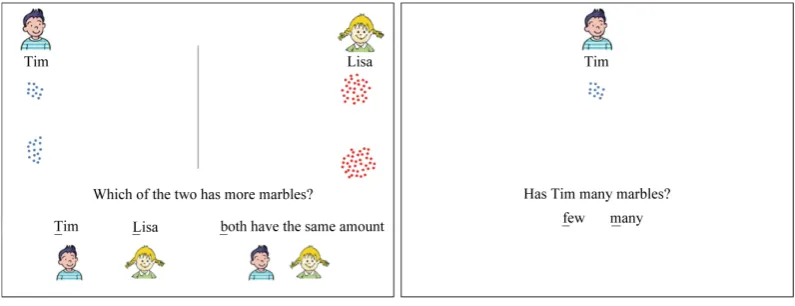
For the estimation task four sets of eight estimation problems were designed, depicting different quantities of marbles. The two sets for the centered group consisted of one quantity of marbles, which belonged to one fictional character (either “Tim” or “Lisa”). In order to provoke a small spatial range and low number of saccades in the centered group, the quantity of mar- bles was presented centrally. Children were asked to estimate if the character owned few or many marbles (see Figure 1). The two sets for the scattered group included two different quanti- ties of marbles of which one belonged either to “Tim” or “Lisa”. To trigger a larger spatial range and higher number of saccades (compared to the centered group), the quantities of marbles were presented at right and left edge of the presentation frame. The children had to indicate which of the characters owned more marbles or if both own the same amount of marbles.
Figure 1.
Example of the estimation task for the scattered group (left) and the centered group (right).
Procedure
Each child was tested individually in the laboratory of the Department of General Psychology at Humboldt-University, Berlin. The children were seated in front of a 22 inch TFT computer monitor, which was equipped with the SMI RED stationary eye tracking system recording at 250 Hz. Children were asked to find a comfortable position (about 60 cm from the screen) and reminded to sit as still as possible. After five- point calibration, they received the instruction of the estimation task, which introduced them to fictional characters “Tim” and “Lisa” as owners of different quantities of marbles. They were then presented with an example problem. The children were reminded that the task did not require counting but only estima- tion and that they should answer as fast and as correct as possi- ble.
In the estimation task, eight different estimation problems were presented consecutively. In a between subject design we wanted to manipulate the range and the number of the saccades during the estimation task to investigate the influence on dis- covering and using the commutativity shortcut strategy on later addition problems. For the centered group the marble quantities were presented centrally and the child had to decide if the pic- tured character had few or many marbles. For the scattered group the marble quantities were presented on the right and left edges of the screen and the child had to decide if one of the pictured characters had more marbles or if both had the same amount. After presenting each estimation problem for two seconds, the screen went blank. The time limit ensured that children had to rely on estimation. The experimenter entered the verbal answer of the child and started the next trial of the estimation task.
After completing the estimation task, the children calculated simple addition problems (arithmetic task). The children were instructed to work through the problems (six per screen) in strict order from top to bottom and not to leave out any. The experimenter entered the given answers so it was directly visi- ble and remained visible when working on subsequent prob- lems. After completing the first six problems, the experimenter started the second and last screen presenting the next six prob- lems. Overall the procedure took about 10 minutes.
Results
The aim was to evaluate whether different eye movement
patterns induced by different estimation tasks (scattered and centered) lead to different eye movement patterns and/or in- creased use of the addends-compare strategy in the arithmetic task.
Eye Movement Data
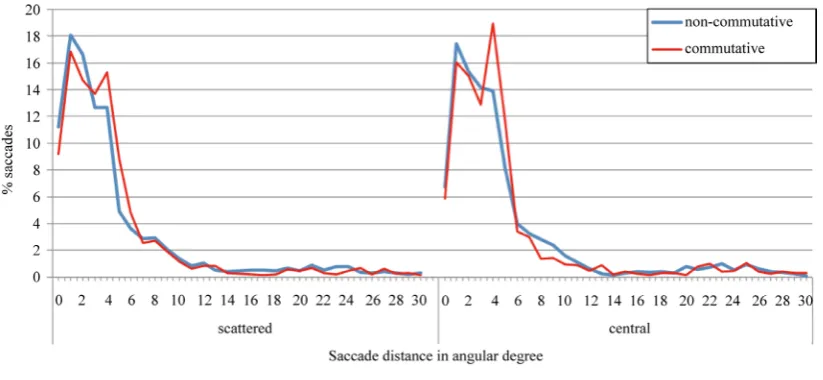
The eyetracking data of one child were not recorded cor- rectly so we present the data of 33 children. In the analysis of the eye movements we focused on saccade distances, which were computed as Euclidean distance in angular degree. The saccade distances from commutative problems were compared to all other (non-commutative) addition problems. Figure 2 depicts a bimodal distribution of saccade distances for the cen- tered and scattered group. The bimodal character seemed more pronounced for commutative problems and especially so for the centered group.
For a more detailed analysis, we differentiated between hori- zontal and vertical saccades. To test if the two groups (scattered and centered group) differ in the saccade distances in the arith- metic task, we conducted ANOVAs for horizontal and vertical saccades separately. The results showed a significant difference between both groups for the horizontal saccade distances in the commutative problems, F(1, 31) = 13.57, p = .001. Surprisingly, the horizontal saccade distance for commutative problems was lower for the scattered as compared to the centered group (see Table 1). There were neither differences for the horizontal saccade distances for the non-commutative problems, F(1, 31) = 1.33, p = .26, nor between-group differences for the vertical saccade distances for non-commutative problems, F(1, 31) = .65, p = .43, and the commutative problems, F(1, 31) = .780, p = .38.
Figure 2.
[image:4.595.54.540.338.409.2]Distribution in percent of saccade distances in angular degree for commutative and non-commutative problems for scattered group (left) and centered group (right).
Table 1.
Mean saccade distance horizontal and vertical for commutative and non-commutative problems analysed for condition.
Condition Saccade distance horizontal Saccade distance vertical
Non-commutative problems Commutative problems Non-commutative problems Commutative problems
Scattered 4.38 4.11 2.28 2.24
Centered 4.24 4.41 2.32 2.3
Total 4.31 4.24 2.30 2.27
and non-commutative problems. Furthermore, this impact was different for horizontal and vertical saccade distances, because the 2-fold interaction was significant, too, F(1, 31) = 15.28, p < .001; ηp2 = .330. We did not obtain a main effect for condi- tion, F < 1. In conclusion we manipulated the eye-movement in the estimation task (scattered and centered) and found different eyemovement patterns in the arithmetic task presented after- wards. For conclusions concerning the strategy use we present now the results of the solving times in the arithmetic task.
Solving Times
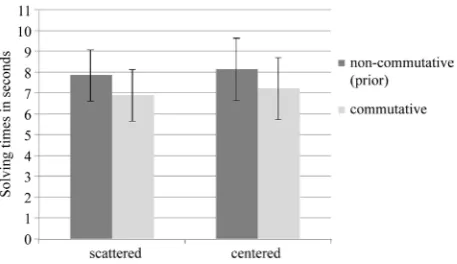
The solving time comprises the time between responding to one arithmetic problem and the time of the key press of the experimenter entering the verbalized answer to the subsequent problem (first key in entering the child’s answer). Figure 3 suggests that children in both experimental conditions bene- fitted from the addends-compare strategy. In line with exploit- ing the commutativity principle, children were faster when faced with the same addends in altered order for a second time on subsequent addition problems. The prior problem needed to be calculated conventionally, whereas the second problem of the commutativity pair consisted of the same addends in a dif- ferent order. Supposed a child first calculated 6 + 3 + 2 and then 6 + 2 + 3 it would not need to calculate when confronted with the second problem—if it used the addends compare strategy. Across experimental conditions, a pairwise compari- son of these two problems showed a significant benefit in solv- ing times for commutative compared to their preceding non- commutative problems t(32) = 3.37, p = .01. Note that mean
solving times of the filler problems were higher, 9.82 sec for the scattered group and 10.04 sec for the centered group. The comparison we focused on can thus be regarded as a conserva- tive estimate of the usage of the addends compare strategy.
To test the difference between the scattered group and the centered group in solving times, we conducted a 2 (commuta- tivity: commutative vs. non-commutative problems) × 2 (con- dition: scattered vs. centered group) ANOVA. As suggested by Figure 3, we obtained a significant main effect of commutativ- ity, F(1, 31) = 10.74, p = .01, ηp2 = .26, but no effect of condi- tion and no interaction effect of commutativity and condition (Fs < 1). The error rate for the twelve arithmetic problems was 10.2% and individual number of errors ranged from 0 to 6 (mean = 1.18; SD = 1.29). Note that children of different age seemed to profit to a similar extent from the addends compare strategy. We obtained no correlation between age and the bene- fit in solving times on commutative as compared to non-com- mutative problems.
Discussion
Figure 3.
The mean solving times in seconds per arithmetic problem for non- commutative (prior) problems (dark grey) in comparison to the com- mutative problems (light grey) for the scattered and the centered group. The error bar displays the 95% confidence interval of the comparison with each other.
commutativity-based shortcuts in mental arithmetic. While we did find an effect of estimation task variant on eye movement patterns in the arithmetic task, we did not obtain any effect on shortcut usage. Children of both experimental groups profited from the commutative addition problems to the same extent.
Surprisingly, the effect of condition on eye movements in the arithmetic task was opposite to our expectations. At present we can only state that we did see an effect of the estimation task on eye movements in a later calculation task and speculate about the reasons for its unexpected direction. The estimation tasks in the scattered and centered group were designed to elicit long- range eye movements to a different extent. To minimize these saccades in the centered group we presented only one character (Tim/Lisa) centrally and slightly changed the question to, whether Tim/Lisa has many or few marbles. In comparison, the scattered group was asked in the estimation task whether Tim or Lisa has more marbles. Both tasks required some form of estimation, but the children in the centered group had to com- pare the centrally depicted marbles with their own concept of few or many. To the scattered group, however, the comparison array was presented simultaneously on the other side of the computer screen. Presumably, in the centred group one addi- tional step of processing was needed (i.e., “What do I consider as few ore many marbles?”). Accordingly, one limitation of the current research is that the two variants of the estimation task not only differed considerably in the type of saccades de- manded, but also in other cognitive processes involved in gen- erating an answer. The requirements in the centered condition might have supported flexibility in thinking in this group, be- cause the criterion to decide between few and many can adap- tively change between the problems (e.g. in one problem a child might consider 8 marbles as many, but after seeing 20 marbles, 8 seem to be only a few). Presumably, such demanding com- parisons might lead to more comparisons between numbers on the screen once the addition problems are being presented. This in turn, might be the reason for the centred group executing longer saccades. Yet, these differences in fixation patterns did not lead to differences in spotting and applying shortcut options. This is coherent with models emphasizing the role of top-down decisions on strategy change in skill acquisition. For instance, Haider and Frensch (1999) suggested that changes in fixation patterns in a skill acquisition task involving a shift towards a more efficient strategy reflect the voluntary decision to change
the strategy. Changes in fixation patterns might often reflect rather than cause changes in processing strategy. This is in line with the concept of adaptive expertise (Verschaffel et al., 2009), according to which learners need to autonomously regulate whether (a) to solve an arithmetic problem in a standard way or to (b) search for/apply a shortcut.
Past work (e.g. Gaschler et al., 2013; Godau et al., submitted) showed that flexible strategy use is mirrored in fixation patterns and that different commutativity-based shortcuts are mirrored in different fixation patterns. For the use of the addends-com- pare strategy, the eye movement pattern showed that the child- ren looked back to the preceding problem featuring the same addends in different order. While using a shortcut strategy is reflected in the corresponding fixation patterns, influencing fixation patterns does not necessarily lead to changes in arith- metic strategies. Future studies might test more direct ways to trigger flexibility in calculation strategies by inducing flexibili- ty in fixation patterns. Visual cues can help the learner attend to and notice relevant information in the problem, which they previously may have ignored (Madsen, Rouinfar, Larson, Los- chky, & Rebello, 2013). In their study, Madsen and colleagues (2013) found that inducing participants to look at helpful areas in physics problems and to ignore distracting areas when no visual cues are present is possibly a first step to support them to reason correctly about the problem. They also found transfer effects in that students could successfully answer and reason about related but different problems without cues (Madsen et al., 2013). Guiding attention to areas with regard to contents is one point; we, on the contrary, wanted to focus more on the eye movement as such, without special attention on content. For further investigations concerning a direct intervention to sup- port flexible strategy use, the eye movement pattern could also be manipulated in a calculation task. During solving the arith- metic problems, children who have more long distance sac- cades (e.g. by presenting distractors in changing corners of the screen) maybe recognize the shortcut strategy more often.
In summary, the current results suggest that estimation prob- lems can indeed influence fixation patterns in a later arithmetic task. While shortcut search and application is reflected in fixa- tion patterns, we did not obtain evidence for the reverse influ- ence. Changed fixation patterns did not lead to higher shortcut usage. Thus, the results are in line with top-down accounts of strategy change: fixation patterns reflect rather than elicit strat- egy change (cf. Haider & Frensch, 1999).
Author Note
The first two authors shared first authorship and contributed equally to this work. Claudia Godau, Humboldt-Universität zu Berlin, Germany; Maria Wirth, Universität Leipzig, Germany; Sonja Hansen and Hilde Haider, Universität zu Köln, Germany; Robert Gaschler, Universität Koblenz-Landau, Germany. This work was supported by Grant FR 1471/12-1 from the Deutsche Forschungsgemeinschaft (DFG, www.dfg.de/) as well as by the Berlin Cluster of Excellence Image Knowledge Gestaltung (www.interdisciplinary-laboratory.hu-berlin.de).
REFERENCES
[image:5.595.60.289.84.216.2]http://dx.doi.org/10.1207/s1532690xci0103_3
Baroody, A. J., Ginsburg, H. P., & Waxman, B. (1983). Children’s use of mathematical structure. Journal for Research in Mathematics
Education, 14, 156-168. http://dx.doi.org/10.2307/748379
Canobi, K. H., Reeve, R. A., & Pattison, P. E. (2002). Young children’s understanding of addition concepts. Educational Psychology, 22, 513- 532. http://dx.doi.org/10.1080/0144341022000023608
Canobi, K. H., Reeve, R. A., & Pattison, P. E. (2003). Patterns of knowl- edge in children’s addition. Developmental Psychology, 39, 521-534. http://dx.doi.org/10.1037/0012-1649.39.3.521
Cowan, R., & Renton, M. (1996). Do they know what they are doing? Children’s use of economical addition strategies and knowledge of commutativity. Educational Psychology, 16, 407-420.
http://dx.doi.org/10.1080/0144341960160405
Dubé, A. K., & Robinson, K. M. (2010). The relationship between adults’ conceptual understanding of inversion and associativity. Canadian Journal of Experimental Psychology/Revue Canadienne de Psy-
chologie Expérimentale, 64, 60-66.
http://dx.doi.org/10.1037/a0017756
Gallistel, C. R., & Gelman, R. (1992). Preverbal and verbal counting and computation. Cognition, 44, 43-74.
http://dx.doi.org/10.1016/0010-0277(92)90050-R
Gaschler, R., Vaterrodt, B., Frensch, P. A., Eichler, A., & Haider, H. (2013). Spontaneous usage of different shortcuts based on the com- mutativity principle. PLoS ONE, 8, Article ID: e74972.
http://dx.doi.org/10.1371/journal.pone.0074972
Gilmore, C. K., McCarthy, S. E., & Spelke, E. S. (2007). Symbolic arithmetic knowledge without instruction. Nature, 447, 589-591. http://dx.doi.org/10.1038/nature05850
Gilmore, C. K., McCarthy, S. E., & Spelke, E. S. (2010). Non-symbolic arithmetic abilities and achievement in the first year of formal schooling in mathematics. Cognition, 115, 394-406.
http://dx.doi.org/10.1016/j.cognition.2010.02.002
Godau, C., Haider, H., Hansen, S., Vaterrodt, B., Schubert, T., Frensch, P. A., & Gaschler, R. (2013). Increasing the usage of an arithmetic shortcut by offering an easy-to-find shortcut based on the same mathematical principle. Manuscript submitted for publication. Haider, H., & Frensch, P. A. (1999). Eye movement during skill acqui-
sition: More evidence for the information-reduction hypothesis. Journal of Experimental Psychology: Learning, Memory, and Cogni-
tion, 25, 172-190. http://dx.doi.org/10.1037/0278-7393.25.1.172
Hansen, S., Haider, H., Eichler, A., Gaschler, R., Godau, C., & Frensch, P. A. (2013). Fostering formal commutativity knowledge with ap- proximate arithmetic. Manuscript submitted for publication.
Madsen, A., Rouinfar, A., Larson, A. M., Loschky, L. C., & Rebello, N. S. (2013). Can short duration visual cues influence students’ reason- ing and eye movements in physics problems? Physical Review Spe-
cial Topics—Physics Education Research, 9, Article ID: 020104.
http://dx.doi.org/10.1103/PhysRevSTPER.9.020104
Obersteiner, A., Reiss, K., & Ufer, S. (2013). How training on exact or approximate mental representations of number can enhance first- grade students’ basic number processing and arithmetic skills. Learn- ing and Instruction, 23, 125-135.
http://dx.doi.org/10.1016/j.learninstruc.2012.08.004
Resnick, L. B. (1992). From protoquantities to operators: Building mathe- matical competence on a foundation of everyday knowledge. In G. Leinhardt, R. Putnam, & R. A. Hattrup (Eds.), Analysis of arithmetic
for mathematics teaching. Hillsdale, NJ: L. Erlbaum Associates.
Robinson, K. M., & Dubé, A. K. (2012). Children’s use of arithmetic shortcuts: The role of attitudes in strategy choice. Child Development
Research, 2012, 10. http://dx.doi.org/10.1155/2012/459385
Sherman, J., & Bisanz, J. (2009). Equivalence in symbolic and non- symbolic contexts: Benefits of solving problems with manipulatives.
Journal of Educational Psychology, 101, 88-100.
http://dx.doi.org/10.1037/a0013156
Siegler, R. S., & Jenkins, E. (1989). How children discover new stra- tegies (Vol. xiv). Hillsdale, NJ: Lawrence Erlbaum Associates, Inc. Siegler, R. S., & Stern, E. (1998). Conscious and unconscious strategy
discoveries: A microgenetic analysis. Journal of Experimental Psy-
chology: General, 127, 377-397.
http://dx.doi.org/10.1037/0096-3445.127.4.377
Sophian, C., Harley, H., & Martin, C. S. M. (1995). Relational and representational aspects of early number development. Cognition and Instruction, 13, 253-268.
http://dx.doi.org/10.1207/s1532690xci1302_4
Thomas, L. E., & Lleras, A. (2007). Moving eyes and moving thought: On the spatial compatibility between eye movements and cognition. Psychonomic Bulletin & Review, 14, 663-668.
http://dx.doi.org/10.3758/BF03196818
Verschaffel, L., Luwel, K., Torbeyns, J., & Dooren, W. V. (2009). Con- ceptualizing, investigating, and enhancing adaptive expertise in ele- mentary mathematics education. European Journal of Psychology of
Education, 24, 335-359. http://dx.doi.org/10.1007/BF03174765
Appendix
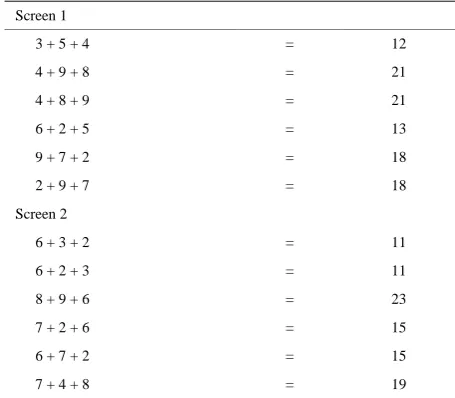
Table A1.
The 12 arithmetic problems (commutative and non-commutative prob- lems). The results printed in italics had to be calculated by the partici- pants.
Screen 1
3 + 5 + 4 = 12
4 + 9 + 8 = 21
4 + 8 + 9 = 21
6 + 2 + 5 = 13
9 + 7 + 2 = 18
2 + 9 + 7 = 18
Screen 2
6 + 3 + 2 = 11
6 + 2 + 3 = 11
8 + 9 + 6 = 23
7 + 2 + 6 = 15
6 + 7 + 2 = 15