Technology (IJRASET)
Model order reduction of SISO and MIMO systems
using particle swarm optimization
A.Santhosh Kumar1, B.Dasu2 1
PG student [C.S], EEE Department, 2Associate professor, EEE Department, Gudlavalleru Engg College, Gudlavalleru, AP, India
Abstract: - In this paper authors proposed model order reduction technique for a linear time invariant higher order using Particle swarm optimization (PSO) technique. PSO technique is a relatively recent heuristic search method whose working is inspired by the swarming or collaborative behavior of biological populations. PSO is employed for determining both the numerator and denominator coefficients of reduced order system by minimizing the Integral Square Error (ISE) between the transient responses of the original and reduced order models, pertaining to unit step input. The reduction procedure is simple, efficient and computer oriented. The proposed algorithm has been extended for the reduction of linear multivariable system also. The proposed method guarantees stability of the reduced order model, if the original high order system is stable. The algorithm is illustrated with the help of numerical examples to highlight the advantages of the approach and the results are compared with the other existing techniques by using the MATLAB/SIMULINK.
Keywords:- Model Order Reduction, Particle Swarm Optimization, Stability, Transfer Function, Integral Squared Error (ISE), SISO and MIMO system.
I. INTRODUCTION
The modeling of complex dynamic systems is one of the most significant subjects in engineering and Science. A model is often too problematical to be used in real life problems. So approximation procedures based on physical considerations or mathematical approaches are used to achieve simpler models than the original one. The subject of model order reduction is very imperative to engineers and scientists working in many fields of engineering, specially, for those who work in the process control area. In control engineering area, model reduction techniques are fundamental for the design of controllers where numerically complex procedures are complicated. This would provide the designer with low order controllers that may have less hardware requirements. Efforts towards obtaining low-order models from high-degree systems are associated to the aims of deriving stable reduced-order models from stable original ones and ensuring that the reduced-order model matches some quantities of the original one. The problem of reducing a high order system to its lower order system is calculated significant in examination, synthesis and simulation of practical systems. Bossley and Lees [1] and others have predictable a method of reduction based on the fitting of the time moments of the system and its reduced model, but these methods have a severe disadvantage that the reduced order model may be unbalanced even though the original high order system is stable. In order to overcome the stability trouble, Hutton and Friedland [2], Appiah [3] and
Chen et. al. [4] expected different methods, which are stability based reduction methods which were adopts several stability
criterion. The other approaches in this path include the methods such as Shamash [5] and Gutman et. al. [6]. These methods do not
create use of any stability criterion but always lead to give stable reduced order models for stable systems. Some collective methods
are also given for example Shamash [7], Chen et. al. [8] and Wan [9]. In these methods the denominator of the reduced order model
Technology (IJRASET)
biological populations. In PSO, a set of randomly generated solutions propagates in the design space towards the optimal solution over a number of iterations based on large quantity of information about the design space that is assimilated and shared by all members of the swarm. In the present work, the authors present error minimization by PSO for order reduction of Single and Multi variable linear dynamic systems. In this method both the reduced order numerator and denominator are determined by reducing the integral square error between the transient responses of original and reduced order systems using particle swarm optimization technique, pertaining to a unit step input. The evaluation between the projected and other well known existing order reduction techniques is also shown in the present effort. The organization of the paper is as follows: Section II, is the statement of the problem. In section III, Particle Swarm Optimization Algorithm with flow-chart is stated; section IV is designated for results and discussions, conclusions are given in section V.
II. STATEMENT OF THE PROBLEM A. MOR for SISO systems
Let the nth order system and its reduced model ( r < n ) be specified by the transfer functions:
( ) = ( )( )=∑
∑ (1)
Where N(S) is the numerator polynomial and D(S) is the denominator polynomial of the higher order system. And also , are
scalar constants of numerator and denominator polynomial correspondingly.
The plan is to find a reduced rth order reduced model R(s) such that it retains the significant properties of G(s) for the identical types of inputs with minimum integral square error.
( ) = ( )
( )= ∑
∑ (2)
Where ( ) is the numerator polynomial and ( ) is the denominator polynomial of the reduced orders system. And as well ,
are scalar constants of numerator and denominator polynomial correspondingly.
B. MOR for MIMO systems
Consider the subsequent nth order LTI system:
) ( ) ( ) (
) ( )
( )
(
. .
t u D t x C t y
t u t
x t
x
f f
f
f f
f
A
B
(3)
Where ∈ the state is vector, ∈ , and ∈ are the input and output vectors in that order. The matrices
, , are the full order system matrices with their suitable extent.
Let the Eigen values of the above full order system be given as:− < − < − < ⋯ … … … . .
Alternatively, consider the reduced order LTI system by means of order r:
) ( )
( )
(
) ( )
( )
(
. .
t u D t x C t y
t u t
x t
x
r r
r
r r
r
A
B
(4)
Where ∈ is the state vector, ∈ , and ∈ are the input and output vectors correspondingly. The matrices
, , are the full order system matrices with their proper extent. The Eigen values of the beyond reduced order system
are preferred to be the dominant Eigen values of the full order system given as:− < − < − < ⋯ … … … . .
C. Performance index
Technology (IJRASET)
to minimize the objective function E .which is integral square error between the transient response of original and reduced model is specified by [13]
ISE is frequently employed for the performance evaluation because of ease of achievement.
ISE=∫ ( ) (5)
( ) = ( )− ( ) (6)
Where Y(t) and ( ) are higher order and lower order step responses correspondingly.
III. PARTICLE SWARM OPTIMIZATION
In conservative mathematical optimization techniques, problem formulation must satisfy mathematical restrictions with highly developed computer algorithm requirement, and may go through from numerical problems. Additional, in a complex system consisting of number of controllers, the optimization of a number of controller parameters using the conservative optimization is very difficult process and sometimes gets struck at local minima resulting in sub-optimal controller parameters. In recent years, one of the most capable research field has been “Heuristics from Nature”, an area utilizing analogies with nature or social systems. Purpose of these heuristic optimization methods a) may find a global optimum, b) can produce a number of substitute solutions, c) no mathematical limitations on the problem formulation, d) comparatively simple in execute and e) numerically strong. More than a few modern heuristic tools have evolved in the last two decades that facilitates solving optimization problems that were formerly difficult or impractical to solve. These tools include evolutionary calculation, simulated annealing, tabu search, genetic algorithm, particle swarm optimization, etc. Among these heuristic techniques Genetic Algorithm (GA) and Particle Swarm Optimization (PSO) techniques appeared as capable algorithms for managing the optimization problems. These techniques are finding reputation within investigate community as design tools and problem solvers because of their flexibility and capacity to optimize in complex multimodal search spaces useful to non-differentiable objective Functions. The PSO method is associate with extensive category of swarm intelligence methods for solving the optimization problems. It is a population based search algorithm where each individual is referred to as particle and represents a applicant solution. Each particle in PSO flies through the search space with a flexible velocity that is enthusiastically customized according to its own flying experience and also to the flying experience of the other particles. In PSO each particles struggle to get better themselves by imitating traits from their successful peers. Further, every particle has a recollection and therefore it is capable of recollection the best location in the search space ever visited by it. The
location matching to the best fitness is known as pbest and the overall best out of all the particles in the population is called gbest
[11]. The customized velocity and location of each particle can be considered using the current velocity and the distances from the
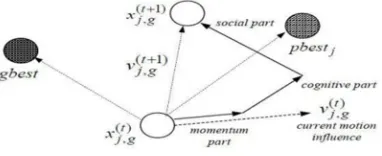
pbestj,g to gbestg as shown in the following formulas [11,13,14]. The velocity modernize in a PSO consists of three parts; namely momentum, cognitive and social parts. The balance among these parts determines the performance of a PSO algorithm. The parameters c1 and c2 determine the relative pull of pbest and gbest and the parameters r1and r2 help in stochastically unreliable these
pulls.
,
( )
= ∗ ( ), + ∗ ( ) ∗ , − ,
( )
+ ∗ ( ) ∗ − ( ), (7)
,
( )
= ( ), + (, ) (8)
With j =1,2,3,………..,n and g =1,2,3,…….,m
Where
n = number particles in the swarm,
m = number of components for the vectors and ,
t = number of iterations (generations),
, ( )
Technology (IJRASET)
w = inertia weight factor,w = − [ − ] ∗
where K=current iteration and N= maximum number iteration .
c1, c2 = cognitive and social acceleration factors respectively,
r1, r2 = random numbers uniformly distributed in the range (0, 1),
, ( )
= the g-th component of the position of particle j atiteration t,
pbest j = pbest of particle j,
gbest = gbest of the group
[image:5.612.212.403.220.298.2]The velocity and location updates of a particle for a two dimensional parameter space is shown in fig.2.
Fig.1 Description of velocity and position updates in PSO for a two dimensional parameter space.
The computational flow chart of PSO algorithm working in the present study for the model reduction is shown in Fig. 2.
Begin
Specify the parameters of PSO The suitable number of particles
and variables
Initialize the population randomly generating the position and velocity
with in the specific ranges
Evaluate the fitness value of each function according to the objective
function
Depending on the fitness value update the particle index p _best and g_best
Stop
iter .= Iter.+1
Update the particle position and velocity using eq .()
Item max > iter.?
The Algorithmic steps involved in PSO as follows:
Step 1: choose the significant parameters of PSO.
Step 2: Initialize a Population of particles with Random Positions and Velocities in the Problem space.
Step 3: calculate the desired Optimization suitable Function for each particle.
Step 4: For each Individual particle, compare the Particles suitable value with its P best. If the
Present value is better than the Pbest value,
Then update Pbest for agent i.
N O YES
Technology (IJRASET)
Step 5: Find out the particle that has the best suitableValue. The value of its fitness function is Identified a gbest.
Step 6: calculate the new Velocities and locations of The particles according to equations (5) &(6)
Step 7: Repeat steps 3-6 until the stopping Criterion of Maximum Generations is met.
IV. RESULTS AND DISCUSSION
To express the proposed method of the PSO model reduction, consider two dynamical examples. The first one is a single input
single output 8 order transfer function [15]. ]. The second example is 2-input 2-output, 10 order power system represented with
its state space full order system [17].
EXAMPLE 1: Consider a system having 8 order transfer function is taken from [15]:
G(S) = 18 + 514 + 5982 + 36380 + 122664 +222088 + 185760 + 40320 + 36 + 546 + 4536 + 22449 + 67284 + 118124 + 109584 + 40320
Step-1:-the transfer function R(s) of a basic reduce Order model from the given G(s).
G(S) = + 40320
118124 +109584 + 40320
Step-2:-The above equation is scaled R(s) becomes
R(s) = + 0.2170
+ 0.9277 + 0.3412
R(s) = 18 + 0.3413 +0.9277 + 0.3413=
1 + 0
2 2+ 1 + 0
Step-3:-The algorithm PSO had to find the numerator parameters =3.187, =0.9967 and denominator Parameters =0.2134,
=1.3101, =1.The transfer function of reduced second order model obtained as
R(s) = 3.187 + 0.9967
+ 1.13101 + 0.2134
Table I: Typical para meter s u sed by the PSO
Types of variables Value
Swarm size 50
Max.genarations 100
C1,C2 2.0,2.0
W start, W end 0.9 , 0.4
fi g. 3 step response of the higher order system a nd r edu ced or der system.
0 1 2 3 4 5 6 7 8 9 10
0 0.5 1 1.5 2 2.5
Step Response
Time (seconds)
A
m
p
lit
u
d
e
Technology (IJRASET)
From the above fig 3.It is observed that the step response of the original higher system is closely matching with the step response of the reduced order system.
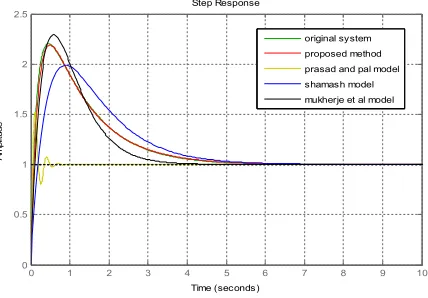
fig.4 step response of the higher order system with proposed method and other methods
[image:7.612.200.414.119.268.2]From the above fig 4.It is observed that the Step response of reduced order system using proposed PSO method is closely matching with the step response of higher order original system when compared with the step responses of other methods. The performance index of the proposed method is compared with other methods are shown in the TABLE 2. In that the integral square error (ISE) between the original higher order system and reduced order system using proposed PSO method is very less when compared with other methods.
TABLE 2.Comparison performances index
EXAMPLE 2: Consider 2-input, 2-output, 10 order power system with the following state space model:
8211 . 0 0526 . 1 0 0 0 0 0 0 0 0 0 20 1000 0 0 1000 1000 0 0 0 0 0 1 . 0 8696 . 10 1153 . 41 0 0 7999 . 0 9849 . 51 9386 . 0 0 0 0 8696 . 10 1153 . 41 0 0 7999 . 0 9849 . 51 9386 . 0 0 0 0 0 8696 . 10 0 0 1672 . 0 8696 . 10 9162 . 0 0328 . 0 0421 . 0 0 0 0 1 0 0 0 0 0 0 0 0 0 0 20 8660 . 0 0 5540 . 9 0 0 0 0 0 0 0 0 1593 . 314 0 0 0 0 0 0 0 0 0350 . 0 0 0410 . 0 1695 . 0 0 0 0 0 0 0 3091 . 0 0 5517 . 0 f A
0 1 2 3 4 5 6 7 8 9 10
0 0.5 1 1.5 2 2.5 Step Response Time (seconds) A m p lit u d e original system proposed method
prasad and pal model
shamash model
mukherje et al model
Method of reduction
Reduced order system ISE
Proposed PSO
3.187 + 0.9967 + 1.13101 + 0.2134
1.9743*10
Prasad and Pal
17.98561 + 500 + 13.24571 + 500
1.0344
Shamash
6.7786 + 2
+ 3 + 2
0.0396
Mukherje et al
11.3909 + 4.4357 + 4.2122 + 4.4357
Technology (IJRASET)
T f B 0 0 1179 . 2 1179 . 2 4428 . 0 0 0 0 0926 . 0 0 0 1000 0 0 0 0 0 0 0 0 0 0 0 0 0 0 0 0433 . 0 0 4777 . 0 0 0 0 0 0 0 0 1 0 0 f C 0 0 0 0 f DThe reduced order state space model when it is optimized with PSO will be:
8972 . 0 3560 . 1 0 0 3560 . 1 8972 . 0 0 0 0 0 2394 . 0 2350 . 3 0 0 2350 . 3 2394 . 0 r A 3139 . 0 5588 . 0 7295 . 0 0000 . 3 0000 . 3 8778 . 0 4475 . 2 3254 . 0 r B 4828 . 0 3143 . 0 1790 . 0 4898 . 0 4463 . 1 5837 . 0 8515 . 1 0000 . 2 r C 0 0 0 0 r D
Fig.5. step response of reduced order for MIMO system
From the above Fig. It is observed that the step response of the original higher system is closely matches with the step response of the reduced order system.
V. CONCLUSIONS
In this work authors proposed model order reduction technique using particle swarm optimization technique for both the SISO and MIMO systems. The characteristics of original system were preserved in the ISE sense pertaining to step input. The obtained results are compared with a recently published conventional method and other well known existing methods to show their superiority. The algorithm is simple, rugged and computer oriented which is implemented in MAT LAB. This can be extended for further design of controllers and compensators as well as state variables controllers and observers for stabilization process.
REFERENCES
Technology (IJRASET)
[3] R.K.Appiah, “Linear model reduction using Hurwitz polynomial approximation”, Int. J. Control, Vol. 28, no. 3, pp 477-488, 1978.
[4] T. C. Chen, C.Y.Chang and K.W.Han, “Reduction of transfer functions by the stability equation method”, Journal of Franklin Institute, Vol.308, pp 389-404, 1979.
[5] Y.Shamash, “Truncation method of reduction: a viable alternative”, Electronics Letters, Vol. 17, pp 97-99, 1981.
[6] P.O.Gutman, C.F.Mannerfelt and P.Molander, “Contributions to the model reduction problem”, IEEE Trans. Auto. Control, Vol. 27, pp 454- 455, 1982. [7] Y. Shamash, “Model reduction using the Routh stability criterion and the Pade approximation technique”, Int. J. Control, Vol. 21, pp 475-484,1975.
[8] T.C.Chen, C.Y.Chang and K.W.Han, “Model Reduction using the stability-equation method and the Pade approximation method”, Journalof Franklin Institute, Vol. 309, pp 473-490, 1980.
[9] Bai-Wu Wan, “Linear model reduction using Mihailov criterion and Pade approximation technique”, Int. J. Control, Vol. 33, pp 1073-1089,1981.
[10] V.Singh, D.Chandra and H.Kar, “Improved Routh-Pade Approximants: A Computer-Aided Approach”, IEEE Trans. Auto. Control, Vol. 49.No.2, pp292-296, 2004.
[11] J. Kennedy and R.C.Eberhart, “Particle swarm optimization”, IEEE Int.Conf. on Neural Networks, IV, 1942-1948, Piscataway, NJ, 1995.
[12] C. B. Vishwakarma and R.Prasad, “Clustering Method for Reducing Order of Linear System using Pade Approximation”, IETE Journal of Research, Vol. 54, Issue 5, pp. 326-330, 2008.
[13] S.Mukherjee, and R.N.Mishra, Order reduction of linear systems using an error minimization technique, Journal of Franklin Inst. Vol. 323, No.1, pp. 23-32, 1987.
[14] S.Panda, S.K.Tomar, R.Prasad, C.Ardil, “Reduction of Linear Time- Invariant Systems Using RouthApproximation and PSO”, International Journal of Applied Mathematics and Computer Sciences, Vol. 5, No. 2, pp. 82-89, 2009.
[15] S. Mukherjee, M. Satakshi, and R.C. Mittal, Model order Reduction using response matching technique, J. Franklin Inst. 342 (2005), pp.503–519..
[16 ] C.B. Vishwakarma and R. Prasad, MIMO System Reduction Using Modified Pole Clustering and Genetic Algorithm, Modeling and Simulation in Engineering 2009(ID 540895) 2009, pp. 1-5.
[17] G. Parmar, S. Mukherjee, and R. Prasad, Reduced order Modeling of linear MIMO Systems Using Genetic Algorithm, Int. J. simul. Model 6(2007) 3, pp. 173-184.
[18] S.Panda, S.K.Tomar, R.Prasad, C.Ardil, “Model Reduction of Linear Systems by Conventional and Evolutionary Techniques”, International Journal of Computational and Mathematical Sciences, Vol. 3, No. 1, pp. 28-34, 2009.
[19] R.Parthasarathy, and K. N. Jayasimha, System reduction using stability equation method and modified Cauer continued fraction, Proc. IEEE Vol. 70, No. 10, pp. 1234-1236, Oct. 1982.
[20] L.S. hieh, and Y.J.Wei, A mixed method for multivariable system reduction, IEEE Trans. Autom. Control, Vol. AC-20, pp. 429-432, 1975.