Technology (IJRASET)
©IJRASET 2015: All Rights are Reserved
7
Optimized Energy Conserving Using Selective
Forwarding Algorithm (SFA) for Wireless Sensor
Network (WSN)
N.Aravindhan1, S.Srinath2, S.Sudharshan3
1
Dr. S.J.S Paul Memorial College of Engineering and Technology, Puducherry, India
Abstract—In a low TTL based wireless network, the node drops all its energy before actually transferring the data given to it. This serves as a drawback where the data is not transferred completely resulting in bandwidth wastage and improper message delivery. To address this problem we formulate new routing techniques by which the data from one part is scheduled to reach the destination based on the computed TTL and available bandwidth. Other than forming a routing tree which may fail when overhearing occurs, RSF splits the data and places them into appropriate bandwidths where the bandwidth wastage is least. Therefore the process is of two steps: Identify the throughput and the mean bandwidth, place the data such that a least amount of bandwidth is wasted. Choosing an appropriate node that handles the incoming bandwidth is tedious and hence requires a bandwidth and energy allocation strategy for successful handling of node switching. Energy efficient node allocation can be done using least possible chance of fading of a node. The condition is achieved my observing the Tx and Rx of the nodes, in a scenario.
Index Terms—minutiae, minutiaetemplate, continuous and spiral components, database.
I. INTRODUCTION
Wireless sensor network (WSN) refers to a group of spatially dispersed and dedicated sensors for monitoring and recording the physical conditions of the environment and organizing the collected data at a central location. WSNs measure environmental conditions like temperature, sound, pollution levels, humidity, wind speed and direction, pressure, etc. WSNs were initially designed to facilitate military operations but its application has since been extended to health, traffic, and many other consumer and industrial areas. A WSN consists of anywhere from a few hundreds to thousands of sensor nodes. The sensor node equipment includes a radio transceiver along with an antenna, a microcontroller, an interfacing electronic circuit, and an energy source, usually a battery. The size of the sensor nodes can also range from the size of a shoe box to as small as the size of a grain of dust. As such, their prices also vary from a few pennies to hundreds of dollars depending on the functionality parameters of a sensor like energy consumption, computational speed rate, bandwidth, and memory.
A. Characteristics
The main characteristics of a WSN include:
1) Power consumption constraints for nodes using batteries or energy harvesting 2) Ability to cope with node failures
3) Mobility of nodes 4) Heterogeneity of nodes
5) Scalability to large scale of deployment
6) Ability to withstand harsh environmental conditions 7) Ease of use
8) Cross-layer design
Technology (IJRASET)
©IJRASET 2015: All Rights are Reserved
8
information gathered from the monitored field (e.g., an area or volume) through wireless links. The data is forwarded, possibly via multiple hops, to a sink (sometimes denoted as controller or monitor) that can use it locally or is connected to other networks (e.g., the Internet) through a gateway. The nodes can be stationary or moving. They can be aware of their location or not. They can be homogeneous or not.
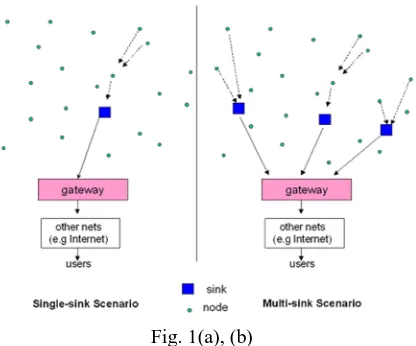
This is a traditional single-sink WSN (Figure 1(a)). This single-sink scenario suffers from the lack of scalability: by increasing the number of nodes, the amount of data gathered by the sink increases and once its capacity is reached; the network size cannot be augmented. Moreover, for reasons related to MAC and routing aspects, network performance cannot be considered independent from the network size. A more general scenario includes multiple sinks in the network (Figure 1(b)). Given a level of node density, a larger number of sinks will decrease the probability of isolated clusters of nodes that cannot deliver their data owing to unfortunate signal propagation conditions. In principle, a multiple-sink WSN can be scalable (i.e., the same performance can be achieved even by increasing the number of nodes), while this is clearly not true for a single-sink network. However, a multi-sink WSN does not represent a trivial extension of a single-sink case for the network engineer. In many cases nodes send the data collected to one of the sinks, selected among many, which forward the data to the gateway, toward the final user (Figure 1(b)). From the protocol viewpoint, this means that a selection can be done, based on a suitable criterion that could be, for example, minimum delay, maximum throughput, minimum number of hops, etc. Therefore, the presence of multiple sinks ensures better network performance with respect to the single-sink case (assuming the same number of nodes is deployed over the same area), but the communication protocols must be more complex and should be designed according to suitable criteria.
Fig. 1(a), (b) B. Features in Wireless Sensor Networks Design
The main features of WSNs are: scalability with respect to the number of nodes in the network, self-organization, self-healing, energy efficiency, a sufficient degree of connectivity among nodes, low-complexity, low cost and size of nodes. Those protocol architectures and technical solutions providing such features can be considered as a potential framework for the creation of these networks, but, unfortunately, the definition of such a protocol architecture and technical solution is not simple, and the research still needs to work on it.
According to some general definitions, wireless ad hoc networks are formed dynamically by an autonomous system of nodes connected via wireless links without using an existing network infrastructure or centralized administration. Nodes are connected through “ad hoc” topologies, set up and cleared according to user needs and temporary conditions. Apparently, this definition can include WSNs. However, this is not true. This is the list of main features for wireless ad hoc networks: unplanned and highly dynamical; nodes are “smart” terminals (laptops, etc.); typical applications include realtimeor non-realtime data, multimedia, voice; every node can be either source or destination of information; every node can be a router toward other nodes; energy is not the most relevant matter; capacity is the most relevant matter.
[image:3.612.205.413.319.492.2]Technology (IJRASET)
©IJRASET 2015: All Rights are Reserved
9
applications. Therefore, WSNs are not a special case of wireless ad hoc networks. Thus, a lot of care must be used when considering protocols and algorithms which are good for ad hoc networks, and using them in the context of WSNs.
C. Components of WSN
D. Challenges in power managements
Low-cost deployment is one acclaimed advantage of sensor networks. Limited processor bandwidth and small memory are two arguable constraints in sensor networks, which will disappear with the development of fabrication techniques. However, the energy constraint is unlikely to be solved soon due to slow progress in developing battery capacity. Moreover, the untended nature of sensor nodes and hazardous sensing environments preclude battery replacement as a feasible solution. On the other hand, the surveillance nature of many sensor network applications requires a long lifetime; therefore, it is a very important research issue to provide a form of energy-efficient surveillance service for a geographic area. Much of the current research focuses on how to provide full or partial sensing coverage in the context of energy conservation. In such an approach, nodes are put into a dormant state as long as their neighbors can provide sensing coverage for them. These solutions regard the sensing coverage to a certain geographic area as binary, either it provides coverage or not.
However, we argue that, in most scenarios such as battlefields, there are certain geographic sections such as the general command center that are much more security sensitive than others. Based on the fact that individual sensor nodes are not reliable and subject to failure and single sensing readings can be easily distorted by background noise and cause false alarms, it is simply not sufficient to rely on a single sensor to safeguard a critical area. In this case, it is desired to provide higher degree of coverage in which multiple sensors monitor the same location at the same time in order to obtain high confidence in detection. On the other hand, it is overkill and energy consuming to support the same high degree of coverage for some non-critical area. Middleware sits between the operating system and the application. On traditional desktop computers and portable computing devices, operating systems are well established, both in terms of functionality and systems. For sensor nodes, however, the identification and implementation of appropriate operating system primitives is still a research issue. In many current projects, applications are executing on the bare hardware without a separate operating system component. Hence, at this early stage of WSN technology it is not clear on which basis future middleware for WSN can typically be built.
II. OVERVIEW
Technology (IJRASET)
©IJRASET 2015: All Rights are Reserved
10
scope of middleware for WSN is not restricted to the sensor network alone, but also covers devices and networks connected to the WSN. Classical mechanisms and infrastructures are typically not well suited for interaction with WSN. One reason for this are the limited resources of a WSN, which may make it necessary to execute resource intensive functions or store large amounts of data in external components. This may result in a close interaction of processes executing in the WSN and a traditional network. One example of such “external” functionality are so-called virtual counterparts, components residing in the Internet which augment real world objects with information-processing capabilities. Thus, middleware for sensor networks should provide a holistic view on both WSN and traditional networks, which is a challenge for architectural design and implementation. Another unique property of middleware for WSN is imposed by the design principle application knowledge in nodes. Traditional middleware is designed to accommodate a wide variety of applications without necessarily needing application knowledge.
Middleware for WSN, however, has to provide mechanisms for injecting application knowledge into the infrastructure and the WSN. Data-centric communication mandates a communication paradigm which more closely resembles content-based messaging systems than traditional RPC-style communication. Moreover, event based communication matches the characteristics of WSN much better than traditional request-reply schemes. In general, communication and application specific data processing is much more integrated in WSN middleware than in traditional systems. The design principle adaptive fidelity algorithms requires the infrastructure to provide appropriate mechanisms for selecting parameters or whole algorithms which solve a certain problem with the best quality under given resource constraints.
III. EXISTING SYSTEM
A. Network Model
Technology (IJRASET)
©IJRASET 2015: All Rights are Reserved
11
For data gathering, we consider a simple interference model, the node-exclusive interference model, in which any two links are not allowed to share a common node to transmit at the same time. Otherwise, a collision occurs and the transmissions discarded. We assume the network is sparse so that the impact of channel access and packet collision on the optimal solution is minimum. We also assume the energy replenished into sensor’s battery is much larger than the energy consumed due to transmission, sensing activities and the amount of energy consumed at the anchor points would be compensated by wireless recharge. Thus, when theSenCar finishes recharging and leaves an anchor point, the node at the anchor point is recharged to a high energy level. Since nodes closer to the anchor points consume more energy, these nodes are more likely to be the candidates of anchor points in the next interval.
B. Energy Harvesting Networks and Data Collection
Prolonging sensor lifetime in energy harvesting/rechargeable networks has recently attracted considerable attention in the wireless networking research community. Other proposed solutions for fair and high throughput data extraction in the presence of renewable energy sources, which aims to compute the lexicographically maximum data collection rate for each node. Chen, et al. considered the problem of maximizing throughput over a finite-horizon time period for a sensor network with energy replenishment. Liu, et al. studied the problem of joint energy management and resource allocation in rechargeable sensor networks to maximize network utility while maintaining perpetual operation. In addition, energy harvesting techniques have been considered along with the traditional data collection with static data sink.
Zhao, et al. formalized the mobile data gathering problems as network utility maximization problems under the constraints of guaranteed network lifetime and data gathering latency. Data collection performance was further improved by equipping the vehicle with multiple antennas to allow concurrent uploading. The network utility maximization was studied for MANETs with lossy links such that the rate-outage probability is within some arbitrarily small target tolerance. A transmission scheduling algorithm was studied for wireless sensor networks with high node densities, where a mobile sink is responsible for gathering the data packets from the sensor nodes with similar observations. However, these works do not consider the current battery energy of sensor node in energy balance constraint and the energy consumptions in receiving and sensing data. In this paper, we account for the node’s battery energy in energy constraint and energy consumptions comprised of transmission/reception/sensing.
C. Wireless Energy Transfer
Recently, there have been great research efforts in the area of wireless energy transfer. It was shown that wireless energy residing in the radio frequencies can be effectively captured to power small devices such as sensors. In order to achieve timely and efficient charging sustainable wireless rechargeable sensor network (SuReSense) which employs mobile chargers that charges multiple sensors from several landmark locations? Chiu, et al. studied mobility aware charger deployment for wireless rechargeable sensor networks with an objective of maximizing the survival rate of end devices. He, et al. considered reader (energy provider)deployment, point provisioning and path provisioning in a wireless rechargeable sensor network to ensure the WISP tags (energy receivers) can harvest sufficient energy for continuous operation. In addition to wireless energy transfer via radio frequencies, energy transfer through magnetic coupling can usually support higher amount of energy transfer in short time with high efficiency. Shi, et al. considered the scenario of a mobile charging vehicle periodically traveling inside a sensor network with static data collection and recharging each sensor node’s battery wirelessly. Zhao, et al. combined wireless energy transfer with mobile data collection and formulated the problem into a utility maximization problem. However, mobile data collection was not considered, while the energy consumptions in receiving data and the time-varying nature of recharging process were not reflected in the analysis. Moreover, the works overlook the fact that the recharge process brings the energy gradually to the level of battery capacity. In wireless charging and mobile data collection in WSNs were jointly studied and distributed algorithms on how to select data rates, adjust link flow and recharge sojourn time were proposed.
We can further improve by exploring various features of the network and evaluating the algorithms in network-wide environment, to deliver a more comprehensive and in-depth solution to fully capture the practical aspects missing.
D. Efficient Resource Allocation
Technology (IJRASET)
©IJRASET 2015: All Rights are Reserved
12
However, these works do not consider the current battery energy of sensor node and the time-varying nature of recharging process
E. Anchor Point Selection
Choosing anchor points is a crucial step of the data gathering process since it determines the efficiency of energy transferring and the latency of data gathering. A trivial scheme is to simply visit all the sensor nodes, gather data through single-hop transmission and use the SenCar to forward data back to the static sink through long range communications. However, this scheme would trigger several new problems in our data collection and wireless recharge scheme.
First, using single-hop data collection can only collect data from a very small number of nodes per interval. Only the nodes reside at the anchor points are able to transmit data while data generated at other nodes is not collected. Therefore, the fairness of data collection among all the nodes is greatly undermined in single hop data collection. In contrast, if multi-hop transmission is used, we can collect data from the larger neighborhood of anchor points thereby improving the fairness of data collection. Second, the average packet latency will be increased with single hop communication. Since if nodes are not visited by the SenCar, their data packets would be buffered until these nodes are selected as anchor points. It would result in longer average data collection latency and is not scalable for large networks. In contrast, in our proposed solution, the SenCar only visits a subset of selected sensor nodes (anchor points) and collects data through multi-hop transmissions, which can enhance data collection fairness, reduce data collection latency, and avoid stopping at unnecessary sensor locations for battery recharge. On the other hand, although directly forwarding data back to the static sink via long range communication seems to be more efficient, such a scheme involves high energy cost. In wireless rechargeable sensor networks, as each sensor has different energy status at different time, it is desirable to recharges many sensors with low energy as possible to ensure the perpetual operation of sensors. Accordingly, the sensors located at the selected anchor points should be those with the most urgent needs of energy supplement. In the meanwhile, to better enjoy the benefit of the energy supply provided by the SenCar, more anchor points should be selected. However, this would prolong the traveling tour length and increase the data gathering latency. Thus, it is an inherent tradeoff between the number of sensors to be recharged in tour and the data gathering latency. Based on these observations, when determining the sequence of anchor points to visit, we jointly consider the remaining energy levels of sensors and the traveling tour length of the SenCar.
IV. PROPOSED SYSTEM
A. Module-I: RSF
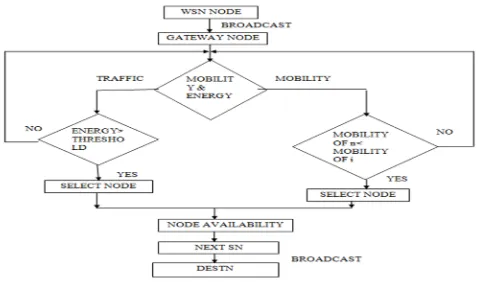
The objective of the proposal is to integrate WSN and Internet by implementing a SN discovery algorithm between WSN node and SN node for SN selection and thereby improving the life time of the SN. WSN node is connected by means of a bridge called Internet SN which acts as a platform for providing Internet access to the WSN node. In WSN, nodes move at random speed and direction which results in dynamic topology. As the overall infrastructure are said to be dynamic, it is necessary to witness the movement of nodes over the entire network. Internet SN node consists of ‘n’ number of SN nodes which are also said to be dynamic and hence they revolve to different positions at different periods of time. Every SN nodes has its own energy and mobility over the network. The WSN nodes broadcast the packets requesting for Internet access through the SN nodes. The SN nodes receive the packets from the WSN nodes and in turn the SN nodes broadcast the packet for providing Internet access to the WSN nodes. Every time when the SN nodes broadcast the packets requesting for internet access, the energy of the SN nodes gets decreased. As the SN nodes are also dynamic there is every chance that the SN node selected by the WSN node for accessing the Internet can be relocated and moved to different direction at certain interval of time. When the SN node is relocated, then the internet access requested by the WSN node is denied. Hence it is necessary for the WSN node to choose a SN which has high energy and low mobility. For selecting the SN which has high energy and low mobility, selective forwarding SN selection algorithm using TTL is implemented, there by the life time of the SN can be improved. There are two criteria for improving the life time of the SN
B. Mobility
Mobility can be defined as the movement of nodes within the network and they are recorded in micro seconds in a topology. C. Energy
Technology (IJRASET)
©IJRASET 2015: All Rights are Reserved
13
The cache table is present at every node which is responsible for storing the energy value and the mobility value of the SN nodes. Every time when the WSN nodes broadcasts the packet, the value of the energy and mobility of the SN nodes are updated simultaneously. Hence the cache table gets updated at every interval of time. Each SN nodes have their own respective energy which are stored in the cache table. When the SN node broadcasts, the energy value gets reduced which are automatically updated in the cache table. Let us consider two scenarios in the process of improving the life time of the SN which are described as follows: Case 1:
When the SN node is in the same position (No Mobility), but the node energy is less than the threshold energy, check for the energy value of all other SN nodes in the network and choose the SN node which has highest energy and select that SN node for providing Internet access to the WSN node.
Case 2:
When the SN node is moved from its position ( dynamic i.e., presence of mobility), then if the SN moves out of range ,then it is necessary for the WSN node to check in the cache table and choose the next SN node which has high energy and low mobility and use that node for accessing the Internet.
Selective forwarding algorithm Using TTL and Mobility
Working principle of the Selective Forwarding SN Discovery Algorithm: Steps for finding an alternate SN:
1) Record all SN nodes’ initial energy and mobility. 2) Store the SN nodes’ mobility.
3) When an alternate SN node is required check for the nodes’ energy and mobility. 4) Select the second SN node based on the following:
a. Node energy > Threshold energy b. Lesser mobility.
5) Compare the energy and mobility of all the nodes; choose a node which has high energy and low mobility among the selected nodes.
6) Broadcast from the source node to the SN node.
7) Check if the SN node is capable of reaching the internet; if it establishes the path to the internet, forward the internet request from WSN node to the Internet node.
[image:8.612.173.412.564.705.2]8) If it doesn’t reach the internet node, repeat steps from step4.
Technology (IJRASET)
©IJRASET 2015: All Rights are Reserved
14
D. QoS-Aware Routing Algorithms
The role of the AC and QAR protocols may be closely related. In order to perform their functions, both types of protocols must discover certain information about the network at the basic level. The routing protocols must perform network topology discovery and maintain a certain view of this at each node to match application’s requirements for route. The job of both types of protocols is to estimate the residual resources in the network. The routing protocols do this to help in route discovery and selection in order to utilize those nodes used for traffic-forwarding and is most likely to support the application’s requirements. It is the job of AC protocol to know which application data sessions may be admitted into the network without violating the QoS promised to previously-admitted session. QAR protocol provides the achievable QoS on a route to the desired level. Since the aim of both AC and QAR protocols is to facilitate the provision of the necessary QoS to user applications. A part of AC and QAR protocols also consists of management and utilization of network resources which provide a certain QoS.
The job of AC protocol is either to reject or accept the newly requested session according to available resources. If the available resources are more than the requested resources, the session is granted admission, otherwise it is rejected. It is the duty of the AC protocol that to make sure the newly admitted session does not affect the previous serving data session.
AC protocol during route discovery must establish if there are any links or nodes having necessary available resources. In QAR protocol, it is performed after the routes have been discovered. In QAR protocols the route discovery process can be used for AC decision, if the required resources are unavailable the admission is rejected otherwise the data sessions is granted. However in contention based 802.11 network the session’s achievable QoS is not only affected by the nodes on the path but also by the neighbors of the nodes along the path. So we have to check the available capacity of neighbor nodes whether they can accept or reject the new session without affecting the already admitted data sessions.
E. Contention Aware Admission Control Protocol
The work is considered a landmark in the design of Admission control protocols for WSNs. The available network resources are measured by AC protocol and checks whether it can support the new data flow or not, without affecting the existing flow.
The proposed protocol is combined with a source routing protocol similar to Dynamic Source Routing. AC in first stage, only partial route of the flow is known to the nodes therefore partial admission is granted to the flow. A route discovery is triggered at that time when a session requesting admission packet arrives at a source node. Nodes monitor the Channel Idle Time Ratio (CITR) and only if their locally available capacity is sufficient then it forwards the Route Request (RReq), considering the intra-route contention. Only local resources are estimated in case of Contention Aware Admission Control protocol-Multi-hop (CACP-Multi-hop) and CACP-Power; during this RReq phase, Carrier Sensing Neighbors (CSN) resources are not checked because it enforces extra overheads on the partial discovered route. The routes in RReq are cashed at the destination. Therefore several routes are cashed due to multiple RReq reaches the destination on different routes. Among the several routes, one route is selected for Route Reply (RRep) on the basis of some criteria, such as the shortest route or first discovered route. Locally available capacity for each intermediate node is again tested by receiving RRep along with the full knowledge of the Intra-route contention. One of the following proposed methods is used by all nodes on the route to check their neighbor’s capacity during the RReq.
Technology (IJRASET)
©IJRASET 2015: All Rights are Reserved
15
Distributed Energy Efficient Clustering scheme (EDDEEC) for heterogeneous WSNs. Our technique is based on changing dynamically and with more efficiency the Cluster Head (CH) election probability. Simulation results show that our proposed protocol achieves longer lifetime, stability period and more effective messages to BS than Distributed Energy Efficient Clustering (DEEC), Developed DEEC (DDEEC) and Enhanced DEEC (EDEEC) in heterogeneous environments.
The EE Path Decision Algorithm
BGP determines the best path to each destination for a BGP speaker by comparing path attributes according to the following selection sequence:
1. Select a path with a reachable next hop. 2. Select the path with the highest energy.
3. If path energies are the same, select the path with the highest local preference value.
4. Prefer locally originated routes (network routes, redistributed routes, or aggregated routes) over received routes. 5. Select the route with the shortest AS-path length.
6. If all paths have the same AS-path length, select the path based on origin: IGP is preferred over EEP; EEP is preferred over Incomplete.
7. If the origins are the same, select the path with lowest TTL value.
8. If the paths have the same TTL values, select the path learned via EEP over one learned via BEP. 9. Select the route with the lowest EEP cost to the next hop.
10. Select the route received from the peer with the lowest EEP router ID.
V.EXPERIMENTAL RESULT
Technology (IJRASET)
©IJRASET 2015: All Rights are Reserved
16
The work can further be improved by using a non-deterministic energy path routing which avoid non-redundant data for the same sink; which decreases the amount of energy spent on same packet on each different transmission.
V. APPLICATIONS
A. Habitat and Ecosystem Monitoring B. Seismic Monitoring
C. Civil Structural Health Monitoring D. Monitoring Groundwater Contamination E. Rapid Emergency Response
F. Industrial Process Monitoring G. Perimeter Security and Surveillance H. Automated Building Climate Control
VI. CONCLUSION
We propose a joint contention and sleep control scheme in the wireless sensor network. We consider the effect of the throughput requirement and energy constraint with the contention and sleep control, then we formulate the optimization problem for achieving the maximize lifetime. With the log transformation and sub gradient algorithm , we present the algorithm to achieve the maximized lifetime.
VII. ACKNOWLEDGMENTS
Technology (IJRASET)
©IJRASET 2015: All Rights are Reserved
17
REFERENCES
[1] Jae-Han Jeon, Hee-Jung Byun, and Jong-Tae Lim, ‘Joint contention and sleep control for lifetime maximization in Wireless Sensor Networks’.
[2] F. Liu, C.-Y. Tsui, and Y. J. Zhang, “Joint routing and sleep scheduling for lifetime maximization of wireless sensor networks,” IEEE Trans.Wireless
Commun., vol. 9, no. 7, pp. 2258–2267, July 2010.
[3] J. Zhu, S. Chen, B. Bensaou, and K.-L. Hung, “Tradeoff between lifetime and rate allocation in wireless sensor networks: a cross-layer approach,” in Proc.
2007 IEEE INFOCOM, pp. 267–275.
[4] C. Long, B. Li, Q. Zhang, B. Zhao, B. Yang, and X. Guan, “The end-to-end rate control in multiple-hop wirelss networks: cross-layer formulation and optimal
allocation,” IEEE J. Sel. Areas Commun., vol.26, no. 4, pp. 719–731, May 2008.
Mr.N.Aranindhan is a student who is pursuing B.Tech (Electronics and Communication Engineering) in Dr. S.J.S PAUL MEMORIAL COLLEGE OF ENGINEERING AND TECHNOLOGY. He is interested in Electro Magnetic wave theory, wave guides and antennas, Digital signal processing, signals and system
Mr.S.Srinath is a student who is pursuing B.Tech (Electronics and Communication Engineering) in Dr. S.J.S PAUL MEMORIAL COLLEGE OF ENGINEERING AND TECHNOLOGY. He is interested in Digital circuits, Digital signal processing, and Electronic circuits.