The London School of Economics and Political Science
Evaluating Compulsory Voting: Australia in Comparative
Perspective
Koichi KATO
UMI Number: U501546
All rights reserved
INFORMATION TO ALL USERS
The quality of this reproduction is dependent upon the quality of the copy submitted.
In the unlikely event that the author did not send a complete manuscript and there are missing pages, these will be noted. Also, if material had to be removed,
a note will indicate the deletion.
Dissertation Publishing
UMI U501546
Published by ProQuest LLC 2014. Copyright in the Dissertation held by the Author. Microform Edition © ProQuest LLC.
All rights reserved. This work is protected against unauthorized copying under Title 17, United States Code.
ProQuest LLC
789 East Eisenhower Parkway P.O. Box 1346
Theses
p
Declaration
I certify that the thesis I have presented for examination for the MPhil/PhD degree of the London School of Economics and Political Science is solely my own work other than where I have clearly indicated that it is the work of others (in which case the extent of any work carried out jointly by me and any other person is clearly identified in it).
The copyright o f this thesis rests with the author. Quotation from it is permitted, provided that full acknowledgement is made. This thesis may not be reproduced without the prior written consent of the author.
I warrant that this authorization does not, to the best o f my belief, infringe the rights o f any third party.
Abstract
Low turnout is a growing concern among the industrial democracies. Compulsory voting has achieved very high turnouts in several countries, but it has been mostly neglected as a solution to the problem of low turnout elsewhere. This thesis considers the usefulness o f compulsory voting for industrial democracies. I argue that, for it to be useful, compulsory voting must be effective on two levels. First, compulsory voting must be effective in increasing turnout. Second, the high turnout resulting from compulsory voting must improve the total utility o f the people— defined here as the well-being of the people—otherwise compulsory voting will not ultimately be useful.
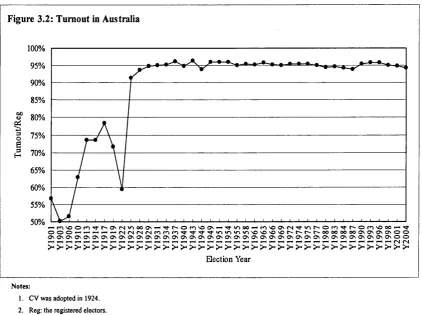
Rational choice models are constructed and operationalised in order to describe, explain and evaluate compulsory voting. Although data analysis is undertaken for a range o f industrial democracies in order to test these rational choice hypotheses, the major focus of this research is on Australia, which has achieved very high turnout levels (around 95% o f the registered voters) since the introduction o f compulsory voting for federal elections in 1924. Furthermore, by examining the case of Australia, this thesis determines the conditions and necessary adjustments for compulsory voting to work effectively in practice. Finally, compulsory voting is tested with rational choice theory and data analysis on the actual industrial democracies in order to see whether this system is applicable under globally varying conditions.
Acknowledgements
This thesis owes a lot to many people. Without their help, it has been simply impossible to finish my PhD project. First, I would like to express my greatest appreciation to Professor Ian McAllister at the Australian National University (ANU). Since I first visited him and had a discussion on compulsory voting (CV) several years ago, he has kindly and generously offered abundant useful help to my research project. He helped me to get accepted as a visiting PhD student at the ANU to undertake my fieldwork. Moreover, he has taken a lot of time for me and has given me much useful advice on my PhD project. He provided me with de facto supervision, and he later accepted my request to officially become my external supervisor.
Second, I want to show my gratitude towards Mr Alan Beattie, who was my first supervisor at the LSE, and Dr Paul Mitchell, who accepted me as his PhD student after Mr Beattie departed from the LSE. As an experienced supervisor, Mr Beattie provided me with sensible advice when I was struggling with my English and methodological studies. Dr Mitchell accepted me as his PhD student when I lost my original supervisor, and so I could continue doing a PhD at the same college.
Third, I would like to express my gratefulness towards the ANU, which accepted me as a visiting PhD student for an extended period of time to exercise fieldwork and to write my thesis under the face-to-face supervision of Professor McAllister. Because of my official status at the ANU, I could also have access to useful survey data stored in the Australian Social Science Data Archive of the ANU.
Fourth, I must confess that I owe a lot to my parents who provided me with sufficient financial support during my prolonged PhD-student life. My father is a retired secondary-school teacher, and my parents live on a pension. Nevertheless, they provided adequate support to me. Without finance, we cannot do anything in a civilised society. This is also the case in academia.
There are many other people who have provided me with academic/personal advice and help, encouragement and mental support. However, it would be inappropriate to compile a very long list of them here. At the very least, I would like to express my deepest appreciation to all o f them.
Table of Contents
Declaration ... 2
Abstract ...3
Acknowledgements ... 4
Table o f Contents ...5
List o f Tables ... 6
List o f Figures ... 7
Preface ...8
Abbreviations ... 9
Introduction ...10
Part I . Context ... 14
Chapter 1. Decline in Turnout: Evaluating the Solutions ... 15
Chapter 2. The Theory and Practice of Compulsory Voting ...31
Part I I . The Effect on Turnout ...52
Chapter 3. The Impact o f Compulsory Voting upon Turnout ...53
Chapter 4. Necessary Conditions and Adjustments ...74
Part HI. Compulsory Voting and Public Policy ... 99
Chapter 5. The Consequences for Voters ...100
Chapter 6. The Implications for Political Parties ...123
Chapter 7. Applicability to Actual Industrial Democracies ... 146
Part IV. Evaluations ... 169
Chapter 8. Reassessing Compulsory Voting ... 170
List of Tables
1.1: Turnout in 18 Industrial Democracies between the 1950s and 1990s ... 20
2.1: Practice o f CV in the World ... 37
2.2: Likely Advantages and Disadvantages o f CV ... 41
2.3: Checklist for Overall Assessment o f CV ...48
4.1: Respect for Freedom and Support for CV (Australia 2001) ... 76
4.2: Industrial Democracies and Enforcement of CV ... 83
4.3: Five-Party Preference at Different Turnout Levels (Cumulative Percentages) ... ...93
5.1: Policy Shift and Utility Loss ... 109
5.2: Distance of FPP from the Median Elector and the Average Total Utility o f Electors ... I l l 5.3: Policy Position and Voting ... 113
5.4: Willingness for Voting under Hypothetical VV (Column Percentages) ...114
5.5: Expected Turnout under Hypothetical VV (Cumulative Percentages) ...114
6.1: Electoral Fluidity (EF) ...130
6.2: Turnout Fluidity (EFa) and Party-Support Fluidity (EFb) in a VV Country ...131
6.3: Turnout Fluidity (EFa) and Party-Support Fluidity (EFb) in a CV Country ...131
6.4: Party Identification Rate in Industrial Democracies ... 133
6.5: Extremism and Election Campaign Activity Participation Rate ... 139
6.6: Charitable Organisation Membership and Political Party Membership ... 141
7.1: Policy Position and Voting in Industrial Democracies ... 148
7.2: %2-Test Results o f the Relationship in Table 7.1 ... 149
8.1: Political Knowledge and Voting in Industrial Democracies under VV ... 184
8.2: Party Identification and Voting in Industrial Democracies under VV ... 186
List o f Figures
1.1: Turnout in Seven Major Industrial Democracies between the 1950s and 1990s ... 21
2.1: Relationship between Two Duties ...33
3.1: Enforcement Level and Turnout ...64
3.2: Turnout in Australia ...67
3.3: Turnout in Belgium ...69
3.4: Turnout in the Netherlands ... 70
4.1: Public Views towards CV in Australia ... 92
4.2: Support for VV among Newly Elected Parliamentarians (Australia) ... 95
5.1: Proportional Decrease in Turnout to 50% ...104
5.2: Disproportional Decrease in Turnout to 50% ...105
5.3: 0-Unit Policy Shift from the Median Elector ... 106
5.4: 1-Unit Policy Shift from the Median Elector to the Right ...107
5.5: Policy Distance and Additional Utility Loss ...109
5.6: Policy Distance and Cumulative Utility Loss ...110
5.7: Relationship between Two Major Parties and Electors ... 116
5.8: Elector’s Policy Position and Their Differential Benefit ... 117
6.1: Two Major Party Policy Positions as Equilibria ...126
6.2: Shift of Two Major Party Policy Positions ... 126
6.3: Effectiveness and Cost o f Election-Fund Raising/Spending ... 128
6.4: Seat Fluidity (EFc) in a CV Country ...134
6.5: Tactical Allocation o f Electoral Resources ... 136
6.6: Demand for and Supply of Election Campaigners ... 142
Preface
Compulsory voting (CV) might be regarded as a gimmick rather than as a real option, but I have been attached to this topic for a long time. I am from a white-collar worker family in Japan, and I have long thought that white-collar workers’ interests are under-represented in politics, despite the large number of white-collar workers. They are not well-organised, they do not donate funds to political parties, and their turnout is low. As a result, their interests are not accurately represented in politics. On the other hand, many minority interests are well-organised, they donate election funds, and their turnout is high. Naturally, their interests are more likely to be represented politically. There is nothing wrong about respecting minority interests: members o f minority-interest groups are citizens, and so their interests should be respected. However, white-collar workers are also citizens, and so their interests should also be respected— more so given their large numbers. Nevertheless, the system does not achieve that.
I understand that the under-representation of white-collar workers is partly a result o f their low turnout. When I was a child, I used to advise my parents to vote. However, they said that their single vote would make no difference in politics and so they would not bother to turn out. In fact, they rarely voted. I now think that they were rational. I failed in persuading them to vote, and I thought that we were trapped and there was no way to escape. Therefore, when I encountered CV later, I was delighted that I finally found what appeared to be a solution to this conundrum. CV would realise our interests more accurately and would make a major contribution to the best interests of the whole population. I hope that this thesis can advance the understanding o f CV and contribute to its wider acceptance as a real option rather than as a gimmick.
Abbreviations
AV alternative voting CV compulsory voting IV inducement voting
JSCEM Joint Standing Committee on Electoral Matters PR proportional representation
Almost all of the industrial democracies have experienced a long-term decline in turnout, and this has led to a growing concern about how to remedy the problem. Compulsory voting (CV) is the most straightforward solution to the problem, and CV has achieved high turnout in several countries. Nevertheless, it has been mostly neglected elsewhere. Moreover, it seems that CV has not even been regarded as a real option (Jones 1954, 25; Mayo 1959, 323; Wertheimer 1975, 278). Although Lijphart demonstrated the usefulness o f CV by combining scientific methods and values (Lijphart 1997) and his work drew new attention to CV (Hirczy de Mino 2000, 45), no other major academic advancement has been made on this topic since then. Although many papers have been published on CV in the past and several of them can be regarded as classics (e.g. Hughes 1966; Lijphart 1997; Robson 1923), there has been no comprehensive work about what impact the introduction o f CV would have on the society. In order to fill this gap, this thesis aims at assessing the overall usefulness of CV for industrial democracies.
CV must be effective on two levels for it to be useful. First, CV must be effective in increasing turnout. Second, the high turnout resulting from CV must be effective in improving the well-being of the people. If these two requirements are not fulfilled, CV will not ultimately be useful. Although it is a matter of argument what the well-being of the people is, this thesis defines it as the total utility o f individuals. However, for technical reasons, this thesis will use the total utility of electors as the value standard instead of that of all individuals. Moreover, CV must be workable for it to be useful in practice. If CV is useful on the two levels in theory but is unworkable in practice, CV cannot actually be applied. Therefore, this thesis tries to determine the conditions and necessary adjustments for CV to work effectively in practice.
range o f industrial democracies in order to test the hypotheses, the major focus o f this research is on Australia, which has achieved very high turnout (around 95% o f the registered electors) since the introduction o f CV in 1924. Furthermore, by examining the case of Australia, this thesis tries to determine conditions and necessary adjustments for CV to work effectively in practice.
In order to achieve the research purpose with the methods and research subjects above, this thesis takes several steps and has eight chapters. First two chapters (i.e. Chapters 1 and 2) present the context of this thesis. Chapters 3 and 4 deal with the effect o f CV on turnout. Chapters 5, 6 and 7 are about the effect of CV on public policy. Chapter 8 is the evaluation of the findings o f this research project. More details o f these chapters are as follows:
• Chapter 1: Assesses the level o f turnout decline in the industrial democracies, and provides an overview of the effectiveness o f major solutions to low turnout (inclusive of CV).
• Chapter 2: Provides an overview of the practice of CV across the world, and then reviews the previous studies o f CV.
• Chapter 3: Develops a formula that provides the reason that CV achieves high turnout, and then tests this hypothesis on empirical data.
• Chapter 4: Determines the conditions for CV to effectively improve turnout and necessary adjustments to meet these conditions.
• Chapter 5: Builds a model showing the effect of CV on the median voter position in the left-right dimension, and then tests this hypothesis on the data. • Chapter 6: Builds a model showing the effect o f CV on party policy positions in
the left-right dimension, and then tests this hypothesis on the data.
• Chapter 7: Examines whether the high turnout resulting from CV would be useful for the industrial democracies under globally varying conditions in order to improve the total utility of electors.
• Chapter 8: Produces an inventory of the findings and the gaps in this research project. The chapter then evaluates to what extent this research has succeeded in assessing the overall usefulness of CV for industrial democracies.
The overall conclusion of this thesis is that CV is likely to be useful for some industrial democracies though not for others. First, CV would achieve high turnout. Several conditions are necessary for CV to effectively realise its potential in this regard,
but the industrial democracies would have sufficient resources to meet these conditions. Second, the high turnout resulting from CV would improve the total utility o f electors, which can be equated to the well-being o f the people, in several industrial democracies. Although the actual industrial democracies exist under a variety o f conditions, CV is versatile and would be useful for many of them. Meanwhile, the main shortcoming of this thesis is that the objective cost-benefit analysis o f CV tends to be partial and some subjective judgement needs to be introduced to perform a full cost-benefit analysis.
It should be noted that the majoritarian model of democracy is used as the underlying assumption throughout this thesis. This assumption is characterised by a two-party system, in which the two major parties alternate in power, and is also featured by a majoritarian electoral system. More details o f this underlying assumption is addressed as the ‘default environment’ in 7.2 o f Chapter 7 in preparation for engineering the ‘best’ electoral system in this hypothetical environment. The choice of this underlying assumption inevitably limits the research scope of this thesis. More specifically, this thesis mles out alternative forms o f democracy, such as consensus democracy characterised by a proportional representation (PR) electoral system, which is more common among industrial democracies and is appreciated by some leading scholars (e.g. Lijphart 1999). As a result, the viewpoint of this thesis is limited within this majoritarian assumption. All hypotheses o f this thesis are formulated and are comparatively tested in this assumptive framework. Therefore, although this thesis analysed several countries and systems that do not share many characteristics with this majoritarian model, the reader should assess the relevance o f this thesis to them (e.g. PR systems) with caution.1
1 T h e a u th o r c h o se th e m a jo rita rian a ssu m p tio n as the th eo retical fra m e w o rk o f th is th e sis b e c a u s e it is th e m o s t
c o m m o n ly -u s e d o n e. H o w e v e r, th is ch oice co u ld also be attrib u ted to h is p e rso n al e x p e c ta tio n fo r th e a d v e rsa ria l tw o -p a rty sy ste m
PART I
CHAPTER 1
Decline in Turnout: Evaluating the Solutions
During the last quarter o f the twentieth century, democratisation has been a worldwide political trend in countries ranging from the former socialist regimes to former dictatorships. According to Huntington (1991, 26), 24.6% o f the total number of countries (30 countries out of 122) were democratic in 1973, and 45.4% o f the total (59 countries out of 130) were democratic in 1990, excluding countries with a population of less than one million.2 Huntington (1991, 3-30) calls this trend ‘the third wave’ o f democratisation (starting in 1974), following ‘the first wave’ which took place around the late nineteenth century (1828-1926) and ‘the second wave’ in the post World War II period (1943-62). He describes this third wave o f democratisation as follows, ‘Overall, the movement toward democracy was a global one. In fifteen years the democratic wave moved across southern Europe, swept through Latin America, moved on to Asia, and decimated dictatorship in the Soviet bloc’ (Huntington 1991,25).3
Despite the major trend of democratisation during the last quarter of the twentieth century, industrial democracies, which have a tradition o f democracy accompanied by liberalism and economic prosperity, have been experiencing a long-term decline in political participation, such as turnout and party identification (Dalton 2000). Although there are many forms of political participation, the decline in turnout has drawn special attention from political students (e.g. Abramson and Aldrich 1982; Blais et al. 2004; Cassel and Luskin 1988; Gray and Caul 2000; Lijphart 1997, 5-7). If ‘the democratic method is,’ as Schumpeter ([1976] 1996, 269) defines, ‘that institutional arrangement for arriving at political decisions in which individuals acquire the power to decide by means o f a competitive struggle for the people’s vote,’ it will be natural that turnout is one o f major concerns for political scholars (see Franklin 2002, 148; Lijphart 2000, 314) though the electoral process actually comprises many aspects other than voting (e.g. political funds, election campaigns, and the mass media).
2 A c c o rd in g to F ree d o m H o u se (K a ra tn y c k y 2 0 0 2 ,9 ) , e le cto ral d e m o c ra c ie s c o v ered 4 0 % o f c o u n trie s in th e w o rld (6 6 o u t o f
1 6 4 ) in th e ir 1 9 8 7 -8 8 s u rv e y a n d th e n th is figure in c re a se d to 6 3 % (121 o u t o f 192) at th e e n d o f 2 0 0 1 .
3 L e D u c , N ie m i a n d N o rris ( 1 9 9 6 ,1 ) refers to th e sam e tre n d as ‘a g lo b a l su rg e to w a rd d e m o c ra c y .’ A c c o rd in g to F ree d o m
In the process o f democratisation in history, franchise expansion was pursued (e.g. Chartism in the UK). However, if politics is open to the public but the public does not participate in politics, politics would end in minority rule rather than majority rule and so the country would hardly be a democracy in any proper sense. Therefore, it seems to be reasonable that the long-term decline in turnout among these successful democracies
has been regarded as a serious problem. Political students have had three concerns in relation to low turnout:
(1) Causes of low turnout,
(2) Consequences of low turnout, and (3) Solutions to low turnout.
Among these three concerns, the main research topic has been the causes o f low turnout.
When there is a problem, it would be normal first to find the causes o f the problem and then to eliminate or control those causes (Abraham 1955, 8). In order to identify the variables related to voting and the mechanisms of voting, numerous data analyses have been exercised (e.g. Campbell et al. [1960] 1980; Miller and Shanks 1996) and rational choice theory has been utilised (e.g. Downs 1957; Riker and Ordeshook 1968). However, the causes o f low turnout are still unclear (see Niemi and Weisberg 2001, chap. 2), and this orthodox approach has not been productive in solving the problem of low turnout. Meanwhile, the consequences o f low turnout do not appear to have drawn much attention, probably because it has been simply normal to regard low turnout as a problem to tackle in democracies (but see Lijphart 1997; Verba 2003).
The solutions to low turnout have drawn much less attention from researchers compared to its causes. However, the pragmatic approach to try to find effective solutions to low turnout without substantial knowledge about its causes (see Lijphart 1997, 7-10; Lijphart 2000, 321; Niemi and Weisberg 2001, 32) might be more productive in tackling with low turnout than the orthodox approach to try to find its causes first. There are several potential solutions to low turnout (e.g. automatic registration, weekend voting, machine voting, absentee voting and civic education), but CV has not been widely used and has not been seriously discussed though CV has recently drown new attention (see Hirczy de Mino 2000, 45).4 CV might have been regarded as an unsophisticated measure, and so it might have been disregarded.
4 T h is n e w a tte n tio n c a n b e attrib u ted to L ijp h art 1997.
However, taking the unceasing slide in turnout among industrial democracies into consideration, it seems to have been the time to pay a real attention to CV.
This thesis aims at assessing the overall usefulness o f CV for industrial democracies. For this purpose, this thesis performs a full cost-benefit analysis o f CV. However, before moving on to the evaluation o f CV, this chapter first observes whether turnout among industrial democracies has actually been declining because, if the problem is not real, research into solutions to this problem would not make sense. The
chapter then provides an overview to all the major solutions to low turnout because, if moderate measures are effective enough to achieve high turnout, we would not need to seriously consider using strong measures like CV. This chapter finds that CV should be combined with easy-voting devices and civic education in order to achieve high turnout.
1.1. The Decline in Turnout among
the Industrial Democracies
When people claim that turnout has been declining among the industrial democracies, they tend to mention several examples of extremely low turnout only, such as the 1995 Japan upper-house election turnout o f 44.5%, the 1996 USA presidential election turnout o f 49.1%, or the 2001 UK general-election turnout of 59.4%. Although recent record-low turnouts might signify a general downward trend in turnout among industrial democracies, this kind of argument in itself is often misleading. Johnston and Pattie (2000, 1) argue that the extent o f the decline in turnout might have been exaggerated. The general long-term trend in turnout among industrial democracies should be assessed with long-term records of turnout in all those countries.
In order to calculate turnout, the number o f votes is divided by the total number of registered electors. However, the detailed calculation method is often a matter of judgement by researchers, whose research orientations are different from each other.
turnout).5 This diversity results from five causes: (a) selected countries (e.g. Western countries only or all industrial democracies in the world), (b) selected elections (e.g. presidential elections or parliamentary elections), (c) time span, (d) numerator (e.g. invalid votes are included or not), and (e) denominator (e.g. the number o f registered electors or the voting age population). In order to meet the purpose o f this research, this thesis will design its own method for calculating turnout and will then assess the results.
Calculating Turnout
In order to know the long-term trend in turnout among industrial democracies, this thesis will design a method for calculating turnout as follows.
Selected countries: 18 industrial democracies. The objects o f observation are 18 industrial democracies: the USA, Japan, Germany, the UK, France, Italy, Canada, Australia, the Netherlands, Belgium, Sweden, Austria, Switzerland, Denmark, Finland, Ireland, New Zealand and Norway. The World Bank (2001, back cover) categorises these countries as ‘high-income OECD members.’ The World Bank (2001, back cover) also categorises Spain, Portugal, Greece, Iceland and Luxembourg as ‘high-income OECD members,’ but this thesis sets aside these countries. Spain, Portugal and Greece have not continuously had democratic competitive elections since 1951, though this thesis wants to observe the long-term trend in turnout.6 Iceland and Luxembourg have small populations o f less than one million, and so this thesis excludes them in order to control conditions.
Selected elections: first-order elections. Presidential elections are observed for the USA, but parliamentary elections (lower house elections in the case o f bicameral system) are observed for the other 17 industrial democracies.
Time span: 1951-2000. The average turnout for each decade from 1951 to 2000 is calculated. Turnouts after 1951 are used in order to avoid the confusion o f the post World War II period. However, turnouts after 2000 are not included because we do not yet have a complete decade in order to produce an average. Using the average from 2001 to the present would be misleading.
5 P o litic a l sc h o la rs h a v e fo u n d a variety o f tr e n d s in tu rn o u t a m o n g in d u strial d e m o c ra cie s: T o p f ( 1 9 9 5 ,4 0 - 4 1 ) , 3
p e rc e n ta g e -p o in t d e c lin e ; D a lto n (1 9 9 6 ,4 4 -4 5 ), 6 p e rc e n ta g e -p o in t d e clin e; In te rn a tio n a l ID E A (P in to r a n d G ra ts c h e w 2 0 0 2 , 8 5 ), 7
p e rc e n ta g e -p o in t d e c lin e ; G ra y a n d C aul (2 0 0 0 ,1 0 9 4 -9 5 ), a ro u n d 10 p e rc e n ta g e -p o in t d eclin e; W a tte n b e rg (2 0 0 0 , 7 1 ), 10
p e rc e n ta g e -p o in t d e clin e.
Numerator: the vote inclusive of invalid votes. The vote inclusive o f invalid votes is used as the numerator. There are two widely-used types o f numerators: the vote
inclusive o f invalid votes and the vote exclusive o f invalid votes. This thesis uses the vote inclusive of invalid votes when it is available, because the purpose is to understand the level of participation in voting and invalid voting can be regarded as a form of this participation.7
Denominator: voting age population. This thesis uses the voting age population as the denominator when calculating turnout for this section. There are two widely-used types of denominators: the number of registered electors and the voting age population. This thesis wants to know to what extent the government reflects the will o f the people, and so its main concern around turnout is the consequences of abstention and the possible solutions to it. Therefore, we are interested in the fact o f voting/abstention itself, and so what we want to know is not the level o f participation in voting among
o registered people but among all of those who are eligible to vote.
Turnout in 18 Industrial Democracies
Table 1.1 shows the turnout averages by decade between the 1950s and 1990s in 18 industrial democracies. The result support the conventional wisdom that turnout has been declining in industrial democracies. The average turnout in 18 industrial democracies was 78.6% in the 1950s. The figure slightly increased by 0.4 percentage point in the 1960s. However, it started declining in the 1970s and reached 71.1% in the 1990s. The average decrease of 5.0 percentage points in the 1990s was relatively substantial. In total, there was a decline o f 7.5 percentage points on average between the 1950s and 1990s. The average decline between the 1960s and 1990s was 7.9 percentage points. Although there have been a variety o f trends in these countries, the general downward trend is clear between 1951 and 2000, particularly in the most recent decades.
6 P o rtu g al an d S p a in h a d an a u th o rita ria n re g im e u n til late 70 s. G re e ce h a d a m ilita ry re g im e b e tw e e n 1967 an d 1974.
7 In th e c ase o f th e U S A , th e n u m b e r o f v o te s in c lu siv e o f in v alid v o te s is n o t a v a ila b le a n d so th is th e sis u ses th e n u m b e r o f
v o te s e x c lu siv e o f in v a lid v o te s fo r th e U SA .
8 T h e v o tin g ag e p o p u la tio n is u se d as th e d e n o m in a to r h ere. H o w ev e r, th e n u m b e r o f re g iste re d e le c to rs is u sed w h e n th e
Table 1.1: Turnout in 18 Industrial Democracies between the 195C s and 1990s
1951-60 Av. (%)
1961-70 Av. (%)
1971-80 Av. (%)
1981-90 Av. (%)
1991-00 Av. (%)
1951-00 Total
1961-00 Total Switzerland 60.6 53.4
(- 7.2) 42.1 (-11.3) 40.4 (-1.7) 36.8
(-3.6) (-23.8) (-16.6) Netherlands 87.9 90.1
(+2.2) 84.8 (-5.3) 81.9 (-2.9) 72.7
(-9.2) C-15:2) (-17.4) Austria 89.3 89.9
(+0.6) 87.2 (-2.7) 87.0 (-0.2) 76.9
(-10.1) (-12.4) (-13.0) Japan 73.2 70.2
(-3.0)
72.6 (+ 2.4)
71.3 (- 1-3)
61.7
(- 9.6) (-11.5) (- 8.5) Canada 69.6 71.9
(+ 2.3)
68.0 (-3.9)
66.9 (- 1-1)
58.5
(- 8.4) (-11.1) (-13.4) France 71.3 67.2
(-4.1) 67.0 (-0.2) 64.0 (-3.0) 60.6
(- 3.4) (-10.7) (-6.6) Germany 84.1 82.6
(- 1.5)
84.8 (+ 2.2)
76.4 (- 8.4)
73.9
(- 2.5) (-10.2) (- 8.7) New Zealand 89.3 82.7
(-6.6)
83.1 (+0.4)
84.1 (+ 1.0)
79.1
(- 5.0) (- 3.6) USA 60.6 61.4
(+0.8) 53.8 (- 7.6) 51.6 (- 2.2) 50.6 (- 1.0)
imiM'Miiiiii.1
H(-10.0)
Wmm
Finland 76.3 84.7(+8-4) 82.0 (-2.7) 79.2 (- 2.8) 69.4
(- 9.8) ( J 49) (-15.3) UK 78.2 73.4
(- 4.8)
75.2 (+1.8)
73.5 * 1 . 7 )
72.4
(-1.1) (-5.8) B 1.0) Belgium 88.9 87.4
(-1.5) 88.0 (+ 0.6) 89.0 (+1.0) 83.8
(- 5.2) (- 5-l) (-3.6) Ireland 73.4 74.2
(+0.8) 81.5 (+7.3) 76.1 (- 5.4) 70.2
(- 5.9) (-3.2) (-4.0) Norway 78.3 82.6
(+4.3) 79.7 (-2.9) 82.5 (+2.8) 75.7
(-6.8) (-2.6) (-6.9) Italy 92.7 94.2
(+1.5) 94.3 (+0.1) 93.1 (-1.2) 90.2
(- 2.9) (- 2.5) (- 4.0) Australia 82.6 84.4
(+1.8) 84.6 (+0.2) 82.9 (-U 7) 82.6
(-0.3) (+0.0) (- !-8)
Denmark 80.6 87.1 (+6.5) 86.5 (-0.6) 84.3 (-2.2) 82.4
(-1.9) (+1-8) (- 4.7) Sweden 78.3 84.9
(+6.6) 87.1 (+2.2) 85.8 (-1.3) 81.4
( -4.4, (+3.1) (-3.5)
Average 78.6 79.0 77.9 76.1 71.1
(+0.4) (-1.1) (-1.8) (- 5.0) (-7.5) (-7.9) Increase 11 states 9 states 3 states 0 states 2 states 0 states Decrease 7 states 9 states 15 states 18 states 15 states 18 states
Notes:
1. S even m ajor countries are underlined.
2. F igures in p arentheses are turnout changes in percentage points.
3. T h e 1971 Sw itzerland election turnout is not included into the calculation because o f the unavailability o f appropriate voting age population.
4. T he 1995 Japan election in the source below is not included because it is an upper-house election.
Source: International IDEA (Pintor and G ratschew 2 0 0 2 ,1 1 7 -6 9 ).
Turnout in Seven M ajor Industrial Democracies
It would be meaningful to extract seven major industrial democracies from 18 countries and to observe their trends in turnout. By limiting the number o f countries in comparison, it becomes possible to graph the turnout change in each country in order to show national-level differences. The seven major industrial democracies are underlined in Table 1.1, and Figure 1.1 presents a graphical representation of turnout in these countries. The change in average turnout of these seven countries is added to this figure (75.5% in the 1950s, 74.4% in the 1960s, 73.7% in the 1970s, 71.0% in the 1980s, and 66.8% in the 1990s). The average turnout declined continuously from 75.5% to 66.8% over the whole period. Moreover, almost all seven major industrial democracies experienced a significant decline in turnout during that period.
Figure 1.1: Turnout in Seven Major Industrial Democracdies between the 1950s and 1990s
100%
95%
90%
-85%
80%
-P 75%
70%
65%
60%
55%
50%
1951-60 1961-70 1971-80 1981-90 1991-00
Source: International IDEA (Pintor and Gratschew 2002, 117-69).
— J a p a n
— • - C a n a d a
— •
— •
-— • - -— U S A
— + -— U K
— I ta ly
— c> “ A v e ra g e
[image:23.595.27.528.36.793.2]democracies had a variety of patterns of turnout between over the four-decade period, the general downward trend is clear. Furthermore, despite the globalisation o f democracy during the last quarter of the twentieth century, which Huntington called ‘the third wave’ o f democratisation, the decline in turnout among the industrial democracies was particularly clear during the same period (i.e. the 1980s and 1990s). It is a widely-accepted assumption that low turnout is a problem for democracy (e.g. Franklin 2002, 148; Lijphart 2000, 314-15). Facing this long-term downward trend in turnout,
the solutions to low turnout have—particularly recently—drawn some attention of
scholars. The next section will overview the potential solutions to low turnout.
1.2. Solutions to Low Turnout
While election is in effect a collective action to deliver proper representation of the people, voting in itself is very much an individual action. Therefore, even if high turnout is desirable for the society, it will not be achieved unless each individual is sufficiently motivated to vote. In other words, unless each individual estimates that the expected individual benefits from voting exceed the expected individual costs o f voting, they will not vote and high turnout will not be achieved (see Models 1 and 2 in 3.1 of Chapter 3 for more theoretical descriptions). Therefore, there are two categories of solutions to low turnout as follows:
(1) Measures to diminish the expected individual costs of voting, and (2) Measures to improve the expected individual benefits from voting.
This section presents an overview of the major potential solutions to low turnout from this view point and will also review empirical studies into the effectiveness o f these solutions in improving turnout.
Easy-Voting Devices
If the expected cost of voting is diminished, turnout would improve (see Models 1 and 2 in 3.1 of Chapter 3). There are many potential institutional devices for reducing the cost o f voting, such as automatic registration, machine voting, short ballots, long polling hours, weekend voting, multiple polling days, postal voting, absentee voting, and less-crowded and close polling places. Empirical studies show that such easy-voting
devices would improve turnout to some extent (Franklin 2002, 158-60; Wolfinger and Rosenstone 1980, 61-88). Therefore, it will be reasonable to conclude that easy-voting devices are reliable and effective solutions to low turnout. Moreover, the introduction o f easy-voting devices does not accompany any major change in the political system (see Lijphart 2000, 321). Although the administrative cost is a potential problem for the adoption o f easy-voting devices, this is less of a problem for the established industrial democracies. However, the cost o f voting is already low in most of the industrial democracies (Aldrich 1993, 261-62; Niemi 1976, 115-16), and so any further reduction in the cost o f voting would not dramatically improve turnout in these countries.
Concentration of Power
If the significance of election result (e.g. the power of parliament) is higher, an individual elector will gain more differential benefit when their preferred party/candidate wins (see Models 1 and 2 in 3.1 o f Chapter 3). The concentration o f power (e.g. the abolition o f second chambers, federal systems, local governments, presidential systems and referendums) would be useful in improving the differential benefit from the electoral outcome. However, this differential benefit will be inevitably discounted by the probability of a single vote to change the electoral outcome, and this probability is infinitesimal. Therefore, any increase in the significance o f an election through the concentration o f power would not substantially improve the individual benefit from casting a single vote in theory, and so it would hardly improve turnout. Nevertheless, empirical studies show that the concentration of power would have some positive effect in improving turnout though this effect is not substantial (Blais and Dobrzynska 1998, 246-47, 250; Franklin 2002, 158-60; R. Jackman 1987, 412, 416; R. Jackman and Miller 1995, 474, 476). However, the division of power has been implemented as a means to avoid despotism and to protect the freedom o f citizens. Therefore, any prospect of a slight improvement in turnout is not likely to justify the drastic concentration o f power in liberal democracies (see Lijphart 2000, 321).
Small Population Size
Chapter 3). The very high turnout levels found in Malta is an interesting example of this hypothesis (see Hirczy 1995). Empirical studies indicate that the small size o f a population has some positive relationship with turnout, but the size of the population needs to be very small in order to make any substantial improvement in turnout according to these studies (Blais and Carty 1990, 176-77; Blais and Dobrzynska 1998, 247-48, 250; Franklin 2002, 158-60). The territory and population of a country has usually been determined in relation to its history, culture, language, ethnicity, religion, relationship with neighbouring countries, etc. Therefore, an improvement in turnout would hardly legitimise division of an already-large country into smaller units. As Lijphart (2000, 321) argues, this finding about the relationship between the small population size and turnout is clearly not useful at all for countries with a large population.
Proportional Representation (PR)
PR would reduce the probability o f wasted votes, and so PR should improve the probability o f a single vote influencing the electoral outcome. As a consequence, PR should improve the expected individual benefits from a single vote and should in turn improve turnout (see Cox 2000b, 236; Lijphart 2000, 318). This hypothesis sounds plausible, but it actually has a fatal defect. Although a vote cast by an individual elector does not end up as a so-called wasted vote under PR, it will still be highly unlikely that this single vote secures an additional seat for their favourite party. Therefore, the probability o f a single vote to change the electoral outcome is still extremely small (see Models 1 and 2 in 3.1 of Chapter 3). Although empirical studies are divided over the level o f its contribution to turnout, they still suggest that PR might have some positive effects on turnout (Blais and Carty 1990, 176-77; Blais and Dobrzynska 1998, 246-48, 250; Franklin 2002, 158-60; R. Jackman 1987, 412, 416; R. Jackman and Miller 1995, 474, 476).
However, the adoption of PR is a major electoral reform and is not likely to be accepted for the sole reason o f improving turnout, particularly for a minor improvement in turnout. If a country has a homogenous society, in which people share political ends and means (Almond 1956, 398), and already has a combination o f a single member plurality (SMP) electoral system and a two-party system, the adoption of PR is very unlikely (see Lijphart 2000, 321). The two major parties, which largely benefit from
SMP and are in a position to reform the present electoral system, have strong motivation to inhibit any major electoral reform because this electoral reform could erode their political/electoral domination (Reynolds 2000, 62).9 Moreover, the introduction of PR might result in a difficult political situation for the nation, such as a multi-party system, a succession o f coalition governments, and possible instability o f the government (see Cox 2000b, 236).
Civic Education
Some people might find pain in abstention and/or pleasure in voting, independently of the electoral outcome. This kind o f pain/pleasure should have a positive effect on turnout (see the explanation about the D term in Model 2 in 3.1 of Chapter 3). The problem is that this kind o f pain/pleasure is largely a matter o f political culture or political socialisation, and so it is difficult to manipulate it compared to institutional devices (see Lijphart 1997, 7). However, civic education could be instrumental for this purpose (see Almond and Verba [1963] 1989, 370-71; Denver and Hands 1990, 271-72; International IDEA 1999, 46-52; McAllister 1998, 11). Many countries provide children with some form o f civic education (Ellis et al. 2006, 22-23). However, research into civic education as a solution to low turnout is underdeveloped, and it is not clear what type o f civic education would be most useful in improving turnout. Moreover, it is even doubtful whether civic education has been, with a clear idea about the nature o f voting, designed to motivate children to vote when they reach voting age and thereafter.
As Denver and Hands (1990, 271) argue, the assumption might have been that political awareness, exposure and discussion increased by civic education would result in more political participation. Their paper provides some empirical evidence supportive of this assumption in the UK (Denver and Hands 1990, 271-72). Although it could have been true that civic education has positive effect on turnout, it is also true that the UK has—particularly recently—experienced a long-term decline in turnout. Therefore, civic education is not likely to be a reliable measure to improve turnout at present, and a rapid technical development in this area is unlikely (see the next section for more explanation o f civic education in this regard).
Compulsory Voting (CV)
CV imposes sanctions on abstainers, and CV provides electors with a disincentive to abstain. Therefore, CV should improve turnout (see Models 3 and 4 in 3.1 of Chapter 3 for its theoretical grounds). While an individual elector has to bear the cost of voting if they vote, they have to incur the sanction against abstention if they do not vote under the CV system. Although very high turnout has not been achieved in all CV countries (see Table 2.1), empirical studies (i.e. regression analyses) indicate that CV tends to improve turnout by 6-15 percentage points (Blais and Carty 1990, 176-77; Blais and Dobrzynska 1998, 246-77, 250; Franklin 2002, 158-60; R. Jackman 1987, 412, 416; R. Jackman and Miller 1995, 474, 476). If the cost o f voting is low in industrial democracies as Niemi (1976, 115-16) and Aldrich (1993, 261-62) argue, some minor sanction against abstention would be sufficient to motivate electors to turn out.
1.3. Evaluating the Solutions
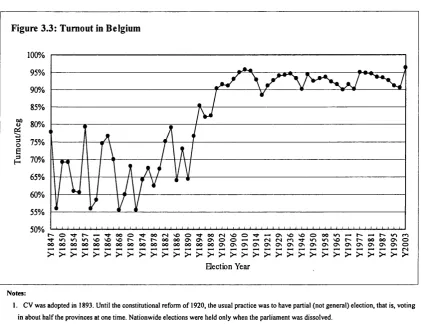
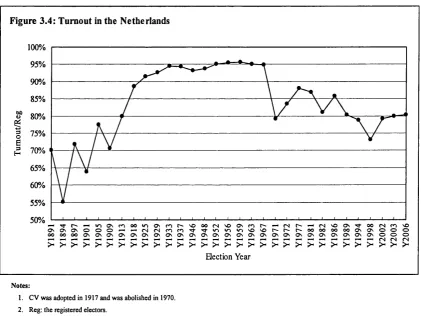
Among the major solutions to low turnout outlined above, CV is the most promising one (see Lijphart 2000, 321). CV has achieved very high turnout in several industrial democracies but it has mostly been neglected elsewhere. Moreover, the practice of CV has been declining across the world as Hirczy de Mino (2000, 45) argues. The Netherlands, which introduced CV in 1917, abolished it in 1970 (Mackie and Rose 1991, 322). The number o f Swiss cantons with CV has declined to one (Gratschew 2004, 28-29). In Austria, three provinces had CV for national-level parliamentary elections but the CV system was abolished altogether in 1992 (Federal Ministry of the Interior, Austria 2007).10 CV is seen as an unsophisticated means o f improving turnout and it is understandable that popularly-elected politicians and well-educated scholars have hesitated in discussing and proposing CV.
Solutions to low turnout must be adaptable and effective. Measures to improve the differential benefit from the electoral outcome (e.g. concentration o f power) and measures to improve the probability o f changing the electoral outcome by a single vote
Z e a la n d 2 0 0 6 ).
10 N a tio n w id e C V fo r p re sid e n tia l e le c tio n s w as a b o lis h e d in 1982, a n d th e C V s y ste m w as th e n up to p ro v in c e s b u t th e la st
C V p ro v in c e a b o lis h e d it in 2 0 0 4 (F ed e ra l M in istry o f th e In te rio r, A u stria 200 7 ).
(e.g. division o f a large country into small units, and adoption o f PR) are ineffective and/or impractical (see Lijphart 2000, 321). The remaining options are as follows:
(1) Easy-voting devices to reduce the individual cost o f voting,
(2) Civic education as a ‘soft power’ measure to motivate people to vote, and (3) Compulsory voting as a ‘hard power’ measure to motivate people to vote.
Evaluating Easy-Voting Devices
Easy-voting devices are unlikely to provoke much fundamental objection, though they might have some practical/technical difficulties (e.g. administrative cost) and some of the easy-voting devices might not be adopted in the end. Any reduction in the cost of voting would have some effect o f improving turnout, and empirical studies support this hypothesis (see the last section). However, these empirical studies also indicate that the effectiveness o f easy-voting devices is not substantial. It will be impossible to reduce this cost to zero even if all possible easy-voting devices were adopted. Moreover, the cost o f voting seems to be already low in most of the industrial democracies (see Aldrich 1993, 261-62; Niemi 1976, 115-16). Therefore, the government’s flexibility to introduce this measure is limited, and so the effect o f this effort would also be limited. It seems that some other measures to motivate electors to vote need to be combined with the adoption o f easy-voting devices in order to substantially improve turnout.
Evaluating Civic Education
desirable, civic education might fail in motivating them to individually cast a vote, whose probability to change the electoral outcome is infinitesimal. Hence, electoral education would not be sufficiently effective in motivating children to vote though it could possibly have some positive effect on turnout (Denver and Hands 1990, 271-72).
Therefore, civic education also needs to be moral education for this purpose. A curriculum for this moral education should be designed to implant into children (1) a feeling of guilt if they failed to vote and/or (2) a feeling o f satisfaction when they do vote. The current civic-education curricula of most industrial democracies do not appear to have achieved this goal judging from the fact that turnout has been decreasing. It is even doubtful whether civic education has ever been designed as moral education for this purpose with any clear understanding about the nature of voting as individual action. A simple intensification o f current civic education is therefore not likely to substantially increase turnout.
It would be difficult to design an effective curriculum for moral education even if it were possible (see Lijphart 1997, 7). From an ethical viewpoint, it would be difficult to perform challenging experiments on children or young adults. Moreover, it would be difficult to identify and control the variables other than civic education.11 Furthermore, each cycle of experiment would inevitably be long, and curriculum designers cannot get a proper feedback from their experiment before tested children reach the voting age. Moreover, civic education might be insufficiently effective in improving turnout even if a proper curriculum were designed and implemented. Therefore, industrial democracies that already have a problem o f low turnout would need to consider using other solutions to low turnout in addition to easy-voting devices and civic education.
Evaluating Compulsory Voting (CV)
In contrast to the two other devices, CV would achieve an immediate, substantial increase in turnout, and so CV is worthy of special attention (see Lijphart 1997, 8-10). However, CV has not been widely used in practice, and researchers have not paid much attention to it as a real option until recently (see Hirczy de Mino 2000, 45). Nevertheless, against the background o f continuous decline in turnout among industrial democracies, it is worth seriously considering the usefulness of this ‘hard-power’ measure. There may
11 I a p p re c ia te P ro fe sso r K e n ’ic h IK E D A h a v in g m e n tio n e d it in c o n v e rsa tio n w ith th e a u th o r o n 13 J u ly 2 0 0 6 .
be some cases in which ‘soft power’ is more useful in achieving the political goal in terms o f cost and friction than ‘hard power.’ However, controlling human mind is more difficult than controlling human behaviour, and so ‘soft power’ is possibly less effective in achieving the same goal. Overall, when ‘soft power’ is sensibly combined with ‘hard power,’ the goal is likely to be achieved most sufficiently, most effectively and most smoothly (see Nye 2004, 147).12
1.4. Conclusion
As the first part o f this chapter pointed out, turnout has been declining among the industrial democracies. As a result, the discussion of effective and practical solutions to remedy the problem has been growing. Measures to improve the differential benefit from the electoral outcome (e.g. concentration o f power) and measures to improve the probability o f changing the electoral outcome by a single vote (e.g. division o f country and adoption o f PR) are generally ineffective and/or impractical. However, measures to reduce the cost o f voting and measures to motivate electors to vote independently of the electoral outcome may be effective in improving turnout. More specifically, these potentially effective measures are easy-voting devices (e.g. automatic registration, absentee voting and weekend voting), civic education and CV. These three measures are not opposed to each other either in theory or in practice, and so these measures can be used in combination.
Among these three likely solutions, easy-voting devices would diminish the cost of voting and so would help electors to overcome the threshold of the cost o f voting and to turn out. However, the cost o f voting is already low in most of the industrial democracies, and so the scope for improvement in turnout by the use o f these devices would be limited. Civic education is an attempt to motivate people to vote by using ‘soft power.’ However, civic education deals with psychological orientations towards politics, about which we do relatively little. Consequently, its successful exercise would be technically difficult. Moreover, civic education is a long-term measure, and it would
12 A p a rt fro m e ffe c tiv e n e s s , it is d o u b tfu l w h e th e r s o ft p o w e r is m o re h u m a n e th a n h a rd p o w er. W h ile h a rd p o w e r trie s to
c o n tro l h u m a n b e h a v io u r, s o ft p o w e r tries to c o n tro l th e ir m in d . I f s o ft p o w e r w e re e ffe c tiv e ly e x e rc ise d , p e o p le w o u ld n o t b e free
have little immediate effect on turnout. In contrast, CV is an attempt to motivate people to vote by using ‘hard power.’ It would have an immediate, substantial effect in improving turnout and this effect would persist so long as CV exists. CV is a promising solution to low turnout, and so CV is worth serious consideration to use in combination with easy-voting devices and civic education. The next chapter examines the practice of CV across the world and reviews previous studies of CV.
CHAPTER 2
The Theory and Practice of Compulsory Voting
As Chapter 1 demonstrated, turnout has been declining among the industrial democracies, and CV is the most promising solution to low turnout. CV has achieved high turnout in several countries (e.g. Australia and Belgium). However, it has been mostly neglected elsewhere as a solution to the problem of turnout. CV is a strong measure, and so it is understandable that governments hesitate in its introduction. Nevertheless, if it becomes clear for industrial democracies that CV is useful to a great degree, many industrial democracies will overcome this hesitation and will introduce CV. Many academic studies have examined CV (and major works are introduced in this chapter), but they have not persuaded many industrial democracies to adopt it. This thesis aims at assessing the overall usefulness of CV for industrial democracies. However, before starting this assessment, this chapter will overview the practice of CV in the world and the previous studies on CV in order to identify the proper course of research into the usefulness of CV.
In order to lay the foundations of the research into the usefulness o f CV, this chapter will first define CV and describe actual CV systems across the world. This observation suggests that the practice of CV is enormously diverse, and the reality of CV is too unwieldy to make any meaningful assessment o f its usefulness. Therefore, without formulating an ideal type, it would be impossible to properly assess the usefulness of CV. Thus, this chapter will describe the typical CV and will then formulate the ideal type of CV for industrial democracies. Second, the chapter will evaluate previous studies of CV with an intention of assessing the overall usefulness of CV. Finally, the chapter will identify niches in the previous studies in regard to the usefulness o f CV for industrial democracies.
2.1. Practice of Compulsory Voting
CV’ and will determine the scope of CV for observation. Next, the section will describe how CV operates across the world. This overview suggests that the practice o f CV is enormously diverse even within the accepted parameters o f CV. Consequently, this section will identify the ‘typical CV’ and will finally formulate the ‘ideal type of CV’ for industrial democracies.
A Definition of CV
CV is a much disputed concept (but see a definition o f CV by Hirczy de Mino 2000, 44). For example, social (or political) sanction against abstention, like that o f the former Soviet-block countries, has occasionally been included in the concept o f CV (e.g. Derbyshire and Derbyshire 1989, 98-103). Meanwhile, it has been argued that compulsory voting is a misnomer, and it is practically compulsory attendance at the polling place because of the existence o f the secret ballot system (Robson 1923, 576). It is also arguable whether a law that requires electors to vote but does not provide any penalty against offenders should be considered to be CV. Therefore, CV needs to be defined, otherwise it will be difficult to identify actual CVs for examination. For the purpose of this thesis, a minimalist approach defines CV as follows:
CV is a legal arrangement to provide that voting/tuming-out is a legal duty.
However, this definition is not sufficiently inclusive. Therefore, this subsection will try to clarify it by providing several examples and more explanations as follows.
Turning out to vote is the minimum requirement to meet this definition, though voting rather than turning-out per se is the actual purpose o f the introduction o f CV. So long as a legal regulation meets this condition, it does not matter whether this regulation requires tuming-out only (i.e. an attendance at the polling place), the casting o f a valid or invalid vote, or the casting of a valid vote. Although this is an abstention abatement regulation rather than ‘compulsory voting,’ this thesis still regards it as a broad definition of CV. Under the secret ballot system, it is technically difficult to check whether each elector actually cast a valid vote. Therefore, what can be compulsory is attendance at the polling place rather than voting, as Robson (1923, 576) argues.
A legal duty to vote/turn-out is an essential part of this definition. So long as a regulation provides that voting/tuming-out is a legal duty, this regulation fits the
definition of CV. Therefore, any prescription of legal sanctions against offences is not essential for the definition of CV. Moreover, even if some sanction against abstention is provided, the actual imposition of prescribed sanctions on offenders is not essential, either. Furthermore, if a regulation does not explicitly provide that voting/tuming-out is a legal duty but prescribes legal sanctions against non-voting/abstention, this regulation is regarded as implicitly providing that voting/tuming-out is a legal duty.
[image:35.595.27.528.32.819.2]A moral duty to vote/tum-out is irrelevant to this definition, while a legal duty to vote/tum-out is essential to the definition. As shown in Figure 2.1 below, the moral duty overlaps with the legal duty. However, all moral duties are not—and do not need to be— legal duties (Wertheimer 1975, 283). So long as a legal regulation provides a legal duty (i.e. shaded (b) and (c) in Figure 2.1) of voting/tuming-out, this regulation fits the definition of CV and it does not matter whether voting/tuming-out is a moral duty. Therefore, a legal regulation that merely declares voting/tuming-out to be a moral duty (like that of Portugal) falls into the sub-set (a) in Figure 2.1 below.13 However, if a legal regulation provides that voting/tuming-out is a duty without specifying whether it is a moral or a legal duty, this duty is regarded as a legal one because rules and regulations are supposed to make legal arrangements rather than making moral declarations.
Figure 2.1: Relationship between Two Duties
Moral Duty Legal Duty
Legal sanctions against non-voting/abstention may be provided but are not essential for this definition of CV. For example, the CV law may provide that voting is a
13 C o n stitu tio n o f th e P o rtu g u ese R ep u b lic, A rtic le 49 , S ectio n 2 p ro v id es as fo llo w s, T h e rig h t to v o te sh all b e e x ercise d
p e rso n ally a n d sh all c o n stitu te a c iv ic d u ty .’ < w w w .p a rla m e n to .p t/in g le s/c o n s_ le g /c rp _ in g /in d e x .h tm l> (18 S e p te m b e r 2007).
duty but it may not stipulate any penalty for illegitimate abstention (see Table 2.1). Without any sanctions, it is impossible for the government to legally enforce voting/tuming-out and so this legal regulation cannot be ‘compulsory’ voting/tuming-out in the literal sense, though there can still be ‘obligatory’ voting/tuming-out. However, compulsory voting (CV) is a much more widely-used expression than obligatory voting among political students, and so this thesis follows the majority and uses this conventional expression of CV.
The actual enforcement of voting/tuming-out is not essential for meeting this definition of CV even if the law provides legal sanctions against non-voting/abstention. When rules and regulations prescribe legal sanctions against offences, the government is supposed to impose these sanctions on offenders. However, in reality, the government may not be interested in actually imposing these sanctions on offenders (Gratschew 2002, 106; Gratschew 2004, 26). In particular, the government may not have sufficient resources to investigate cases, identify offenders and impose sanctions on them. Even if the government does not impose the prescribed sanctions on non-voters/abstainers, this omission does not matter regarding this definition o f CV. For example, the sanction against abstention is imprisonment in Greece, but this sanction has never been applied, according to IPU 2007. However, the case of Greece fits the definition o f CV (see Table 2.1 for cases o f ‘weak’ enforcement).
Social sanction/enforcement o f voting/tuming-out does not satisfy this definition of CV. This is because social sanction/enforcement implies that voting/tuming-out is a social duty but does not imply that it is a legal duty. In many o f the former Soviet-block countries, voting/tuming-out was legally voluntary but was socially— or politically— compulsory (see Derbyshire and Derbyshire 1989, 98-103). However, the definition of CV o f this thesis does not include such kind of *de fa c t o ' compulsory voting. Even in authentic liberal democracies, some peer pressure to vote/tum-out exists. However, none o f such social sanction/enforcement o f voting/tuming-out is relevant to this definition o f CV.
Function of CV
The subsection above provided a descriptive, legal definition of CV. In order to examine its function, it is possible to explain the expected, direct effect o f CV and its mechanism as follows:
The function o f CV is to mobilise electors to vote/tum-out by providing them with material and non-material disincentives to abstain from voting.
This explanation of the function o f CV should not be confused with the definition of CV. For example, the social sanction/enforcement o f voting/tuming-out satisfies this explanation of CV above, but it does not satisfy the descriptive, legal definition of CV used in the last subsection. However, this thesis does not regard such social sanction/enforcement as CV. CV is nothing more than an institutional device and, as is so often the case with such devices, CV can have a variety of effects according to its usage and environment. However, this variety does not affect the nature of CV as an institutional device, and CV in itself is neither useful nor harmful. Therefore, CV might eventually be useful for several countries but might not so for others.
Inducement voting (IV), under which the government offers electors some material inducement to vote/tum-out (e.g. a monetary reward), can be logically an alternative to CV (Hasen 1996, 2135, 2169; Lijphart 1997, 11; Rydon and Goot 1989, 11). However, its exercise is new and rare (see Balinov 2006; Birch 2007, 19-20; Ellis et al. 2006, 23-24; Gratschew 2006; Hasen 1996, 2136; Hasen 2000; Hicks 2002; Keaney and Rogers 2006, 24). Its effect and mechanism can be explained as follows:
The function o f IV is to mobilise electors to vote/tum-out by providing them with material incentives.
will briefly explain the underlying mechanism o f IV.
The Practice of CV in the World
Table 2.1 below lists the countries in the world that use CV, including developing countries.14 In this table, CV countries are listed according to the level of turnout o f the registered electors (i.e. ‘Turnout/Reg’ in Table 2.1 below). The results show that the practice of CV is not common, but it is not necessarily rare either. The number of CV countries is 28 (16.1%) out o f the 174 independent democracies whose data are stored in the International IDEA database o f elections (Pintor, and Gratschew 2002).15 CV countries are therefore a substantial minority among democracies.
14 T a b le 2.1 is c o m p ile d fro m G ra tsc h e w 2 0 0 2 a n d G ra ts c h e w 2 0 0 4 , b e c a u s e h e r im p lic it sele c tio n sta n d a rd o f C V c o u n trie s
see m s to b e th e sam e as th e d efin itio n o f C V b y th is th e sis and h e r lists o f C V c o u n trie s a re m o re in fo rm a tiv e th a n o th e r lists: C IA
2 0 0 7 ; D e rb y sh ire an d D e rb y sh ire 1 9 8 9 ,9 8 -1 0 3 ; H e rm a n 1 9 7 6 ,1 4 6 -4 7 ; L e D u c , N ie m i a n d N o rris 2 0 0 2 ,1 3 - 1 5 ; N o h le n e t al. 2 0 0 0 ,
3 5 5 -7 3 . IP U 2 0 0 7 a lso p ro v id e s in fo rm a tio n a b o u t e le cto ral sy ste m s a n d v o tin g s y ste m s (in c lu s iv e o f C V ) in each co u n try .
15 S w itz e rla n d is c o u n te d as o n e o f C V c o u n trie s in th is calcu la tio n .
Table 2.1: Practice o f CV in the World
Country Turnout/Reg (% ) Turnout/V A P (% ) Sanctions Enforcement Australia 95.5 82.1 a, b Strict
Singapore 95.3 35.4 d Strict
Uruguay 91.6 95.4 b, d Strict
Cyprus 91.0 76.8 a, b Strict
Belgium 90.9 83.2 a, b, d, e Strict
Nauru 90.3 50.1 a, b Strict
Chile 89.2 77.5 a, b, c Weak
Luxembourg 87.4 58.7 a, b Strict Liechtenstein 86.8 54.0 a, b Weak
Turkey 86.2 79.8 b Weak
Italy 82.2 86.1 None Not enforced Fiji 82.1 65.3 a, b, c Strict
Peru 81.7 78.6 b, d Weak
Brazil 80.4 80.5 b Weak
Argentina 78.4 78.8 a, b, d Weak
Greece 75.7 86.5 Weak
Costa Rica 75.6 79.0 None Not enforced
Paraguay 73.4 52.4 b N/A
Bolivia 71.1 56.2 d N/A
Honduras 68.4 65.8 None Not enforced Thailand 66.2 70.1 None Not enforced Dominican Republic 65.8 53.9 None Not enforced
Mexico 57.8 51.3 None/e Weak
Ecuador 57.6 58.2 b Weak
Egypt 46.2 27.7 a, b, c N/A
Guatemala 43.6 32.3 None Not enforced
Gabon N/A N/A N/A N/A
Switzerland (Schaffhausen) - - b Strict
Average 77.3 66.0 -
-N otes:
1. Turnout is the average o f last tw o parliam entary (low er-house if applicable) elections com piled by P intor and G ratschew 2002. Votes include
invalid votes w hen available.
2. Reg: the registered electors, VAP: the voting age population, N/A: not available.
3. Sanctions: a= E xplanation, b=Fine, c=Possible Im prisonm ent, d= Infringem ent o f C ivil R ights or D isenfranchisem ent, e=Other.
4. In S w itzerland, only o ne o f 26 cantons has CV.
5. The N etherlands abolished C V in 1970. In A ustria, several provinces had CV for the N ational C ouncil but this C V w as abolished in 1992
according to the Federal M inistry o f Interior, A ustria (2007). Italy abolished sanctions against abstention but still has a law providing that voting is a
duty w ithout clarifying w hether it is a legal duty or m oral duty, according to G ratschew (2004, 28-29).
S o u rces: Electoral C om m ission 2006, 18; G ratschew 2002; G ratschew 2004; P intor and G ratschew 2 0 02, 125-56.
understanding the practice o f CV across the world. However, the reality o f the practice o f CV is, o f course, much more complex than this model. First, the regulation of CV