Audiovisual Abstractions
Max Hattler
A report submitted in partial fulfilment of the requirements of the School of Arts and Digital Industries, University of East London,
for the degree of Professional Doctorate in Fine Art
Contents
1. Introduction ... 4
2. Autobiographical Context ... 4
3. Creative Practice and Theory ... 8
a. Theory and Artists ... 8
i. Visual Music and Audio-Vision ... 8
ii. Improvisation Within a Restricted Framework ... 16
iii. Reflection Between Abstraction and Figuration: Towards an Abstracted Heterotopia ... 20
iv. Spiritual, Psychedelic, Synaesthetic Experience ... 23
b. Creative Practice ... 25
i. Animation Works ... 26
1. War Machines ... 26
2. Metaphysical Machines I: Meta/Physics ... 29
3. Abstractions of the Everyday ... 33
4. Metaphysical Machines II: Expanded Abstractions ... 37
ii. Audiovisual Performance ... 48
1. Collaborative Experiments in Found Footage, Narrative and Audio ... 48
2. Metaphysical Machines III: The Hattlerizer ... 50
4. Professional Practice ... 54
a. Professional Practice Listings ... 54
i. Solo Exhibitions and Retrospectives ... 54
ii. Joint Exhibitions ... 55
iii. Selected Group Exhibitions ... 55
iv. Film Festivals ... 58
v. Awards ... 60
vi. Artist Residencies ... 62
vii. Collections ... 62
viii. Teaching ... 62
ix. Workshops ... 63
x. Artist Talks and Lectures ... 63
xi. Audiovisual Performances ... 68
xiii. Curating ... 72
xiv. Filmography ... 73
1. Short Films and Video Installations ... 73
2. Performances ... 73
3. Music Videos and Concert Visuals ... 74
4. Other Works ... 74
xv. Publications ... 74
1. Writings ... 74
2. Works Discussed in Books and Academic Papers ... 74
3. Selected Press ... 75
4. TV ... 80
5. Radio ... 81
6. DVDs ... 81
b. Reflections On Professional Practice ... 82
i. Tripolar at MOCA Taipei ... 82
ii. Audiovisual Collaborations ... 84
iii. Teaching and Workshops ... 84
iv. Curating Wilderness of Mirrors ... 85
5. Conclusion ... 87
6. Bibliography ... 87
7. Appendices ... 92
a. List of Illustrations ... 92
b. Additional Illustrations ... 94
c. ‘Audiovisual Abstractions’ Doctorate in Fine Art Exhibition ... 96
1. Introduction
The doctoral programme has supported my transformation from a sometimes experimental, sometimes commercial animation director to an artist working with animation. That is to say, it has helped me question the origins of my hitherto largely intuitive approach by framing it within a wider artistic-theoretical context. This has enabled me to reposition and revaluate my moving image practice, and brought me to a point where I have focus in terms of concept, technique, methodology and professional practice. This report is divided into sections. ‘Autobiographical Context’ outlines relevant personal history, education and practice prior to the doctorate programme. ‘Creative Practice and Theory’ forms the main body of my reflective, contextual and critical analysis of my practice throughout the five years of the doctorate. Through a discussion of artists and theorists I investigate several interconnected areas of importance to my work: the interface between abstraction and figurative spaces; the use of animation and abstraction in an expanded sense including live performance; and the relationships between sound, music and image. An examination of the development of my artistic practice will contextualise it within this framework. ‘Professional Practice’ provides an account of exhibitions, performances and other professional engagements, and some further reflective thoughts on how this has integrated into my doctoral research. The conclusion collates my overall final position.
2. Autobiographical Context
took me to ‘psychic readings’ with a supposedly clairvoyant counsellor and medium who told me I should study business administration as a solid foundation for my life— not what I wanted to hear. My relationship to the metaphysical worldview put forward by school and my mother was complicated. It embedded in me an innate acceptance of a higher realm, while my scientifically orientated intellect continually questioned this view. I wanted to believe, but more than that, I wanted proof. By the time I was seventeen, the rift between my parents had become unbearable, and I moved to Frankfurt on my own, to get some distance while completing secondary school, and continuing to make music. Trying to make sense of the paranormal for myself, I briefly experimented with drugs and meditation, and got interested in the writings of self-described agnostic mystic Robert Anton Wilson, and Carlos Castaneda’s The Teachings of Don Juan books which describe his training in shamanism. A school presentation on scientific research into UFOs and the existence of extra-terrestrial life temporarily made me the laughingstock of my class.
Upon graduating from school I was unsure about which direction to pursue, and work as a conscientious objector in a Camphill care home for special needs youngsters suddenly made studying any art or design discipline seem self-indulgent. I decided to read Media and Communications at Goldsmiths. Music making gave way to filmmaking, at the same time as pseudo-science gave way to academic inquiry. My search for the metaphysical realm concluded, without proof, and my focus shifted to my studies. This satisfied my creative interests, while it also taught me more widely about a broad spectrum of critical perspectives on culture and the media, including cultural theory; concepts of audience; theories of postmodernity, identity and globalisation; semiotics; film analysis; music as communication; differing psychological perspectives on the analysis of culture and communications, and more. In the practice part of the programme, I specialized in animation, finding in it a way of amalgamating my interests in computer and time-based production, sound and image.
My MA dissertation discussed animation as a privileged space for the communication of inner states of consciousness, emotions, subjectivity and dreams. By looking at animation’s position on the borders of art and film, avant-garde modernism and Hollywood consumerism, philosophy and anarchy, and dream and reality, I tried to point out some of the characteristics which differentiate it from live-action film and from static, non-narrative visual art. I argued that its inherent qualities allow for the creation of deeply personal and dreamlike films, and that its relationship to ideas and practices of the surrealist and modernist avant-garde put it in a unique position in these in-between territories which can be a vital means for critique and criticism in and of the real world. I developed an interest in the space between abstraction and figuration, where storytelling is freed from the constraints of traditional narrative, contemplating atmospheres and microcosms rather than employing fully explicit narratives: Close-ups as reflections on the big picture, aesthetics as reflections on politics. In my graduation film Collision (2005) I explored the idea of abstract storytelling. Using the colours of American, British and Arabic Islamic countries’ flags, and the shapes of Islamic patterns and American quilts, the film opens up an abstract field of reflection on the clash of cultures into beautiful, yet unsettling kaleidoscopic scenes.
Figure 1: Max Hattler, Collision, 2005
2D digital animation, colour, sound, 1080p HD video, 3 min
Upon graduating from the RCA in 2005, I directed experimental music videos, concert visuals, and some further commercial work for clients including Basement Jaxx and IKEA, but continued to make abstract films as I realized that only an independent practice gives me the freedom to develop the ideas that I am interested in. My film Drift
photography in extreme close-up creates a foreign yet familiar world, removed from reality, yet sometimes almost too close. In the music, this tension is mirrored. Original samples are exploded into a multitude of tiny elements before being reconstructed into a tight arrangement based on the Fibonacci series. AANAATT (2008), inspired by constructivism and Laszlo Moholy-Nagy, shifts between three-dimensional objects and two-dimensional surfaces, as it folds the illusion of space through the use of mirrors to give way to the abstract logic of tubes, discs, cylinders and other shapes as they scale, rotate and transform.
Figure 2: Max Hattler, Drift, 2007 Flash animation, photography and compositing
Colour, sound, PAL video, 4 min
Figure 3: Max Hattler, AANAATT, 2008 Stop motion animation, colour, sound
1080p HD video, 5 min
real-time generated visual elements, video loops and sequences, in combination with music or soundscapes. This allowed me to take the making process out of the studio and into a live environment, thereby embracing chance and serendipity as core constituents of the work. Initially, this took the form of VJ sets in nightclubs or with live bands, which were based on the abstraction of found footage through fast-paced, real-time visual effects. This provided a counterpoint to my films in terms of practice as well as aesthetics, and I enjoyed the almost cathartic experience of a relentless visual outpouring. Over time, I began to move away from VJing towards a more considered format of audiovisual performances, with a fixed timeframe of 30 to 60 minutes, conceptually more stringent content, often performed in collaboration with other sound and visual artists, at arts venues, media art, film and music festivals.
In 2008, my mother passed after a short and sudden battle with cancer, certain in the knowledge that a better life would await on the other side. This opened old wounds for me and provoked a renewed interest in notions of the spiritual, not in proof or direct experience, but in an engagement through my artistic practice. It also prompted a reflection on my position in life, and on my creative output. While I was content with the overall quality and scope of my work since graduating from the RCA four years earlier, I realised that what I needed was a clearer critical context and a better understanding of my own practice. In the following year, I enrolled on the Professional Doctorate programme in order to address these issues, in the hope of developing my work into a more unified and concise artistic expression.
3. Creative Practice and Theory
a. Theory and Artists
i. Visual Music and Audio-Vision
“formative evolutions and revolutions in the sphere of the purely artistic (abstract forms), roughly analogous to the events which take place in music, and with which our ears are familiar.” (Eggeling in Daniels 1997) Hans Richter came to abstract painting through ‘musically’ articulating forms on the canvas, and subsequently applied this approach to film. He points out that “the relationship between forms on the canvas is a rhythmical relationship. And rhythm, in my opinion, is the essence of filmmaking, because it is the conscious articulation of time.” (Richter in Starr 1972) His film Rhythm 21 explores the square shape of the projected film in a rhythmical progression of growing and expanding rectangles. “The simple square,” so Richter, (in Russett & Starr 1988: 49) “gave me the opportunity to forget about the complicated matter of our drawings and to concentrate on the orchestration of movement and time.” Walter Ruttmann foresaw in 1919 that due to continued technological progress a “new, hitherto latent type of artist would emerge, approximately half-way between painting and music.” (Ruttmann in Daniels 1997)
My own interest in working with the moving image also stems primarily from an abstract and musical perspective rather than a narrative one (although, as will be discussed later, there is a narrative component to some of my work). Through my father, I was exposed to making music from an early age. After learning to play classical violin using musical notation as a child, I replaced it by computers to create electronic music throughout my teens. Rather than using notation, the process employed was based on a slow, non-linear improvisation aided by digital technology: the sequencing, layering, editing and re-editing of sounds, loops and samples into a linear form of rhythmic and musical relationships, the orchestration of movement1 and time, until a point of completion was reached. I subsequently transposed this process to the moving image. Digital tools facilitate the crossover and convergence between time-based sound and image media, as both are interacted with through a series of similar interfaces and operations: timelines, layers, key frames, cutting and slicing, copy-paste, effects and transitions, additions and multiplications. All media can be worked with simultaneously, equally, as they are essentially reduced to maths.
Oskar Fischinger (1900–1967) is widely regarded as the master of absolute film (Moritz 2004; Fuxjäger 2012; Posner 1995). He originally chose music as a career, studying
violin and organ building (for mathematical harmonic theory) and later architectural drafting and tool design. In 1921, he was thrilled by the first performance of Walter Ruttmann’s Lichtspiel Opus I, a colour abstract film with a live musical score by Max Butting, and as a result was inspired to devote himself to absolute cinema, which could best combine his skills at graphic art and music (Moritz n.d.). Fischinger describes his work alternately as optical poetry or visual music (Foye 2002). “The most unique thing that cinema could do,” writes film historian William Moritz (1999) with reference to absolute film, “is present a visual spectacle comparable to auditory music, with fluid, dynamic imagery rhythmically paced by editing, dissolving, superimposition, segmented screen, contrasts of positive and negative, color ambiance and other cinematic devices.”
The term visual music is widely used and can be defined in several overlapping ways (see Fuxjäger 2012; Keefer & Ox 2008; McDonnell 2007): (1) the translation of music or sound into a visual language, either on a static canvas (e.g. Paul Klee, Wassily Kandinsky, Harry Smith) or in a time-based medium such as film; (2) the translation of image to sound or music, such as in Oskar Fischinger’s Ornament Sound experiments (Figure 44); or (3) a time-based visual composition that is similar to the structure of music. Cindy Keefer and Jack Ox (2008) see this as “a new composition created visually but as if it were an aural piece. This can have sound, or exist silent.” (4) Anton Fuxjäger also uses the term visual music to describe moving image works—on film or performed live—which are “as abstract as music.” (2012: 120)
of Fischinger’s films of that period, in spite of his denials that they are not visualized or illustrated music, their formal principles rest heavily on the musical analogy: one kind of shape corresponding to one kind of sound, another to another, one kind of movement corresponding to one development in the melody, and so on, repeats in the music being followed by repeats in the animation.” (Le Grice 1977: 65) Yet, a closer reading reveals that Fischinger’s works are not purely manual translations of music into images. Anton Fuxjäger (2012) defines ‘music translations’ as “certain parameters of the accompanying music are transcoded into certain visual parameters, the accompanying music thereby provides the temporal structure of the audiovisual artwork.” (2012: 120) Using Studie Nr. 6 as a case study, Fuxjäger shows that “(o)n the visual layer Fischinger built a temporal structure that sometimes mirrors each note of the music, at other times only some of them. Sometimes the visual motifs change in accordance with the music but in most cases they don’t. So, as a whole, the structure of the music and the structure of the images together create a new, even more complex structure.” (2012: 124)
Figure 4: Oskar Fischinger, Studie Nr. 6, 1930 16mm film, b/w, sound, 2 min
curving objects provides a behavioural parallel to the energetic signature of the melody.” (Battey 2014) It becomes clear that Fischinger’s films are more than translations of music into moving images. Instead, music and images unite to form a total audio-visual structure that is both the result of the music and the images, what Fischinger (in Moritz 2004: 180) calls “a new, higher Oneness.”
Figure 5: Oskar Fischinger, Composition in Blue, 1935 35mm film, colour, sound, 4 min
Music: Overture to The Merry Wives of Windsor by Otto Nicolai.
“Composition in Blue is more than merely an optical ‘illustration’ of music. It pictures a new, higher Oneness. (…) It is a breakthrough, a further developmental step towards a
new art of the future.” (Fischinger in Moritz 2004: 180)
emotions in balance,” writes Mary Ellen Bute (in Naumann 2011). “To achieve strong emotional reactions we must charge our perspective sensual apparatus with greater and more intense exciters. In the field of art these stronger exciters are synchronized art forms.” (ibid.)
Michel Chion’s concept of synchresis, an acronym created by combining the words synchronism and synthesis, is useful here. In his book Audio-Vision: Sound on Screen, Chion (1994: 63) defines synchresis as “the spontaneous and irresistible weld produced between a particular auditory phenomenon and the visual phenomenon when they occur at the same time.” He stresses that the possibility of recombination of sound and image is essential to the making of film sound. “For a single face on the screen there are dozens of allowable voices – just as, for a shot of a hammer, anyone of hundreds of sounds will do. The sound of an axe chopping wood, played exactly in sync with a bat hitting a baseball, will ‘read’ as a particularly forceful hit rather than a mistake by the filmmakers.” (1994: XVIII) Synchresis fuses sound and image into an audiovisual unit whose logic is accepted as truth and experienced on a visceral level by the viewer. While Chion talks about sound for live action film, this also applies to other kinds of moving image such as animation or live visuals. Especially with visual abstraction, synchresis helps to make it believable and bring it to life. Tight synchronisation of sound to abstract image, even more so when using non- or semi-abstract sounds, also gives hints of meaning and guides the reading of the work. An example for this is my short film RE:AX (2011) where a visually pared down language of shapes is juxtaposed with a comparatively complex soundtrack. Precise synchronisation between the recognizable sounds of rockets and explosions with the abstract images links the two media and anchors the reading of specific events, while the overall orchestral score guides the emotional response of the viewer. In my film Shift (2012), the synchresis between small objects and ‘gigantic’ sounds exponentially increases the perceived size of the objects on screen.
its ‘language’ from music. In most cases AV work is concerned with formal compositional structures, of time and rhythm, which are closer to music than to specifically cinematic or visual art codes.” (Andrews 2009) This also holds true for my own audiovisual performance practice (see below). Cornelia and Holger Lund’s book
Audio.Visual: On Visual and Related Media (2009) sets out a framework for the discussion of visual music and audiovisual performance. One of the contributors, composer and sound artist Friedemann Dähn, sees no universally accepted vocabulary of visual music, no clear visual analogies of harmony, rhythm, melody and counterpoint. Echoing Water Ruttmann’s 1919 prediction, Dähn (2009: 153) notes that “(p)erhaps a new type of artist is emerging that either unites both aspects—i.e. is both musician and visual artist,” or, with different ensembles of sound and light artists “visual music can be created in each individual context and a unique audiovisual language can be developed, just as each musician or band develops its own sound.” (ibid.) Since 1999, Friedemann Dähn, together with Thomas Maos, has been organizing CAMP Festival for Visual Music, specifically for the latter purpose: to create an innovative forum and interactive laboratory in which sound artists and musicians meet projection, installation and video artists. CAMP (Collaborative Arts and Music Project) Festival is defined by experimental and electronic music in convergence with visual disciplines: “For several days a selected group of artists, who belong to the international avantgarde in their field, work in a ‘laboratory of time’ on audio-visual projects which will be presented to the public at the final performances.” (Dähn 2011) The focus is on live improvisation, intermedial exchange and collaboration between artists in creating works that are truly audiovisual: not illustrated music or films with a score, but audiovisual works which are more than the sum of their parts: visual music in the sense of equal collaboration between sound and visual artists. In 2011, I was invited to participate in CAMP Festival for Visual Music, which was held in Zagreb and Karlsruhe. These two weeklong intensive meetings of around 10 audio and visual artists gave me many new impulses. The ethos of live improvisation and collaboration meant that the attending sound artists were genuinely interested and able to improvise to the moving images with virtuosity, which resulted in some transcendent moments of audiovisual oneness.
complex structures coexist (Kurokawa, n.d.). He regards sound and image as one unit, not as separate entities, and constructs elegant and precise computer based works with this audiovisual language. His works take on multiple forms such as audiovisual concerts, screening works, and installations.
Figure 6: Ryoichi Kurokawa, Syn_, 2011 Audiovisual concert, diptych, 2.1ch sound, 30-45 min
Figure 7: Ryoichi Kurokawa, Syn_ at Festival Némo 2013, Le Centquatre, Paris, photo by Quentin Chevrier
Klee and Norman McLaren to Wassily Kandinsky had dreamed during the twentieth century, long before the appearance and the democratisation of digital technologies.” (in Tuffrey 2013) Experiencing _Syn is exhilarating and awe-inspiring, as eye and ear are showered with an onslaught of impeccable synchresis, a perfectly orchestrated choreography of sound and image. Revisiting _Syn at Reykjavík Visual Music · Punto y Raya Festival 2014, however, left me with the impression of having seen the same truly striking film twice, rather than having experienced a live performance. As all elements are meticulously pre-produced for maximum impact, the live aspect is to an extent lost.
ii. Improvisation Within a Restricted Framework
One of my aims with audiovisual performance has always been to play live, to take my work on the road and to create in the moment. Just as a musician might labour for months in the studio to record an album, to then go on tour and perform new material, I wanted to complement the lengthy and sometimes solitary experience of animation filmmaking with the adrenalin-fuelled engagement of live performance. It is important for me that the audience also participates in this process through recognizing that what they are experiencing is happening in the moment. Live improvisation, therefore, has been a key concern, as its imperfect nature invites the intellectual engagement of the audience. The performance practice of Kurt Laurenz Theinert (b. 1963) is important in this regard. Theinert regards real-time reciprocal reaction between sound and visual artist as the cornerstone of his improvised live performances, where a certain range of error becomes an intrinsic and enjoyable part of the process (Kubon 2014). “Not only the emotional level would be lost if you were to precisely pre-compose each light performance,” says Theinert. “The audience of my light concerts would also be bored very quickly, simply because everything would be perfect and the mind of the viewer would have nothing more to do.” (Theinert in Kubon 2014)2 The non-representational nature of Theinert’s visual language, in correspondence with the abstractness of music, further stimulates sound-image association on the part of the viewer. (Theinert 2014) His multi-projector visualisations fill the whole room, not unlike music, immersing the viewer within. Theinert performs with a custom-made visual instrument, which he developed with software designers Roland Blach and Philip Rahlenbeck. This Visual Piano is a unique hardware/software combination, which gives Theinert a great degree
of live control, allowing for the real-time ‘musical’ performance of moving graphic shapes. “These dynamic and immediate drawings in light are not (as with VJ soft- and hardware) generated by pre-recorded clips, but every moment of the performance is being played and modulated live and in real time via the keyboard and pedals. Form and content are of one here. The Visual Piano performances explore professional contemporary artistic practice through the abstract, ephemeral medium of light.” (Stürzl n.d.) The Visual Piano is in many ways similar to the Hattlerizer visual instrument I developed on the doctorate, which will be discussed in detail further below.
Figure 8: Kurt Laurenz Theinert, Visual Piano, 2013
Audiovisual performance with music by Fried Dähn and Thomas Maos, B-Seite Festival, Trinitatiskirche, Mannheim, Germany
Figure 9: Kurt Laurenz Theinert, Visual Piano, 2011 Audiovisual performance with music by Nicola Lutz,
While improvisation plays a key role in my live performances, it is also an important aspect of my film practice. In the live performances with the current Hattlerizer system, free improvisation takes place within a set of pre-coded, clearly defined visual and temporal parameters including modifications of scale, rotation, position, direction, speed and mirroring. Similarly, while the outcome of each new film project is open ended, the making process is always driven by free experimentation within a set of rules. An interesting frame of reference can be found in Eurythmy, an expressive movement art taught at Waldorf schools as part of its curriculum which strongly emphasizes creative disciplines including music and art, Johann Wolfgang von Goethe’s colour theory and Wassily Kandinsky’s thinking on the spiritual in art. Eurythmy employs a movement repertoire whose gestures relate to sounds and rhythms of speech, tones and rhythms of music, and emotions such as sorrow and joy. It also cultivates a feeling for the qualities of contraction and expansion, curves and straight lines, colour, and the directions of movement in space. Once these fundamental repertoire elements are learned, they can be composed into free artistic expressions. (“Eurythmy” 2014) In a similar sense, I establish a repertoire of rules and cross-medial relationships, which is then freely explored. While I, like any self-respecting teenager, hated Eurythmy lessons, they might after all have left an imprint. In my practice, the repertoire of rules is different for each work. It is either defined at the start of the project or it emerges during the production. Often a film starts from a single, sometimes vague idea, which is then nurtured through a process of slow improvisation. Rather than working with storyboards, I make use of the computer’s capabilities to work nonlinearly, shaping the film’s constituent elements into a linear order until a point of completion is reached, like in my previous music making. As animation takes a long time to create, research and development can happen throughout the making process and feed into the work. Formal, aesthetic, conceptual and narrative constraints are elaborated, allowing for free experimentation within. Such parameters might include rules regarding the types of allowed elements and combinations of sound, music, movement, colour palette, shapes and forms, animation technique, software, frame rate, duration, screen size and number, and so on.
language in his paintings, demonstrates in his book Point and Line to Plane (1979, first published 1926) the graphic interpretation of the opening themes of Beethoven’s Fifth Symphony. Harry Smith consequently applied Kandinsky’s method to bebop jazz compositions in his paintings (Foye 2002). Smith was deeply influenced by Kandinsky’s writings, as he was by music, particularly the emergence of bebop in the 1940s (Foye 2002). “In the music of Dizzy Gillespie, Thelonious Monk, and Charlie Parker, Smith found a revolutionary music which unlike his other interests was a contemporary expression of his own generation—an aesthetic of the now.” (Foye 2002)
Figure 10: Harry Smith, Film No. 3: Interwoven, 1947
Hand-painted 35mm photographed in 16mm film, colour, sound, 3 min
Smith’s abstract films from that period visually embody bebop, which is characterized by frantic tempos, rhythmic intricacies, harmonic complexities, and improvisational freedom. These films consist of sequenced film frames hand-painted over years using stencils, tape, paint, bleach and petroleum jelly, underscoring the surface aspects of celluloid while simultaneously expanding the fictive territory of the film frame (Brougher 2005: 117). “In works such as Early Abstractions: Film No. 3 (Interwoven)
Compared to Harry Smith’s analogue approach, the digital basis of my filmmaking practice allows for more flexible improvisation and experimentation. In a live context, where improvisation takes on a real-time dimension, the digital aspect becomes even more important. While my animation work always involves digital technology at some point in the process, this is not a statement in itself but a means to an end. The choice of tools and materials eventually always depends on the specific requirements of the project at hand. With each new piece, I try to incorporate new rules and constraints regarding aesthetics, materials, and techniques, to experiment how concepts translate across media, from 2D to 3D animation, to stop motion or photography-based animation. This is also a way of keeping the process interesting for myself—something I have found to be an important factor in sustaining an art practice.
iii. Reflection Between Abstraction and Figuration: Towards an Abstracted Heterotopia
While my films are not narrative in a traditional sense, they are also never completely non-narrative. I propose that they narrate in a way, which requires a different kind of viewer engagement. That is to say, they require a proactive audience, rather than the reactive audience of traditional cinema. My work invites the viewer to investigate and ‘read’ it, as opposed to being handed it on a plate. Different readings are possible and encouraged, as the work functions more as an open-ended ‘thinking space,’ rather than transmitting a closed-off meaning. Related to this is the fact that my work cannot, at least not always, be classed as purely non-objective. Instead, fluctuating between the non-objective and recognizable realms, it functions within a broader notion of abstraction, an aesthetic that comes out of ideas of repetition, mirroring, shapes, and texture, what Michael O’Pray (2003) calls ‘abstracted’ as opposed to purely abstract. By using patterning or mirroring, such as in my works Sync, RE:AX or Heaven and Hell, by rearranging objects as in Shift, Model Starship or Unclear Proof, or by zooming into real images as in All Rot or Nidden Partikel, formal aspects become highlighted and enable a distancing effect from the everyday, which can serve as a way of questioning, undermining and commenting back on reality.
presented, the viewer is freed from all everyday associations, and allowed extraordinary perceptions and unusual experiences. “In the spirit of non-objective art,” writes Moritz (1976) about Oskar Fischinger, “he maintained, correctly, that his films were absolute experiences in and of themselves, not representations of some other object or experience.” Fischinger sees this in strong contrast to live action film, which he regards as “photographed surface realism-in-motion. (…) There is nothing of an absolute artistic creative sense in it. It copies only nature with realistic conceptions, destroying the deep and absolute creative force with substitutes and surface realisms.” (1995: 4) Anton Fuxjäger sees the purpose of non-objective art exactly in enabling this kind of ‘meaning-less’ reception, where recognition and meaning-making are suppressed, enabling perceptions in the viewer which are qualitatively different from everyday experience. “In my opinion, attempts to attribute meaning to non-objective art, to interpret it, are misplaced. They fail to recognize the nature of this genre, which consists precisely in not transporting meanings. It is therefore in some way indeed meaning-less, but not purposeless.” (Fuxjäger 2011: 2)3
This qualitatively different mode of reception, removed from everyday experience, is key. In my view, however, meaning-making and a removal from the everyday are not mutually exclusive. On the contrary, I see this removal as a privileged reflective position from which to comment back on reality. Abstraction can open up an alternative space in which shapes, textures and movements suggest meanings. Abstract shapes can be imbued with meaning through movement, repetition, metamorphosis, and juxtaposition, or through their combination with sound or figurative elements. All these aspects can work together to provide pointers in the reading of the work. Animation, employing the aesthetics of abstraction in this sense, exploits ambivalence and ambiguity in the construction of more open-ended narratives that engage the viewer in a different way. Not non-objectivism as a complete negation, but abstraction as a way of undermining, of injecting irony, of removing the viewer from the everyday to enable a questioning of the perceived realities of human existence. In an environment oversaturated with the same media images, representing things in a more abstract sense, while giving hints of meaning, which feed the viewer’s imagination, may be more engaging for some people by offering up an alternative view.
Michel Foucault’s (1986) concept of heterotopia can be useful here. Foucault sees heterotopias as “something like counter-sites, a kind of effectively enacted utopia in which the real sites, all the other real sites that can be found within the culture, are simultaneously represented, contested, and inverted.” (1986: 24) While speaking about heterotopias as real physical spaces, there is enough flexibility in the concept to use it for a discussion of moving image work. Kevin Hetherington (in Topinka 2010: 59) sees heterotopias as “counter-hegemonic (…) spaces of alternate ordering. Heterotopia organize a bit of the social world in a way different to that which surrounds them.” Similarly, for Peter Johnson (in Topinka 2010: 60) heterotopias are an attempt to “think differently about, and uncouple the grip of, power relations.” In the examination of moving image work which opens up this kind of engagement though the negotiation of an abstract mode and figurative representation, I would like to propose the term ‘abstracted heterotopia.’
Figure 11: Ryoichi Kurokawa, ground, 2011
3 HD displays, colour, 3.1ch multi-channel sound, 12 min loop
perspective of conflict, war, and suffering, Kurokawa succeeds in presenting a new view of the region’s turmoil by readjusting the space and time of context. By reconstructing Demoustier’s footage, adding gestural manipulations and distortions and adding audio, Kurokawa both distorts and amplifies reality of war in the Middle East.”
iv. Spiritual, Psychedelic, Synaesthetic Experience
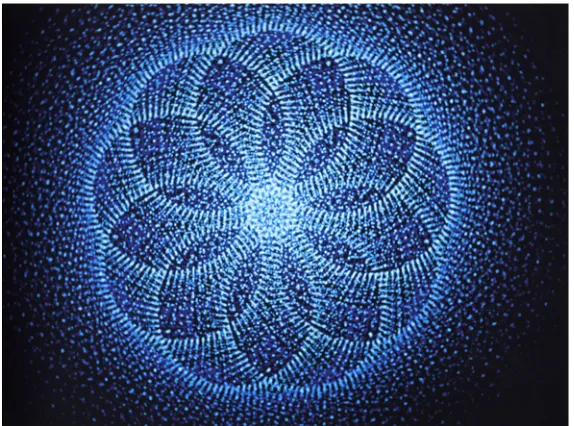
John Whitney hypothesized in his 1980 book Digital Harmony that “the attractive and repulsive forces of harmony’s consonant/dissonant patterns function outside the dominion of music.” (Whitney 1980) Just as musical harmonies are recognized as harmonic by the listener and in return elicit a sense of harmony, the mathematical construction of abstract visual patterns and symmetries is perceived as beautiful and can evoke harmonizing feelings of awe and wonder in the viewer. This connection is manifested in the use of visual symmetries and patterning (as well as the use of music) in religious and spiritual contexts since the beginning of mankind across cultures, notably the sacred geometry of churches, temples, totem poles, and mandalas used for meditation. John’s brother James Whitney (1921-1982) created a series of mandalic films which succinctly express this connection. Profoundly influenced by Eastern metaphysics, he concluded that the cosmic aspects of metaphysical thought could only be articulated through abstract animation. (Brougher 2005: 125) James Whitney’s film
Lapis (1963-66), the result of “the artist’s extraordinary ability to shape and form mandalic imagery”4 (Brougher 2005: 125), presents the audience with “an attempt to approximate mind forms” (Youngblood 1970: 222). Bruce Posner (1995: 2) describes
Lapis as “a non-verbal experience that isn’t so much about a metaphysical idea as it is a metaphysical experience in itself.”
It is interesting to note that psychedelic drugs, often described as a gateway to spiritual experience, and closely related to musical rituals and subcultures, can induce hallucinatory states which induce seeing visual patterns and symmetries, and a cross-wiring of the senses in which music can be experienced visually. “Under the influence of mind-manifesting hallucinogens one experiences synaesthesia,” writes Gene Youngblood (1970: 81) in his influential book Expanded Cinema. Youngblood defines audiovisual work which allows for the simultaneous harmonic reception of different
sensory impulses as synaesthetic cinema: “Synaesthetic cinema is a space-time continuum. It is neither subjective, objective, nor nonobjective, but rather all of these combined: that is to say, extra-objective. Synaesthetic and psychedelic mean approximately the same thing. Synaesthesis is the harmony of different or opposing impulses produced by a work of art. It means the simultaneous perception of harmonic opposites. Its sensorial effect is known as synaesthesia, and it’s as old as the ancient Greeks who coined the term.” (Youngblood 1970: 81) He proposed that this emergent “expanded cinema,” practiced by artists such as the Whitney brothers and Jordan Belson, would help bring about a new “cosmic consciousness.”
Figure 12: James Whitney, Lapis, 1966
[image:24.595.183.470.262.475.2]Colour, sound, 9 min
Harry Smith, who had a keen interest in both psychedelic drugs and mysticism, attributes his preoccupation in combining film and music to the experience of seeing the music visualised before his mind’s eye while high on marihuana: “I had a really great illumination the first time I heard Dizzy Gillespie play. I had gone there very high, and I literally saw all kinds of colored flashes. It was at that point that I realized music could be put to my films.” (Smith in Foye 2002) Psychedelic influences have been a recurrent component in the development of audiovisual work up to the present day. For example, Alex Rutterford, creator of the super-synchretic Autechre Gantz Graf music video, in which a shape-shifting object is perfectly synchronized to each sound in the abstract soundtrack, puts its genesis down to an LSD-induced experience: “If you’ve taken a few trips and seen that kind of geometrical stuff, then the film’s not too dissimilar from [the one I saw] in my head. And the shit I saw was just fucking incredible. I wish I could have one of those virtual film head sets that you could just plug in, have that trip and just record it, ‘cause the material that I had in my head could last me several lifetimes. (…) My original was so much more fucked and complicated, and intense, but the end product was a fairly accurate representation of what I first thought.” (Rutterford in Kilroy 2002)
b. Creative Practice
sound and image in audiovisual live performance. Exploring these artists has helped me comprehend the similarities and differences in the ways we respond to the interests we have. This has allowed me to position myself further amongst the many other artists who are also preoccupied with the advancement of audiovisual art today, and who use abstract and musical approaches in the structuring of their moving image work. Working through the issues raised led to the creation of a new body of work, a discussion of which follows, in a thematic, semi-chronological order.
i. Animation Works
1. War Machines
One aspect, which initially drew me to animation, was the ability to have total, single-handed control over all parts of the process. As the projects grew in scale, I learned, reluctantly at first, to delegate certain elements of the production to assistant animators, sound designers and composers. Over time, I became accustomed to working with other people, so long as artistic control remained with me, and I started to integrate creative collaboration into my artistic practice. As my process is based on improvisation and experimentation within a set of rules, this can be applied to a group of people who work within those parameters under my direction. Throughout the doctorate, my approach has fluctuated between two poles: either working on my own or with one or two assistants and a sound designer, or assuming the role of orchestrator-conductor of a larger group of collaborators.
Figure 14: Max Hattler, Spin, 2010
[image:27.595.122.531.56.288.2]2D and 3D computer animation, b/w and colour, sound, 1080p HD video, 4 min
Figure 15: Busby Berkeley, Dames, 1934 35mm, b/w, sound, 91 min
tormented soldier’s face fills the screen, breaking the spell of abstraction’s distancing effect, and bringing home the message of suffering in all its brutal clarity.
During the production of Spin, the animation was timed to a dance routine song from Busby Berkeley’s Dames (1934). This was later replace by a new soundtrack composed specifically to picture in the style of a Berkeley big band song. The resulting film displays a tightly synchronized audiovisual choreography in which the musical development underlines the overall narrative progression.
Figure 16: Max Hattler, RE:AX, 2011 Colour and b/w, sound, 1080p HD video, 2 min
reaction (RE:AX), in a journey from discord to harmony. Precise synchronisation of the graphic shapes to recognizable sounds of rockets and explosions links the two media and anchors the reading of specific events, while the overall orchestral score guides the viewer’s emotional response. For this piece I did all the animation myself, and collaborated on sound with Eduardo Noya Schreus. He responded very well to my instructions, and through a series of iterations and revisions the soundtrack was elaborated. In fact, collaboration was so easy that I continued to work with Noya Schreus on Model Starship (2012), X (2012) and Constant Sky (2013). Other than war and peace, the juxtaposition of ‘black and white conflict’ versus ‘multi-coloured synthesis’ can also be read as oppositions of earthly and celestial, material and spiritual, sober and psychedelic. The next section will look at a series of works which further explore these ideas.
2. Metaphysical Machines I: Meta/Physics
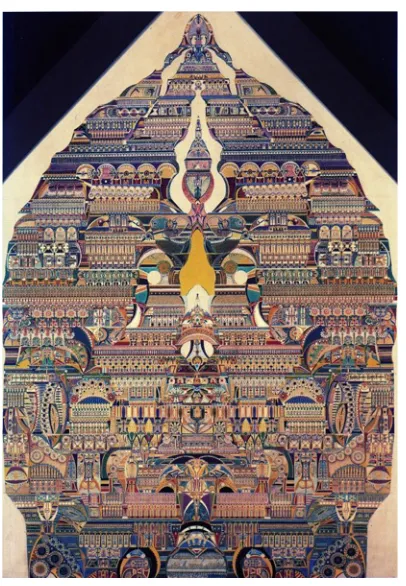
Figure 17: Augustin Lesage,
[image:30.595.272.527.54.358.2]A Symbolic Composition of the Spiritual World, 1925, oil on canvas
Figure 18: Augustin Lesage,
A Symbolic Composition of the Spiritual World, 1923, oil on canvas
Figure 19: Max Hattler, Heaven and Hell, 2010
[image:30.595.118.533.428.661.2]Heaven and Hell lures the viewer into a rhythm of infinitely receding digital landscapes. Patterning, mirroring and looping are used to evoke the sacred geometry of places of worship as much as the imagery of psychedelic hallucinatory experience. While Heaven
refashions Lesage’s work into an ascending futuristic neon metropolis, Hell presents a more sinister rendition in the form of a descent into the cryptic architecture of ever-moving pillars, sliding doors, and shifting facades. Rather than narrative resolution, these loops present continuums, endless repetitive states where heaven and hell become interchangeable machines of infinity.
[image:31.595.120.533.446.713.2]The soundtracks were created at the same time as the animation. Heaven has a bright and sparkly, rhythmically ambient accompaniment, while Hell is underscored by a dark and doomy soundscape. When installed side by side, the soundtracks from both loops overlap in ever-changing unsynchronized variations. My first piece created specifically as an installation, Heaven and Hell opened up new opportunities for showing in a gallery context as opposed to film festivals. There were several elements in Heaven and Hell that I wanted to explore further, in terms of exhibition installation, collaborative modes of production, and conceptually regarding notions of the spiritual, circularity, and time.
Figure 20: Max Hattler, Sync, 2010
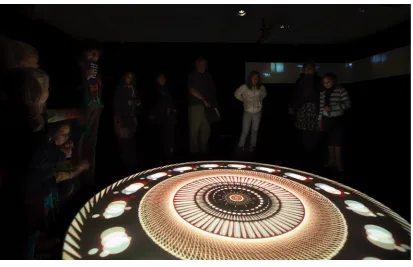
Later in the same year I received an invitation from Dutch arts organisation Pavlov E-Lab to create an artwork on the subject of time, with advice from two science professors, theoretical physicist Eric Bergshoeff and chronobiologist Martha Merrow. This offered an ideal opportunity to advance some of the ideas fleshed out in Heaven and Hell. After a series of discussions with Bergshoeff and Merrow I elaborated a concept for a new piece, Sync (2010), which would allow me to link a spiritual perspective gleaned from James Whitney’s mandalic imagery5 with a scientifically-inspired rendition of time and its underlying physics. Taking cues from Ray and Charles Eames’ 1977 film Powers of Ten, the temporal progression of Sync goes through a single-shot abstract visualisation of time scales from subatomic Planck time to the lifespan of the universe itself. The sound is derived from a continuous modulation of frequencies, which correspond to the progression of time scales that the image plane describes. Sync is modelled on a zoetrope (‘wheel of life’ in Greek), an optical device that produces the illusion of movement from a rapid circular succession of static images. The narrative and animation of the whole film are produced by one single image, a gigantic virtual disc spinning at 7400 degrees per second, which a virtual camera continuously zooms out of. This serves to encapsulate the central premise of the film, that there is an underlying unchanging synchronisation at the centre of everything, a sync that was decided at the beginning of everything, the Big Bang. Everything follows from it, everything is ruled by it: all time, all physics, all life, and all animation. The circular shape of the piece, and its abstract imagery, turn it into a large mesmerising mandala (‘circle’ in Sanskrit), a spiritual and ritual symbol in Hinduism and Buddhism, representing the Universe. This links Sync back to a metaphysical level, and invites questions about a spiritual dimension to the universe and its creation. Through its display as a continuous loop, there is also an implication of (universal) rebirth at the core of the work. Created as an installation consisting of a projection onto a wooden disc elevated from the floor, I wanted to give Sync a physical presence in the exhibition space, like an abstract campfire that tells its story to an audience congregated around it. Both Sync and Heaven and Hell can, through their combinations of the mechanical, the meditative and the mind-expanding, be seen as attempts at reconciling the metaphysical with the scientific.
3. Abstractions of the Everyday
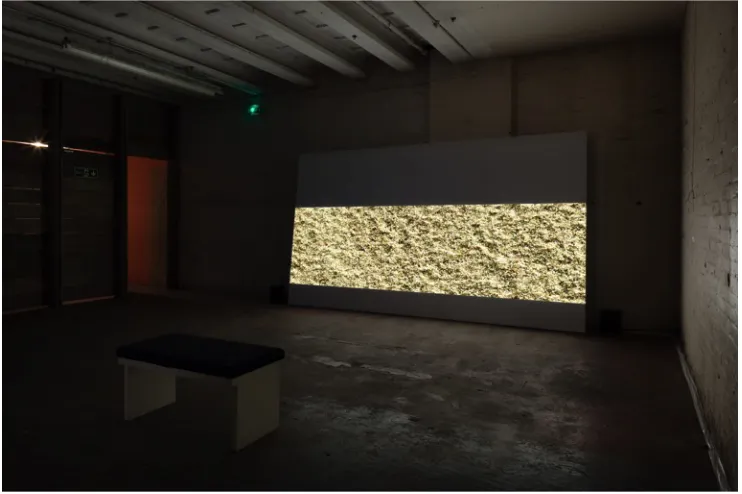
[image:33.595.141.512.370.617.2]Another line of inquiry in my work deals with the abstraction of the everyday as a way of reflecting on reality. Nidden Partikel (2012) had its genesis in an investigation of the mundane elements of a specific site, which were subsequently transcended through abstraction. This piece was developed during an artist residency at Nida Art Colony in Lithuania in April 2012. The work presents image and sound created from the same source, the Lithuanian seashore, and portrays an abstraction of the visual understanding of panoramic beach aesthetics through the use of an extremely wide frame. The fine details of natural elements culminate to create a scene where sea and sand collide and distort to emerge as noise. Offering this work as an alternative view on the sound and image of an untuned cathode ray tube television, where white noise creates a meditative noise bath that is both sonic and visual, Nidden Partikel asks the audience to consider the audio and visual similarities between footage of natural elements and the experience of technology, while also hinting at the granular atomic construction of all matter.
Figure 21: Max Hattler, Nidden Partikel, 2012
Photographic re-animation, colour, sound, HD video, 1 min loop
Installation view, Brick Wall Waterfall, Hackney Downs Studios, London, 2012
as degenerate art by the regime. Nidden Partikel was premiered, rather fittingly, at the
[image:34.595.122.533.138.388.2]Brick Wall, Waterfall exhibition curated by MA Curating Contemporary Art students from the Royal College of Art.
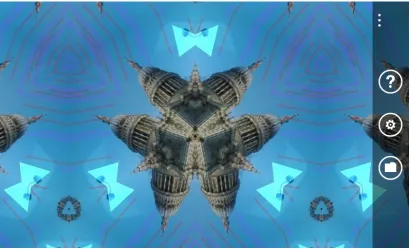
Figure 22: Max Hattler, Kaleidobooth, 2012 Smartphone application for Windows Phone platform
During year three of the doctorate, digital arts organisation onedotzero invited me to create an interactive artwork for smartphones in collaboration with dedicated programmers, with an entirely open brief. Seeing an opportunity to branch out into a different medium and transpose my work into an interactive digital format other than live performance, I teamed up with software developers IndieSkies who coded audiovisual app Kaleidobooth (2012) under my direction. The resulting piece is a digital kaleidoscope which uses the phone’s camera, motion sensor, gyroscope and audio input to create kaleidoscopic images, which can be saved or shared on social networks by the user. An application like this, available to the general public, obviously opens up a host of questions about artistic authenticity and authorship. Is Kaleidobooth a piece of art, a game, or a program? Is every image made with it a ‘Hattler’? What if someone used
heterotopia of sorts, brought about by the abstraction of real-world input through digital kaleidoscopic mirroring and repetition.
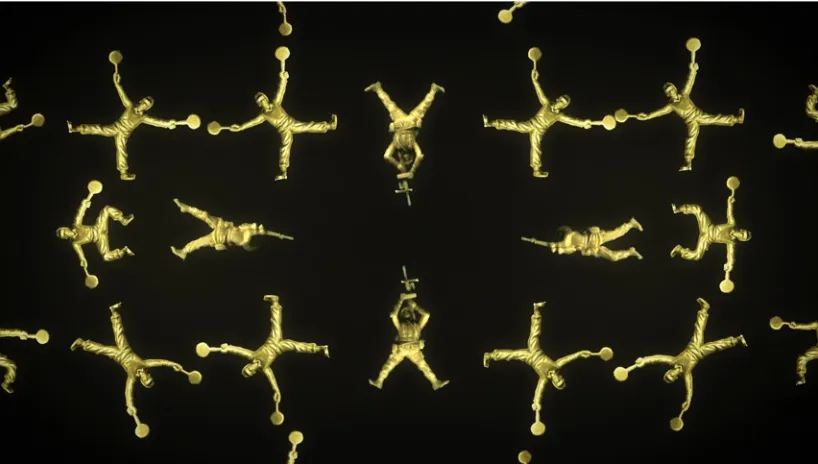
Figure 23: Max Hattler, Model Starship, 2012
Stop motion animation, colour, sound, 1080p HD video, 1 min
Figure 24: Max Hattler, Unclear Proof, 2013
Stop motion animation, colour, sound, 1080p HD video, 1 min
I continued this thematic enquiry of everyday abstraction in two stop motion animation works, companion pieces Model Starship (2012) and Unclear Proof (2013). Both were initiated by external invitations, the former by a fashion blog with the brief to create anything I wanted with a bag of makeup products, the latter by Lago Film Fest who invited me to make a short film of my choosing using only objects found in a winery near the festival. Expanding on the mirror animation technique of my 2008 work
alternate reality. This allows the audience to reflect on the objects’ previous function— and on the wider cultural and symbolic function of objects as a whole—through their recontextualisation into a new, otherworldly role.
Ki Young Park (2012) sees the reappropriation of everyday objects in Model Starship in the spirit of Duchamp’s readymades: “Turning the familiar products into something new and creating a scene that you could see in a sci-fi movie by filming using their shapes and materials, with images reflected from mirrors, was sensational. The artist was able to produce images that are vague and abstract but clear and concise at the same time as he went through the process of observing the products, imaging, and recognizing their patterns. (…) Bringing his imagination into action, he recreated (…) ready-made products into an eye-catching art film. It gave me a refreshing jolt of the same kind as when Fontaine of Marcel Duchamp shocked the contemporary art world.” Further, somewhat tongue-in-cheek context for the reading of these two films can be gleaned from their titles. Model Starship can be read as ‘toy spacecraft’ or as the struggle for a ‘fashion model’s celebrity’ through makeup products. Unclear Proof, linking intoxication with hallucination, hints at the possible connections of levels of proof in alcohol and the existence of aliens. In contrast to the music-based AANAATT, these two works had their soundtrack composed to picture, allowing for extremely tight synchronisation of the science fiction sounds, which support the recontextualisation of the objects by underlining their abstracted otherworldly qualities.
At this point I would briefly like to elucidate the science fiction theme that runs through my work—sometimes subdued as in Heaven and Hell above or All Rot below, at other time more overtly, as in Model Starship and Unclear Proof above, or Shift, X and
4. Metaphysical Machines II: Expanded Abstractions
Through reading and discussions on doctorate, in seeing how other doctoral students present their work, and encouraged by my first installation attempts with Heaven and Hell and Sync, I was inspired to further explore alternative ways of presenting work outside of the single screen. The next group of works, while continuing to develop visual music aspects, science fiction, physics and metaphysics-related themes, are combined by this search for expanded formats.
Figure 25: Max Hattler, Shift, 2012
Stop motion animation, colour, sound,1080p HD video, 3 min
“cyborgian monstrosities” (Hothi 2012a: 34). Setting a framework for the audience’s imagination to explore, these transformations create anthropomorphic and mechanomorphic associations, which raise questions about the ambiguous moral nature of technology, while hinting at other-dimensional machinations at work in the universe. Formally, Shift is inspired by the aesthetics of early 20th-century modernism, linking it to the period’s utopian impulse: El Lissitzky, Man Ray, and films such as Ralph Steiner’s tribute to the machine age, Mechanical Principles (1930), and Fernand Léger’s Ballet Mecanique (1924), which combines the dynamic abstraction of Constructivism with the absurd qualities of Dada, all fed into the work. The materials used in Shift come from the archives of product designer Hans (Nick) Roericht, a graduate and long-time custodian of the now defunct Ulm School of Design, which is a direct descendant of the Bauhaus.
In order to help transcend the real-world origin of the objects in Shift, to turn them into the machine-like workings of another dimension and raise their scale from earthly to galactic, a tightly synchronized abstract science fiction soundscape had to be employed. This led to unforeseen complications as I went through a series of sound collaborators in search of the required effect. While all of them said that they understood exactly what kind of sound I wanted for Shift, none achieved anything near to what was required. I eventually ended up with sound designer and composer David Kamp who took up the challenge and succeeded, through utmost perseverance. The final result was worth the difficulties, and I am aware that I would not have been technically able to obtain the same outcome on my own. However, this experience, paired with encouragement from the doctorate, made me reconsider producing soundtracks myself. As a result, I created the sound for Nidden Partikel, and I co-authored the sound design for All Rot, which will be discussed further below.
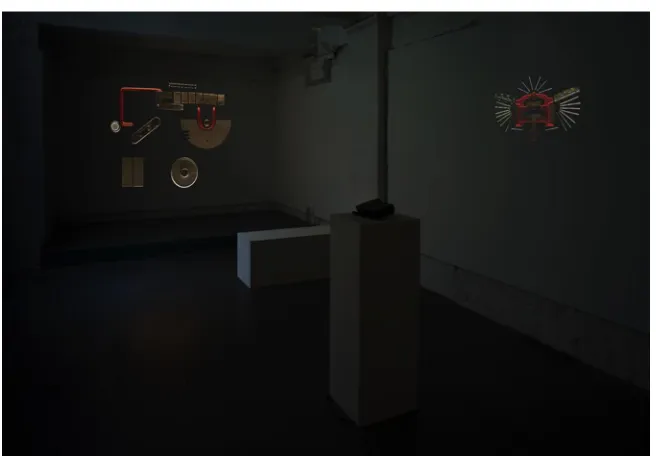
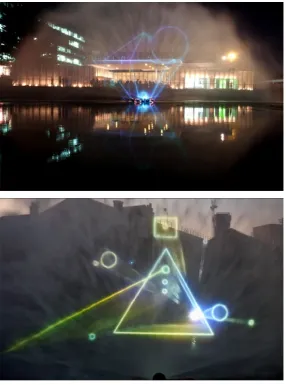
the attention of the viewer and set the scene, while its sound filled the whole gallery floor. The subsidiary silent image loops opened the main film’s visual space up and extended it, together with the sound, across the room. Curating a whole space in this manner was exciting and felt like a genuine progression of my work. This made me consider further presentation options. When I was approached with the offer to develop a projection piece for a water screen in King’s Cross, I immediately agreed. I was enthusiastic about creating something for a novel mode of display within a public art context, which would allow me to explore yet more ways of engaging an audience with my work.
Figure 26: Max Hattler, Shift, 2012
Installation view,solo show at Tenderpixel, London, March 2012
Figure 46) which emphasizes the sculptural qualities of a beam of light, the look of John Whitney’s Matrix III (1972), the neon computer world of Disney’s Tron films (1982, 2010) and Jean Michel Jarre’s Laser Harp (1981) visual instrument, and the movements in Oskar Fischinger’s Studien (1930s) paired with the abstract reduction of classic arcade games such as Asteroids (1979) and Battlezone (1980). This range of influences is abstracted into a closely synchronized audiovisual amalgamation, a neon and artificial, yet strangely organic and alive world, which Kevin Holmes (2012) described as “a perfectly synced dance of light and sound.”
Figure 27: Max Hattler, X, 2012 2D Flash animation, colour, sound, 6 min
1920 x 1440 px HD video projection, 30 x 22 m water screen
Installation view, King’s Cross Filling Station, Regent’s Canal, London, 2012
elements struggling for balance. However, this quickly developed into more abstractly visualising dynamic exchanges and the balancing of different elements. I wanted for the work to continue along the lines of Shift and Sync in the exploration of a mechanical universe, but transposed into a much more digital aesthetics—hence also the computer games and film references above. The end result is completely abstracted into the kinetic relationships of basic shapes, the movement and energy balances within a self-contained universe, a self-referential geometric system. Like Shift, but more so through its complete removal from representation, X presents the viewer with the workings of a metaphysical machine with its own logic and rules. Within this choreography of shapes and lines, a kind of abstract language emerges. Relationships are constantly created and dissolved between the shapes as they move, spark off one another, overlap or meld together. While these correspondences of light and New Age dazzle do not make sense to the viewer, they hint at the possibility that if one kept watching, an important meaning might eventually present itself. It can be read as an abstraction of synaptic reactions in “an attempt to approximate mind forms” (Youngblood 1970: 222, referring to James Whitney’s Lapis), or as the solving of an unknown equation, X, through the cross-actions of the components of a universe in which everything is by itself yet can intersect with each other.
Figure 28: Max Hattler, A Very Large Increase in the Size, Amount, or Importance of Something Over a Very Short Period of Time, 2013
2 min and 6 min loops, colour, 2 x stereo sound
Installation view, Erarta Museum, St. Petersburg, Russia, 2012 (preview version)
A Very Large Increase in the Size, Amount, or Importance of Something Over a Very Short Period of Time (2013) develops the fluid line drawn animation of X into a more organic direction inspired by bifurcation processes, chaos theory, and the dynamics of bubble growth. Representing an open complex system reaching thresholds and complexifying organically, the piece relies on tight synchronization between music and image in the spirit of Oskar Fischinger, to portray an ever-evolving audiovisual structure. A Very Large Increase consists of a two-minute projection loop, complemented by a subsidiary ambient six-minute loop on a plasma screen. The sound of both loops overlaps, without direct sync between them. This combination extends the overall experience out of the single screen and into the exhibition space and creates an audiovisual environment, which, although based on loops, is never quite the same as it was before. The multi-screen approach in A Very Large Increase was encouraged by the
base was diverse, I decided to use different techniques, digital 2D animation using Adobe After Effects and Flash, and Autodesk Maya-based 3D animation. After discussing the concept, the participants were split into four groups, each working on different sections, which were combined at the end with additional linking animation to create the final result. While it was planned to compose the music during the animation production, this turned out to be impossible, as the participating composer ended up in hospital. So for the first exhibition of A Very Large Increase, which was scheduled to start at Erarta Museum on the last day of the workshop, a temporary soundtrack had to be used. This was subsequently replaced by Julien Mier’s micro-edited, super synchronized score, which actualized my aspirations for the piece, and made it win the Visual Music Award 2014.
end result was unsatisfactory for both parties, as everyone felt they had been cheated and their ideas had been compromised.
Figure 29: Max Hattler, Constant Sky, 2013
Mixed-media animation, colour, sound, fulldome 360° format, 11 min
The final animation work I would like to discuss is All Rot (2014). It in many ways presents the culmination of my efforts on the doctorate. Attending the Directional Forces 2013 artist residency at ArToll Kunstlabor in Germany led to the development of this work. During the residency I experimented with different short pieces, engaging with the immediate surroundings of the ArToll building, which is set within parkland inhabited by a series of mental health institutions, most of them high security prisons. Using photography as the basis, my aim was reintroduce tactile qualities, grit, texture and physical marks, as opposed to the completely virtual, digital abstraction of works such as A Very Large Increase or Sync. I made one short photographic animation loop,
Diamond, which cycles through a series of photographs of holes in a terrace banister as if they were the window out of a prison cell, in the shape of a glowing diamond. The second piece took the abandoned mini golf course just outside the ArToll building as its source material. Crazy golf seemed strangely appropriate to the location. After photographing the golf course tracks in close-up, I proceeded to digitally re-animate the photographs into a short abstract sequence, enhancing the texture and worn paint marks through inverting and levelling the colour channels of the image. At times, the surrounding background would become visible, breaking the abstract universe of the film, and reintroducing a sense of place. This then developed into All Rot, where direct references to the place have been eradicated in favour of a completely abstract approach, led by the compositional and aesthetic qualities of Harry Smith’s early abstractions (Figure 10), and the paintings of abstract expressionist Barnett Newman (Figure 47). The introduction of physical marks and textures gives All Rot both filmic and painterly qualities, which bring it closer to Smith and Newman’s work, and create a more visceral experience for the viewer. The construction process however is completely digital, allowing for relatively fast, immediate and controllable improvisation in the creation of the piece.
All Rot operates within strict constraints, some of which are taken from Nidden Partikel, such as using photographic re-animation as the basis for a site-specific exploration, and transcendence of the site through abstraction. Another shared limitation is not to use any layering of images—all movement is created solely from scale, rotation and position transformations of the source material. This technique also borrows from my 2006 piece
40), with which All Rot shares another fixed constraint, the square frame. This constitutes a subtle way of undermining the ‘screen’ represented by a traditional film gauge, thereby positioning the work closer to painting. It also forced me to think outside of the film format, and embrace different compositional strategies.
.
Figure 30: Max Hattler [photo], abandoned mini golf course ArToll, Bedburg-Hau, Germany, March 2013
Figure 31: Max Hattler [photo], untreated All Rot source material
As mentioned above, the work went through a progression from a more representational to an increasingly abstract engagement with the place, foregrounding formal qualities of shape, colour and movement. Having tried revealing some of the surrounding site in my experiments, I found that this lessens the effect of the abstraction, and makes the work
world our way not his way.” A reference to the place remains in the title: All Rot is an anagram of ArToll, the locus of the residency. It is also an allusion to decay: to the decaying abandoned mini golf course, and to mental decay and the inevitability of death (we all rot eventually) which one is confronted with at ArToll on a daily basis. On another level though, when understood in German, the title refers to the film’s qualities of abstract shape and colour which conjure up associations of planetary movements, implying a transcendence of the earthly plane: the direct translation of All Rot is Outer Space Red. In a strangely coincidental way, the title All Rot, when understood as All Rotate, also links to my RCA student film Everything Turns (2004)—a semi-figurative drawn animation inspired by Durs Grünbein’s poem Vertigo—which emblematizes the futility and brevity of human life, while hinting, when presented as a loop, at the possibility of rebirth.
Figure 32: Max Hattler, All Rot, 2014
Photographic re-animation, 2-channel square HD video loops, sound
ii. Audiovisual Performance
1. Collaborative Experiments in Found Footage, Narrative and Audio
[image:48.595.140.514.358.636.2]During the first year on the doctorate, I experimented with different aspects of live performance, with the aim of bringing my live work closer to my animation practice. I collaborated with animation artist Noriko Okaku on three distinct performances, Oh Yes, /\/\/\, and (O), each one probing a different aspect of playing live. Oh Yes, featuring a custom soundtrack by Kyoto-based dubmarronics, takes as its starting point found footage material sourced on YouTube to create a multi-coloured meditation on bodies, movement and pop culture. Our approach was one of frantic live improvisation to the music, using VJ software, video mixers and video feedback. The performance was presented at a range of film festivals including Moves Festival, Cimatics Festival, Curtas Vila do Conde, Muuuvi Festival, Square Eyes and International Short Film Festival Leuven.
Figure 33: Max Hattler & Noriko Okaku, Oh Yes, 2009 35 min audiovisual live performance