Effect of Warm Mix Additive on the Performance of the Bituminous Mix
Darshan P. Joshi
1Ashraf M. Mathakiya
2 1PG Student
2Assistant Professor
1,2Department of Civil Engineering
1,2
Atmiya Institute of Technology & Science, Rajkot, India
Abstract— Asphalt industries expend a lot of powers anddischarge contamination gases into the climate. Warm blend black-top is the most perceived approach to limit these negative effects, which have offered ascend to various issues identified with their execution and the materials utilized. WMA innovation permits the blending, set down, and compaction Asphalt blends at fundamentally bring down temperatures contrasted with Hot Mix Asphalt (HMA). The innovation can lessen creation temperatures by as much as 30 percent. The present examination explores the impacts of two unique sorts of warm blend black-top added substances on the properties of black-top fasteners and blends. In this examination consistency review bitumen VG-30 is considered and two sorts of warm blend added substances Zycotherm with the doses (0.05%, 0.1%, and 0.15%) is utilized. This Research introduces an orderly lab examine With Aggregate covering, Marshall Mix Design for Dense Bituminous Macadam (DBM) grade II for warm blend added substance (WMA) i.e. Zycotherm.
Key words: Warm Mix Asphalt (WMA), Bituminous
I. INTRODUCTION
Warm Mix Asphalt (WMA) is a quick developing innovation, now acknowledged around the world. Use of lower temperatures to create black-top blends isn't new.WMA is characterized as the black-top blend whose blending temperature is from 100°C to 135°C .In this innovation natural added substances, compound added substances and frothing innovation are utilized to fabricate and spread black-top blends at bring down temperature than ordinary Hot Mix Asphalt (HMA) by diminishing the black-top viscosity.WMA is delivered, set and compacted at temperature10°C to 40°C lower than the customary Hot Mix Asphalt It is an innovation that permits bringing down of the generation and clearing temperature of Hot Mix Asphalt (HMA) by decreasing the consistency of cover which helps in expanding the workability of blend without trading off the execution of black-top. It lessens vitality utilization, carbon dioxide emanation, oxidative solidifying of Asphalt, overhead and aggregate expenses of the Asphalt business by bringing down the generation temperature in this manner making a superior workplace. Be that as it may, the lower blending temperatures have raised worries on the execution of the blends. So there is have to altogether assess and describe the WMA blends to guarantee satisfactory Performance. Warm blend black-top is created when water, chemicals or different added substances are utilized to deliver black-top at bring down
temperatures.
Outflows of ozone depleting substances amid warm blend black-top generation are fundamentally lower than amid hot blend black-top creation. With a decrease of around 40°C in black-top blend creation temperature, around 33% of the CO emanations delivered can be diminished. Lessening in vitality/fuel utilization is likewise an advantage of WMA.
So that for reducing the emission of temperature warm mix additive is used.
II. OBJECTIVE
To determine the effect on performance of bituminous mix by using Zycotherm as a warm mix additive.
III. SCOPE
This study works are limited to DBM grade-2 & BC grade- 2 for Bitumen Mix design.
1) To conduct the aggregate coating test by using Zycotherm-having 0%, 0.05 %, 0.1%, 0.15% doses. 2) To perform marshal stability test by using
Zycotherm-having 0%, 0.05 %, 0.1%, 0.15% doses.
IV. MATERIAL & METHOD
Fig. 1: Flowchart of Experimental Design
V. RESULTS
A. Aggregate Gradation for DBM G-2
The screening analysis test was used to determine the aggregate size of the collected quarry samples. Through this screening test, the ratio of coarse aggregate, fine aggregate and filler is determined to ensure that the aggregate is well mixed within the specified level of concrete grade MORTH.
Sieve Desig nation
Actual % passing % Passing proposed mix design Total Passin g, % Limit as per 20m m 10m m 6m m Stone dus t 20m m 10m m 6m m Stone dus t MoRT H-V rev. Table - 500/10 0.35 0.20 0.2
0 0.25
Gradi ng 2 37.5 100 100 100 100 35 20 20 25 100 100 26.5 100 100 100 100 35 20 20 25 100.00 90-100 19 65 100 100 100 23 20 20 25 87.75 71-95 13.2 6.78 99.0
9 100 100 2 20 20 25 67.19 56-80 4.75 0.02 1.59 90.5
1 100 0 0 18 25 43.43 38-54 2.36 0.02 0.76 50.5
5 100 0 0 10 25 35.17 28-42 0.3 0.02 0.60 3.52 25.6
1 0 0 1 6 7.23 7-21 0.075 0.02 0.42 1.95 10.9
[image:2.595.309.546.68.250.2]6 0 0 0 3 3.22 2-8 Table 1: Gradation of DBM Grade 2
Fig. 2: Gradation of Dense Bituminous Macadam Grade 2 B. Basic Properties of Bitumen
Bitumen test VG - 30 VG-30+ Zycother m (0.05%) VG-30+ Zycother m (0.1%) VG-30+ Zycother m (0.15%) Requirement s as per IS
73- 2013 Penetratio
n at 250C
,mm 63
64 65 66 Min 45
Softening
point 49 49 49 49 Min 47
Ductility @270C ,
cm 82
87 98 90 NA
Specific gravity
1.0
5 1.00 1.03 1.02 NA
Table 2: Test Results Bitumen Sample
C. Aggregate Coating Test Results With & Without Warm Mix Additive
Coating is only measured on aggregate retained on 9.5 mm sieve. The stripping value of aggregates is determined as the ratio of the uncovered area observed visually to the total area of aggregates, expressed as a percentage. Express the stripping value as the ratio of the uncovered area observed visually to the total area of aggregates in each test.
Additive (Zycotherm) Aggregate coating value
MORTH Specification (2013)
0% 97%
Minimum 95% 0.05%
95% 0.1%
[image:2.595.45.289.397.614.2]0.15%
Table 3: Aggregate Coating Results With & Without Warm Mix Additives
D. Marshall Stability Test Results With & Without Warm Mix Additive for Dense Bituminous Macadam Grade II
%Bitumen Stabilit y(KN) Flow (mm) CDM (g/cc) VMA (%) Air voids (%) VFB (%)
4 .0 7.45 4.30 2.410 14.69
0 5.860
60.1 80
[image:2.595.317.542.566.658.2]5.0 11.09 5.51 2.440 14.46 9 3.366
76.7 36
5.5 10.24 5.26 2.431 15.20 6 2.800
81.5 86
Fig. 3: Marshall Stability & Flow with Different Binder Content
Fig. 4: Air voids VMA & VFB with Different Binder Content
E. Marshall Test Result with Adding Zycotherm as a Warm
[image:3.595.47.541.48.743.2]Mix Additive.
Table 5. Marshall Stability test result with Zycotherm
%Bitumen Stability(KN)
0.05% 0.10% 0.15%
4 8.42 8.57 8.27
4.5 10.01 10.08 10.03
5 10.83 10.91 10.81
5.5 10.42 10.49 10.27
Table 4: Marshall Test result without Warm Mix Additives
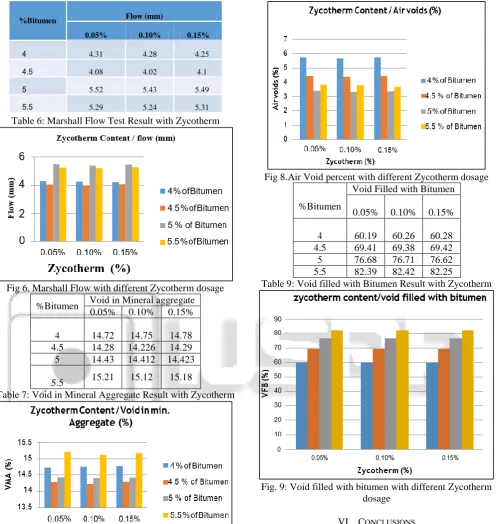
[image:3.595.310.547.482.737.2]Table 6: Marshall Flow Test Result with Zycotherm
Fig 6. Marshall Flow with different Zycotherm dosage %Bitumen Void in Mineral aggregate
0.05% 0.10% 0.15%
4 14.72 14.75 14.78
4.5 14.28 14.226 14.29
5 14.43 14.412 14.423
5.5 15.21 15.12 15.18
Table 7: Void in Mineral Aggregate Result with Zycotherm
Fig 7: Void in Mineral Aggregate with Different Zycotherm Dosage
%Bitumen Air voids
0.05% 0.10% 0.15%
4 5.73 5.65 5.71
4.5 4.42 4.39 4.45
5 3.41 3.35 3.39
5.5 3.83 3.78 3.69
[image:4.595.51.548.67.592.2]Table 8: Air Void Percent Result with Zycotherm
Fig 8.Air Void percent with different Zycotherm dosage
%Bitumen
Void Filled with Bitumen 0.05% 0.10% 0.15%
4 60.19 60.26 60.28
4.5 69.41 69.38 69.42
5 76.68 76.71 76.62
5.5 82.39 82.42 82.25
Table 9: Void filled with Bitumen Result with Zycotherm
Fig. 9: Void filled with bitumen with different Zycotherm dosage
VI. CONCLUSIONS
Following are the important conclusions that are drawn from the present study:
It is observed from the experiment result the physical properties of bitumen has improved by adding 0.1% Zycotherm as a warm mix additive.
By adding 0.1% Zycotherm as a warm mix additive the Marshall parameter like Stability is increased by 33.63%. Flow is minimum. Air void percent, voids in mineral aggregate and void filled with bitumen increased more effective as compare to other percentage of Zycotherm.
REFERENCES
[1] Arun S Bagi, Vijay Gomarshi, Shivaraj B S (2014). mix design properties and moisture sensitivity characteristics
%Bitumen Flow (mm)
0.05% 0.10% 0.15%
4.31 4.28 4.25
4.08 4.02 4.1
5.52 5.43 5.49
[image:4.595.284.544.72.559.2]of dense bituminous macadam mixes modified with rediset, a warm mix additive International Journal of Research in Engineering and Technology
[2] Ambika Behl, Gajendra Kumar, Girish Sharma, Dr.P.K Jain (2013) “Evaluation of field performance of warm-mix asphalt pavements in India” 2nd Conference of
Transportation Research Group of India (2nd CTRG). [3] Arunesh Tiwari, Aamirhamza Chariwala, Shailendra
Prajapati, Prashant Ray (2007) " A Study on Warm Mix Design on Bitumen’s Mixes (VG 30) Using Rediset-WMX"International Journal of Innovative Research in Science,Engineering and Technology ISSN(Online): 2319-8753.
[4] B. Harish Kumar, K. Alekh Kumar, G. Sumanth Kumar, M.Vidya reddy (2015)" Laboratory Investigation On Warm Mix Asphalt Using Zycothrm As An Additive" International Journal of Engineering & Science Research [5] Divya Va, Gyanen Takhelmayum (2017) ) “Evaluation of Laboratory Performance of Sasobit and Zycotherm as An Additives for Warm Mix Asphalt on Performance Characteristic” International Journal ofAdvances in Scientific Research and Engineering
[6] Mitul Patel, Vikas Patel, Devendra K.Patel, Prof.C.B.Mishra (2014) " Evaluating Properties of VG 30 Paving Mix With and Without Warm Mix Additive" International Journal of Innovative Research in Science, Engineering and Technology ISSN: 2319- 8753
[7] Metta Pavanchandra, B.P.R.V.S.Priyatham, K.S.B Prasad, D.V.S.K.Chaitanya (2017“Effect of Zycotherem on Mechanical Properties of Warm Mix Asphalt for Different Aggregate Gradations “journal of Transportation Research Procedia 14 (2016) 778 – 786. [8] Raveesh J1, Manjunath (2017)." Laboratory Evaluation
of WMA with Zycotherm Warm Mix Additive" International Journal for Research in Applied Science & Engineering Technology ISSN: 2321-9653.
[9] Supriya Mahida and Chandravadan B. Mishra (2017) "“Evaluating the Efficacy of Warm Mix Asphalt”" journal of Construction and Building Materials 88 (2015) 32–40.
[10]Shaleha I. Vahora, Prof. C. B. Mishra (2017)" Critique of Warm Mix Additive in Mix Design" International Journal for Research in Applied Science & Engineering Technology Volume 5 Issue V, May 2017 ISSN: 2321-9653.
[11]Asphalt Mix Design Manual Ms-2 Chapter 7.
[12]Ministry Of Road Transport And Highway Specification For Road And Bridge Work (Mort&h) 5th Revision. Section 500 page 189.
[13]IS.6241.1971 “Method of Test for Determination of Stripping Value of Road Aggregate”.