2017 2nd International Conference on Computer Science and Technology (CST 2017) ISBN: 978-1-60595-461-5
A Flexible Data Structure for Heterogeneous
Information Integration
Xin-Yang WANG
1,a*, De-Yu QI
1, Wei-Wei LIN
1and Na-Qin ZHOU
11Research Institute of Computer Systems, South China University of Technology,
Guangzhou 510006 China
*Corresponding author
Keywords: Common data model, Data integration, GDM algebraic operation, GriData.
Abstract. A uniform mechanism to express and operate various data is essential for
the development of big data and internet of things, and the common data model provides fundamental supports for the integration of heterogeneous data. By comparing with the advantages and disadvantages of several primary common data models, this paper proposes a new common data model called GriDoc Data Model (GDM). Through the introduction of concepts, such as Paragraph, Section, GriData and GriDoc, the model establishes a flexible mechanism to express different kinds of heterogeneous data. On the basis of the GDM model concept, this paper defines the
basic algebraic operations and presents the process of integrating and querying GDM object data.
Introduction
The amount of information is growing in exponential speed as the result of human society production activities, especially the developments of cloud computing and big data technologies prompt data to expand with unprecedented dramatic speed in size, structure and format. It is necessary to integrate all kinds of heterogeneous data with a uniform mechanism.
Generally, the integration of heterogeneous data can be implemented from two aspects of data structure and semantic. For example, the OEM model[1, 2] is for
structured, semi-structured and un-structured data and is a simple self-description object model, which allows object nesting. Its variant model the OIM model [3-5] is
also for structured and semi-structured data. However, OEM and its variants mix data value with data schema, leading to data repetition and waste of memory. The data models have to be modified accordingly with the change of data source, and their ability to express semantic relations among data is also very limited. Due to the characteristics of content self-description, platform independence, separation of content and display, and good expansibility, etc., XML is also suitable for describing
heterogeneous data sources. A lot of XML-based data integration models are available,
such as the XML tree data model in [6]; XML DTD is adopted as structural description
for data interchange in the SIMS system[7]; the XML-based data integration model
XIDM [8-10] is applied in the Panorama system; the SUDAI [11-13] model uses
3 I
ODM as the description tool and XML as the media to store data description results.
identical concept is often expressed by different words and meanwhile the same word may indicate different meanings. Thereby, XML has obvious defects in solving
semantic conflicts. There are also some other information techniques of data structure. The hypergraph-based common data model HDM [14, 15] realizes schema mappings among data models of ER, UML, relational database and ORM.
The semantic-based heterogeneous information description model ODMI3and its
relevant model language 3 I
ODL [16] are put forward in the MOMIS[17] system.
3 I
ODM overcomes the drawbacks that exist in OEM and OIM, saves memory space,
improves the retrieval efficiency, and is especially suitable for integrating dynamic and complex heterogeneous data. However, the 3
I
ODL languageis not convenient
enough for ordinary people to describe data source and lacks good versatility since it is not a network exchange language.
From the existing heterogeneous data integration models, we know that data model characteristics, such as data description ability, semantic analysis ability, loose coupling relationship with physical data, and certain degree of flexibility, determine the performance of common data model. This paper puts forward a new common data model called the GriDoc Data Model (GDM). The model is capable of describing
structured, semi-structured and non-structured data, and has better data description ability. GriDoc objects have rich relationships among each other, and thereby the model also has strong semantic description capability. Meanwhile, the GDM model
has superior performance on decoupling with underlying physical data, high reusability, data sharing and flexibility of data operation. The following chapters will further depict these properties.
GDM Common Data Model
Definition 1. In GDM model, the minimum data organization unit that has definite
data structure is called Paragraph. If denoted by P, Paragraph is a quintuple P=<GID, n, t, ref, c>, where GID (Global ID) is a global unified identification in GDM model,
and is unique; n denotes Paragraph name; t denotes the data type represented by
Paragraph; ref is a Boolean variable that indicates the Paragraph data is value or
reference; c is the value of Paragraph data.
Paragraph can represent both data value and attribute value. By treating data value as a special attribute, it is feasible to express any data attribute with Paragraph uniformly, with Paragraph name representing attribute name and Paragraph value representing attribute value. All these attributes are organized by another GDM data
object, i.e. Section, defined as Definition 2.
Definition 2. In GDM model, the data organization unit composed of one or more
data structure elements is called Section. If denoted by S, S is a quadruple S=<GID, n, D, R>, where GID (Global ID) is the global unified identification; n denotes Section
name; D is the list of GDM objects in S, i.e. D={di | di=Pj or di=S'k, and S'k≠S; i,j,k=1,2,3…n; n≥0}; R is the relation list of GDM objects in S, i.e. R={LR}, LR={<di, dj> | di, dj∈D, 1≤i, j≤n}.
Figure 1. The Data Structure and Example of Section.
From Definition 2, it is known that Section is a compound data structure. A Section contains one or more atomic Paragraphs, or one or more Sections except itself, or both. So a Section can include any type and any number of GDM objects (except itself). As
is shown in Fig.1(b), the Section S1 contains S2, S3 and P4, while S2 and S3 contain P1, P2 and P1, P3 respectively. When taking S2 and S3 as its children, S1
automatically includes the true child nodes and indirect child nodes (see Definition 4) of S2 and S3, and has good dada reusability; since P1 is shared by S2 and S3 at the same time, the model has a good data sharing property.
Definition 3. In GDM model, Paragraph and Section are collectively called GriData
(i.e. GDM object). If GriData is denoted by G, then G={gi| gi=P or gi=S}.
There are various relations among GriDatas.
Definition 4. For ∀gp, gq∈G, and gq≠P, if gp is one of sub elements in gq, then gp is
called the true child node of gq; if gp is the true child node of some true child node in gq, then gp is called the indirect child node of gq; similarly, true child nodes of gq’s
indirect child nodes are also collectively called indirect child nodes of gq, and so on.
Definition 5. For ∀gp, gq∈G, and gq≠P, if gp is a true child node of gq, then we say gq properly includes gp, denoted as gp⊂gq; if gp is an indirect child node of gq, then we
say gq indirectly includes gp, denoted as gpÐgq; otherwise, they are accordingly
denoted as gp⊄gq and gpÐ/ gq.
Definition 6. For ∀gp∈G, all the true child nodes of gp constitute the true child
node set, denoted by subdir(gp); all the indirect child nodes of gp constitute the indirect
child node set, denoted by subindir(gp); all the true child nodes and indirect child nodes
uniformly form the child node set of gp, denoted by sub(gp), and sub(gp)=subdir(gp)+subindir(gp).
There is sequence among child nodes in GriData, if gp is the i-th child node of gq, it
is denoted as gp=gq(i).
Definition 7. ∀gp, gq, gr∈G, gr≠P, gp=gr(i), gq=gr(j) (i,j≥1), if j=i+1, then gp is called
the direct precursor node of gq, denoted by gp→gq, and accordingly gq is the direct
descendant node of gp; if j>i+1, then gp is called the indirect precursor node of gq,
denoted by gpgq, and accordingly gq is the indirect descendant node of gp.
Example 1. A table Student in relational database is shown in Fig.2(a), and it’s
Figure 2. Example of Structured Data by GDM model.
In Fig.2(b), the table and every record are denoted by Sections, and every record contains many fields, shown in Fig.2(c). Each field is also a Section object and contains attributes Value, Type, etc, treating the value of a field as a special attribute.
These attributes are atomic and represented by the Paragraph object. Take the field
SID for example, it is integer type, and its value is 001. In Fig.2(c), Paragraph Value
represents the value of SID field, where ID is its global ID; n is the name of the
Paragraph- “value”; t denotes the data type that Paragraph Value represents, since SID
is integer, t=“integer”; ref means whether the value of the Paragraph is reference type
or not, if ref=“true”, then c is the “address” of referenced value, otherwise, c is the
value of Paragraph Value, here since ref=“false”, thus c=001. Paragraph Type denotes
the data type of SID field, and the meanings of GID and n are as previously
mentioned; since a data type is usually expressed with string, t=“String”, and the SID
field is integer type, thus ref=“false” and c=“integer”.
It is necessary to note that in Paragraph Value t=“integer” and in Paragraph Type
c=“integer” both represent the SID field data type. The repetition is indispensable
because the former is used for data reading and manipulation, and the latter is for data description and expression. The advantage of this mechanism is especially obvious in integrating non-structured data, as is shown in Example 2.
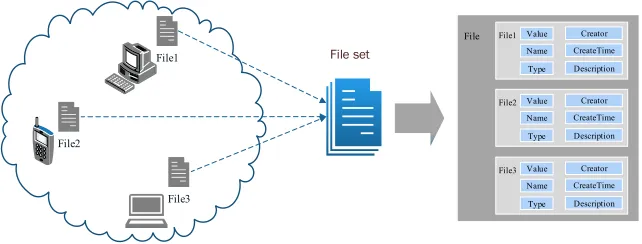
Example 2. File1, File2 and File3 are of various types and distributed over different network nodes. They are integrated into the GriDoc File through virtual views, shown
in Fig.3.
File
Value Name Type File2 Creator
CreateTime Description Value Name Type File1 Creator
CreateTime Description
Value Name Type File3 Creator
CreateTime Description
File1
File2
File3
File set
[image:4.612.146.467.576.698.2]During the heterogeneous data integration process, a series of operations on GDM
data objects are needed. The following will define basic algebraic operations of GDM
objects and offer GDM object manipulation functions on the basis of the algebraic
operations.
GDM Object Algebraic Operation
The GDM object algebraic operation has a characteristic of closeness, namely the
results of GDM object algebraic operation are not influenced by data format
heterogeneity.
Suppose there are two GriData objects gp=(rp, Vp, Ep) and gq=(rq, Vq, Eq), the GDM
object algebraic operations are defined as follows. (1)GDM Object Union
g=gp+gq=(r, V, E)
where r=g, V={vi|∀vi∈G, (vi∈Vp)∨(vi∈Vq)}, E={ei|∀vi, vj∈G, vi⊂gp, vj⊂gq, and ei∈((Ep - <rp, vi>)∨(Eq - <rq, vj>)∨( vi→vj∨vivj)∨(<r, vi>∨<r, vj>))}, i.e. the
union of gp’s and gq’s true children sets, denoted bygp+gq;
When incorporating gp into gq, due to the non-recursiveness of GriData, it must
guarantee that gq is unequal to gp, and gqshould’t be the child node of gp, i.e. (gp≠gq)∧
(gq⊄gp)∧(gqÐ/ gp).
(2)GDM Object Difference
g=gp−gq=(r, V, E)
where r=g, V={vi|∀vi∈G, vi∈(vj⊂gp∧vj⊄gq)∨vi∈sub(vj)}, E={ei|ei=<vi, vj>, ∀vi, vj∈G, (vi⊂gp∧vj⊂gp)∧(vi⊄gq∧vj⊄gq), then ei∈(
i v
E ∨
j
v
E )∨(<r, vi>∨<r, vj>)∨(vi →vj∨vivj)}, i.e. the difference of gp’s and gq’s true children sets, denoted by
p q g −g
.
(3)GDM Object Selection
If let f be selection condition, then
( ) ( , , )
f p
g=σ g = r V E
Where r=g, V={vi|∀vi∈G, vi∈(vj⊂gp∧f(vj)=“true”∨vi∈sub(vj)}, E={ei|ei=<vi, vj>, ∀vi, vj∈G, (vi⊂gp∧vj⊂gp)∧(f(vi)= “true”∧f(vj)=“true”), then ei∈(
i v
E ∨
j
v
E )∨(<r, vi> ∨<r, vj>)∨(vi→vj∨vivj)}.
(4)GDM Object Projection
In GriData object gp=(rp, Vp, Ep), given a group of absolute paths path1, path2, …, pathn with respect to gp, where pathk=/gp/gk1…/gkn, 1≤k≤n, if the projection of gp on path is denoted by the symbol
1
[path, ,pathn]( )gp
Π , then
1
[path, ,pathn]( ) ( , , )p
g= Π g = r V E
where r=g, V={vi|∀vi∈G, 1≤ k≤n, (vi∈(|pathk|-{rp}))∨(vi⊂end(pathk))∨(viÐ end(pathk)) }, E={ei| 1≤k≤n, ei∈(pathk - <rp, r1>)∨<r, r1>∨ ( )
k end path
E }.
(5)GDM Object Join
joining all the child nodes of end(path2) in g2 as the child nodes of end(path1) in g1can
be denoted as
1 2
1| |path path, ,f 2 ( , , )
g=g × g = r V E
Where r=g,
V={vi|∀vi∈G, (vi∈((V1 – r1) ∨ sub(end(path2)))) ∧ f(sub(end(path1)), sub(end(path2)))="true" ∧ (∀pathm∈g1, pathn∈g2, (begin(pathm)=end(path1) ∧ begin(pathn)=end(path2)∧pathm≠pathn))},
E={ei|∀vi, vj, vk, vl∈G, vi⊂g1, vj⊂end(path2)∧vj⊂/end(path1), vk∈sub(vj), vl⊂ end(path1), thenei∈(E1 - <r1, vi>)∨<r, vi>∨(vj⊂end(path1)∨vkÐend(path1))∨
j
v
E ∨
(vj→vl∨vjvl) }.
(6)GDM Object Cutting
Given a group of absolute paths path1, path2, …, pathn, where pathk=/gp/gk1…/gkn, 1 ≤k≤n, the operation of cutting all the child nodes of these paths is denoted with
1
[path, , pathn]( )gp
Θ , there is
1
[path, ,pathn]( ) ( , , )p
g= Θ g = r V E
where r=g, V={vi|∀vi∈G, 1≤k≤n,vi∈(Vp– sub(end(pathi)) - rp)}, E={ei|∀vj∈G, 1≤k ≤n, vj∈sub(end(pathi)), then ei∈(Ep - <end(pathi), vj>
-j
v
E )}.
When integrating heterogeneous data of massive amount, the GDM object cutting
operation is always used for gathering a part of the data or cutting a portion of the data off to improve the efficiency.
Example of Data Integration and Query
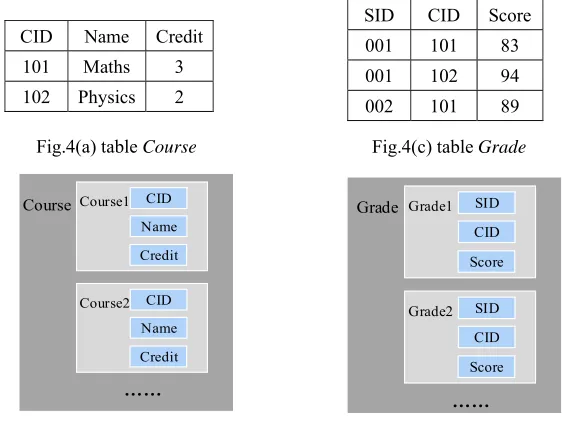
In addition to the table Student in Example 1, suppose there are another two data
source tables Course and Grade, which record the information of courses and student
grades respectively. The structures of the tables and their relevant GDM models are
shown in Fig.4.
Figure 4. Tables Course and Grade and their relevant GDM models.
SID
CID
Grade Grade1
Score
SID
CID Grade2
Score
……
CID
Name
Course Course1
Credit
CID
Name Course2
Credit
……
Fig.4(b) the GDM model of Course Fig.4(d) the GDM model of Grade
CID Name Credit 101 Maths 3 102 Physics 2
SID CID Score 001 101 83 001 102 94 002 101 89 Fig.4(c) table Grade
[image:6.612.152.433.470.685.2]Example 3. Query all the selected course names and grades of student No. 001. The query process can be divided into the following three steps:
① '
. "001"( )
Grade SID
G =
σ
= Grade② '
'' '
/ / / , / / / , . .
| | ourse
i i
G grade CID Course course Name Grade CID Course ID
G =G × = C
③ '' ''
'' /G grade CID Name/ i/ / , /G grade Score/ i/ ( ) Result= Π G
Where grade and courseiare the i-th record respectively in tables Grade and Course.
The above example shows that GDM model is capable of implementing complex
querying from different data sources, which is of great significance for heterogeneous data integration.
Conclusions
By comparing existing data models, this paper puts forward a new uniform data model, i.e. the GDM model. The model expresses various data intuitively and flexibly
on the basis of concepts, such as Paragraph, Section, GriData, GriDoc, et al. This paper then defines basic algebra operations of GDM objects, which provides essential
theory support for GDM object manipulations. A comprehensive example of
integrating and querying GDM object data is provided, showing that GDM model has
favorable ability for heterogeneous data integration and operation.
Further researches on issues such as schema translation, heterogeneous data semantic integration, data query and system framework of the GDM model will be
discussed in our subsequent works.
Acknowledgements
Many thanks are given to those who offer assistance to complete the research work, and special gratitude are to the reviewers and editors for their diligent work and relevant suggestions.
This work is also supported by the National Natural Science Foundation of China (Grant Nos. 61070015 and 61402183), Guangdong Natural Science Foundation (Grant Nos. 10351806001000000, S2012030006242 and S20130400124), Guangdong Provincial Scientific and Technological Projects (Grant Nos. 2014B090901028, 2016A010101007, 2016B090918021, 2014B010117001, 2014A010103022 and 2014A010103008), Guangdong frontier and key technical innovation projects (Grant No. 2014B010110004), Guangzhou major special research collaborative innovation projects (Grant No. 2060404) and Guangdong research cooperation projects (503036363071).
References
[1] Gong A, Yang XW. An Algorithm of Semi-structured Data Scheme Extraction Based on OEM Model[M]: Springer Berlin Heidelberg, 2011. 315-319 p.
[2] Papakonstantinou Y, Garcia-Molina H, Widom J. Object Exchange Across Heterogeneous Information Sources[C]. Eleventh International Conference on Data Engineering, 1995: 251.
[4] Wang N. Query Decomposition and Optimization in Heterogeneous Data Integration System [J]. Journal of Software, 2000.
[5] Zhang WY, Fei HE, Ming GU. Studying Data Exchange System Based on OIM Data Object Model [J]. Application Research of Computers, 2005.
[6] Arcieri F, Melideo G, Nardelli E, Talamo M. Keeping coherence among web sources[C]. International Workshop on Web Information and Data Management, 2001: 16-23.
[7] Junyan Z. Research of Information Sourse Description Model Based on Heterogeneous Data Exchange [D]: South China Normal University; 2009.
[8] Rui LI, Zheng LU, Xiao W, Bing LI. Research on XIDM-Based Schema Mapping in Multidatabase Systems [J]. Journal of Computer Research & Development, 2004, 41(3):485-491.
[9] Li B, Lu ZD, Peng DC. XIDM: A Common Data Model Based on XML [J]. Wuhan University Journal of Natural Sciences, 2001, 6(Z1):432-437.
[10] Li R, Lu Z, Xiao W, Wei W. XML-based integration data model and schema mapping in multidatabase systems [J]. Systems Engineering & Electronics Journal of, 2005, 16(2):437-444.
[11] Tang JY, Zhang WM, Song JF, Xiu BX, Xiao WD. A Data Model and Algebra for Capability Object Integration in Heterogeneous Data Integration Systems [J]. Journal of National University of Defense Technology, 2004.
[12] Tang JY. A Data Source Capability Description Framework towards Heterogeneous Data Sources Integration [J]. Computer Science, 2004, 31(4):170-172. [13] Xiao Y, Deng S, Liu Z. Design and Implementation of a Semantic-based Visual Description Tool for Information [J]. Application Research of Computers, 2004. [14] Rizopoulos N, Mçbrien P. A general approach to the generation of conceptual model transformations[C]. International Conference on Advanced Information Systems Engineering, 2005, Springer: 326-341.
[15] Boyd M, Mcbrien P. Comparing and Transforming Between Data Models Via an Intermediate Hypergraph Data Model[M]: Springer Berlin Heidelberg, 2005. 69-109 p.
[16] Beneventano D, Dannoui AR, Sala A. Data lineage in the MOMIS data fusion system[C]. IEEE International Conference on Data Engineering Workshops, 2011: 53-58.