Cite this:Catal. Sci. Technol.,2013, 3, 2057
Hemicellulose hydrolysis catalysed by solid acids
†
Piera Demma Cara`,abcMario Pagliaro,bAhmed Elmekawy,dDavid. R. Brown,d Peter Verschuren,aN. Raveendran Shiju*aand Gadi Rothenberga
Depolymerising hemicellulose into platform sugar molecules is a key step in developing the concept of an integrated biorefinery. This reaction is traditionally catalysed by either enzymes or homogeneous mineral acids. We compared various solid catalysts for hemicellulose hydrolysis, running reactions in water, under neutral pH and relatively mild temperature and pressure (1201C and 10 bar) conditions. Sulphonated resins are highly active, but they leach out sulphonic groups. Sulphonated silicas are less active, but more stable. They have weakly and strongly bound sites and the strongly bound ones do not leach. Zeolites are moderately active and stable. Among them, H-ferrierite especially, despite its small pores, exhibited high activity as well as good recyclability.
1. Introduction
Switching from crude oil to biomass as the source for chemicals is the big challenge we chemists face in the 21st century.1 In that respect, the main research thrust must be directed at lignocellulose, the most abundant fraction of biomass. Ligno-cellulose is made up ofca.50% cellulose, 30% hemicellulose and 20% lignin. Although cellulose and lignin are the subject of many studies,2–23there are very few reports on hemicellulose conversions.24–33 Here we are particularly interested in the hemicellulose xylan, which is composed of different C5 and C6sugar units (xylose, arabinose, mannose, glucose, and galactose) linked by b(1–4) glycosidic bonds.25 Xylan is non-edible and abundant, so its hydrolysis into sugars has important implica-tions for both the food and the chemical sectors. Selective hydrolysis of xylan would produce monosugars, which are both a primary food source as well as renewable raw materials for making valuable chemicals.25,27
Traditionally, hemicellulose hydrolysis is catalyzed by enzymes and mineral acids. The problem is that these routes incur separation/recycling difficulties, expensive catalyst recovery and
corrosion problems. Efficient catalysis over solid acids in water can avoid all these problems, as it is carried out at neutral pH and catalyst/product separation is simple.34 Moreover, a stable solid catalyst can be reused, giving an economic advantage, especially in large-scale processing.35Recently, Dhepe and Sahu reported a one-pot process for the conversion of solid hemicellulose into monomers using solid acid catalysts in aqueous media.27They showed that solid acid catalysts could hydrolyze hemicellulose in a one-pot method to produce xylose and arabinose with 41% yield. Also, the conversion of arabinogalactans into sugars over ion-exchange resins has been reported.24Arabinose was the primary product, followed by the release of galactose without further degradation of the monomers. Here we report the efficient hydrolysis of hemicellulose xylan using a number of solid acid catalysts. By testing various materials (sulfonated resins, sulfo-nated silicas and zeolites), we found that the zeolite H-ferrierite, despite its small pores, is well suited for catalyzing xylan hydro-lysis under mild conditions.
2. Experimental section
2.1 Materials and instrumentation
Unless stated otherwise, chemicals were purchased from commer-cial sources and used as received. Beechwood xylan (Sigma Aldrich) was used as the hemicellulose substrate. Amberlyst 70 and Amberlyst 35 were purchased from Rohm and Haas; H-ZSM5 zeolites in protonic form with a nominal Si/Al ratio of 50, 80 and 100 and zeolite Y with a nominal Si/Al ratio of 5.1 were purchased from Zeolyst International; Faujasite in sodium form and ferrierite in ammonium form (a nominal Si/Al ratio of 55) were purchased from Shell. D5082 and D5081 are sulphonated hypercrosslinked polystyrene resins and were supplied in bead form by Purolite Ltd. a
Van’t Hoff Institute for Molecular Sciences, University of Amsterdam,
P.O. Box 94157, 1090GD Amsterdam, The Netherlands. E-mail: [email protected]; Web: http://hims.uva.nl/hcsc
bIstituto per lo Studio dei Materiali Nanostrutturati, CNR, via U. La Malfa 153,
90146 Palermo, Italy
cDipartimento Sistemi Agro-Ambientali, Universite`a degli Studi di Palermo,
viale delle Science, 90128 Palermo, Italy
dMaterials and Catalysis Research Centre, Dept. of Chemical and Biological Sciences,
University of Huddersfield, Queensgate HD1 3DH, UK
† Electronic supplementary information (ESI) available. See DOI: 10.1039/ c3cy20838a
Received 3rd December 2012, Accepted 29th March 2013
DOI: 10.1039/c3cy20838a
www.rsc.org/catalysis
Science & Technology
PAPER
Open Access Article. Published on 03 April 2013. Downloaded on 17/03/2014 11:32:13.
This article is licensed under a
Creative Commons Attribution 3.0 Unported Licence.
X-ray diffraction (XRD) patterns were measured on a Rigaku miniflex diffractometer. Data were recorded in the 2yrange of 3–901 with an angular step size of 0.051 and a counting time of 51 min 1. The N2 adsorption–desorption isotherms were measured at 77 K on a Micromeritics ASAP-2020 after evacua-tion at 2001C for 5 h. Surface areas were calculated by the BET method. The ammonia adsorption flow calorimetry system is based on a Setaram 111 DSC with an automated gas flow and switching system and a mass spectrometer (Hiden HPR20) for sampling the downstream gas flow.36,37The sample (10–25 mg) was held on a glass frit in a vertical silica sample tube and activated at 1501C under a dried nitrogen flow (5 ml min 1) for 5 h. After activation, the sample temperature was maintained at 150 1C and 1 ml pulses of the probe gas (1% ammonia in nitrogen) at atmospheric pressure were injected at regular intervals into the carrier gas stream. The ammonia concen-tration downstream of the sample was monitored continuously by mass spectroscopy. Pulse intervals were chosen so as to ensure that the ammonia concentration in the carrier gas returned to zero, allowing the DSC baseline to stabilise. The net amount of ammonia irreversibly adsorbed from each pulse was determined by comparing the MS signal with that recorded through a control experiment using a blank sample tube. The net heat released by each pulse was calculated from the thermal DSC curve.
All catalytic experiments were carried out in a Parr 5000 multi-autoclave system. Samples were analysed by size-exclusion chromatography (SEC), using PL aquagel-OH 30 8mm and PL aquagel-OH MIXED 8mm columns in series, a refractive index detector (RID-10A, Shimadzu) and ultrapure water (0.5 ml min 1) as a mobile phase.
2.2 Procedure for catalyst synthesis
Sulfonic acid functionalized silica gel was synthesized via a modification of a published procedure.38 Silica gel (2 g; Biosolve 60 Å, 0.063–0.200 mm) was added to toluene (20 ml). The mixture was heated to 115 1C and stirred for 1 h. Then, 3-mercaptopropyltrimethoxysilane (10.0 mmol, 2.0 g) was added, under stirring at the same temperature. After 24 h the solid was filtered, washed with water (520 ml) and then dried in air. The dry cake was then re-suspended in 35 ml of 33% H2O2(aq)in a closed vessel and stirred for 1 h at 601C (elevated temperature is advantageous39). The solid was then filtered, washed with water, and suspended in 35 ml of 10% H2SO4(aq). After stirring for 1 h at room temperature, the sulfonic acid catalyst was filtered, washed with water (420 ml) and dried at 1101C for 16 h.
The Faujasite (zeolite Y) in sodium form was exchanged into its ammonium form by dispersing it in 1 M NH4NO3(aq) (20 ml g 1 zeolite). The suspension was heated at 80 1C for 3 h, after which the zeolite was filtered, washed with water (420 ml) and dried for 6 h at 1201C. Finally, the zeolite was converted from the ammonium form to the protonic form by heating to 5001C at 51C min 1and calcining at this tempera-ture for 4 h. The NH4-ferrierite was similarly converted into its protonic form.
2.3 General procedure for catalytic hydrolysis of xylan
Beechwood xylan (0.1 g) and a solid acid catalyst (0.1 g, 0.33 equiv. H+ sites per sugar–sugar bond) were added to 10 ml of deionized water and placed in a stainless steel autoclave reactor at 120 1C under a pressure of 10 bar argon. Substrate conversion and product yields were quantified by SEC-HPLC analysis. Catalyst reusability was tested by first isolating the solid catalyst by filtration or decantation, then washing it with 20 ml of water and 20 ml of acetone. The zeolites were calcined at 5001C for 4 h while the resins, because of their instability at high temperature, and the sulfonated silica gel catalysts were dried overnight at 1201C. After the workup each catalyst was re-tested with a fresh reactant mixture. Conversions were higher than the total amount of sugar products. However, we could not detect the additional products using our HPLC system; so here we report only the amounts of xylose and arabinose.
3. Results and discussion
One notable difference between crude oil and biomass as a starting material is the much greater variation in biomass feedstock quality. Because of this, projecting the results from one study to another should be done cautiously, keeping in mind the characteristics of the respective feed batches.
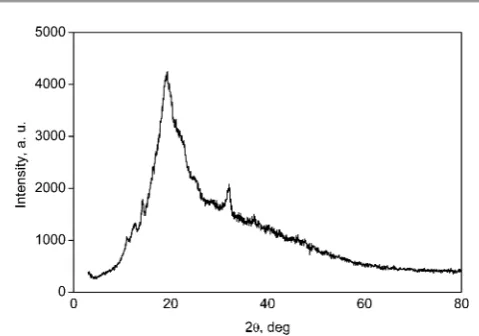
The nature of hemicelluloses also depends on the type of wood.25 The most important hemicelluloses in softwoods (coniferous trees) are galactoglucomannans and arabinoglucuronoxylans. Furthermore, softwoods contain arabinogalactan, xyloglucans, and other glucans. The most important hardwood hemicellulose is xylan, especiallyO-acetyl-4-O-methylglucuronoxylan, amounting to about 80–90% of the hardwood hemicelluloses. Fig. 1 shows the X-ray diffraction pattern of ‘‘our’’ beechwood xylan. The broad peak at 201 indicates some short-range order in the amorphous polymeric structure of the hemicellulose. The magnitude of this short-range order or semi-crystallinity can change from batch to batch and thus can affect the reactivity of the sample.
In a typical reaction, beechwood xylan and solid acid catalyst were mixed in deionized water at 1201C under 10 bar argon.
Fig. 1 X-ray diffraction pattern of xylan from beechwood.
Open Access Article. Published on 03 April 2013. Downloaded on 17/03/2014 11:32:13.
This article is licensed under a
[image:2.595.307.547.534.702.2]Though the weight ratio between xylan and catalyst is 1 : 1, the ratio between the H+sites of the catalyst and the sugar–sugar bond of the xylan is much lower (e.g.0.255 mmol of H+in the case of Amberlyst 70 for 0.75 mmol of sugar bonds). Reaction progress was monitored by SEC-HPLC (see the Experimental section for detailed procedures), and the yield was calculated considering the MW of the xylan as 132 g mol 1.
3.1 Sulfonic acid functionalized polystyrene resins
Fig. 2 shows the kinetics of xylose and arabinose formation by xylan hydrolysis using Amberlyst 70. The resin has a concen-tration of 2.55 mmol H+g 1. Under our conditions it releases 0.255 mmol of H+per 0.75 mmol sugar–sugar bonds indicating a catalytic reaction. The hydrolysis was fast, yielding more than 60% of xylose and arabinose in 2 h. After 4 h the yield of sugar monomers stabilised at 76%.
Control experiments confirmed that only trace amounts of sugar monomers were obtained in the absence of a catalyst (Fig. 3). The xylan breaks into high molecular weight fragments and oligomers under these conditions. Using homogeneous H2SO4 (0.036 M) yielded 74% of sugar monomers. The sulphonated resins
Amberlyst 70 and Amberlyst 35 both gave similar catalytic performance, with ca. 80% yield of xylose and arabinose. D5081 and D5082 gave slightly lower yields of sugar monomers (typically 55–70%, see Fig. 3), probably due to the weaker acid sites than the Amberlyst resins.40 This is consistent with the relatively large separation between acid groups and lower interactions between neighbouring sulphonic acid groups. Earlier studies showed that D5082 has stronger acid sites than D5081, which explains the observed activity trend.41
We then carried out catalyst recycling studies using Amberlyst 70 and D5082 resins (Fig. 4). A significant decrease in the yield of xylose and arabinose was observed after the first recycling, indicating rapid catalyst deactivation. This deactiva-tion continued with further recycling tests.
We envisage two pathways for the deactivation of sulfonic acid resins. One is organic fouling. By-products such as humin can be trapped in the polymeric matrix, masking the active sites. In such cases, calcining the catalyst can reverse the deactivation. Another option isvialeaching of the sulfonic acid groups, especially above 150 1C. Such leaching results in a permanent loss of catalytic activity.
To confirm or exclude the leaching of the sulfonic acid groups, we carried out hot filtration tests, comparing the reaction progress before and after filtering the solid catalyst (Fig. S1, ESI†). These tests confirmed that both Amberlyst 70 and purolite D5082 undergo leaching of sulfonic groups. We therefore moved to two other types of solid acid catalysts: sulphonated silica gel and proton-exchanged zeolites.
3.2 Sulfonic acid functionalized silica gel
Fig. 5 shows the kinetics of xylan hydrolysis over silica gel functionalized with sulfonic acid groups.
After 3 h, complete conversion of xylan was observed with more than 50% xylose and arabinose yield. No improvement in sugar yields was observed thereafter. Also in this case, we tested the recyclability of the solid catalyst.
The combined yield of xylose and arabinose decreased after the first recycling, but then remained stable at around 25% in Fig. 2 Time-resolved yield of xylose and arabinose using Amberlyst 70. Reaction
conditions: xylan (0.1 g); Amberlyst 70 (0.1 g); water (10 ml); 1201C, 10 bar (Ar).
Fig. 3 Yield of xylose and arabinose using different resins, compared with H2SO4and blank reaction. Reaction conditions: xylan (0.1 g); catalyst (0.1 g);
water (10 ml); 1201C, 10 bar Ar, 4 h.
Fig. 4 Yield of xylose and arabinose after the recycling test using Amberlyst 70 and purolite D5082. Reaction conditions: xylan (0.1 g); catalyst (0.1 g); water (10 ml); 1201C, 10 bar Ar, 4 h.
Open Access Article. Published on 03 April 2013. Downloaded on 17/03/2014 11:32:13.
This article is licensed under a
[image:3.595.317.539.49.206.2] [image:3.595.48.291.311.482.2] [image:3.595.45.290.521.683.2]subsequent recycling experiments (Fig. 6). This shows that sulfonated silica gel has two types of sulfonic groups: loosely bound ones that leach into solution, and strongly bound ones (most probably inside the pores) that remain available for catalysis also after recycling.41
[image:4.595.51.287.47.213.2]3.3 Zeolites
Fig. 7 shows the hydrolysis of xylan catalyzed by three different proton-exchanged zeolites: H-Faujasite (HY), HZSM-5 and H-ferrierite. HZSM-5 with Si/Al ratios 50 and 80 gave 33% and 29% sugar yields respectively. Despite its larger pores, HY gave a lower yield (20%). Surprisingly, H-ferrierite gave the highest yield (43%) of xylose and arabinose. Hemicellulose is too large to enter the ferrierite pores. Hence, the initial depolymerisation must take place on the external surface of the catalyst. Possibly, H-ferrierite has stronger acid sites on its external surface compared to HY and H-ZSM-5, resulting in higher activity.
We then carried out further experiments using ferrierite. Increasing the temperature to 1401C gave faster reactions with yields comparable to those obtained at 1201C (Fig. S2, ESI†).
Optimal yields were obtained after 4 h, and longer reaction times led to coke formation. We then ran tests at 1601C, but this caused xylan degradation (Fig. S3, ESI†). Further experi-ments were therefore conducted at 1401C for 4 h.
We also ran reactions with lower ferrierite/xylan ratios (Fig. S4, ESI†). The yield of xylose and arabinose was 31%, considerably higher than the blank reaction, when the catalyst amount was decreased from 0.1 g to 0.025 g. This shows that ferrierite efficiently catalyses the conversion of xylan. Triple recycling tests of the ferrierite showed only a marginal decrease in activity when the spent catalyst was washed with water and calcined in static air (Fig. S5, ESI†).
We evaluated the total acidity of the samples by ammonia adsorption microcalorimetry (Fig. 8). The initial differential heat of NH3 adsorption was the highest for H-ferrierite, indi-cating stronger acid sites than HY and HZSM-5. Though an arbitrary method, averaging the values above a reasonable heat of adsorption provides an indication of acid strength. The average enthalpies above 85 kJ mol 1are 122.4 kJ mol 1, 107.6 kJ mol 1 and 99.3 kJ mol 1for H-ferrierite, HZSM-5 and HY respectively. Fig. 5 Combined yield of xylose and arabinose using sulfonated silica gel.
Reaction conditions: xylan (0.1 g); Amberlyst 70 (0.1 g); water (10 ml); 1401C, 10 bar (Ar).
Fig. 6 Yield of xylose and arabinose after the recycling test using sulfonated silica gel. Reaction conditions: xylan (0.1 g); catalyst (0.1 g); water (10 ml); 1401C, 10 bar (Ar), 3 h.
Fig. 7 Yield of xylose and arabinose using different zeolites as catalysts. Reaction conditions: xylan (0.1 g); catalyst (0.1 g); water (10 ml); 1201C, 20 h, 10 bar (Ar).
Fig. 8 NH3adsorption microcalorimetry data H-ferrierite, HY, and HZSM-5 zeolites,
showing the heat of NH3adsorption as a function of the surface coverage.
Open Access Article. Published on 03 April 2013. Downloaded on 17/03/2014 11:32:13.
This article is licensed under a
[image:4.595.318.539.49.211.2] [image:4.595.48.289.255.423.2] [image:4.595.307.551.510.694.2]This indicates again that our H-ferrierite sample has strong acid sites. The BET surface areas of H-ferrierite (305 m2 g 1) and HZSM-5 (300 m2 g 1) were similar, so the higher initial activity of ferrierite could be attributed to its higher acidic strength. Though microcalorimetry cannot distinguish between external and internal acid sites, the results give an indication of overall acidic strength. Interestingly, ferrierite showed excep-tional performance in butene skeletal isomerization. It is a very selective and stable catalyst, resulting in high yields of isobutene at relatively low temperatures without the need for a diluted feed.42The SEM images of zeolites are given in ESI† (Fig. S6). The samples are aggregates of particles. HY consists of aggregates of 200–500 nm size particles. H-ferrierite is composed of flakes of sizes of a few hundred nm. HZSM-5 has a particle size of around 100–300 nm.
4. Conclusions
Beechwood xylan is readily hydrolysed to a mixture of mono-meric sugars and dimer/oligomer byproducts in the presence of a solid acid catalyst. The catalytic activity varies considerably depending on the solid acid type. Acidic ion exchange resins rapidly lose their activity due to leaching of sulfonic acid groups. Sulfonated silica gels are better, despite showing a considerable loss of activity after the first reaction run. The proton-exchanged zeolite ferrierite affords the best results in terms of both activity and catalyst stability. We attribute this to its relatively high acid strength, as evaluated by NH3adsorption microcalorimetry.
Notes and references
1 B. Kamm, P. R. Gruber and M. Kamm,Biorefineries – Industrial Processes and Products, Wiley-VCH, Weinheim, 2006.
2 Z. Strassberger, S. Tanase and G. Rothenberg, Eur. J. Org. Chem., 2011, 5246–5249.
3 S. Van de Vyver, L. Peng, J. Geboers, H. Schepers, F. de Clippel, C. J. Gommes, B. Goderis, P. A. Jacobs and B. F. Sels,Green Chem., 2010,12, 1560–1563.
4 A. Takagaki, C. Tagusagawa and K. Domen,Chem. Commun., 2008, 5363–5365.
5 P. L. Dhepe and A. Fukuoka, ChemSusChem, 2008, 1, 969–975.
6 A. Fukuoka and P. L. Dhepe,Angew. Chem., Int. Ed., 2006,45, 5161–5163.
7 A. Fukuoka and P. L. Dhepe,Chem. Rec., 2009,9, 224–235. 8 T. Minowa, F. Zhen and T. Ogi,J. Supercrit. Fluids, 1998,13,
253–259.
9 A. Onda, T. Ochi and K. Yanagisawa,Green Chem., 2008,10, 1033–1037.
10 R. Palkovits, K. Tajvidi, J. Procelewska, R. Rinaldi and A. Ruppert,Green Chem., 2010,12, 972–978.
11 J. Pang, A. Wang, M. Zheng and T. Zhang,Chem. Commun., 2010,46, 6935–6937.
12 R. Rinaldi, R. Palkovits and F. Schueth, Angew. Chem., Int. Ed., 2008,47, 8047–8050.
13 R. Rinaldi and F. Schueth,ChemSusChem, 2009,2, 1096–1107.
14 S. Suganuma, K. Nakajima, M. Kitano, D. Yamaguchi, H. Kato, S. Hayashi and M. Hara,J. Am. Chem. Soc., 2008,
130, 12787–12793.
15 N. Villandier and A. Corma, Chem. Commun., 2010, 46, 4408–4410.
16 G. W. Huber, S. Iborra and A. Corma,Chem. Rev., 2006,106, 4044–4098.
17 A. Corma, O. de la Torre and M. Renz,Energy Environ. Sci., 2012,5, 6328–6344.
18 P. Gallezot,Catal. Today, 2011,167, 31–36.
19 A. Corma, S. Iborra and A. Velty, Chem. Rev., 2007, 107, 2411–2502.
20 J. C. Serrano-Ruiz, D. J. Braden, R. M. West and J. A. Dumesic,Appl. Catal., B, 2010,100, 184–189.
21 D. M. Alonso, J. Q. Bond and J. A. Dumesic,Green Chem., 2010,12, 1493–1513.
22 M. Rose and R. Palkovits,Macromol. Rapid Commun., 2011,
32, 1299–1311.
23 M. Hara,Energy Environ. Sci., 2010,3, 601–607.
24 B. T. Kusema, G. Hilmann, P. Maki-Arvela, S. Willfor, B. Holmbom, T. Salmi and D. Y. Murzin, Catal. Lett., 2011,141, 408–412.
25 P. Ma¨ki-Arvela, T. Salmi, B. Holmbom, S. Willfo¨r and D. Y. Murzin,Chem. Rev., 2011,111, 5638–5666.
26 R. Sahu and P. L. Dhepe,ChemSusChem, 2012,5, 751–761. 27 P. L. Dhepe and R. Sahu,Green Chem., 2010,12, 2153–2156. 28 E. I. Guerbuez, S. G. Wettstein and J. A. Dumesic,
ChemSusChem, 2012,5, 383–387.
29 C. Li, M. Zheng, A. Wang and T. Zhang,Energy Environ. Sci., 2012,5, 6383–6390.
30 E. S. Kim, S. Liu, M. M. Abu-Omar and N. S. Mosier,Energy Fuels, 2012,26, 1298–1304.
31 R. Xing, W. Qi and G. W. Huber,Energy Environ. Sci., 2011,
4, 2193–2205.
32 Y. Ogaki, Y. Shinozuka, T. Hara, N. Ichikuni and S. Shimazu,Catal. Today, 2011,164, 415–418.
33 R. Xing, A. V. Subrahmanyam, H. Olcay, W. Qi, G. P. van Walsum, H. Pendse and G. W. Huber, Green Chem., 2010,12, 1933–1946.
34 K. Wilson, D. J. Adams, G. Rothenberg and J. H. Clark, J. Mol. Catal., 2000,159, 309–314.
35 N. R. Shiju, G. Rothenberg and D. R. Brown, Top. Catal., 2010,53, 1217–1223.
36 M. Bandyopadhyay, N. R. Shiju and D. R. Brown, Catal. Commun., 2010,11, 660–664.
37 N. R. Shiju, M. AnilKumar, W. F. Hoelderich and D. R. Brown,J. Phys. Chem. C, 2009,113, 7735–7742. 38 P. F. Siril, N. R. Shiju, D. R. Brown and K. Wilson, Appl.
Catal., A, 2009,364, 95–100.
39 E. Cano-Serrano, G. Blanco-Brieva, J. M. Campos-Martin and J. L. Fierro,Langmuir, 2003,19, 7621–7627.
40 E. Andrijanto, E. A. Dawson and D. R. Brown,Appl. Catal., B, 2012,115–116, 261–268.
41 R. Ciriminna, L. M. Ilharco, A. Fidalgo, S. Campestrini and M. Pagliaro,Soft Matter, 2005,1, 231–237.
42 A. C. Butler and C. P. Nicolaides,Catal. Today, 1993,18, 443–471.
Open Access Article. Published on 03 April 2013. Downloaded on 17/03/2014 11:32:13.
This article is licensed under a