A Rights-Based Perspective on
Permissible Harm
Susanne Burri
A thesis submitted to the Department of Philosophy, Logic and Scientific Method of the London School of Economics and Political Science
Declaration
I certify that the thesis I have presented for examination for the PhD degree of
the London School of Economics and Political Science is solely my own work. The
copyright of this thesis rests with the author. Quotation from it is permitted, provided
that full acknowledgement is made. This thesis may not be reproduced without the
prior written consent of the author. I warrant that this authorisation does not, to the
best of my belief, infringe the rights of any third party.
I declare that my thesis consists of 70,201 words.
Abstract
This thesis takes up a rights-based perspective to discuss a number of issues related
to the problem of permissible harm. It appeals to a person’s capacity to shape her
life in accordance with her own ideas of the good to explain why (i) her death can be
bad for her, and why (ii) each of us should have primary say over what may be done
to her.
The thesis begins with an investigation of the badness of death for the person who
dies. If death is bad for us, this helps explain the wrongness of killing. The thesis
defends the deprivation account—i.e. the idea that death is bad for us when and
because it deprives us of good life—against two Epicurean challenges. It adds that
death is also bad when and because it thwarts our agency.
Next, the thesis deals with the logic of our moral rights to non-interference. It
proposes a conception of rights according to which the stringency of our rights derives
from and is justified by the rational aspect of our human nature. It argues that this
conception of moral rights solves the paradox of deontology.
While our rights to non-interference are stringent, they are not absolute. The
thesis considers two possible exceptions to the general rule that it is impermissible to
harm an innocent person against her consent. First, using an actual case from WWII,
it investigates the circumstances under which a government may expose some parts
of its population to an increased risk of harm in order to decrease the risk to others.
Second, it considers the permissibility of self-defence against an innocent threat. It
argues that the potential victim of an innocent threat has a justice-based reason to
Contents
Page
List of Tables 7
Acknowledgements 8
1 Introduction 10
1.1 On the Ethical Significance of Our Rationality . . . 12
1.2 Two Provisos on Permissible Harm . . . 17
1.3 Understanding What is at Stake in a Decision Situation . . . 22
2 How Death is Bad for the Person Who Dies 24 2.1 Introduction . . . 24
2.2 Two Epicurean Arguments Against the Badness of Death . . . 26
2.3 The Deprivation Account of the Badness of Death . . . 28
2.3.1 Comparativism . . . 29
2.3.2 The Deprivation Account and the First Epicurean Argument . 32 2.3.3 The Deprivation Account and the Timing Puzzle . . . 35
2.3.4 A Dialectical Stalemate . . . 37
2.4 Death from a Deliberative Perspective . . . 41
2.4.1 Choosing the Best Expected Life . . . 41
2.4.2 Epicurean Maximax . . . 43
2.4.3 Focusing on Intrinsic Value . . . 46
2.5 An Agency-Based Account of the Badness of Death . . . 48
2.5.2 Death as a Frustrator of Categorical Desires . . . 49
2.5.3 How Death Is Bad For Us as Agents . . . 52
2.5.4 Agential Reasons to Put Death Off Into the Future . . . 56
2.5.5 Solving the Problem for the Deprivation Account . . . 58
2.6 Conclusion . . . 60
3 Moral Status and the Paradox of Deontology 63 3.1 Introduction . . . 63
3.2 The Paradox of Deontology . . . 66
3.3 The Agent-Focused Approach to Solving the Paradox of Deontology . 67 3.4 The Inviolability Approach . . . 70
3.5 Inviolability and Moral Importance . . . 73
3.6 The Saveability Criticism of the Inviolability Approach . . . 74
3.7 Moral Status, Moral Importance, and the Saveability Criticism . . . . 76
3.7.1 Moral Status and Moral Importance . . . 76
3.7.2 Do Groups Have a Moral Status? . . . 78
3.7.3 The Weights-Based View of Moral Reasons . . . 80
3.7.4 From Weights to Trumps . . . 85
3.8 A Moral Status That Fits Us . . . 94
3.8.1 Inviolability and Our Capacity for Rational Agency . . . 95
3.9 The Enforceability Criticism . . . 97
3.10 Why the Enforceability Criticism Fails . . . 101
3.11 Effective Rights to Non-Interference . . . 106
3.12 Conclusion . . . 110
4 The Redirection of Bombs During World War II 113 4.1 Introduction . . . 113
4.2 The Historical Case . . . 115
4.3 The Feasibility of Confusing the Enemy . . . 120
4.4 The Historical Case in the Philosophical Literature . . . 122
4.5 Showing Equal Concern . . . 131
4.5.1 Did Redirection Show Equal Concern? . . . 134
4.6 The Right to Life . . . 138
4.6.1 Negative and Positive Aspects of the Right to Life . . . 138
4.6.2 The Significance of the ‘No Involvement’ Baseline . . . 142
4.7 The Defensibility of the Redirection Strategy . . . 146
4.8 Conclusion . . . 153
5 A Profiting Innocent Threat and You: Why It’s a Toss-Up 155 5.1 Introduction . . . 155
5.2 Arguments in Favour of Permissibility . . . 156
5.3 Arguments Against Permissibility . . . 158
5.4 The Toss-Up Between a Profiting Innocent Threat and His Victim . . 160
5.4.1 The Misconception . . . 160
5.4.2 The Differences Between a Threat and His Victim . . . 161
5.4.3 Weighing Claims . . . 168
5.4.4 The Distributive Perspective . . . 170
5.5 Comparing Innocent Threat Cases . . . 172
5.6 A Prerogative to Save One’s Own Life? . . . 174
List of Tables
Page
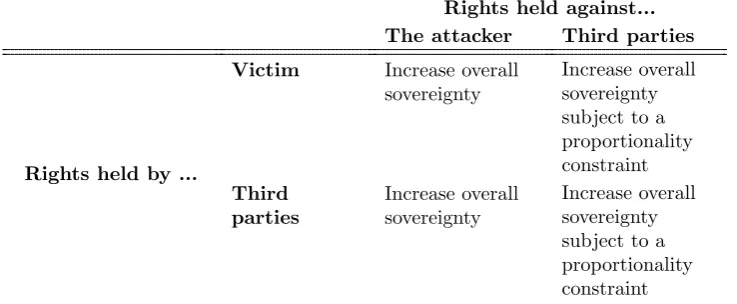
1 The Enforceability Dimension According to Otsuka . . . 99
Acknowledgements
As a supervisor, Alex Voorhoeve has proved incredibly fast at being extremely helpful.
I have often received his constructive and careful feedback to a piece of written work
not just within days of sending it to him, but within hours, allowing me to work
on a particular problem in the most effective way possible. Our discussions greatly
advanced my understanding of the material, and they consistently left me inspired.
I appreciate how Alex never failed to treat me respectfully and fairly, and how he
managed to be genuinely encouraging. I thank Alex for his invaluable support during
four years of outstanding supervision.
I am also very grateful to Luc Bovens for acting as a second supervisor. He has
provided insightful and interesting comments and was available for extremely useful
discussions with respect to chapters 2 and 3 of this thesis. No matter how busy he
was, Luc never turned me away when I knocked on his door with a favour to ask or an
issue to discuss. I am convinced that the LSE Philosophy Department is such a great
place largely because it is headed by such a compassionate and cheerful character.
I thank Ralph Oppenheimer for his generous financial support through the LSE
Department of Philosophy PhD Partnership Scholarship. I am honoured by the keen
interest that Ralph has taken in my work and in my progress, and in the confidence
that he has put in me. Without his support, I would not have been able to pursue
my passion for philosophy.
I thank my partner Thomas Seiler for his unwavering patience and understanding
especially during the last few months of my PhD. Thomas kept me sane by convincing
me to go swimming or running on a daily basis. He was always willing to engage in
philosophical discussion and help me clarify my thoughts. His loving encouragement
proved vital to the completion of this thesis.
I am profoundly grateful to my parents and my two sisters. Their unconditional
and uncomplicated love and support sustained me throughout my PhD, and I have
drawn many philosophical inspirations from the extended conversations we tend to
I owe a large debt of gratitude to Dieter Thom¨a. With his extraordinarily
well-taught course “Der Liberalismus und seine Kritiker”, he inspired me to complement
my undergraduate degree in economics with postgraduate studies in both economics
and philosophy, which eventually led me to pursue a PhD in philosophy. Dieter has
been an invaluable source of encouragement and support throughout my academic
career.
Karin Ohashi, Francesca Pero, Esha Senchaudhuri, Chlump Chatkupt, Foad
Dizadji-Bahmani, Constantin B¨urgi, Ben Ferguson, Roberto Fumagalli, Sascha Gysel, Dominik
Hangartner, Peter Helles, Tom Hinrichsen, Andreas P¨ahler, Mantas Radˇzvilas, Alan
Robinson, Hamid Seyedsayamdost, and Francesco Sp¨oring are some of the friends who
have shared in the ups and downs of my life as a PhD student, thereby making that
life meaningful, fun, and memorable. Special thanks go to my very good friend Katya
Pirozhkova. Without Katya, I would not have stumbled upon Vladimir Nabokov’s
translation of Eugene Onegin, which figures importantly in the introduction to this
1
|
Introduction
“The trouble is, as so often in philosophy, it is hard to improve
intelligibility while retaining the excitement.”
– Donald Davidson (1974, p. 5)
“In art as in science, there is no delight without the detail, and it is on
details that I have tried to fix the reader’s attention. Let me repeat that
unless these are thoroughly understood and remembered, all ‘general
ideas’ (so easily acquired, so profitably resold) must necessarily remain
but worn passports allowing their bearers short cuts from one area of
ignorance to another.”
– Vladimir Nabokov (1975, p. 8)
In February of 2013, my friend Katya and I went to see a wonderful production of
Tchaikovsky’sEugene Onegin at the Royal Opera House. After the performance, we
walked around Covent Garden, feeling inspired and deeply moved. Katya recounted
how she had read Pushkin’s novel in the original Russian many years ago, and she
told me that she still remembered it as one of the most beautiful books she had ever
read. Back at home, I ordered Nabokov’s English translation of Pushkin’s novel.
When it arrived in the mail a few days later, I unwrapped it with great anticipation,
and immediately started reading it. Nabokov’s introduction was intriguing. He
emphasized that he had taken no liberties in his translation; that his aim had been to
express in English precisely what Pushkin had written in Russian. Nabokov admitted
that some of the beauty of the original was lost in his literal translation, but he
cost of distorting their meaning. I turned the page, and started with the main text.
After twenty minutes or so, I gave up. Nabokov’s translation was unbearably dull
and awkward; it was more painful to work through than most philosophy texts I have
encountered. I never bothered giving it a second try. At least in art, I believe that
there is no understanding without emotional engagement. It is funny that Nabokov—
literary genius and admirer of Pushkin—assumed there was a way of staying true to
the original text without trying to preserve its poetic beauty.
When it comes to philosophy, I am willing to slowly work my way through a
problem or a difficult text. Here, what Nabokov (1975, p. 8) says seems exactly right:
unless we pay careful attention to the details, we end up taking “short cuts from
one area of ignorance to another.” In philosophy, precision is thus more important
than beauty, and emotional involvement, rather than promoting our understanding,
can sometimes keep us from thinking clearly. Still, when it comes down to it, what
makes thinking about philosophical problems worthwhile is the fact that they have an
emotional hold on us. As philosophers, we grapple with problems we find exciting and
important, and we grapple with thembecause we find them exciting and important.
When we lose sight of this—as sometimes happens when we struggle to think clearly
about some small aspect of a much larger issue—doing philosophy can start to feel as
cumbersome and pointless as reading an ugly translation ofEugene Onegin.
How do we retain our excitement for a philosophical problem when we are working
on clarifying some small aspect of it? Personally, I have noticed that I remain excited
about a problem if I periodically take a step back, and contemplate what I am working
on from a certain distance. Hence this introduction, which I use to take a step back
from the chapters of my thesis, so as to contemplate them from a distance. In the
following pages, I explain what intrigues me about the different questions that my
thesis tackles, and I speculate about some of the wider implications of my main
conclusions.
The four chapters of my thesis focus on four different questions. Nonetheless, as I
shall now explain, they are unified by a number of shared methodological assumptions
1.1
On the Ethical Significance of Our Rationality
Especially the first two chapters of this thesis are based on the methodological
assumption that a human person is a certain kind of creature, and that we can
use this idea to justify some of the philosophical claims that we make. I particularly
heavily rely on the idea that a human person is a rational being who lives her life in
a purposeful way.
In chapter 2, I investigate how death can be bad for the person who dies. The
ancient Greek philosopher Epicurus (1926, p. 85) famously argued that there is no way
in which a person’s death can be bad for her, and that we should thus all “[become]
accustomed to the belief that death is nothing to us.” According to the currently
most favoured position in the philosophical literature, Epicurus’ claim rests on an
important oversight, and a person’s death is bad for her just in case and to the extent
that she would have lived an overall better life had her death not occurred when it did
in fact occur. The basic idea behind thisdeprivation account of the badness of death
is simple and compelling. But it is not clear how well the deprivation account can
deal with a number of Epicurean challenges. In chapter 2, I defend the insights of the
deprivation account against two Epicurean challenges. I show how from a deliberative
perspective, the deprivation account lays out an intelligible and practically relevant
way in which death can be bad for the person who dies. The Epicurean resistance to
calling death ‘bad’ unhelpfully obscures this fact.
When I first encountered the deprivation account of the badness of death, I felt
that there was something amiss. I am much more confident in my judgement that it
would be bad for me if I died tonight than I am in my judgement that I will eventually
have lived a better life if I do not die tonight. Yet according to the deprivation account,
these two seemingly distinct judgements come to one and the same judgement, so that
one should feel similarly confident in both.
My hunch that there was something amiss with the deprivation account led me to
come up with and defend anagency-based account of the badness of death. The
agency-based account is not meant to replace the deprivation account, but tocomplement its
which a person has an all-things-considered reason to avoid her own death. But it fails
to make clear that a person’s death can be non-comparatively bad for her. I argue
that this failure stems from the fact that defenders of the deprivation account see a
human person primarily as abearer of experiences, or as someone to whom good and
bad things happen. But a human person is also an agent, or someone who lives her
life guided by goals and principles that she has set for herself. Once we bear in mind
that a human person is an agent, it becomes apparent that the deprivation account is
importantly incomplete as a description of how a person’s death can be bad for that
person.
To the extent that we live our lives as agents, we live a life that fits our nature
as rational beings. Robert Nozick (1974, pp. 49-50) suggests that the distinguishing
feature of a rational being is its capacity to govern itself in the light of reasons. To
Nozick, a rational being is “able to formulate long-term plans for its life, able to
consider and decide on the basis of abstract considerations or principles it formulates
to itself and hence not merely the plaything of immediate stimuli, a being that limits
its own behavior in accordance with some principles or picture it has of what an
appropriate life is for itself and others” (Nozick, 1974, p. 49). Insofar as we are
rational beings, our lives are meaningful and valuable if we are able to live them in a
self-determined way, i.e. by pursuing plans and projects in accordance with our own
ideas of the good.
In chapter 3, I argue that an appeal to the rational aspect of our human nature
helps justify and explain why as human persons, we have stringent moral rights to
non-interference. Moral rules built around stringent rights to non-interference neither
make it morally permissible to minimize the harm that comes to innocent persons,
nor do they make it morally permissible to distribute harm equally among similarly
undeserving recipients. But with stringent rights to non-interference, each of us enjoys
an almost exclusive authority over the ‘territory’ of his or her own body and mind
(while being in turn required to steer clear of the sovereign territories of other people).
As rational beings with a strong social bent, this sovereignty is something we rightly
value, and that therefore fits the kind of creature we are. Being sovereign over our
as we please, while living together in peace.
How should our moral rules deal with the fact that the sovereignty of the individual
is not always respected? Suppose a vicious murderer is threatening to kill five innocent
people, thereby arrogating to himself a decision over their fate. If he manages to
kill the five, he thwarts their plans and projects, and he destroys their capacity for
rational agency. Now suppose that there is a way to stop the murderer, but it involves
killing one innocent person as a means to secure the safety of the five. Is it morally
permissible to kill the one as a means to secure the safety of the five? Intuitively, the
answer is ‘no’. But this intuitive judgement is difficult to justify. To see why, suppose
that it is permissible to kill the one, and you go ahead and kill him. Then only one
person has his agency destroyed and his plans and projects thwarted. From the point
of view of what our rights to non-interference protect, this would seem to be a better
outcome than the outcome in which five people have their agency destroyed and their
plans and projects thwarted. This means that if our intuitive judgement is correct,
then our rights to non-interference sometimes make it impermissible to bring about
what is a best possible outcome from their own point of view. How can this be? In
its general form, this problem is standardly referred to as the paradox of deontology
(Nozick, 1974, pp. 28-30).
In chapter 3, I follow Frances Kamm (1996) in defending a status-based approach
to answering the paradox of deontology. Kamm’s basic idea is that the paradox of
deontology rests on a mistaken understanding of the purpose of our rights to
non-interference. To Kamm, we do not have rights to non-interference only because, or
even primarily because, they help protect us against unwanted interference. Rather,
the primary purpose of our rights to non-interference is to mark us out as beings
who are owed respectful treatment, and who rightfully have the final say over what
should happen to them. To put the same idea differently, the main point of our moral
rights to non-interference is to protect and give expression to our inviolability. The
more stringent our rights, the more inviolable we are. The more inviolable we are, the
fewer the circumstance under which morality endorses our being harmed against our
consent, and the higher our moral status. Kamm (1996, p. 272) argues that having a
are “worthy of respect, owed respect.” As a solution to the paradox of deontology,
this suggests that it may be impermissible to kill one person as a means to save five
others because this implies that we are morally highly important beings who are owed
respectful treatment.
I argue that Kamm’s status-based approach to solving the paradox of deontology
can be fleshed out into a viable solution to the paradox. I consider two criticisms to
the status-based approach: asaveability criticismand anenforceability criticism. The
saveability criticism (Kagan, 1991, pp. 919-20) accuses the status-based approach of
arbitrarily favouring the importance captured by our inviolability over the importance
captured by another aspect of our moral status—our ‘saveability’. A person’s
saveability increases as more may permissibly be done to others to save her from harm.
I show that the saveability criticism is well-founded, and that we should therefore not
appeal to considerations of moral importance to defend the idea that being highly
inviolable is good for us. I suggest that we should instead appeal to considerations of
fittingness. On the fittingness defence of the status-based approach, we have reason
to believe that each of us is highly inviolable just in case this fits the kind of moral
creature we are. I propose that as rational beings, we are capable of shaping our life
in accordance with our own ideas of the good, and we aspire to lead our lives in a
self-determined way. This makes it fitting that each of us should have primary say
over what may be done to him or her (Quinn, 1989b, p. 309). To the extent that our
moral rules make us sovereign over our bodies and minds, they therefore recognize
and give expression to our capacity for rational agency—they endow us with a moral
status that fits therational aspect of our human nature.
The enforceability criticism (Otsuka, 2011, pp. 51-4) grants that our moral status
should fit the kind of creature we are. It also grants that as rational beings who
aspire to lead self-determined lives, it is fitting that we should be highly inviolable, as
being highly inviolable makes us personally sovereign by putting us in charge of our
bodies and minds. But it contends that the fittingness defence of the status-based
approach depends on too narrow an understanding of personal sovereignty. More
specifically, it holds that an appropriate conception of personal sovereignty cannot
If this is correct, then our personal sovereignty might increase not only with the
stringency of our rights to non-interference, but also with our moral authority to
defend ourselves against illegitimate interference. Michael Otsuka (2011) claims that
our authority to defend ourselves consists of and increases with enforcement rights
we have against culpable attackers as well as against innocent third parties (whom it
may sometimes be helpful to harm in order to fend off an attack). He then shows that
on his conception of personal sovereignty, the fittingness defence of the status-based
approach is undermined.
I maintain that the enforceability criticism fails. I argue that while Otsuka is
right to insist that there is an enforceability dimension to personal sovereignty, he is
wrong to believe that it extends to enforcement rights we have against innocent third
parties. This restores the fittingness defence of the status-based approach to solving
the paradox of deontology.
However we spell out its details, it is an intuitively plausible and promising idea
that the rational aspect of our human nature helps justify and explain thestringency
of our moral rights to non-interference. But what explains their limits? Why do
we not have absolute rights to non-interference? In chapter 3, I argue that we care
about promoting best possible outcomes for a number of reasons, and that these
reasons need to be balanced against status-based considerations. For one thing, a
capacity for rational agency is not the only morally relevant aspect of human nature.
Another relevant aspect is sentience, or the fact that a human person is a “complex,
feeling creature who cares about whether it lives or dies” (Kamm, 1996, p. 277).
It is reasonable to assume that our sentience grounds a moral concern with what
actually happens to us, thus underpinning consequentialist ideas according to which
we should try and do what best promotes the general welfare. Insofar as these ideas
are on the right track, we can understand conflicts between respecting people’s rights
to non-interference and promoting the general welfare as clashes between the moral
implications of our rationality and our sentience—the former giving rise to our moral
status as sovereign individuals who must not be interfered with against their consent,
the latter grounding a consequentialist concern with the general welfare.
connection between our moral rules and certain basic features of our human nature.
In addition to being intuitively plausible, it allows us to frame morally difficult decision
situations as clashes between the moral implications of different aspects of our human
nature. In this way, it enables us to understand why reasonable people sometimes
disagree about the right thing to do. Unlike many other moral philosophers, I do not
think that there is always one right ‘solution’ to a morally difficult decision situation,
a solution that we are able to identify if only we give the matter due consideration.
It seems to me that where the implications of different but fundamental values pull
apart, there will sometimes be no unambiguously right thing to do—only differently
unsatisfactory courses of action we can take. This does not mean that thinking about
morally difficult decisions strikes me as a waste of time. Quite to the contrary, I
believe that much is gained if we are able to improve our understanding of the nature
of moral conflicts, and are able to identify what is at stake in any given difficult
decision situation.
1.2
Two Provisos on Permissible Harm
Our moral rights to non-interference are stringent, but they are not absolute. Under
certain circumstances, it becomes permissible to infringe them. In chapters 4 and 5,
I look at two exceptions to the general rule that it is morally impermissible to harm
an innocent human person against her consent.
Chapter 4 is a philosophical investigation of an actual historical case. During
World War II, the German Wehrmacht started terror bombing London. The Germans
were assumed to be targeting the area around Charing Cross in Central London, but
the actual ‘mean point of impact’ (MPI) of their bombs lay in Dulwich, some four
miles south-east of Charing Cross. With the help of double agents that the British
authorities had recruited among German spies, it would have been possible to redirect
the bombs even further away from Central London. Implementing this redirection
strategy would likely have saved a great number of civilian lives in Central London,
while resulting in an increase of civilian deaths in certain areas in South London.
deaths. While the British deception authorities were convinced that redirecting the
bombs was the right thing to do, the War Cabinet’s Ministers were doubtful. They
felt that it was “not for the Government to authorise action which would result in
certain areas in South London [. . . ] sustaining heavier casualties than they do at the
present time”, and they therefore issued an order not to redirect the bombs, but to
“confuse the enemy” (PREM 3/111A, 3 August 1944).
After taking a close look at the historical details of the case, I discuss whether the
Ministers were right to feel hesitant about the redirection strategy. Were there any
considerations that spoke against it? If yes, did these considerations make it the case
that confusing the enemy would have been morally preferable to redirection?
Implementing the redirection strategy would have significantly reduced the expected
overall number of civilian deaths. While redirecting the bombs would have caused
some harm, it would thus also and expectably have prevented much greater harm.
This means that the British authorities had alesser evil justificationfor adopting the
redirection strategy. Moreover, it is plausible to assume that redirecting the bombs
need not have involved intending harm. I use some of the ideas behind Kamm’s
Doctrine of Triple Effect to argue that even though the redirection strategydepended
on the occurrence of bomb incidents in certain parts of London, none of these incidents
had to be intended as a means to implement the redirection strategy (Kamm, 2007,
p. 95-120).
Non-intentional harm that comes with a lesser evil justification is the textbook
example of harm that may permissibly be inflicted on innocent persons. But then
why did the Ministers feel uneasy about redirection? I argue that they had good
reason for doing so. A government owes its duty of protection equally to all of its
citizens. This means that the protective measures which it implements should show a
sufficiently equal regard for the safety of all of its citizens. But there is an important
sense in which the redirection strategy did not do this. To adopt it meant to try
and keep the people living in Central London safe by making those living in South
London bear the brunt of the German attack. The fact that redirecting the bombs
meant singling out a part of the population to bear the brunt of the German attack
it would nevertheless have been right to redirect the German bombs, as avoiding to
show unequal concern would have come at too high a price in human lives. But I also
argue that it wouldonly have been right to adopt the redirection strategy subject to
the qualification that this would have been accompanied by a serious effort to put a
swift end to the bombings. Why this qualification? I propose that it is an application
of the following more general proviso:
Proviso on Redirection. If you redirect a threat away from more
and towards fewer people, then you ought to subsequently expend
the same effort and expenses to protect the smaller number as you
ought to have expended to protect the larger number in the absence
of redirection.
According to the proviso on redirection, what makes redirecting a threat justifiable is
partly a commitment to do just as much to stop the threat as you would have done—
and should have done—in the absence of redirection. If you do less to stop the threat
once you have contained its potential impact through redirection, this makes it the
case that you redirected the threat partly to save expenses and effort, and not just
to save lives. But the consideration that it would save expenses is not a valid reason
in favour of exposing innocent people to grave danger. If you put innocent people’s
lives at risk through redirection, it should be only because this serves to significantly
reduce a comparable risk to more numerous others.
The redirection of bombs during WWII would have been morally permissible
partly because it came with a lesser evil justification, and because redirecting the
bombs need not have involved intending harm. By contrast, chapter 5 argues that
there are circumstances under which it is permissible to harm an innocent person
when both of these factors are absent. To get a feel for these kind of circumstances,
imagine that you find yourself at the bottom of a deep well (Nozick, 1974, p. 34).
Thugs have picked up an innocent person—call him Bob—and have thrown him down
the well. Bob is now falling towards you. If you do nothing, your body will cushion
Bob’s otherwise lethal fall. This will guarantee his survival, but it will kill you. If
morally permitted to shoot your ray gun?
If you are, then it is permissible to intentionally kill an innocent person in the
absenceof a lesser evil justification. What could possibly ground such a permissibility?
Some moral philosophers appeal to the idea of an agent-relative prerogative to argue
that you may permissibly kill Bob (see e.g. Quong, 2009). Their idea is that because
Bob will kill you unless you kill him—and because you haven’t forfeited any of your
rights to non-interference—you may permissibly save your own life by vaporizing Bob.
To their mind, our morality would be overly demanding if you lacked a right to defend
yourself against being crushed by Bob.
I argue against the idea of an agent-relative prerogative to kill an innocent threat
such as Bob. Intentionally killing an innocent person merely because one puts one’s
own interests first is a gravely disrespectful thing to do. Of course, it can be extremely
difficult to keep a cool head when one’s own life is at stake, so that it may sometimes
be appropriate toexcusesomeone who has killed an innocent other in order to secure
their own survival. But this in no way suggests that it would bemorally justifiable to
shoot Bob. In light of the fact that our moral rules are based on a strong presumption
against harming innocent others, it is difficult to see how you could be permitted to
kill Bob merely because it would be good for you if you were.
Based on these considerations, I reject a prerogative-based justification for harming
Bob. But I still think that you may permissibly harm Bob. More precisely, I argue
that you have a justice-based reason to inflict on Bob the harm that he would be
duty-bound to suffer for your sake. To see what I mean, suppose that Bob could
redirect himself away from you at the cost of a broken leg (Kamm, 1996, p. 96).
It then seems that Bob would be under a duty to do so, even though an innocent
bystander would not have to break one of her legs to keep Bob from harming you
(ibid.). Why would Bob have to incur substantial harm to avoid harming you if he
could? In essence, because our morality is built on a strong presumption against
harming innocent others. Metaphorically speaking, if Bob were physically able to
avoid trespassing on your sovereign territory, then he would be morally required to
take great pains to do so.
are able to avoid harming Bob. Given our morality’s strong presumption against
harming innocent others, isn’t it simply your tough luck that you have to let yourself
be crushed by Bob? I argue that it is not. In brief, the protective logic of our moral
rights to non-interference is built around—and for its functioning depends on—the
idea of mutual recognition between moral equals. This means that you owe it to Bob
not to just vaporize him because he is the kind of creature who can understand that if
he could avoid crushing you, then he would have to go to great lengths to do so. But
if you must constrain yourself towards Bob partlybecause Bob would have to suffer
substantial harm to avoid crushing you if he could, it would be unjust if you could
not impose that harm on Bob on his behalf.
How much harm would Bob have to impose on himself to avoid harming you if he
could? I argue that if Bob were falling towards you with a ray gun at his disposal,
he would have to treat your interests as on a par with his own. This means that he
would have to flip a coin to choose between vaporizing himself and saving his life by
crushing and killing you. It follows that in the original set-up, you may burden Bob
with a 50% chance of death, as this is the amount of harm that he would have to
inflict on himself for your sake.
I contend that it is impermissible to burden Bob with more harm than a 50%
chance of death. Given the circumstances, there is a certain amount of harm that
may rightly be assigned to Bob, i.e. the amount of harm that he would have to suffer
to avoid harming you if he could. Once you impose on Bob harm in excess of this
amount, you violate his rights to non-interference. These considerations suggest a
second proviso on permissible harm. It can be stated as follows:
Constraint on Agent-Relative Prerogatives. If you harm an
innocent person only so as to avoid harm to yourself, you must not
impose on the innocent person harm in excess of the amount that
he would have a duty to inflict on himself if he were able to.
As a constraint on agent-relative prerogatives, this proviso states that even if it would
greatly benefit you, you must not do to Bob what he would not have to do to himself
1.3
On the Importance of Understanding What is
at Stake in a Decision Situation
Normative ethical theorizing should provide us with practically relevant insights: it
should have the potential to help us determine what we ought to do in a given decision
situation (see e.g. Rachels, 2000, p. 89, Feldman, 2006, p. 49). But when we stop
to think about it, it may appear doubtful whether I have managed to clarify in a
practically relevant way what was at stake in the British decision to redirect the
German bombs.
As mentioned in section 1.2, I argue that if the British authorities had adopted
the redirection strategy, they would not have shown equal concern for the safety of
all of their citizens. I suggest that this consideration provided a pro tanto reason
against adopting the redirection strategy. But then I go on to conclude that all
things considered, the German bombs should have been redirected, as avoiding to
show unequal concern would have come at too high a price in human lives. From a
practical point of view, this discussion would seem useful only if it specified how the
trade-off between showing equal concern and minimizing losses ought to be decided.
But I make no suggestions to this effect. Practically speaking, what is the point of
arguing for theimportanceof a consideration without specifying the conditions under
which it isdecisive?
I agree that the arguments presented in chapter 4 would gain in practical relevance
if they were more specific about the proper trade-off between showing equal concern
and other considerations. But this does not make them useless as they stand. If you
know what considerations are important in a given decision situation, this allows
you to try and find an alternative that accommodates them all. To see what I
mean, suppose that you are one of the War Cabinet’s Ministers. You have to decide
whether to support or oppose the redirection strategy. You know that redirection is
a protective measure that doesnot show equal concern for the safety of all, and you
understand that this gives you a reason to avoid it. Even if you do not knowprecisely
to guide deliberation: it tells you to look for alternatives to redirection that better
express an equal concern for the safety of all citizens, and to give these alternatives
serious consideration. If you raise the issue with your fellow Ministers, and if you
and your fellow Ministers are a dedicated and resourceful bunch, you may be able
to come up with an ingenious alternative to redirection that avoids showing unequal
concern, but that nevertheless promises to be highly effective as a protective measure.
You might also find that given the circumstances, all of the available alternatives
for action—including doing nothing—would amount to showing similarly unequal
concern. If so, you would be justified in implementing the most effective protective
measure. It is of course possible that no such clearly best alternative can be found.
When this is the case, knowing what is of importance may help guide you in the right
direction, but it will not lead you all the way to a satisfactory practical conclusion. As
mentioned further above, I believe that there can also be circumstances under which
no entirely satisfactory practical conclusion exists.
When Nabokov decided to translate Eugene Onegin, he failed to properly take
into account considerations of style and beauty. Instead of being painfully aware of
the difficult trade-off between preserving the beauty of Pushkin’s verses and staying
close to their literal meaning, Nabokov resolutely set considerations of style aside,
and concerned himself only with literal meaning. The result proved disastrous. Had
Nabokov felt the full force of both considerations, he probably would have struggled
to juggle them, and there is no guarantee that he would have managed to settle on a
suitable compromise between them. But in light of his literary genius, he just might
2
|
How Death is Bad for the
Person Who Dies
*
“When you are dead, you don’t know that you are dead. It is difficult
only for other people.
It is the same when you are stupid.”
– Unknown
2.1
Introduction
It is uncontroversial that a person’s death can be a terrible misfortune for other people.
To lose someone you love is often an immensely painful and disruptive experience.
But can death also be bad for the person who dies?1 Most people intuitively think that it can. The Greek philosopher Epicurus (1926, p. 85), however, has argued
against this intuitive judgement, and has put forward the idea that we should all
become “accustomed to the belief that [our own] death is nothing to us.” Today, a
number ofEpicurean argumentsbased on Epicurus’ insights are still used to challenge
the wide-spread belief that death can be bad for the person who dies.
In the philosophical literature, the currently most favoured explanation of the
badness of death is offered by thedeprivation account. According to the deprivation
* An earlier version of this chapter was presented at the Stockholm Philosophy Graduate Conference.
I thank Jens Johannson for a constructive response and several helpful discussions. I am grateful to Katie Steele for providing useful feedback on the decision-theoretic aspects of this chapter. I also thank Ben Bradley and Steven Luper for helpful comments on earlier versions of this chapter.
1 In what follows, I put aside the bad effects someone’s death can have on other people, and I
account, a person’s death is bad for her just in case—and to the extent that—she
would have led a better life had she not died when she did in fact die. The deprivation
account is more congenial to our intuitions than the Epicurean position. But it is not
clear whether defenders of the deprivation account are able to provide satisfactory
answers to the challenges raised by the Epicurean arguments against the badness of
death.
In this chapter, I defend the deprivation account against two Epicurean challenges.
I argue that the deprivation account lays out an intelligible way in which our own
death can be bad for us, and that the Epicurean resistance to calling death ‘bad’
unhelpfully obscures this fact. I also put forward an agency-based account of the
badness of death which complements the insights of the deprivation account.
The structure of this chapter is as follows. In section 2.2, I present two Epicurean
arguments against the badness of death. According to a first argument, death cannot
be bad for the person who dies because it lacks the kind of features that could make
it either good or bad for her. According to a second argument, death cannot be
bad for the person who dies because there is no time at which she could possibly
suffer its supposed misfortune. In section 2.3, I introduce the deprivation account,
and I discuss how we ought to resolve the stand-off between an Epicurean and a
defender of the deprivation account. I suggest that Epicureans and defenders of the
deprivation account talk past each other because they do not mean the same thing
when they talk about harm. I also suggest that we do not have to resolve their
fundamental disagreement before we can make philosophical progress. As long as
there are practical implications which make it clearhow our death can be bad for us,
we need not establish whether our death canharm us.
In section 2.4, I argue that from a deliberative perspective, the deprivation account
shows that we can havereason to avoid our own death, i.e. reason to put its occurrence
off into the future at some cost to ourselves. In addition to this, I show that an
Epicurean ought not to resist the idea that we can have reason to avoid our own
death. But if the Epicurean should accept that there are valid reasons to avoid death,
then he should also accept that there is at least one clear sense in which death can
bad for her not only when, and not only because, it deprives her of a better life. I
put forward an agency-based account of the badness of death according to which our
death is bad for us as agents when and because it frustrates some of our plans and
projects. I show that despite appearances to the contrary, the deprivation account is
unable to adequately capture this ‘agential’ aspect of the badness of death. Section
2.6 concludes.
2.2
Two Epicurean Arguments Against the Badness
of Death
In his Letter to Menoeceus, Epicurus advises his friend that death is “nothing”
(Epicurus, 1926, p. 85) or at least “no concern” (Epicurus, 2006, sec. 125) to the
person who dies:
“Become accustomed to the belief that death is nothing to us. For
all good and evil consists in sensation, but death is deprivation of
sensation. [. . . ] So death, the most terrifying of ills, is nothing to
us, since so long as we exist, death is not with us; but when death
comes, then we do not exist. It does not then concern either the
living or the dead, since for the former it is not, and the latter are
no more” (Epicurus, 1926, p. 85).
This passage provides material for two Epicurean arguments2 in favour of the view
that death cannot be bad for the person who dies. According to a first argument,
a person’s death cannot be bad for her because it lacks the kind of features that
could make it either good or bad for her. This argument rests on two premises: the
termination thesis3and hedonism. Thetermination thesisasserts that a person ceases
to exist when she dies. Hedonism is a theory of value according to which pleasure is
the only intrinsic good, and pain the only intrinsic bad. If something is intrinsically 2 I refer to the two arguments as ‘Epicurean’ because they are based on the passage just quoted,
but are not intended as a reconstruction of Epicurus’ views. Rather, they are meant to capture two challenges to the view that a person’s death can be bad for her that are frequently discussed in the philosophical literature on the topic.
valuable—so that it is either intrinsically good or intrinsically bad—it is good or bad
because of the way it is in itself (Olson, 2013, p. 67); its goodness or badness “is
not derivative from or due to the [value] of anything beyond itself” (Luper, 2013b,
p. 318). Whenever something is good or bad without being intrinsically valuable, it
is therebyextrinsically valuable (Luper, 2013a, p. 100). For a hedonist, ‘catching a
cold’ is extrinsically bad because it causes us to feel pain (if only a few days later);
‘taking an aspirin’ when we are in pain is extrinsically good because it reduces the
amount of suffering that we have to go through.
If the termination thesis is correct, a person’s death marks the end of her conscious
experience, so that neither the event of her death nor her being dead can cause her
to feel pain or pleasure.4 By hedonism, this would seem to imply that neither the event of her death nor the state of her being dead can be good or bad for her. But if
this is right, then a person’s death cannot be bad for her. In sum, the first Epicurean
argument challenges those who believe that death can be bad for the person who dies
to explainhow a person’s death can affect her adversely.
According to the second Epicurean argument, death cannot be bad for the person
who dies because there is no point in time during which she could possibly suffer
its supposed misfortune. As Epicurus puts it, “[. . . ] when we exist, death is not
present, and when death is present, we do not exist” (2006, sec. 125). Like the first
Epicurean argument, this second argument depends on the termination thesis. Only
if we cease to exist when we die is it true that “when death is present, we do not
exist.” In addition to the termination thesis, the second Epicurean argument depends
on a temporal goods assumption, according to which an event E is bad (good) for
a person only if there is a time during which E affects her adversely (beneficially)
(Luper, 2009b, p. 124; see also Broome, 2004, p. 237). While the second Epicurean
argument is compatible with hedonism, it does not require it, as it puts no constraints
on what it means for a person to ‘be affected adversely (beneficially)’, other than that
4 This is not to deny that the process leading up to a person’s death can be painful (or pleasurable)
‘being affected adversely (beneficially)’ is something we are, or that happens to us, at
particular points in time. If—contra the Epicurean—we believe that our own death
can be bad for us, the second Epicurean argument challenges us to explain when a
person’s death can affect her adversely. In light of this, I will refer to the second
Epicurean argument as thetiming puzzle.5
2.3
The Deprivation Account
In his seminal articleDeath(1974), Thomas Nagel argues that death is usually bad for
the person who dies. At the core of Nagel’s argument is the idea that if we did not die
when we do in fact die, we would (at least for a while) continue to live, and that any
given death thus deprives the person who dies of life that she would otherwise have
led. Nagel then argues that a given death is bad for the person who dies whenever—
and to the extent that—the additional life that she would have enjoyed by dying a
later death would have been good on balance. Because he assumes that life is usually
good, he concludes that death is usually bad. By arguing in this way, Nagel was the
first philosopher to present adeprivation account of the badness of death.
The deprivation account is built around the idea that death can beextrinsically bad
for the person who dies. Similar to the way in which ‘taking an aspirin’ is extrinsically
good for us to the extent that it reduces the amount of pain that we have to suffer, our
death is held to be extrinsically bad for us to the extent that it reduces the amount
of ‘good life’ that we are able to live through. If a version of the deprivation account
is correct, then the Epicurean arguments presented in section 2.2 are not sound. But
does the deprivation account stand up to scrutiny?
Given the way in which Nagel presents his ideas, the deprivation account seems to
involve a potentially incoherent comparison. If death is bad just in case it would be
better to go on living, then it seems that in order to assess the badness of death, we
need to compare how good it is to be dead with how good it would be to remain alive.
But the thought that there is some ‘goodness level’ that can be assigned to the state
of being dead—for example a goodness level of zero, so that being dead is ‘intrinsically
5 This is Luper’s (2009a, sec. 4) terminology. Silverstein (1980, p. 405) and Bradley (2004, p. 6)
neutral’—begs the question against the Epicurean position, which plausibly asserts
that the state of being dead lacks intrinsic value (Hanser, 2008, p. 440). On the
assumption that ‘being dead’ lacks intrinsic value, the intrinsic value of ‘being dead’
simplydoes not exist, and we cannot thus compare it to something else (Silverstein,
1980, pp. 404-5).6
2.3.1
Comparativism
Fred Feldman (1992), John Broome (1993, 2004), and Ben Bradley (2004, 2009) have
built on Nagel’s ideas to develop more refined versions of the deprivation account.
They make it clear that the deprivation account does not have to rely on a potentially
incoherent comparison between the state of being dead and that of continuing to live,
but can instead be made to rest on a conceptually straightforwardcomparison between
two lives. According to their versions of the deprivation account, a specific death is
extrinsically bad for the person who dies if and only if the life that is terminated by
that death isintrinsically worse than the life the person would have led had she not
died when she did in fact die. Analogously, a given death isextrinsically good for the
person who dies if and only if the life that is terminated by that death isintrinsically
better than the life the person would otherwise have led.7
Feldman, Broome, and Bradley argue not only that our death can be extrinsically
6 Ben Bradley (2004, 2009) argues that we should assign a well-being level of zero to the state of
being dead. I briefly discuss Bradley’s ideas in section 2.3.3.
7 There are two interesting and related questions here, one metaphysical, the other epistemic. The
bad for us; they also claim that whenever a person’s death is extrinsically bad for her,
it is at the same time and to the same extentoverall bad for her, or bad for herall
things considered (Luper, 2013a, p. 100). Feldman (1992, p. 138 & p. 151) defines
the overall badness (goodness) of an eventE for a person P as follows:
An eventE is [overall]8bad for a personP wheneverP’s life would
have contained more intrinsic goodness had E not happened. E
is [overall] good forP wheneverP’s life would have contained less
intrinsic goodness hadE not happened.
If something is overall bad for us, then it is intrinsically or extrinsically bad for
us (or both). But not everything that is intrinsically or extrinsically bad for us is
overall bad for us. On the assumption of hedonism, it is intrinsically bad to undergo
a painful treatment at the dentist, but if undergoing the treatment minimizes your
tooth-related pain in the long run, it is overall good to undergo it. Catching a cold
is extrinsically bad, but if it causes you to stay at home, enter a prize draw out of
boredom, win £100,000, and embark on your dream vacation, its extrinsic badness
is outweighed by its extrinsic goodness, so that catching the cold was onlypartially
bad9 for you—overall, it turned out to be very good indeed (Luper, 2009b, p. 83).10 Comparativism is a popular account of what it means for something to benefit
or harm us. Feldman, Broome, and Bradley, as well as most other defenders of the
deprivation account, subscribe to it. According to comparativism, an event is against
our interests and its occurrence harms us if and only if its occurrence is overall bad
8 Feldman uses ‘comparatively’ instead of ‘overall’. On my understanding of the terms, something
isoverallbad for you if and only if it is bad for you all things considered, so that your life would have gone better had it not occurred. Something iscomparativelybad for you if and only if it is worse for you than some relevant alternative. On the deprivation account, when your death is bad for you, it is both bad for you all things considered, and bad for you compared to the alternative of continued life.
9 Bradley (2013) usespro tantogood or bad in place of Luper’spartiallygood or bad.
10In this chapter, I assume that pains and pleasures are all measurable on a common cardinal scale.
for us, so that our lives would have gone better had it not occurred (Luper, 2013b,
p. 319). An event is in our interest and its occurrence benefits us if and only if
its occurrence is overall good for us, so that our lives would have gone worse had
it not occurred (ibid.). On the deprivation account, whenever a person’s death is
extrinsically bad for her, it is at the same time and to the same extent overall bad
for her. Combined with a comparativist understanding of harm, this implies that
whenever a person’s death is bad for her, it harms her and is against her interests.
The deprivation account and the comparativist understanding of harm
that underlies it are compatible with a wide variety of theories of value, including
hedonism. As long as a theory of value permits us to compare whole lives in terms of
their intrinsic goodness, the deprivation account will at least in principle allow us to
assess whether a given death was overall good or bad for the person who died under
that theory of value.
A theory of value which allows us to compare whole lives in terms of their intrinsic
value may merely allow us to rank different lives in order, i.e. from best to worst.
If so, it measures the values of different lives on an ordinal scale. Alternatively, it
may in addition to this allow us to evaluate how much better or worse a given life
was compared to another. If so, it measures the values of different lives on a cardinal
scale, and we can meaningfully interpret the differences in the ‘goodness numbers’
that we assign to different lives. In this chapter, I assume that our theories of value
allow us to measure goodness cardinally. At least in principle, it is then possible to
determine justhow good or bad a given death was. More precisely, the extent of the
goodness or badness of a given death will be determined by the size of the difference
between the intrinsic goodness of the counterfactual life that a person would have led
had she not died when she did in fact die and the intrinsic goodness of her actual life.
A large difference corresponds to a bad death. As the difference becomes smaller and
turns negative, death becomes less bad and turns from a harm into a benefit.
Many of us find it plausible to assume that continuing to live is usually a good
thing, and that longer lives tend to be more intrinsically valuable than shorter lives
(see e.g. Nagel, 1974, p. 80; Broome, 2004, p. 237; McMahan, 2002, pp. 103-4). If
earlier age will tend to be worse than death at a later age.11
2.3.2
The Deprivation Account and the First Epicurean
Argument
The first Epicurean argument challenges us to explainhow death can be bad for the
person who dies. If pleasure is the only intrinsic good, and pain the only intrinsic
bad, and if death can be characterized as the absence of both, how can death possibly
be good or bad?
The deprivation account gives a clear answer. A person’s death is overall and
extrinsically bad for her just in case (and to the extent that) she would have lived an
intrinsically more valuable life had it not occurred. For a hedonist, a life’s intrinsic
value is determined by itsbalance of pleasure over pain. The higher that balance, the
more intrinsically valuable the life (see footnote 10). On the assumption of hedonism,
a person’s death is thus bad for her just in case she would have lived a life with a
higher balance of pleasure over pain had it not occurred.
This seems to refute the first Epicurean argument. But an Epicurean might beg
to differ. Consider the following counterargument: “When we ask whether a person’s
death can be bad for her, we are trying to establish whether death can genuinely
harm the person who dies, or be a true misfortune for her. This is what we are
really interested in. Contrary to what comparativism asserts, being overall bad isnot
sufficient for some X to genuinely harm us, as not everything that is overall bad for us
harms us. This is not to deny that ‘being overall bad’ may be a necessary condition for
some X to constitute a harm. But what isdefinitelya necessary condition for genuine
harm is that either X or its consequences (or both) be intrinsically bad. Death is
11This holds true only under the assumption that someone would live longer if they did not die
not intrinsically bad, and it has no intrinsically bad consequences. Hence our death
cannot be bad for us in the relevant sense—it cannot genuinely harm us.”
Kai Draper (2013b, p. 72) refers to something that is intrinsically bad, or that has
intrinsically bad consequences (or both) as “bad in the absolute (i.e. non-comparative)
sense.” To Draper (2004, 2013a, 2013b), it is likely—and it makes for the most
charitable interpretation of Epicurus’ views—that Epicurus took absolute badness
to be the relevant notion for his purposes.
How appealing is the Epicurean counterargument just presented? Suppose we
grant for the time being that we are interested in establishing whether death can
genuinely harm the person who dies. Why shouldn’t the fact that X is overall bad
for a person be sufficient to establish that X harms that person? Draper (2013a, p.
299) argues as follows:
“It is [overall] bad for me that I am not omnipotent, that I am
not universally loved, and that I do not receive a relaxing massage
whenever I would like one. I do not, however, count any of those
deprivations among my misfortunes, nor do I regard them as harms,
nor do I find anything troubling in their nature. Or [. . . ] suppose
that I am receiving a massage, a wonderful massage from Bjorn
at Bjorn and Sven’s House of Swedish Massage. Suppose further
that were I not enjoying that massage, I would be enjoying an
even better massage from Bjorn’s even more talented partner, Sven.
Then Bjorn’s giving me a wonderful massage is [overall] bad [. . . ].
Nevertheless, I should scarcely be entitled to count my massage
among my misfortunes, or to accuse poor Bjorn of having harmed
me.”
Levenbook (2013, pp. 188-9, note 2) agrees with Draper that comparativisim is
inadequate as it stands, or that “unless some other necessary condition is added [to
the comparativist definition of harm], there will be no way to distinguish between
failure to benefit and harm.”
counterintuitive that Bjorn’s wonderful massage should constitute a harm.12 Also, if our death can be bad for usmerely in the way in which a wonderful massage can
be bad, this would seem to take most of the sting out of death’s badness. But it
does not follow from these two considerations that we should add ‘being absolutely
bad’ as a necessary condition for ‘being a harm’. There might be events that we
clearly consider harmful but that are not absolutely bad.13 Also, once we start to
doubt comparativism, we may start to doubt that ‘being overall bad’ is a necessary
condition for ‘being a harm’. Luckily, it is not the purpose of this chapter to find an
adequate definition of harm. For our purposes, the important points to note are the
following:
1. If ‘being absolutely bad’ is a necessary condition for ‘being a harm’, then the
deprivation account does not establish that death can harm the person who
dies.
2. It is not unreasonable to think that ‘being absolutely bad’ is a necessary condition
for ‘being a harm’.
The idea that only absolutely bad things can harm us—theabsolute badness thesis—
is similar to the timing puzzle, but the two should be kept apart. Both can be
understood as resting on the assumption that a person’s death isrelevantly bad for
her only if it harms her, and both can be understood to give a necessary condition
for harm. Moreover, read as challenges to the deprivation account, both can be
understood to give a necessary condition for harm which the mortal ‘harm’ identified
by the deprivation account is then claimed not to meet. But at least on the face of it,
the timing puzzle and the absolute badness thesis give different necessary conditions
for harm. The timing puzzle asserts that X harms you only if there are identifiable 12Levenbook (2013, p. 189) points out that “[o]ne of Webster’s definitions for ‘harm’ is physical or
mental damage.”
points in time at which X affects you adversely. By contrast, the absolute badness
thesis makes no mention of time. Of course, if it is assumed that X affects you
adversely just in case X is intrinsically bad for you or has intrinsically bad effects
on you, then the timing puzzle becomes a more demanding version of the absolute
badness thesis. It then asserts that X can harm you only if X is absolutely bad for you
andthis badness is locatable in time. On a theory of value where intrinsic badness for
a person is always and straightforwardly locatable in time—such as hedonism—the
timing puzzle and the absolute badness thesis will then coincide. But if it is possible
for some X to affect you adversely without being absolutely bad for you, the timing
puzzle and the absolute badness thesis remain distinct.
2.3.3
The Deprivation Account and the Timing Puzzle
Can defenders of the deprivation account provide a satisfactory solution to the timing
puzzle? Suppose we grant that my actual death will harm me because it will deprive
me of a better life that I would have led had I not died when I will in fact die. If so,
when does my death affect me adversely? Nagel (1970, p. 78) thinks that I suffer the
misfortune of my deathatemporally:
“[When] is a subject’s actual life, taken as a whole, worse than the
life he would have lived had he not died his actual death? The
answer would seem to be that it is timelessly worse. On [Nagel’s]
analysis, the harm of death cannot be located temporally at all.”
(Hanser, 2008, p. 448; cf. also Bradley, 2004, p. 2)
This position begs the question against thetemporal goods assumption, according to
which an event X is bad for a person only if there is a time at which it affects her
adversely. Hanser (2008) finds this unacceptable. He argues that we should reject
the deprivation account because it fails to provide an adequate solution to the timing
puzzle.
Defenders of the deprivation account disagree. They think that the timing puzzle
can be dealt with in one way or another. Some back Nagel’s atemporal view (e.g.
Feldman, 1991); or while we are alive (e.g. Pitcher, 1984; Luper, 2004); or when
our death occurs (e.g. Lamont, 1998); or for a time after our death (e.g. Bradley,
2004; 2009). In this section, I consider as examples Bradley’s and Broome’s proposed
answers to the timing puzzle.14 While each of them holds considerable intuitive
appeal, I argue that they both fall short of providing a compelling solution to the
timing puzzle.
Bradley (2004, 2009, ch. 3) suggests a version of the deprivation account according
to which we suffer the misfortune of our death during a specific period of timeafter
our death, roughly for as long as we would have continued to live a good life had we
not died when we did in fact die. Granting hedonism, he argues that we should assign
a well-being level of zero to the state of being dead, and that a person is affected
adversely by her death at all those times after her death at which her welfare level
would have been positive had she not died when she did in fact die. Analogously, a
person is affected beneficially by her death at all those times after her death at which
her welfare level would have been negative had she not died when she did in fact die.
This neatly yields the comparativist conclusion that the overall harm which our death
causes us is the total net welfare that it deprives us of.
Bradley’s solution to the timing puzzle is elegant, but it argues against intuitively
highly plausible Epicurean assumptions, so that an Epicurean is unlikely to be moved
its elegance. By assigning a welfare level of zero to the state of being dead, and by
claiming that we suffer the harm of our death once we no longer exist, Bradley refuses
to let himself be constrained by the Epicurean presupposition that ‘being dead’ lacks
intrinsic value.
Broome defends Nagel’s idea that if a person’s death is bad for her, it affects her
adversely in anatemporal way. Broome (2004, p. 237) concedes to the Epicurean that
many things that are good or bad for us are ‘temporal goods’, in that they are good
14Bradley’s and Broome’s answers are both consistent with hedonism. Pitcher’s and Luper’s
or bad for us only because there is a time during which we enjoy their benefits or are
in some way worse off because of them. What Broome (ibid.) denies is that all things
that are good or bad for us are temporal in this way. To Broome, there is at least
one “obvious way for an event to harm you without harming you at any time: it only
has to shorten your life” (ibid.). Based on this, Broome (2004, p. 238) recommends
we reject the Epicurean temporal goods assumption, and with it the challenge of the
timing puzzle.
An Epicurean would not feel the force of Broome’s argument. To Broome, it
is “obvious” that an event which shortens your life can harm you without affecting
you adversely at any time because he accepts a comparativist account of harm. But
from an Epicurean point of view, comparativist accounts of harm appear deficient.
It follows that what seems “obvious” from Broome’s point of view requires careful
elaboration from an Epicurean point of view.
2.3.4
A Dialectical Stalemate
Epicureans claim that our own death cannot harm us. They reach this conclusion
based on hedonism and the termination thesis. Defenders of the deprivation account
are willing to grant both hedonism and the termination thesis. They nevertheless
arrive at a different conclusion. Neither side is convinced by the arguments of the
other. In one way or another, the two sides are talking past each other. But where
does their fundamental disagreement lie?
As I see