2016 Joint International Conference on Artificial Intelligence and Computer Engineering (AICE 2016) and International Conference on Network and Communication Security (NCS 2016)
ISBN: 978-1-60595-362-5
A Model Based on Multi-agent for Dynamic Bandwidth
Allocation in Networks
Guang LU, Jian-Wen QI
Army Officer Academy, Hefei, Anhui province, China, 230031
Keywords: Dynamic Bandwidth Allocation, Agent Model, IPACT, Bargain, USR.
Abstract. For the problem that traditional IPACT may cause superior USR, this paper constructs the Agent dynamic bandwidth allocation model. Introduced the idea of bargaining game. Proposed a local bandwidth allocation algorithm based on the bargain—bargain. Resequencing the date packets after bargaining according to the user level, delay and the size of packet. It Improves the thinking in traditional IPACT that date packet in order polling. The method may effectively solve the bandwidth allocation problem under the action of many factors. Experiments show that the model can effectively reduce the USR. It can also improve the efficiency of bandwidth allocation.
Introduction
In traditional bandwidth allocation process, OLT (Optical Line Termination) sends the data obtained from the network to each ONU (Optical Network Unit) after demodulating, ONU sends the received information to each user after demodulating [1]. In this mechanism, the data transmission is linear and sequential [2], if the multi-factors were acting on different applications, this mechanism can’t effectively solve the problem of queue scheduling. If it has interactions between different business and the business user level, delay, packet size and other factors intertwined, the inefficiency of allocation will be reduced [3].And for the traditional bandwidth allocation process, the algorithm which OLT and ONU used in bandwidth allocation is the
interleaved polling with adaptive cycle time (IPACT).In this algorithm, it takes bytes as the unit to
calculate, but in the scheduling of the queue, it us packet as a unit. Thereby, it caused the phenomenon that the bandwidth will be set aside if the bandwidth less than a packet length, and also, it will have a greater USR (unused slot remainder) and result a waste of bandwidth resources[4].
To solve these problems, we use the methods of Agent-based modeling for business modeling in OLT and ONU, abstracting the related factors in bandwidth allocation, it may improve the model's ability to describe the complex factors. For the design of the algorithm, we introduced the idea of gaming based on IPACT and designed a redistribution algorithm of local bandwidth based on bargain – bargain. According to the perspective in economics, we benefitted the bandwidth allocations and established three bargaining conditions of user grade, packet size and delay, it may resequencing the business after fully bargaining, and also, it may solve the queuing problem of date packet in transmission process better. According to the experiment, this method can eliminating the transmission slots and enhance the effect of the eliminate about USR.
Agent Model
Limitations of the Traditional Bandwidth Allocation Models
allocation will also changed in real-time, these factors will affect the efficiency of bandwidth allocation, but the current bandwidth allocation modeling used mostly use the holistic way of thinking, it has no stratified decomposition for the demand, it can’t describe the influence of the bandwidth allocation while multiple factors exist, it may cause the lower efficiency of allocation, the greater latency and other issues. The methods of Agent-based modeling is an effective way for the analysis of complex systems. This method is a top-down analysis and bottom-up integrated way for complex system, it can effectively sort out the system and abstract relevant factors easily which affecting network bandwidth allocation. This model may improve the description ability of multiple influencing factors [6].
Model Establish
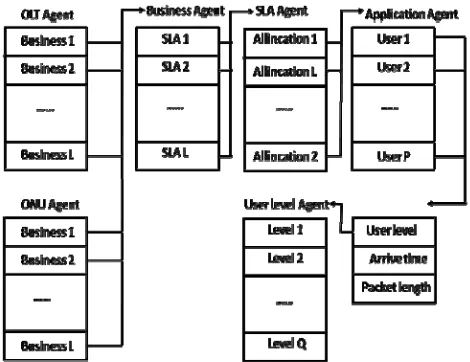
According to the different types of business in networks, we modeled OLT and ONU by sub-Agent. For each OLT and ONU, we classified the date packets by business and established the business Agent as a basic unit of the model to describe the network bandwidth usage.
In real networks, for a separated business, there will be different SLA(service level agreement) according to the different needs of its transmission. Use SLA to describe different business may be able to express the effect of user level, arrival time on bandwidth and time delay clearly. Thus, we abstracted all the different SLA classes in each business and established SLA Agent.
In network environments, there are a lot of applications connected to the OLT and there will be a number of applications for each user of the SLA class. These applications may be the same or may be different, and in the same way, for the same application, it may also exist in several SLA class. Abstract the applications of each SLA may describe the interaction clearly between the various application classes in bandwidth allocation process. Thus, we established the application Agent.
There will also have some different users under each type of applications, and when the users are involved in the process of the network, they may have different bandwidth requirements, latency requirements and priority needs, these factors may affect the efficiency of bandwidth allocation directly. Thus, regarding the user as an abstract factor for each type of application decomposition may helps to break down the bandwidth requirements more deeply. Based on this, we established the user Agent.
For different users, priorities, arrival time and packet length will affect the user’s bandwidth acquisition while participating in the network. These factors together constitute the user’s level that is the order of the date packets in the bandwidth allocation process. Accordingly, taking user level as an abstraction to build user level Agent may make it easily to describe each user in networks.
[image:2.612.187.422.522.703.2]Based on the analysis above, we established the bandwidth allocation model; it is shown in Figure 1.
In this model, we recorded the user level UL,packet arrive timeAT, length of packet PL,and set
coefficient above the three factors 、 、 which represent the importance of the influence in
bandwidth allocation, its value changes with dynamic bandwidth allocation requirements.
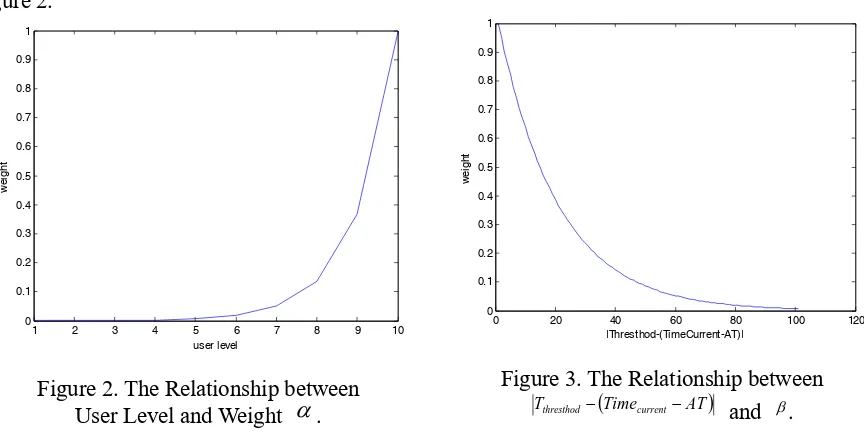
The user level is divided into 1 to 10,is the weight of the user, and it’s value increases
[image:3.612.91.523.143.362.2]exponentially with the increase of user level. The relationship between
and user level is shown infigure 2.
1 2 3 4 5 6 7 8 9 10
[image:3.612.210.409.501.656.2]0 0.1 0.2 0.3 0.4 0.5 0.6 0.7 0.8 0.9 1 user level wei ght
Figure 2. The Relationship between
User Level and Weight
.0 20 40 60 80 100 120
0 0.1 0.2 0.3 0.4 0.5 0.6 0.7 0.8 0.9 1 |Thresthod-(TimeCurrent-AT)| we ig ht
Figure 3. The Relationship between
Time AT
Tthresthod current and .
is the weight of packet arrival time AT. If the current time meet with the following conditions,
the date package was effective, otherwise, the packet was lost.
0 Time AT
Tthresthod current (1)
In the above formula, Tthresthodis the threshold of delay. When the TimecurrentAT is closer to Tthresthod,
the value of will get greater. The relationship is shown in figure 3.
is the weight of the date packet length PL. If the longer the packet length ,the longer the
arrive time,the weight ofPLwill get greater. The relationship betweenPLand is shown in figure 4.
0 10 20 30 40 50 60 70 80 90 100
0 0.1 0.2 0.3 0.4 0.5 0.6 0.7 0.8 0.9 1
data packet length
w
ei
ght
Figure 4. The Relationship between Packet Length and .
1
UL AT+ PL
N i i
i
U p
According to the analysis of the three parameters of the user levelUL, the packet arrival
timeATand the packet lengthPL,we can get the comprehensive effect evaluation parameters Ui pi
of the business pi among the i
th business:
1
UL AT+ PL
N i i
i
U p
(3)
IPACT (Interleaved Polling with Adaptive Cycle Time) Process of the Model
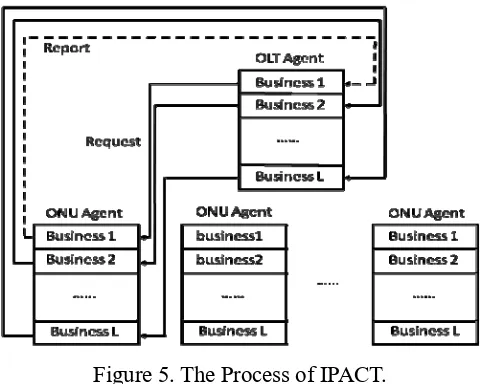
[image:4.612.186.428.290.482.2]The core idea of the traditional IPACT algorithm is Request-Grant- Report, that is the OLT send the Grant information to the appropriate ONU according to the information in polling list. After the ONU be authorized, it send the data through the passive optical splitter while it’s window opened, and add a report information at the end of the data to tell the OLT the remaining size of bandwidth and other informations in the cache about the ONU, it may be prepared for the next authorization[7]. As mentioned above, this algorithm will have a greater USR and resulting in a waste of bandwidth resources. Based on the traditional IPACT algorithm and combined with the Agent model established, we use the ONU Agent and OLT Agent as the basic unit to polling and proposed an improved IPACT algorithm shown in figure 5:
Figure 5. The Process of IPACT. The specific process of the algorithm is as follows:
1) Do the bargain between the ONU Agent, the OLT Agent of the Business class use the ONU Agent which selected by the gaming Send bandwidth request;
2) ONU Agent calculates the amount of the bandwidth requirements and reports it to the OLT; 3) Authorizing the OLT Agent based on the DBA algorithm and calculating USR, after that, the OLT Agent recording the USR to the next query;
4) The ONU reporting the authorization to the OLT and packing the USR to the next OLT according to the mechanism of the queue management.
Compared to the traditional IPACT process, this mechanism introduced a bargaining game theory. In this mechanism, the data of the network are classified according to the bargaining game after fully selection, and it may select the ONU which the size of bandwidth are adapted to the requirements to send the query request ,it may improve the accuracy of query, this mechanism can enhance the efficient of elimination about USR.
The Design and Simulation of the Algorithm
The Dynamic Bandwidth Allocation Principles Based on Gamming
According to the model we established and the improved IPACT process, the main influencing factors for bargaining is delay, user ratings and the size of packet. According to the theory of bargaining game, we established the standards of bargaining by the constitution of the three factors
mentioned above. In a polling cycle, for the business p which has m kinds of SLA, we
useSLAlm p to represent the influencing factors of gamming, regardUL
p as the user class,regardPL p as the size of packet, regardUL p as the latency. In the equation, Tnow means the arrive
time of users andTthresholdmeans the threshold of the delay in this cycle. Thus, we can choose the
optimal object function of the ONU Agent.
N
i
i i i
i U p U
S
1 min
max arg
(4)
In this function, Ui pi may calculated by the function (4), Uimin is the minimum values of the
comprehensive assessment from the experimental tests. We may give a new function(5) after do the
logarithmic treatment of(4):
N
i
i i i
i U p U
S
1
min ln
max arg
(5)
For each business class arrives, we established the rules of the gamming based on the three factors mentioned above. In a cycle, we may ascertain the order of polling after sort the class of each business under the principle established.
The Mechanism of the Elimination of USR
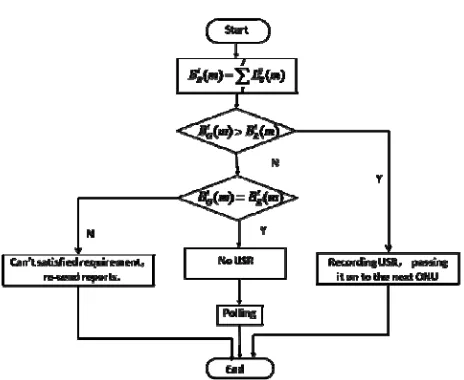
Some paper proposed a method of the elimination of USR called baton[8].It point out that in a cycle, while the 2 adjacent ONU satisfied with the condition:
g r i/2 i1/2i
RTT RTT
t t m
[image:5.612.197.429.459.649.2]t (6)
Figure 6. The Elimination Mechanism of USR.
1) While the length of the authorization is equal to the report, there is no USR, the polling will be in order;
2)While the length of the authorization is greater than the report, recording the USR and passing it on to the next ONU and go to the next cycle of polling;
3) While the length of the authorization is less than the report, that is the authorization can’t satisfied with the requirement of the queue and the authorization will be in progress after re-send reports.
Taking the jth class of business in the ith ONU among the mth cycle for an example, the process of
the polling of this mechanism we mentioned above is shown in figure 6:
In the figure, i( )
R
B m is for the size of the bandwidth of the ith ONU among the mth cycle, ij( )
B
L m is
for the length of the queue of the jth class of business of the ith ONU among the mth
cycle, i( )
G
B m is
for the size of the bandwidth of the authorization of the ith ONU among the mth cycle.
Simulation and Analysis
We use the dynamic bandwidth allocation model based on Agent and the algorithm based on bargaining game to select the ONU Agent in this paper for simulation. We did the experiment under the conditions that the load of the system is full and the length of the cycle is 10.25ms.We count the elimination times of USR about the mechanism in this paper and document 8,the results is shown in Table 1.
Table 1. The Comparison of the Frequency of USR Elimination in One Second between this Text and Document 8.
Time(s) Our
mechanism
Mechanism in document
8
Time(s) Our
mechanism
Mechanism in document 8
1 991 990 6 997 996
2 985 985 7 1002 1000
3 999 995 8 989 986
4 989 988 9 993 993
5 1003 999 10 1001 998
While the length of the authorization is greater than the report, our mechanism can passing the USR on to the next ONU Agent, but in the document 8,it will be deleted directly, so our mechanism can both maintain the size of the cycle and improve the efficiency of the usage of bandwidth.
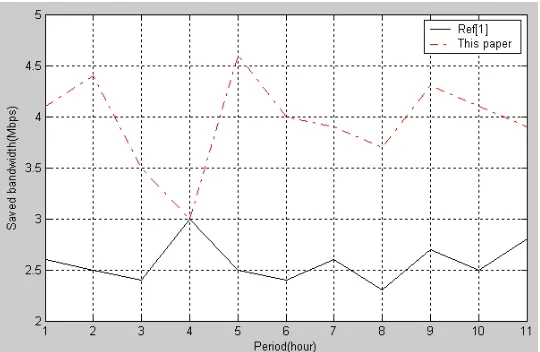
Under the conditions that the load of the system is full and the length of the cycle is 10.25ms, We count the savings of the bandwidth about the mechanism in this paper and document 8, the result of the simulation is shown in Figure 7:
[image:6.612.172.442.550.726.2]
Figure 7 shows that the mechanism for USR eliminating in document 8 can save about 2.5Mbps of the bandwidth, but when use the model we suggested, the number of the bandwidth savings is about 4Mbps, it’s greater than the mechanism mentioned in document 8.
Summary
In this paper, we established a dynamic bandwidth allocation model based on the thinking of Agent, we established five sub-Agent: the business Agent, SLA Agent, application Agent, User Agent, user rating Agent, and decomposed the affecting factors about the bandwidth allocation among the OLT and ONU layer by layer. It may enhance the ability to describe the multiple factors in the process of bandwidth allocation. For the algorithm, we improved the algorithm of IPACT based on this model, introduced the idea of gaming and put forward a local redistribution algorithm based on bargain-bargain, regard the user level, delay, packet size as a bargaining conditions to sort the online users, it can enhance the efficiency of elimination about USR. According to the result of the simulation, the efficient of elimination about USR is significantly better than the traditional mechanism.
Reference
[1]Yeoul S., Lee S., Lee Tae-Jin, et al. Double-phase polling algorithm based on partitioned ONU subgroups for high utilization in EPONs [J]. Journal Optical Communication Network, 2009(5): 484-497.
[2]Chen Yong, Xiong Ying, Liu Hu. Research on network bandwidth allocation technology based on three networks convergence [J].Video Engineering, 2012, 36(11): 70-72.
[3]Liang Gen, Liang Huomin, et al. Dynamic bandwidth allocation algorithm for multi link delay optimization. [J]. Application Research of Computers, 2012, 29(10): 3926-3928.
[4]Zhang Jinyu, Liu Li. The implementation mechanism of distributed dynamic bandwidth allocation based on utility EPON [J]. Journal of Software, 2008(7): 1693-1706.
[5]Jia Jie, Li Yanyan, Chen Jian, et al. Power control and channel allocation in cognitive wireless mesh networks based on differential evolution [J]. Acta Electronica Sinica, 2012(1): 82-85.
[6]Li Xiong. Agent-based Warfare Modeling [D]. National Defense Industry Press: 59-93.