_.
-
===~":
- - -
---
=-
---=
==:' - -
--!.
='===
--
-~-==
===== - -:-
=
Application Program
1440/1460
Administrative Terminal System
(1440-CX-07X and 1460-CX-08X)
Application Description
H20-0l29-l
This system consists of control and functional programs that permit maqy different text-proc-essing and data-handling activities to be carried on simultaneously through different terminals.
CONTENTS
PROGRAM ABSTRACT
.
.
. .
.
•
•
SYSTE1'1 DESCRIPTION
·
.
.
ADMINISTRATIVE TERNINAL SYSTEH APPLICATIONS • Publications •
Programmer's Aid. Data Entry • • File Maintenance • Desk Calculator
Information Retrieval. Terminal Communications. Other Applications •
FUNCTIONAL SPECIFICATIONS • Basic Functions
Extended Functions • Timing •
SYSTEM REQUIREMENTS • Programming Systems Basic Machine Systems
.
.
.
• •
•
•
•
•
•
•
·
.
.
.
·
.
• •
• •
·
.
·
. . .
• • •
·
.
• •
Optional Machine System Features •
·
.
•
•
• 1 • 2•
•
• 4•
• • 4 • 7•
•
• • • • 8•
•
•
•
• •
• •
• •
•
•
.
.
•
• 9 .10 .10 .10 .10
.11 .11 .12 .12
.14 .14 • • 14 • • • 15
This publication, H20-0l29-l, is a major revision of, and obsoletes the previous edition, H20-0l29-0.
This publication was prepared for production using the IBM 1440/1460
Administrative Terminal System. Page impressions for photo-offset
printing were obtained from a typewriter terminal and then reduced 15 percent.
PROGRAM ABSTRAC~
The IBM 1440/1460 Administrative Terminal System (ATS) consists of the control and functional programs that permit many different text-processing and data-handling activities to be carried on simultaneously through up to 40 different terminals. The IBM 2741 Communications Terminals used by this system are essentially IBM SELECTRIC~
typewriters. Disk storage is used to hold both working items and items to be recalled for use or modification. In addition, users mi add prog:rarns to the system that will permit concurrent execution of simple peripheral operations such as card-to-tape and tape-to-print~
The system has many functional capabilities. Some of these are:
•
•
•
•
•
•
•
•
Enter information through a typewriter keyboard, with backspacing and retyping to correct errors.
Replace a word, phrase, or sentence in text which has been entered or recalled from storage.
Add or delete lines or sentences.
Copy information.
Transmit information to any other terminal or to a punched card or magnetic tape.
Store and retrieve any defined set of information. Provision is made to prohibit unauthorized retrieval of information.
Produce precisely formatted output from rough input, including such features as automatic page heading, footing, and
numbering, and right-margin justification, if desired.
Free-form text and fixed-format information may be intermixed.
SYSTEM DESCRIPTION
ATS consists of a unique combination of operating programs and an IBM
1440/1460 Data Processing System and related input/output equipment,
especially prepared to handle text streams.
A text stream is any
combination of spaces, characters, words, sentences, or paragraphs
in any sequence and entered at any period of time, which may be
required to be assembled as output.
The output may be used directly,
reproduced, or be read as input to be processed by a conventional
data processing operation.
ATS stores input information in the computer system and returns the
information automatically as typewritten data upon demand.
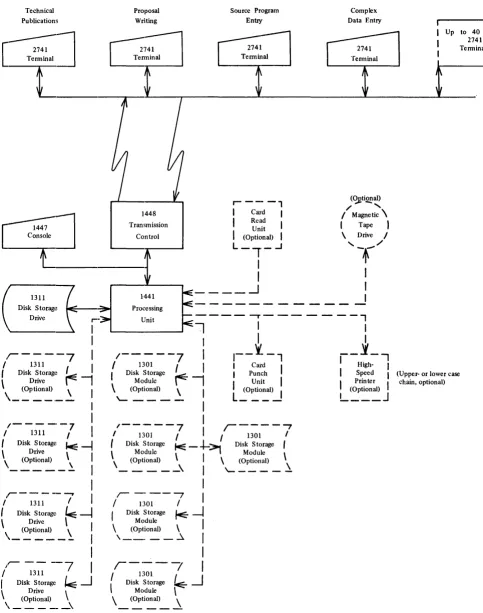
Simultaneous operation of a number of remote terminals is permitted,
each of which may be handling a different application (see Figure 1).
The output may be formatted by specific editing processes selected
by the terminal operator.
Typed or printed output is prepared in lines of a length designated
by the operator.
Right-margin justification may be selected as an
option.
Justification is implemented by analysis of the spaces between
text words and placement of additional single spaces distributed
across the line.
Uniform captions may be inserted automatically at
the top and bottom of each page.
The pages are numbered if the
operator so elects.
Any number of sections of stored text may be
obtained upon demand by the operator.
The backspace key is used to erase (cancel) erroneous data during the
initial typing operation.
Text in storage can be modified by the
deletion or insertion of new words, phrases, sentences, and paragraphs.
Lines of fixed-format information or unit sections of free-form text
designated by the typist are sequentially numbered in storage.
This
number sequence is automatically changed whenever the text is modified.
Thus, a count of unit items is available as a tally for recordkeeping
purposes.
Information placed into storage as a document can be kept confidential
by tagging the document with a security code to prevent unauthorized
access to, or accidental modification of, the stored data.
The System provides for the output of information at any terminal
although the data may have been originally entered or revised at one
or more different terminals.
In addition, ATS permits communication
among the several terminals of a system by storing requests for output
at specified terminals.
The terminal operator may accept these
requests whenever it is convenient to do so.
Technical
Publications
Proposal Writing
REPRESENTATIVE REMOTE OPERATING STATIONS
Source Program Entry
Complex Data Entry
Up to 40 (total) 2741 Terminals
[~J
l '
__
-r--~_--I.---L-Console
1448
Trammission
Control
r- - - - , I Card I
I
Read 1 UnitI
(Optional) 1(Ootional) / '
-,
I Magnetic \
I
TapeI
\ Drive I'"
./[
~J
[ , - - - - l
L-l"-...J
I
T
I
I
1
Disk1~~~rag(h'
Drive .-_
I
I
' - - - - 7
I
I 1311
I
, Disk S torage ~ \ Drive \ -I
(Optional) \
\ ,
-/ - - - -'-7
/ 1311 I
I
Disk ~ torag{~J.e-/
\ Dnve \
\ (Optional)
I
---~
I
r - - - r
I 1311 I
I
I
I
Disk S torag{~f.E:
~\ Drive \
I
\
(Optional) \
- - - -
I
I
,r- - -
--7
I
I 1311I
Disk Storage:k-.J
\ (Optional) Drive \\ _ -
-
--_\I
---'
1441
Processing
Unit - - - - --r - - - .,
"l
I 1I
I
I
1---7
I
1--
i
-1
__
'1._-,
I
1301I
I
I CardI
1 High- II
Disk Storage I PunchI
Speed IModule
r=-
I
I
UnitI
I
PrinterI
\ (Optional) \
I
(Optional) 1 I (Optional)' - - - - -
I
L____
_ ___
J
'---7
I
r---,
I 1301 I
I
I 1301 IDisk Storage I-E _ ~~ Disk Storage ,
\ Module - I Module \
\ (Optional) \
I
\
(Optional)- - - - -\
I
'- - - - -
~
I
r- - - - ,
I
'
I
1301 ~ IDisk S torage ~--I
Module
I
\ (Optional) \
,-_.
--~I
I
r - - - 7
I
I
1301Disk Storage
k--.J
I
Module \ \ _ (Opti~:l)_.i
Figure 1. IBM 1440/1460 Administrative Terminal System - block diagram, showing optional equipment in dotted lines
[image:5.613.58.541.82.695.2]ADMINISTRATIVE TERMINAL SYSTEM APPLICATIONS
ATS provides a new concept for the production of large-volume transcriptions. Text is held in accessible storage while copy is proofread and edited. The typist then revises the stored text by
means of program-controlled deletion and insertion. Manual retyping
of corrected drafts and of final text is eliminated.
The ATS concept is dynamic to the point that its total possib~lities challenge the imagination. A description of a few of the applications follows.
PUBLICATIONS
All publications activity is concerned with presenting information for different purposes. A few of the more common types of publications are:
•
•
•
•
Advertisements Technical Manuals Proposals
Reports
The primary advantage that ATS has to offer the publishing field is time, both in the initial production of documentation and in the revision cycles. Advertisements are for the most part rather bri.ef, and little is to be gained by using the terminal for this application. Proposals, reports, and technical manuals, however, can all be
profitably produced by means of the system.
Initial Production
In the process of accumulating the material which makes up a
publication, i t is very difficult to keep the material in such a way that later parts of the manual can be readily added to the original portions or that the entire document can be produced quickly and accurately for perusal of the authors or others with regulatory authority.
Revisions
It is often necessary to revise documents, both before and after
Technical Manuals
Most major military systems require several hundred separate manuals. This amounts to a total of about two million pages per year. An
estimate for a major aerospace company would be 50,000 to 80,000 pages per year. Technical documentation costs have been estimated to amount to 2.4% of the cost of all hardware contracts that involve a technical manual requirement. Each year some $400 million is spent by the
military on the production of technical manuals. This includes writing, editing, illustrating, producing, and publishing.
OnE~ of the major problems in this activity is the total elapsed time in the revision cycle for technical manuals. In many instances, i t may require 40 to 60 days to introduce a change to the field because of documentation lag.
ThE~ initial production of manuals can be better planned, but pressure to get the manuals out on time is still considerable. Late delivery of manuals can hold up payment on an entire contract. Some of the other problems in manual preparation are:
•
•
•
•
The morale of the typist herself, which is related directly to production performance
Maintaining quality of finished copy (right-hand justification, heading, footing, etc.)
Peaks and valleys in workload. These create higher costs because of overtime and/or purchase of outside vendor service.
Conservation of author's editing time
ATS helps to solve these problems in the following ways:
•
•
•
Erasures are made in working storage and not on paper. The operator will not be slowed down by the worry of stopping to erase. Rough draft is speeded up considerably by automatic right-hand justification. The typist need not concern
herself with this problem. The program automatically
calculates spacing to arrive at justified format. It also automatically types heading and footing information as well as page numbers.
Repetitive typing is not only time-consuming and therefore expensive, but also boring to the typist. Much of the information is retyped only to make changes. This can run as high as eight revisions: an average would be about four. With ATS the document is called out from permanent storage to working storage. There the typist makes only the
additions, changes, or deletions and returns i t to permanent storage. She may ask that i t be typed out in total for author editing or final printing. An optional method would be to have the documents printed out periodically on the high-speed printer. This may require an uppercase and lowercase chain on the printer.
Norkload peaks and the pressures of meeting deadlines are greatly relieved. Manuals can be accumulated in permanent storage and changes made as they occur. Then when the release date arrives, the printed document incorporates the latest changes. This capability is also valuable for
o
o
The author has the advantage of getting rapid turnaround service on his proofs. He can concentrate on fewer problems or projects at one time. He also gets better copy and
spends less time editing minor items. He develops confidence in the system.
A rule of thumb for economic justification analysis wou.ld be one typist servicing seven authors with ATS, versus one typist servicing four with conventional typing. This
is
based on industry studies and actual experience at a pilot installation.
A spirit of competition develops between typists with ATS and those without i t . Secretaries and clerical personnel
appreciate having terminal capabilitYe Production has
improved significantly in many installations. In addition
the number of iterations is reduced, because the retyped data (which is done at machine speed) is more accurate.
Proposal Preparation
The advantages of ATS for technical writing apply to proposal
preparation. However, there are some unique characteristics of this activity:
o
o
o
A proposal is a selling tool. It must represent the best of what a company intends to accomplish.
Many proposals are written in the face of rigid deadline requirements.
Standard phraseology which describes capability and/or products is used many times over.
ATS processing can contribute to proposed activity in the following ways:
o
o
o
o
Very attractive copy is produced by automatic formatting and right-margin justification.
Proposal deadlines become less fearsome when the information in storage can simply be called out to make changes. A't
deadline time the latest information is available for h.igh-speed printing.
Standard phraseology can be called from storage and incorporated as is or with minor changes in the writer's text.
communication of the latest changes or status of a proposal is assisted by the ability of any writer to request a
printout nf any other parts of the proposal with which he must coordinate.
Report Writing
period and the report is finished. All of the other benefits of
formatting, margin justification, heading, footing, and page numbering are there to assist.
PROGRAMMER'S AID
ATS can be a very valuable tool for programmers. The following are the results of comparisons and observation of programming activities at one ATS installation:
1. The programmer's production is increased because he has one tool available in his work space with which he can accomplish all his normal work. He has neither the excuse nor the
need to go to another work center for keypunching and listing.
2. The programmer's production is further increased by the fact that the machine paces the operator. The give and take between the terminal and the programmer becomes a rhythmic response which induces a pace.
3. Production is greater because the programmer has complete documentation on his program, can make changes to i t instantly, and can still maintain current up-to-date documentation without leaving his off~ce.
4. The use of a terminal system allows a programmer (by taking inventory of the statements stored in his area) to keep track of his production and to measure i t against his goal.
5. The learning curve to operate the ATS terminal is very short.
6. The following comparison was made of three procedures for maintaining one source program file consisting of 11,000 eighty-column card images:
Working Time Assumptions Total
If on tape, no key-punch in programmer's office, assume print
file on 1401 every
second update. 32.0 min.
If in cards, key-punch in programmer's office, assume print
file on 1401 every
fifth update. 9.5 min.
If ATS terminal in programmer's office, assume print changed page on terminal each
change to document. 2.5 min.
Likely Waiting Time
8 work hr.
none (but no current hard copy)
1.5 min.
Number of People Involved
2
2
7. In constructing new files the terminal input may be about equal to the single act of keypunching. The ~rogrammer
is
comeosing in finished form: keypunching, veri Y1ng, iistIng,
ver1fying the f1n1shed·~ for accuraci' and document1~
the program. At any step an error can e recognized an a change made without the programmer leaving the office.
8. Correcting a mistake in the current coding line, if the programmer
is
aware of the mistake just after i t occurred,is
a simple operation. By pressing the ATTN Key and then the Backspace Key, the erroneous characters are erased, and the correct ones can then be entered.9. The system eliminates bulky card storage. All of a programmer's coding can be sbored in the system.
10. Code
is
printed on coding forms. Coding that has many fixed fieldsis
very difficult to read when printed on plain paper. With ATS, a printed coding sheet can be inserted into the terminal before printing a programmer's code. This feature saves time and eliminates many errors.DATA ENTRY
In the capture of data for machine and/or computer processing, ATS has many advantages over other alternatives such as card punches, paper tape, and optical scanners. This
is
especially true in high-volume, complex jobs such as file conversions where the input data has any or all of the following characteristics:o Input of uppercase, lowercase and special characters
o Variable-length data records (over 80 characters)
o Coding of input records
o Variations in quality and format of input information
The following are some of the advantages ATS has for data entry:
o
o
o
o
o
ATS terminals may be placed at the source of the data, and the information can be captured and verified by the
originating department. This eliminates the rekeying of
data at the card punch and balancing to control totals.
Uppercase and lowercase characters and variable-length records are handled automatically. ATS has an 88-character set without multiple key strokes; more with overstriking.
Fewer employment and training problems. Typists are plentiful and the ATS terminal operation
is
easy to learn.Coding problems can often be minimized by ATS, thus
eliminating the need for special coders. The large character set
is
a real advantage when codingis
required.o
o
o
o
o
Verific:ation can be made by a proofreader instead of a verifier operator, and corrections can be easily made without reentering the entire record.
Data can be entered with a minimum of formatting requirements (no fixed fields).
Personnel costs are reduced as fewer typists and proofreaders are needed.
Since ATS source data entry is faster, fewer terminals are needed.
No cards are used as an intermediate medium, card costs and card-handling costs are eliminated,
In capturing data by keypunching, the following sequence of events usually takes place:
1. Source documents are written or typed in a form acceptable for card punching.
2. The data is keypunched.
3. Some or all of the data is verified.
4. Computer and peripheral device time is used for card-to-tape, editing, batch totals, and listing operations.
With ATS these events can be reduced to no more than two steps, The c=reator of the source information can input the data, and a proofreader c=an verify either line-printer or terminal-printed output and enter .~ny corrections. Data is then transmitted to tape or disk storage :Cor futher processing. The system thus captures the information in machine-readabl.e form at the source, thereby saving time and simplifying operations.
li'ILE MAINTENANCE
ATS also attacks the basic problem of maintaining current and accurate c=hanges to a file. Who should be responsible for this accuracy? In the past, accuracy has depended on the originator of the information. Data processing then receives the input, converts it, processes it, cind returns answers as required. Although ATS still depends on the ()rigina'tor of the information for accuracy, the change to the file is immediate, and the originator has proof positive that the copy is correct because the system types back what i t has recorded. Tremendous benefits result when design engineering and/or manufacturing engineering :ls able to reflect accurate and immediate changes to bills of material. This, of course, implies the possibility of being able to callout a listing of the latest bill when desired.
DESK CALCULATOR
The desk calculator feature in ATS can add, subtract, multiply, and divide. It can also take roots, powers, and factorials, and can. evaluate simple algebraic expressions. It is as useful in an engineering department as it is in an accounting department. Engineering labor reporting, engineering drawing control, basic
engineering data control, plus the inquiry capabilities, make the ATS terminal a real problem-solver for engineering departments.
INFORMATION RETRIEVAL
ATS provides a method of data retrieval. Related documents may be assigned contiguous groups of numbers. A storage report on a group of numbers gives a list of all documents in that group by title, number, and date stored. Specific documents to be retrieved at a terminal could be selected from the storage report. A separate index of documents, such as a KWIC index, could also be maintained outside the system and used for locating pertinent documents stored in t,he system. ATS is also an excellent means of data input for subsequent entry into other information retrieval systems by punched cards or magnetic tape.
TERMINAL COMMUNICATIONS
Any terminal may transmit its working storage to any other terminal and as many messages as desired to the same terminal. Since the
system does not poll, the receiving terminal must request that messages be transmitted to it. The computer attracts the receiving terminal operator's attention by typing the word (MSG) the first time that terminal is used after a message has been directed to it.
OTHER APPLICATIONS
ATS indeed challenges the imagination. The system is receiving acceptance across a wide variety of industries and applications. A few of these are:
Patent documents
System and procedure manuals Legislative drafts
Legal abstracts Contracts
Directories
Trust deeds and wills Price lists
Automotive shop manuals
FUNCTIONAL SPECIFICATIONS
---~--,---The syst.em is a multiterminal, multiapplication, real-time processor with time-sharing capabilities. A keyboard terminal is the basic input device. Key combinations supply control to the system. Output is provided by typewriter, printer, tape deck, disk, or card punch. Maximum record lengths on tape or disk for user-written programs depend on the amount of buffer area needed for terminals and the amount of core storage used for other resident programs. Features included in the program are given below.
BASIC FUNCTIONS
1. Data entry. Information can be manipulated by line or by unit, where a unit is of any length and
is
defined by a double carriage return.2. The user can manipulate information in the follo\-Jing ways:
a. Corrections
(1) Backspace and retype during entry
(2) Retype beginning with a particular word
(3) Replace a word or phrase
(4) Add to a line or unit
(5) Delete a line or unit
(6) Insert a line or unit
b. Data moves
(1) Store and retrieve information from file
(2) Gather stored data in any sequence
(3) Transmit to any other terminal
(4) Copy information by transmission to the originating terminal
3. Output Edit
a. Limit free-form text. lines to a length specified from the terminal
b. Justify right-hand margins
c. Intermix free-form text with fixed-format information
d. Place page headings, title, or chapter headings on all pages of a document
f.
Number document pages at top and/or bottom automat:ically
g.
Control vertical spacing of the output document
h.
Halt to let the operator change typewriter print elements
or to permit other required manual action, including entry
of variable information
EXTENDED FUNCTIONS
o
o
o
o
o
TIMING
Data capture ability for large installations of keypunches
and key verifiers
Capability for program card deck control for large programming
groups and for assembling sections of the programs and selected
test decks.
Special functions provided for this type of
activity are automatic duplicate, sequence numbering, and
field definition
Basic desk calculator functions (add, subtract, multiply, and
divide), plus roots, powers and factorials, and evaluation
of simple algebraic expressions
A store-and-forward communication capability both from and
to any terminals on the system
Ability to perform normal peripheral operations simultaneously,
such as card-to-tape and tape-to-printer (when using ATS on
an IBM
1460Data Processing System).
Basic timing factors are:
o
o
o
o
o
Typewriter output:
14.8characters per second
Typewriter input:
As fast as a person can type
Card reading:
Up to
600cards per minute
Card punching:
Causes system delays with a
1402Card Read
Punch, not recommended \-,hile terminals are in operation
Peripheral printing: Up to
1100lines per minute
The ability of the system to do peripheral work depends upon the
amount of core storage available, which is in turn determined by the
maximum number of active terminals on the system and the mix of
operations being performed by active terminals.
The criterion that
must be satisfied to do any input/output operation is that the operation
will never require more than
100milliseconds of computer interlock
time.
Information for proper interfacing of user-written peripheral programs
is provided wit 1 the system documentation.
The rate at which ATS documents may be written out on a high-speed printer or magnetic tape also depends on the number of active terminals and the types of operations being concurrently performed on these
SYSTEM REQUIREMENTS
PROGRAMMING SYSTEMS
ATS is coded using the IBM 1440/1460 Disk Autocoder (140l-AU-008).
This system is not needed for its operation.
System initialization prior to operation may require the appropriate
one of the following IBM utility programs.
•
•
1401/1460 Disk Utility Programs (140l-UT-053)
1440 Disk Utility Utility Programs (1440-UT-04l)
BASIC MACHINE SYSTEMS
Terminals
ATS uses IBM 2741 Communication Terminals.
Depending upon the type
of communication service connecting the terminal with the computer,
an IBM Line Adapter (modem) or a Common Carrier Line Adapter may
berequired.
See your IBM Data Processing sales representative for
additional information concerning these requirements.
Computer System
ATS can use either of two central processing units.
A basic IBM 1440
system requires one IBM 1441 Processing Unit, Model A6 (16,000 positions
of core storage).
A basic IBM 1460 system requires one IBM 1441
Processing Unit, Model B6 (16,000 positions of core storage).
Either of these 1441 Processing units requires the following special
features:
Bit Test, Console Attachment, Direct Seek, Disk Storage
Control, Indexing and Store Address Register, and Transmission Control
Unit Attachment.
The following IBM units and features are also required for a basic
system:
1.
One 1311 Disk Storage Drive, Modell, with the Direct Seek
feature.
(An additional 1311 Disk Storage Drive is strongly
recommended. See "Additional Disk Storage" under "Optional
System Features", below.)
2. . One 1316 Disk Pack for each IBM 1311 Disk Storage Drive:
attached to the system.
5~ One 1448 Transmission Control unit, Hodel 1, with:
•
•
•
•
Attachment Feature 1050/1060.
RPQ feature E38485 for attaching 2741 terminals. This feature includes provisions for attaching one group of up to ten lines.
For attachment of additional groups of ten lines, up to a maximum of three additional groups, Line Group features, as required, and one RPQ feature 811390 for each line group.
Either a Line Adapter Set 1050/1060 feature (IBM modem), or a Common Carrier Adapter Set 1050/1060 feature for each two lines, up to a maximum of five per line group
(20 in all). If modems are required for any terminal, the corresponding modem must be installed at the 1448. See your IBB Data Processing sales representative for additional information concerning these requirements.
6.. One 1461 Input/Output Control for a 1460 system.
Some method of program loading must also be supplied. This may be either a card reader (as described in the following section) or another 1401, 1440, or 1460 system that can load the program on a 1316 Disk Pack to be mounted on one of the 1311 Disk Storage Drives on the systemG
OPTIONAL MACHINE SYSTEM FEATURE S
Additional Disk Storage
One or more additional disk storage units are required for the most effective operation of the system. These may include up to four 1311 Disk Storage Drives, Model 2, with Direct Seek and Seek Overlap
features, and 1316 Disk Packs. These also require that the Seek Overlap Adapter feature be installed on the 1441 Processing Unit and that the Seek Overlap feature be installed on the 1311 Disk Storage Drive, Modell.
From one to five modules of IBM 1301 Disk Storage may be used. If any 1301 Disk Storage is used, two 1311 Disk Storage Drives must be used, and the Expanded Disk Storage Control feature must be installed on the 1441 Processing unit. It is suggested that one magnetic tape drive l~ included in a system with 1301 Disk Storage to provide for efficient backup procedures.
High-S;;>eed Printing;
On a 1460 system, a 1403 Printer with the Print Storage feature in the 1461 Input/Output Control may be used. On a 1403 Printer, the Auxiliary Ribbon Feeding feature for polyester film-ribbon,
is
recommended where output ~ull be used for direct reproduction.
Instead of a regular 1403 Printer on either a 1440 or a 1460 system, a special printer may be attached that will permit both uppercase and lowercase letters and an expanded set of special characters at up to about 300 lines per minute. Installation of uppercase and lowercase printing capabilities will require the following:
o
o
A 1446 Printer Control or a 1461 Input/Output Control, with RPQ feature 813148.
A 1403 Printer, Model 2, with RPQ features 812033 and 812034, and either RPQ feature 898059 or the Interchangeable Chain Cartridge Adapter feature, and 33 RPQ features E33255. Part 823380 is required to provide the 120 characters of uppercase and lowercase Courier type, including special characters. RPQ features 818019 and 818020 must also be installed on the 1441 Processing Unit.
Translate Feature
The system uses the translate feature on the 1441 Processing Unit, if installed, in the following functions:
o Uppercase and lowercase printing
o Loading documents from punched cards
o Loading documents from magnetic tape
o Offline printing of ATS archive tapes
Presence of the feature will significantly reduce the central processing unit time required for the foregoing functions.
Magnetic .Tapes
Up to six magnetic tape drives may be attached to the system to serve as high-speed output terminal and to provide archival document storage. A magnetic tape written on one of these drives may be used by another system as input for processing. On a 1440 system, a 7335 Magnetic Tape Unit, Modell or 2, may be used.
Card Punching and Reading
One card punch or card read punch may be attached to the system to prepare punched cards. These may be either in a format prespecified by the user or in a special format suitable for storing information to he read back into disk storage at a later date. On a 1440 system, a 1442 Card Read Punch, Modell or Model 2, or a 1442 Card Reader, Model 4, and/or a 1444 Card Punch, Modell, will provide this
H20-0129-1