P Selvam,(2010), Vol. 1 (9): 82-87 ISSN: 0975-8232
Available online on www.ijpsr.com 82 IJPSR (2010), Vol. 1, Issue 9 (Research Article)
Received on 10 May, 2010; received in revised form 13 July, 2010; accepted 14 August, 2010
EVALUATION OF ANTIDIABETIC ACTIVITY OF A POLYHERBAL FORMULATION IN ALLOXAN INDUCED DIABETIC RATS
P. Selvam
Maharaji College of Pharmacy,Chennai (Tamil Nadu), India
ABSTRACT
Objective of the study was to assess the antidiabetic activity of a polyherbal formulation in alloxan induced diabetic rats.
Methods: The antidiabetic activity of a polyherbal formulation in alloxan induced diabetic rats was assessed using Alloxan β- cytotoxin induced chemical diabetes in a wide variety of wister albino rats.
Result: The polyherbal formulation contain the following plants leaves of Caesalpinia bonducella, Mucona puriens, Pongamia pinnata. The extracts were prepared by continous hot soxhlet extraction using petroleum ether and water.
Conclusion: The study reveals that the polyherbal formulations have antidiabetic activity and the action may be due to the restoration or regeneration of β-cells of pancreas.
Keywords:
Antidiabetic, Polyherbal formulation in
alloxan,
Caesalpinia bonducella,
Mucona puriens,
Pongamia pinnata
Correspondence to Author:
P Selvam
Maharaji College of Pharmacy, Chennai (Tamil Nadu), India E- mail:
Available online on www.ijpsr.com 83 INTRODUCTION: Since time immemorial man’s
quest for medicinal agents that alleviate his sufferings has remained unquenched. The instinctive behavior of primitive man helped him to realize the beneficial action of plants in the treatment of various ailments, from about 11th -18th centuries, a dog man known as the "doctrine of Signatures" was almost the sele of means by which man attributes medicinal values to certain plants. This dogma held that the color, shape, habital as other physical characteristics of a plant were medicative of its medicinal value. Thus the worm shaped embryo of Chenopodium (warm seed) suggested it to be of value in liner disorders, the serpentine shape of Rauwolfia roots (snake root) indicated that they should be useful in treating of snake bites.
Later through conscious rational action he gained better understanding about the medicinal properties of plants 1. In certain civilization and culture like in India, China and Arabic Countries, the experience plants get systematically recorded and incorporated in organized system of medicine like Ayurvedha, Siddha, and Chinese medicine 2. Even today Phytopharmaceuticals like morphine, digitalis, glycosides, vincristine and vinblastin are still used as drugs of choice by allopathic physicians. About two third of the drugs of the modern system of medicine have been developed from natural sources mainly from plants 3.
Today we understood that plant represents an immense respiratory of biochemical including pharmaceuticals, flavors and novel bioactive substances. Medicinal plants play an important sale in the health care of developing countries, currently 70% of the world population use herbal medicines and world health promotes the use of herbal remedies as they are not only pate and easily available at low lost but are also time tested 4. Since ancient
times, plants have been an exemplary source of medicine. Ayurveda and other Indian literature mention the use of plants in treatment of various human alignments. India has about 45, 000 plant species and among them, several thousands have been claimed to possess medicinal properties. Researches conducted in last few decades on plants mentioned in ancient literature are used traditionally for diabetes have shown antidiabetic property. The Indian traditionally system of medicine and have shown experimental and clinical antidiabetic property 5. For the treatment of diabetes and their complication the commonly used Indian plants are: Allium cepa, Allium Sativum, Aloe vera, Cojanus cajon, Coccinia indica, Caesalpinia bonducello, Ficus bengalenesis, Gymnncona sylvestve, Momordica chorantio, Ocimum Sanctum, Pteorocarpus marsupium, Swertia chirayita, Tinospora cordifolia, Tinospora foenum graceum. All plants have been shown varying degree of hypoglycemic and anti hyperglycemic activity 6.
MATERIALS & METHODS:
Collection of plants: The plants were collected from Anna nagar in Chennai and Seethanjeri in Thiruvellore in the month of August-September. The leaves were collected from the fresh plant and dried in shaded conditions at room temperature of about 37°C.
Preparation of sample: The leaves of Caesalpinia bonducella, leaves of Mucona puriens and leaves of Pongamia pinnata were collected and kept for shade drying. Then the leaves are subjected to coarse powder. The coarse powder was subjected to continuous hot soxhlet extraction.
Extraction Process:
International Journal of Pharmaceutical Sciences and Research ISSN: 0975-8232
Available online on www.ijpsr.com 84 soxhlet extraction apparatus. The extraction was
carried out until the process was completed. Completion of the extraction was determined by the absence of color in the side arm of soxhlet apparatus and testing the siphoned solution. The extract was evaporated under reduced pressure until all the solvent have been removed to give an extract sample.
Preliminary Phytochemical Studies: Various extracts obtain from four plants were subjected to chemical test 7.
Test for alkaloids: A small portion of solvent free petroleum ether, Chloroform, alcoholic extract was stirred separately with few drop of dil. hydrochloric acid. The filtrate was tested with various reagents for presence of alkaloids.
Meyer’s reagent shows Cream precipitate.
Dragendroffs reagent gives Orange brown precipitate.
Hager’s reagent shows Yellow precipitate.
Wagner’s reagent gives Reddish brown precipitate.
Toxicity Study: The acute toxicity of the extract was evaluated in 56 normal albino mice. They were grouped into seven and each group contains eight mice (four male and four female). Each group was kept for fasting for 24hrs, after which they were treated once orally with one of the increasing doses of extract: 0, 5, 10, 15, 20, 25 or 30 g/Kg/b. w. The volume of each administrated dose did not exceed one ml. the mice were then observed for at least 48hrs and up to seven days, for death, lethargy, jerkiness, sensitiveness to noise and touch, stools quality and frequency.
Diabetic Screening Methods:
Preparation of Animals: Wister albino rats (150-200g) of both sexes were maintained under
laboratory condition. They were fed with standard laboratory diet and acclimatized for period of seven days under standard environmental conditions of 55% humidity, temperature (22±5°C) and 12hr dark/light cycle.
Induction of diabetes8: Rats were made diabetic by injecting alloxan (100 mg/kg) i. p. in 0.2 ml Tween 80. Alloxan, a β-cytotoxin, induced chemical diabetes in a wide variety of animal species by damaging the insulin secreting pancreatic cell (β-cell), results in a decrease in endogeneous insulin release which paves the ways for the decreased utilization of glucose by the tissues. Diabetic rats with plasma glucose level > 150 mg/dl were included in the study
Experimental design 9, 10: In the experiment, a total of 24 rats (18 diabetic surviving rats, 6 normal rats) were used. The rats were divided into five groups containing 6 rats in each group.
GROUP I: Vehicle control (1% Tween 80 of about 2ml was given)
GROUP II: Negative control (Alloxan 100mg/kg. b. w. suspended in Tween 80)
GROUP III: Dose I group (Alloxan 100mg/kg. b. w.
suspended in Tween 80 + Polyherbal formulation 200mg/kg b. w.)
GROUP IV: Dose II group (Alloxan 100mg/kg. b.
w. suspended in Tween 80 + Polyherbal formulation 300mg/kg b. w.)
GROUP V: Positive control (Alloxan 100mg/kg. b.w. suspended in Tween 80 + Glibenclamide 10mg/kg b. w.).
Available online on www.ijpsr.com 85 efficacy of the alloxan on the experimental rats.
Group III and IV for which polyherbal formulation of dose 200 and 300mg/kg are given subsequently. Group V animals are served as standard. Glibenclamide drug which was compared with the group III and IV.
Statistical Analysis: The data were expressed as mean ± SEM obtained from the number of experiments(n) one way ANOVA followed by Dunnett’s post test was performed using graph pad software. Differences between groups were considered.
RESULTS & DISCUSSIONS:
Priliminary Phytochemical Analysis: These drugs show the presence of alkaloids, carbohydrates and glycosides, fixed oils and fats, tannins and phenolic compounds and flavonoids. The
polyherbal formulation contains the following plants leaves of Caesalpinia bonducella, Mucona puriens, Pongamia pinnata. The extracts were prepared by continuous hot soxhlet extraction using petroleum ether and water. The yield value of the individual plant extract is mentioned in the
Table 1. The phytochemical analysis of the polyherbal formulations are shown in the Table 2. TABLE 1: YIELD OF EXTRACT
Drug Name % Yield of Extract
Caesalpinia bonducella 8.2 %
Mucona puriens 7.8 %
Pongamia pinnata 7.6 %
TABLE 2: PHYTOCHEMICAL SCREENING OF THE PLANT EXTRACTS
Plant Name
Phytoconstituents
Alkaloids Carbohydrates
& Glycosides Phytosterols
Fixed oils
& Fats Saponins
Tannins & Phenolic compounds
Proteins & Free Amino
Acids
Flavonoids
Caesalpinia
Bonducella - - - + - - - +
Mucuna
Pruriens - + - + - + - -
Pongamia
Pinata - - - + - -
(+): Indicates Presence; (-): Indicates Absence
Acute toxicity studies were carried out to fix the dose for the polyherbal formulation. The LD50 of
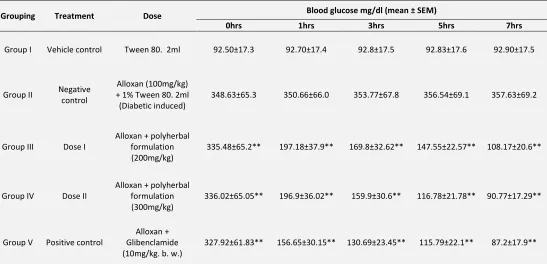
the polyherbal formulation were found to be 2000mg/kg above the 200mg/kg dose it proves the antidiabetic property and this study was carried out for 15 days. So the effective doses of the polyherbal formulation were found to be 200mg/kg. After alloxan administration the rats with the blood glucose level above 150mg/dl were grouped as diabetic. The entire experimental rat’s blood glucose levels were tested using glucometer for every 2hrs after the
International Journal of Pharmaceutical Sciences and Research ISSN: 0975-8232
[image:5.612.35.582.95.359.2]Available online on www.ijpsr.com 86 TABLE 3: EFFECT OF POLYHERBAL FORMULATION ON BLOOD GLUCOSE LEVEL OF ALLOXAN INDUCED DIABETIC RATE AFTER SINGLE DOSE
Grouping Treatment Dose Blood glucose mg/dl (mean ± SEM)
0hrs 1hrs 3hrs 5hrs 7hrs
Group I Vehicle control Tween 80. 2ml 92.50±17.3 92.70±17.4 92.8±17.5 92.83±17.6 92.90±17.5
Group II Negative control
Alloxan (100mg/kg) + 1% Tween 80. 2ml (Diabetic induced)
348.63±65.3 350.66±66.0 353.77±67.8 356.54±69.1 357.63±69.2
Group III Dose I
Alloxan + polyherbal formulation (200mg/kg)
335.48±65.2** 197.18±37.9** 169.8±32.62** 147.55±22.57** 108.17±20.6**
Group IV Dose II
Alloxan + polyherbal formulation (300mg/kg)
336.02±65.05** 196.9±36.02** 159.9±30.6** 116.78±21.78** 90.77±17.29**
Group V Positive control
Alloxan + Glibenclamide (10mg/kg. b. w.)
327.92±61.83** 156.65±30.15** 130.69±23.45** 115.79±22.1** 87.2±17.9**
** P < 0.001 more significant Vs negative control. Values are given average blood glucose (mg) ± SEM (Standard Error Mean) n=6
The results were compared with reference standard Glibenclamide. The single dose of polyherbal formulation (300mg/kg. b. w.) was more significantly reduced the blood glucose level then 200mg/kg b. w. when compared with the standard Glibenclamide. Ethanolic extract have proven the antidiabetic property than the water extract. So we have taken ethanolic extract were chosen for the experimental purpose. From the above result, our study indicates that the polyherbal formulation have antidiabetic activity. The number of functionally intact β- cells in the islet of Langerhans is of much importance for the development course of diabetic. The renewal for β-cells in diabetics has been studied in several animal models. It was also suggested that regenerations of β-cells have proven destruction by alloxan may be the primary cause of the recovery of alloxan injected guinea pigs from the effects of the drug 11. From the
above suggestion it can be concluded that the antidiabetic activity of the polyherbal formulation may be due to restoration of β-cells of the pancreas and this effect may be due to the presence of tannin 12, 13 flavonoids , alkaloids are may be due to the synergistic effect of the above phytoconstituents in the polyherbal formulation.
Available online on www.ijpsr.com 87 results, our study reveals that the polyherbal
formulations have antidiabetic activity and the action may be due to the restoration or regeneration of β-cells of pancreas. Further investigation is necessary to standardize the formulation and to find the active constituents present in the formulation responsible for the antidiabetic activity.
ACKNOWLEDGEMENT: The authors are grateful to Mrs. P. Deepa for her guidance, support and great direction towards dissertation work, and we also thank Maharaji college of Pharmacy Besant Nagar Chennai for providing all the facilities to conduct this work.
REFERENCE:
1. Akula Ravikumar, C. Tamizharasi; A. Jaswanth; V.Loganathan; D. Dhayabharan; B. Jaykar-52nd IPC 2000. 2. Alfred, G.G. Theodore, W.R.Aklam, S.N. and Plams, T.
Goodman and Gilman,Pharmacological basis of therapeutics.
3. Amalraj T, Lgnachimuthu S, 1998 indian J of Exp. Biol (36): 1032-1033.
4. Archana Sachdewa, Rashmi Nigam, Khemani: I.D. Indian J. Exp.Biol; 2001, 39 284-286.
5. Aritajat S, Wutterapol S, Saebphet K: South east Asian J Trop Med Public Health; 2004,35 supp 12:53-8.
6. Askam M, Javad K, Singh S, Jafri MA, Ind.J. of Pharmacol. 2002, 32, 157.
7. Kokate, C.K.Purohit AP, Gokhale SB, Pharmacogneos 1st Edition, Nirali Prakashan Pune. 1990,102
8. Pinakini KShankar, Vasanth Kumar and Namita Rao Iranian Journal of pharmacy ology and Therapeutics 2005. 1735-2657/05/41-16-19.
9. Sharma SR, Dwived: SK Swarup D., Jnt. J. Pharmacol 1997, 35(2):132-133
10. Annapurna A, Kanaka, Mahalakshmi D, Muralikrishna K, 2001. Indian J Exp Biol, 39(5):500-502.
11. Geetha M, Whi AK. J.Nat. Rem. 2001, 1(1): 64-66 12. Gorray KC Baskin D. Broadsky, J.Fujimoto Responses of
Pancreatic B Cells to Alloxan and Streptozotcin in the guinea pig Pancreas 1986, 1: 130-138.