3170
USE OF PEAK-TO-AVERAGE POWER RATIO IN
ORTHOGONAL FREQUENCY DIVISION MULTIPLEXING
TECHNIQUES: A REVIEW OF THE DRAWBACKS
1A. ABDALMUNAM,2MS ANUAR,3MN JUNITA
1Designation, Affiliation, Department of Computer and Communication Engineering, Malaysia
E-mail: 1[email protected] , 2[email protected] , 3[email protected]
ABSTRACT
The goal of this study is to provide readers knowledge of high. peak-to-average. power ratio. (PAPR) that is the bottleneck of the orthogonal frequency division multiplexing (OFDM) system. This study also highlights the drawback of the PAPR reduction techniques and each of which are explain briefly. This review starts with an illustration of the OFDM system and PARR. Introduction of several techniques that can be classified into three parts (distortion signal, scrambling signal, and coding) for compacting the above-mentioned problem of high peak which is the objective of this study. Further in this paper most of PAPR lessen techniques are elaborated with their drawbacks which illustrated in detail. Each technique reduced the high output of power envelope fluctuation but at the expense of reduced data rate, greater transmission of signal strength, increased system intricacy and regression the performance bit-error-rate (BER).
Keywords:-MCM, OFDM, PAPR, CM, commanding, PTS, SLM, interleaved, TR. TI, ACE, Coding, PW,
ACF,
1. INTRODUCTION
It is an extensively known irrefutable fact that the quantity of data transported over communication systems raises speedily. Not exclusively the file scopes rise, nevertheless, immense bandwidth required applications such as video on demand and video conferencing need growing information rates to transmit the information through an affordable amount of your time or to fulfill time period connections. To support this type of facilities, multicarrier modulation (MCM), particularly orthogonal frequency division multiplexing (OFDM). Moreover, because of it has high bandwidth efficiency and robustness against multipath fading channels, Orthogonal frequency-division multiplexing (OFDM) is a promising technique for next-generation high-speed wireless communications and is a candidate for broadband wireless communications [1, 2]. The well-known bottleneck of OFDM is high peak-to-average-power-ratio (PAPR), anyhow this problem occurs at an OFDM signals transmitter system while using a method to establish the multiple subcarrier orthogonality on each other, that is Fast-Fourier-Transform(IFFT) or some time using Inverse-Discrete-Fourier-Transform(IDFT). If the signal
has been transmitted by high PAPR level. The average power crucially reduced) which especially placed in uplink transmissions. OFDM system requires a significant range of power amplifier (PA) transmission and decreases power effectiveness, which increase and decrease the price of mobile devices and battery longevity, respectively [3-5]. Additionally, because the transmitter’s PAs are restricted by top power, a large envelope fluctuation can cause degradation of BER performance via in-band and out-of-band radiation. Commonly, an input signal is reduced in power to avoid these negative effects, which allows the PA to be operated within linear range [6, 7].
3171 the HPA during amplification of the baseband signals meanwhile the OFDM system is reduced in performance [2, 8, 9]. Formulation of the OFDM equation and diagram are shown in the following.
x 1
√2 x e 0 nk N 1
[image:2.612.94.290.162.318.2](1)
Figure 1: Block diagram of the transmitter and receiver in an OFDM system.
A number of approaches, such as Companding [10-12], Partial Transmit Sequence (PTS) [13-15], Selective Mapping (SLM) [16, 17], Interleaved [18], Tone Reservation [19, 20], Coding [21], Tone Injection [22, 23], Active Constellation Extension [24, 25], Peak Windowing [26], and Amplitude Clipping [27-29] have been proposed to address the OFDM PAPR problem. In the implementation of all these previously proposed PAPR reduction techniques, a balance exists between PAPR, BER and computational complexity.
2. PAPR in OFDM GENERALIZATION
PAPR describes the relationship of a sample's full power in an OFDM transmitting symbol divided by the OFDM symbol’s average power [30]. High PAPR happens when various sub-carriers are not in phase in a multicarrier system. At each moment, they differ at different phase values. When all points concurrently reach up to maximum value, an output envelope abruptly shoots up that produces a 'peak' in the output envelope as shown in figure 2. The peak system may be high relative to the mean of the entire system due to the presence of many separately adapted sub-carriers in an OFDM system. This proportion of the peak to the mean power value is characterized as a Peak-to-Average Power Ratio [30]. The instant output of an OFDM signal often possesses sizable crests described as a PAPR, occasionally denoted as PAR. The aim of reducing the high peak provides significant saving
of power. Power saving could be more pertinent whenever the system has mobile terminals which is contain battery life limited. The PAPR of the uninterrupted-time OFDM signal’s baseband x(t) is defined as the proportion of the largest immediate power to the mean power that is
usually expressed in [31] as:
𝑃 𝑑𝐵 𝑃𝐴𝑃𝑅
10 𝑙𝑜𝑔 (2) Where E[.] denote the expected value
The reduction efficiency of PAPR is calculated using the Cumulative Distribution Function (CDF) [32] which is informative evaluate used to assess the PAPR reduction accomplished:
𝑃𝑟 𝑃𝐴𝑃𝑅 𝑧 1 𝑃𝑟 𝑃𝐴𝑃𝑅 𝑧 1 1 𝑒 (3)
In all past study the they described the CCDF of PAPR in term of K which indicate to subcarrier’s numbers
There are two type of OFDM signal which is continuous OFDM signal and discrete OFDM signal, most of studies indicate that the PAPR of OFDM discrete signal lower than OFDM continuous signal by ~0.5-1dB [33], as mention in a relation below
𝑃𝐴𝑃𝑅 𝑥 𝑛 𝑃𝐴𝑃𝑅 𝑥 𝑡 (4)
Figure 2: high peak of OFDM signal created by several sinusoids.
[image:2.612.326.523.439.578.2]3172 Furthermore, there are some limitations for reducing the PAPR such as computational complexity is high, due to the IDFT blocks number, which exists in PTS, SLM and interleaving techniques, in order to get the phase sequence in PTS and SLM number of multipliers should be used, codeword searching, permuting function from the set that results lessen in PAPR. Large complexity leads to increases machine cycle of PAPR reduction in the processor of real time[34].
The techniques of signal distortion are suffering from BER increases[35, 36]. To enhance the BER performance need to incorporate the decoding and strong-error-correcting algorithms but with a tradeoff of computational complexity.
Large memory size is required in the PAPR lessening techniques such as Coding, PTS, SLM and Interleaving. Because in these techniques, large memory size is required for look up tables to store the sets of codewords, poly phase sequences, different data blocks representing the same information, interleaved data. From these look up tables, entry that has less PAPR is selected for transmission.
[image:3.612.117.261.463.593.2]Finally, the good sequences designing is a big challenge[37]. Additionally, there are three major parts to enhance the performance of PAPER lessening techniques that illustrates in the figure 3
Figure 3: Dimensional’s optimization to enhance the techniques of a PAPR lessening[38].
Although the PAPR is the conventional used. most commonly used as a metric to measure the envelope fluctuation of the OFDM signal. Newly metric has been proposed to quantify the large output envelope fluctuation which calls Cubic Metric (CM) and adopted by third generation partnership project (3GPP)[39]. The stimulus
behind the CM that the nonlinearity of the power
amplifier (PA) which is known as a signal distortion that is due to the product of third-order intermodulation which can be expressed as a signal convolution and third order nonlinearity of the PA model. Whereas PAPR contemplates only the main peak of power, CM measures for the secondary peaks of the power which affect the PA performance. Which presented as a better measure of non-linearity introduced by PA of MCM.
The CM defined as [40, 41]:
𝐶𝑀| 𝑅𝐶𝑀| 𝑅𝐶𝑀 | ⁄𝐾
Where RCM is a raw CM for a continuous signal
𝑠 𝑡 that define as below. The terms k=1.56 and
𝑅𝐶𝑀 are used to fulfill the estimate of the power de-rating.
𝑅𝐶𝑀 𝑠 𝑡 | 20log 𝑟𝑚𝑠 | | (5)
3. MOTIVATION OF PAPR LESSEN
3.1 Nonlinear drawback of HPA and ADC
Most of the transmitter uses the high power amplifier (HPA) in a radio system, to get adequate transmission power. The HPA is often employed at saturation region or somehow it fixed near to saturation level. the amplitudes fluctuation of the signal is a very sensitive effect of the nonlinearity of HPA characteristics.
3173 envelope fluctuation PAPR due to interference problem.
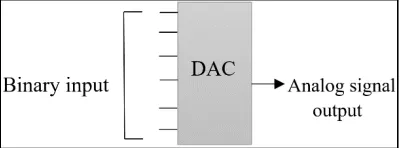
Another parameter to track the large signal peaks which demand digital to analog convertor (DAC) with sufficient dynamic range to accommodate the distortional peaks of OFDM signal.
[image:4.612.91.291.363.437.2]While, high DAC tuning supports high PAPR with a sensible amount of quantization noise, but it might be very costly for a given sampling rate of the system. Whilst, a low-precision DAC would be cheaper, but its quantization noise will be considerable, and as a result it lessens the signal Signal-to-Noise Ratio (SNR) when the dynamic range of DAC would be higher to support high PAPR[42]. Furthermore, OFDM signals show Gaussian distribution for large quantity of subcarriers, that indicate the peak signal is rarely appear and uniform quantization by the ADCs is not desirable.
Figure 4: Structure of digital to analog converter
3.2 Power saving
When operate the HPA with high dynamic range, it demonstrates poor efficiency of power. Which that been exhibits that PAPR lessen can maintain the power significantly, whereas the net power saving is directly proportional to the desired average output power and it is highly dependent upon the clipping probability level[43]. Suppose that an ideal linear model for HPA, where linear amplification is achieved up to the saturation point, and thus can be formulate as
.
(6) Where is an efficiency of HPA also it can be define as =𝑃 , /𝑃 where 𝑃 , is the
average of output power and 𝑃 is a constant amount of power regardless of the input power.
4. PAPR LESSENING TECHNIQUES
A. Partial Transmit Sequence (PTS)
[image:4.612.328.519.389.475.2]Partial transmission sequence (PTS) is a non-distortion arrangement in which the input data block is divided into several disjointed blocks and IFFT is performed. These IFFT sub-block outputs are weighted or scrambled by a number of rotation factors, which are totaled to create different candidate signals. Ultimately, the minimum PAPR signal is chosen for transmission [36]. As long as a PTS need to be implement, complexity must be taken into account which is a substantial parameter in the transmitter because it raises exponentially with the quantity of subsequence, for this reason the vector’s rotation should be limited to a set with a finite number of element PTS is weakened by high computational complexity [37] that results from thoroughly searching for candidate signals and additionally needs data regarding rotation factors to be sent to the receiver as a side information.
Figure 5: PTS structure for PAPR reduction[32]
B. SELECTIVE MAPPING (SLM) Selected mapping (SLM) is very impotant method of PAPR reduction, that used extensivaly which provides significant grin. SLM technique illusrated as a conventional in the figure 4. The input of data block 𝐗 𝐗𝟎, 𝐗𝟏, … . . 𝐗𝐤 𝟏𝐓
after the conversion of serial-to-parall is multipied by U different phase sequences 𝐏𝐮
𝐏𝟎𝐮, 𝐏𝟏𝐮, … … , 𝐏𝐤 𝟏𝐮 𝐓 The index u (u=(1,2…..U))
is sent by the conventional selected mapping technique [44] that define the selected phase-sequence 𝐏𝐔 as a side information (SI), which
3174 technique [30]. Independent scrambling rotations are applied to all subcarriers by SLM [32].
Figure 6: selected mapping structure for PAPR reduction[44]
C. Interleaving
[image:5.612.93.287.145.284.2]Interleaved OFDM is a PAPR reduction method that generates several OFDM signals with identical data which is use interleavers. This method is used interleavers instead of phase sequences like in other techniques (SLM and PTS). An interleaver is a expedient that works on a symbol block and allows or rearranges it in an explicit mode. Several interleavers are employed to make a number of adequately dissimilar variations from the initial data block to generate a significant lessening in PAPR. Permutations could be carried out on symbols or bits; the IDFT is then calculated separately for each permutation to make many OFDM signals [38]. Subsequently the OFDM signal is selected for transmission with the smallest PAPR. M-1 interleavers as in fig.4 and M IDFT blocks are needed for the inclusion of the original data block in the PAPR comparison of M different OFDM signals. Also, 𝐋𝐨𝐠𝟐 𝐌 SI bits must be transmitted to the receiver, since it is necessary for the receiver to recognize which interleaver has been chosen to generate the transmission signal. This technique has one weakness. The SI must be sent to the receiver as in selective mapping (SLM) and partial transmit sequence(PTS).
Figure 7:Block diagram of Interleaved OFDM transmitter[39, 45].
The identification of optimal phase sequences requires comprehensive searches, which makes the above three techniques costly from a computation perspective. Furthermore, side information at the receiver may be required for the input symbols to be decoded. Incorrectly received side information leads to burst errors that reduce transmission [32].
D. Tone reservation
[image:5.612.329.519.474.554.2]The tone reservation (TR) executed by using peak-canceling signal (PCS) that fulfills the constraints of the tone reservation is used to implement TR technique [19, 26]. TR has nulls in the data subcarrier positions and consists of peak reduction tones (PRTs) on the reserved subcarriers. OFDM PAPR is reduced by setting a side several tones for generating a PCS. Several ways used to compute PRTs values such as quadratically constrained quadratic optimization[46], Active set approach[47], and gradient method[48] all these method need many iteration to satisfy the PAPR reduction. So for this reason the method, suffers from high computer complexity.
Figure 8 : Tone reservation structure for PAPR reduction [19]
E. Tone injection (TI)
3175 redundant constellations to the original constellation. The TI technique offers an increase in the energy of the another constellations point and a greater complexity of implementation. There is therefore a trade-off in the reduction of PAPR and complexity.
Figure 9 : Tone injection structure for PAPR reduction [22]
The two methods above need more power and complex methods of optimization to locate the best tones to diminish the PAPR. In addition, the high complexity needed to locate the best phase rotation vector and side information for phase rotation information can be an encumbrancer on the receiver for actual implementation [27, 49].
F. Active Constellation Extension
(ACE)
[image:6.612.91.285.211.314.2]Active constellation extension (ACE) or active set extension (ASE) is a PAPR reduction method in which modification or pre-distortion of the modulation constellation over active subcarriers in the OFDM data block results in reduction of the PAPR of the data block without lessening BER functionality [27]. Certain exterior constellation points are extended dynamically to the exterior of the initial constellation. On the other word it is an important technique for lessening the PAPR by adjusting constellation mapping. Importantly, the BER will be degraded if a reduction in the smallest distance between each of the constellation points occurs; thus, in the ACE technique, shifting can occur only with the outer points. Increased transmission power results from this shifting, which, regardless of which optimization techniques were used to discover the best points for shifting, is considered to be a disadvantage. The required high complexity needed for finding the optimal extension. that is a drawback of this technique [49].
Figure 10:Active constellation extension technique:16-QAM constellation[39].
G. COMPANDING TECHNIQUE (CT) This method is applied to audio signals. CT was classified as a signal distortion scheme that finites the peak envelope of the communicating signals directly to the preferred value [ 34, 35]. The first CT had been used is µ-law in order to decrease PAPR in OFDM communication systems. The µ-law method such as like anothor proposed technique or method has a trade off. The power spectral density(PSD) has been increased at the transmiter signal phase. Furthermore, got worse at the terms of BER performance. Addtionally this method improved by many researcher but still the avarage power in same level [50].This signal processing technique (CT), results in in-band distortion and out-band high frequency modules, which reduces BER function and limits spectral effectiveness.
Figure 11:Companding in OFDM system
[image:6.612.323.521.543.667.2]
3176
H. Peak Windowing (PW)
Peak windowing (PW) as a conventional utilizes each 𝑷𝒏 as in equation below to beget the peak canceling signal (PCS). Whereas PW chooses the highest envelope only omong the nieghbors of peaks 𝑷𝒏 to beget the PCS. Then, the PCS will not exceeds the peaks 𝑷𝒏 . PW lessens
PAPRs while the BER will be degaded and occurs out of band radiation [26]. In the PW technique, large signal peak and a specific window are multiplied[31]; for example, Gaussian shaped window, cosine, or Kaiser and Hamming window.
𝑷𝒏 𝟏
𝑨
⃓𝒙𝒏⃓ ⃓𝒙𝒏⃓ 𝑨
𝟎 ⃓ 𝒙𝒏⃓ 𝑨 (5)
[image:7.612.98.285.346.431.2]Where 𝑷𝒏 is real-valued function between 0 to 1 and A is a threshold that must be determined, which is determine by take the satuation level of power amplifier(PA).
Figure 12: peak windowing structure for PAPR reduction[39]
I. AMPLITUDE CLIPPING (AC)
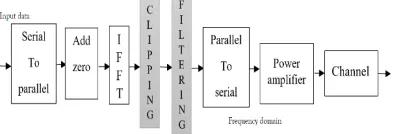
[image:7.612.326.528.366.475.2]A process that limits the amplitude to a specified level is called amplitude clipping (AC), which produces a discontinuity of the signal. An infinite bandwidth results and, after the clipping function, a low pass filter should be used, as shown in Figure . Out-of-band radiation is reduced by the low pass filter [51-53] but another problem is generated by the filter: growth of the in-band amplitude and, consequently, BER performance is degraded because of increased in-band distortion.
Figure 13:OFDM baseband transmitter structure with clipping and filtering functions
J. ITERATIVE CLIPPING AND
FILTERING (ICF)
The most widely-used and practical solution is the iterative clipping and filtering (ICAF) technique, because of its lack of bandwidth expansion, minimal computational complexity, and ease of execution minus receiver-side support. In-band distortion is the main disadvantage of the ICAF technique, which, if a relevant clipping threshold (CT) level is selected, can be reduced. Furthermore, an adaptive ICAF scheme was proposed by Byung and Kim in (2013) who evaluated implementation of the standard ICAF method, which enhances PAPR lessening of OFDM signals by clipping the signal with a modified CT in each clipping operation. This method reduces PAPR by set CT in each clipping operation. Some of the researchers tried to combat the distortion with the same number of iteration compare with conventional iterative clipping and filtering method but still suffer from in-band distortion [49].
Figure 14: iterative Clipping and Filtering structure of PAPR reduction
K. CODING
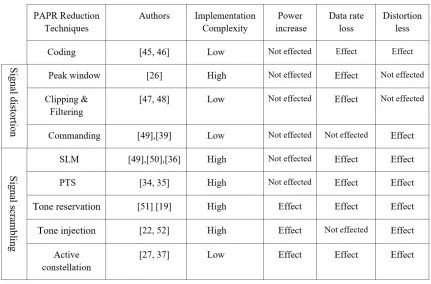
[image:7.612.92.289.629.696.2]3177 PAPR values to an acceptable level. The coding technique includes linear block coding and golay complementary sequence. This aforementioned method (coding) must send redundant bits, which produces degradation in the data bit rate[31]. For reduction of PAPR in OFDM signal, many techniques have been offered in the literature. Additional details are illustrated in the table
below. Schemes for reducing PAPR are assigned to two categories, as shown in table I.
1. The techniques of Signal distortion.
2. The techniques of Signal scrambling.
[image:8.612.91.522.234.518.2]3. Coding
Table I: gives the contrastive study of discriminates important PAPR minimization approaches as deliberated, for several resources
5. CONCLUSION
The OFDM is a promising and important technique because of frequency selective channel, high data rate, vigor against inter-simple interference (ISI), and robustness against multipath fading. Nevertheless, a bottleneck of multi-carrier modulation is PAPR, especially in the OFDM technique. The major technique have been used to reduce the high envelope fluctuation (PAPR) such as Partial Transmit Sequence (PTS), selective mapping, interleaving, tone reservation, tone injection, active constellation extension or it calls active set extension, peak windowing, amplitude clipping and filtering, iterative clipping and filtering. To solve the large output of power envelope fluctuation, several techniques were
proposed but they all result in BER deprivation performance furthermore substantially reduced the high crest. To reduce the PAPR and maintain BER performance should combine or hybrid different technique from these two-side frequency domain and time domain. In this paper, we highlighted the major drawback of PAPR lessening techniques and make comparison between them in Table I, in term of power increasing, complexity, bit rate loss, and distortion loss.
6. RECOMMENDATIONS AND FUTURE
WORK
3178 measurements effects on the system performance and highlight the weakness of reduction techniques of PAPR. In addition, the power saving, ADC and HPA nonlinear also introduced. The researches on PAPR reduction techniques are still ongoing, but still, the tradeoff between PAPR and BER exist. Readers may find this review paper beneficial because it covers most of the PAPR lessen techniques. Further work can be done using an optimization algorithm in the frequency domain and time domain to enhance the above-mentioned tradeoff.
REFERENCES
[1] H. Kaiho and T. Hattori, "Reduced complexity of spread spectrum OFDM for PAPR reduction and its basic performance," in TENCON 2009-2009 IEEE Region 10 Conference, 2009, pp. 1-5.
[2] K. Bulusu, H. Shaiek, D. Roviras, R. Zayani, M. Renfors, L. Anttila, et al.,
"Power Amplifier Effects and Peak-to-Average Power Mitigation," in Orthogonal Waveforms and Filter Banks for Future Communication Systems, ed: Elsevier,
2017, pp. 461-489.
[3] Y.-J. Kim, U.-K. Kwon, D.-Y. Seol, and G.-H. Im, "An Effective PAPR Reduction of SFBC-OFDM for Multinode Cooperative Transmission," IEEE Signal Process. Lett.,
vol. 16, pp. 925-928, 2009.
[4] F. B. Offiong, S. Sinanovic, and W. O. Popoola, "On PAPR reduction in pilot-assisted optical OFDM communication systems," IEEE Access, vol. 5, pp.
8916-8929, 2017.
[5] A. Sangannavar and K. V. Reddy, "PAPR optimization in MIMO-OFDM system for WiMAX," in 2017 International Conference on Energy, Communication, Data Analytics and Soft Computing (ICECDS), 2017, pp. 603-607.
[6] J. Watanabe and H. Ochiai, "A new low-complexity trellis shaping design based on clipping for PAPR reduction in BICM-OFDM system," in Wireless Communications and Networking Conference (WCNC), 2018 IEEE, 2018, pp.
1-6.
[7] S. Shakib, H.-C. Park, J. Dunworth, V. Aparin, and K. Entesari, "20.6 A 28GHz efficient linear power amplifier for 5G phased arrays in 28nm bulk CMOS," in
Solid-State Circuits Conference (ISSCC),
2016 IEEE International, 2016, pp.
352-353.
[8] T. Gotthans, R. Maršálek, J. Blumenstein, and G. Baudoin, "Experimental evaluation of digital predistortion with FBMC and OFDM signals," in Wireless and Microwave Technology Conference (WAMICON), 2015 IEEE 16th Annual, 2015, pp. 1-3.
[9] K. Tani, Y. Medjahdi, H. Shaiek, R. Zayani, and D. Roviras, "PAPR reduction of post-OFDM waveforms contenders for 5G & Beyond using SLM and TR algorithms," in
2018 25th International Conference on Telecommunications (ICT), 2018, pp.
104-109.
[10] T. Jiang, Y. Yang, and Y.-H. Song, "Exponential companding technique for PAPR reduction in OFDM systems," IEEE Transactions on broadcasting, vol. 51, pp.
244-248, 2005.
[11] T. Jiang and G. Zhu, "Nonlinear companding transform for reducing peak-to-average power ratio of OFDM signals,"
IEEE Transactions on Broadcasting, vol.
50, pp. 342-346, 2004.
[12] T. G. Pratt, N. Jones, L. Smee, and M. Torrey, "OFDM link performance with companding for PAPR reduction in the presence of non-linear amplification," IEEE Transactions on Broadcasting, vol. 52, pp.
261-267, 2006.
[13] C. Ye, Z. Li, T. Jiang, C. Ni, and Q. Qi, "PAPR reduction of OQAM-OFDM signals using segmental PTS scheme with low complexity," IEEE Transactions on Broadcasting, vol. 60, pp. 141-147, 2014.
[14] K.-S. Lee, Y.-J. Cho, J.-Y. Woo, J.-S. No, and D.-J. Shin, "Low-complexity PTS schemes using OFDM signal rotation and pre-exclusion of phase rotating vectors," Iet Communications, vol. 10, pp. 540-547,
2016.
[15] M.-J. Hao and P.-H. Huang, "Pilot assignment for PTS-OFDM with channel estimation for PAPR reduction," in
Intelligent Signal Processing and Communication Systems (ISPACS), 2016 International Symposium on, 2016, pp. 1-6.
[16] M. A. Taher, M. J. Singh, M. Ismail, S. A. Samad, M. T. Islam, and H. F. Mahdi, "Post-IFFT-modified selected mapping to reduce the PAPR of an OFDM system," Circuits, Systems, and Signal Processing, vol. 34, pp.
3179 [17] J.-Y. Woo, H. S. Joo, K.-H. Kim, J.-S. No,
and D.-J. Shin, "PAPR analysis of class-III SLM scheme based on variance of correlation of alternative OFDM signal sequences," IEEE Communications Letters,
vol. 19, pp. 989-992, 2015.
[18] J. Bai, C. Cao, Y. Yang, F. Zhao, X. Xin, A.-H. Soliman, et al., "Peak-to-average power
ratio reduction for DCO-OFDM underwater optical wireless communication system based on an interleaving technique," Optical Engineering, vol. 57, p. 086110, 2018.
[19] T. Jiang, C. Ni, C. Ye, Y. Wu, and K. Luo, "A novel multi-block tone reservation scheme for PAPR reduction in OQAM-OFDM systems," IEEE Transactions on Broadcasting, vol. 61, pp. 717-722, 2015.
[20] C. Ni, Y. Ma, and T. Jiang, "A novel adaptive tone reservation scheme for PAPR reduction in large-scale multi-user MIMO-OFDM systems," IEEE Wireless Communications Letters, vol. 5, pp.
480-483, 2016.
[21] M. Peng, M. Chen, H. Zhou, Q. Wan, L. Jiang, L. Yang, et al., "Hybrid PAPR
reduction scheme with Huffman coding and DFT-spread technique for direct-detection optical OFDM systems," Optical Fiber Technology, vol. 40, pp. 1-7, 2018.
[22] W. Wang, M. Hu, Y. Li, and H. Zhang, "A low-complexity tone injection scheme based on distortion signals for PAPR reduction in OFDM systems," IEEE Transactions on Broadcasting, vol. 62, pp.
948-956, 2016.
[23] Y. Hei, J. Liu, W. Li, X. Xu, and R. T. Chen, "Branch and bound methods based tone injection schemes for PAPR reduction of DCO-OFDM visible light communications," Optics express, vol. 25,
pp. 595-604, 2017.
[24] S.-H. Wang, W.-L. Lin, B.-R. Huang, and C.-P. Li, "PAPR reduction in OFDM systems using active constellation extension and subcarrier grouping techniques," IEEE Communications Letters, vol. 20, pp.
2378-2381, 2016.
[25] J. Zhong, X. Yang, and W. Hu, "Performance-Improved secure OFDM transmission using chaotic active constellation extension," IEEE Photonics Technology Letters, vol. 29, pp. 991-994,
2017.
[26] J. Hou, J. Ge, and F. Gong, "Tone Reservation Technique Based on
Peak-Windowing Residual Noise for PAPR Reduction in OFDM Systems," IEEE Trans. Vehicular Technology, vol. 64, pp.
5373-5378, 2015.
[27] M. A. Taher, J. S. Mandeep, M. Ismail, S. A. Samad, and M. T. Islam, "Reducing the power envelope fluctuation of OFDM systems using side information supported amplitude clipping approach," International Journal of Circuit Theory and Applications,
vol. 42, pp. 425-435, 2014.
[28] K. Anoh, C. Tanriover, and B. Adebisi, "On the optimization of iterative clipping and filtering for PAPR reduction in OFDM systems," IEEE Access, vol. 5, pp.
12004-12013, 2017.
[29] J. Zhou and Y. Qiao, "Low-PAPR asymmetrically clipped optical OFDM for intensity-modulation/direct-detection systems," IEEE Photonics Journal, vol. 7,
pp. 1-8, 2015.
[30] D. Mestdagh, J. G. Monsalve, and J.-M. Brossier, "GreenOFDM: a new selected mapping method for OFDM PAPR reduction," Electronics Letters, vol. 54, pp.
449-450, 2018.
[31] W. Xiao, H. Deng, Y. Li, and S. Jiang, "PAPR reduction in VLC-OFDM system using a combination of shuffled frog leaping algorithm and hill-climbing algorithm,"
Wireless Personal Communications, vol.
97, pp. 3757-3771, 2017.
[32] F. Sandoval, G. Poitau, and F. Gagnon, "Hybrid peak-to-average power ratio reduction techniques: Review and performance comparison," IEEE Access,
vol. 5, pp. 27145-27161, 2017.
[33] D.-W. Lim, S.-J. Heo, and J.-S. No, "An overview of peak-to-average power ratio reduction schemes for OFDM signals,"
Journal of Communications and Networks,
vol. 11, pp. 229-239, 2009.
[34] M. Woh, S. Seo, H. Lee, Y. Lin, S. Mahlke, T. Mudge, et al., "The next generation
challenge for software defined radio," in
International Workshop on Embedded Computer Systems, 2007, pp. 343-354.
[35] J. Song and H. Ochiai, "Performance Analysis for OFDM Signals With Peak Cancellation," IEEE Trans. Communications, vol. 64, pp. 261-270,
2016.
3180 signals," IEEE Communications Letters,
vol. 19, pp. 1438-1441, 2015.
[37] Y. Polyanskiy and Y. Wu, "Peak-to-average power ratio of good codes for Gaussian channel," IEEE Transactions on Information Theory, vol. 60, pp. 7655-7660,
2014.
[38] A. B. Kotade, A. B. Nandgaonkar, and S. L. Nalbalwar, "Peak-to-Average Power Ratio Reduction Techniques in OFDM: A Review and Challenges," in 2018 International Conference On Advances in Communication and Computing Technology (ICACCT), 2018, pp. 319-324.
[39] Y. Rahmatallah and S. Mohan, "Peak-to-average power ratio reduction in OFDM systems: A survey and taxonomy," IEEE communications surveys & tutorials, vol.
15, pp. 1567-1592, 2013.
[40] A. Skrzypczak, P. Siohan, and J.-P. Javaudin, "Power spectral density and cubic metric for the OFDM/OQAM modulation," in Signal Processing and Information Technology, 2006 IEEE International Symposium on, 2006, pp. 846-850.
[41] M. Deumal, A. Behravan, and J. L. Pijoan, "On cubic metric reduction in OFDM systems by tone reservation," IEEE Transactions on Communications, vol. 59,
pp. 1612-1620, 2011.
[42] S. Jacobsson, G. Durisi, M. Coldrey, and C. Studer, "Linear precoding with low-resolution DACs for massive MU-MIMO-OFDM downlink," arXiv preprint arXiv:1709.04846, 2017.
[43] R. J. Baxley and G. T. Zhou, "Power savings analysis of peak-to-average power ratio in OFDM," IEEE Transactions on Consumer Electronics, vol. 50, pp. 792-798, 2004.
[44] V. Sudha, M. Syamkumar, and D. S. Kumar, "A Low Complexity Modified SLM and Companding based PAPR Reduction in Localized OFDMA," Wireless Personal Communications, vol. 96, pp. 3207-3226,
2017.
[45] S.-y. Zhang and B. Shahrrava, "A Selected Mapping Technique Using Interleavers for PAPR Reduction in OFDM Systems,"
Wireless Personal Communications, vol.
99, pp. 329-338, 2018.
[46] J. Tellado, "Peak-to-average power reduction for multicarrier modulation," Ph. D. Thesis, 1999.
[47] B. S. Krongold and D. L. Jones, "An active-set approach for OFDM PAR reduction via
tone reservation," IEEE transactions on signal processing, vol. 52, pp. 495-509,
2004.
[48] A. Ghassemi and T. A. Gulliver, "A simplified suboptimal algorithm for tone reservation OFDM," in Communications, 2009. ICC'09. IEEE International Conference on, 2009, pp. 1-5.
[49] B. M. Lee and Y. Kim, "An adaptive clipping and filtering technique for PAPR reduction of OFDM signals," Circuits, Systems, and Signal Processing, vol. 32, pp.
1335-1349, 2013.
[50] O. Gazi, "A new companding technique for PAPR reduction in OFDM communication systems," in Ultra Modern Telecommunications and Control Systems and Workshops (ICUMT), 2011 3rd International Congress on, 2011, pp. 1-5.
[51] R. O'neill and L. Lopes, "Envelope variations and spectral splatter in clipped multicarrier signals," in Personal, Indoor and Mobile Radio Communications, 1995. PIMRC'95. Wireless: Merging onto the Information Superhighway., Sixth IEEE International Symposium on, 1995, pp. 71-75.
[52] D. J. Mestdagh, P. M. Spruyt, and B. Biran, "Effect of amplitude clipping in DMT-ADSL transceivers," Electronics Letters,
vol. 29, pp. 1354-1355, 1993.
[53] Y. Li, Y. Zhou, E. Kang, and T. Zhao, "A peak to average power ratio reduction scheme in ACO-OFDM system employing constant amplitude zero auto correlation and clipping," in Image and Signal Processing, BioMedical Engineering and Informatics (CISP-BMEI), International Congress on,
2016, pp. 1278-1282.
[54] J. Joung, C. K. Ho, K. Adachi, and S. Sun, "A survey on power-amplifier-centric techniques for spectrum-and energy-efficient wireless communications," IEEE Communications Surveys & Tutorials, vol.
![Figure 1: Block diagram of the transmitter and receiver in an OFDM system. A number of approaches, such as Companding [10-12], Partial Transmit Sequence (PTS) [13-15], Selective Mapping (SLM) [16, 17], Interleaved [18], Tone Reservation [19, 20], Coding [](https://thumb-us.123doks.com/thumbv2/123dok_us/8899371.954305/2.612.326.523.439.578/transmitter-approaches-companding-transmit-sequence-selective-interleaved-reservation.webp)

![Figure 7:Block diagram of Interleaved OFDM transmitter[39, 45].](https://thumb-us.123doks.com/thumbv2/123dok_us/8899371.954305/5.612.93.287.145.284/figure-block-diagram-interleaved-ofdm-transmitter.webp)
![Figure 10:Active constellation extension technique:16-QAM constellation[39].](https://thumb-us.123doks.com/thumbv2/123dok_us/8899371.954305/6.612.323.521.543.667/figure-active-constellation-extension-technique-qam-constellation.webp)