5166
THE IMPACT OF CHARACTERISTICS OF ONLINE FAN
COMMUNITY AND FANS ON LOYALTY TO STARS AND
THE COMMUNITIES
1JONGHUN KIM, 2MINCHEOL KANG, 3KIMIN KIM
1Silicon Mitus, Seongnam, South Korea
2Department of e-Business, School of Business, Ajou University, Suwon, South Korea
3Department of Business Administration, School of Business, Ajou University, Suwon, South Korea
E-mail: 1[email protected], 2[email protected], 3[email protected]
ABSTRACT
This study seeks to enhance understanding of online fan communities. We examined how online fan communities and their members affect loyalty to stars and the communities. We also examined how social and psychological factors such as social presence and identification mediate those impacts. By surveying online fans of Korean Wave Stars, we found that, among the online fan community characteristics, social connectedness, self-disclosure and deep profiling affect social presence, and, among the fan characteristics, self-focused attention and empathy affect social presence. We also found that social presence affects online fan community identification and star identification, which in turn affect online fan community loyalty and star loyalty. Moreover, star identification is found to transit to online fan community identification while star loyalty transited to online fan community loyalty. These findings provide significant theoretical and practical implications for the entertainment and media industries by adding to scant research on online fan communities.
Keywords:Online Fan Community, Korean Wave Stars, Loyalty, Social Presence, Identification
1. INTRODUCTION
Due to the advent of the Internet, entertainment content that was once available only through traditional media such as TV or radio has become accessible online, fueling the rapid development of the entertainment industry. According to Price Waterhouse Coopers, total spending on digital services is expected to 12.2% compound annual growth rate from 2013 to 2018, which holds 65% of global growth of entertainment and media spending, excluding spending on Internet access [1].
Fandom is a group that engages in cultural consumption of a certain star or celebrity [2]. It comprises a series of fan communities that consume, reproduce and share various entertainment contents [3, 4]. However, as online entertainment industry has grown, online fan communities have become major targets for the consumption of cultural goods and culture marketing. Online fan communities are also
expected to play a mediating role in continuous growth of related industries, not only by providing fans with places where they can share information about stars but also by providing firms with places where the firms can deploy marketing campaigns such as star marketing and viral marketing so that they can increase their revenue, secure their competitive advantages and improve their corporate images. Unfortunately, however, limited research has been conducted on online fan communities, and most extant studies have focused on the characteristics of the common objects that lead to form online fan communities or the relationships between the characteristics of online fan communities and the behaviors of fandoms [e.g., 5, 6].
5167 communities, it is necessary to consider social and psychological characteristics of the fans in virtual environment. However, to our knowledge, few studies have examined the characteristics of the fans in virtual environment. In order to fill this void, we seek to investigate the impact of online fan community characteristics and fan characteristics on loyalty to the star and loyalty to the online community. Also, we seek to examine the mediating role of social and psychological factors of the fans on the above mentioned relationships.
2. LITERATURE REVIEW
2.1. Online Fan Community
Unlike general public, fans intentionally form special relationships with stars, and fandom appears when the fans unite to create a force [2]. Fandom selects out certain cultural aspects and infuses them into the fans [4]. Fandom is not composed of people who are passive or fanatic recipients of culture, but composed of people who are active in reproduction of culture by forming a community where they interact with each other [3].
Fans who had interacted offline realized the potential of the new features of online media as online communities appeared in the 1990s, and they volunteered to form online fan communities. Online fan communities are the mediated social spaces in digital environment where fans interact with each other and/or with the star [7]. In describing online fan communities, Baym [5] considered both the characteristics of fandom and the characteristics of the online media. For example, fans can use online media in order to engage in various activities such as e-zines, fan fiction, fan art, fan vids and fan subbing, while creating and sharing content easily and freely.
2.2. Social Presence Theory
Social presence, the “sense of being together” [8], is an important factor for the members of online communities to participate [9]. Social presence is also an important concept that helps explain the community members’ way of communication and interaction and their psychological experiences in CMC environment. Short and his colleagues [10] defined social presence as the “degree of salience of the other person in a mediated communication and the consequent salience of their interpersonal interactions.” They also argued that different communication media deliver information
differently and users of those media feel social presence differently. As different media have different capacities to carry interpersonal communicative cues, channels that deliver rich nonverbal cues such as face-to-face communications provide higher social presence [8].
However, the concept of social presence has been interpreted and defined in many different ways, leaving it vague and unclear and generating several operational definitions and measurement tools [11, 12]. While early studies took unidimensional conceptualization approaches, later studies adopted multi-dimensional conceptualizations [9]. Below are a few examples of multi-dimensional conceptualizations: affective, interactive, and cohesive responses [13]; social context, online communication, interaction, and privacy [12]; awareness, affective social presence, and cognitive social presence [14]; co-presence, social richness, self-reported involvement and partner involvement, and social attraction [15];
2.3. Identification
Identification is the process that one does not cognize oneself as an audience member but imagines oneself as a character in the text, and thus it produces psychological attachment or an attitude change due to a strong absorption and emotional experience [16]. Therefore, Identification is an important psychological and behavioral factor for the fans’ interactions with other members and the stars in online fan communities.
Organizational identification has been a popular research topic in the field of organizational behavior. Combining social identity theory and organizational research, Ashforth and Mael [17] defined organizational identification as “a perceived oneness with an organization and the experience of the organization’s successes and failures as one’s own,” and recognized it as the “perception of belongingness.” Research on identification has also been conducted in the fields of sports and games [e.g., 18, 19]. In a similar vein, Milne and McDonald defined fan identification as “the personal commitment and emotional involvementcustomers have with a sport organization” [20].
5168 voluntary participation such as knowledge sharing, community promotion and behavior changes.
2.4. Characteristics of Online Fan Community
Via CMC in virtual spaces, members of online fan communities interact with each other and build communal relationships [21]. Therefore, in the context of online fan communities, both the characteristics of fan communities and the characteristics online communities co-exist.
2.4.1. Social connectedness
Social connectedness is defined as “short-term experience of belonging and relatedness based on quantitative and qualitative social appraisals and relationship salience” [22], and “a positive emotional appraisal of the quality and quantity of interactions within ongoing social relationships” [23]. A perceived sense of belonging or connectedness is a basic psychological need, and it brings about positive outcomes when satisfied [24]. Therefore, social connectedness is an emotional experience and a feeling of psychological involvement constantly maintained via touch or contact with others [11, 23].
As it does in offline communities, social connectedness plays a positive role in online communities. For example, social connectedness in virtual health communities is related to the motivation to join them [25], and learners’ feeling of social connectedness is a key factor for the success of online courses [26]. While a theoretical framework was suggested that can help enhance social connectedness in online learning environment [27], Grieve and his colleagues [28] found that constructs of social connectedness in online and offline environments are separate and different ones.
2.4.2. Self-disclosure
Self-disclosure is a communication process by which one reveals one’s personal information [29]. People interact with each other by sharing information via various media such as SNS, web sites and instant messaging. Therefore, self-disclosure, i.e., the sharing of personal information, is essential in building close relationships with others [30]. Self-disclosure is particularly important in initial stages of interactions, since the determination of people to interact again and develop further relationships depends on others’ self-disclosure [31]. In addition, self-self-disclosure promotes
self-disclosure of the other, being a reciprocity that leads to more positive interpersonal outcomes [31].
However, face-to-face communications and CMC involve different types of self-disclosure. Bargh and his colleagues [32] cited “anonymity” versus “self-disclosure” as an important difference between the interactions via Internet and face-to-face. Interestingly, Schouten and his colleagues [33] found that CMC results in richer self-disclosure than does face-to-face communications, while Tidwell and Walther [34] found that CMC interactants engage in deeper self-disclosures than face-to-face interactants do.
2.4.3. Deep profiling
Context information that is created through social interactions is accumulated and stored in online communities. Therefore, members of a community are always able to search for and assess it, and new members can refer to it in order to understand their fellow members [35]. Indeed, one of the advantages of online communities is deep profiling, the “digital organization of social information with which community members can identify the focal person,” that occurs through member directories, ranking systems, reputation, feedback and interaction archive [35]. Consequently, deep profiling allows users to perform social evaluation of others, making it a key factor in user interactions [36].
2.5. Characteristics of Online Fans
Being users of community services of online communities, online fans express their identities and reproduce content that reflects their tastes. While the characteristics of online community affect the activities of members of the online community, the characteristics of the members also affect the members’ activities. Therefore, we suggest that the characteristics of fans should be considered importantly in studying online fan communities.
2.5.1. Self-focused attention
5169 individual attends to his conscious state, his personal history, his body or any other personal aspects of himself [37]. Therefore, self-focused attention is a disposition in which one’s attention becomes self-directed and focused on one’s own inner characteristics [38].
Further, self-focused attention can be either private or public awareness. Private self-awareness is a focus on personal, more covert aspects of oneself such as perceptions, thoughts and feelings, while public self-awareness is attention to oneself as a social object and concerns about one's appearance and the impression made in social situations [39]. Interestingly, however, CMC shows higher levels of private self-awareness and lower levels of public self-awareness than does face-to-face communication [40].
2.5.2. Empathy
Empathy is the reactions of one individual to the observed experiences of another [41], and a form of complex psychological inference in which observation, memory, knowledge, and reasoning are combined to yield insights into the thoughts and feelings of others [42]. Thus, empathy is the process by which one imaginatively transposes oneself into the experiences of others [43].
Researchers have so far described empathy from two perspectives: one group views empathy as either innate or as a faculty that can be developed, while the other views it as a situation-specific state that appears in response to specific stimuli [43]. Most studies on empathy in the online environment discuss its role in communication. For example, Preece [44] argued that empathy plays an important role in empathetic communication in online textual communities, and software needs to be designed to support emotional communication as well as factual information exchange.
2.5.3. Self-presentation
Self-presentation is a process to communicate one’s identity to others so that they construct a more refined and detailed understanding of oneself, therefore, user names, signatures, avatars or nicknames, profiles, personal Webpages and interactive tools are all ways of self-presentation used to represent oneself or one’s identity in the online environment [35].
However, self-presentation is used
interchangeably with impression management [45], and styles of it can be either acquisitive or protective [46]. The acquisitive style is characterized to be more actively participating in social interactions, and people employ this style when they feel that it is likely to create a preferred impression on others. In comparison, the protective style is characterized to be limitedly participating in social interactions, and people employ this style when they feel it is unlikely to create a preferred impression on others.
Online self-presentation has been researched also. In a study examining how computer-mediated self-presentation can alter identities, Gonzales and Hancock [47] distinguished private and public self-presentation, and investigated how they affect one’s self-concept. Papacharissi [48] examined how individuals use their personal homepages to present themselves online, and found that the information displayed differs according to the purposes and the characteristics of the media.
2.6. Loyalty
Online loyalty is the loyalty to an online site, with intent to revisit the site [49]. Virtual community loyalty is the willingness of members of a virtual community to recommend membership to others [50]. Therefore, sustainability of online communities depends heavily on the community loyalty—the continuous participation —of their members [51].
As the Web 2.0 era began, the importance of online communities has become apparent particularly from the marketing perspective, and thus interest in online community loyalty has increased. For instance, it is suggested that user satisfaction is a determinant of loyalty in virtual communities [52], affective commitment has significant impact on community loyalty behavior [53], and interpersonal attraction factors have positive effects on virtual community loyalty [54].
Meanwhile, most research on fan loyalty has focused on loyalty to sports teams [e.g., 55] rather than to stars or celebrities. A rare example is a study of Munyau and Mwirigi [56], in which they found customers are more inclined to buy products to which they are highly loyal than the celebrity-endorsed products.
3. RESEARCH MODEL
5170 relationships through constant mutual interactions based on their common attraction to the star. Fans not only share mutual feelings but also construct archives. Therefore, social connectedness, self-disclosure and deep profiling can be important characteristics of online fan communities. Moreover, individual fans have common psychological characteristics such as self-focused attention and empathy, together with the fundamental need for self-presentation in online communities.
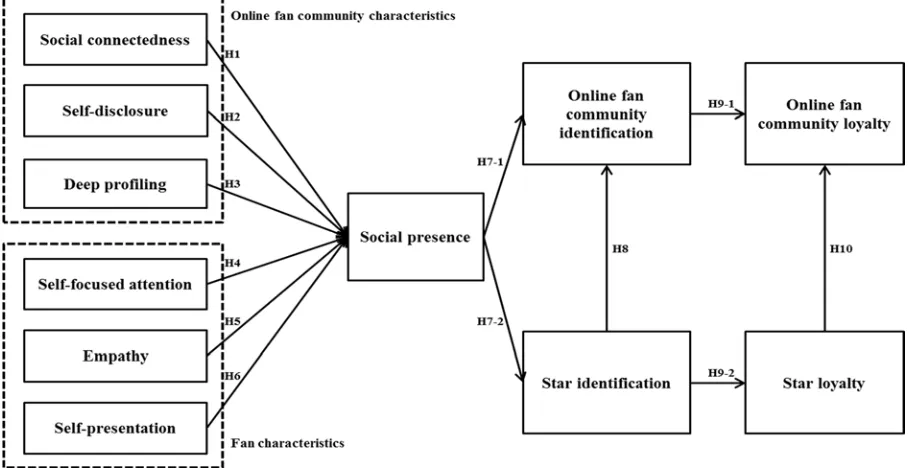
[image:5.612.89.545.245.479.2]This study examines the relationship between the characteristics of online fan communities and the characteristics of fans and their loyalty to the stars and the communities. As fans in online communities interact mostly online, the social and psychological factors that arise due to the online medium are expected to play a mediating role on the relationships between the characteristics of online fan communities and the characteristics of fans and their loyalty to the stars and the communities. Figure 1 shows the research model of this study.
Figure 1. Research Model
In communication media, social connectedness and social presence are complementary [8], and, as a psychological human need, social connectedness is more fundamental than social presence [11]. Consequently, psychological connectedness has an important impact upon social presence [57]. Accordingly, we posit the following:
Hypothesis 1: Social connectedness has a positive
effect on social presence.
Sharing personal experiences via conversations is a representative type of self-disclosure, plays a significant role in participants’ perceptions of relationships, and enhances mutual understandings and intimacy [58]. As a form of emotional expression, self-disclosure contributes to the development of social presence among individuals [59]. Evidently, self-disclosure in text-based
computer conferencing has a positive effect on affective responses such as social attraction [13]. Accordingly, we posit the following:
Hypothesis 2: Self-disclosure has a positive effect
on social presence.
Being an aspect of social presence, deep profiling can expedite mutual understanding in online communities [14], and can significantly affect the experiences of social network game users through social presence [60]. Also, deep profiling is a technical antecedent of social presence in online communities [9]. Therefore, we posit the following:
Hypothesis 3: Deep profiling has a positive effect on
social presence.
5171 personal attitudes [61]. Since this study deals with fans’ self-focused attention, and since users’ private awareness in CMC is higher than public self-awareness [40], this study focuses mainly on private self-awareness.
Private self-awareness affects consumer decision making such as choices of favorite things [62], and such decision making is related to social judgment, which is a component of social presence [63]. Self-focused attention affects attraction, which is an affective reaction [64], and participants with heightened private self-awareness in CMC perceive stronger social attraction [65], which is another component of social presence [15, 66]. Consequently, we posit the following:
Hypothesis 4: Self-focused attention has a positive
effect on social presence.
Fans feel empathy for entities such as stars [67]. Users employ emoticons to express empathy online [68], which increases their social presence [69]. While strong empathy tends to lead to high social presence in CMC [43], communications in the virtual environments can trigger empathy and thus enhance social presence [70]. Therefore, we posit the following:
Hypothesis 5: Empathy has a positive effect on
social presence.
People construct their online identities using various personas that represent themselves, such as avatars, signatures, nicknames, profiles and personal websites [35, 71]. Such self-presentation is one of many ways to enhance social presence [72]. Thus, self-presentation is a technical antecedent of social presence [9]. By conducting a survey on the users of instant message service who use Buddy Icons to reflect their physical and/or psychological characteristics, Nowak [73] found that self-presentation to manage others’ impressions increases social presence. Based on these findings, we posit the following:
Hypothesis 6: Self-presentation has a positive effect
on social presence.
Users’ social presence in virtual environments is significantly correlated with their identification with virtual characters [74]. However, social identity is affected by various dimensions of social presence [54]. Also, social presence via communication technologies in a dispersed social work environment facilitates increased organizational identification [75]. Accordingly, we posit the followings:
Hypothesis 7-1: Social presence has a positive effect
on online fan community identification.
Hypothesis 7-2: Social presence has a positive effect
on star identification.
Most studies on the transition and the impact of fan identification have conducted in sports marketing area. For instance, sports fans’ team identification affect their recognition of, patronage of, attitudes to, and satisfaction with the sponsors of the sports team [76], team identification has a positive impact on sponsor identification In a study on professional soccer fans [77], and members’ identification with a specific interest affect their community identification [78]. Based on the findings, we posit the following:
Hypothesis 8: Star identification has a positive
effect on online fan community identification.
Perceived social presence in online environments influences loyalty [49]. For instance, loyalty to NASCAR(National Association for Stock Car Auto Racing)-sponsored brands was significantly higher for the fans who scored high on fan identification [79], and online community identification affects loyalty of the community [78]. Based on these findings, we posit the followings:
Hypothesis 9-1: Online fan community
identification has a positive effect on online fan community loyalty.
Hypothesis 9-2: Star identification has a positive
effect on star loyalty.
Fan loyalty positively affects the development of positive brand attitudes and purchase intentions [80]. For example, compared to non-NASCAR fans, NASCAR fans showed stronger loyalty to NASCAR-sponsored brands [79]. These findings imply that loyalty to favored subjects can be linked to loyalty to other subjects that sponsor and/or support the original subjects. We can thus infer that online fan community loyalty is higher for fans with a high degree of star loyalty. Therefore, we posit the following:
Hypothesis 10: Star loyalty has a positive effect on
online fan community loyalty.
4. RESEARCH METHODOLOGY
4.1. Measurement
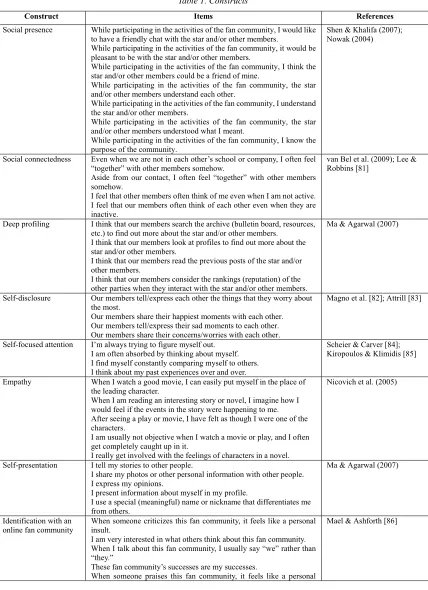
5172 studies, or modified them to reflect the context of online fan communities if necessary. We measured each item on a 7-point Likert scale.
Table 1. Constructs
Construct Items References
Social presence While participating in the activities of the fan community, I would like to have a friendly chat with the star and/or other members.
While participating in the activities of the fan community, it would be pleasant to be with the star and/or other members.
While participating in the activities of the fan community, I think the star and/or other members could be a friend of mine.
While participating in the activities of the fan community, the star and/or other members understand each other.
While participating in the activities of the fan community, I understand the star and/or other members.
While participating in the activities of the fan community, the star and/or other members understood what I meant.
While participating in the activities of the fan community, I know the purpose of the community.
Shen & Khalifa (2007); Nowak (2004)
Social connectedness Even when we are not in each other’s school or company, I often feel “together” with other members somehow.
Aside from our contact, I often feel “together” with other members somehow.
I feel that other members often think of me even when I am not active. I feel that our members often think of each other even when they are inactive.
van Bel et al. (2009); Lee & Robbins [81]
Deep profiling I think that our members search the archive (bulletin board, resources, etc.) to find out more about the star and/or other members.
I think that our members look at profiles to find out more about the star and/or other members.
I think that our members read the previous posts of the star and/or other members.
I think that our members consider the rankings (reputation) of the other parties when they interact with the star and/or other members.
Ma & Agarwal (2007)
Self-disclosure Our members tell/express each other the things that they worry about the most.
Our members share their happiest moments with each other. Our members tell/express their sad moments to each other. Our members share their concerns/worries with each other.
Magno et al. [82]; Attrill [83]
Self-focused attention I’m always trying to figure myself out. I am often absorbed by thinking about myself. I find myself constantly comparing myself to others. I think about my past experiences over and over.
Scheier & Carver [84]; Kiropoulos & Klimidis [85]
Empathy When I watch a good movie, I can easily put myself in the place of
the leading character.
When I am reading an interesting story or novel, I imagine how I would feel if the events in the story were happening to me. After seeing a play or movie, I have felt as though I were one of the characters.
I am usually not objective when I watch a movie or play, and I often get completely caught up in it.
I really get involved with the feelings of characters in a novel.
Nicovich et al. (2005)
Self-presentation I tell my stories to other people.
I share my photos or other personal information with other people. I express my opinions.
I present information about myself in my profile.
I use a special (meaningful) name or nickname that differentiates me from others.
Ma & Agarwal (2007)
Identification with an online fan community
When someone criticizes this fan community, it feels like a personal insult.
I am very interested in what others think about this fan community. When I talk about this fan community, I usually say “we” rather than “they.”
These fan community’s successes are my successes.
When someone praises this fan community, it feels like a personal
5173
Construct Items References
compliment. Identification with a
star
When someone criticizes this star, it feels like a personal insult. I am very interested in what others think about this star.
If a story in the media (broadcast, newspaper, etc.) criticized this star, I would feel embarrassed.
This star’s successes are my successes.
When someone praises this star, it feels like a personal compliment.
Mael & Ashforth (1992)
Loyalty to an online fan community
I will visit this fan community on a regular basis in the future. I will frequently visit this fan community in the future. I will recommend others to use this fan community.
When I need to know/express something about this star, this fan community is my first choice.
To me this community is the best fan community to visit or to be active in.
Srinivasan et al. [87]; Roca et al. [88]
Loyalty to a star I will support this star on a regular basis in the future. I will frequently support this star in the future. I will recommend this star to others. I like to support this star.
To me this star is the best star to support.
Srinivasan et al. (2002); Roca et al. (2006)
4.2. Data Collection
We first reviewed the validity of the questionnaire items according to the feedback from researchers in MIS field, and then checked out whether any item was hard to understand for the general public. Completing the pre-inspection of the questionnaire, cooperating with the operations groups of the online fan communities, we carried out an online survey on four message boards maintained by Korean online fan communities from October 26 to November 8, 2013. The four online fan communities were at least three years old, and dedicated to Korean Wave Stars (i.e., an actor, an actress, a male singer, and a female singer, respectively). Three communities had over 30,000 members, and one had slightly over 10,000 members. Of the total 216 responses, we used 201 for empirical analysis after excluding 15 incomplete or double-checked responses. The detailed demographic data of the respondents are shown in Annex 1.
5. RESULTS
5.1. Data Analysis
We employed SPSS Ver. 19 to analyze the 201 samples acquired from the survey. We conducted exploratory factor analysis to check the reliability and validity of the variables of each construct, employed the PLS (partial least squares) method for hypothesis testing, and conducted confirmatory factor analysis using Smart PLS 2.0.
We conducted principal component analysis using varimax rotation in order to extract the factors. Since the measured variables with primary factor loadings greater than 0.5 can be considered important ones [89], we extracted total 46 measured variables for 11 constructs. We employed Cronbach’s alpha and composite reliability scores in order to examine the reliabilities of the measured variables of each construct selected through the exploratory factor analysis (see Annex 2 for details). The correlation analysis using PLS to examine the degree and direction of the relations among the constructs shows that all constructs have positively directed correlations at the levels where the p-values are less than 0.01 (see Annex 3 for details).
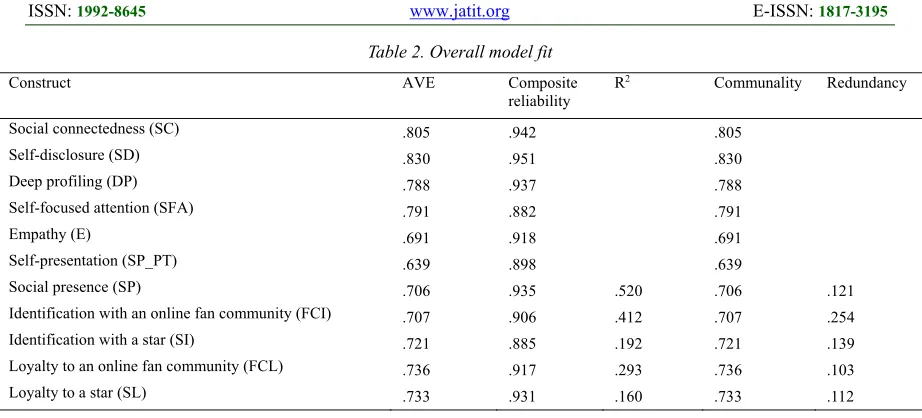
To ensure reliability (or internal consistency), it is desirable to have a Cronbach’s alpha value of 0.7 or higher and a composite reliability value of 0.8 or higher [90]. As shown in Annex 2 and Table 2, the scores of all constructs satisfy the criteria.
5174
Table 2. Overall model fit
Construct AVE Composite
reliability R
2 Communality Redundancy
Social connectedness (SC) .805 .942 .805
Self-disclosure (SD) .830 .951 .830
Deep profiling (DP) .788 .937 .788
Self-focused attention (SFA) .791 .882 .791
Empathy (E) .691 .918 .691
Self-presentation (SP_PT) .639 .898 .639
Social presence (SP) .706 .935 .520 .706 .121
Identification with an online fan community (FCI) .707 .906 .412 .707 .254
Identification with a star (SI) .721 .885 .192 .721 .139
Loyalty to an online fan community (FCL) .736 .917 .293 .736 .103
Loyalty to a star (SL) .733 .931 .160 .733 .112
We may estimate discriminant validity in two ways. If the square root of each construct’s AVE is bigger than the correlation coefficient between the construct and the other constructs, it can be considered to have discriminant validity [91], which is the case for this study (see Annex 3 for details). It can also be evaluated by the factor loadings and cross loadings related to the measured variables of each construct, which can be acquired using PLS analysis [93]. Since the factor loading of each measured variable is greater than the corresponding cross loading, it can be considered to have discriminant validity as well (see Annex 4 for details).
To evaluate the PLS structural equation model fit, we analyzed the overall model fit, goodness of fit, and explained variance (R2) for each construct. First,
the index for overall model fit can be evaluated by the degree of redundancy; if all redundancies have positive values, it is considered to fit well [93]. Table 2 shows that all redundancies have positive values.
Goodness of fit can be evaluated by communality and R2. The communality values need
to be higher than 0.5, and those of the constructs of this study satisfy the criteria. The square root value of the multiple of the average of all the R2 values and
the average of the communality values should be at least 0.1; when the value is 0.36 or above, it is considered to have high goodness of fit, and when the value is between 0.25 and 0.36, it is considered to have medium goodness of fit [94]. In this study, the value is 0.483 which shows high goodness of fit. The R2 value of each construct is recommended to
be greater than 0.1 [95]. In this study, all values satisfy the criteria.
Since this research is based on self-reported data from survey respondents who used an identical measurement tool, the common method bias might occur. We conducted Harman’s one-factor test using exploratory factor analysis in order to check this potential bias [96]. The result shows that the amount of variance explained by the first factor (i.e., the strongest factor) is 31.88% and those of other factors are 8.56%, 6.57%, 6.11%, 5.93%, 4.35%, 3.89%, 2.88%, 2.57%, 2.18%, and 1.91%, respectively. Therefore, we conclude that common method bias is less likely to occur, since a single factor holds the majority of the covariance among measures.
5.2. Results of Hypothesis Testing
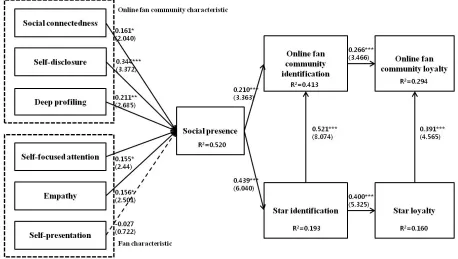
We tested our hypotheses through confirmatory factor analysis on the PLS path model, of which the results are shown in Figure 2.
The results of the hypothesis test indicate that all hypotheses except Hypothesis 6 are statistically significant. The results are described in detail below. First, the result shows that characteristics of online fan community such as social connectedness, self-disclosure, and deep profiling have positive effects on social presence. We found that self-disclosure has the most significant effect.
Second, we found that, among the characteristics of fans, self-focused attention and empathy have positive effects on social presence, and self-presentation has no statistically significant effect. These results differ from those in the extant studies that claimed the relationship between self-presentation and social presence [e.g., 9, 72, 73].
5175 positive effect on both fan community identification and star identification, and star identification has a positive effect on online fan community identification. These results support a positive relationship between social presence and identification suggested by Jung [6]. It is also significant that we found a transition of star identification to online fan community identification.
[image:10.612.88.546.212.471.2]Fourth, we found that online fan community identification has a positive effect on online fan community loyalty, and star loyalty also has a positive impact on online fan community loyalty. Therefore, it is likely that a stronger identification with the online fan community and/or with the star strengthens the positive effects on online fans’ loyalty, enhancing their consistent participation and support.
Figure 2. Results for the structural model.
Finally, we found that loyalty to the star has a positive effect on loyalty to the online fan community. Therefore, it is likely that the stronger the loyalty to the star, the more loyal the fans will be to their online fan community by the transition effect.
5.3. Discussion
We identified important roles and properties of fans’ social presence in online fan communities. First, we found that social connectedness, self-disclosure, and deep profiling have significant impacts on social presence. Therefore, in order to increase social presence, and thus ultimately enhance online fans’ e-loyalty [49], the members of online fan communities must be made to feel that their relationships are maintained via continuous interactions in an atmosphere where they can share their emotions. Moreover, the information that the members create
via their interactions should be stored safely where the members can easily access.
We also found that self-focused attention and empathy have significant impacts on social presence. In other words, the degree to which fans concentrate their interest (or attention) on their own thoughts or feelings, and the degree to which they sympathize with others’ experiences and situations, directly influence perception of being with others in online fan communities. Thus, understanding the characteristics of the members of online fan communities helps better understand diverse characteristics of online fan communities.
5176 fan community loyalty, and star identification affects star loyalty, respectively. In other words, social presence can make fans feel they are identical to the online fan community as well as the star, and ultimately it can produce psychological attachment to or attitude change for the online fan community and the star.
To summarize, while social presence is affected by the characteristics online fan community and the characteristics of fans, it eventually affects loyalty to both online fan communities and stars via its impact on both fan community identification and star identification. Therefore, when building and operating online fan communities, entertainment management companies and corporate marketers can utilize the role of social presence by fully understanding its significance.
Another meaningful finding is that identification with the star affects identification with the online fan community, and loyalty to star affects loyalty to the online fan community, which identifies the transition effect of identification and loyalty. The online fan community is a place where fans share and pursue their common tastes or purposes; therefore, identification with and loyalty to the star are directly linked with identification with and loyalty to the online fan community. Consequently, in order to manage online fan communities successfully, diverse tools may be needed that can help promote identification with and loyalty to the stars [e.g., 97].
6. CONCLUSION
This study contributes to theory by adding to scant research on online fan communities. This study also contributes to practice by providing practical implications about the development of star marketing.
However, this study has several limitations. First, we surveyed four online fan communities that operate mostly with Koreans. Therefore, considering the possibility of cross-cultural factors, it might be inappropriate to apply the result of this study to online fan communities comprised of Westerners or culturally diverse members. It is well noted that Eastern culture differs from Western one in various dimensions. For example, according to Hofstede, the index value of individualism of Korea is 16 compared to 91 for the USA and the index value of long term orientation of Korea is 100 compared to
26 for the USA. Therefore, in order to generalize the result of this study, it would be necessary to conduct further research to compare the characteristics of Eastern and Western online fan communities and identify the consequences of their differences, if any.
Second, due to the limited number of research variables, some of the attributes of online fan community (e.g., demographic factors such as gender, age, anonymity, and star involvement) could not be considered in this study. Such attributes must be considered in future research in order to better understand online fan communities.
Lastly, advances in ICT (information and communications technologies) have enabled various mobile devices and applications to connect to online communities. Some attributes may be more important to the activities in online fan community, as the connections become more active; however, these were not examined. Studying the effects of such attributes would provide interesting and meaningful implications.
REFERENCES:
[1] PwC, "Global Entertainment and Media Outlook, 2014–2018," 2013.
[2] H. Jenkins, Textual poachers: Television
fans and participatory culture. New York,
NY: Routledge, 2015.
[3] M. R. Real, Exploring media culture: A
guide vol. 22. Thousand Oaks, CA: Sage,
1996.
[4] J. Fiske, "The Cultural Economy of Fandom " in The Adoring Audience: Fan
Culture and Popular Media, L. A. Lewis,
Ed., ed London: Routledge, 1992, pp. 30-49.
[5] N. K. Baym, Tune in, log on: Soaps,
fandom, and online community vol. 3.
Thousand Oaks, CA: Sage Publications, 1999.
[6] S. Jung, "The Impact of Fan Community Characteristics on Voluntary Participations of Fan Community Members," Doctoral dissertation, Sejong university, Seoul, Korea, 2012.
[7] R. P. Bagozzi and U. M. Dholakia, "Intentional social action in virtual communities," Journal of interactive
marketing, vol. 16, pp. 2-21, 2002.
5177 and asynchronous communication media,"
Human-Computer Interaction: Theory and
Practice (Part II), vol. 2, pp. 924-928, 2003.
[9] K. N. Shen and M. Khalifa, "Design for Social Presence in Online Communities: A Multidimensional Approach," AIS Transactions on Human-Computer
Interaction, vol. 1, pp. 33-54, 2009.
[10] J. Short, E. Williams, and B. Christie, The
social psychology of telecommunications.
Hoboken, NJ: John Wiley & Sons, 1976. [11] R. Rettie, "Connectedness, Awareness and
Social Presence," in PRESENCE 2003, Aalborg, Denmark, 2003.
[12] C.-H. Tu and C.-J. Yen, "A study of multi-dimentional online social presence," in
Frontiers in higher education, L. W. Cooke,
Ed., ed Hauppauge, NY: Nova Science Publishers, 2006, pp. 77-104.
[13] L. Rourke, T. Anderson, D. R. Garrison, and W. Archer, "Assessing social presence in asynchronous text-based computer conferencing," International Journal of
E-Learning & Distance Education, vol. 14, pp.
50-71, 2007.
[14] K. N. Shen and M. Khalifa, "Exploring multi-dimensional conceptualization of social presence in the context of online communities," in Human-Computer
Interaction. HCI Applications and Services,
ed: Springer, 2007, pp. 999-1008.
[15] H.-J. Chang and W.-Z. Ian, "Instant messaging and interruption in organizational settings: A social presence’s perspective," First Monday, vol. 17, 2012. [16] J. Cohen, "Defining identification: A
theoretical look at the identification of audiences with media characters," Mass
Communication & Society, vol. 4, pp.
245-264, 2001.
[17] B. E. Ashforth and F. Mael, "Social identity theory and the organization," Academy of
management review, vol. 14, pp. 20-39,
1989.
[18] W. A. Sutton, M. A. McDonald, G. R. Milne, and J. Cimperman, "Creating and fostering fan identification in professional sports," Sport Marketing Quarterly, vol. 6, pp. 15-22, 1997.
[19] Z. Zhang and D. Won, "Buyer or browser? An analysis of sports fan behaviour online,"
International Journal of Sports Marketing
& Sponsorship, vol. 11, pp. 124-139, 2010.
[20] G. R. Milne and M. A. McDonald, Sport
marketing: Managing the exchange process.
Burlington, MA: Jones & Bartlett Learning, 1999.
[21] H. Rheingold, The virtual community:
Homesteading on the electronic frontier.
Cambridge, MA: MIT press, 1993. [22] D. T. van Bel, K. Smolders, W. A.
IJsselsteijn, and Y. de Kort, "Social connectedness: concept and measurement,"
in Intelligent Environments
2009-Proceedings of the 5th International Conference on Intelligent
Environments-Barcelona, Spain 2009, 2009, pp. 67-74.
[23] W. IJsselsteijn, J. van Baren, P. Markopoulos, N. Romero, and B. De Ruyter, "Measuring affective benefits and costs of mediated awareness: Development and validation of the ABC-questionnaire,"
in Awareness Systems, ed: Springer, 2009,
pp. 473-488.
[24] P. E. Jose, N. Ryan, and J. Pryor, "Does Social Connectedness Promote a Greater Sense of Well‐Being in Adolescence Over Time?," Journal of Research on
Adolescence, vol. 22, pp. 235-251, 2012.
[25] J. L. Welbourne, A. L. Blanchard, and M. B. Wadsworth, "Motivations in virtual health communities and their relationship to community, connectedness and stress,"
Computers in Human Behavior, vol. 29, pp.
129-139, 2013.
[26] K. Kreijns, P. A. Kirschner, W. Jochems, and H. Van Buuren, "Determining sociability, social space, and social presence in (a) synchronous collaborative groups," CyberPsychology & Behavior, vol. 7, pp. 155-172, 2004.
[27] P. J. S. van Tryon and M. Bishop, "Theoretical foundations for enhancing social connectedness in online learning environments," Distance Education, vol. 30, pp. 291-315, 2009.
[28] R. Grieve, M. Indian, K. Witteveen, G. A. Tolan, and J. Marrington, "Face-to-face or Facebook: Can social connectedness be derived online?," Computers in Human
Behavior, vol. 29, pp. 604-609, 2013.
[29] V. J. Derlega, S. Metts, S. Petronio, and S. T. Margulis, Self-disclosure. Thousand Oaks, CA: Sage Publications, Inc., 1993. [30] I. Altman and D. A. Taylor, Social
penetration: The development of
interpersonal relationships. New York, NY:
Holt, Rinehart & Winston, 1973.
5178 Reciprocal self-disclosure promotes liking in initial interactions," Journal of
Experimental Social Psychology, vol. 49,
pp. 860-866, 2013.
[32] J. A. Bargh, K. Y. McKenna, and G. M. Fitzsimons, "Can you see the real me? Activation and expression of the “true self” on the Internet," Journal of social issues,
vol. 58, pp. 33-48, 2002.
[33] A. P. Schouten, P. M. Valkenburg, and J. Peter, "An experimental test of processes underlying self-disclosure in computer-mediated communication,"
Cyberpsychology, vol. 3, pp. 1-15, 2009.
[34] L. C. Tidwell and J. B. Walther, "Computer‐ mediated communication effects on disclosure, impressions, and interpersonal evaluations: Getting to know one another a bit at a time," Human communication
research, vol. 28, pp. 317-348, 2002.
[35] M. Ma and R. Agarwal, "Through a glass darkly: Information technology design, identity verification, and knowledge contribution in online communities,"
Information systems research, vol. 18, pp.
42-67, 2007.
[36] V. Sachdev, Why do people engage in social
computing? A need fulfillment perspective.
Ann Arbor, MI: ProQuest, 2007.
[37] S. Duval and R. A. Wicklund, A theory of
objective self awareness. New York:
Academic Press, 1972.
[38] R. E. Ingram, "Self-focused attention in clinical disorders: review and a conceptual model," Psychological bulletin, vol. 107, p. 156, 1990.
[39] S. Prentice-Dunn and R. W. Rogers, "Effects of public and private self-awareness on deindividuation and aggression," Journal of Personality and
Social Psychology, vol. 43, pp. 503-513,
1982.
[40] K. Matheson and M. P. Zanna, "The impact of computer-mediated communication on self-awareness," Computers in Human
behavior, vol. 4, pp. 221-233, 1988.
[41] M. H. Davis, "Measuring individual differences in empathy: evidence for a multidimensional approach," Journal of
personality and social psychology, vol. 44,
p. 113, 1983.
[42] W. J. Ickes, Empathic accuracy. New York, NY: Guilford Press, 1997.
[43] S. G. Nicovich, G. W. Boller, and T. B. Cornwell, "Experienced Presence within
Computer‐Mediated Communications: Initial Explorations on the Effects of Gender with Respect to Empathy and Immersion," Journal of Computer‐
Mediated Communication, vol. 10, pp.
00-00, 2005.
[44] J. Preece, "Empathy online," Virtual Reality,
vol. 4, pp. 74-84, 1999.
[45] E. Goffman, The presentation of self in
everyday life. New York, NY: Doubleday,
1959.
[46] B. R. Schlenker and M. F. Weigold, "Interpersonal processes involving impression regulation and management,"
Annual review of psychology, vol. 43, pp.
133-168, 1992.
[47] A. L. Gonzales and J. T. Hancock, "Identity shift in computer-mediated environments,"
Media Psychology, vol. 11, pp. 167-185,
2008.
[48] Z. Papacharissi, "The presentation of self in virtual life: Characteristics of personal home pages," Journalism & Mass
Communication Quarterly, vol. 79, pp.
643-660, 2002.
[49] D. Cyr, K. Hassanein, M. Head, and A. Ivanov, "The role of social presence in establishing loyalty in e-service environments," Interacting with computers,
vol. 19, pp. 43-56, 2007.
[50] F. F. Reichheld and P. Schefter, "E-loyalty,"
Harvard business review, vol. 78, pp.
105-113, 2000.
[51] M. M. Wasko and S. Faraj, "“It is what one does”: why people participate and help others in electronic communities of practice," The Journal of Strategic
Information Systems, vol. 9, pp. 155-173,
2000.
[52] H.-F. Lin, "Antecedents of virtual community satisfaction and loyalty: an empirical test of competing theories,"
CyberPsychology & Behavior, vol. 11, pp.
138-144, 2008.
[53] C.-P. Lin, "Learning virtual community loyalty behavior from a perspective of social cognitive theory," International Journal of Human-Computer Interaction,
vol. 26, pp. 345-360, 2010.
[54] K. N. Shen, A. Y. Yu, and M. Khalifa, "Knowledge contribution in virtual communities: accounting for multiple dimensions of social presence through social identity," Behaviour & Information
5179 [55] S. Stevens and P. Rosenberger, "The
influence of involvement, following sport and fan identification on fan loyalty: an Australian perspective," International Journal of Sports Marketing and
Sponsorship, vol. 13, pp. 220-234, 2012.
[56] P. K. Munyau and F. M. Mwirigi, "The Influence of Customer Loyalty on Celebrity Endorser Choice Decision Making: An Exploratory Survey of Customers of Selected Celebrity Endorsed Products in Kenya," European Journal of Business and
Management, vol. 5, pp. 86-93, 2013.
[57] K. Y. Liang, "Promoting social presence: Building connectedness in educational cyberspace," University of British Columbia, Vancouver, BC, Canada, 2006. [58] H. Lee, "Privacy, Publicity, and
Accountability of Self‐Presentation in an On‐Line Discussion Group," Sociological
Inquiry, vol. 76, pp. 1-22, 2006.
[59] D. R. Garrison, T. Anderson, and W. Archer, "Critical inquiry in a text-based environment: Computer conferencing in higher education," The internet and higher
education, vol. 2, pp. 87-105, 1999.
[60] U.-K. Lee, K. K. Kim, and J. R. Lee, "The Effect of Community Artifacts and Media Richness Elements on the Experiences of
the Social Network Game
Users:'Anypang'Case," The Journal of
Society for e-Business Studies, vol. 18, pp.
191-211, 2013.
[61] W. J. Froming, G. R. Walker, and K. J. Lopyan, "Public and private self-awareness: When personal attitudes conflict with societal expectations," Journal of
Experimental Social Psychology, vol. 18,
pp. 476-487, 1982.
[62] C. Goukens, S. Dewitte, and L. Warlop, "Me, myself, and my choices: The influence of private self-awareness on choice," Journal of Marketing Research,
vol. 46, pp. 682-692, 2009.
[63] J. Krueger, Ed., Social judgment and
decision making (Frontiers of Social
Psychology. New York, NY: Psychology Press, 2012, p.^pp. Pages.
[64] M. F. Scheier and C. S. Carver, "Self-focused attention and the experience of emotion: Attraction, repulsion, elation, and depression," Journal of Personality and
Social Psychology, vol. 35, p. 625, 1977.
[65] M. Z. Yao and A. J. Flanagin, "A self-awareness approach to computer-mediated
communication," Computers in Human
Behavior, vol. 22, pp. 518-544, 2006.
[66] K. L. Nowak, "The influence of anthropomorphism and agency on social judgment in virtual environments," Journal of Computer‐Mediated Communication,
vol. 9, pp. 00-00, 2004.
[67] N. Matsumoto and A. Tokosumi, "The sense of well-being derived from empathy and attachment for a cohabitant character,"
Virtual Social Agents, p. 80, 2005.
[68] J. Preece and K. Ghozati, "Experiencing empathy online," The Internet and health communication: Experiences and
expectations, pp. 147-166, 2001.
[69] S. R. Aragon, "Creating social presence in online environments," New Directions for
Adult and Continuing Education, vol. 2003,
pp. 57-68, 2003.
[70] D. M. Romano, G. Sheppard, J. Hall, A. Miller, and Z. Ma, "Basic: A believable, adaptable socially intelligent character for social presence," in Proceedings of the 8th Annual International Workshop on
Presence, 2005, pp. 287-290.
[71] H. J. Schau and M. C. Gilly, "We are what we post? Self-presentation in personal web space," Journal of consumer research, vol. 30, pp. 385-404, 2003.
[72] K. N. Shen, M. Khalifa, and A. Yu, "Supporting social interaction in virtual communities: Role of social presence,"
AMCIS 2006 Proceedings, p. 527, 2006.
[73] K. L. Nowak, "Choosing Buddy Icons that look like me or represent my personality: Using Buddy Icons for social presence,"
Computers in Human Behavior, vol. 29, pp.
1456-1464, 2013.
[74] Y. Jung, "Moderating effects of social presence on behavioral conformation in virtual reality environments: A comparison between social presence and identification," in 12th Annual
International Workshop on Presence, Los
Angeles, CA, 2009.
[75] S. A. Allen, "Dispersed Social Work: Understanding Social Presence and Organizational Identification Through the
Use of New Communication
Technologies," Doctoral dissertation, The George Washington University, Washington D.C., 2014.
5180
marketing, vol. 17, pp. 275-294, 2003.
[77] Y.-m. Kim and S. Kim, "The relationships between team attributes, team identification and sponsor image," International Journal
of Sports Marketing & Sponsorship, vol. 10,
pp. 215-229, 2009.
[78] H. Woratschek, B. Popp, and D.-K. B. Popp, "Branded Communities as an Alternative Branding Concept to Brand Communities: The Case of a German Football Community," presented at the 38th EMAC Annual Conference 2009, Nantes, France, 2009.
[79] A. M. Levin, F. Beasley, and T. Gamble, "Brand loyalty of NASCAR fans towards sponsors: The impact of fan identification,"
International Journal of Sports Marketing
& Sponsorship, vol. 6, pp. 11-21, 2004.
[80] W. Dees, T. Hall, Y. Tsuji, and G. Bennett, "Examining the effects of fan loyalty and goodwill on consumer perceptions of brands at an action sports event," Journal of
Sponsorship, vol. 4, pp. 38-50, 2010.
[81] R. M. Lee and S. B. Robbins, "Measuring belongingness: The Social Connectedness and the Social Assurance scales," Journal
of Counseling Psychology, vol. 42, p. 232,
1995.
[82] C. Magno, S. Cuason, and C. Figueroa, "The development of the self-disclosure scale," in Designing written assessment for
student learning, C. Magno and J.Ouano,
Eds., ed eBook: Scribd.com, 2008.
[83] A. Attrill, "Sharing only parts of me: Selective categorical self-disclosure across internet arenas," International Journal of
Internet Science, vol. 7, pp. 55-77, 2012.
[84] M. F. Scheier and C. S. Carver, "The Self‐ Consciousness Scale: A Revised Version for Use with General Populations1,"
Journal of Applied Social Psychology, vol.
15, pp. 687-699, 1985.
[85] L. A. Kiropoulos and S. Klimidis, "A self-focused attention scale: Factor structure and psychometric properties," Cognitive
Therapy and Research, vol. 30, pp. 297-306,
2006.
[86] F. Mael and B. E. Ashforth, "Alumni and their alma mater: A partial test of the reformulated model of organizational
identification," Journal of Organizational
Behavior, vol. 13, pp. 103-123, 1992.
[87] S. S. Srinivasan, R. Anderson, and K. Ponnavolu, "Customer loyalty in e-commerce: an exploration of its antecedents and consequences," Journal of
Retailing, vol. 78, pp. 41-50, 2002.
[88] J. C. Roca, C.-M. Chiu, and F. J. Martínez, "Understanding e-learning continuance intention: An extension of the Technology Acceptance Model," International Journal
of Human-Computer Studies, vol. 64, pp.
683-696, 2006.
[89] J. F. Hair, W. C. Black, B. J. Babin, R. E. Anderson, and R. L. Tatham, Multivariate
data analysis vol. 6: Pearson Prentice Hall
Upper Saddle River, NJ, 2006.
[90] J. C. Nunally and I. H. Bernstein, "Psychometric theory," ed. New York, NY: McGraw-Hill, 1978.
[91] C. Fornell and D. F. Larcker, "Evaluating structural equation models with unobservable variables and measurement error," Journal of marketing research, pp. 39-50, 1981.
[92] R. P. Bagozzi and Y. Yi, "Multitrait-multimethod matrices in consumer research," Journal of Consumer Research,
pp. 426-439, 1991.
[93] W. W. Chin, "The partial least squares approach to structural equation modeling,"
Modern methods for business research, vol.
295, pp. 295-336, 1998.
[94] M. Tenenhaus, V. E. Vinzi, Y.-M. Chatelin, and C. Lauro, "PLS path modeling,"
Computational statistics & data analysis,
vol. 48, pp. 159-205, 2005.
[95] R. F. Falk and N. B. Miller, A primer for
soft modeling. Akron, OH: University of
Akron Press, 1992.
[96] P. M. Podsakoff and D. W. Organ, "Self-reports in organizational research: Problems and prospects," Journal of
management, vol. 12, pp. 531-544, 1986.
[97] H.-F. Lin and G.-G. Lee, "Determinants of success for online communities: an empirical study," Behaviour & Information
5181 Annex 1. Demographics of survey respondents
Demographics Frequency
(N=201)
Percent (%)
Gender Male 62 30.85
Female 139 69.15
Age Less than 20 101 50.25
20–29 19 9.45
30–39 39 19.4
More than or equal to 40 42 20.9
Education No high school diploma 99 49.26
high school graduate 43 21.39
College graduate 56 27.87
Masters/Ph.D. 3 1.49
Occupation Student 115 57.21
Company staff 15 7.46
Professional/Technician 19 9.45
Self-employed 2 1.00
Sales/Service 4 1.99
Government employee 3 1.49
Other 43 21.39
Familiar with an online fan community 1 (Strongly disagree) 0 0
2 4 1.99
3 6 2.99
4 24 11.94
5 43 21.39
6 43 21.39
7 (Strongly agree) 81 40.3
Activity experience in an online fan
community Less than a year 58 28.86
1 year–2 years 69 34.33
2 years–3 years 31 15.42
3 years–4 years 13 6.47
More than 4 years 30 14.93
Frequency in an online fan community Approximately once a month 7 3.48
Approximately once a half month 4 1.99
Approximately once a week 18 8.96
Approximately once every two or three
days 24 11.94
More than once a day 148 73.63
Usage experience on the Internet Less than 3 years 9 4.48
3 years–6 years 24 11.94
6 years–9 years 34 16.92
9 years–12 years 50 24.88
12 years–15 years 84 41.79
Time spent on the Internet (Hours per day) Less than an hour 37 18.41
1 hour–3 hours 97 48.26
3 hours–5 hours 39 19.40
More than 5 hours 28 13.93
5182
Construct Indicator Factor loading Cronbach’s alpha
Social connectedness (SC) SC1 .723 .917
SC2 .689
SC3 .784
SC4 .797
Self-disclosure (SD) SD1 .687 .932
SD2 .622
SD3 .705
SD4 .701
Deep profiling (DP) DP1 .863 .909
DP2 .850
DP3 .828
DP4 .739
Self-focused attention (SFA) SFA1 .767 .747
SFA2 .757
Empathy (E) E1 .780 .888
E2 .761
E3 .812
E4 .804
E5 .810
Self-presentation (SP_PT) SP_PT1 .802 .862
SP_PT2 .848
SP_PT3 .846
SP_PT4 .773
SP_PT5 .623
Social presence (SP) SP1 .688 .913
SP2 .708
SP3 .752
SP4 .761
SP5 .762
SP6 .788
Identification with an online fan community (FCI) FCI2 .569 .860
FCI3 .627
FCI4 .751
FCI5 .776
Identification with a star (SI) SI1 .614 .800
SI2 .724
SI3 .750
Loyalty to an online fan community (FCL) FCL1 .826 .877
FCL2 .851
FCL4 .624
FCL5 .631
Loyalty to a star (SL) SL1 .877 .900
SL2 .874
SL3 .618
SL4 .825
5183 Annex 3. Construct correlation and discriminant validity*
Construct (1) (2) (3) (4) (5) (6) (7) (8) (9) (10) (11)
SC (1) .888
SD (2) .165 .831
DP (3) .278 .392 .841
SFA (4) .410 .204 .397 .858
E (5) .534 .274 .560 .579 .911
SF_PT (6) .337 .184 .576 .490 .658 .897
SP (7) .295 .421 .167 .204 .274 .189 .889
FCI (8) .197 .276 .256 .123 .300 .306 .281 .799
SI (9) .325 .333 .614 .286 .436 .285 .237 .221 .849
FCL (10) .323 .154 .335 .480 .369 .337 .257 .146 .400 .856
SL (11) .513 .370 .439 .448 .637 .506 .396 .243 .439 .409 0.840
5184
Annex 4. Confirmatory factor analysis (factor loadings and cross loadings)
Construct DP E FCI FCL RD SC SFA SF_PT SI SL SP
DP1 .923 .122 .244 .356 .482 .323 .221 .130 .285 .293 .464
DP2 .912 .169 .265 .373 .471 .345 .266 .143 .282 .304 .490
DP3 .901 .142 .204 .343 .463 .241 .323 .160 .247 .295 .462
DP4 .809 .155 .279 .391 .484 .285 .238 .286 .351 .255 .402
E1 .214 .835 .317 .218 .300 .177 .368 .246 .204 .208 .318
E2 .178 .834 .335 .193 .241 .121 .399 .233 .325 .185 .338
E3 .064 .814 .325 .107 .139 .152 .295 .213 .275 .062 .255
E4 .087 .814 .303 .174 .177 .144 .275 .208 .295 .059 .273
E5 .122 .859 .347 .145 .255 .172 .388 .243 .286 .104 .337
FCI2 .290 .379 .815 .308 .442 .404 .156 .252 .588 .190 .361
FCI3 .285 .344 .828 .386 .517 .499 .214 .204 .513 .343 .444
FCI4 .106 .271 .810 .242 .385 .477 .030 .189 .399 .257 .245
FCI5 .218 .310 .906 .374 .517 .559 .129 .209 .533 .330 .390
FCL1 .325 .144 .299 .877 .421 .351 .251 .075 .210 .470 .385
FCL2 .351 .136 .285 .899 .437 .358 .242 .081 .221 .458 .355
FCL4 .317 .197 .398 .827 .594 .490 .063 .144 .320 .369 .393
FCL5 .421 .226 .387 .826 .544 .492 .137 .124 .231 .344 .405
SD1 .509 .326 .516 .516 .902 .564 .230 .275 .376 .268 .571
SD2 .489 .212 .514 .560 .878 .574 .249 .182 .414 .481 .612
SD3 .462 .225 .508 .511 .938 .660 .260 .338 .356 .308 .574
SD4 .482 .236 .501 .521 .924 .601 .257 .304 .439 .276 .561
SC1 .281 .169 .563 .496 .607 .901 .207 .201 .240 .322 .472
SC2 .281 .185 .568 .448 .630 .907 .151 .237 .310 .355 .470
SC3 .301 .158 .466 .386 .531 .877 .167 .321 .212 .270 .409
SC4 .349 .147 .464 .421 .589 .902 .151 .349 .256 .257 .460
SFA1 .301 .372 .179 .225 .296 .217 .941 .235 .257 .296 .419
SFA2 .209 .390 .103 .116 .165 .093 .834 .283 .142 .126 .255
SF_PT1 .080 .214 .185 .084 .213 .241 .268 .784 .184 .159 .159
SF_PT2 .171 .188 .161 .047 .200 .193 .154 .814 .168 .096 .160
SF_PT3 .140 .204 .156 .086 .232 .259 .191 .839 .129 .166 .168
SF_PT4 .144 .219 .149 .056 .181 .231 .284 .799 .096 .073 .179
SF_PT5 .215 .252 .308 .172 .320 .273 .218 .756 .259 .099 .261
SI1 .284 .282 .590 .166 .322 .275 .177 .235 .873 .354 .375
SI2 .244 .283 .485 .168 .349 .156 .249 .164 .824 .284 .357
SI3 .297 .284 .481 .395 .443 .287 .184 .158 .848 .376 .385
SL1 .234 .047 .210 .447 .260 .290 .245 .127 .248 .895 .279
SL2 .254 .054 .225 .404 .236 .212 .205 .070 .266 .882 .291
SL3 .318 .197 .322 .332 .392 .310 .190 .234 .377 .717 .428
SL4 .294 .185 .300 .445 .327 .307 .265 .137 .385 .893 .379
SL5 .279 .160 .360 .419 .355 .311 .192 .064 .413 .880 .364
SP1 .390 .385 .407 .379 .547 .386 .249 .226 .429 .330 .801
SP2 .453 .266 .359 .414 .523 .442 .263 .161 .357 .434 .821
SP3 .351 .326 .323 .341 .422 .300 .287 .180 .346 .267 .769
SP4 .453 .313 .396 .388 .587 .484 .423 .238 .402 .371 .896
SP5 .503 .321 .395 .376 .576 .452 .444 .210 .394 .363 .898