Full Length Research Article
STATE OF ART IN NURSING ON USING JEAN WATSON'S THEORY OF TRANSPERSONAL CARE
*1
Arieli Rodrigues Nóbrega Videres,
1Taciana da Costa Farias Almeida,
1Gerlane Ângela da Costa
Moreira Vieira,
2Patrícia Josefa Fernandes Beserra,
3Gabriela Lisieux Lima Gomes,
4Marta Miriam Lopes Costa,
5Simone Helena dos Santos Oliveira,
6
Maria Miriam Lima da Nóbrega and
6Lenilde Duarte de Sá
1
Nurse. PhD student of the Post graduate Program in Nursing at the Federal University of Paraíba. Assistant
Professor of the Federal University of Campina Grande, Paraíba, Brazil
2
Nurse. PhD student of the Post graduate Program in Nursing at the Federal University of Paraíba, João Pessoa,
Paraíba, Brazil
3
Nurse. PhD student of the Post graduate Program in Nursing at the Federal University of Paraíba. Substitute
professor of the Department of Nursing in Collective Health at the Federal University of Paraíba,
João Pessoa, Paraíba, Brasil
4
Nurse. PhD in Sociology and Health Sciences. Professor Post, Department of Surgical Medical Nursing and
Administration at the Federal University of Paraíba, João Pessoa, Paraíba, Brazil
5
Nurse. PhD in Nursing. Professor at the Technical School of Health of the Federal University of Paraíba,
João Pessoa, Paraíba, Brazil
6
Nurse. Professor Post, Department of Public Health Nursing and the Graduate Program in Nursing at the
Federal University of Paraíba, João Pessoa, Paraíba, Brazil
ARTICLE INFO ABSTRACT
Objective: To reflect about the state of the art in nursing as the use of Transpersonal Caring Theory of Jean Watson.
Methods: Bibliometric study developed in the Virtual Health Library and the theses/dissertations database cataloged at the Center for Studies and Research in Nursing of the Brazilian Nursing Association, from 1999 to 2014, using the descriptor "Nursing" associated to the keywords "transpersonal care" and "Jean Watson." Data collection was conducted between May and June 2016. It was selected 43 works submitted to a quantitative analysis for the year and the publication of region, method of research and field of expertise.
Results: Among the selected publications, 30 are dissertations and theses and 13 correspond to scientific articles published in national and international journals. The year 2000 was the one with the highest number of publications (06). Regarding the type of study, 34 used a qualitative approach, and of these 17 were classified as exploratory and descriptive studies. Using the theory of Transpersonal Caring for Nursing was identified in 31 studies conducted in settings of primary and tertiary care.
Conclusion: The results have highlighted an overview of using the Transpersonal Caring Theory of Jean Watson, which confirms the commitment to consolidate the scientific body of nursing, favoring the use of this theoretical support in practice and contributing to the growth of the profession.
Copyright©2017, Arieli Rodrigues Nóbrega Videres et al.This is an open access article distributed under the Creative Commons Attribution License, which permits unrestricted use, distribution, and reproduction in any medium, provided the original work is properly cited.
INTRODUCTION
This study presents as it's object of research, the state of art in nursing on using the Theory of Jean Watson, which deals with Transpersonal Caring, one that transcends time, space and
*Corresponding author: Arieli Rodrigues Nóbrega Videres, Nurse. PhD student of the Post graduate Program in Nursing at the Federal University of Paraíba. Assistant Professor of the Federal University of Campina Grande, Cajazeiras, Paraíba, Brazil.
matter through intersubjective human relationship in which the professional affects and is affected by the other, and both who are present at the moment of care, feel that union sharing the phenomenal field that becomes part of the life story of both (Watson, 2012). The inquietetude for the theme stemmed from readings and in-depth discussions on the theoretical and philosophical aspects of care provided by the disciplines; Care in Nursing and Health and Critical Analises of Nurisng Theories offered by the Graduate Program in Nursing, doctoral
ISSN: 2230-9926
International Journal of Development Research
Vol. 07, Issue, 02, pp.11522-11527, February,2017
DEVELOPMENT RESEARCH
Article History:
Received 22nd November, 2016 Received in revised form 27th December, 2016 Accepted 14th January, 2017 Published online 28th February, 2017
Key Words:
Nursing,
level, of the Federal University of Paraiba, state of Paraíba, Brazil. Caring is the essence of nursing. It is a moral ideal,
rather than a task-oriented behavior and includes
characteristics such as the occasion of the actual care and the moment of transpersonal care, phenomenas that occur when there is a true relationship between the nurse and the person who needs care (Tomey, 2004). The effectiveness of nursing care requires its foundation in a theoretical framework, in a nursing theory, which should guide the way of fufillment of this care so that the goals can be achieved (Favero, 2013). The Theory of Human Care, developed by Jean Watson between 1975 and 1979, emerged from the results of his studies during the Doctorate in Clinical and Social Psychology, which led to the book "The Philosophy and Science of Caring", published in 1979, bringing new meaning and dignity to the world of nursing and the caring of beings (Favero, 2009 and Watson,
1979). Jean Watson's theory rooted in existential
phenomenological assumptions of authors such as Michel Foucault, Martin Heidegger, Carl Rogers and Emmanuel Levinas focuses on the concept of caring for the other, which, in turn, establishes itself in the meaning of communication and inter-subjective contact through the joint participation of the
self as a whole, in a relationship I-you, individual-nurse. This
contact is a process that transforms, generates and potentializes
the healing process, which means recovery, restoration and
reconstitution of the being, the user (Favero, 2009; Watson, 1979 and Pessoa, 2006). Care is the most valuable attribute that nursing has to offer humanity and the disease can be cured by this care (Watson, 1979), described by Watson as something precious and sophisticated, the presence of love in
his performance, hence the meaning of caritas, a Latin word
that symbolizes affection, cuddling, appreciation, to give
special attention (Watson, 2005). The process Clinical Caritas
proposed by Watson in his work "Caring science as sacred science" in 2005 (Watson, 2005), represents a process of caring that goes beyond the traditional and static models of nursing, it requires opening the nurse to spiritual issues and existential dimensions, comprising himself and others as evolving beings, based on the sacredness of the being care (Mathias, 2006).
Assume that the practice of nursing care is not only the result of the care / welfare, but also reconstruction, which parts from the interior of each person, and that this act of care requires an epistemology, a transforming science and a model that integrates broad forms of knowledge (Borges, 2013). For transpersonal care to happen, there is need for a moment of care, in which self nurse joins the self of the individual, becoming one; meeting this that causes permanent changes in the lives of both being able to transcend into the future, resulting in the ability to provide restoration / reconstruction
(healing) and love, but not necessarily cure (Favero, 2013).
Care transcends the idea of performing a task or
accomplishment protocols because it involves exact
comprehension of aspects of health and the relationship between those who care and who are cared for. In this perspective, one can infer that intention, attention and mental standard of caregivers can influence the results of those who receive care and vice versa (Borges, 2013). Conscious interventions in caring favor the restoration of health and their human wholeness. These actions promote the personal growth of individuals and Nursing, translated by more meaningful interpersonal relationships, with the help / trust and even the feeling of freedom (Silva, 2010). Acknowledging care as a way-of-being essential to human life and for the preservation
of all life, and that, the nurse being responsible for the caregiver must take ownership of dimensions of alterity, respect, sacredness, reciprocity and complementarity in relation to the other in search of reconstitution, it is questioned: What is the state of the art in nursing on using the Transpersonal Caring Theory of Jean Watson?
Reflections on the theory and its application have contributed to the progress of professional nursing practice at the prospect of going beyond the objective dimension of care through the inclusion of concepts, beliefs and values of those involved, respecting the spirituality of the being cared for and the so that this transpersonal meeting occurs, providing that the nurse be the acting element in the reconstitution (healing) of the caregiver (I) and the being cared for (you) (Gomes, 2013). Through social, ethical, political and religious commitment of nursing to a society in a constant process of (re) definition of ethical and individual precepts in that the sense of care is masked by technical aspect of praxis, it is pivot to reinforce the importance of the applicability of this theory in the humanistic nursing practice through bibliometric character studies, in order to fidget other researchers to reflect on the possibility of working with their theory and consequently disclose successful experiences and limitations identified in their application. Therefore, the present study aims to reflect on the state of the art in nursing on using Jean Watson's Transpersonal Caring Theory.
MATERIALS AND METHODS
A bibliometric, descriptive study with a quantitative approach of documental basis was set up. Bibliometry allows obtaining information of the communication processes written by identifying trends and growth of the knowledge produced, in this case, in the form of theses, dissertations and articles, as well as provides, the results obtained, assistance for the formulation of scientific policy for the area of nursing (Pizzani, 2008). For its development, a search in the catalog of theses and dissertations of the Center for Studies and Research in Nursing (CSRNn) of the Brazilian Nursing Association (BNAn) and the Virtual Health Library (VHL) using the descriptor " Nursing "associated with the keywords" Jean Watson "and" Transpersonal care" was carried out. Data collection took place from May to June 2016. Inclusion criterias were established as: articles, dissertations and theses that approached the use of Jean Watson's Theory independently from the category studied, published in Portuguese, English and Spanish without temporal boundaries. Not available online studies were deleted. A tool for recording
information was elaborated, which included studies
highlight that the information selected for analysis have gone through peer review.
RESULTS
30 works were found in the catalogs of CSRNn published in the period of 1999-2014. In VHL, 27 were identifieded, and six were excluded due to duplicate publication in different databases. This way, 51 works were identified in the catalogs of CSRNn / BNAN and VHL that, after crossing performed in search of repetitions, resulted in the exclusion of eight articles selected in the databases LILACS and BDENF, making it a total universe of 43 productions.
Considering the year of publication as a relevant bibliometric index for the temporal characterization of the productions under analysis, it is observed that in 16 years, the period
[image:3.595.149.451.216.368.2]between 1999-2014, the need to associate the theoretical concepts of Jean Watson to the practice of nursing as a science, profession and discipline has been intensified in the 2000s with the publication of six papers and in 2013, with five productions. Nevertheless, other 16 works, so equally distributed between the years 2003, 2006, 2009 and 2012 were published on the subject of Nursing Transpersonal Care (Figure 1). Among the publications selected, eight (18.6%) are theses and 22 (51.2%) dissertations, of which 14 (46.7%) were produced in the Southeast, 11 (34.4%) in the Southern Region, four (13.3%) in the Northeast and one (3.3%) in the Midwest. When analyzing the institutions that held these productions, it is observed that the Federal University of Rio de Janeiro was
[image:3.595.162.437.428.546.2]the one that produced the most papers on Jean Watson's theory, corresponding to 11 (36.7%) of the studies, followed by the Interagency Master's Program from the Federal
Figure 1. Distribution of the number of papers by year of publication. 2016
Table 1. Distribution of studies by Region, Periodicals, and Qualis –CAPES 2014. 2016
Region/Country Periodicals Qualis CAPES
Number of Publications
%
Midwest Brazillian Nursing Jrnl. A2 01 7,7 South Nursing Text and Context A2 02 15,4
Cogitare Nursing B2 03 23
Science, Care and Health B2 01 7,7 Southeast Acta Paul of Nursing A2 02 15,4 UERJ Nursing Jrnl. B1 01 7,7
Anna Nery School B1 01 7,7
Jrnl. of Nursing of USP A2 01 7,7
Colombia Aquichan B1 01 7,7
Total - 13 100
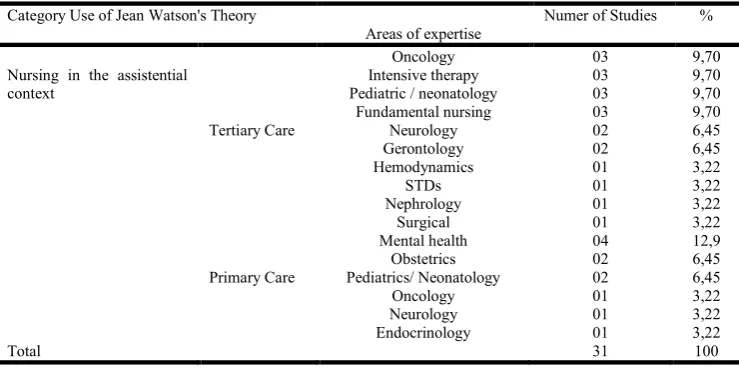
Table 2. Use of Jean Watson's theory per area of nursing practice 2016
Category Use of Jean Watson's Theory
Areas of expertise
Numer of Studies %
Nursing in the assistential context
Tertiary Care
Oncology Intensive therapy Pediatric / neonatology
Fundamental nursing Neurology Gerontology Hemodynamics
STDs Nephrology
Surgical
03 03 03 03 02 02 01 01 01 01
9,70 9,70 9,70 9,70 6,45 6,45 3,22 3,22 3,22 3,22
Primary Care
Mental health Obstetrics Pediatrics/ Neonatology
Oncology Neurology Endocrinology
04 02 02 01 01 01
12,9 6,45 6,45 3,22 3,22 3,22
[image:3.595.114.484.579.763.2]University of Santa Catarina in partnership with the Federal University of Paraná with six (20%), Ceara Federal University with four (13.3%), Federal University of Parana three (10%), Federal University of São Paulo two (6.7%), and the Federal University of Santa Catarina, Maringa, Brasilia and the State of Rio de Janeiro with one (3.3%) each. Regarding the type of production, it turns out that out of 43 papers identified 13 (30.2%) correspond to scientific articles published in national and international journals, notably the Cogitare Nursing Journal, responsible for serving three (23%) productions. The journals Acta Paulista of Nursing and Nursing Text and Context published two articles each (30.8%) and other periodicals such as Brazilian Journal of Nursing; Aquichan; UERJ Nursing Journal; Anna Nery School Journal of Nursing; Science, Care and Health; and the Journal of Nursing of USP accounted for a (7.7%) publication each (Table 1). From these 13 articles, six (46.1%) originated from the South, followed by the Southeast with five (38.5%) and one (7.7%) in the Midwest Region. In addition to these regions, it was identified that one (7.7%) publication originated from scientific journal of Colombia. Regarding the classification of periodicals as the Qualis / Coordination for the Improvement of Higher Level (CIHL) in 2014, it is observed that six (46.1%) were published in journals classified in A2, three (23.8%) in B1 and four (30.8%) in B2. Regarding the type of study, it is clear that in 34 publications the authors chose the qualitative approach, two (5.4%) to quantitative and only one (2.7%) opted for the hybrid approach (mixed). As for the type of procedure and objectives, the studies of qualitative nature were classified as follows: 17 (45.9%) exploratory descriptive studies, five (13.6%) case studies, three (8.1%) convergent-care studies, three (8.1%) studies / trials reflective, the other being classified as ethnographic, phenomenological, theoretical, interpretative analysis, experience report and systematic review. Between the two (5.4%) publications of quantitative nature, one (2.7%) corresponded to the descriptive study and one (2.7%) to the validation study. It is worth noting that six other productions did not make the search method explicit. Another bibliometric index analyzed corresponds to the use of the theory of Caring in Nursing. Thirty-one studies (72%) portray the use of this theory in nursing practice, whether in primary care or tertiary. Six (14%) works present a theoretical and reflective character on it. Another six refer to field studies (14%) from the perspective of students, nurses, teachers and assistants and aides / nursing technicians on transpersonality of nursing care and the possible forms of applicability (Table 2).
DISCUSSION
The total productions on the use of Jean Watson's Transpersonal Caring Theory found in theses, dissertations and articles highlights an important overview on the current scientific scenario of Nursing, since the studies to address the nursing theories are in constant growth. In literature there is a growing number of studies that try to reflect on the applicability of models and theories of nursing. This trend has enabled the validation and construction of new ways to interpret them, a fact explained by the increased application of these in the practice of nursing, which is essential to the continuity of such studies (Victor, 2005). The perspective of many jobs in this field have focused on theories of needs, systemic and humanistic theories, seeking theoretical or practical studies from use of these models and theories, to further improve the quality of care, which contributes substantially to the promotion of health and well-being of the
individual (Victor, 2005). A look back to the year of publication of the workson the screen is configured as indispensable, when considered the the publications of theoretical authorship, especially in the periods between the years 1999-2000 (seven works developed) and 2005-2007 (nine works). In the year 1999, with the publication of the
book Postmodern Nursing and Beyond, Watson Designs
Nursing and health care in the middle of tthe XXI century, (re) plotting the care practices in a paradigm that recognizes the sacred relationship between being human- technology-nature and the universe to expand (Neil, 2004 and Wills, 2016). Later, in the year 2005, starting from the publication of the
work Caring Science as Sacred Science, there was a
significant interest of nursing professionals who utilized and / or reflected on Watson's theory, as seen in nine published works (between 2005 -2007).
With the expansion and evolution of the theory, the ten care factors initially proposed in 1979 are replaced by the 10
elements of the process Clinical Caritas (Neil, 2004 and Wills,
2016). Through the elements of the clinical caritas process it is possible to deeply understand the dimensions of the process of life and human experiences. The proposition of healing as reconstitution and the sacredness of being cared, together with its connection to a plan that goes beyond the concrete and visual, gain visibility (Neil, 2004 and Wills, 2016). Since then, nursing has been developing studies that approach, if not all, at least some of the 10 elements. It is inferred that the use of those items identified in the results of this study contributed to the strengthening of Nursing as a science. Another bibliometric index that deserves attention refers to the number of searches carried out in regions of the country where they were produced. It is observed that in the South and Southeast regions 25 dissertations and theses were developed and in the Northeast and Midwest the were only five dissertations and theses. It appears that 11 articles were published in journals located in the South and Southeast, and only one in the Midwest Region.
It can be inferred that, the fact that the southern and southeastern regions being responsible for 37 (86%) of the researches and publications on the Jean Watson’s Theory, It is Important to stress that in 2013, these regions had 49.4% and
19.1%, respectively, of the Stricto Sensu Programs in Brazil
University of Parana, configured as a means for disseminating the work produced by the Graduate Program of the institution and others, such as the Federal University of Santa Catarina.
The data show that the magazine has been fulfilling its role as disseminator of scientific knowledge of the Graduate Programs (Enfermagem, 2007). It is also noticed that all scientific articles on the theory of Jean Watson were published in journals with Qualis System / CAPES between A2 and B2 layers, revealing a high scientific impact. The Qualis is a set procedure used by CAPES to the stratification of quality of
productions of the Graduate programs Stricto Sensu in Brazil.
It allows the publication of the intellectual production of researchers, teachers, students and professionals, and help find items with greater scientific rigor. The current evaluation criteria adopted classification in seven indicative layers of quality: A1, A2, B1, B2, B3, B4, B5 and C, being A1 and C attributes of greater and lesser weight, respectively. It is possible to say that the publications selected in this research are found among the attributes of greater weight and therefore have better quality (Erdmann, 2009).
As for the methodological approach of the research, the development of the exploratory and descriptive productions with a qualitative approach is justified, considering that it was philosophic studies suffering existential phenomenological influences. To this end, research using Jean Watson theory tend to emphasize the aspects of subjectivity, which include the beliefs, values and feelings that, in turn, are experienced in these research designs. The descriptive and exploratory research can be explained given that both start with a phenomenon of interest. The descriptive focuses on the perspective of observing and describing the phenomenon, while the exploratory investigates the nature and the factors with which it is related (Polit, 2011). Concerning the qualitative approach, it is considered that there is a dynamic relationship between the real world and the subject, i.e., an inseparable bond between the objective world and the subjectivity of the subject which can not be translated into numbers. The interpretation of the phenomenas and the attribution of meaning are basic in this process and do not require the use of methods and statistical techniques.
The natural environment is the direct source for data collection and the research tends to analyze his data inductively (Prodanov, 2013). As seen in Table 2, Jean Watson's theory has been applied in the most diverse professional nursing actions fields, as far as from home care to hospital. Corroborating these results, studies elucidate the possibility and relevance of the application of the theory in different contexts of Education, Humanities and Health (Neil, 2004), specifically in nursing, as in perioperative units, neonatal intensive care and transplant (Pessoa, 2006 and Wills, 2016). Apart from the care practice, Scientific care as Sacred Science has been used in national and international academic programs and research studies aiming to contribute to the education of nurses, so that it can develop a significant moral and
philosophical basis for practice (Neil, 2014 and Wills et al.,
2016). Within the scope of Tertiary Care, one perceives the concern of researchers (six papers) to approximate the concepts of theoretical to assistance offered to people seriously ill and / or clinically more vulnerable to the process of death, which are critical and cancer patients. In addition to the care of the body, this sick being needs care that transcends the stereotypical mind with fear of dying and feelings of exclusion
and self prejudice. This being cries out for spiritual care able to provide himself with balance and autonomy. Especially in these fields, the nurse needs to humanize care launching himself in the subjectivity of the other to understand their real needs, not only physiological.
Hence the importance of electing a theoretical basis, such as the theory of Transpersonal Caring, that guides the nurse practice in the care of this being. Additionally, 14 studies in the areas of pediatrics, neonatology, neurology, gerontology, hemodynamics, nephrology, sexually transmitted diseases (STDs), surgical and fundamental nursing also successfully carried out such an approach in the search for a better systematization of care and, consequently, rehabilitation and cure. In the context of primary care, 12 studies using the theoretical framework of Jean Watson were developed with an emphasis on family involvement. Standing out in home care to assistance to an individual with mental illness and chemical dependency (five) papers, women in a pregnancy cycle (two), children in vaccination rooms and newborn egressing from the ICU (two), neoplastic patients (one ), patients with mellitus diabetes (one) and sequelae of stroke (one). Studies point out the transpersonality as a way to improve the practice of nursing care, simultaneously, clarify the existing barriers in its implementation, especially in Primary Health (Gomes, 2013).
In the present study, one can observe the concern of researchers to involve the family in the care plan to the being that is ill or needs care, contributing to the strengthening of the professional relationship x individual x family and to the rehabilitation and healing process. To think family as a instrument that facilitates the nurse's work is also think about their needs as caregivers in need of care. Thus, the professional must know the relationship established in the home environment, looking towards to raise awareness with the illness situation imposed on the family so they can trace coping strategies together to minimize the changes and / or sequelae resulting from the disease process.
Conclusions
REFERENCES
Borges, M.S., Santos, D.S. 2013. O campo de cuidar: uma
abordagem quântica transpessoal do cuidado em
enfermagem. Cienc Cuid Saude, Jul/Set; 12(3):606-11. Erdmann, A. L. et al. 2009. A avaliação de periódicos
científicos qualis e a produção brasileira de artigos da área de enfermagem. Rev Latino-am Enfermagem,17(3):403-9.
Erdmann AL et al. A avaliação de periódicos científicos qualis
e a produção brasileira de artigos da área de enfermagem. Rev Latino-am Enfermagem 2009;17(3):403-9.
Favero, L., Meier, M.J., Lacerda, M.R., Mazza, V.A. de, Kalinowski, L.C. 2009. Aplicação da teoria do cuidado transpessoal de Jean Watson: uma década de produção
brasileira.Acta Paul Enferm., 22(2):213-8.
Favero, L., Pagliuca, L.M.F., Lacerda, M.R. 2013. Cuidado
transpessoal em enfermagem: uma análise pautada em modelo conceitual. Rev Esc Enferm USP, 47(2):500-5. Gomes, I.M., Silva, DI da, Lacerda, M.R., Mazza, V.A. de,
Méier, M.J., Mercês, N.N.A. das. Teoria do cuidado transpessoal de Jean Watson no cuidado domiciliar de
enfermagem à criança: uma reflexão.Esc Anna Nery(impr)
2013 jul-set; 17(3):555-61.
Mathias, J.J.S. dos, Zagonel, I.P.S., Lacerda, M.R. 2006.
Processo clinical caritas: novos rumos para o cuidado de
enfermagem transpessoal. Acta Paul Enferm., 19(3):332-7.
Neil, R.M. Jean Watson: Filosofia e Ciência do Cuidar. In: Tomey AM, Alligood MR. Teóricas de enfermagem e a sua obra: modelos e teorias de enfermagem. Loures: Lusociência; 2004.
Pessoa, S.M.F., Pagliuca, L.M.F., Damasceno, M.M.C. 2006. Teoria do Cuidado Humano: análise crítica e possibilidades
de aplicação a mulheres com diabetes gestacional. Rev
Enferm UERJ.,14(3):87-92.
Pizzani, L., Silva, R.C., Hayashi, M.C.P.I. 2008. Bases de dados e bibliometria: a presença da educação especial na
base Medline. Rev Bras Biblio Doc, Jan-Jun; 4(1):68-85.
Polit, D.F., Beck, C.T., Hungler, B.P. 2011. Fundamentos de Pesquisa em Enfermagem. 7ed. Porto Alegre: Artmed. Prodanov, C.C., Freitas, E.C. de. Metodologia do trabalho
científico [recurso eletrônico]: métodos e técnicas da pesquisa e do trabalho acadêmico. 2ed. Novo Hamburgo: Feevale; 2013.
Scochi, Carmen Gracinda Silvan et al. Pós-Graduação Stricto
Sensu em Enfermagem no Brasil: avanços e perspectivas. Rev. bras. enferm. 2013;66:80-9.
Silva, C.M., Valente, G.S.C., Bitencourt, G.R., Brito, L.N. 2010. A teoria do cuidado transpessoal na enfermagem: análise segundo Meleis. Cogitare Enferm, 15(3):548-51. Tomey, A.M., Alligood, M.R. 2004. Teorias de Enfermagem e
a sua obra. 5ed. Lusidacta.
Victor, J.F., Lopes, M.V.O., Ximenes, L.B. 2005. Análise do diagrama do modelo de promoção da saúde de Nola J.
Pender. Acta Paul Enferm., 18(3):235-40.
Watson, J. 1979. Nursing: the philosophy and science of caring. Boston: Little, Brown.
Watson, J. 2005. Caring science as sacred science. Philadelphia: FA. Davis.
Watson, J. 2008. Nursing: the philosophy and science of caring. Revised edition. Colorado (USA): University Press of Colorado.
Watson, J. Human caring science: a theory of nursing. 2nd ed. Ontario: Jones e Bartlett Learning; 2012.
Wills, E.M. Grandes Teorias da Enfermagem baseadas no Modelo Interativo. In: McEwen M, Wills EM. Bases Teóricas de Enfermagem. 4ed. Artmed; 2016