Full Length Research Article
HUMAN RELATIONS PRACTICES AND PERFORMANCE OF ELEMENTARY SCHOOL PRINCIPALS IN
REGION III, PHILIPINES
Elvira E. Sagun and *Emma C. Ventura
Ramon Magsaysay Technological University, Iba, Zambales, Philippines 2207
ARTICLE INFO ABSTRACT
The study aimed to determine the human relations practices of elementary school principals in selected schools in Region III. It focused on the level of performance of school principals and the human relations practices with regards to administrator’s role. The study made use of the descriptive method involving twenty- two (22) school principals and one hundred ninety -seven (197) school teachers. In the statistical data analysis, the Percentage, average weighted mean, T-Test and Analysis of Variance were used. Findings revealed that majority of the principals are female, 52 years old, married, with master’s degree and doctorate units, specialized in Math/Science, have been in the service for almost 21-25 years and attended seminars for more than 21 times. While majority of the teacher-respondents are female, 42 years old, married, finished Bachelor’s degree course with master’s units, major in Makabayan and attended seminars for 1 to 5 times. Results showed that one hundred percent (100%) of the principals achieved outstanding/excellent performances. Among the five aspects of human relation practices, the principal-respondents perceived Very Good (4.23) on “supervisory of teaching and learning”. It was followed by “problem-solving techniques” with mean rating of 4.20 (VG); “administrators’ role in management with mean rating of 4.16 (VG); understanding and motivating teachers recorded at 4.07 (VG); and the lowest was obtained in “developing positive attitude for teachers” with mean of 4.06 (VG). The over-all rating of principal was 4.06 described as “Very Good”. On the other hand, the teacher perceived aspect of “problem solving techniques with the highest rating of 4.08 described as “Very Good” and lowest was “understanding and motivating teachers” with a mean of 3.80 (VG). Both respondents have similar perceptions of the five aspects of human relation practices There is a significant difference in the responses of the two groups of respondents with regards to the human practices of school principals. However, there is no significant difference on the human relation practices of school principals when grouped according to the profile variables. It is also noted that there is a negative correlation between the level of performance of school principals and the human relation practices. It is recommended that school principals may focus on the supervisory function to improve the total learning situation and to stimulate growth as a means of helping teachers and to help themselves. School principals or school heads may encourage or motivate teachers to perform their tasks at their best and understand their needs and problems
Copyright©2017 Elvira E. Sagun and Emma C. Ventura.This is an open access article distributed under the Creative Commons Attribution License, which permits unrestricted use, distribution, and reproduction in any medium, provided the original work is properly cited.
INTRODUCTION
Human relation is the skill or ability to work effectively with and through other people. It implies a desire to understand others, their needs, and their weaknesses as well as their talents and abilities. For anyone in a workplace setting, human relations also involves an understanding of how people work together in groups, to satisfy both individual needs and group objectives (Lamberton and Minor, 1998). Dealing with other people can never be completely avoided. No matter what we do for a living or how well we do it, our relationship with other is the key to any success or failure of an organization.
*Corresponding author: Emma C. Ventura
Ramon Magsaysay Technological University, Iba, Zambales, Philippines 2207.
Even when a person is otherwise only average in performance at a job, good human relation skills will usually make that person seem better to others. Sadly, the opposite is also true: Poor human relation skills can be made otherwise able person like a poor performer. Thus, human relations in the broad sense are central to how all organizations operate. In fact, an organization is by definition a set of human relations. The study of these relations has, over the years, drawn from a variety of social sciences, including sociology, psychology, and even psychiatry. Human relations are not a study of how to understand human behavior so as to manipulate others into what you want them to do. Good human relations mean being real, being positive and being honest. Practicing effective human relations means being yourself at your very best. The idea that personal feelings (or human relations) affect performance in the workplace is an old one, dating back at
ISSN: 2230-9926
International Journal of Development Research
Vol. 07, Issue, 02, pp.11591-11595, February,2017
DEVELOPMENT RESEARCH
Article History:
Received 19th November, 2016 Received in revised form 27th December, 2016 Accepted 16th January, 2017 Published online 28th February, 2017
Key Words:
Educational Management, Human Relations, Performance, Teacher’s attitudes, Problem -Solving Skills, Descriptive,
least to Mayo (1933). A series of experiments in the 1920s, the so-called Hawthorne experiments, showed that human intangibles, such as morale, often had more bearing on production than did the physical workplace and worked organization (Kaninan, 2004). This lead to "Human Relations" theory in the narrow sense, as exemplified by the work of Abraham Maslow. Maslow theorized that human beings have a "hierarchy of needs." At the most fundamental levels are food, clothing, shelter, and the like.
As these basic needs are met, people shift their efforts to subtler needs, such as for friendship and self- fulfillment. (http://www.jstor.org/stable/2138761). In rapidly changing times, technical-rational approaches to leadership may be attractive, yet in reality are unlikely to result in improved schooling, unless accompanied by professional dimension and human relations. According to Harris, (2002) effective leaders had a high degree of emotional intelligence and were acutely aware of the need to build positive relationships with pupils, teachers and parents. Effective leaders above all are people centered and emphasize human needs before organizational needs. They distribute leadership to others and invest in various forms of teacher leadership and empowerment. Effective leaders can combine a moral purpose with a willingness to be collaborative and to promote collaboration amongst colleagues, whether through teamwork, or by extending the boundaries of participation in leadership and decision-making. Previously, school administration had assumed the structure of the "essentially autocratic" business world which excluded the necessity of considering the human factor. Careful studies on human relationships were considered to be unnecessary.
Today concepts of educational administration and leadership have changed. Leadership in group processes is not a function of position; it evolves from the group, thus giving the responsibility for the selection of leadership to the group members. The effect upon leadership in education has been to take the emphasis away from domination by the leader over a subordinate to developing an attitude of guidance or helpfulness. To be successful as a leader, elementary school principal need to have a good knowledge of the culture in which they are working. Leaders should have an understanding of subordinates’ feelings. Leadership is a "relation between persons." These changing concepts of leadership underline the need for studies in human relations and emphasize the importance of research efforts such as the present study. Because elementary school principals and administrators play a major role in creating a school culture, it is necessary that administrators’ human relation practices be identified as basis for effective and successful school administration. Thus, the researchers is very optimistic in considering the foregoing claims to be considered as the rationale in conducting a study on the human relation practices of elementary school principals in Region III assuming their human relation practices may directly or indirectly affect sound school administration.
MATERIALS AND METHODS
The descriptive survey method of research was used in the study. It involved the twenty -two (22) school principals in the different divisions along Central Luzon and the one hundred ninety- seven (197) school teachers in the elementary
were randomly selected using convenience sampling to represent each group of respondents.The questionnaire- checklist was used as the main instrument for the two groups
of respondents. Part 1 included the profile of the two groups
of respondents such as age, gender, civil status, educational attainment, length of service, field of specialization and seminars attended. Part II focused on the performance of the School Principals and the perceptions of the two groups of respondents regarding the Human Relation Practices of the School Principals in various elementary schools in selected provinces. The scale composed of fifty (50) items using the 5 point scale as follows: 5- Strongly Agree; 4 – Agree; 3 – Undecided; 2 – Disagree and 1 – Strongly Disagree.
RESULTS AND DISCUSSION
Profile of Respondents
Most of the principal-respondents belonged to age bracket of
56-60 with a computed mean age of 52.09. Majority of the
principal-respondents were female, married, earned a degree of
masters with doctorate units specialized in Math and Sciences,
served for 21-25 years and attended various seminars, workshop, and seminars. On the other hand, most of the teacher were between ages 36-38 with a mean age of 42.4. Majoritywere female, married, finished BS degree with MA/MS units and specialized in the fields of Makabayan. Most of them served for 6-10 years and attended only some training and seminars.
Performance of School Principals
Data revealed that all school principals achieved an outstanding/excellent performances recorded at one hundred percent. According to an interview with some school heads, a school principal is rarely rated by his or her supervisor as Very Satisfactory or Satisfactory performance because they have been promoted due to their outstanding achievements and contributions in their fields of expertise when they were mere teachers.
Perceptions of Respondents on Human Relation Practices of School Principals
Table 1. Summary Table on the Human Relation Practices
Human Relation Practices Principal Teachers
Mean Description Mean Description 1.Administrators Role in Management 4.16 Very Good 3.95 Very Good 2.Supervisory Aspects of Learning and Teaching 3.83 Very Good 3.96 Very Good 3.Understanding and Motivating Teachers 4.07 Very Good 3.80 Very Good 4.Developing Positive Attitude of Teacher 4.06 Very Good 3.90 Very Good 5.Problem Solving Techniques 4.20 Very Good 4.08 Very Good
Over-all Weighted Mean 4.06 Very Good 3.94 Very Good
[image:3.595.46.551.186.268.2]T-Test on Significant Difference between Responses of the Two Groups
Table 2. T-Test Result between the Responses of the Principal and Teacher on the Human Relation Practices
Human Relation Practices Principals Teachers
Mean Std.Dev. Mean Std.Dev. t-value df p Decision Interpretation 1. Administrators Role in Management 4.18 0.49 3.94 0.57 1.90 217 0.0589 Accept Ho Not significant 2. Supervisory Aspect of Learning and Teaching 4.22 0.45 3.96 0.59 2.04 217 0.0425 Reject Ho Significant 3. Understanding and Motivating Teachers 4.07 0.48 3.80 0.60 2.05 217 0.0414 Reject Ho Significant 4. Developing Positive Teacher’s Attitude 4.07 0.53 3.90 0.59 1.29 217 0.1982 Accept Ho Not significant 5. Problem Solving Techniques 4.20 0.38 4.09 0.63 0.79 217 0.4325 Accept Ho Not significant
Overall 4.15 0.37 3.94 0.52 1.83 217 0.0679 Accept Ho Not significant
Test of Significant Differences in Human Relation Practices When Grouped According to Profile Variables
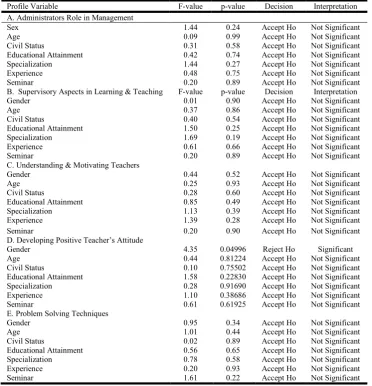
Table 3. Test Significant Difference on Human Relations When Grouped According to Profile Variables
Profile Variable F-value p-value Decision Interpretation A. Administrators Role in Management
Sex 1.44 0.24 Accept Ho Not Significant
Age 0.09 0.99 Accept Ho Not Significant
Civil Status 0.31 0.58 Accept Ho Not Significant
Educational Attainment 0.42 0.74 Accept Ho Not Significant
Specialization 1.44 0.27 Accept Ho Not Significant
Experience 0.48 0.75 Accept Ho Not Significant
Seminar 0.20 0.89 Accept Ho Not Significant
B. Supervisory Aspects in Learning & Teaching F-value p-value Decision Interpretation
Gender 0.01 0.90 Accept Ho Not Significant
Age 0.37 0.86 Accept Ho Not Significant
Civil Status 0.40 0.54 Accept Ho Not Significant
Educational Attainment 1.50 0.25 Accept Ho Not Significant
Specialization 1.69 0.19 Accept Ho Not Significant
Experience 0.61 0.66 Accept Ho Not Significant
Seminar 0.20 0.89 Accept Ho Not Significant
C. Understanding & Motivating Teachers
Gender 0.44 0.52 Accept Ho Not Significant
Age 0.25 0.93 Accept Ho Not Significant
Civil Status 0.28 0.60 Accept Ho Not Significant
Educational Attainment 0.85 0.49 Accept Ho Not Significant
Specialization 1.13 0.39 Accept Ho Not Significant
Experience 1.39 0.28 Accept Ho Not Significant
Seminar 0.20 0.90 Accept Ho Not Significant
D. Developing Positive Teacher’s Attitude
Gender 4.35 0.04996 Reject Ho Significant
Age 0.44 0.81224 Accept Ho Not Significant
Civil Status 0.10 0.75502 Accept Ho Not Significant
Educational Attainment 1.58 0.22830 Accept Ho Not Significant
Specialization 0.28 0.91690 Accept Ho Not Significant
Experience 1.10 0.38686 Accept Ho Not Significant
Seminar 0.61 0.61925 Accept Ho Not Significant
E. Problem Solving Techniques
Gender 0.95 0.34 Accept Ho Not Significant
Age 1.01 0.44 Accept Ho Not Significant
Civil Status 0.02 0.89 Accept Ho Not Significant
Educational Attainment 0.56 0.65 Accept Ho Not Significant
Specialization 0.78 0.58 Accept Ho Not Significant
Experience 0.20 0.93 Accept Ho Not Significant
Seminar 1.61 0.22 Accept Ho Not Significant
Table 4. Test on Significant Relationship between Human RelationPractices and Performance
Human Relation PracticesAspects Computed r p-value Interpretation 1. Administrator’s Role in Management -0.2861 0.197 not significant 2. Supervisory Aspects of Learning & Teaching -0.1095 0.628 not significant 3. Understanding and Motivating Teachers -0.0772 0.733 not significant 4. Developing Positive Teacher’s Attitude -0.2576 0.247 not significant 5. Problem Solving Techniques -0.1325 0.557 not significant
[image:3.595.113.486.307.694.2] [image:3.595.131.468.724.792.2]Elton Mayo, who was the founder of the Human Relations Movement. When managers took a greater interest in employees, they felt more valued and empowered. His work also showed that they were more motivated if they were managed and consulted more.
T-Test on Significant Difference between Responses of the Two Groups
Findings revealed that there is significant difference on the
responses of the two groups particularly on the aspects:
supervisory aspects of learning and teaching and
understanding and motivating teachers. Since the computed p-value recorded at 0.0414 and 0.0425 are lower than the 0.05 level of significance, the null hypothesis is rejected. However, other aspects of human relations practices such as administrators role in management, developing positive teacher’s attitude and problem solving techniques reveal no significant differences and higher than the 0.05 level of significance, thus the null hypothesis is accepted.
Test of Significant Differences in Human Relation Practices When Grouped According to Profile Variables
Based on the result of the ANOVA table to test the significant difference of the human relation practices, it is clearly observed that there were no significant differences on the profile variables such as gender, age, civil status, educational attainment, specialization, experience and seminars attended.
Results revealed that there is a low negative correlation
between the human relation practices and performance of the school principals. The p-value is greater than 0.05 level of significance hence, the null hypothesis is accepted. All the computed values of are not significant. This is somehow expected since all the school principals obtained outstanding
performances. Results revealed that there is a low negative
correlation between the human relation practices and performance of the school principals. Therefore, the null hypothesis is accepted. All the computed values of r are not significant. This is somehow expected since all the school principals obtained outstanding performances.
Conclusions
From the above results and findings, the following are concluded:
The principal respondents exhibited outstanding or
excellent level of performances in their respective schools.
Problem -solving techniques tend to be the number one
among the human relation practices of school heads as perceived by the two groups of respondents. The Supervisory Aspects of Learning and Teaching aspect was rated by principal the lowest while the teacher gave lowest rating on the aspect of understanding and motivating teachers.
There is a significant difference between the responses
of the two groups of respondents with regards to the human relation practices of school principals.
There is no significant difference on the human relation
practices of school principals when grouped according to the profile variables.
There is a negative correlation between the level of
performance of school principals and the human relation practices.
Recommendations
School principals may focus on the supervisory
function to improve the total learning situation and to stimulate growth as a means of helping teachers and to help themselves.
Since the school principals obtained outstanding
performances, their dedication and commitment to their job must be sustained in order to attain quality instruction in their respective schools.
Problems arise in the school system and therefore,
school heads or principals, should possess managerial skills in order to solve issues and problems effectively.
School principals or school heads maybe motivated
teachers to perform their tasks at their best and understand their needs and problems.
REFERENCES
Bulach, C. R., and Potter, L. 1998. Assessment Centers:
Meeting the needs of educational leaders. NASSP
Practitioner, 24(3), 1-4.
Davis, S. H. 1998. Superintendents' perspectives on the involuntary departure of public school principals: The most frequent reasons why principals lose their jobs.
Educational Administration Quarterly, 34(1), 58-90.
Harrill, J. L. 1990. A descriptive study of South Carolina district-level curriculum/instructional leaders' perceptions
of needed competencies and skills. Dissertation Abstracts
International, 51(08), 2620. (University Microfilms No.
AAI9101463)
Hutchison, C. I. 1988. Leadership skills. Performance and
Instruction, 27(8), 2-5.
Jolly, R. A. F. 1995. The effectiveness of secondary educational administration preparation at Kansas regents
universities. Dissertation Abstracts International, 56(11),
4224.(University Microfilms No. AAI96099508)
Jung, C., Howard, R., Emory, R., &Pino, R.
1977).Interpersonal Communications. Portland, OR:
Northwest Regional Educational Laboratory.
Kramer, B. H. 1993. Empirically indicated effective school-site leader behaviors: A meta-analysis and theoretical
comparison (effective leadership).Dissertation Abstracts
International, 54(09), 3282.(University Microfilms No.
AAI9803729)
Lamberton, Lowell H. and Leslie Minor, 1998. Human Relations Strategies for Success. Irwin Mirror Press Chicago.
Ruoss, E. G. 1992.Essential competencies for independent
school leaders (leadership training).Dissertation Abstracts
International, 54(05), 1623.(University Microfilms No.
AAI9324891)
Sass, M. W. 1989. The AASA performance goal and skill areas' importance to effective superintendence performance as viewed by professors of educational administration and
practicing superintendents. Dissertation Abstracts
International, 50(09), 2742. (University Microfilms No.
AAI9006076)
Schneider, J. 1998. University training of school leaders isn't
Stanton, Jr., J. E. 1994. Personnel management competencies
of selected public school superintendents. Dissertation
Abstracts International, 55(10), 3060. (University
Microfilms No. AAI9506452)
Thomas, P. G. 1994. A case study of leadership behaviors exhibited by the principal and others in a collaborative
school environment. Dissertation Abstracts International,
56(01), 0056. (University Microfilms No. AAI9514643)