2557
SEMANTIC-BASED E-GOVERNMENT FRAMEWORK
BASED ON DOMAIN ONTOLOGIES: A CASE OF KUWAIT
REGION
NASER ALAZEMI1, Abdullah J. Al-Shehab2, Hawaf Abd Alhakem3
Helwan University, Department of Information System, Faculty of Computers and Information Science, Cairo-Egypt
[email protected], [email protected]2,[email protected]3
ABSTRACT
Accessibility of information in the web is the main feature in knowledge acquisition. Ontology is an explicit specification of conceptualization. It defines the terms with specified relationships between them, and can interpret by both humans and computers. Currently, E-Government is facing several problems relating for integration of the information systems, extraction, and representation across heterogeneous organizations. In Addition, e-government is the civil and political conduct of the government, which involves using information and communication technologies (ICT). Therefore, e-government services need to provide information where format and methods of delivery adapt according to the users and situations. In recent years, semantic Web technologies based on ontology have brought about promising solutions to the above engineering problems. In this paper, we propose a semantic-based framework for e-government. In addition, the platform Protégé for semantic ontology development is introduce. We proposed ontological model for the Education ministry domain and Medicine ministry domain. The Web Ontology Language (OWL) represents this ontology, which is the standard language for the semantic web. Moreover, it was testing in proposed semantic framework. The ontology will be useful in the knowledge of the e-government semantic integration, and semantic Web applications.
Keywords: E-government; Semantic Web; Domain ontology; Services; Framework; owl; Integration;
Citizens;
1. INTRODUCTION
Accessibility of information in the web is the main feature in knowledge acquisition. Over the past few years, an increasing amount of scholarly attention has been focus on citizen adoption of e-government. In order to ensure that relevant studies were not miss, the search terms remained broad. These were ‘factors influencing e-government adoption’, ‘citizen adoption of e-government’, ‘trust in government’, ‘citizens’ perceptions on
e-government’, ‘e-government trustworthiness’,
‘impact of citizen satisfaction on e-government’ and ‘e-government adoption in developing countries’ [2]. The development of an efficient e-Government for offering information and electronic services (e-services) to citizen and enterprise is the main objective of many Governments [1].
The growing interest in semantic technologies within the e-government paradigm where proved by
the huge number of contemporary projects focusing on the exploitation of semantic knowledge for e-government. The e-government evolution is brought about by expansion and adoption based on communities, citizen, businesses and public administrations. In most countries, it has generally seen as a four-step process: presence phase,
interaction phase, transaction phase and
transformation phase [2].
2558 In semantic web, information is represent in a machine-readable format, to make e- government processes fully automated. It can be achieve with help of ontological descriptions of web services. Considering the heterogeneous and distributed nature of the e-Government domain, which semantics can be effectively used as a common background platform for describes the processes and services as transparent for end users (citizens and-or businesses).
Figure 1: The semantic Web architecture
The issue of e-government information sharing can be resolved by using Web Service effectively and conveniently. The Web Service application in e-government enhances the current deployment and decrease the cost of information integration [5].
Web service aims to achieve interoperability between web servers by using existing technologies; this has done by building blocks to enable integration of web services that are name as composition constructs. Composition constructs have two essential types in service composition [6].
The goal of Access e-government is to facilitate citizen access to the Public Administration (PA) services. This is to be establish by making service browsing, discovery, and execution easier and more effective. In addition, many e-government applications run by using various web services available online. Where one web service is not enough to fulfill the user requirements, the integration of e-government web services is need. Therefore, the Semantics platform provides the capability to model and represent the knowledge within a given domain by means of explicit formalization of key domain concepts. Figure 2
shows the scenario where e-government is apply in semantic web services.
Figure 2: E-government Scenario (Adapted from [1])
1.1.Semantic Web Services
The core idea of the Semantic Web is to make information (available on the web) understandable not only by humans but also by machines. Semantic Web builds an additional layer on top of the existing World Wide Web.
Ontology
Ontology is a formal, explicit specification of a shared conceptualization of some domain knowledge (in Gruber 1993). It is a valid description of domain knowledge; the domain members agree to follow the ontology for describing domain concepts. Ontology is express in a language that is depending on the language expressivity, also used to represent the viewpoint of citizens in the application; thus, making it easier for them to navigate through the different services and administrations, such as life events, procedures and services [7].
[image:2.612.92.307.219.378.2]2559
1.2.Data and Services Integration
Data integration system aims to provide uniform access to a set of heterogonous data sources and to free the user from the need to know about how data is structure at the sources and how it is to be reconciled in order to answer queries. Data integration is mostly achieve using one of the three approaches: Application Integration (mediation), database federation and data warehousing [9].
The generation of Ontologies is an important activity to enable semantic data integration. Efficiency in data integration can be achieves by ontologies. The formation of ontology helps a range of applications that deliver the right information at the right time to make better-informed decisions, throughout the lifecycle of discovery and development of various applications such as marketing. Thus, a range of semantic technologies, based on ontologies, enable the proper integration of knowledge in a way that is reusable by several applications across governance or business; from discovery to corporate affairs, more details as in [10].
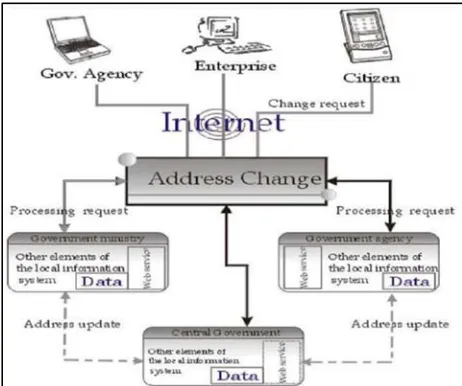
[image:3.612.72.303.517.710.2](Ben Fadhel & Kone, 2005) in [11] the authors proposed design and implementation of an e-government Web service platform as in Figure 3. This platform supports functionalities and modules of a Web service-based portal, which plays the role of an online intermediary. The service search module is a channel to make government services available, online address change service is also presented in [12].
Figure 3: Platform e-government Web service for address
The rest of paper organized as follows: The section two reviews the challenges, abilities and problems faced by the e-government semantic techniques have applied in the e-government system. The section three shows the semantic description of Web services. Section four discusses semantic Web models and Frameworks that can be used for e-government. Section five displays the data and explains the integration of services. The conclusion is explained in section six.
2. RELATED WORK
Over the past few years, an increasing amount of scholarly attention has been focus on citizen adoption of e-government. In another study, Carter and Bélanger [13] present an integrated model for studying citizen adoption of e-government services in the USA, which captures individuals’ perceptions of technology adoption characteristics and trustworthiness. Their model integrates constructs from various fields: information systems, sociology and public administration.
The e-government domain is an obvious and promising application field for ontologies. Since legislative knowledge is, by nature, many stakeholders share formal to a large extent and its definition.
Many e-government projects have being developed and various approaches have proposed for the design and the development of the architecture, which will help deliver e-government services to citizens. The eGOV project [14] proposes the architecture, which enables ‘one-stop government’. In order to describe the services, a markup language (GovML) has been developed [15]. GovML defines a set of metadata to describe public administration services and life events.
2560 The ONTOGOV project [18] is developing a platform that will facilitate the consistent composition, reconfiguration and evolution of e-government services. The e-POWER project [19] has employed knowledge modeling techniques for inferences like consistency check, harmonization and consistency enforcement in legislation. The SmartGov project [20] developed a knowledge-based platform to assist public sector employees in generating on-line transaction services.
[21] Presented an ontological approach to illustrate how e-services could be derive from citizens’ needs expressed in the form of simple phrases for e-government service integration. This done by using a semantic objective and a service discovery technique. The derived e-service ontologies represented in OWL and the Web Service Modeling Language (WSML).
Muthaiyah and Kershberg in [22] proposed another ontological approach for semantic interoperability in e-government by using a shared hierarchal ontology. They organized knowledge at different levels by local ontologies. Mapping
described a semantic bridging process
methodology; the integration and merging of local ontologies have represented in OWL syntax.
In [23], e-government services presented, in the form of a customer-oriented e-government Web portal hosted on an intelligent platform. This achieved by presenting the notion of an intelligent document and a Life Event service, both of which are semantically modeled with the OWL ontology
to enable services and related public
administrations’ interoperability. These allow
automatic services composition, advanced
searching mechanisms and better usability from the user’s point of view.
A software engineering platform was proposed by [24] for the development and management of e-government services namely ONTOGOV. The ONTOGOV platform practices Semantic Web technologies using OWL-S and Web Service Modeling Ontology (WSMO) to build eight kinds of ontologies, describing the e-government domain; they include organizational ontology, legal ontology, profile ontology, domain ontology, web service orchestration ontology, service ontology, life-event ontology and life-cycle ontology. The public administrators use these ontologies to describe and compose its services. The life-cycle ontology has used to achieve the maintenance of
e-services (and the software components) and service ontology integration done by web service is orchestration ontology [25].
In [26], a multilevel abstraction of life-events for e-government services integration have presented. They define a life-event as a collection of actions required to deliver a public service, satisfying the requirements of a citizen in a real-life scenario. The model used three kinds of ontologies: e-government ontology, regulatory ontology and service ontology. These ontologies have represented in OWL to allow the integration of dynamic services via semantic searching and matching of concepts [11].
In the study [25] Presented ontology-based approach for semantic interoperability in e-government. An E-government Business Ontology (EG-BOnt) have used to describe the business process of e-government services. Each business process has described in terms of its output, input, logical relations and resource constraints with other related businesses. Afterwards, each class of the EG-BOnt has defined using the OWL language for
its strong semantic and logic relation
expressiveness [27].
In his work, Vincent [28] presented a framework for generating semantic model ontologies in OWL syntax from a government service domain. He did this by first analyzing government services and then contracting domain ontology to get its semantic content to facilitate the design of e-government systems. This resulted in the provision of a usable framework for semantic knowledge representation in e-government processes.
3. E-GOVERNMENT OF KUWAIT
Kuwait Government Online (KGO) portal presents its services to all Kuwait citizens, residents, visitors, government and civil sectors. The Government of Kuwait approved the National e-Governance aims of making all Government services accessible to the common man and ensures efficiency, transparency and reliability of such services at affordable costs to realize the basic needs of the common man. The Government of Kuwait has been taking numerous initiatives to put Kuwait on the information technology by introducing various initiatives in Kuwait towards the adoption and usage of e-government.
2561 challenges of adopting e-government in Kuwait,
which include administrative problems,
technological challenges, infrastructural problems, lack of trust on online services, security concerns and the digital divide. Apart from these challenges, there are many social challenges such as language barriers, low IT literacy, and low user friendliness of government websites, inability to access internet and lack of awareness in citizens.
The challenges of adopting e-government raise the question of how Kuwait can make the e-government projects more effective to provide her citizens efficient, effective and transparent access to
public services that the citizens deserve. Which factors influence the intentions of citizens to use e-government services?
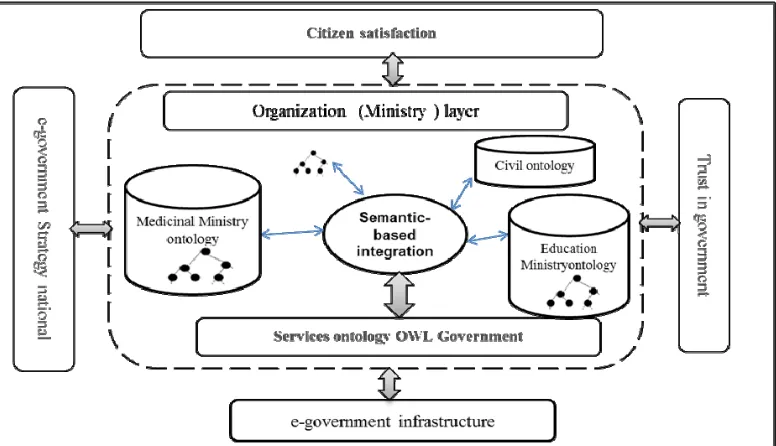
4. PROPOSED FRAMEWORK KUWAIT
[image:5.612.140.528.259.482.2]Figure 4 shows the proposed framework, it is consisting of layers, which are e-government infrastructure, e-government strategy nation, organization layer, Services ontology OWL government, Trust in government, and Citizen Satisfaction. The protégé tool used to develop the ontologies.
Figure 4: Semantic-based e-government framework
Citizen satisfaction: Customer or user satisfaction
is a measure of subjective evaluation of any outcome or experience associated with the purchase of a product/service Westbrook [29]. According to Shankar et al. [30], customer satisfaction has measured by transactional
satisfaction and overall satisfaction.
Transactional satisfaction has derived from specific individual transactions. Transactional satisfaction leads to overall satisfaction of the customer, which in turn, can induce adoption [30]. To measure citizen adoption, items are adapted from Al Hujran et al. [31].
Trust in government: Trust in government is
defined as ‘the citizen’s belief or expectation that the government will perform a particular action
important to him/her in the absence of his or her control over the government’s performance’ Alsaghier and Ford at [32]. It is the ‘party-based trust’ as government is the party responsible for providing e-government services. According to [32] the attributes of ‘trust in government’ are
honesty, truthfulness, helpfulness and
competency. Considering these attributes, the items for this construct are adapted accordingly from the previous researches done by Carter and Bélanger [33] and Alsaghier and Ford [32].
Services ontologies-OWL Government: Services
2562
E-government strategy nation: E-government
infrastructure: Government in good working order, Availability of resources, functioning governance processes, Consensus on drivers for e-Government, Political support & leadership.
4.1.Ontologies Development Methodology
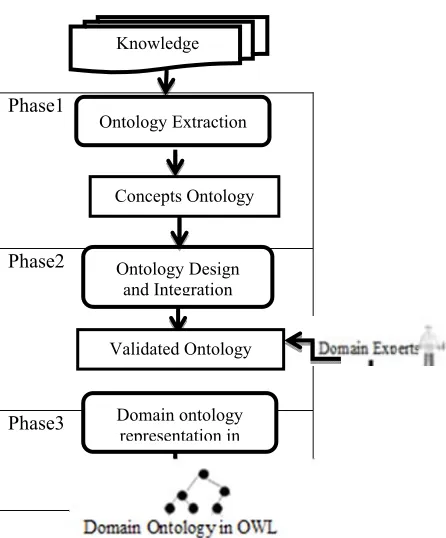
The Figure 5 shows the methodology that we have followed to build the domains ontologies for the e-government in the OWL (Web Ontology Language) language. The Methodology includes four phases: First, Ontology Extraction Phase, which extracts the concepts from knowledge sources. Second, Ontology Design and Integration Phase, which design the required models to build a unified and integrated ontology for domains mentioned in our e-government framework. Third, the Ontology Verification Phase, which verifies the ontology concepts by domain experts. Fourthly, the Ontology Implementation Phase, which represents the ontology using the OWL language. Details for each phase discusses in the following sub-sections.
Phase1
Phase2
Phase3
Phase 1: In this phase, we have extracted the
knowledge of the domain from several sources.
Phase 2: In this phase, we have designed the
structure of the ontology, which depends on the main classes that has extracted from the previous phase. The Design models of the ontology have represented using the UML (Unified Modeling
Language) language. The Verification Phase: In
this phase, the domain experts have consulted to review all vocabulary in the ontology to removes the duplicates, and to validate the main classes and individuals related to the classes. Moreover, in this phase the experts can be add or edit the classes in the tree.
Phase 3: This phase is responsible to implement
the domains ontology using the OWL, which is the standard language for the semantic web. The input for this phase is the main concepts, which represented in the design phase. The protégé-OWL editor version 4.3 [34] has been exploited to implement the ontology.
4.2.Application: Semantic-Based Integration In
The Kuwait E-Government
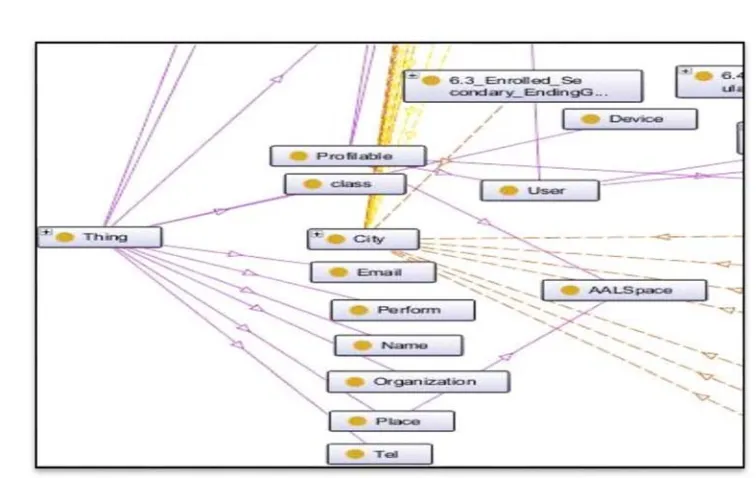
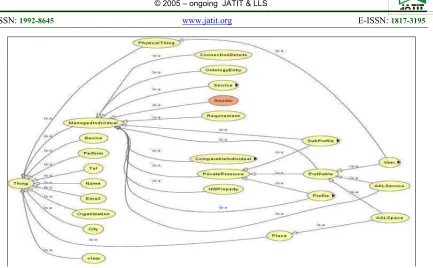
Adoption proposed framework aims to integrate the semantic building ontologies of e-government. In this case, study a sample of framework in the e-government suggested of Kuwait e-e-government was use. The case study contains two ontologies. The first one is for the Medicine ontology, which included the citizen information from the medicine ministry and the second one is for the personal information for the citizen in the education ministry, the protégé was used for develop the domain ontology. Figure 6 shows the sample of the domain ontology of citizen in the ministry of medicine, Figure 7: Sample RDF of the personal information ontology and figure 8 shows the ontology of the citizen information in the education ministry.
Ontology Extraction
Concepts Ontology
Ontology Design and Integration
Validated Ontology
[image:6.612.86.309.399.668.2]Domain ontology representation in Knowledge
2563
Figure 6: sample of the personal information ontology for citizen
Figure 7: Sample RDF of the personal information ontology
<!-- http://ontology.universAAL.org/Profile.owl#HRSubProfile -->
<Class rdf:about="http://ontology.universAAL.org/Profile.owl#HRSubProfile">
<rdfs:label rdf:datatype="http://www.w3.org/2001/XMLSchema#string">Human Resource Profile</rdfs:label>
<rdfs:subClassOf rdf:resource="http://ontology.universAAL.org/Profile.owl#SubProfile"/> <rdfs:subClassOf>
<Restriction>
<onProperty rdf:resource="http://ontology.universAAL.org/Profile.owl#hasHRContact"/> <allValuesFrom rdf:resource="http://www.w3.org/2001/XMLSchema#string"/>
</Restriction> </rdfs:subClassOf> <rdfs:subClassOf> <Restriction>
<onProperty rdf:resource="http://ontology.universAAL.org/Profile.owl#hasHRQualificaton"/> <allValuesFrom rdf:resource="http://www.w3.org/2001/XMLSchema#string"/>
</Restriction> </rdfs:subClassOf> <rdfs:subClassOf> <Restriction>
<onProperty rdf:resource="http://ontology.universAAL.org/Profile.owl#hasHRPaymentInfo"/> <allValuesFrom rdf:resource="http://www.w3.org/2001/XMLSchema#string"/>
[image:7.612.111.489.92.331.2]2564
Figure 8: owl-Viz of the personal information ontology
5. DISCUSSION
Creating an OWL ontology from a e-government domain as confirmed in this work is an important step towards the development of Semantic-based applications as e-government applications, which have potential to perform semantic inference and reasoning over the OWL ontologies and facilitate
software components integration and
interoperability.
In addition, Achieving semantic interoperability is a big challenge of Kuwait e-Government based semantic. The proposed framework aims at building ontology for Kuwait e-Government. Moreover, many platforms as Java API, .NET, ASP and so forth, exist for developing Semantic Web applications based on OWL ontologies [36][37].
To explain, we consider a set of concepts from the e-education domain where a set of information and services has developed for citizens.
- Domain concept = {Perform, Place, etc.} - Service Concept = {Managed-Individual, Service-Control, etc.}
For instance, the usage context of Service-Control has defined through their relationships with the type of imported information (citizen). The Governmental features will be added using concept from the developed ontologies. The functional features: will described through OWL-S elements (Profile, Process, etc.).
The protégé ontology editor has used to build our ontology, so this tool verifies both the syntactic and semantic qualities. The social quality concern of the ontology when is published in the open domain, for instance, the numbers of other ontologies that link to it. According to the [38] [39], there are two steps included in the evaluation: Step 1-Semantic analysis: This phase is response to identifying the componential method and semantic relations between concepts. Evaluate how the ontology can present the word meaning (formulae and relations).
Step 2- Semantic Application: Test the ontology on the remaining Place nouns, which not used during the design, and test it on new words from a new semantic filed, then observes to what range the model can expand them. Evaluate the lexical, vocabulary, or data layer, the focus is on the concepts, instances etc. which in the ontology and the vocabulary used to explain the concepts.
6. CONCLUSION
In this article, semantic-based framework for e-government has presented. The current research focusing on Semantic Web development, in the e-government paradigm, does not refer to any existing ontology development methodology. The e-government specific ontology models that they have developed or the ontology-based solutions for
e-government services integration (and
2565 There is a lack of existing governmental services types, and the need dramatically change (re-engineer) the way governmental services are presented to the end user, is explained. The e-government services need to provide information where format and methods of delivery adapt according to the users and situations.
Moreover, to demonstrate how our approach is efficient, we have proposed ontological model for constructing semantic model ontologies in OWL
Web Service Standard for e-government
applications that represents a big challenge in the Kuwait e-Government. For this purpose, we have developed a set of specific ontologies that match the Kuwait E-government requirements.
One of the advantages of the semantic technique of the government services is the capability formally describe meaning and context of the services; both traditional as well as electronic ones provided as electronic forms or as web services, without the necessity to modify the services themselves. The framework will be use simple ontology engineering
techniques (modeling and representation
techniques) to capture the semantic content of an e-government service, this makes the framework easy to understand and user-friendly, the platform employed includes protégé to create and import the OWL ontology.
REFERENCES
[1] Dombeu, Jean Vincent Fonou, and Magda
Huisman. "Combining ontology development methodologies and semantic web platforms for e-government domain ontology development." arXiv preprint arXiv:1104.4966 (2011).
[2] Gupta, Kriti Priya, Swati Singh, and Preeti
Bhaskar. "Citizen adoption of e-government: a
literature review and conceptual
framework." Electronic Government, an
International Journal 12.2 (2016): 160-185.
[3] F. Garc, R. Mart, J. M. Go, and R.
Valencia-garc, Applying intelligent agents and semantic web services in eGovernment environments, J. Knowl. Eng., vol. 28, no. 5, 2011.
[4] T. Berners-Lee, Linked DataDesign Issues,
W3C, 2006
[5] W. Ning, B. He, L. Hui, W. Xuehua, and W.
Yanzhang, The Application of Web Service Technology in Government Information
Resources Sharing System, 2009
IEEE/WIC/ACM Int. Jt. Conf. Web Intell. Intell. Agent Technol., vol. 3, pp. 373376, 2009.
[6] Rodrigo Mantovaneli Pessoa, Eduardo Silva,
Marten van Sinderen, Dick A. C. Quartel, and
Lus Ferreira Pires. 2008. Enterprise
interoperability with SOA: Survey of service
composition approaches. In EDOC
Workshops. 238251.
[7]
http://what-when-how.com/information-
science-andtechnology/semantic-web-in-e-government-information-science/ (Accessed
Date Aug 2017)
[8] S. Zaidi, A Cross-language Information
Retrieval Based on an Arabic Ontology in the Legal Domain, Proceedings Int. Conf. Signal-Image Technol. Internet-Based Syst., pp. 8691, 2005.
[9] Lacroix Z and Crichlow T (2003),
Bioinformatics: Managing Scientific Data, Morgan Kaufman
[10] Drumm, Christian. ”Integrating eGovernment
Services using Semantic Web Technologies.” In AAAI Spring Symposium: Semantic Web Meets eGovernment, pp. 10-13. 2006.
[11] Fadhel, Ben Jafar, and Mamadou Tadiou
Kone. ”An eGovernment Web Services Platform on the Semantic Web.” In EGOV (Workshops and Posters), pp. 143-149. 2005.
[12] J. Vincent, F. Dombeu, J. F. Dombeu, and M.
Huisman, A Framework for Semantic Model Ontologies Generation for E-government Applications, ICDS 2011, Fifth, no. c, pp. 152158, 2011.
[13] Carter, Lemuria, and France Bélanger. "The
utilization of e‐government services: citizen
trust, innovation and acceptance
factors." Information systems journal 15.1 (2005): 5-25.
[14] eGOV ProjectWebsite:
http://www.egovproject.org
[15] Kavadias G., Tambouris E.: GovML: A
Markup Language for Describing Public Services and Life Events. Working Conference on Knowledge Management in Electronic Government, 2003.
[16] The EU-PUBLI.con Project Website:
http://www.eu-publi.com
[17] The FASME Project Website:
http://www.fasme.org/index-org.html
[18] OntoGov Project Website:
http://www.ontogov.com
[19] Van Engers T., Patries J.M., Kordelaar J., Den
2566
[20] SmartGov Project Website:
http://www.smartgovproject.org
[21] P. Salhofer, B. Stadlhofer and G. Tretter,
Ontology Driven E- government, Electronic Journal of E-government, Vol. 7, No. 4, pp. 415-424, 2009.
[22] S. Muthaiyah and L. Kerschberg, Achieving
Interoperability in Egovernment Services with two Modes of Semantic Bridging: SRS and SWRL, Journal of Theoretical and Applied Electronic Commerce Research, Vol. 3, No. 3, pp. 52-63, December, 2008.
[23] L.M.A. Sabucedo, L.E.A. Rifon, F. Corradini,
A. Polzonetti and B. Re, Knowledge-based Platform for E-government Agents: A Web-based Solution Using Semantic Technologies, Journal of Expert Systems with Applications, Elsevier Inc., Vol. 2010, No. 37, pp. 3647-3656, 2010.
[24] D. Apostolou, L. Stojanovic, T.P. Lobo, J.C.
Miro and A. Papadakis Con- figuring E-government Services Using Ontologies, IFIP International Federation for Information Processing, Springer Boston, Vol. 2005, No. 189, pp. 1571-5736, 2005.
[25] Y. Xiao, M. Xioa and H. Zhao, An Ontology
for E-government Knowledge Modelling and Interoperability, In Proceedings of IEEE
International Conference on Wireless
Communications, Networking and Mobile Computing, (WiCOM 2007), Shanghai, pp. 3600-3603, 21-25 September, 2007.
[26] F. Sanati and J. Lu, Multilevel Life-event
Abstraction Framework for E-government Service Integration, In Proceedings of the 9th European Conference on E-government 2009 (ECEG 2009), London, UK, pp. 550- 558, 29-30 June, 2009.
[27] J. Vincent, F. Dombeu, J. F. Dombeu, and M.
Huisman, A Framework for Semantic Model Ontologies Generation for E-government Applications, ICDS 2011, Fifth, no. c, pp. 152158, 2011.
[28] Dombeu, Jean Vincent Fonou, and Magda
Huisman. ”Combining ontology development methodologies and semantic web platforms for e-government domain ontology development.” arXiv preprint arXiv:1104.4966 (2011).
[29] Westbrook, R.A. (1980) ‘A rating scale for
measuring product/service satisfaction’,
Journal of Marketing, Vol. 44, pp.68–72.
[30] Shankar, V., Smith, A.K. and Rangaswamy, A.
(2003) ‘Customer satisfaction and loyalty in
online and offline environments’, Journal of Research in Marketing, Vol. 20, pp.153–175.
[31] Al Hujran, O., Aloudat, A. and Altarawneh, I.
(2013) ‘Factors influencing citizen adoption of e-government in developing countries: the case of Jordan’, International Journal of Technology and Human Interaction, Vol. 9, No. 6, pp.1–19.
[32] Alsaghier, H. and Ford, M. (2009)
‘Conceptualizing citizen’s trust in e-government: application of Q methodology’, Electronic Journal of E-Government, Vol. 7, No. 4, pp.295–310.
[33] Carter, L. and Bélanger, F. (2005) ‘The
utilization of e-government services: Citizen trust, innovation and acceptance factors’, Information Systems Journal, Vol. 15, No. 1, pp.5–25.
[34] Protégé,http://protege.stanford.edu
A. Saekow and C. Boonmee, “A Practical
Approach to Interoperability Practical
Implementation Support (IPIS) for
E-government Interoperability,” Electronic
Journal of E-government, Vol. 7, No. 4, pp. 403-414, 2009.
[35] H. Knublauch, M. Horridge, M. Musen, A.
Rector, R. Stevens, N. Drummond, P. Lord, N.F. Noy, J. Seidenberg and H. Wang, “The Prot´eg´e OWL Experience,” Workshop - OWL: Experiences and Directions (OWLED-2005), Galway, Ireland, November, pp. 1-11, 2005.
[36] Al-Yahya, Maha, et al. "An ontological model
for representing semantic lexicons: an application on time nouns." Arabian Journal for Science and Engineering 35.2 2010
[37] Zhang, C., Wang, H., Cao, L., Wang. W. and
![Figure 2: E-government Scenario (Adapted from [1])](https://thumb-us.123doks.com/thumbv2/123dok_us/8903751.955935/2.612.311.539.131.285/figure-e-government-scenario-adapted.webp)