2435
CLOUD COMPUTING AND MULTI-AGENT SYSTEM:
MONITORING AND SERVICES
TARIQ FALAH ALWADA’N
Associate Professor, The World Islamic Science & Education University, Department of Computer Science, Jordan
E-mail: [email protected]
ABSTRACT
In cloud computing, client can use and retrieve the services anytime by using any smart devices to manage complex computing processes and to access very large data storage. The developers have recognized the required of an automated system that can help in utilizing the cloud power, enhancing its functionality and improve its performance. Multi-Agents System (MAS) technique presents a perfect way for scalable and open systems that are changed dynamically. MASs are usually used to resolve challenges via a decentralized method where a group of agents cooperate to solve a problem. In this paper a new architecture is introduced which consists of a Multi Agent System that being employed by a cloud computing to assist in determining the best resources and to create negotiation method among cloud providers and users to utilize the full capability of cloud computing. Also this architecture is designed so that it can monitor the user’s jobs while they are being processed.
Keywords: Cloud Computing, Multi-Agents System; public cloud; private; hybrid cloud.
1. INTRODUCTION
[image:1.612.82.290.551.704.2]Cloud computing can be described according to several viewpoint such as data storage, job processing, applications and the utilization of virtual environment. Cloud computing is a class of on-demand resources approach to a shared collection of computing services (for example; storage, networks, applications, servers and services) that can be monitored and controlled with a smallest management power or minimum interaction of a service provider as shown in Figure 1. [1] [2]
Figure 1: Cloud Resources [25]
Cloud computing is mean to grant access to a large quantity of computing capability by merging different resources using a single system interface. A major benefit of the cloud computing is to supply utility computing, which is illustrated as an information technology service mode in which resource provider initiates computing services and provides them on request [3][6]. Cloud users may be charged on monthly basis as a cost of running a certain service [4]. Groups or individuals can use applications or access their data from any place on-demand throughout cloud technology as it offers a prototype by which its structure looks like a “cloud” [5].
Many researchers in the information technology field have attempted to provide a description of cloud computing. One of these descriptions is presented by [5] as: “Cloud is a parallel and distributed computing system consisting of a collection of inter-connected computers that are dynamically provisioned and presented as one or more unified computing resources based on SLA (service-level agreements) established through negotiation between the service provider and consumers.”
2436 technique model is composed of three common types as follow: [7] [8] [9] [39].
Public Cloud: in this type the cloud services
are transmitted over a network that is used for public use. In this type the cloud provider offers services and infrastructure to a group of cloud clients. The site of the infrastructure is at third party where the client does not have any control and capability over it.
Private Cloud: sometimes called as internal
cloud. It is applied on a secure environment which is guarded by a firewall. This type must be controlled by a specific organization, and only to allow authorized people monitoring and controlling the cloud data.
Hybrid Cloud: this is a mixed model between
the public and the private types; in which the resources that are not critical can be transferred and stocked in the public cloud which is managed by a third party provider, whilst the critical resources should be managed internally.
An intelligent agent is a programmed object which is worked in support of another object or objects to carry out a job or accomplish a specific job. Multi agent system is a set of agents that act together and interact with the external environment. Agent systems have the ability to represent domain information and to act by a certain amount of self-government to perform actions required to reach specified aims. Figure 2 shows the job of intelligent agent. Intelligent Agents are structured to run autonomously in altering environment. The main characteristics of agents can be summarized as following: [10]
Autonomy: the ability to work dynamically to
a certain amount instead of clients or programs and to change the way in which agents accomplish their aims.
Pro-activity: the ability to make choices as
consequence of internal judgments.
Re-activity: the ability to respond to external
instances and to adapt their actions and build their assessments according to these instances.
Negotiation: the ability to run channels of
communication between agents to achieve a degree of collaboration.
Communication and Cooperation: the
capability to cooperate and interconnect with other agent or (agents), to swap data, obtains commands and provides reactions.
Learning: the capacity to enhance functioning
and performance over time while working with the outside environment.
Figure 2: Intelligent Agent [2]
Many methodologies have been presented for the growth of a system that contains multi agent objects; they may be one of the object-oriented methodologies, such as Multi agent System Engineering (MaSE) [23] or knowledge-based methodologies, such as: CommonKADS [24].
The MaSE methodology has been chosen for the evaluation of this research; this is because of the simplicity, the automation process for generating software agents and the availability of documentation [11].
The outline of the contributions of this paper relative to the recent literature in the field can be summarized as:
Compared to other papers in the field, this
paper provides a deeper summary of the cloud and multi agent systems functions and provides the required information to readers about the two technologies without having to dig through the details presented in other papers.
Introducing a new design that is composed of
multi agent system that being used by the cloud environment to help in choosing the best resources and to create negotiation technique between cloud providers and users to make use of the full potential of cloud computing.
In addition, this design is structured so that it
can monitor the user’s jobs while they are being processed.
This paper is organized as follows. Section two is the related works to this research. Section three gives an overview of the cloud architecture. Section four discusses the Multi Agent System functions, followed by a section that introduces the proposed system and the system design. Section six presents the implementation and the testing phase, followed by conclusion and references.
2437 Mohammed Bousmah and others in [11] presented a Smart Cloud Learning System which is a mixed method that joins the cloud system, the learning management system and the agents’ technology. Multi-Agents System method offers a perfect way for scalable systems where the structure is changed continuously and required interaction, collaboration and negotiation. By now educational organizations have begun using the cloud environment and merge it to their own system settings and utilize its large potential. Depending on the features of multi-agents system and cloud computing method to assist e-learning session, Mohammed Bousmah and others in [11] introduced a design of a new row in cloud computing named Smart Cloud Learning System that should be run to support services anyplace at anytime by using any piece of equipments, for all players in the learning session. This system is designed just for the cloud learning system while the new solution in this paper is a comprehensive solution to any cloud environment.
Richa Bhargava and others in [12] discuss the structural design of a system contains a multi agent system (MAS) which mainly concentrates on the price negotiation method among cloud providers and cloud users and is being constructed to reduced the complexity between both of them. The mechanism of finding the service is depending on the best price matching offered by the cloud provider. This proposed system is based on collaborative agents and is being managed in central manner, but it has not been simulated or tested as in the proposed structure in this paper.
Domenico Talia in [10] has mention the concern about a little notice that has been given to introduce a methods for developers and users to request, discover, construct and make use of cloud computing resources. Dynamic and adaptable agents are appropriate tools for discuss user admittance, automating the services and resources discovery, trading and controlling the cloud resources. In his research he had introduced a situation when cloud agents operate on the cloud operating systems to offer intelligent data use monitoring , services and controlling services and energy-utilization for the infrastructures of cloud computing, but it has not been simulated or tested.
Dinesh Kumar and Ashwin R. mentioned in [2] that the cloud computing can be built-in with multi agent systems to create an intelligent behavior in a cloud environment. The result of such a system can get high-performance and make clouds more autonomic and flexible. Again this model has not
been simulated or tested as in the proposed structure in this paper.
Jian Chen and others in [13] have introduced a new negotiation model based on multi-agent system which is used to adapt the changes that can be happened in cloud environment during the price negotiation. The middle agent could cut down the negotiation time and improve the rate success of negotiation. The model is concentrate on the competition-time-history which is affected by multiple influencing factors throughout negotiation, and produces sensible proposal in accordance with present market by merging all the factors. The proposed system in this paper is also designed where the middle agent (broker) could cut down the negotiation time and improve the rate success of negotiation. In addition, it can also help in monitoring the users’ jobs while they are being processed.
3. CLOUD ARCHITECTURE
A cloud Architectures are the structures of computer software applications, which their services can be utilized on request and can be reached using the internet [14]. From a client's viewpoint, the cloud processes can be shown as in figure 3.
Figure 3: Cloud Process from Client Side [15]
3.1 Cloud Architecture Layers
Figure 4 shows the relation between cloud layers. These layers can be described as following:
Infrastructure as a Service (IaaS): is a business
2438 operations and to perform self-monitoring when applying this service.
Software as a Service (SaaS): is a storage and
transport type where the customer obtains the storage room from the cloud provider on rental fee [19]. The users usually transport their data through the internet, and the cloud providers offer their software to the users by which the user has the right to access and use their data.
Platform as a Service (PaaS): is the type for
operating applications throughout the internet
by renting software and hardware
[image:4.612.102.300.322.476.2]infrastructures [20]. This type supplies the clients with a chance to get virtual use of servers and software applications on demand for running, maintaining and executing existing applications and upgrading new ones.
Figure 4: Cloud Computing Layers [16]
3.2 Cloud Service Broker (Resource Broker)
The broker acts as a public or a private cloud service. It works as middle application or a computer between the cloud clients and the cloud providers [21]. Usually the broker is considered as a database center to the users and the providers in the cloud environment [38].
In general it is a coordinator between two or more participants to find out and decide the best resources to fit the clients’ jobs. This is done when the cloud clients send their input files which include the job descriptions to the broker. The broker sends these files to the best cloud providers, monitors jobs running, retrieves the results and sends it back to the clients [22].
A cloud broker might probably be obtained the rights to discuss deals with cloud
service providers on the side of the cloud clients. In this case, the broker has the privileges to split services between multiple service providers to decrease the cost and speed up the operation. The broker also could possibly provide the external clients with a graphical interface (GI) and/or application software that allow the cloud clients to perform their cloud services similar to if they were being purchased from one provider. This type of broker is named as a “cloud aggregator” [7] [21]. Because of the nature of the broker’s job, usually it takes more times from the broker side to look at its database to determine the best providers for the coming jobs. Another problem that might be happened if some providers are out of order (failed) for some reasons; in this case the status of the providers might not be updated in the broker
database until a period of time.
4.
Multi-Agent Systems
Computation tasks and Modeling are turning into much more complicated as the system size extended. Consequently, it is difficult to deal with a large system using centralized techniques. Multi-agent systems (MASs) present an excellent way for distributed control. The main benefits of employing multi-agent technologies involve: [26]
1. They can takes into account the
application exact characteristics and environment.
2. They can investigate and module the
local interactions between individuals. As a result, multi-agent technologies offer a quite good way to distribute control in a computational model. Additionally, artificial intelligence (AI) methods can be employed.
In [27] an agent is described as a computer structure that is located in a system that is dynamically changing to fit its objectives.
In this time, there are many activities regarding the growth of agent systems [28] (such as, RETSINA [29], DMARS [30] and MOLE [31]). The standardization of those systems, are OMG [32], KSE [33] and then FIPA [34].
The Foundation for Intelligent Physical Agents (FIPA) [35] is global organizations of nonprofit companies that are sharing the attempts to
create characteristics for common agent
2439 execution information and inside designs should be migrating to developers’ platform. Figure 5 shows FIPA model of an agent platform.
Figure 5: FIPA model of an agent platform [37]
5. PROPOSED SYSTEM
The usual question that most researches asked is how to utilize the cloud services infrastructures, data storage, energy efficiency, service delivery and cost. On the other hand, the focusing in the area of agents’ technology is on the intelligent part of agents and how to use them for solving complicated applications.
The cloud broker is considered as the heart of the cloud system. It has the capability to interact with agents that act on behalf of the clients and providers. The broker is an agent manger by itself; it coordinates the interactions between the clients and providers agents, monitors the running jobs and keeps the clients’ agents up to date with the running process.
In this paper, the broker has been moved from acting as a database storing the providers’ specifications, handling the clients’ jobs to the providers and the jobs results from providers to the clients into an agent manager that has the ability to control event creation; registering and removing each agent in the system.
The main player engrossed in cloud system operations is usually people who look in the cloud provider’s website and choose the purchases (if these purchases are suitable). This matter is happened because of the short on a way of supporting negotiation interfaces via existing cloud providers to deal with it dynamically. The proposed system is a multi-agent system that aims to interact with the cloud environment on the side of cloud clients so as to obtain the records of all available cloud providers who can fulfill the user’s specifications and to choose the best providers
[image:5.612.318.519.226.344.2]between them. Also, this system aims to monitor the jobs accomplishment and to provide the agent manger (broker) with the right feedbacks about the job process. The new design has been structured and evolved using JADE platform which has the capability to supply an easy understanding of job specifications and broker replies in the cloud environments [7]. Many scenarios have been performed using JADE platform. The architecture of the system is given in figure 6.
Figure 6: The Architecture of the Proposed System
The interaction of cloud clients and cloud providers in figure 6 is explained in the following stages:
1. Clients (Human Actor) describe
their jobs by determine the required
hardware and software
specifications to accomplish their jobs as in table 1 and table 2.
2. The Agent Manager (broker)
obtains the job descriptions
(requests) from clients, and
compares the request with the registered cloud providers and chooses the best provider(s) for the job.
3. The broker sorts out the choices that
were acquired in second step and chooses the best ones between them. This type of sorting is done according to the negotiation time and cost. After that, the broker contacts the agents that are responsible for the connection between the broker and the providers to make sure that the providers are available to receive the new jobs.
4. The broker may have the privileges
2440
5. The broker sends the job to cloud
provider(s) to run the client’s job, and at the same time the broker set a Time-to-Live (TTL) counter which is a method that limits the lifetime (lifespan) of the running job.
6. If the TTL is finished before
completing the job, the broker will ask the providers’ agent to terminate the running job. This will help in stopping the running from being continue for endless.
7. During the job running the
provider’s agent sends periodic feedbacks about the level of accomplishment of the job to the broker. This stage helps the broker to monitor the accomplishment of the job.
8. If the running job failed to continue
at any stage, the feedbacks coming from the providers’ agents will help the broker to find an alternative provider(s) to accomplish the job. And this will save the time of the running job instead of waiting until the (TTL) is finished.
9. In the last stage, the broker sends
the jobs results back to clients.
6. IMPLEMENTATION AND TESTING
The JADE platform was chosen to carry out the proposed topology. Java Agent Development framework (JADE) is software that is design to help the growth of the agent application according to the FIPA characteristics for practical smart multi agent systems. Figure 7 shows the structure of JADE platform. The idea of JADE is to facilitate development while guaranteeing standard fulfillment throughout a complete group of system agents and services [28]. To reach this aim, JADE supports the following attributes for the agent programmer [36].
1. It supports mobility, security and other
utilities.
2. Hook agent framework to java GUI
applications.
3. Support communications between the
agents in the same or different platforms.
4. Support mobile devices.
5. Open source.
6. FIPA Compliant.
7. New interaction protocol can be easily
introduced.
[image:6.612.337.542.149.295.2]8. Support graphical runtime environment.
Figure 7: JADE Platform [36]
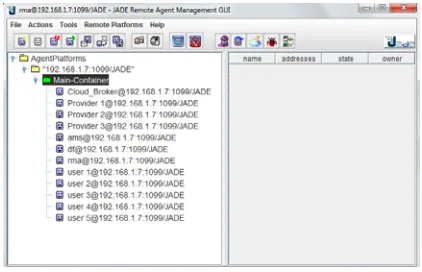
[image:6.612.327.538.399.535.2]The simulation is implemented within two parts. Figure 8 shows the JADE platform that was implemented in the testing phase.
Figure 8: The Simulation Platform
2441 creation; registering and removing each agent in the system.
The broker should determine the TTL for each job before sending these jobs to be processed to the suitable provider(s). Table 3 shows the detail for the second stage. At this stage the agent mangers should receive periodic messages (every 1000 ms) from the cloud providers that contain the status of the running jobs. In this case, the broker has the ability to find alternative providers in the case of failing.
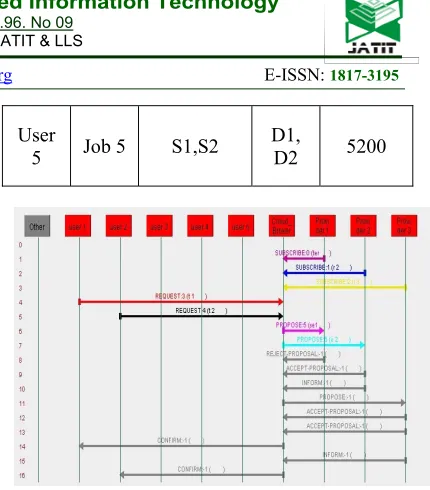
Figure 9 shows a branch of the simulation for the first part which was executed using the Jade Platform, followed by figure 10 that contains the simulation for the second stage.
Table 1: Hardware Specification
User
Name Name Job
Application Requirements Hardware CPU
Speed (MHz)
RAM Size (GB)
Storage Size (GB) User
1 Job 1 1.2 2 250
User
2 Job 2 2 2 --
User
3 Job 3 1.3 1 1500
User
4 Job 4 1 1 --
User
[image:7.612.321.536.41.286.2]5 Job 5 2 3 2500
Table 2: Software Specification and the Jobs’ Required time
User Nam
e
Job Nam e
Application
Requirements Require
d Time
(ms) Software
Applicatio n Name
Data Nam
e User
1 Job 1 S1,S2 D1, D2 4000
User
2 Job 2 S1,S3 -- 25000
User
3 Job 3 - D4 45000
User
4 Job 4 S1 D1 3500
User
5 Job 5 S1,S2 D1, D2 5200
[image:7.612.84.302.296.489.2]Figure 9: Simulation for Part One- Stage 1
Table 3: Job’s Specification and Time Required
User Name
Job Name
Job Required
Time (ms)
Stage 2 Broker TTL (ms)
User 1 Job 1 4000 5000
User 2 Job 2 25000 26000
User 3 Job 3 45000 46000
User 4 Job 4 3500 4500
User 5 Job 5 5200 6200
Figure 10: Simulation for Part One- Stage 2
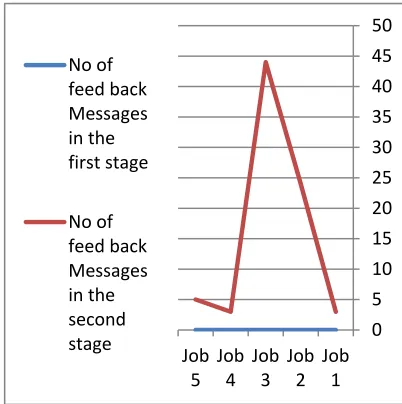
[image:7.612.322.535.356.637.2]2442 not help the broker to trace down the running jobs. On the other hand, it can be seen in stage two that there are periodic massages (every 1000 ms) between the agent manager (broker) and cloud providers which will help in monitoring the job process after each 1000 ms. This will help the broker to find an alternative provider(s) in reasonable time to run the failed job.
Figure 11: Number of Transferred Messages in Part 1
The simulation in second part is also divided into two scenarios. In the first one, the same five jobs above with the same specification in the table 1, table 2 and table 3 were sent to the cloud broker from different users. The broker looks into its database and determines the suitable service providers for them. According to the proposed system, the broker should determine the TTL for each job, and then the jobs should send the jobs to be processed to the suitable provider(s). The simulation assumed that two of those jobs had been failed during the running time and the processing accumulated time was calculated for all the jobs.
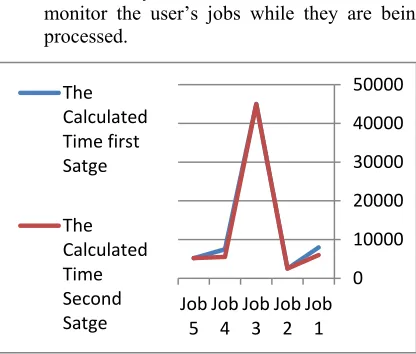
[image:8.612.325.531.135.269.2]In the second scenario, the same jobs from the same cloud users were sent over again to the broker and also two of those jobs assumed to be failed during the running time. The propose of this experiment is to determine the ability of the broker to receive the required feedbacks about the running jobs and to determine the required time to recover from the failed stage and to find a suitable provider for the failed jobs. The accumulated time for the second scenario is calculated and compared to the results of the first scenario as shown in figure 14.
[image:8.612.100.301.195.397.2]Figure 12 and figure 13 show a branch of the two scenarios in part two that were executed using the Jade Platform.
Figure 12: Simulation for Part Two- Stage 1
Figure 13: Simulation for Part Two- Stage 2
It can be seen from figure 14 that the required time that was need for the first stage for Job 1 and 4 is more than the time in stage 2. That is because the agent manger detected that Job 1 and Job 2 were stopped because of the provider failing and directly the two jobs were moved to other providers. While in the first stage the broker had to wait until the TTL time finished, realizing that the two jobs failed to be completed.
A cloud platform could have diverse customers who use particular application protocols. If the customers want to use the services of other customers, then the limitation of the cloud which presents just a particular application protocol is a barrier to its expansion.
From the previous experiments, this paper has managed to achieve the proposed expectations which can be summarized as:
Presenting a new system that contains a multi
agent system that being used by the cloud platform to help in choosing the suitable 0
5 10 15 20 25 30 35 40 45 50
Job 1 Job
2 Job
3 Job
4 Job
5 No of
feed back Messages in the first stage
[image:8.612.318.531.286.447.2]2443 resources and to create negotiation method between cloud providers and users to make use of the broad potential of cloud computing.
Also, this system is structured so that it can
[image:9.612.86.294.139.316.2]monitor the user’s jobs while they are being processed.
Figure 14: The Required Time for Each Stage
7. CONCLUSIONS
Cloud computing is designed to authorize access to large amount of computing resources. Multi-Agents System (MAS) technology introduces an ideal way for open and scalable systems that is varied dynamically. In this paper a new design was introduced which is composed of MAS that being used by the cloud environment to help in choosing the best resources and to create negotiation technique between cloud providers and users to make use of the full potential of cloud computing. In addition, this design is structured so that it can monitor the user’s jobs while it is being processed.
REFRENCES:
[1] https://www.nist.gov/programs-projects/nist-cloud-computing-program-nccp, “NIST Cloud Computing Program – NCCP”, 18:40:50 GMT, Saturday, 20 January 2018.
[2] Dinesh Kumar, Ashwin R., “Multi-Agent based Cloud Services”, International Conference on EGovernance & Cloud Computing Services, Proceedings published by International Journal of Computer Applications, , Vol. EGOV, No. 1, 2012, pp. 7-10.
[3] http://whatis.techtarget.com/ “M. Rouse. What is public cloud?” 16:14:08 GMT, Tuesday, 23 January 2018
[4] Cisco Systems. “Managing the Real Cost of On-Demand Enterprise Cloud Services with Chargeback Models”, White Paper.(pp. 10), 2010.
[5] C. Y. R Buyya. “Vision, hype and reality for delivering computing as 5th utility”, Cloud computing and emerging IT platforms, 2009. [6] Tariq Alwada’n, Omar Al-Zitawi2, Jalal Omer
Atoum, “Cloud Computing: Privacy, Mobility and Resources Utilization”, International Journal of Computer Trends and Technology (IJCTT), Vol. 41 No. 1, November 2016. [7] Tariq Alwada’n, “Cloud Computing Topology:
Towards Enhancing the Performance”,
International Journal of Computer Science and Information Security (IJCSIS), Vol. 14, No. 11, November 2016.
[8] De Chaves, et al. “Towards a design for
analyzing enterprise Clouds”. IEEE
CommunicaLons Magazine. 2011.
[9] Himanshi Babbar, “Adoption Of Cloud
Computing Technologies In Business”,
International Journal Of Research In Computer Applications And Robotics, Vol.5 Issue 3, Pg.: 1-8 March 2017.
[10] Domenico Talia, “Cloud Computing and Software Agents: Towards Cloud Intelligent Services”, Proceedings of the 12th Workshop on Objects and Agents, Rende (CS), Italy, Jul 4-6, 2011.
[11] Mohammed Bousmah, Ouidad Labouidya, Najib El Kamoun, “ Design of a Cloud Learning System Based on Multi-Agents Approach”, International Journal of Advanced Computer Science and Applications, Vol. 6, No. 3, 2015. [12] Richa Bhargava, A. K. Srivastva, Vandana
Srivastava. “A Framework of Multi Agent System in Cloud Computing”, International
Journal of Science, Engineering and
Technology Research (IJSETR), Volume 4, Issue 6, June 2015.
[13] Jian Chen, Xinwei Han, Guorui Jiang, “A Negotiation Model Based on Multi-agent System under Cloud Computing”, The Ninth International Multi-Conference on Computing in the Global Information Technology, ICCGI 2014.
[14]https://computer.howstuffworks.com/cloud-computing/cloud-computing1.htm,“J.Strickland. Cloud Computing Architecture”, 16:44:09 GMT, Thursday, 25 January 2018.
0 10000 20000 30000 40000 50000
Job 1 Job
2 Job
3 Job
4 Job
5 The
Calculated Time first Satge
2444 [15] Laurențiu A. Dumitru, Sergiu Eftimie, Ciprian
Răcuciu, “Using clouds for FPGA
development--A commercial perspective”,
Journal of Information Systems & Operations Management, vol. 11, no. 1, 2017, p. 42+. Academic OneFile, Accessed 25 Jan. 2018.
[16]
http://pdhewaju.com.np/2016/12/17/cloud-infrastructure-and-services/,“Cloud
Infrastructure and Services”, 16:04:09 GMT, Thursday, 25 January 2018.
[17] B. et al. Sotomayor. “Virtual infrastructure management in private and hybrid clouds”. IEEE Internet Computing 13 , (pp. 14-22). 2009.
[18] Cisco Systems. Managing the Real Cost of On-Demand Enterprise Cloud Services with Chargeback Models. White Paper.(pp. 10). 2010.
[19] Quattra Inc. Quattra cloud vision and frame work value. (pp 1-5). 2012.
[20]http://searchcloudcomputing.techtarget.com/defi nition/Platform-as-a-Service-PaaS, “ Platform as a Service (PaaS)”, 18:55:28 GMT, Thursday, 25 January 2018.
[21] H. Michael et al. NIST Cloud Computing Standards Roadmap.2011.
[22] The Nimrod-G Grid Resource Broker and Economic, 2012.
[23] Arnon Sturm. 2005. “Multiagent Systems Engineering (MaSE) – An Introduction”,
available from
http://www.pa.icar.cnr.it/cossentino/al3tf1/docs/ mase4agentlink.pdf [Accessed 19:40:57 GMT Friday, 26 January 2018].
[24] C. e.a. Iglesias, “Analysis and design of
multiagent systems using
MAS-CommonKADS,” in Proc. of AAAI'97, Workshop on Agent Theories, Architectures and languages, Providence, RI, 1997.
[25]https://www.datamation.com/cloud-computing/what-is-cloud-computing.html, “Cloud Computing”, 16:25:06 GMT, Tuesday, 30 January 2018.
[26] Jing Xie & Chen-Ching Liu, “Multi-agent systems and their applications”, Journal of International Council on Electrical Engineering, VOL. 7, NO. 1, 188–197, Jul 2017.
[27] Wooldridge M., “An introduction to multiagent systems”. New Jersey: Wiley; 2008.
[28] Fabio Bellifemine, Agostino Poggi, and Giovanni Rimassa, “Developing multi-agent systems with a FIPA-compliant agent
framework”, John Wiley & Sons Ltd, Volume 31, Issue 2, Pages 103–208, February 2001. [29] Sycara K, Pannu A, Williamson M, Zeng D.
Distributed intelligent agents. IEEE Expert 1996; 11(6):36–46.
[30] Rao AS, Georgeff MP. BDI agents: From theory to practice. Proceedings of the First International Conference on MultiAgent Systems, San Francisco, CA, 1995; 312–319. [31] Baumann J, Hohl F, Rothermel K, Straßer M.
Mole—Concepts of a mobile agent system. World Wide Web1998; 1(3):123– 137.
[32] Milojicic D, Breugst M, Busse I, Campbell J, Covaci S, Friedman B, Kosaka K, Lange D, Ono K, Oshima M, Tham C, Virdhagriswaran S, White J. MASIF—The OMG mobile agent system interoperability facility. Proceedings of the 2nd International Workshop of Mobile Agents (MA ’98)(Lecture Notes in Computer Science, vol. 1477), Rothermel K, Hohl F (eds.). Springer: Stuttgart, 1998; 50–67.
[33] Patil RS, Fikes RE, Patel-Scheneider PF, McKay D, Finin T, Gruber T, Neches R. The DARPA knowledge sharing effort: Progress report. Proceedings of the Third Conference on Principles of Knowledge Representation and Reasoning, Cambridge, MA, 1992; 103–114. [34] Foundation for Intelligent Physical Agents.
Specifications. http://www.fipa.org [1999]. [35] Foundation for Intelligent Physical Agents.
Specifications. 1999. Available at
http://www.fipa.org.
[36] https://www.slideshare.net/AryanRathore4/all-about-agents-jade, “All About Agent Jade”, 18:59:22 GMT, Tuesday, 30 January 2018. [37]https://web.fe.up.pt/~eol/SOCRATES/Palzer/mu
ltiagentsystems.htm, “Multi-agent systems”, 19:46:44 GMT, Tuesday, 30 January 2018. [38] Tariq Alwada'n, Omar Al-Zitawi, Suffian
Khawaldeh and Mohammed Almasarweh, “Privacy and Control in Mobile Cloud Systems”. International Journal of Computer Applications, Volume 113, Number 1, March 2015.
![Figure 1: Cloud Resources [25]](https://thumb-us.123doks.com/thumbv2/123dok_us/8903707.955911/1.612.82.290.551.704/figure-cloud-resources.webp)
![Figure 4: Cloud Computing Layers [16]](https://thumb-us.123doks.com/thumbv2/123dok_us/8903707.955911/4.612.102.300.322.476/figure-cloud-computing-layers.webp)
![Figure 5: FIPA model of an agent platform [37]](https://thumb-us.123doks.com/thumbv2/123dok_us/8903707.955911/5.612.81.284.145.267/figure-fipa-model-of-an-agent-platform.webp)