FT O ^ R FEFOI)L: T R A C K K G C G H T R O I I . E R D E S F S N F O R
A S W M I M M M M M N M , S Y S T E M
P S Z 19:16 (Pind. 1/97)
UNIVERSITITEKNOLOGI MALAYSIA
BORANG PENGESAHAN STATUS TESIS •
JUDUL: A FULL ORDER SLIDING MODE TRACKING CONTROLLERDESIGN FOR AN ELECTROHYDRAULIC CONTROL SYSTEM
SESI PENGAJIAN: 2004/2005
Saya RAFIDAH BTE NGADENGON @ NGADUNGON (HURUF BESAR)
mengaku membenarkan tesis (PSM/Sarjana/Dolctor Falsafah)* ini disimpan di Perpustakaan Universiti Teknologi Malaysia dengan syarat-syarat kegunaan seperti berikut:
1. 2.
3.
4.
Tesis adalah hakmilik Universiti Teknologi Malaysia.
Perpustakaan Universiti Teknologi Malaysia dibenarkan membuat salinan untuk tujuan pengajian sahaja.
Perpustakaan dibenarkan membuat salinan tesis ini sabagai pertukaran antara institusi pengajian tinggi.
**Sila tandakan { / )
SULIT
• •
T E R H A D
(Mengandungi maklumat yang berdarjah keselamatan atau kepentingan Malaysia seperti yang termaktub di dalam (AKTA RAHSIA RASMI 1972)
(Mengandungi maklumat T E R H A D yang telah ditentukan oleh organisasi/badan di mana penyelidikan dijalankan)
T I D A K T E R H A D
( T A N D A T A N G A N PENULIS)
Alamat tetap:
KG. PT. KADIR, 83210 SENGGARANG, BATU PAHAT, JOHOR
( T A N D A T A N G A N PENYELIA)
N a m a Penyelia:
P.M. D R MOHAMAD NOH B. AHMAD
Tarikh: 4 APRIL 2005 Tarikh: 4 APRIL 2005
CAT AT AN: * Potong yang tidak berkenaan.
** Jika tesis ini SULIT atau TERHAD, sila lampirkan surat daripada pihak berkuasa/organisasi berkenaan dengan menyatakan sekali sebab dan tempoh tesis ini perlu dikelaskan sebagai SULIT atau TERHAD. • Tesis dimaksudkan sebagai tesis bagi Ijazah Doktor Falsafah dan
"I hereby, declare that I have read this thesis and in my opinion this thesis is sufficient in terms of scope
and quality for the award of degree of
Master of Engineering (Electrical-Mechatronics and Automatic Control)
/ i ^ L-v L u
Signature :
Name of Supervisor : ASSOC. PROF DR. MOHAMAD NOH AHMAD
A FULL ORDER SLIDING MODE TRACKING CONTROLLER DESIGN FOR AN ELECTROHYDRAULIC CONTROL SYSTEM
RAFIDAH BTE NGADENGON @ NGADUNGON
A project report submitted in partial fulfilment of the requirements for a award of the degree of
Master of Engineering ( Electrical-Mechatronics and Automatic Control)
Faculty of Electrical Engineering Universiti Teknologi Malaysia
ii
I declare that this thesis "A Full Order Sliding Mode Tracking Controller design for an Electrohydraulic Control System" is the result of my own research except for works that have been cited in the reference. The thesis has not been accepted any
degree and not concurrently submitted in candidature of any other degree.
Signature
Name of Author : RAFIDAH BTE NGADENGON@ NGADUNGON
iii
IV
ACKNOWLEDGEMENT
First of all, I am greatly indebted to ALLAH SWT on His blessing to make this project successful.
I would like to express my gratitude to honourable Associate Professor Dr. Mohamad Noh Ahmad, my supervisor of Master's project. During the research, he helped me a lot especially in guiding me, tried to give me encouragement and assistance which finally leads me to the completion of this project.
V
ABSTRACT
Electrohydraulic control system are widely use in industry due to continuous operation, higher speed of response with fast motion etc. However, there is a drawback that it is difficult to control because of the highly nonlinear and parameters uncertainties. In this project, a Full Order Sliding Mode Controller is design to control the system. First, the mathematical model of the electrohydraulic servo control system is developed. Then the mathematic model will be transformed into state space representation for the purposed of designing the controller. The system will be treated as an uncertain system with bounded uncertainties where the bounded are assumed known. The proposed controller will be designed based on deterministic approach, such that the overall system is practically stable and tracks the desired trajectory in spite the uncertainties and nonlinearities present in the system. The performance and reliability of the proposal controller will be determined by performing extensive simulation using MATLAB/SIMULINK. Lastly, the
VI
ABSTRAK
Sistem elektrohidraulik banyak digunakan secara meluas di industri kerana operasi yang berterusan, tindakbalas halaju yang lebih tinggi dengan gerakan yang pantas. Bagaimanapun kekurangan utama sistem ini ialah sukar untuk dikawal kerana kadar ketaklelurusan yang tinggi dan wujudnya ketidak pastian parameter. Dalam projek ini, sebuah pengawal ragam gelincir tertib penuh telah direkabentuk untuk mengawal sistem. Tahap pertama melibatkan pembangunan model matematik bersepadu yang mewakili sistem elektrohidraulik. Kemudian, model matematik tersebut ditukar kepada perwakilan dalam bentuk keadaan ruang bagi tujuan rekabentuk pengawal sepertimana telah dicadangkan. Sistem akan diperlakukan sebagai sistem tidak pasti dengan ketidak pastian sempadan dimana had maksimum sesetengah parameter dianggap diketahui. Pengawal yang dicadangkan akan
direkabentuk berdasarkan pada kaedah deterministic, dimana keseluruhan sistem secara praktikalnya di anggap stabil dan mengikut kehendak trajektori. Walaupun wujudnya ketidak pastian dan ketaklelurusan dalam sistem. Perlakuan atau simulasi dan kebolehharapan cadangan kawalan akan ditentukan dengan bantuan perisian MATLAB/SIMULINK. Akhir sekali, keupayaan diantara pengawal ragam gelincir tertib penuh akan dibandingkan dengan kawalan lelurus bebas lipatan dan
VI! CONTENTS SUBJECT PAGE TITLE DECLARATION DEDICATION
LIST OF FIGURES LIST OF SYMBOLS
CHAPTER 1 INTRODUCTION
i ii iii ACKNOWLEDGEMENT iv ABSTRACT v ABSTRAK vi CONTENTS vii IX x
LIST OF ABBREVIATIONS xii
1.1 Introduction 1 1.2 Objective 8 1.3 Scope of Project 9 1.4 Research Methodology 9 1.5 Literature Review 10 1.6 Thesis Layout 11
CHAPTER 2 MATHEMATICAL MODELLING 13
2.1
2.2
2.3
Introduction
Mathematical Modelling System in State Space
13 14
CHAPTER 3 CONTROLLER DESIGN 22
3.1 Introduction to Variable Structure Control (VSC) 22 with sliding mode control
3.2 Decomposition Into An Uncertain Systems 23
3.3 Problem Formulation 25 3.4 System Dynamics During Sliding Mode 27
3.5 Tracking Controller Design 28
CHAPTER 4 SIMULATION RESULTS 32
4.1 Introduction 32 4.2 Simulation Using Integrated Sliding Mode Controller 33
4.2.1 The Selection of Controller Parameters 33
4.2.2 Simulation of Full Order SMC 35 4.4.3 The Effect of the Value of Controller 36
Parameter, a
4.3 Simulation Using Independent Joint Linear 43 Control (IJC)
4.4 Simulation Using Advanced Control 47
CHAPTER 5 CONCLUSION & SUGGESTION 51
5.1 Conclusion 51 5.1 Suggestion For Future Work 52
REFERENCES 53
APPENDIX A : Matlab Program Listing 56
IX
LIST OF FIGURES
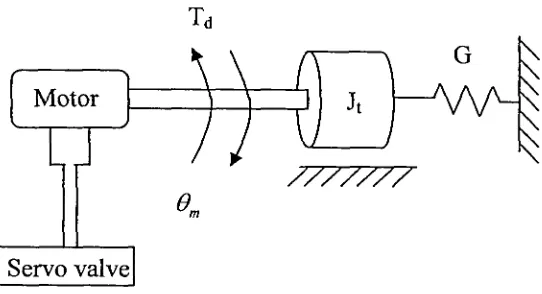
1.1 Physical model of nonlinear electrohydraulic servo 3 control system
4.1 Angular Displacement vs Time with satisfied control 38 parameter
4.2 Angular Velocity vs Time with satisfied control 39 parameter
4.3 Angular Acceleration vs Time with satisfied control 39 parameter
4.4 Control Input with satisfied control parameter 40 4.5 Sliding surface with satisfied control parameter 40 4.6 Angular Displacement vs Time with unsatisfied control 41
parameter
4.7 Angular Velocity vs Time with unsatisfied control 41 parameter
4.8 Angular Acceleration vs Time with unsatisfied control 42 parameter
4.9 Angular Displacement vs Time with IJC 45 4.10 Angular Velocity vs Time with IJC 45 4.11 Angular Acceleration vs Time with IJC 46 4.12 Angular Displacement vs Time with Advanced Control 49
X
LIST OF SYMBOLS
SYMBOL DESCRIPTION 1. UPPERCASE
A(**) N x N system matrix for the intagrated electrohydraulic control system
N x 1 input matrix for the intagrated direct drive robot arm A B{*,*) matrix representing the uncertainties in the input matrix K various damping coefficient of the load
PE effective bulk modulus of the system C 1 x N constant matrix of the sliding surface c, total leakage coefficient of the motor Cd the coefficient
Dm volumetric displacement
£(*) a continuous function related to AB(*,*)
G(*) a continuous function related to A W(*,*)
Gnel nonlinear stiffness of the spring
J , total inertial of the motor and load Kc flow pressure coefficient
K< flow gain which varies at different operating points
Pl load pressure PS supply pressure
QL load flow
Td disturbance of the system
v, total compressed volume
U(*) iVx 1 control input vector for a N DOF robot arm
xn 2Nx 1 state vector for the intagrated direct drive robot arm
displacement of the spool in the servo valve
xi
T
(*) transpose of (*) ||(*)T|| Euclidean norm of (*)
2. LOWERCASE
w area gradient
t time (s)
3. GREEK SYMBOLS
Y norm bound of continuous function H(*)
P
norm bound of continuous function E(*)P fluid mass density
e .
joint displacement (rad)e
joint velocity (rad/s)e
joint acceleration (rad/s2)od desired joint angle (rad)
4 desired joint velocity (rad/s) desired joint acceleration (rad/s2)
a Integral sliding manifold
LIST OF ABBREVIATIONS
IJC Independent Joint Control
LHP Left Half Plane
PI Proportional-Integral
PID Proportional-Integral-Derivative
SMC Sliding Mode Control
1
CHAPTER 1
INTRODUCTION
1.1 Introduction
2
The control of hydraulic system is difficult because of the nonlinear dynamics, load sensitivity and parameter uncertainties due to fluid compressibility, the flow pressure relationship and internal leakage. In addressing this problem, many advanced control approaches have been proposed. The other methods employed variable
structure control is sliding mode control. Sliding Mode Control has been known as an efficient and robust approach to control the nonlinear system with uncertainties.
Hydraulic system can always be made to responds quickly than electrical devices of the same power rating. The electrical signal processing take place almost instantaneously and occurs at a very low power level. There is thus rapid response even with large distance between the source of the control signal and the actual mechanism. And its including servo valve itself. The hydraulic system also good in moving a large mass and its responds must inevitably be relatively slow.
Electrohydraulic system uses low power electrical signals for precisely
controlling the movements of large power pistons and motors. The interface between the electrical equipment and the hydraulic (power) equipment is called 'hydraulic servo valve'. These valves that use in the system must responded quickly and accurately. One of the examples is in aircraft controls. Many mechanism which use other methods of control particularly if they are already employed hydraulic could benefit from incorporating electrohydraulic technique.
3
[image:19.605.171.442.76.223.2]Td
Figure 1.1 : Physical model of nonlinear electrohydraulic servo control system
There are many unique feature of hydraulic control compared to other types of control. Some of the advantages are the following [Herbett E. Merrit, 1967]:
1. Heat generated by internal loses is a basic limitation of any machine. Lubricants deteriorate, machine parts seize, and insulation breaks down as temperature increase. Hydraulic components are superior to others in this respect since the fluid carries away the heat generated to a convenient heat exchanger. This features permits smaller and light components.
2. The hydraulic fluid also acts as a lubricants and makes possible long components life.
3. There is no phenomena in hydraulic components comparable to the saturation and loses in magnetic materials of electrical machine. The torque developed by an electrical is proportional to currents and is limited by magnetic saturation. The torque developed by
4
Therefore hydraulic actuators developed relatively large torques for comparatively small devices.
4. Electrical motors are basically a simple lag device from applied voltage to speed. Hydraulic actuators are basically a quadratic resonance from flow to speed with a high natural frequency.
Therefore hydraulic actuators have a higher speed of response with fast start, stop and speed reversal possible. Torque to inertia ratios are large with resulting high acceleration capability. On the whole, higher loop gains and bandwidths are possible with hydraulic actuators in servo loops.
5. Hydraulic actuators may be operated under continuous, intermittent, reversing and stalled condition without damage. With relief valve protection, hydraulic actuators may be used for dynamics breaking. Larger speed range are possible with hydraulic actuators. Both linear and rotary actuators are available and add to the flexibility of
hydraulic power elements.
6. Hydraulic actuators have higher stiffness, that is inverse of slope of speed-torque curves, compared to other drive deices since leakage are low. There is a little drop in speed as loads are applied. In closed loop system, this results in greater positional stiffness and less position error.
7. Open and closed loop control of hydraulic actuators is relatively simple using valve and pumps.
5
Although hydraulic offers many distinct advantages, several advantages tend to limit their use. Major disadvantages are the following [Herbett E. Merrit, 1967]:
1. Hydraulic power is not so readily available as that if electrical power. This is not a serious threat to mobile and airborne application but most certainly affect stationary application.
2. Small allowable tolerance results in high cost of hydraulic components.
3. The hydraulic fluid imposes an upper temperature limit. Fire and explosion hazard exists if a hydraulic system is used near a source of ignition. However, these situation have improved with the available of high temperature and fire resistant fluids. Hydraulic systems are messy because it is difficult to maintain a system free from leaks and there is always a possibility of complete loss of fluid if a break in the system occurs.
4. It is impossible to maintain the fluid free of dirt and contamination. Contaminated oil can clog valve and actuators and, if the contaminant is abrasive, cause a permanent loss in performance and failure.
Contaminated oil is the chief source of hydraulic control failure. Clean oil and reliability are synonymous terms in hydraulic control.
6
6. Hydraulics are not so flexible, linear, accurate and inexpensive as electronics and electromechanical computation, error detection,
amplification, instrumentation and compensation. Therefore, hydraulic devices are generally not desirable in the low power portions of control systems.
The outstanding characteristic of hydraulic power elements have combined with their comparative inflexibility at low power levels to make hydraulic control attractive primarily in power portions of circuit and systems. The low power portions of systems are usually accomplished by mechanical and electromechanical means.
All control system can be reduced to a few basic groups of elements, the
elements of each group performing a specific function in the system. The division into group of elements can be carried out in a number of different ways, but selecting the following four groups forms a convenient structure for the deviation of hydraulic and electro-hydraulic system.
i) The power source. ii) The control elements. iii) The actuators.
iv) The data transmission elements.
The power source consists invariable of a pump or combination of pumps and ancillary equipments, examples accumulators, relief valves, producing hydraulic energy which is processed by the control elements to achieve the required operation of the actuators. In system which have the supply pressure maintained at a constant level, the hydraulic power source can be either a fixed or variable displacement pump.
7
the form of mechanical, pneumatic, hydraulic or electrical signal. The input variable is mostly a low power electrical or digital signal.
The actuator convert the hydraulic energy generated by the power source and processed by the control elements into useful mechanical work. The actuator have either a linear or rotary output, can be classified into cylinders or jacks, rotary
actuators and motors. The actuator producing linear output is referred as a cylinder or jack.Cylinder can be either single acting or double acting. Single acting cylinders are power driven in one direction only, while double acting cylinders are power driven in both direction. Cylinder can be constructed as an single ended or double ended. Double ended symmetric cylinder are frequently used for high performance servo system, but have greater overall length and more expensive than single-ended actuators. Single ended cylinder widely used for industrial and aerospace control system cause of smaller size and lower cost.
Hydraulic motors are essentially hydraulic pumps in which the sense of energy conversion has been reversed. While a pump converts mechanical energy supplied to its drive shaft by a primary mover into hydraulic energy.The motor reconverts the hydraulic energy provided by the pump into mechanical energy at its output shaft.
8
system. The control output variable in a hydraulic operated force motion can be force, velocity, position acceleration, pressure and flow.
1.2 Objective
The objectives of this research are as follows:
1. To transform the integrated nonlinear dynamic model of the Electrohydraulic control system into a set of nonlinear uncertain model comprising the
nominal values and the bounded uncertainties. These structured uncertainties exist due to the limit of the angular positions, speeds and accelerations.
2. To design a controller using the Full Order Sliding Mode Controll approach and prove the stability of the system using Lyapunov approach.
3. To simulate the Electrohdraulic control system controlled by the Full Order Sliding Mode Controller and to compare its performance with other
conventional controllers.
1.3 Scope of Project
The scopes of work for this project are