Automatic Topic Model Adaptation for Sentiment Analysis in Structured
Domains
Geoffrey Levine and Gerald DeJong
University of Illinois at Urbana-Champaign Urbana, IL
[email protected] and [email protected]
Abstract
We present a novel topic modeling ap-proach to sentiment analysis for docu-ments organized into hierarchical cate-gories. In our approach, positive, nega-tive, and subject matter topics are learned and used to infer document labels. A Markov chain Monte Carlo model pro-cedure adapts the number and structure of topics based on a minimum descrip-tion length objective funcdescrip-tion. We ap-ply our approach to Yelp.com business re-views and Amazon.com book rere-views and demonstrate that 1) the model adaptation procedure selects a high quality model from the space of alternatives, and 2) the resulting model performs well relative to state of the art regression and topic model-ing approaches.
1 Introduction
Selecting an appropriate model is an important part of any machine learning endeavor. The model must be chosen in a manner so as to balance two objectives: 1) Be sufficiently rich to capture the relevant patterns in the data, and 2) Be simple enough to avoid spurious patterns in the training data (overfitting). In natural language processing tasks, there are often many modeling choices to be made regarding what feature granularities and interactions to consider. It is important to make these decisions in a manner such that the resulting model strikes a balance between these two some-what contradictory objectives.
In order to appropriately make these choices, we must consider not only the task involved but also the training data available. With copious data we can reliably calibrate complex models, but with limited data complex models risk overfitting. Many general model selection techniques exist in
which each candidate model is fit to the training data and scored with respect to a particular cri-terion. While these approaches allow us to com-pare a small number of models in order to select the most appropriate, they require calibrating each model’s parameters to the training data. However, when there are many modeling choices to be made and thus a large space of alternative models, fitting all of them to the training data is computationally prohibitive.
In this paper, we present a novel topic mod-eling approach for structured sentiment analysis domains and an automatic model adaptation ap-proach that takes advantage of categorical meta-data. This model adaptation approach resolves the structure of the metadata with the significant pat-terns in the training data to determine the number and range of latent topics.
We demonstrate our approach on Yelp.com business reviews as well as Amazon.com book re-views. We show that our model adaptation ap-proach selects an appropriate model given a par-ticular amount of training data, and the resulting model is high quality relative to alternative regres-sion and topic modeling approaches.
2 Background
Sentiment analysis, in which the opinion of the au-thor is estimated from a document, has recently grown in popularity. Many works have explored unigram models (Pang and Lee, 2005; Snyder and Barzilay, 2007). Higher-order n-gram models are explored in (Pang and Lee, 2008; Baccianella et al., 2009). In order to combat the high dimensional feature space that accompanies such models, mod-els restricting features based on part of speech pat-terns (Baccianella et al., 2009) or opinion tem-plates (root, modifiers, negation words) (Qu et al., 2010) have been introduced.
Topic models are generative models in which the words in a document are assumed to be
ciated with one of a number of abstract “topics.” Latent Dirichlet allocation (Blei et al., 2003) is a popular topic model in which the topic distribu-tion per document is assumed to have a Dirich-let prior. In supervised LDA (Blei and McAuliffe, 2007), the distribution of document topics is used to produce a document label. (Zhao et al., 2010; Titov and McDonald, 2008b; Titov and McDon-ald, 2008a) focus on topic modeling based ap-proaches to aspect-based sentiment summariza-tion, identifying product features and the opinion associated with each.
Model selection is the act of using data to choose a statistical model from a set of candidates. Often, this task is performed by fitting each can-didate model to the training data and using a cri-terion to score the models and select one. Popu-lar criteria include the Akaike information crite-rion (AIC) (Akaike, 1974), the Bayesian informa-tion criterion (BIC) (Schwarz, 1978), and the min-imum description length principle (MDL) (Rissa-nen, 1978; Grunwald, 2007). Structural Risk Min-imization (Vapnik, 1995) defines a general frame-work in which a nested hierarchy of hypotheses can be defined based on prior knowledge of the do-main, such that a hypothesis balancing goodness of fit with simplicity can be identified. The work presented in this paper is closely related to the model adaptation procedure presented in (Levine et al., 2010), in which a hill-climbing approach is used to explore a large space of generative models.
3 Topic Modeling for Sentiment Analysis in Structured Domains
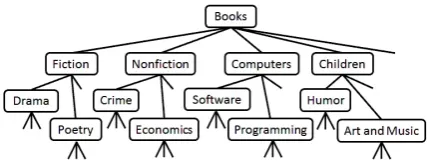
Our approach takes advantage of hierarchical cat-egorical metadata. Formally, this hierarchy forms a tree structure, which we refer to asC(See Figure 1). Individual nodes in the tree are called cate-gories, for which we use notationc. A
categoriza-tion, c, is a set of categories,c ={cd,1, cd,2, ...}. c can be thought of as metadata about a
prod-uct/service being reviewed. For example, with re-gard to a book review, c could equal {“Fiction”,
“Fiction\Drama”, “Fiction\Drama\Romance”, ... }. cmust be well formed. That is, if a nodec∈ C appears in categorizationc, all ancestors ofc(in
the tree C) must also appear inc. c can contain multiple distantly related categories. For exam-ple, a particular book could belong to both “Fic-tion\Poetry” and “Children\Humor.”
[image:2.595.309.523.62.145.2]Documents, or examples, are denoted d =
Figure 1: A subtree of the category tree,C, corre-sponding to the Amazon Books domain.
hxd,cd, ydi.xd=[wd,1, wd,2, ..., wd,|xd|]is a
vec-tor ofwords. Each word is an element from the vocabulary, V = {w1, w2, ..., w|V|}. cd is the document’s categorization. yd is a numeric
rat-ingfrom a discrete space ({1,2,3,4,5}for our do-mains). The rating is an overall score given by the document’s author to the product or service being reviewed.
We are given a collection of documents,D, and our goal is to learn a functionf(hx,ci)to predict
ratingyˆfrom anunlabeled documentso as to
min-imize the expected loss over the unknown distri-bution of documents:
E(loss(y, f(hx,ci))) (1)
We use the squared error loss function.
3.1 Model Structure
We will start by presenting our generative docu-ment topic model. In this model, each review is composed of a mixture of topics, and each topic is associated with a distribution over words. We use
t∈T to denote a topic, andPtto denotet’s word
distribution. Within a document, each word is as-sumed to be generated from a particular topic, al-though which topic is unobservable. In many topic model approaches, such as latent Dirichlet alloca-tion (Blei et al., 2003), topics are learned in an unsupervised or weekly supervised fashion (as is the case with supervised LDA).
In our model, we assume each document is gen-erated according to a rigid topic distribution (more similar to labeled LDA (Ramage et al., 2011)). Each document is a mixture of three topics: 1) a positivetopic (+), in which the reviewer is speak-ing favorably about the product/service, 2) a nega-tivetopic (-), in which the reviewer is speaking un-favorably, and 3) a subjecttopic (si)
The proportion of positive words to negative words is a function of the rating score. Subject topics reflect the language used when discussing a particular product or group of products, and do not directly influence a document’s rating. Still, learning these topics appropriately is crucial to the performance of the model. When a word is indica-tive of either the posiindica-tive or negaindica-tive topic, it is im-portant to account for its probability in the subject topic. For example, the word “good” may be less indicative of a book review’s rating if the review discusses a book about ethics. Furthermore, if subject topics are not learned appropriately, words related to the subject matter of products/services with a disproportionate number of positive train-ing reviews would be attributed to the positive word topic. This will lead to poor performance on unseen data. On the other hand, if these words are correctly attributed to the subject topic, then the high ratings will appropriately be attributed to the unconditional positive words appearing in the reviews.
What constitutes a subject worthy of having its own topic? For books, should we only make broad distinctions such as fiction vs. non-fiction? Should we learn a unique subject topic for each book? Should we use something in between these two ex-tremes? In answering these questions, we need to balance goodness of fit to the training data with model simplicity. There is no optimal answer, it is a function both of the domain (in that we need to make the most “significant” distinctions), and the amount of training data available to calibrate our model (more training data allows us to reli-ably learn the additional parameters introduced by making additional distinctions).
There exists a many-to-one relationship be-tween documents and subject topics. The mapping from document to subject topic is a function of the document’s categorization, si = g(cd), si ∈ T.
We call the function g the topic mapping
func-tion. The range of g is the set of subject topics, {s1, s2, ..., sN} ⊂ T. In Sections 3.1.1 and 3.1.2
we assume thatgis fixed. In Section 3.2, we
con-sider exploring the space of alternative topic map-ping functions.
We assume that in expectation, a fixed but un-known fraction,α of each document is composed
of the subject topic. The remainder of the review is composed of the positive and negative topics, and the positive/negative ratio is related to the
docu-ment’s rating. Let ymin and ymax represent the
minimum and maximum scores in the rating scale. For documentdwith score ydthe expected
frac-tional breakdown into topics is as follows:
Positive: f+(yd) =(1−α)
yd−ymin
ymax−ymin
Negative: f−(yd) =(1−α)
ymax−yd
ymax−ymin
Subject: fs(yd) =α (2)
In total, a model M is composed of the topic
mapping function, the value α, and the word distributions associated with each topic. M = (g, α, P+, P−, Ps1, Ps2, ..., PsN).
3.1.1 Training
Expectation maximization (Hastie et al., 2001) can be used to train our topic model. The procedure works by iteratively updating 1) the assignment of words in each document to latent topics (Expec-tation Step), and 2) the word distributions asso-ciated with each topic (Maximization Step). EM proceeds as follows:
Expectation Step
Each word is assigned an expected topic distri-bution. For wordiin documentd:
qd,i(+) =
f+(yd)P+(wd,i)
Zd,i
qd,i(−) =
f−(yd)P−(wd,i)
Zd,i
qd,i(g(cd)) =
fs(yd)Pg(cd)(wd,i) Zd,i
Zd,i =
X
t∈{+,−,g(cd)}
ft(yd)Pt(wd,i) (3)
Maximization Step
Topic word distributions are updated so as to maximize the likelihood of the training data. For each topict:
Pt(w) =
P
d∈D
P|xd|
i=1 Iw(wd,i)qd,i(t)
P
d∈D
P|xd|
i=1 qd,i(t)
(4)
where
Iw(wd,i) =
1 ifwd,i=w
3.1.2 Inference
Given the trained topic models we use Bayes’ the-orem to compute the probability that an unlabeled documenthxd,cdiis associated with a particular rating. LetTd={+,−, g(cd)}:
P(y|xd,cd) =
P(y)P(xd,cd|y)
P(xd,cd)
=
P(y)Q|xd|
i=1
P
t∈Tdft(y)Pt(wd,i)
P
y0P(y0)Qi|x=1d|Pt∈Tdft(y)Pt(wd,i)
(6) For evaluation purposes, we output the expected value of y and compute the squared error to the
true value.
3.2 Model Adaptation
In this section we introduce a Markov chain Monte Carlo approach to selecting a topic mapping func-tion g. Here, we stochastically explore the space
of topic mapping functions, driven by the mini-mum description length principle and estimates of the effect of modifications tog. This approach
re-sists local minima and efficiently finds a high qual-ity topic mapping function.
3.2.1 Minimum Description Length Objective
Our goal is to find a model that balances fit to the training data with simplicity, and concentrates its flexibility where most useful to capture relevant patterns in the domain. We accomplish this by utilizing a two part minimum description length objective function. The objective is the sum of 1) the description length (in bits) required to encode the model and 2) the description length of the data given the model.
L(M,D) = L(M) + L(D|M) (7)
where L(M) is a function of the number of
model parameters (≈ the product of the number of topics and the vocabulary size) andL(D|M)is
the negative log likelihood of the data given the model. Thus the goal is to jointly minimize the complexity of the model and maximize the likeli-hood of the data given the model, and the objective can be rewritten as:
L(M,D) =β(N+ 2)|V|+−log(l(D|M))
[image:4.595.329.506.62.137.2](8)
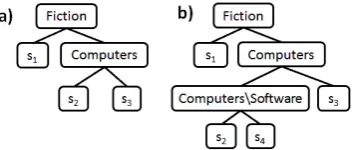
Figure 2: Two possible partitioning trees for the Amazon.com Books category tree (Figure 1). Tree b) is formed by splittings2in a) based on
member-ship in the “Computer\Software” category.
whereβ is a complexity penalty constant, which
is selected via cross-validation.
3.2.2 Topic Mapping Functions
The topic mapping functiongmaps from
catego-rizationc to a subject topicsi ∈ T. We select a
particularg from the space ofbinary partitioning
trees, G. In a binary partitioning tree, each
in-ternal node references a categoryc, and each leaf
node references a subject topicsi. See Figure 2.
Starting at the root, a categorization, c is
recur-sively assigned by each internal node to 1) the left subtree if the referenced category c is in c, and
2) the right subtree otherwise, until a leaf (with associated subject topic) is reached. For exam-ple, within the book review domain, a node may reference the category “Computers.” In this case, computer books are recursively assigned a subject topic by the left subtree, and all others by the right subtree. We allow only well formed partitioning trees: Any node ingthat references a categoryc
with parent categoryparent(c) ∈ Cmust have an ancestor that referencesparent(c). For example,
we do not allow a node in g to reference
“Com-puters\Software”, unless we have already condi-tioned on the “Computers” category. This con-straint guarantees that we partition the space of categorizations into coherent regions (we would never assign “Computer\Hardware” and “Fiction” books to the same subject topic while assigning “Computer\Software” to a different topic).
3.2.3 Adjacent Model Estimation
In order to guide the search throughG, we
Given a particularg, there are a finite number of possible merge and split operations to the leaves. Key to our search is the fact that we can estimate the change to the description length objective that each possible modification will cause, using the la-tent topic distributions assigned to each topic dur-ing expectation maximization. Consider mergdur-ing two subject topicssiandsj:
d
∆L=−β|V| − X
t∈{si,sj} X
w∈V
#t(w)log
Pmi,j(w)
Pt(w)
(9) where
#t(w) =
X
d∈D |xd|
X
i=1
Iw(wd,i)qd,i(t)
Pmi,j(w) =
P
t∈{si,sj}#t(w) P
t∈{si,sj} P
d∈(D)
P|xd|
i=1qd,i(t)
(10) Now consider splitting subject topicsibased on
categoryc:
d
∆L=β|V| − X
t∈{si,c,si,!c} X
w∈V
#t(w)log
Pt(w)
Psi(w) (11) where
#si,c(w) =
X
d=(x,c,y)∈D
s.t.c∈c
|xd|
X
i=1
Iw(wd,i)qd,i(si)
Psi,c(w) =
#si,c(w) P
d=(x,c,y)∈D
s.t.c∈c
P|xd|
i=1 qd,i(si)
#si,!c(w) =
X
d=(x,c,y)∈D
s.t.c /∈c
|xd|
X
i=1
Iw(wd,i)qd,i(si)
Psi,!c(w) =
#si,!c(w) P
d=(x,c,y)∈D
s.t.c /∈c
P|xd|
i=1 qd,i(si)
(12) These estimates are upper bounds on the change to the description length objective function. Incor-porating these changes (and the associated word distributions) and then retraining the model with expectation maximization may further reduce the objective. These bounds serve as a guide to esti-mate the objective for models that havenot been fit to the training data, which will drive our search throughGfor the optimal topic mapping function.
3.2.4 MCMC exploration
Markov chain Monte Carlo (Gilks et al., 1996) stochastically steps through the space of alterna-tive topic mapping functions. At each iteration of MCMC, the topic model with the current topic mapping function is fit to the training data and the objective change associated with all possible merges and splits is estimated. We then construct a proposal distribution for alternative models that can be reached with these operations. Limiting the proposal distribution to these candidate models, as in (Titov and Klementiev, 2011) and (Singh et al., 2011) induces a decomposable, feasible computa-tion. A model is sampled from this distribution and adopted if certain criteria on its fitness are met. MCMC will converge to a probability distribu-tion over models. By making better models (those with a lower objective) more probable, the MCMC chain will be driven towards higher quality els. We use an exponential distribution over mod-els:
P(M) =e−
L(M,D)
ZP (13)
with normalization factorZP.
The proposal distribution,Qassigns some prob-ability to all candidate models that can be reached by a single merge or split to each of the leaves in the current partitioning tree. In Q, splits and
merges to leaves without a common parent are in-dependent by construction. Now, consider a par-ticular leaf,l, that has the following possible splits, S = {c1, c2, ..., cl}, and cannot be merged with
another leaf. For example, in Figure 2a, the leaf corresponding tos1meets this condition as it
can-not be merged to acan-nother leaf and has possible splits{“Fiction\Drama”, “Fiction\Poetry”, “Non-fiction”, “Computers”, “Children”, ... }. Let Ml
represent the subset of models wherelis not split,
andMl,cirepresent the subset of candidate models wherelhas been split with respect to categoryci.
Q(Ml) =
e−τ L(M,D) Zl
Q(Ml,ci) =
e−τLb(Ml,ci,D) |S|Zl
Zl= e−τ L(M,D)+
X
c∈S
1
|S|e
−Lb(Ml,c,D) !
(14)
0 < τ ≤ 1 controls a balance between having
the estimated objectives vs. a uniform proposal distribution.
For all pairs of leaves that share a common par-ent, we entertain a merge operation. In Figure 2a the leaves corresponding to s2 and s3 meet this
criteria. Suppose two leaves,landl0have possible
splitsS ={c1, c2, ..., cl}andS0 ={c01, c02, ..., c0l0}
respectively. In addition to the one merged alterna-tive, there arew= (|S|+ 1)(|S0|+ 1)alternatives
that involve only splits to the two leaves. LetMl,l0
represent the subset of candidate models wherel
andl0are merged
Q(Ml,l0) = w −1
2e−τLb(Ml,l0,D)
w−12e−τLb(Ml,l0,D)+ (Z
l)(Zl0)
(15)
The factor ofw−12 accounts for the difference be-tween the number of neighbors that the models with l and l0 merged vs. split have. If the two
leaves are not merged, then the conditional proba-bility for each of the(|S|+ 1)(|S0|+ 1)remaining
structural alternatives is computed in Equation 14. A new topic mapping function g0 is sampled
fromQand fit to the training data via the
expec-tation maximization presented in Section 3.1.1. If a random value sampled uniformly fromU[0,1)is
less than
P(Mg0)Q(g|g0)
P(Mg)Q(g0|g) (16)
theng0is accepted as the new topic mapping
func-tiongt+1. This guarantees that the Markov chain
will converge to the distribution P ast→ ∞. Be-cause the ratioP(Mg0)/P(Mg) appears in
Equa-tion 16, the normalizaEqua-tion factor ZP in Equation
13 cancels out and does not need to be computed.
4 Empirical Evaluation
We perform a set of experiments to demonstrate the following:
1) Given the topic model structure outlined in Section 3.1, the model adaptation procedure in section 3.2 selects a high performing topic map-ping function while only evaluating a small frac-tion of the total number of funfrac-tions.
2) The topic model resulting from model adap-tation is high quality relative to alternative state-of-the-art approaches.
4.1 Data
We demonstrate our approach to two structured sentiment analysis datasets. First, we gathered a
collection of approximately 8,000 Yelp.com busi-ness reviews from the greater New York area. For this data, businesses are assigned into cate-gories and subcatecate-gories based on the Yelp.com business hierarchy. There are 22 primary cate-gories{Arts and Entertainment, Education, Finan-cial Services, Restaurants,...}, each with 6 to 100 subcategories (restaurants have the most subcat-egories, {Japanese, Barbeque, Cafe, Fast Food, Burgers, Ultra High Enc, Formal, Full Bar,...}). Businesses can be assigned to multiple categories and subcategories within the hierarchy.
Second, we utilize 20,000 Amazon.com book reviews, extracted from the data set first pre-sented in (Qu et al., 2010). Categorical distinc-tions in these domains are related to the Ama-zon.com product hierarchy. A small portion of the product hierarchy appears in Figure 1. Books can be assigned to multiple distantly related cate-gories. For example, the bookSix Wives of Henry VIIIbelongs to “History\Europe\England\Tudor and Stuart,” “Biographies and Memoirs\Specific Groups\Women” and three other categories
For each domain, we have at most one review corresponding to any particular business/book. This allows for a broad coverage of the space of categorizations.
4.2 Results and Discussion
To compensate for extreme variations in the train-ing data we apply two smoothtrain-ing steps. First, we found that for longer reviews, the assumption that each word is drawn independently from the docu-ment’s topics is too strong, and so for reviews with more than 35 words, we scale the term counts such that the total is 35. Second, because of the large size of the vocabulary, after training, some rare words have zero or near zero probability in some of the topics. When these words are observed dur-ing inference, they have a very strong effect on the document’s expected rating. We found that smoothing the subject topics with the overall word distribution across topics stabilizes the predicted ratings and improves performance. The amount of smoothing could be optimized to maximize the likelihood of the test data, but we found that per-formance varied little for a wide range of values and so we choose a 1 to 1 smoothing.
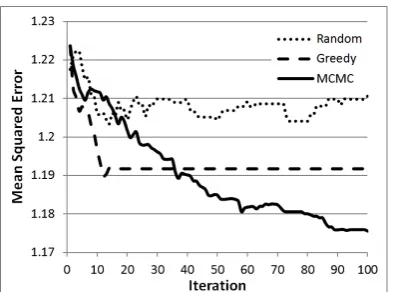
Figure 3: Learning curves for three model sam-pling approaches on Yelp.com test data with 500 training examples (averaged over 20 trials).
The validation data is used to learn the values of
α, the subject topic fraction, andβ, the complex-ity penalty. We found that settingτ, the MCMC
smoothing factor, equal to .1 worked well across our datasets. For each trial, then, disjoint training and test sets are sampled from the remaining data. First, we apply our Markov chain Monte Carlo model adaptation procedure along with greedy and random alternatives to demonstrate the necessity of a directed and stochastic approach. In the greedy approach, at each iteration we estimate the objective for all candidate models that can be reached with a single split/merge to each subject topic and adopt the model with the minimum es-timate. For the random approach, at each itera-tion we start with the simplest topic mapping func-tion (mapping all categorizafunc-tions to one subject topic), and uniformly at random add distinctions until the model has the same number of subject topics as the optimal model found by the MCMC approach. We choose this instead of sampling at random from all possible topic mapping functions as the vast majority of such functions have nearly as many subject topics as training examples. For each approach, at iteration i, we chart the test mean squared error for the best (lowest objective) model observed during training in iterations 1 toi.
[image:7.595.324.509.60.210.2]Figure 3 charts the per iteration mean squared error on the Yelp test data for the three model adaptation approaches. The greedy approach ini-tially makes the fastest progress, but it is suscepti-ble to local minima, and it levels off before being overtaken by the MCMC approach. As the random approach does not leverage the data in determining what distinctions to make, it fails to make progress
Figure 4: A representative partitioning tree learned from 500 training examples on the Yelp.com data.
at the rate of the other approaches. Its poor per-formance is indicative of the importance of having an efficient directed model adaptation approach, as high performing models are few and far between, even if we limit our search to models of the appro-priate complexity level (number of subject topics). Figure 4 shows a representative partitioning tree learned from the Yelp.com dataset.
Next we compare our approach to alternative re-gression and topic modeling approaches. In or-der to implement regression, we 1) Form a vector of unigram (and optionally bigram) occurrences normalized to length 1 (which we found to work better than unnormalized or frequency vectors), and 2) Form a vector corresponding to categori-cal membership with one element for each node in category treeC. For each example, we set each element in the vector to valueγ if the example be-longs to the corresponding category, and 0 other-wise. The feature vector is the concatenation of these two vectors. We tested three regression ap-proaches: ridge regression, lasso, and -support
vector regression with a quadratic kernel (Chang and Lin, 2001). In each case, the cross valida-tion dataset is used to tune the value of γ and
the regularization parameter (for ridge regression and lasso) orand the cost parameter (forSVR). We found that in all cases, lasso and SVR were
ouperformed by ridge regression, and so omit their results.
Yelp.com Data Amazon.com Data Training Examples Training Examples
500 1000 2000 4000 6000 500 1000 2000 4000 6000 TMSD, MCMC 1.207 1.062 .983 .915 .870 1.243 1.161 1.090 1.019 .981
[image:8.595.74.527.63.191.2]TMSD, Simple 1.252 1.108 1.017 .951 .893 1.300 1.256 1.158 1.075 1.027 TMSD, Complex 1.284 1.123 —- —- —- 1.281 1.198 —- —- —-RR, Uni 1.319 1.182 1.103 1.020 .949 1.337 1.265 1.145 1.081 1.033 RR, Uni/Bi 1.285 1.164 1.059 .971 .903 1.310 1.237 1.119 1.041 1.001 SLDA 1.664 1.649 1.606 1.556 1.479 1.621 1.632 1.607 1.581 1.555
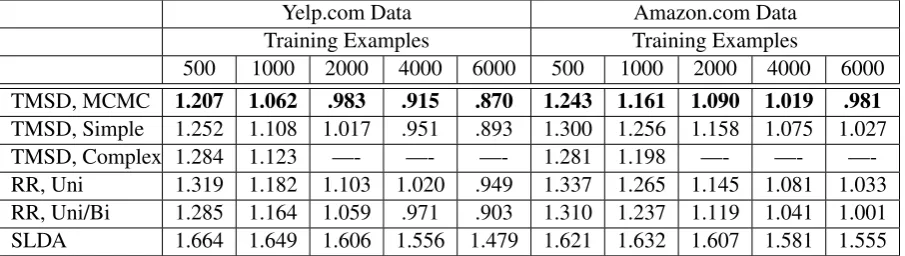
Figure 5: Mean Squared Error for 1) the presented topic model for structured domains (TMSD) using MCMC Model Adaptation (MCMC), the simplest topic mapping function (Simple), or the most com-plex topic mapping function (Comcom-plex), 2) ridge regression (RR) with unigrams (Uni) or unigrams and bigrams (Uni/Bi), and 3) multiclass supervised latent Dirichlet allocation (SLDA). Results are averaged over 10 trials, each with 1000 test examples. The MCMC approach significantly outperforms all other approaches for each training set size (Yelp.com: p<.01, Amazon.com: p<.05).
We used an open source implementation of each approach, (Chang, 2010) and (Wang, 2009), and found that utilizing the multiclass approach and predicting the expected rating based on the pos-terior likelihood of each class outperformed the regression approach, so we present these results. The cross validation data is used to learn the num-ber of latent topics and Dirichlet distribution pa-rameter.
For the Markov chain Monte Carlo approach, in order to hasten learning for this comparison, start-ing from the simplest topic mappstart-ing function, we perform a greedy model adaptation until reaching an estimated local minimum, and then apply 50 additional iterations of MCMC model adaptation. Figure 5 shows the average mean squared error for each approach for various amounts of training data. Our topic model with model adaptation has lower error than each of the alternatives. Paired t-tests reveal that the differences are statistically sig-nificant in all cases (p<.01 for all Yelp.com and
p<.05 for all Amazon.com tests). Using MCMC
model adaptation also outperforms using either the simplest topic mapping function or the most com-plex mapping function (which maps each distinct training categorization to a different subject topic). Ridge regression with unigrams uses the same word and categorical representations as our ap-proach. However, it is unable to entertain the non-linear relationships between document categoriza-tions and words and is outperformed in all cases. Bigrams improve the performance of ridge regres-sion, especially for larger amounts of training data. This suggests that accounting for word ordering
could potentially improve the performance of our topic model as well. sLDA is unable to take advantage of the categorical information during topic construction, and with the limited training data available, its performance is marginally bet-ter than guessing the mean label (MSE: 1.675 for Yelp.com data and 1.660 for Amazon.com data).
5 Conclusion
We present an approach to sentiment analysis for structured domains. In our approach, positive, negative, and subject topics are learned and used to infer document labels. Partitioning tree based topic mapping functions define the number and structure of subject topics. A Markov chain Monte Carlo model adaptation procedure explores the space of topic mapping functions based on a min-imum description length objective. We demon-strate the approach on two sentiment analysis do-mains and show that the model adaptation proce-dure efficiently finds a high performance model that leverages the categorical structure of the doc-uments to outperform other regression and topic modeling approaches.
Acknowledgment
References
H. Akaike. 1974. A new look at the statistical
model identification. IEEE Transactions on
Auto-matic Control, 19(6):716–723.
S. Baccianella, A. Esuli, and F. Sebastiani. 2009.
Muli-facet rating of product reviews. In The 31st
European Conference on Information Retrieval Re-search, pages 461–472.
D. Blei and J. McAuliffe. 2007. Supervised topic
mod-els. InNeural Information Processing Systems.
D. Blei, A. Ng, and M. Jordan. 2003. Latent dirichlet
allocation. Journal of Machine Learning Research,
3:993–1022.
Chih-Chung Chang and Chih-Jen Lin, 2001.
LIB-SVM: A Library for Support Vector Machines.
Software available athttp://www.csie.ntu.
edu.tw/˜cjlin/libsvm.
J. Chang. 2010. Lda: Collapsed gibbs sampling meth-ods for topic models. online.
W. Gilks, S. Richardson, and D. Spiegelhalter. 1996.
Markov Chain Monte Carlo in Practice. Chapman and Hall.
P. Grunwald. 2007. The Minimum Description Length
Principle. The MIT Press, Cambridge, Mass.
T. Hastie, R. Tibshirani, and J. Friedman. 2001. The
Elements of Statistical Learning. Springer, New York, NY.
G. Levine, G. DeJong, L. Wang, R. Samdani, S. Vembu, and D. Roth. 2010. Automatic model
adaptation for complex structured domains. InThe
European Conference on Machine Learning and Principles and Practice of Knowledge Discovery in Databases, pages 243–258.
B. Pang and L. Lee. 2005. Seeing stars: Exploiting class relationships for sentiment categorization with
respect to rating scales. InThe 43rd Annual
Meet-ing of the Association for Computational LMeet-inguis- Linguis-tics: Human Language Technologies, page 124. B. Pang and L. Lee. 2008. Opinion mining and
senti-ment analysis. Foundations and Trends in
Informa-tion Retrieval, 2(1–2):1–135.
L. Qu, G. Ifrim, and G. Weikum. 2010. The bag-of-opinions method for review rating prediction from
sparse text patterms. InThe International
Confer-ence on Computational Linguistics, pages 913–921.
D. Ramage, D. Hall, R. Nallapati, and C. Manning. 2011. Labeled lda: A supervised topic model for
credit attribution in multi-labeled corpora. In The
Conference on Empirical Methods in Natural Lan-guage Processing.
J. Rissanen. 1978. Modeling by shortest data
descrip-tion. Automatica, 14:445–471.
G. E. Schwarz. 1978. Estimating the dimension of a
model. Annals of Statistics, 6(2):461–464.
S. Singh, A. Subramanya, F. Pereira, and A. McCallum. 2011. Large-scale cross-document coreference us-ing distributed inference and hierarchical models. In The 49th Annual Meeting of the Association for Computational Linguistics: Human Language Tech-nologies.
B. Snyder and R. Barzilay. 2007. Multiple aspect
rank-ing usrank-ing the good grief algorithm. InThe 8th
An-nual Conference of the North American Chapter of the Association for Computational Linguistics: Hu-man Language Technologies, pages 300–307.
I. Titov and A. Klementiev. 2011. A bayesian model
for unsupervised semantic parsing. InThe 49th
An-nual Meeting of the Association for Computational Linguistics.
I. Titov and R. McDonald. 2008a. A joint model of text and aspect ratings for sentiment summarization. In The 46th Annual Meeting of the Association for Computational Linguistics: Human Language Tech-nologies, pages 308–316.
I. Titov and R. McDonald. 2008b. Modeling online
re-views with multi-grain topic models. InThe
Seven-teenth International Conference on World Wide Web, pages 111–120.
V. Vapnik. 1995. The Nature of Statistical Learning
Theory. Springer-Verlag.
C. Wang, D. Blei, and L. Fei-Fei. 2009.
Simultane-ous image classification and annotation. In IEEE
Conference on Computer Vision and Pattern Recog-nition.
C. Wang. 2009. Supervised latent dirichlet allocation for classification. online.
W. Zhao, J. Jiang, H. Yan, and X. Li. 2010. Jointly modeling aspects and opinions with a maxent-lda
hybrid. In The Conference on Empirical Methods