The Application of RFID Technology to Capture and Record Product and
Process Data for Reverse Logistics Sorting Activity
Azli Nawawi, Khalid Hasnan and Salleh Ahmad Bareduan
Faculty of Mechanical and Manufacturing Engineering University Tun Hussein Onn Malaysia (UTHM), Malaysia
Tel : +6013-7721379. Fax : +607-4537705 E-mail : [email protected]
ABSTRACT
Nowadays, product manufacturers and consumers started to be more concerned about the environment. For that reason, manufacturers started to accept used product from the consumer community in order to recycle, remanufacture, resale, refurbished or for disposal. This activity is known as Reverse Logistics which descibes as a process where manufacturers accept used products from consumers for the purpose of recycling, remanufacturing, reuse or disposal. Although Reverse Logistics can be considered as an environmentally friendly activity, some manufacturers have some reservation based on some drawbacks for example difficulty in forecasting product returns, complex product identification process and returns management. An Automated Product Identification System is proposed as a substitute to manual identification method to identify product returns. Radio Frequency Identification (RFID) technology is used as a data storing mechanism for recyclable products. All value added activities are 'recorded' in the RFID tags mounted on the product. These data will act as a 'product diary' for that particular product. Once the product enters the Reverse Logistics chain, Reverse Logistics operators can retrieve all information in the RFID tags, including all information on the materials and parts for recycling purpose. This system will save a lot of time for identifying materials and parts in a particular used product.
Keywords:
Reverse Logistics, RFID, Sorting, Product Data, Product Recycle
1. INTRODUCTION
Reverse Logistics can be considered as an environmentally friendly activity because it will slow down the rapid expansion of landfill area. This is due to the increased amount of solid waste generated with respect to time. In 1970, the amount of solid waste generated by each American citizen was 5 ½ pounds and in 1982, the amount increased to 8 pounds for each citizen [1]. It is believed that the amount of waste generated will increased with respect to time. This horrific trend is happening everywhere around the globe.
The most tormenting part is our landfills expand at an alarming rate due to the increasing rate of waste generated. For that reason, we will face a decrease in land available for disposal sites [1]. This is the strongest reason for implementing Reverse Logistics process. Used products from consumers will be transported to the factory or recycling center for further processing. As a result, the amount of new material needed will be less because some of the raw material can be recycled from the used products. On the other hand, products that have been remanufactured will be sold to the second market.
2. REVERSE LOGISTICS
Reverse Logistics is the process of planning, implementing, and controlling the efficient, cost effective flow of raw materials, in process inventory, finished goods and related information from the point of consumption to the point of origin for the purpose of recapturing value or proper disposal [2]. Reverse Logistics can also be defined as the movement of materials back up the supply chain [3].
Reverse Logistics activity will help to reduce the purchase of ’virgin’ raw material since raw material for the next generation of products can come from recycling and remanufacturing activities. Besides, Reverse Logisitcs is also dedicated as one way to reduce the rapid expansion of our landfill since not all products are thrown directly to the landfill.
There are various reasons for doing Reverse Logistics. One of them is recyclers are able to get back a large portion of production materials [1-2]. Moreover, some claimed that the use of secondary material in production will result less energy required [1]. Besides, Reverse Logistics operation will help to enhance the image of the firm [1].
In addition, manufacturers implement Reverse Logistics because they want to encourage their customers to buy their new products [2]. This case is valid in automotive industry and currently in Malaysia, a national auto-maker company (Proton) is offering discounts to buyers who can trade in their old cars in order to purchase new Proton cars.
2.1 Reverse Logistics Issues
Reverse Logistics can be considered as one complicated process. This is because Reverse Logistics deals with many issues. One of Reverse Logistics issues is channel conflict [1]. In some cases, recycling activities are considered as less important compared to other value added or money making activities. Channel conflict also occurs whenever recycling activities are taken for granted.
Besides, transportation for collecting returns is also considered as one major issue in Reverse Logistics system. According to [1], manufacturers found out that the cost for transporting returns was not really profitable compared to transporting virgin raw materials.
Another issue of Reverse Logistics is product returns or wastes come in wide varieties [1]. For that reason, the sorting process will be more difficult. In order to resolve this issue, several conceptual models for Reverse Logistics were developed. One of them is a conceptual model for handling used mobile phones [5]. The developed model is a general model for managing returns of used mobile phones. In addition, there were also Reverse Logistics models developed for other industries such as metal industry, automobile and others [6-7].
In addition, the problem of choosing strategic locations for recycling centers is not easy to solve [1, 8]. In [1], it was suggested that marketing should play its role in informing consumers about locations of recycling centers. Besides, a generic algorithm proposed in [8] aims to solve the problem of finding strategic locations for recycling centers. A recycling center at a strategic location will maximize coverage of consumers.
Lack of product information is another important issue in implementing Reverse Logistics. According to [9], there is lack of effort focusing on designing a reliable information system for Reverse Logistics. In order to overcome this issue, researchers started to propose the possibility of implementing Information Technology (IT) to the existing Reverse Logistics system [10].
In 1998, [2] mentioned that the information system for Reverse Logistics operation did not provide the status of returns. For that reason, [2] suggested that the information system for Reverse Logistics need to be enhanced and improved by utilizing emerging technologies such as two dimensional bar codes and RFID systems. From there, the existing bar codes system was proposed as a medium for recyclers to access important product information such as product make, product model and the correct disassembly sequence [11]. As the cost of implementing RFID is decreasing, RFID technology was proposed as a medium for sending product information to recyclers [12-13].
This paper proposes a system that will utilize enormous advantages of RFID such as no line-of-sight, less human intervention, data storing ability and fast scanning mechanism.
3. RADIO FREQUENCY IDENTIFICATION (RFID) TECHNOLOGY
As expected by previous researchers [2, 10], Radio Frequency Identification (RFID) technology can be a really useful tool for enhancing Reverse Logistics product information system. RFID simplifies the checking and monitoring of tasks, and provide up-to-date information on process status, enabling users to react swiftly to unforeseen events [14].
RFID system consists of three main elements (refer
Figure 1): a tag, a reader and a middleware. The tag, also called transponder, is made of a chip and an antenna. It contains a unique code that provides the unique identification of each object [15]. The reader, also known as interrogator has an antenna which emits radio signals and receive signal in return from the tag. The distance of the reading range depends on multiple factors; the frequency that is used, the orientation and polarization of the reader, the environment [15]. Lastly, the middleware can provide the primary link between RFID readers and databases [16].
Figure 1: RFID System Components [17]
Low-cost RFID tag is capable of reading or writing information of an entity without contact physically, while it possesses a fast recognition speed, and has a relatively greater storing ability compared with bar-code [16]. According to [18], when using a bar-code system for detection purpose, label must be correctly positioned relatively to the reader. This characteristic is called Line of Sight which requires human intervention for scanning purpose and it will provide chance for error and inefficiencies.
4. AUTOMATED PRODUCT IDENTIFICATION SYSTEM
An Automated Product Identification System is proposed as a substitute to manual identification method to identify product returns. Quality product data information assists in reducing time for identification and sorting process. This will also reduce operational cost.
The most suitable recycling procedure will be suggested for different part of a particular product. In order to achieve this, relevant information regarding the product will be embedded in an RFID passive tag mounted on the product. The product that flows through the supply chain system until it stops whenever it is delivered to the customer. This product will serve the customer until the end of its lifecycle.
4.1 Operational Method
In the field of conventional RFID-enabled supply chain, RFID tag is embedded on new and finished product so that every supply chain actors (supplier, manufacturer, distributor and retailer) can monitor and track the location of a particular product. Once the product is purchased by a customer, the RFID tag will obsolete and expired.
In this project, the RFID tag that has been mounted on the new product will not be deactivated. This tag will be built tough enough to last with the product for years of usage. Whenever this product is returned for recycling or disposal, the RFID tag will still be in used for Reverse Logistics purpose.
Figure 2: Automated Product Identification System Architecture
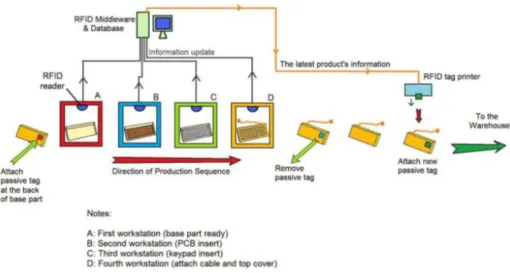
The proposed system (refer
Figure 2) will utilize Class 0 and Class 1 tags. Class 0 tag is a passive tag that is read only. The unique ID in the tag was set during the manufacturing process of the tag. Class 0 tag does not have any Write capability [19]. Class 0 tag will be mounted on a base part for particular product. Class 0 tag can also be reusable.
The product in the project architecture is a computer keyboard that will go through four value-adding processes (Base Part Ready, PCB Insert, Keypad Insert and Attach Cable and Top Cover). Once the base part goes through several workstations for value-added process on the base part, RFID system will record all value added activities that will transform the base part into a final and finished product. For that reason, the Class 0 tag is only used for tracking purpose on the production floor.
Before the final product goes into the packaging section and the warehouse, the Class 0 tag will be peeled off of the final product. Next, all value added information and other relevant information related to the final product will be sent to the RFID printer. This printer then will print a new Class 1 passive tag that contains all information mentioned before.
The Class 1 tag is the second type of RFID tag used in this system. The Class 1 tag will be mounted on the finished product until its End-of-Life (EOL). The Class 1 tag has the same feature as the Class 0 tag except the Class 1 tag has Write Once capability. In other words, Class 1 tag has the WORM (Write Once/Read Only Memory) capability [19]. With this WORM capability, the user can write any suitable ID on the tag using an RFID printer.
In the proposed system, at the end of its lifecycle, the product will be sent to any Recycle Center and from here, the product will enter the Reverse Logistics chain that will lead to Reverse Logistics facilities. Upon arrival at the facility, the product will be scanned using an RFID reader. The product information in the passive tag will be accessible to any employee at Reverse Logistics facility.
4.2 Benefits of the system
This system will save a lot of time for identifying materials and parts in a particular used product. In addition, this project will offer certain benefits to different groups of people:
i.
Reverse Logistics operators: ability to rapidly identify materials and parts in a used product.ii.
Manufacturers: ability to record all value-added activities and track products on the supply chainiii.
Logistics companies: ability to track every product on the supply chain with the help of RFID technologyiv.
Consumers: Better after sales services (product returns, recycling, disposal etc) and faster product delivery.5. CONCLUSION
RFID technology is used as a data storing mechanism for recyclable products. All value added activities are 'recorded' in the RFID tags mounted on the product. These data will act as a 'product diary' for that particular product. Once the product enters the Reverse Logistics chain, Reverse Logistics operators can retrieve all information in the RFID tags, including all information on the materials and parts for recycling purpose. This system will save a lot of time for identifying materials and parts in a particular used product.
REFERENCES
[1] J. Barnes, "Recycling: A problem in reverse logistics," Journal of Macromarketing, vol. 2, pp. 31-7, 1982.
[2] D. D. S. Rogers and D. R. S. Tibben-Lembke, Going Backwards: Reverse Logistics Trends and Practices. Reno: Reverse Logistics Executive Council, 1998.
[3] M. Amini, et al., "Reverse Logistics Process Reengineering: Improving Customer Service Quality," Issues in Supply Chain Management, vol. 5, 1999.
[4] M. P. d. Brito and R. Dekker, "A Framework for Reverse Logistics," in Reverse Logistics: Quantitative Models for Closed-Loop Supply Chains, R. Dekker, et al., Eds., ed Heidelberg: Springer-Verlag, 2004, p. 24.
[5] F. T. S. Chan, et al., "Reverse Logistics Model for Mobile Phone Industry," 2007, pp. 294-299.
[6] Z. Qi and W. Hongcheng, "Research on Construction Mode of Recycling Network of Reverse Logistics of Automobile Enterprises " presented at the 2008 International Conference on Information Management, Innovation Management and Industrial Engineering, 2008.
[7] C. Jiang and F. Yibin, "A Reverse Logistics Decision-making Model for Steel Industry: A Case Study of China," 2008, pp. 1-4. [8] C. K. M. Lee and T. M. Chan, "Development of RFID-based Reverse Logistics System," Expert Systems with Applications, vol. 36,
pp. 9299-9307, 2009.
[9] V. Ravi and R. Shankar, "Analysis of interactions among the barriers of reverse logistics," Technological Forecasting and Social Change, vol. 72, pp. 1011-1029, 2005.
[10] A. I. Kokkinaki, et al., "An Exploratory Study onElectronic Commerce for Reverse Logistics," 2000.
[11] S. Saar, et al., "Towards intelligent recycling: a proposal to link bar codes to recycling information," Resources, Conservation and Recycling, vol. 41, pp. 15-22, 2004.
[12] A. Kulkarni, et al., "Networked RFID systems in product recovery management," 2005, pp. 66-71.
[13] A. Parlikad, et al., "Improving product recovery decisions through enhanced product information," Reverse logistics, vol. vip, 2005. [14] Y. Z. Mehrjerdi, "RFID-enabled supply chain systems with computer simulation," Assembly Automation, vol. 29, pp. 174–183, 2009. [15] S. Aysegul, et al., "A simulation approach to evaluate the impact of introducing RFID technologies in a three-level supply chain,"
presented at the Proceedings of the 40th Conference on Winter Simulation, Miami, Florida, 2008.
[16] L. Fagui and M. Zhaowei, "The Application of RFID Technology in Production Control in the Discrete Manufacturing Industry," in Video and Signal Based Surveillance, 2006. AVSS '06. IEEE International Conference on, 2006, pp. 68-68.
[17] S. A. Elshayeb, et al., "Improving Supply Chain Traceability Using RFID Technology " International Conference on Recent and Emerging Advanced Technologies in Engineering 2009, 2009.
[18] E. Sahin, et al., "Performance evaluation of a traceability system. An application to the radio frequency identification technology," in Systems, Man and Cybernetics, 2002 IEEE International Conference on, 2002, p. 6 pp. vol.3.