Journal of Chemical and Pharmaceutical Research
__________________________________________________
ISSN No: 0975-7384 CODEN(USA): JCPRC5
J. Chem. Pharm. Res., 2011, 3(1):79-83
79
Study of phenol and its derivatives based on dipole moment
Alok Shukla1, Rajendra Prasad Tewari1 and Gayasuddin Khan2*
1
Department of Physics, Maharani Lal Kunwari Post Graduate College, Balrampur, U.P., INDIA
2
Department of Physics, K. S. Saket Post Graduate College, Ayodhya-Faizabad, U.P., INDIA
______________________________________________________________________________
ABSTRACT
We have studied the dipole moment and net dipole moment of a series of phenols. The dipole moment of each compound of phenol at x, y and z-axes, and the net dipole moment have been evaluated by the semi-empirical MINDO/3 method. The study has concluded that the magnitude of dipole moment is increased by adding ethyl, isopropyl and methyl alcohol group at ortho position while that of methyl alcohol and azo group at para position and the magnitude of dipole moment decrease by adding methyl alcohol at ortho position of phenol. Thus the substitutions of various groups as well as its position affect the magnitude of dipole moment along the various coordinates.
Keywords: Phenol, MINDO/3, MOPAC, dipole moment.
______________________________________________________________________________
INTRODUCTION
The magnitude of the dipole moment or the polarity of bond depends primarily on the relative electron attracting tendencies of the two atoms concerned and varies from one element to another. Dipole moments [1, 2] have both the magnitude and the direction. Phenol and its few derivatives have been used to study the effect of substituent and it position on the magnitude of the dipole moment [3]. Firstly we have studied the above effects along the x, y and z-axes. Finally net dipole moment has been study.
EXPERIMENTAL SECTION
80
optimized by PCMODEL software. The dipole moment of each compound with respect to x, y and z-co-ordinates has been evaluated by the semi-empirical MINDO/3 method [6-11]. The net dipole moment may be regarded as equal to vector sum of the individual bond moments. The net dipole moment of each compound has also been evaluated by the same method.
RESULTS AND DISCUSSION
The dipole moment of phenol at x-axis is 0.50015 D. The substitution of phenol at ortho- position by ethyl group increases its dipole moment from 0.50015 to 3.99059 D (o- ethyl phenol). Further replacement of this ethyl group by isopropyl group decreases its dipole moment from 3.99059 to 1.08538 D (o- isopropyl phenol). Replacement of this isopropyl group by methyl alcohol group also decreases its dipole moment from 1.08535 to 0.29609 D (o- hydroxyl
phenol o-ethyl phenol
o-isopropyl phenol o-hydroxyl benzyl alcohol
p-hydroxyl benzyl benzene p-hydroxyl azobenzene
81
benzyl alcohol). In case of methyl alcohol derivatives of phenol (o- hydroxyl benzyl alcohol) have the dipole moment 0.29609 D while its positional isomer (p- hydroxyl benzyl benzene) has dipole moment 1.40567 D. Replacement of methyl alcohol group from p- hydroxyl benzyl benzene by azo group also decreases dipole moment from 1.40567 to 0.34625 D. The trend of dipole moment along x-axis is shown in below Figure 2.
0 0.5 1 1.5 2 2.5 3 3.5 4 4.5
Phenol o- ethyl phenol o- isopropyl
[image:3.595.69.528.185.307.2]phenol o- hydroxyl benzyl alcohol p- hydroxyl benzyl benzene p-hydroxyl azobenzene d ip o le m o m e n t
Figure 2. Trend of dipole moment along x-axis
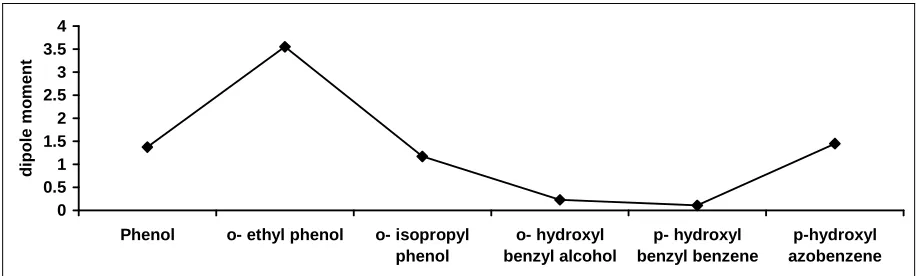
The dipole moment of phenol at y-axis is 1.37468 D. The substitution of phenol at ortho- position by ethyl group increases its dipole moment from 1.37468 to 3.54926 D (o- ethyl phenol). Replacement of the ethyl group by isopropyl group decreases its dipole moment from 3.54926 to 1.16945 D (o- isopropyl phenol). In case of methyl alcohol derivatives of phenol, the o- hydroxyl benzyl alcohol have dipole moment is 0.22683 D while its positional isomer has dipole moment 0.10686 D. Replacement of methyl alcohol group from p- hydroxyl benzyl benzene alcohol by azo group increases the dipole moment from 0.10686 to 1.44644 D. The trend of dipole moment along y-axis is shown below Figure 3.
0 0.5 1 1.5 2 2.5 3 3.5 4
Phenol o- ethyl phenol o- isopropyl
phenol o- hydroxyl benzyl alcohol p- hydroxyl benzyl benzene p-hydroxyl azobenzene d ip o le m o m e n t
Figure 3. Trend of dipole moment along y-axis
[image:3.595.69.528.454.592.2]82
11.31096 D. The trend of dipole moment along z-axis is shown in below Figure 4. Thus the substitutions of various groups as well as its position affect the magnitude of dipole moment along the various coordinates.
0 2 4 6 8 10 12
Phenol o- ethyl phenol o- isopropyl
[image:4.595.71.525.157.290.2]phenol o- hydroxyl benzyl alcohol p- hydroxyl benzyl benzene p-hydroxyl azobenzene d ip o le m o m e n t
Figure 4. Trend of dipole moment along z-axis
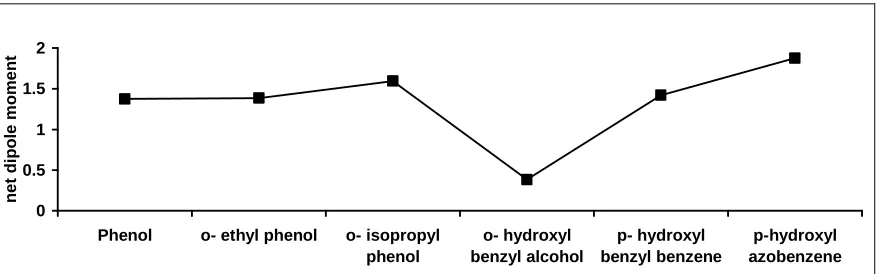
The net dipole moment of phenol is 1.375591 D. Substitution of phenol at ortho position by ethyl group i.e. o- ethyl phenol increases its magnitude from 1.375591 to 1.386731 D. Replacement of ethyl group by isopropyl group increases its magnitude from 1.386731 to 1.595573 D (o- isopropyl phenol). Further replacement of isopropyl group by methyl alcohol group decreases its magnitude from 1.595573 to 0.38529 D (o- hydroxyl benzyl alcohol). In case of methyl alcohol derivatives of phenol the net dipole moment is 0.385369 D (o- hydroxyl benzyl alcohol) while is positional isomer has the dipole moment 1.421507 D (p- hydroxyl benzyl benzene). Replacement of methyl alcohol group from p-hydroxyl benzyl benzene by azo group increases its magnitude of dipole moment from 1.421507 to 1.876817 D (p-Hydroxyl azo benzene). The trend of net dipole moment is shown in below Figure 5.
0 0.5 1 1.5 2
Phenol o- ethyl phenol o- isopropyl
phenol o- hydroxyl benzyl alcohol p- hydroxyl benzyl benzene p-hydroxyl azobenzene n e t d ip o le m o m e n t
Figure 5. Trend of net dipole moment
CONCLUSION
[image:4.595.76.516.462.599.2]83
Acknowledgement
The paper is abstracted from the thesis of Dr. Alok Shukla. The authors are thankful to Prof. K. Singh, Department of Physics; Avadh University; Faizabad, for valuable suggestions for preparation of the manuscript.
REFERENCES
[1] J. A. Reese, T. V. Nguyen, T. M. Korter and D. W. Pratt, J. Am. Chem. Soc., 2004, 126(36), 11387
[2] John R. Lombardi, Journal of Chemical Physics, 1969, 50, 3780. [3] J. S. Yadav, P. C. Mishra and D. K. Rai, J. Mol. Struct., 1972, 13, 311. [4] A. Komornicki and J. W. Mclever, Chem. Phys. Lett., 1971, 10, 303.
[5] A. Svobodová, J. Psotová and D. Walterová, A Review. Biomed. Papers, 2003, 147 (2): 137. [6] Weber, Manfred, Weber, Markus and Kleine- Boymann, Michael, "Phenol" in Ullmann’s Encyclopedia of Industrial Chemistry, Wiley-VCH, 2004.
[7] R.C. Binning, and K.M. Sando J. Am. Chem. Soc., 1980, 102, 2948. [8] Pedro J. Silva, J. Org. Chem., 2009, 74 (2), 914.
[9] O.P. Singh and J.S. Yadav, Proc.Ind. Acad. Sci.(Chem. Sci.), 1985, 95, 427. [10]O.P. Singh and J.S. Yadav Int. J. Quant. Chem., 1986, 5, 441.