International Journal of Emerging Technology and Advanced Engineering
Website: www.ijetae.com (ISSN 2250-2459, ISO 9001:2008 Certified Journal, Volume 6, Issue 9, September 2016)
95
The Improved Perfromance of Face Detection Based on Partial
Feature and TLBO
Abhilasha Wakde
1, Virendra Shrivastava
21Student at IES Institute of Technology and Management, Bhopal, India 2Assistant Professor at IES Institute of Technology and Management, Bhopal, India
Abstract—Face detection and recognition is important area of researcher in biometric security system. The changing of face expression and some physical component accrued for the process of face is major problem for face detection and recognition. For the improvement of face detection and recognition used various algorithm such as LBP, wavelet and many more function. In this paper proposed a hybrid method for face detection. The hybrid method of face detection is basically enhancement of local binary pattern method. For the improvement of LBP method used optimization technique for better face detection. The teacher learning based optimization is dynamic optimization technique and gives better result instead of PSO and ACO. The proposed algorithm implemented in MATLAB software and used Google image database for face detection. For the evaluation of performance used hit and miss ratio.
Keywords— TLBO, Feature Extraction, Biometric Face Detection, Classification, LBP.
I. INTRODUCTION
Biometric identification plays very important role in authentication and authorization. The process of authentication and authorization required security measure parameter for the validation of human identification. The identification of human, there are three major components are used such as face, finger and iris. The finger and iris is also important parameter for human identification. But the face detection and face recognition is major role in passport verification and document verification purpose [1, 2]. Nowadays fraud passport is issued by some illegal agencies. The authentication and validation of passport is major concern. We study various research and journal paper related to face detection based on feature extraction process. In feature extraction process the main problem is loss of face data and mismatch of face template. Some problem found in survey given below. The biometric community has long accepted that there is no 'template aging effect' for face detection, meaning that once you are enrolled in a face detection system, your chances of experiencing a false non-match error remain constant overtime.
The false match rate is how often the system says that two images are a match when in truth they are from different persons [5,6]. The false non-match rate is how often the system says that two images are not a match when in truth they are from the same person. Increase the ratio of miss decrease the ratio of Hit. In this paper modified the face detection technique based on local binary pattern. For the purpose of modification used teacher learning based optimization. The teacher learning based optimization algorithm is dynamic and memory based optimization technique. Here teacher based optimization technique optimized the local binary pattern for the better generation of template for the matching of facial data. For the extraction of feature point from the given image used various algorithm and method. But here used partial feature extractor. The partial feature extractor gives the boundary value of image for the creation of template. The creation of template used point of matching function for the process of matching and measure the score function for the process of detection [7,8]. Rest of this paper is organized as follows in Section II discusses about TLBO machine, Section III proposed algorithm IV. Experimental result analysis finally, concluded in section V.
II. TEACHER LEARNING BASED OPTIMIATION (TLBO)
International Journal of Emerging Technology and Advanced Engineering
Website: www.ijetae.com (ISSN 2250-2459, ISO 9001:2008 Certified Journal, Volume 6, Issue 9, September 2016)
96
The first part consists of the ―Teacher phase‖ and the second part consists of the ―Learner phase‖. The ―Teacher phase‖ means learning from the teacher and the ―Learner phase‖ means learning through the interaction between learners. In the sub-sections below we briefly discuss the implementation of TLBO.Initialization
Following are the notations used for describing the TLBO N: number of learners in class i.e. ―class size‖
D: number of courses offered to the learners
MAXIT: maximum number of allowable iterations
The population X is randomly initialized by a search space bounded by matrix of N rows and D columns. The jth parameter of the ith learner is assigned values randomly using the equation
( ) . / ( )
Where rand represents a uniformly distributed random variable within the range (0, 1), xmin j and xmax j represent the minimum and maximum value for jth parameter. The parameters of ith learner for the generation g are given by
( ) [ ( ) ( ) ( )
( )] ( )
A. Teacher phase
Mg which is the mean parameter of each subject of the learners in the class at generation g is given as
[
] ( )
The teacher Xg Teacher for respective iteration is considered as the learner with the minimum objective function value. Shifting the mean of the learners towards its teacher takes place in the Teacher phase of the algorithm. A random weighted differential vector is formed from the current mean to obtain a new set of improved learners and the desired mean parameters and added to the existing population of learners.
( )
( ) . / ( )
TF is the teaching factor which decides the value of mean to be changed. Value of TF can be either 1 or 2.
The value of TF is decided randomly with equal probability as,
, ( )* +- ( )
Where TF is not a parameter of the TLBO algorithm. The value of TF is not given as an input to the algorithm and its value is randomly decided by the algorithm using Eq. (5). So many experiments are conducted on many benchmark functions and it is concluded that the Teacher based optimization algorithm performs better if the value of TF is between 1 and 2. If the value of TF is either 1 or 2, however, the algorithm is found to be performing much better and hence to simplify the algorithm, the teaching factor is suggested to take either 1 or 2 depending on the rounding up criteria given by Eq. (5). If Xnew is found to be a superior learner than Xg in generation g , than it replaces inferior learner Xg in the matrix.
B. Learner phase
This phase consists of the interaction of learners with one another or between them. The knowledge of the learners tends to increase by the process of mutual attraction. The random interaction among learners improves his or her knowledge. For a given learner Xg , another learner Xg is randomly selected (i≠ r). The ith parameter of the matrix Xnew in the learner phase is given as[18]:
( ) * ( ) ( ) ( )
( ) ( )
III. PROPOSED ALGORITHM
This section describes the proposed algorithm of face detection based on feature selection and feature optimization process. Face image data base is used and passes through partial feature extractor at first and a shape feature of face image database is given by the feature extractor. The extracted shape features pass through TLBO algorithm and selects the proper feature and optimized the feature and finally passes through the support vector machine for classification of feature and finally detected the face and calculate the hit and miss ratio of detected face [18]. The process of algorithm discusses step by step in below section. Here discusses the step:
1.Input F1,F2….Fn in O1,O2,………..On fo Ftotal population
International Journal of Emerging Technology and Advanced Engineering
Website: www.ijetae.com (ISSN 2250-2459, ISO 9001:2008 Certified Journal, Volume 6, Issue 9, September 2016)
97
3. Define feature as teacher and pass4. Do
5. feature each teacher do 6. feature each Oi do 7. Select next feature 8. End for
9. Estimate feature template 10. Passes through LSVM
11. If estimated value Vi equal to template, then 12. Load map (Oi, Si)
13. Update the face template 14. End if
15. End forG
16. Population is empty 17. Face is detected 18. Process is terminated
International Journal of Emerging Technology and Advanced Engineering
Website: www.ijetae.com (ISSN 2250-2459, ISO 9001:2008 Certified Journal, Volume 6, Issue 9, September 2016)
98
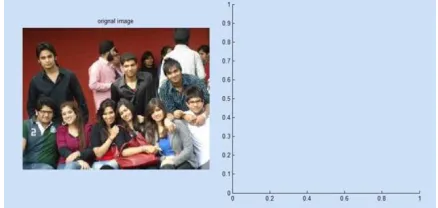
IV. EXPERIMENTAL ANALYSIS [image:4.612.317.561.167.270.2]In this section discuss the experimental result analysis. The proposed algorithm implemented in MATLAB software and used goggle image database for face detection. For the evaluation of performance measure hit and miss ratio of detected face.
Fig.2. Shows the original input image 2 for face detection using LBP method.
Fig.3. Shows the result image 2 for face detection using proposed method.
TABLE I
SHOWS THE COMPARATIVE RESULTS FOR GROUP IMAGE 1 WITH USING LBP AND PROPOSED METHOD
Group Image Name
Method Total No Of Face
Hit Miss Detection Ratio %
Group image
1
LBP 35 5 2 14.28
Proposed 35 25 3 71.42
TABLE II
SHOWS THE COMPARATIVE RESULTS FOR GROUP IMAGE 2 WITH USING
LBP AND PROPOSED METHOD
Group Image Name
Method Total No Of Face
Hit Miss Detection Ratio %
Group image
2
LBP 15 1 1 6.66
Proposed 15 3 1 20
TABLE III
SHOWS THE COMPARATIVE RESULTS FOR GROUP IMAGE 3 WITH USING
LBP AND PROPOSED METHOD
Group Image Name
Method Total No Of Face
Hit Miss Detection Ratio %
Group image
3
LBP 25 8 0 32
Proposed 25 21 1 84
TABLE IV
SHOWS THE COMPARATIVE RESULTS FOR GROUP IMAGE 4 WITH USING
LBP AND PROPOSED METHOD. Group
Image Name
Method Total No Of Face
Hit Miss Detection Ratio %
Group image
4
LBP 6 5 1 83.33
Proposed 6 6 4 100
TABLE V
SHOWS THE COMPARATIVE RESULTS FOR GROUP IMAGE 5 WITH USING
LBP AND PROPOSED METHOD
Group Image Name
Method Total No Of Face
Hit Miss Detection Ratio %
Group image
5
LBP 4 1 0 25
[image:4.612.59.278.214.318.2]International Journal of Emerging Technology and Advanced Engineering
Website: www.ijetae.com (ISSN 2250-2459, ISO 9001:2008 Certified Journal, Volume 6, Issue 9, September 2016)
99
In this section we show the comparative result analysis in the form of graph for various group images using for face detection on LBP and proposed method. The result shows the no. of person in a group images and we find the miss ratio, hit ratio and detection ratio for respective image. The summary of each group images describe below:Fig.4. Shows that the Comparative result graph for group image 1 and
find the no. of person in an image, hit ratio, miss ratio and detection ratio on the basis of LBP and our proposed method, then we find that the our proposed method result is always better than the LBP method.
Fig.5. Shows that the Comparative result graph for group image 2 and
find the no. of person in an image, hit ratio, miss ratio and detection ratio on the basis of LBP and our proposed method, then we find that the our proposed method result is always better than the LBP method.
Fig.6. Shows that the Comparative result graph for group image 3 and find the no. of person in an image, hit ratio, miss ratio and detection ratio on the basis of LBP and our proposed method, then we find that the our proposed method result is always better than the LBP method.
Fig.7. Shows that the Comparative result graph for group image 4 and find the no. of person in an image, hit ratio, miss ratio and detection ratio on the basis of LBP and our proposed method, then we find that the our proposed method result is always better than the LBP method. 0
20 40 60 80
Comparative result graph for
face detection for group
image 1 with LBP and
Proposed method
LBP
Proposed
0 5 10 15 20 25
Comparative result graph for
face detection for group
image 2 with LBP and
Proposed method
LBP
Proposed
0 20 40 60 80 100
Comparative result graph for
face detection for group
image 3 with LBP and
Proposed method
LBP
Proposed
0 50 100 150
Comparative result graph for
face detection for group
image 4 with LBP and
Proposed method
LBP
International Journal of Emerging Technology and Advanced Engineering
Website: www.ijetae.com (ISSN 2250-2459, ISO 9001:2008 Certified Journal, Volume 6, Issue 9, September 2016)
100
Fig.8. Shows that the Comparative result graph for group image 5 and find the no. of person in an image, hit ratio, miss ratio and detection ratio on the basis of LBP and our proposed method, then we find that the our proposed method result is always better than the LBP method.
V. CONCLUSION AND FUTURE SCOPE
In this paper proposed the hybrid method of face detection. The hybrid method is combination of partial feature extractor and teacher learning based optimization technique. The teacher learning based optimization technique optimized the feature of face data and improves the performance of face detection. The proposed algorithm implemented in MATLAB software and for the validation of algorithm used goggle image dataset. For the evaluation of result used hit and miss ratio of face image. The proposed method gives better result instead of LBP method. The improved method of face detection increases the time complexity of detection. Now in future reduces the time complexity of algorithm.
Acknowledgement
I take this opportunity to thank Prof. Virendra Shrivastava work under their valuable guidance, closely supervising this work over the past few months and offering many innovative ideas and helpful suggestions, valuable advice and support. Inspite of their busy schedule they have really been an inspirations and driving force for me. They have constantly enriched my raw ideas with their experience and knowledge.
REFERENCES
[1] Ruth Agada and Jie Yan ―Edge based Mean LBP for Valence Facial Expression Detection‖, IEEE, 2015, Pp 1-7.
[2] Dr Ravi Subban and SavithaSoundararajan ―Human Face Recognition using Facial Feature Detection Techniques‖, IEEE, 2015, Pp 940-947.
[3] Ruth Agada and Jie Yan ―A Model of Local Binary Pattern Feature Descriptor for Valence Facial Expression Classification‖, IEEE, 2015, Pp 634-639.
[4] HuyTho Ho, Rama Chellappa ―Pose-Invariant Face Recognition Using Markov Random Fields‖ IEEE TRANSACTIONS ON IMAGE PROCESSING, VOL- 22, 2013. Pp 1573-1584.
[5] Meng Yang, Lei Zhang, Simon Chi-Keung Shiu, David Zhang ―Robust Kernel Representation With Statistical Local Features for Face Recognition‖ IEEE TRANSACTIONS ON NEURAL NETWORKS AND LEARNING SYSTEMS, VOL-24, 2013. Pp 900-912.
[6] Jiwen Lu, Yap-Peng Tan, Gang Wang and Gao Yang ―Image-to-Set Face Recognition Using Locality Repulsion Projections and Sparse Reconstruction-Based Similarity Measure‖ IEEE TRANSACTIONS ON CIRCUITS AND SYSTEMS FOR VIDEO TECHNOLOGY, VOL. 23, 2013. Pp 1070-1080.
[7] Suresh Chandra Satapathy, Anima Naik and K Parvathi‖ A teaching learning based optimization based on orthogonal design for solving global optimization problems‖ in Springer Open Journal, 2013. [8] Kirti Jain, Dr. Sarita Singh and Dr. Gulab Singh‖ Partial Feature
Based Ensemble of Support Vector Machine for Content based Image Retrieval‖ in International Journal of Innovative Research in Computer and Communication Engineering Vol. 1, Issue 3, May 2013.
[9] W. Deng, J. Hu, and J. Guo ―Extended SRC: Undersampled face recognition via intra-class variant dictionary‖ IEEE Trans. Pattern Anal. Mach. Intell., vol. 34, no. 9, pp. 1864–1870, Sep. 2012. [10] O. Nikisins and M. Greitans, ―Reduced complexity automatic face
recognition algorithm based on local binary patterns,‖ Peoceedings of 19th International Conference on Systems, Signals and Image Processing (IWSSIP 2012), pp. 447–450, 2012.
[11] J. Z. G. V. Struc and N. Pavesic, ―Principal directions of synthetic exact filters for robust real-time eye localization,‖ Proceedings of COST 2101 European Workshop, BioID 2011, pp. 180–192, 2011. [12] Rui Min, AbdenourHadid and Jean-Luc Dugelay ―Improving the
Recognition of Faces Occluded by Facial Accessories‖ in IEEE, 2011.
[13] Y. Wei and L. Tao, ―Efficient histogram-based sliding window,‖ Proceedings of IEEE Conference on Computer Vision and Pattern Recognition (CVPR), 2010.
[14] B. Cheng, J. Yang, S. Yan, Y. Fu, and T. Huang ―Learning with l1-graph for image analysis‖ IEEE Trans. Image Process., vol. 19, no. 4,pp. 858–866, Apr. 2010.
[15] W. Deng, J. Hu, J. Guo, W. Cai, and D. Feng ―Robust, accurate and efficient face recognition from a single training image: A uniform pursuit approach‖ Pattern Recognit., vol. 43, no. 5, pp. 1748–1762, 2010.
0 20 40 60 80 100 120
Comparative result graph for
face detection for group
image 5 with LBP and
Proposed method
LBP
International Journal of Emerging Technology and Advanced Engineering
Website: www.ijetae.com (ISSN 2250-2459, ISO 9001:2008 Certified Journal, Volume 6, Issue 9, September 2016)
101
[16] M. Sadeghzadeh and M.H. Shenasa, Correlation Based FeatureSelection Using Genetic Algorithms, Proceedings of the Third International Conference on Modeling, Simulation and Applied Optimization, Sharjah, U.A.E., 2009.
[17] Suresh Chandra Satapathy, Anima Naik and K Parvathi‖ A teaching learning based optimization based on Orthogonal design for solving global optimization problems‖ in Springer Open Journal, 2013. [18] Kapil Verma et al. Int. Journal of Engineering Research and