Laura Devine is a Master of Architecture 2018 candidate at the University of Michigan
and received her Bachelor of Science in Architecture from the University of Virginia.
She focuses on designing for social impact through co-design and participatory
planning. She is currently researching sustainable land occupation practices and
community-based mapping in a variety of informal settlements in São Paulo, Brazil.
Laura is also a co-founder of Knot, a bi-weekly student publication at Taubman College.
She values innovative, holistic approaches to sustainability driven by community-based
initiatives and interdisciplinary collaboration within and beyond design professions.
LAURA DEVINE
Master of Architecture 2018
DEVI
NE
P
araisópolis is São Paulo’s second-largestfavela, a term specifically referring to
Brazilian informal urban neighborhoods.1
It covers roughly 197 acres and houses approximately 80,000 residents. The neighborhood is located close to the city center and, because of its favorable location within the metropolis, it has an incredible density that puts every piece of land under intense pressure of social appropriation, temporalities, and ongoing spatial negotiations. A variety of districts exist within the neighborhood, including a thriving retail corridor, fenced social housing blocks, steep hillsides occupied by precarious wooden structures, and low
lands that are defined by open sewage and flooding. Security of tenure, living
conditions, exposure to risk, and access
ABSTR AC T
The following is an altered-photo series unpacking some of the conflicts for space
within a consolidated informal settlement in São Paulo, Brazil. My research of informal
settlements began with coursework in the Winter of 2017 and was further developed
over a summer in São Paulo working with RADDAR, a local research and design firm.
With RADDAR, I was able to teach and learn from young adults within the community
how to leverage group mapping as a means to communicate needs and urgencies
of urban conditions. The following was developed based on primary observations,
documentations, surveys, and conversations with local residents, community leaders,
and colleagues throughout 2017. Through several means of engagement to facilitate an
intimate analysis of spatial appropriation, I gained an appreciation for the complexities
of occupying public spaces within the favela. I observed that informal settlements
have a complicated relationship to the “public right-of-way” because of the lack of
formal regulations, which results in self-policing from the community. In contrast to an
American planning perspective, I argue that disparate groups occupying public space
at their own discretion both inhibit and create the lively street culture that defines public
life in favelas. This essay begins to typologize the methods of occupation of the street as
either fluid, meaning transitory or temporary; enduring, meaning permanent; and fluidly
enduring, meaning temporary occupations in lasting and predictable locations. Through
a deeper reading, it is possible to extrapolate the values and power structures of the
favela from the analysis of current encroachments.
to services vary across the neighborhood. For instance, some families live in densely packed, unstable wooden structures
on steep hillsides prone to large fires,
while other areas are experiencing the construction of six- and seven-story buildings, indicative of a booming rental and real estate market. This density has reached beyond the land’s capacity.
The appropriation of public space,
specifically concerning sidewalks, is a result
FLUID CONFLICTS
The spatial delineations of a favela are
always in flux, and the sidewalks experience
a variety of short-term hindrances. These
fluid conflicts are often unpredictable and
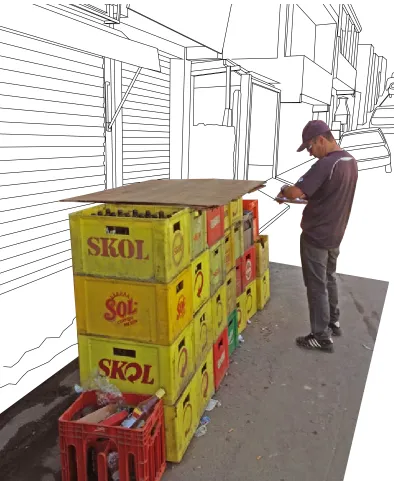
temporary. While the objects that occupy the right of way are not persistent, the patterns of acceptable interferences are. For instance, vehicles, both running and
broken-down, occupy significant space on
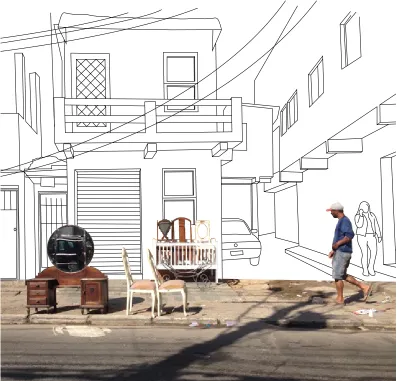
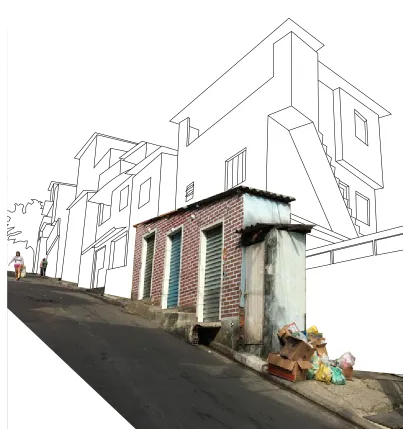
the sidewalks. There are frequent rows of cars that haven’t been moved in months in front of large, blank facades or trucks idling on the sidewalks while goods are unloaded. The sidewalks are also used as space to temporarily gather and store goods or construction supplies. Piles of bricks, empty bottles, and unwanted household goods are common sights. It seems to fall to the responsibility of the occupants of the blocked building to defend their sidewalk and advocate for their portion to
be cleared. These fluid conflicts are difficult
to regulate due to their unpredictability and short presence in a particular location. However, the multitude of occurrences that are present on every block add up to a phenomenon that is socially accepted within the neighborhood.
estate market exists, enabling current
residents to financially benefit from the
entrepreneurialism that occupies the right of way. Certainly, no public space is claimed without the notice of neighbors and community leaders, so it can be inferred that the appropriated spaces
provide some broader benefit that
outweighs the cost of the loss of public space. However, the holistic political and social structure within Paraisópolis is not made fully available to researchers for a variety of reasons, including censorship
of the flow of information both in and out
of the community, the desire to control outside resources to assert political power, and illegal businesses that wish to operate undisturbed.
My experience of growing to appreciate the diverse appropriation of Paraisópolis’ sidewalks was disorienting. While working as a designer, I measured buildings down to the half inch to avoid encroaching upon public easements. I held a strict reverence for the right of way that I found culturally inappropriate in Paraisópolis. I discovered that compromising public space both simultaneously hinders and creates a unique street life that residents value. On one hand, this practice can enable a social network for entrepreneurs through a row of tiny shops, a place for friends to greet each other over restaurant railings, and a buzz of activity and life that is unique to each favela. On the other hand, the trespass into public space further constrains the narrow streets, reducing access to space, light, and air. While the self-regulation of the encroachments is telling of the community’s value of public life, it is also indicative of unseen power dynamics that determine who, what, how, and for how long public space can be appropriated for private
DEVI
[image:4.540.72.466.68.549.2]NE
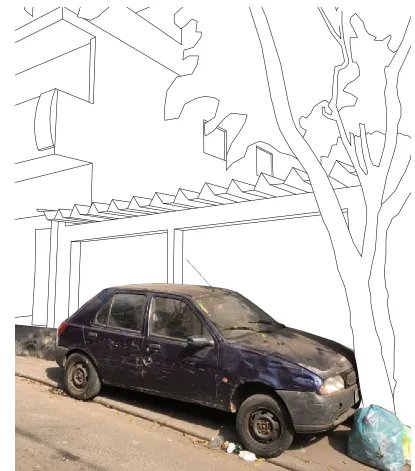
Figure 2: —FLUID CONFLICTS— A dusty, broken-down car has been abandoned in front of a home and appears to be blocking a garage. It doesn’t look like it has been moved in months and has trash around it. It is possible that the vehicle was taken out of the garage that it currently blocks. If so, the homeowner could then transform the former garage into living space. This process could be triggered by the family growing or deciding to rent the space for extra income. Either way, the old car occupies the public realm, and the possible freed interior space has been put to a higher use.
FL
UID C
ONFLIC
DEVI
[image:6.540.72.469.157.538.2]NE
ENDURING CONFLICTS
High land values within Paraisópolis are evident through the “for rent” signs posted on facades and the continued building construction that I observed. Increasing land value has residents and entrepreneurs craving more space to expand the
footprints of their shops or restaurants.
Commercial space is so profitable that tiny
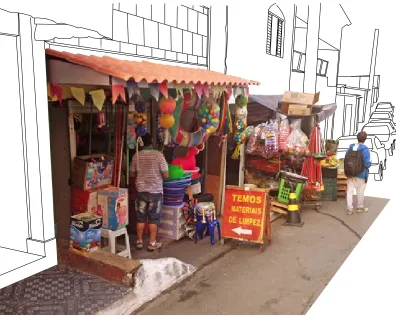
candy and electronic shops occupying only the sidewalks are common and successful. For larger shops, claiming the sidewalk in front of their business increases their usable space. The arrangements of who, when, and how the sidewalks can become permanently occupied by a built structure are unclear, but the practice seems to be sanctioned by the neighbors and residents who have political or social
influence. Permanently building on the sidewalks has a significant impact on
the urban experience because it further reduces the already-narrow streets. In a high-density neighborhood, the continued spatial appropriation of sidewalks gives a sense of increasing density and population capacity and changes the proportions of the urban street. However, due to their service-oriented functions, these businesses create an activated street and give the favela a unique character. Their presence and popularity suggest that the community
DEVI
[image:8.540.81.471.65.557.2]NE
Figure 5: —ENDURING CONFLICTS— Small candy and electronic shops are built in the narrow width of the sidewalk. This group of entrepreneurs has most likely made an arrangement with the owner of the home they block. A few possible scenarios are either that the stores are run by the family living behind them, creating a live/work space, or that the family “sold” its portion of the sidewalk for use by others. These little shops serve to create a micro-community, building ties among separate shop-owners and neighbors, while providing small-scale retail and income generation to residents.
ENDURING C
ONFLIC
DEVI
[image:10.540.65.470.240.540.2]NE
FLUIDLY ENDURING
CONFLICTS
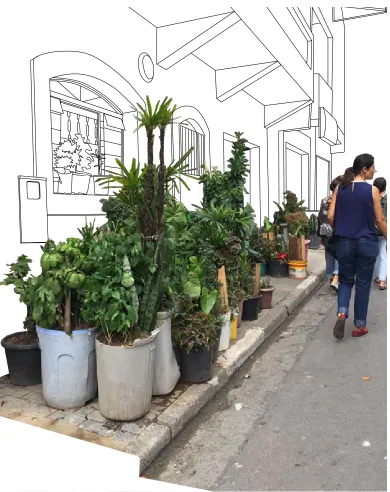
There are many hidden spatial
appropriation routines within the favela that have typical or predictable sites but are only temporarily occupied. These temporary appropriations conform to a routine that is tacitly agreed upon within the neighborhood. While the occupation is impermanent, the sites and available
goods and services of these conflicts are
consistent in the minds of the residents. While these encroachments leave no permanent physical artefacts, they are enduring within the collective mind of the community. They are routine and predictable but tentative encroachments that straddle both of the previous
DEVI
[image:12.540.71.467.64.536.2]NE
Figure 8: —FLUIDLY ENDURING CONFLICTS— Every day this DVD stand pops up and is operated by a variety of employees. The stand is located next to a popular appliance retailer and stakes a significant spatial claim. This spot is most likely coveted by other informal businesses for its prime location. An informal system of “rent” or site defense is probably in place. While this business is most likely lucrative, the cost of a permanent shop is out of the owners’ reach.
FL
UIDL
Y ENDURING C
ONFLIC
DEVI
[image:14.540.72.468.234.550.2]NE
CONCLUSION
My recognition and appreciation for the nuanced complexities that surround the varied spatial appropriations of sidewalks within Paraisópolis has shifted my design thinking. Researching both the costs and
benefits of this use pattern has made
me reconsider my own design ethics for public spaces to include room for informal appropriations of a variety of durations. While some of these practices appear to undermine public enjoyment, such as trash collections and old vehicles, the lively street culture and hum of retail activity are highly valued within this community. From the perspective of an outside researcher, however, investigating the possible power dynamics that enable and protect the disparate occupations of the sidewalks is an insightful strategy to better understand the
latent community dynamics. ■