2019 International Conference on Information Technology, Electrical and Electronic Engineering (ITEEE 2019) ISBN: 978-1-60595-606-0
The Application of Multi-source Data Verification and Validation
Technology in TT&C System
Zheng LIU
*, San-wen LI and Kai CHEN
China Satellite Tracking and Controlling Department, Jiangyin 214431, China
*Corresponding author
Keywords: TT&C, Multi-source Data, Verification and Validation.
Abstract. With the development of our country's aerospace industry, the unified TT&C system has been growing by focusing on the direction of automation and intensification, so as to meet the requirements of multi-targets and multi-models. As the recently adopted independent equipment surveillance collects limited information, it is hard to ensure that the status to be monitored in an all-round way and the malfunction to be analyzed at a fast speed. In this document, the whole system data collection function for the TT&C system has been fully utilized to conduct collection and analysis for a large number of real-time dynamic data with wide variety by combination of multi-source data integration theory, and has put the multi-source relationships into place and established the effective verification model, with the inspection of TT&C test, the comprehensive surveillance of the system working status and fast analysis and positioning of malfunction have been realized.
Introduction
Nowadays, the multi-targets TT&C has become a normal state for maritime TT&C test, however, with such influences as the relatively complicated installation location for responder antenna of various target and the adjustment of the target posture in the flight track during the multi-objective TT&C test, the state of various targets in relatively complicated during the test. Meanwhile, thanks to the complicated TT&C system equipment configuration and the connectivity among various subsystems, the rapid malfunction positioning and abnormal handling are unavailable upon abnormality occurs. At present, majority of the real-time surveillance of TT&C system equipment are carried out by the independent party, featuring complicated parameter status, easy to ignore abnormal information, and the information obtained from each subsystem only represents information shown on the current equipment interface, which usually reflects the working status of one target, the one information channel and one demodulation equipment. For instance, multi-stars entered into the interference zone in succession during a test, leading to the unstable signal, robust fluctuation of main tracked target data, it is unable to distinguish whether the target was abnormal or the equipment broke down, hence, the accuracy of judgment for the system working state could not be achieved [1]. By fully taking advantage of mutual validation function between data collection of overall TT&C system and data, and on the strength of redundant configuration of the system key components as well as various signal channel characteristics, this document compares different demodulation equipment in real-time manner to see the effects of their demodulation on signals upon making the different target configurations in the sky to go through the same signal channel or same target passing different signal channels, and has raised the multi-source data verification and validation method, which could detects the malfunction in signal channel and responder at a fast speed.
Studies on Multi-source Data Verification and Validation Method
Multi-source Concept
observation of multi variables, i.e. the concrete value for the multi-source sample. For the interconnected system involving many links, the deep analysis for the system situation could be conducted via collection of multi-source data and confirmation of the correct validation comparison rules. While the multi-source data verification and validation means that the multi-source sample value reflecting the same fact could be mutually verified and validated, multi-source data verification and validation is a process of inspection and analysis under certain principle and handling evaluation in a multilevel manner in many ways. By integrating data into local incomplete information collected from various channels and many aspects, removing the redundancy and contradiction among multi-source information and lowering the uncertainty through complementation, so the relatively integrity and consistency description for the system environment has been formed, in this way, the decision and planning made for the system have been improved, and reacting has been made more quickly and accurately, so as to reduce the risks in making decisions. The multi-source data verification and validation is not only targeted at analysis of information source features to deal with uncertainties, but build excellent relationships among the specific personnel, equipment, target and environment in terms of background of people requesting information and the circumstances [2].
Typical Form
In the case that the same input signal passes through different signal channels with same features, the output features shall be the same. The probability of error occurred at the same time is relatively low if the individual signal channel A and B is highly reliable respectively, when the signal of certain signal channel is normal, then the signal from another channel shall also be in a normal state. The above shows that the verification of signal channel a made to channel b has been done, as shown figure 1.
Channel a
Channel b
[image:2.595.189.409.388.446.2]signal a monitor
Figure 1. Verification mode between signal channels.
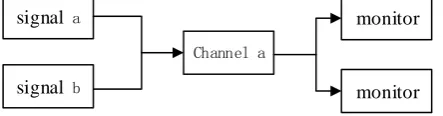
Upon the different input signals with same features passing through the same channel and on the condition that the output signal corresponds to one input signals is normal, then the output signal corresponds to another input signal has nothing to do with signal channel, but with the signal itself, which means verification of A signal made to signal B has been done, as shown in figure 2.
monitor
monitor
signal a
Channel a
signal b
Figure 2. Verification mode between signals.
As for the TT&C system, signal A and B could correspond to signals with different TT&C targets, such as satellite, rocket etc or correspond to different responders for the same satellite. The surveillance indicates that they could also correspond to the corresponding demodulation equipment or different demodulation channels. Meanwhile, as an important part of TT&C system, the reliability of the demodulation equipment itself is also faced with risks of working abnormality. Most of information shown on the demodulation equipment interface is subject to reporting system surveillance via network, which makes it possible for the status centralized surveillance to be conducted, at the same time, to ensure that the test could be completed by the system, redundant backup for some key components would be done via the TT&C equipment, facilitating the verification of multi-source data verification [3].
[image:2.595.189.411.542.600.2]device or equipment witnesses a downward trend, signal could still be demodulated through demodulation equipment interface. Under the circumstances that the key technical index is lower than that under normal state, it is not easy for the operator to detect the malfunction part. Some parameters in demodulation equipment could reflect the equipment working state and signals, which also serve as the basis of verification and validation.
Verification and Validation
With reference to the verification of signal itself, it places emphasis on the comparison between the actual value and theory value, and the state keeps changing during the test, especially at the arc segment with many measurements conducted, featuring fast changing rate and high demand for emergency response, so it is essential to conduct feature analysis beforehand and acquire the latest theory value based on real time update of the target features, obtain the actual value of the corresponding parameters pursuant to method for acquiring target feature parameters, and set the corresponding threshold range to prepare corresponding emergency responds scheme and form the application model for self verification and emergency response, for example, the relations between Doppler frequency and targeted speed in theory manner, so as to guide the relations between the distance value and actual measured distance value.
Faced with the complicated numerous multi-source date, the data acquired through different channels needs to be gone through integration treatment, and construct the correlation of different channels in light of association relationship among the obtained parameters, the relationship in the aspects of cause and effect, sequence, concurrency, mutual exclusion and space. In the wake of constructing verification relationship for the TT&C system, it could determine the working state of the related target and equipment by collecting and comparing the data results of these verification relations. In the case that the equipment data with same target signal is withdrew and demodulated and subjects to normal demodulation with signals from other signal channel, it is possible to make fast judgment that the signal channel see the performance degradation if one signal data is relatively low, when the signal with same targets for the whole demodulation equipments enjoys normal state, the various target situations under the same channel have reflected the signals of the target [4].
The Surveillance Judgment of System Design from TT&C System
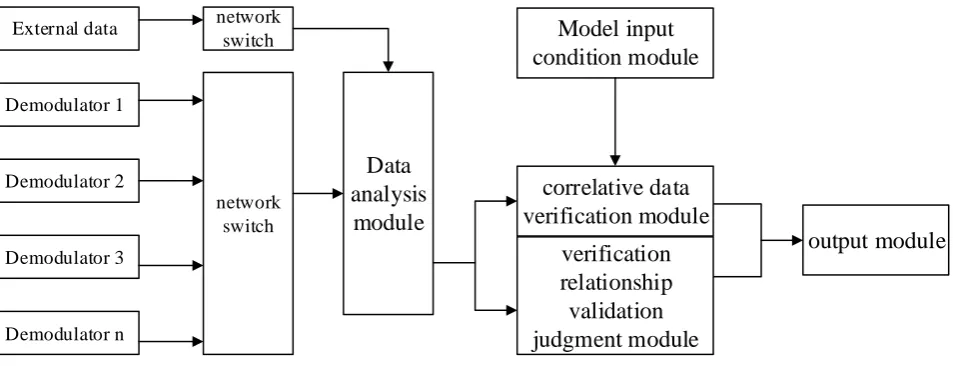
On the basis of the establishment of multi-source data verification model of TT&C system and the confirmation of such verification, the purpose of surveillance the state of TT&C system and self judgment and malfunction positioning could be achieved by the visualized software design. The design method of the system could be divided into the following steps, namely obtaining the equipment related information and exterior data for the system from the local area network and the surveillance network before reporting to verification module for the correlative data verification upon analysis to make determination for the verification relationship, then the final output results shall be submitted to operator for references, as shown in figure 3.
Data analysis module: collects the surveillance information from various equipments by using the surveillance software, and analyzes the necessary key parameter status information from the state reported by demodulation equipment.
Model input condition module: As the target numbers and features for each test are different, it is essential to establish the corresponding verification relationship model in terms of the actual configuration strategy and make it as the input condition for the verification and validation judgment module.
comparison validation for each verification relationship according to the various surveillance equipment status and input model condition.
Demodulator 1
Demodulator 2
Demodulator 3
Demodulator n
External data network
switch
network switch
Data analysis
module
correlative data verification module
verification relationship validation judgment module
Model input condition module
[image:4.595.63.540.105.288.2]output module
Figure 3. Multi-source data verification and validation system design.
Application Analysis
Since the low response to the status change has made the test date abnormal so far in the course of test, the requirements for status change needs to be explored in depth, which could not only enhance the forming of precise decision requirements, but largely satisfy the decision requirements for the status change and boost the rapid response to the status change, in a bid to minimize the losses caused by the change of status. Facing a large quantity of correlative and complicated multi-source date and with the help of the reliability and problem solving capacity of multi-source data verification and validation, it is essential to construct the multi-source date verification model and quantify the correlation degree of various data by making use of self verification and comparison verification as well as normalization. In the aspect of status surveillance, signal to noise ratio of various targets shall be indicated in the form of curve graph for the different target status with same signal channel in terms of requirements during certain test, in this way, facilitating the real-time accurate surveillance of the signal fluctuation process for various targets and providing basis for the implementation of switch of tracking target.
Summary
References
[1] Jiaxing Liu, Spacecraft TT&C and Information Transmission Technology, National Defend Industry Press, Beijing, 2011.
[2] Qian Song, Recent Progresses in Research of Integrating Multi-Source remote Sensing Data for Crop Mapping, J. Scientia Agricultura Sinica. 6 (2015) 1122-1135.
[3] Ruimin Li, Study on Methods of Travel Time Estimation Based on Multi-source Data Fusion, J. Journal of Highway and TransportationResearch and Development. 2 (2014) 99-103.