Generalized class of composite method of
estimation for crop acreage in small
domain
Pandey, Krishan and Tikkiwal, G.C.
University of Petroleum Energy Studies, Dehradun, India, J.N.V.
University, Jodhpur, Rajasthan
12 November 2010
Online at
https://mpra.ub.uni-muenchen.de/37163/
ISSN 0973 - 2675 Volume 5, Number 3 (2010), pp. 319–333 © Research India Publications
http://www.ripublication.com/ijss.htm
The Generalized Class of Composite Method of
Estimation for Crop Acreage in
Small Domain
Krishan K. Pandey1 and G.C. Tikkiwal2
1
College of Management & Economic Studies, University of Petroleum & Energy Studies, Dehradun- 248007, India
2
Department of Mathematics & Statistics, J.N.V. University, Jodhpur, Rajasthan -342011, India
Abstract
This paper defines and discusses a generalized class of composite estimators for small domains, using auxiliary information, under systematic sampling scheme. The generalized class of composite estimators, among others, includes a number of direct, synthetic and composite estimators. Further, it demonstrates the use of the estimators belonging to the generalized class for estimating crop acreage for small domains and also compares their relative performance with the corresponding direct and synthetic estimators, through a simulation study.
Key words: Inspector Land Revenue Circles (ILRCs), Timely Reporting Scheme (TRS), Absolute Relative Bias (ARB), Simulated relative standard error (Srse), Simulation-Cum-Regression (SICURE) model.
Introduction
and alternative estimators are also termed, in the literature of small area estimation, respectively as direct and indirect estimators.
It is evident that at some point, as the sample size in a small area increases, a direct estimator becomes more desirable than a synthetic one. This is true whether or not the sample was designed to produce estimates for small areas.
Gonzalez (1973), Ghangurde and Singh (1977, 78), Tikkiwal, G.C. and Pandey, K.K. (2006, 07), among others have studed the synthetic estimator based on auxiliary variables viz. the ratio synthetic estimator. These studies show that synthetic estimators provide reliable estimates to some extent.
Gonzalez, Waksberg (1973) and Schaible, Brock, Casady, Schnack (1977) studied errors of synthetic and direct estimates for standard metropolitan statistical areas and Counties of United State of America. The authors of both the papers conclude that when in small domains sample sizes are relatively small the synthetic estimator outperforms the simple direct; whereas, when sample sizes are large the direct outperforms the synthetic. These results suggest that a weighted sum of these two estimators, known as composite estimator, can provide an alternative to choose one over the other. In general, a composite estimator may be defined as follows:
(
)
, , 1 ,
c a a d a a syn a
y =w y + −w y
Where yd a, is a direct estimator and ysyn a, is a synthetic estimator of Ya, the
population mean of small area ‘a’ and w aa( =1,..., )A are suitably chosen weights. Here yc a, is a model dependent estimator as it is a combination of design-based
estimator yd a, and model dependent design based estimator ysyn a, [Cf. Sarndal
(1984)]. The optimal values wa' of wa may be obtained by minimizing the mean
square error of yc a, with respect to wa and it is given by
(
)
(
)(
)
(
)
(
)
(
)(
)
, , ,
'
, , 2 , ,
syn a d a a syn a a a
d a syn a d a a syn a a
MSE y E y Y y Y
w
MSE y MSE y E y Y y Y
− − −
=
+ − − −
It can be seen in many practical situation E y
(
d a, −Ya)(
ysyn a, −Ya)
is small relativeto MSE y
(
syn a,)
, wa' becomes more manageable. In this case wa' may be approximated by(
)
(
)
(
)
, '
, ,
1 1 syn a
a
a d a syn a
MSE y w
F
MSE y MSE y
= =
+
+ , Where
(
)
(
)
,
,
d a a
syn a
MSE y F
MSE y
=
The weights wa* can be estimated by replacing the mean square errors of yd a, and
,
syn a
y by their usual estimates, i.e. * , ,
, , ,
( ) ˆ
( ) ( )
syn r a a
d a syn r a
mse y w
v y mse y
=
+
Further Schaible (1978) proposed a modified “average” weighting scheme based on several weighting variables under their different models.
being operationally more convenient in practice, is often used in large – scale field surveys under multistage design. In such survey, like crop acreage surveys in India, ultimate stage of smapling units like villages / households / agricultural fields etc. are selected by systematic smapling scheme. Systematic sampling scheme, apart from operationally more convinient, provides more efficient estimators under certain conditions [Cf. Cochran (1977), Sukhatme et al (1984), Madow (1946) & Osborne, J.G. (1942)].
Formulation of the problem & Notations
Let us suppose that we have a finite population U = (1,…, i ,….N) which is divided into ‘A’ non-overlapping small areas Ua of size Na (a = 1,…., A) for which estimates are required. Let the characteristic under study is denoted by ‘y’ and also assume that the auxiliary information is available which is denoted by ‘x’. Suppose the population units in small area ‘a’ are numbered 1 to Na i.e. Ua =(1,...,Na) and na units are to be selected by systematic sampling scheme. A systematic sample
of size na is selected from each small area ‘a’, (a = 1,….., A) either (i) by linear
systematic sampling scheme, (when Na =n ka a, ka being an integer) or (ii) by circular systematic sampling scheme, ( when Na ≠n ka a). Consequently,
a A
a
N N
=
∑
=1
and
1
a a
n n
=
=
∑
,Further, the various population and sample means for characteristic Z = X, Y can be defined as:
Z = Mean of the population based on Nobservations.
a
Z = Population mean of domain ‘a’ based on Naobservations.
z = Mean of the sample ‘s’ based on nobservations.
a
z = Sample mean of domain ‘a’ based on na observations.
Case (i): For the case Na =n ka a i.e. for linear systematic sampling scheme,
arrange the population units into n ka a arrays and select a random number, say, i between 1 and ka then every kath unit thereafter. So the sample consist na units from
( )
a a a
N =n k units, and the sample is { ,i i+ka,...,i+(na−1) }.ka The number i, is called random start and ka is the sampling interval. Further, let zai j denotes the value of the auxiliary variate and characteristic under study of z=x y, respectively for the jth unit of the ith sample bearing serial number
i +(j-1) ka , i =1,..., ka ; j =1,..., na . Therefore,
1
a ai j
i j a
Z z
N
=
∑∑
, .1
1 na
ai ai j j a
z z
n =
=
∑
= mean of the ith systematic sample ofVarious mean squares and coefficient of variations of subpopulation, ‘Ua’ for characteristic z=x y, is denoted by
2 2 . 1 1 ( ) 1 a a k
z ai a
i a
S z Z
k = = − −
∑
, a a z z a S C Z =The coefficient of covariance between X and Y is denoted by
a a a a x y x y a a S C X Y
= , where . .
1 1 ( )( ) 1 a a a k
x y ai a ai a
i a
S y Y x X
k =
= − −
−
∑
Case (ii): For the case Na ≠n ka a i.e. for those small areas where Na na is not an integer but ka is the integer nearest toNa na, Lahiri (1954) suggested to use circular systematic sampling scheme. Here in this case a random number is chosen from 1 to
a
N and the units corresponding to this random number are chosen as the random
start. There after every kath unit is chosen in a cyclic manner till a sample of na units is selected. Thus if i is a number selected at random from 1 to Na, the sample consists of units corresponding to these numbers are
{i+(j−1) }ka if i+(j−1)ka ≤Na
{i+(j−1)ka−Na} if i+(j−1)ka >Na , j =1,2,…….., na
Further, suppose that zai j denotes, the value of the auxiliary variate and characteristic under study of z=x y, respectively for the jth unit of the ith sample bearing the number {i+(j−1) }ka or {i+(j−1)ka−Na} as the case may be for
1, 2,..., a.
j= n The various mean squares and coefficient of variations of sub population ‘Ua’ for characteristics z=x y, is given as below:
2 2 1 . 1 1 ( ) 1 a a N
z ai a
i a
S z Z
N = = − −
∑
, 2 1 2 1 2 a a z z a S C Z =The coefficient of covariance between X and Y is denoted by
1 1 a a a a x y x y a a S C X Y
= , where 1 . 2 . 2
1 1 ( ) ( ) 1 a a a N
x y ai a ai a
i a
S y Y x X
N =
= − −
−
∑
A Generalized class of composite estimators
Following Tikkiwal and Pandey (2007), we, in this section, define a generalized class of composite estimators of population mean Ya based on auxiliary variable ‘x’ under systematic sampling scheme, as follows;
(
)
.
, . 1
ai w
c g a ai a w
a a
x x
y w y w y
X X
α β
= + −
… (3.1)
well for fairly big range of values of α [Srivastava (1967)], and the generalized synthetic estimators ys a, given by Tikkiwal & Ghiya (2004) defined as below:
. , .
G ai
d a ai a
x
y y
X
α
=
… (3.2)
and
,
w s a w
a
x
y y
X
β
=
… (3.3)
The proposed generalized class of composite estimators includes a number of direct, synthetic and composite estimators as special cases. The Table (3.1) shows a list of such estimators with corresponding choice of values of the different constants.
Table: 3.1: Various Direct & Indirect Estimators as special case of the generalized class of composite estimators.
No. Estimator wa (1−wa) α β
1. Simple Direct (yaii) 1 0 0 -
2. Simple Synthetic (yw) 0 1 - 0
3. Simple Ratio (( / ) ai ai a
y i x i X ) 1 0 -1 -
4. Ratio Synthetic (( / ) w w a
y x X ) 0 1 - -1
5. Simple Product (( / ) ai a ai
x i X y i) 1 0 1 -
6. Product Synthetic (( / ) w a w
y X x ) 0 1 - 1
7. Composite: combining simple direct with simple synthetic (w ya aii+(1−w ya) w)
a
w (1−wa) 0 0
8. Composite: combining simple direct with ratio
synthetic ( (1 ) w
a ai a a
w
y
w y w X
x
+ −
i )
a
w (1−wa) 0 -1
9. Composite: combining simple ratio with ratio
synthetic ( ai (1 ) w
a a a a
ai w
y y
w X w X
x x
+ −
i
i
)
a
w (1−wa) -1 -1
The estimator given in (3.1) perform well under the following condition,
( )
( )a a
It is noted that the composite estimator yc g, is consistent; if the condition given in (3.4) is satisfied.
Design Bias and Mean Square Error
The design bias of the composite estimator yc g, , is given by
(
,)
(
,)
(
,)
(
1)
(
,)
G
c g c g a a d a a s a
B y =E y −Y =w B y + −w B y … (4.1)
Where B
( )
yGd,a for the case of linear systematic sampling schemen, is given as follows;(
)
(
)
(
)
2,
1 1
2
a a a
a G
d a a x y x
a
k
B y Y C C
k α α α − − = +
… (4.2)
and for the case of circular systematic sampling scheme the expression is as follows;
(
)
(
)
(
)
2, 1 1
1 1
2
a a a
a G
d a a x y x
a
N
B y Y C C
N α α α − − = +
… (4.3)
The bias of the estimator ys a, is given by
(
)
' 2(
)
'' 2(
)
1,
1 1
1 a y xa a a y xa a
s a a a
a
a a a a a a a
S S
k N
x
B y Y p p
X k X Y N X Y
β β − − = + +
∑
∑
(
)
(
)
2(
)
2'' 1
' 2 2
2 2
1 1 1
2
a a
x x
a a
a a a
a a a a a
S S
k N
p p Y
k X N X
β β− − −
+ + −
∑
∑
… (4.4)
Where
∑
' denotes the summation over those small areas, whereNa =n ka a, and''
∑
denotes summation over those small areas whereNa ≠n ka a. Further mean square error of yc,g is given by(
)
2(
)
(
)
2(
)
(
)
(
)
(
)
, , 1 , 2 1 , ,
G G
c g a d a a s a a a d a a s a a
MSE y =w MSE y + −w MSE y + w −w E y −Y y −Y
Now under the condition that the covariance term ( G, )( , ) d a a s a a
E y −Y y −Y is small relative to MSE y( s a, ), as discussed in Section 1, the above expression of MSE y
(
c g,)
,can be written as MSE y
(
c g,)
=w MSE ya*2(
d aG,) (
+ 1−wa*)
2MSE y(
s a,)
. . . (4.5) Where expression of ( G, )d a
MSE y is given under linear & circular systematic
sampling scheme, respectively as follows;
2 2 2 2
,
( 1)
( ) 2
a a a a
G a
d a a y x x y
a
k
MSE y Y C C C
k α α
−
= + + . . . (4.6)
and ( , ) 2 ( 1) 12 2 12 2 1
a a a a
G a
d a a y x x y
a
N
MSE y Y C C C
N α α
−
Which is minimum if a a2 a x y x C C
α = − [ Cf. Srivastava (1967)]. Further, design bias
and mean square error of generalized synthetic estimator ys a, , is given as follows;
(
)
' 2 '' 2 1
,
1 ( 1)
( ) a y xa a a x ya a
s a a a a a a
a a
S S
k N
B y Y p p
k X Y N X Y
β
− −
= +
∑
∑
(
)
2 2' 2 '' 2 1
2 2
1 ( 1)
( 1) 2 a a x x a a a a a a a a S S k N p p
k X N X
β β− − −
+ +
∑
∑
... (4.8) And(
)
2 2 2
' '' 1
2 2 2 2
, , 2 2
1
(
1)
(
)
(
)
1
a ya a yas a s a a a a a a
a a a
S
S
k
N
X
MSE y
E y
Y
Y
p
p
X
k
Y
N
Y
β
−
−
=
−
=
+
+
∑
∑
(
)
2 2' 2 '' 2 1
2 2
1 ( 1)
(2 1) a xa a xa
a a a a a a S S k N p p
k X N X
β β − −
+ − +
∑
∑
(
)
' 2 1 '' 2( 1) 1
4 a y xa a a x ya a
a a a a a a S S k N p p
k X Y N X Y
β − − + +
∑
∑
(
)
' '' 1
2 2 1 2( 1)
2 1 a y xa a a y xa a
a a a a a a
a a a
S S
k N
X
Y Y Y p p
X k X Y N X Y
β β − − + − + +
∑
∑
(
)
2 2' 2 '' 2 1
2 2
1 ( 1)
( 1) 2 a a x x a a a a a a a a S S k N p p
k X N X
β β− − −
+ +
∑
∑
… (4.9)The suitable value of β is the one for MSE y( s a, ) is minimum. So minimizing the
,
( s a)
MSE y with respect to β, gives simplified expression of β , which is given as follows;
(
)
(
)
' 2 '' 2 1
2 2
' 2 '' 2 1
2 2
1 ( 1)
1 ( 1)
a a a a
a a
y x x y
a a a a a a a a x x a a a a a a a a S S k N p p
k X Y N X Y
S S
k N
p p
k X N X
β
− − − + = − − + ∑
∑
∑
∑
… (4.10)Estimation of MSE of composite estimator under systematic
sampling scheme
random and for lack of knowing what else to do, estimate the variance using simple random sample formulae. Unfortunately, if followed indiscriminately this practice can lead to badly biased estimators and incorrect inferences concerning the population parameters of interest. Wolter (1984) investigated several biased estimators of variances with a goal of providing some guidance about when a given estimator may be more appropriate than other estimators. The criterion to judge the various estimators on the basis of their bias, their mean square error, and proportion of confidence interval formed using the variance estimators which contain the true population parameter of interest. This study suggests the use of biased but simple estimator v2y for (V yaii), when sample size is very small for both the situations viz.,
when Na =n ka a and Na ≠n ka a. The expression of v2y is given as follows; 2
2
2 1
(1 )
2( 1)
a
n
i j y
j
a a
a
v f
n = n
= −
−
∑
… (5.1), 1
i j i j i j i j
a a
where a y y y
n
and f
N
−
= Δ = −
=
… (5.2)
Similarly estimate of V x( ai.)is given by v2x, where 2
2
2 1
(1 )
2( 1)
a
n
i j x
j
a a
b
v f
n = n
= −
−
∑
… (5.3), 1
i j i j i j i j a
a
where b x x x
n and f
N
−
= Δ = −
=
… (5.4)
We note that above estimators v2y and v2x are based on overlapping differences of
i j
y
Δ &Δxi j respectively. Further, the estimate of covariance term between yai. and
.
ai
x , given by Swain (1964), is
2 2 ˆ ( ai , ai ) y x
Cov y i x i =r v v … (5.5)
Where r is correlation coefficient between x and y observations based on the sample of size na.
Estimation of mean square error of direct estimator
Following Srivastava (1967), the generalized class of direct estimators of Ya under
systematic sampling scheme is . , .
G ai
d a ai a
x
y y
X
α
=
. Its mean square under case (i) is
2 2 ,
( d aG ) ( ai ) a ( ai ) 2 a ( ai , ai )
Where a a
a
Y R
X
= . Thus a consistent estimator of ( , )
G d a
MSE y is given by
2 2
, 2 2 2 2
(
d ag)
y a x2
a y xmse y
=
v
+
α
r v
+
α
r r v v
… (5.7)Where a a a
y
r
x
=
is the ratio of sample means. It is also observed that the meansquare error for direct estimator in case of circular systematic sampling is given by
(
)
2 2, ( ) ( ) 2 ( , )
G
d a c ai c a ai c a ai ai c
MSE y =V y i +α R V x i + αR Cov y i x i … (5.8)
Thus consistent estimator of
(
d aG,)
cMSE y is given by
' 2 2 ' ' '
, 2 2 2 2
( d a cg ) y a x 2 a y x
mse y =v +
α
r v +α
r r v v … (5.9)Where ' 2y
v and ' 2x
v are the estimates of variances of (V yaii)c and (V xaii)c respectively in case of circular systematic sampling design. To be calculate similarly as of v2x and v2y.
Estimation of mean square error of synthetic estimator
The expression for the Mean Square Error given in (4.9), can be approximated under the synthetic condition given in (3.4) as follows;
{
}
' 2 ' ' 2 2 2 ' 2 ' ' 2
,
( s a) a ( ai ) a ( ai )c a a ( ai ) a ( ai )c
a a a a
MSE y =
∑
p V y i +∑
p V y i +β R∑
p V x i +∑
p V x i{
' 2 ' ' 2}
2 a a ( ai , ai ) a ( ai, ai )c
a a
R p Cov y x p Cov y x
β
+
∑
i i +∑
i i … (5.10)Thus a consistent estimator of MSE y( s a, ) is given by
{
' 2 ' ' 2 '}
2 2{
' 2 ' ' 2 '}
, 2 2 2 2
( s a) a y a y a a x a x
a a a a
mse y =
∑
p v +∑
p v +β
r∑
p v +∑
p v{
' 2 ' ' 2 ' '}
2 2 2 2
2
β
ra a p r v va y x a p r v va y x+
∑
+∑
… (5.11)Where a a a
y
r
x
=
is the ratio of sample means.Crop Acreage Estimation for Small Domains - A Simulation Study
This section demonstrates the use of the generalized class of composite estimatoryc,g,
Existing methodology for estimation
In order to improve timelines and quality of crop acreage statistics, Timely Reporting Scheme (TRS) is used by most of the States of India. The TRS has the objective of providing quick and reliable estimates of crop acreage statistics and there-by production of the principle crops (i.e. Jowar, Bajra, Maize etc.) during each agricultural season. Under the scheme, the Patwari (Village Accountant) is required to collect acreage statistics on a priority basis in a 20 percent sample of villages, selected by stratified linear systematic sampling design taking Tehsil (a sub-division of the District) as a stratum. These statistics are further used to provide state level estimates using direct estimators viz. unbiased (based on sample mean) and ratio estimators.
Details of the Simulation Study
For collection of revenue and administrative purposes, the State of Rajasthan, like most of the other states of India, is divided into a number of districts. Further, each district is divided into a number of Tehsils and each Tehsil is also divided into a number of Inspector Land Revenue Circles (ILRCs). Each ILRC consists of a number of villages. For the present study, we take ILRCs as small domains.
[image:11.595.89.508.532.704.2]In the simulation study, we undertake the problem of crop acreage estimation for all Inspector Land Revenue Circles (ILRCs) of Jodhpur Tehsil of Rajasthan. They are seven in number and these ILRCs contain respectively 29, 44, 32, 30, 33, 40 and 44 villages. These ILRCs are small domains from the TRS point of view. The crop under consideration is Bajra (Indian corn or millet) for the agriculture season 1993-94. The Bajra crop acreage for agriculture season 1992-93 is taken as the auxiliary characteristic x. The various information regarding the ILRCs of Jodhpur Tehsil are provided in the Table 6.2.1.
Table 6.2.1: Total Area (Irrigated and Unirrigated) under Bajara Crop in Inspector Land Revenue Circles (ILRCs) of Jodhpur Tehsil for Agricultural seasons 1992-93 and 1993-94.
S.No ILRCs of Jodhpur Tehsil
No. of villages in ILRC
Total
area(Irr.+U.Irr.) under the crop Bajra in 1992-93
Total
area(Irr.+U.Irr.) under the crop Bajra in 1993-94 1
2 3 4 5 6 7
Jodhpur (1) Keru (2) Dhundhada (3) Bisalpur (4) Luni (5) Dhava (6)
Jajawal Kalan (7) 29 44 32 30 33 40 44
7799.5899 21209.5880 19019.0288 15153.9248 19570.1323 25940.0979 18007.4120
5696.5000 15699.6656 16476.4863 14269.0000 16821.4508 25075.5000 15875.0000
Total 252 126699.7737 109913.6027
(1) Direct ratio estimator . 1, , ,
.
ˆ ai
a a d r a a a ai
y
T N y N X
x
= =
Where .
1
1 na
ai ai j j a
y y
n =
=
∑
; and .1
1 na
ai ai j j a
x x
n =
=
∑
(2) Ratio synthetic estimator ˆ2, , , w a a s r a a a
w
y
T N y N X
x
= =
Where, yw =
∑
' p ya ai.+∑
" p ya ai.And, xw =
∑
' p xa ai.+∑
" p xa ai.(3) Composite estimator (a weighted average of simple direct and synthetic ratio estimators)
3, , , , , .
ˆ (1 ) (1 ) a
a a a d s a a s r a a a ai a w w
X
T N w y w y N w y w y
x
= + − = + −
(4) Composite estimator (a weighted average of direct ratio and synthetic ratio estimators)
.
4, , , , ,
.
ˆ (1 ) ai (1 ) w
a a a d r a a s r a a a a a a
ai w
y y
T N w y w y N w X w X
x x
⎡ ⎛ ⎞ ⎛ ⎞ ⎤
⎡ ⎤
= ⎣ + − ⎦= ⎢ ⎜ ⎟ + − ⎜ ⎟ ⎥
⎝ ⎠ ⎝ ⎠
⎣ ⎦
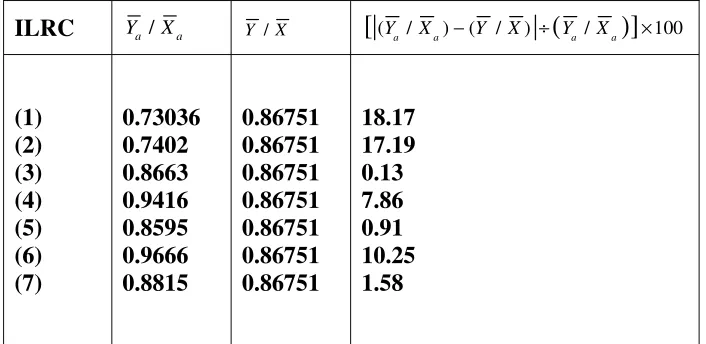
[image:12.595.122.475.534.706.2]Prior to simulation, we examine the condition of generalized synthetic and synthetic ratio estimators as given in Eq. (3.4). These results are presented in following tables 6.2.2 & 6.2.3 respectively. We note that both the above conditions meet for ILRCs (3), (5), (7) deviate moderality for ILRCs (4) & (6) and deviate considerably for ILRC (7).
Table 6.2.2: Absolute Differences (Relative) under Synthetic Assumption of Synthetic Ratio Estimator for Various ILRCs.
ILRC Ya /Xa Y /X
[
(Ya /Xa)−(Y /X) ÷(
Ya /Xa)
]
×100(1) (2) (3) (4) (5) (6) (7)
0.73036 0.7402 0.8663 0.9416 0.8595 0.9666 0.8815
0.86751 0.86751 0.86751 0.86751 0.86751 0.86751 0.86751
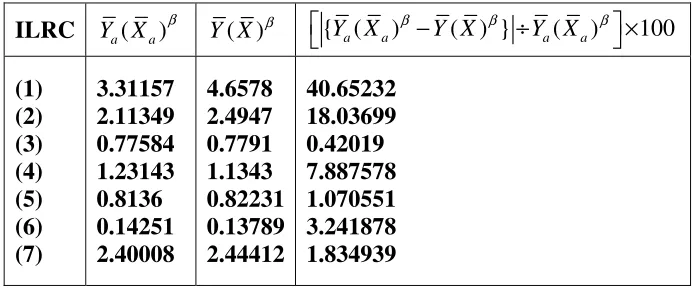
Table 6.2.3: Absolute Differences under Synthetic Assumption of Generalized Synthetic Estimator for Various ILRCs.
ILRC Y Xa( a)β Y X( )β { (Y Xa a)β −Y X( ) }β ÷Y Xa( a)β×100
(1) (2) (3) (4) (5) (6) (7)
3.31157 2.11349 0.77584 1.23143 0.8136 0.14251 2.40008
4.6578 2.4947 0.7791 1.1343 0.82231 0.13789 2.44412
40.65232 18.03699 0.42019 7.887578 1.070551 3.241878 1.834939
Now for simulation study, [Length of simulation is estimated with the help of concept discussed by Whitt, W. (1989) & Murphy, K.E. Carter, C.M. & Wolfe, L. H. (2001), based on the steady state condition] taking villages as sampling units, 500 independent systematic samples each of size 25, 50, 63, 76 and 88 are selected by the procedure described in section 2 from the population of 252 villages of Jodhpur Tehsil. That is selecting approximately 10 percent, 20 percent, 25 percent, 30 percent and 35 percent villages independly form each ILRC. For each small area estimator under consideration and for each sample size we compute Absolute Relative Bias (ARB) and Average Square Error (ASE), as defined below.
500
, 1 ,
1 ˆ
500 ˆ
( ) 100
s k a a s
k a
a
T T
ARB T
T
=
−
= ×
∑
... (6.1)
and , ,
, ˆ
( )
ˆ
( ) 100
ˆ
( )
k a k a
k a ASE T Srse T
E T
= × ... (6.2)
Where
(
)
500 2
, ,
1
1
ˆ ˆ
( ) 500
s
k a k a a
s
ASE T T T
=
=
∑
− and500
, ,
1
1
ˆ ˆ
( ) 500
s
k a k a
s
E T T
=
=
∑
For k = 1,……,4 and a =1,……., 7.
Where, subscript ‘k’ is used for a particular small area estimator and subscript ‘a’ is for a particular ILRC.
Results & Conclusion
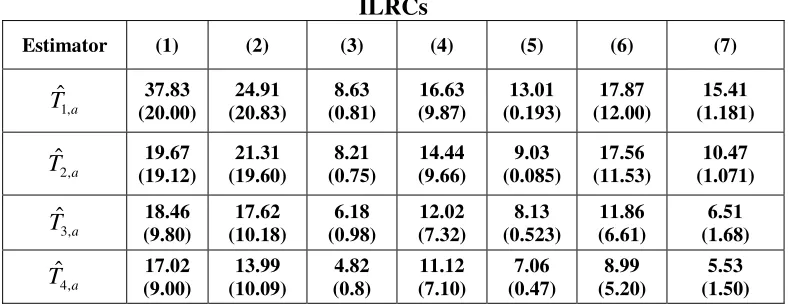
We present the results of ARB and Srse in Table (6.3.1) only for n=50, (a sample of 20 percent villages, as presently adopted in TRS) as the findings from other tables are similar.
We note from the table that none of the estimators satisfy the rule in ILRCs 1 and 2. This may be because, in these circles, there is considerable deviation from the synthetic condition, as observed earlier.
Table 6.3.1: Simulated relative standard error (in %) and Absolute Relative Bias (in %) for various ILRCs under SRSWOR scheme, for n = 50.
ILRCs
Estimator (1) (2) (3) (4) (5) (6) (7)
1,
ˆ a
T 37.83
(20.00)
24.91 (20.83)
8.63 (0.81)
16.63 (9.87)
13.01 (0.193)
17.87 (12.00)
15.41 (1.181)
2,
ˆ a
T 19.67
(19.12)
21.31 (19.60)
8.21 (0.75)
14.44 (9.66)
9.03 (0.085)
17.56 (11.53)
10.47 (1.071)
3,
ˆ a
T 18.46
(9.80)
17.62 (10.18)
6.18 (0.98)
12.02 (7.32)
8.13 (0.523)
11.86 (6.61)
6.51 (1.68)
4,
ˆ a
T (9.00) 17.02 (10.09) 13.99 (0.8) 4.82 (7.10) 11.12 (0.47) 7.06 (5.20) 8.99 (1.50) 5.53
(Note: The figures shown in parentheses are the Absolute Relative Biases in percentage.)
In ILRCs 4 and 6, where the condition deviate moderately, Tˆ4,a alone satisfies the
rule to some extent. In ILRCs 3, 5 and 7, where the synthetic condition closely meet, both Tˆ3,a and Tˆ4,a satisfy the rule but Tˆ4,a’s performance is slightly better than Tˆ3,a.
Finally, in view of the above discussion, it is recommended that the use of composite estimator Tˆ4,a (which is a weighted sum of direct ratio and ratio synthetic
estimators), for crop acreage estimation for small domains like ILRCs, tehsils and districts under the TRS scheme, for the cases where the synthetic assumption is satisfied. For other cases we suggest to investigate SICURE model or Bayesian approach to small area estimation problems.
Reference
[1] Cochran, W.G. (1977). “Sampling Techniques”, Wiley & Sons.
[2] Ghangurde, P.D. and Singh, M.P. (1978). “Evaluation of efficiency of
synthetic estimates”, Proceeding of the Social Statistical Section of the
American Statistical Association, 53-61.
[3] Ghangurde, P.D. & Singh, M.P. (1977). “Synthetic estimates in periodic
[4] Gonzalez, M.E. (1973). “Use and evaluation of synthetic estimates”,
Proceedings of the social statistical section of American Statistical Association, 33-36.
[5] Gonzalez, N.E. and Waksberg, J.(1973). “Estimation of the error of synthetic
estimates”, Paper presented at first meeting of international association of
survey statisticians, Vienna, Austria, 18-25.
[6] Lahiri, D.B. (1954).“On the question of bias of systematic sampling”, Proceedings of the world Population Conference, 6, 349-62.
[7] Madow, L.H. (1946).“Systematic sampling and its relation to other sampling
designs”, Journal of American Statistical Association 41:204-217.
[8] Murphy, K.E. Carter, C.M. & Wolfe, L.H. (2001). “How long should I simulate, and for how many trials?A practical guide to reliability
simulations”,Reliability and Maintainability Symposium, 2001, Proceedings,
Philadelphia, p.p. 207-212.
[9] Osborne, J.G. (1942).“Sampling errors of systematic & random survey of
covertype areas”, Journal of American Statistical Association 37:256-264.
[10] Purcell, N.J. and Kish, L. (1979). “Estimation for small domain”. Biometrics, 35, 365-384.
[11] Sarndal, C. E.,(1984). “Design- consistent versus model-dependent estimation
for small domains”, Jour. Amer. Stat. Assoc.,79, 624-31.
[12] Schaible, W.L., Brock, D.B., Casady, R.J. and Schnack, G.A. (1977). “An empirical comparison of the simple synthetic and composite estimators for
small area statistics”, Proceedings of Amer. Statist. Assoc., Social Statistics
section 1017-1021.
[13] Schaible, W.L. (1978). “Choosing weights for composite estimators for small
area statistics”, Proceedings of the survey research methods section, Amer.
Statist. Assoc., Washington. D.C., 741-746.
[14] Srivastava, S.K. (1967). “An estimator using auxiliary information in sample
surveys”, Calcutta Statist. Assoc. Bull. , 121-132.
[15] Sukhatme, P. V. Sukhatme, B. V., Sukhatme, S. and Asok, C. (1984).
“Sampling Theory of Surveys with Applications (3rd Edition)”, Indian Society
of Agricultural Statistics, New Delhi.
[16] Swain, A.K.P.C. (1964).“The use of systematic sampling in ratio estimates”, JISA, 2, 160-164.
[17] Tikkiwal, G.C. and Ghiya A. (2000). “A generalized class of synthetic
estimators with application of crop acreage estimation for small domains”,
Biom. J., 42, 7, 865-876.
[18] Tikkiwal, G.C. and Ghiya A. (2004). “A generalized class of composite
estimators with application to crop acreage estimation for small domains”,
Statistics in Transitions (6), 5, 697-711.
[19] Tikkiwal, G.C. and Pandey, K.K. (2007). “On Synthetic and Composite Estimators for Small Area Estimation under Lahiri-Midzuno Sampling
Scheme”, Statistics in Transition New Series, vol. 8. No. 1, 111-123.
[20] Tikkiwal, G.C. and Pandey, K.K. (2006). “Generalized Class of Synthetic
presented in National Conference at Saurastra University, Gujrat form November 11-13, 2006.
[21] Whitt,W. (1989).“Simulation run length planning”, in the proceedings of the 1989 winter simulation conference, AT & T Bell laboratories U.S.A., pp- 106-112.
[22] Wolter, K.M. (1984). “An investigation of some estimators of variances for