http://dx.doi.org/10.4236/wsn.2016.85008
The Effect of Queuing Mechanisms
First in First out (FIFO), Priority
Queuing (PQ) and Weighted Fair
Queuing (WFQ) on Network’s
Routers and Applications
Mustafa El Gili Mustafa
1,2, Samani A. Talab
21Computer Department, Community College, Shaqra University, Shaqra, Saudi Arabia
2Faculty of Computer Science and Information Technology, Neelian University, Khartoum, Sudan
Received 12 August 2015; accepted 28 May 2016; published 31 May 2016
Copyright © 2016 by authors and Scientific Research Publishing Inc.
This work is licensed under the Creative Commons Attribution International License (CC BY). http://creativecommons.org/licenses/by/4.0/
Abstract
The paper presents the simulation results of the comparison of three Queuing Mechanisms, First in First out (FIFO), Priority Queuing (PQ), and Weighted Fair Queuing (WFQ). Depending on their effects on the network’s Routers, the load of any algorithm of them over Router’s CPUs and me- mory usage, the delay occurred between routers when any algorithm has been used and the net-work application throughput. This comparison explains that, PQ doesn’t need high specification hardware (memory and CPU) but when used it is not fair, because it serves one application and ignore the other application and FIFO mechanism has smaller queuing delay, otherwise PQ has bigger delay.
Keywords
Queuing Mechanisms, QoS, First in, First out (FIFO), Priority Queuing (PQ), Weighted Fair Queuing (WFQ)
1. Introduction
process and be sent directly to the hardware queue to be sent out the physical interface. Software interfaces only congest when the Hardware Queue for the Interface has reached capacity [6].
3. Packet Scheduling
Packet scheduling mechanism is one of important items for QoS control [6]. Packet scheduling specifies the ser-vice policy of a queue within a node (e.g. an IP router, an ATM switch). In practice, scheduling decides the or-der that is used to pick the packets [7] out of the queue and to transmit them over the channel. The Scheduling envisaged allows to achieve QoS differentiation and to reduce the queuing delay in order to optimize the end to end delay [8]. The simplest algorithm is FIFO, where packets are served in the same order as they arrive in the queue [2].
4. Queue Management
Scheduling is often linked to queue (buffer) management schemes. They are used, for example, to establish the dropping strategy when the buffer is full. There are three possibilities:
1) Tail drop, which discharges the last arrived packets; 2) Front drop, which eliminates the first packet in the queue.
3) Random drop, which discharges a randomly selected packet within the queue [2].
5. Queuing Mechanisms
There are five queuing mechanisms which are:
• Priority Queuing (PQ).
• Custom Queuing (CQ).
• Weighted Fair Queuing (WFQ).
• Class-Based Weighted Fair Queuing (CBWFQ).
• Low-Latency Queuing (LLQ) [6].
5.1. First in, First out (FIFO)
FIFO is an acronym for First In First Out. This expression describes the principle of a queue or first-come first serve behavior: what comes in first is handled first as shown in Figure 1, what comes in next waits until the first is finished etc. [9].
5.2. Priority Queueing
Figure 1. First-in, First-out (FIFO) queuing.
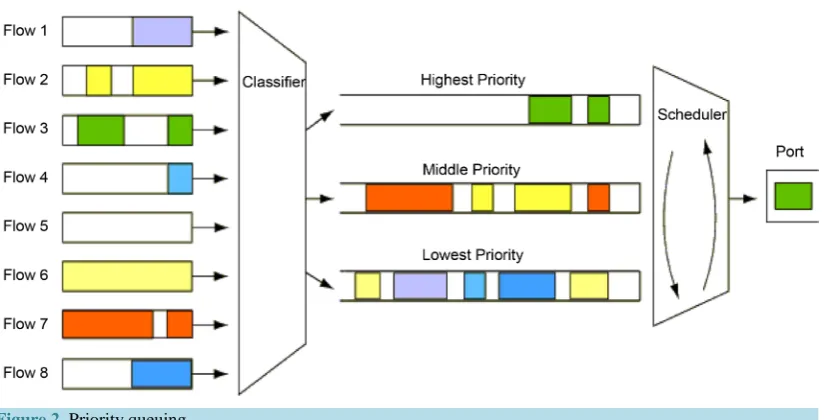
Figure 2. Priority queuing.
system and then placed into different priority queues. Packets are scheduled from the head of the given queue only if all queues of higher priority are empty. Within each of the priority queues, packets are scheduled in FIFO order. Some of the PQ benefits are relatively low computational load on the system and setting priorities so that real-time traffic gets priority over applications that do not operate in real time. One of the biggest problems us-ing PQ is the high amount of the high priority traffic. If the volume of higher-priority traffic becomes excessive, lower priority traffic can be dropped as the buffer space allocated to low-priority queues starts to overflow. This could lead to complete resource starvation for lower priority traffic [10].
5.3. Weighted Fair Queuing
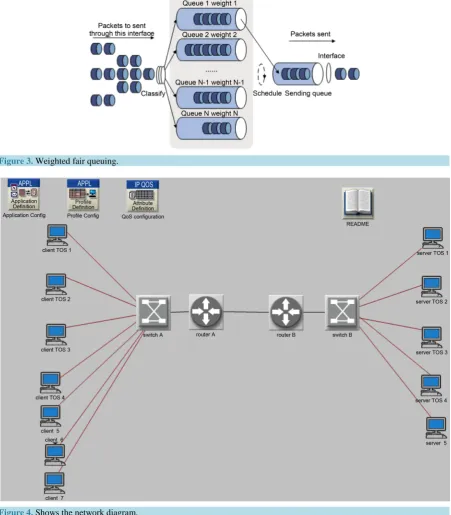
[image:3.595.109.523.274.484.2]Figure 3. Weighted fair queuing.
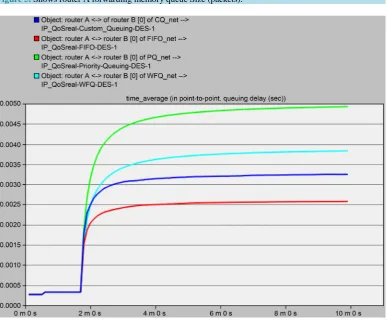
Figure 5. Shows router A forwarding memory queue Size (packets).
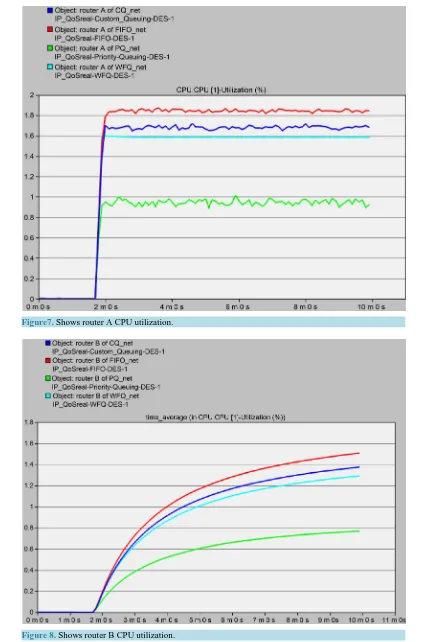
[image:5.595.121.509.387.710.2]Figure7. Shows router A CPU utilization.
Figure 9. Shows A buffer usage (default queue) Size.
Because the FIFO mechanism use default Queue as main Queue, that is shown in Figure 9 after it WFQ, and the less one PQ when it used the Default Queue.
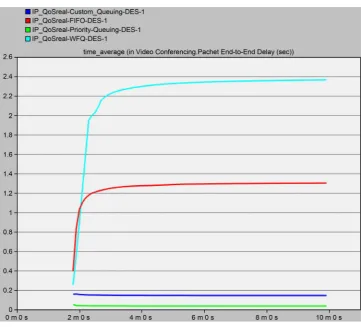
As shown in Figure 10 The delay of using different Queuing mechanisms, the delay is less when we use PQ, then FIFO and WFQ has a big delay comparing with PQ and FIFO.
9. Conclusions
PQ doesn’t need high specification hardware (memory and CPU) but when used it is not fair, because it serves one application and ignores the other application.
FIFO mechanism has smaller queuing delay, otherwise PQ has bigger delay.
References
[1] Homg, M.-F., Lee, W.-T., Lee, K.-R. and Kuo, Y.-H. (2001) An Adaptive Approach to Weighted Fair Queue with QoS Enhanced on IP Network. IEEE Catalogue No. 01 CH37239.
[2] Marchese, M. (2007) QoS over Heterogeneous Networks. John Wiley & Sons Ltd. http://dx.doi.org/10.1002/9780470058763
[3] Wu, D.P. (2000) Scalable Video Transport over Wireless IP Networks. IEEE.
[4] Cranley, N. and Davis, M. (2006) Study of the Behaviour of Video Streaming over IEEE 802.11b WLAN Networks. IEEE.
[5] Ben Ali, R., Pierre, S. and Lemieux, Y. (2004) DiffServ QoS Performance Evaluation of Multimedia Telephony. CCECE 2004-CCGEI 2004, Niagara Falls, Maylmai.
[6] Taniguchi, S., Kawate, R., Sato, K., Horiuchi, E. and Yokotani, T. (2012) Performance Evaluation of the Simplified WFQ to Multiplex a Huge Number of Queues. IEEE. http://dx.doi.org/10.1109/cqr.2012.6267099
[7] Balogh, T. and Medvecký, M. (2011) Performance Evaluation of WFQ, WF2Q+ and WRR Queue Scheduling
Algo-rithms. IEEE.
[8] Dekeris, B., Adomkus, T. and Budnikas, A. (2006) Analysis of QoS Assurance Using Weighted Fair Queueing (WFQ) Scheduling Discipline with Low Latency Queue (LLQ). Information Technology Interfaces ITI, Cavtat.
[9] Islam, Md.Z. (2012) A Comparative Analysis of Different Real Time Applications over Various Queuing Techniques. IEEE.
[10] Zoric, S., Kos, M. and Bajric, H. (2011) Fairness of Scheduling Algorithms for Real-Time UMTS Traffic in Case of IP Link Congestion.