© 2016, IRJET ISO 9001:2008 Certified Journal Page 172
Analysis of Surface Roughness for Cylindrical Stainless Steel Pipe (Ss
3163) In CNC Lathe Turning Process Using ANN Method
Arvind Singh Tomar
1, Rohit Pandey
21,2Assistant Professor, Mechanical & Automation Engineering Deptt. Amity University, Gwalior (M.P.) -
474005, INDIA.
---
Abstract: - Today CNC technology has major
contribution in industries. CNC machines are main platform in the contribution of good quality products in industries. Basically CNC machines are automated operating machines which are based on code letters, numbers and special characters. The numerical data required for manufacturing a part provided by machine is called CNC (Computer Numerical Controlled) Surface quality of the machined parts is one of the most important product quality indicators and most frequent customer requirements. Metal cutting processes are important due to increased consumer demands for quality metal cutting related products more precise tolerances and better product surface roughness that has driven the metal cutting industry to continuously improve quality control of metal cutting processes. The main objectives are to find the optimized parameters and the most dominant variables cutting speed, feed rate, axial depth and radial depth. The ANN model indicates that the feed rate is the most significant factor affecting surface roughness. The mathematical model developed by using multiple regression method shows the accuracy of surface roughness Prediction. The result from this research is useful to be implemented in both time consuming and laborious works in industry to reduce time and cost in surface roughness prediction.
KEYWORDS: - CNC machines, surface
roughness, ANN
I. INTRODUCTION
The development of CAD/CAM system is evolving to the phase of integrated
manufacturing systems, which is oriented towards the need of 21stcentury. Efforts are made to maintain and improve the vitality of manufacturing system. Keeping it as centre stone of all economic activities and ensuring that manufacturing remains an attractive industrial area. Optimization of corporate
activities in computer integrated
© 2016, IRJET ISO 9001:2008 Certified Journal Page 173 II. LITERATURE REVIEW
[01].Tasdemir et al. (2008) applied ANN to predict surface roughness a turning process. This method was found to be quite effective and utilizes fewer training and testing data. [02] Hazim et.al (2009) developed a surface roughness model in end milling by using Swarm Intelligence. From the studies, data was collected from CNC cutting experiments using Design of Experiments approach. The inputs to the model consist of Feed, Speed and Depth of cut while the output from the model is surface roughness. The model is validated through a comparison of the experimental values with their predicted counterparts.
[03].Benardos & Vosniakos presented various methodologies and practices that were employed to predict surface roughness. The approaches listed in their review paper were classified into those based on machining theory, experimental investigation, designed experiments, and artificial intelligence.
[04].Choudhury et al. discussed the
development of surface roughness prediction models for turning EN 24T steel (290 BHN) using a response surface methodology. A factorial design technique was used to study the effects of the main cutting parameters such as cutting speed, feed, and depth of cut on surface roughness. The tests were carried out using uncoated carbide inserts without any cutting fluid.
[05] V. Pallavi, Anoop kumar and T. Mohandas (2012). Optimization of turning parameters for surface roughness using taguchi method.
International Journal of Mechanical
Engineering. Vol. 5 : Issue 2.
[06] Surinder kumar, Meenu and P.S. Satsangi (2012). A genetic algorithmic approach for optimization of surface roughness prediction model in turning using UD-GFRP composite. Indian Journal of Engineering and Materials Sciences. Vol. 19, 386-396.
[07] Reddy et al.performing experiment for optimized the parameter for MRR using
Taguchi methodology and ANOVA. The L9 Orthogonal array is used in MINITAB 15 which shows the percentage contribution of each influencing factor on MRR.The material used for the experiment is (100 x 34 x 20 mm) blocks of aluminium cast heat-treatable alloy. [08] Yang et al. studied the surface roughness on end milling with gene expression programming. In this research, a method based on gene expression programming (GEP) has been proposed to construct the prediction model of surface roughness. GEP combines the advantages of the genetic algorithm (GA) and genetic programming (GP).
[09] Chockalingam et al. studied the effect of different coolant conditions on milling of AISI 304 stainless steel.Cooling methods used in this investigation were flooding of synthetic oil, water-based emulsion, and compressed cold air. Cutting forces and the surface roughness were studied and tool flank wears observed. In this study, the comparison between different coolants effect to the milling of AISI 304 stainless steel is done.
[10] Routara et al.[investigated the
optimization of parameters using response surface method. For this research three different materials 6061-T4 aluminium, AISI 1040 steel and medium leaded brass UNS C34000 were used. For this research he used the ANOVA approach and F test.
[11] Thakkar et al.[optimized of Process Parameters for Surface Roughness and Material Removal Rate for SS 410 Material. All experiment conduct on CNC turning and the output parameters are MRR & SR is predicted by ANOVA.
MACHINING PARAMETERS AFFECTS THE SURFACE ROUGHNESS
© 2016, IRJET ISO 9001:2008 Certified Journal Page 174
combination of rotary and translator movement either of the work-piece or of the cutting tool or both. The presence of these motions e.g., feed and cutting speed permits the exertion of the process of cutting continuously. In machine tools with rotary priming cutting motion, the cutting speed is given by:
V = πDN m/min.
1000 where D is diameter of the milling cutter (mm) N is the cutter rotational speed in rpm. Surface roughness is an important measure of product quality since it greatly influences the performance of mechanical parts as well as production cost. Surface roughness has an impact on the mechanical properties like fatigue behaviour, corrosion resistance, creep life, etc. It also affects other functional attributes of parts like friction, wear, light reflection, heat transmission, lubrication, electrical conductivity, etc. Sometimes, various catastrophic failures causing high costs have been attributed to the surface finish of the components in question. As a result, there have been a great many research developments in modelling surface roughness and optimization of the controlling parameters to obtain a surface finish of desired level since only proper selection of cutting parameters can produce a better surface finish
III. EXPERIMENTAL METHODOLOGY FOR SS 316L PIPE
The specimens of 316LStainless Steel pipe used for experimentation of the following Table shows nominal and actual composition of 316L SS used for the study. It was subjected to turning operation which was carried out on
© 2016, IRJET ISO 9001:2008 Certified Journal Page 175
Tolerance design is used to determine the best tolerances for the parameters [12].Taguchi’s orthogonal array provides the set of
experimental data (less number of
experimental runs) and Taguchi’s S/N ratio is the logarithmic function of desired output. The objective of using S/N ratio as a performance measurement is to develop products and processes insensitive to noise factors.
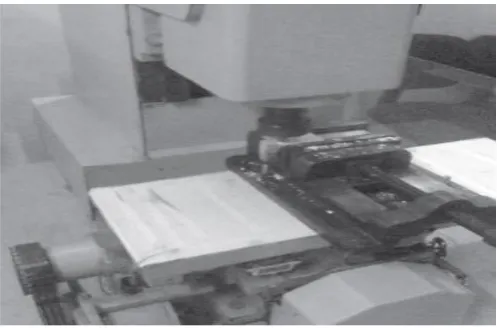
Figure 1: Machining process on the work
piece.
Design ation/ wt%
Cr Ni C Mn Si P S Mo
Nomin al Value 316L
14 -16
10 -12
0.
03 2.0 1.8 0.025 1.04 3.0-4.0
Actual Value 316L
18 .2 9
10 .6 1
0. 00 4
1.1
[image:4.595.36.285.483.647.2]75 32 0. 0.042 0.023 2.25
Table 1: Chemical composition of pipe SS 316L
work specimen
Material Removal Rate (MRR): Material removal rate (MRR) is defined as the material is removed per unit time. Its unit is mm3 /sec. MRR = V*f*d mm3 /sec V = Cutting Speed (in mm/sec) f = Tool feed (in mm) d = Depth of cut (in mm) Surface Roughness: Surface roughness is defined as a group of irregular waves in the surface, measured in micrometers. It is produced by the fluctuations of short wavelengths characterized by asperities (local maxima) and valleys (local minima) of varying amplitudes and spacing.[13]Surface roughness is defined by various characteristics of the surface profile such as centre-line average R. peak-to-valley height Hand average roughness depth, but these have limitations. The randomness of the profile is no measured by any of these parameters. The randomness of the surface profile causes the roughness value to vary under the given cutting conditions and is caused by the random nature of the mechanism of formation of the built-up edge, side flow and tool wears. There are various methods used for the roughness measurement such as stylus profilometry, light sectioning and taper sectioning methods, scanning electron microscopy and transmission electron microscopy etc.
© 2016, IRJET ISO 9001:2008 Certified Journal Page 176
3.5 in previous chapter. The mathematical model obtains to predict surface roughness is;
Ŷ= 2.1066 – 0.0011X1 + 0.0040X2 – 0.00971X3 (9)
Where; Ŷ= Surface Roughness (μm) Surface Roughness Analysis and Compare Prediction and Experimental Value for Cylindrical www.theijes.com The IJES Page 67 X1 = Cutting Speed (M/min.) X2 = Feed Rate (mm/min) X3 = Depth of Cut (mm)
A. ARTIFICIAL NEURAL NETWORKS ANN:-
It is a computational approach that quite
different from conventional digital
computation. The digital computers operate sequentially and do something arithmetic computations extremely very fast. On other side the biological neurons in the human brain are slow devices and are capable of performing a tremendous amount of computation works which necessary to do in everyday complex tasks. Commonsense reasoning and dealing with fuzzy
Logic situations. The underlining reason is that unlike a conventional computer, but the brain contains a huge number of neurons, information processing elements of the biological nervous system is acting in parallel. ANNs are parallel distributed information processing structure consisting of processing elements interconnected via unidirectional signal channels called connection weights. Although modelled after biological neurons, ANNs are much simplified. Some of the major attributes of ANNs are: a) they can learn from examples and generalize well on unseen data. b) They are able to deal with situation where input data are erroneous, incomplete, or fuzzy.
B. BIOLOGICAL NEURAL NETWORKS:-
The fundamental unit of biological neural network is called a neuron or a nerve cell. It
consists of a cell body where the cell nucleus is located. Tree like nerve fibres called dendrites are associated with cell body. These dendrites receive signals from other neurons. Extending from the cell body is a single long fibre called the axon, which eventually branches. Machine tools can be used effectively by considering the optimal cutting parameters like speed, feed, and depth of cut. However these parameters greatly influence on the material removal rate and surface finish. This paper aims to investigate the surface roughness values at various speeds, feed and depth of cut conditions by using Artificial Neural Networks.
IV. CONCLUSION:-
In this paper, from the above discussion we found that most of the researchers had taken input parameters (speed, feed, depth of cut) and in some cases other parameters such as nose radius, environment etc. and facing output parameters SR, MRR. A review of the ANN technique to develop the prediction model for surface roughness has been discussed. Examples of studies are given with their relative abilities and limitations in the relation to modelling of machining process focusing on the prediction of a surface roughness measured by using ANN approaches. ANN can produce an
accurate relationship between cutting
© 2016, IRJET ISO 9001:2008 Certified Journal Page 177 REFERENCES
[1] Benardos, P.G. and Vosniakos,
G.C.,”Prediction of surface roughness in CNC face milling using neural networks and Taguchi’s design of experiments.” Robotics and computer integrated manufacturing, Vol. 18, pp.343-354, 2002.
[2] Zhang, Julie Z., Chen, Joseph C. and Kirby, E. Daniel,” Surface roughness optimization in an end-milling operation using the Taguchi design method.”Journal of Materials Processing Technology Vol.184, pp. 233–239, 2007.
[3] Gologlu,Cevdet and Sakarya,Nazim, “The effects of cutter path strategies on surface roughness of pocket milling of 1.2738 steel based on Taguchi method.” Journal of materials processing technology Vol.206,pp. 7– 15, 2008. [4] Prajapati, Navneet K. and Patel, S. M.,” Optimization of process parameters for surface roughness and material removal rate for SS 316 on CNC turning machine.” International Journal of Research in Modern Engineering and Emerging Technology, Vol. 1, Issue: 3, pp.40-47, 2013
[5] Chandrasekaran, K., Marimuthu,P., Raja, K and ManimaranA,”Machinability study on AISI 410 with different layered inserts in CNC turning during dry condition.” International Journal of Engineering& Material Science, Vol. 20, pp.398-404, 2013.
[6] Reddy, B. Sidda, Kumar, J. Suresh and Reddy K. Vijaya Kumar,” Optimization of surface roughness in CNC end milling using response surface methodology and genetic algorithm.” International Journal of Engineering, Science and Technology,Vol. 3, No. 8, pp. 102-109, 2011.
[7] Kromanis, A. and Krizbergs, J.,”3d Surface roughness prediction technique in endmilling using regression analysis.”( 6th International
DAAAM Baltic Conference Industrial
Engineering),2008.
[8] Bajic, D., Lele,B. and Zivkovic, D.,”Modeling
of machined surface roughness and
optimization of cutting parameters in face milling.” Vol.47, pp.331-334, 2008.
[9] Chockalingam, P.and Wee Lee Hong,” Surface Roughness and Tool Wear Study on Milling of AISI 304 Stainless Steel Using Different Cooling Conditions.” International Journal of Engineering and Technology Vol. 2, No. 8,pp.1386-1392, 2012.
[10] Routara, B. C., Bandyopadhyay,
A.andSahoo, P.,” Roughness modeling
andoptimization in CNC end milling using response surface method: effect of work piece material variation.” International Journal of Advance Manufaturing and Technology,Vol. 40, pp.1166–1180, 2009.
[11] Thakkar, Jitendra and Patel Mitesh I.,” A Review on Optimization of Process Parameters for Surface Roughness and Material Removal Rate for SS 410 Material during Turning Operation.”International Journal of Engineering Research and Applications,Vol. 4, Issue 2, pp.235-242, 2014.
[12] Newman, S.T. and Nassehi, A.,”Universal
Manufacturing Platform for CNC
Machining.”Annals of the CIRP, Vol. 56, pp. 459-463, 2007.
[13] Ghani, J.A., Choudhury, I.A. and Hassan, H.H.,” Application of Taguchi method in the optimization of end milling parameters.” Journal of Materials Processing Technology, Vol. 145, pp. 84–92, 2004 [17] Ross Philip J, “Taguchi techniques for quality engineering” (McGraw-Hill book company, New Delhi),2005.
[14]. ANN is the fast fourier transform (FFT) function and its graphic display were integrated in to the software program developed by Mat lab view, data were visualized in real time. [15]. the method presented effectively measure surface finish and vibration of bearing. The goal of this research is successfully met.
[16]. ANN has been used to learn the collected. Neural network configuration was trained. The results of neural network model showed close matching between the model output and directly measured vibration. This method seems to have prediction potentials for
non-experimental pattern additionally ANN
© 2016, IRJET ISO 9001:2008 Certified Journal Page 178