Classification and Decision-Theoretic
Framework for Detecting and
Reporting Unseen Falls
byShehroz Khan
A thesis
presented to the University of Waterloo in fulfillment of the
thesis requirement for the degree of Doctor of Philosophy
in
Computer Science
Waterloo, Ontario, Canada, 2016
c
Declaration
I hereby declare that I am the sole author of this thesis. This is a true copy of the thesis, including any required final revisions, as accepted by my examiners.
Abstract
Detecting falls is critical for an activity recognition system to ensure the well being of an individual. However, falls occur rarely and infrequently, therefore sufficient data for them may not be available during training of the classifiers. Building a fall detection system in the absence of fall data is very challenging and can severely undermine the generalization capabilities of an activity recognition system. In this thesis, we present ideas from both classification and decision theory perspectives to handle scenarios when the training data for falls is not available. In traditional decision theoretic approaches, the utilities (or conversely costs) to report/not-report a fall or a non-fall are treated equally or the costs are deduced from the datasets, both of which are flawed. However, these costs are either difficult to compute or only available from domain experts. Therefore, in a typical fall detection system, we neither have a good model for falls nor an accurate estimate of utilities. In this thesis, we make contributions to handle both of these situations.
In recent years, Hidden Markov Models (HMMs) have been used to model temporal dynamics of human activities. HMMs are generally built for normal activities and a thresh-old based on the log-likelihood of the training data is used to identify unseen falls. We show that such formulation to identify unseen fall activities is ill-posed for this problem. We present a new approach for the identification of falls using wearable devices in the absence of their training data but with plentiful data for normal Activities of Daily Living (ADL). We propose three ‘X-Factor’ Hidden Markov Model (XHMMs) approaches, which are similar to the traditional HMMs but have “inflated” output covariances (observation models). To estimate the inflated covariances, we propose a novel cross validation method to remove “outliers” or deviant sequences from the ADL that serves as proxies for the unseen falls and allow learning the XHMMs using only normal activities. We tested the proposed XHMM approaches on three activity recognition datasets and show high detec-tion rates for unseen falls. We also show that supervised classificadetec-tion methods perform poorly when very limited fall data is available during the training phase.
We present a novel decisiontheoretic approach to Fall detection (dtFall) that aims to tackle the core problem when the model for falls and information about the costs/utilities associated with them is unavailable. We theoretically show that the expected regret will always be positive using dtFall instead of a maximum likelihood classifier. We present a new method to parameterize unseen falls such that training situations with no fall data can be handled. We also identify problems with theoretical thresholding to identify falls using decision theoretic modelling when training data for fall data is absent, and present an empirical thresholding technique to handle imperfect models for falls and non-falls. We also develop a new cost model based on severity of falls to provide an operational range
of utilities. We present results on three activity recognition datasets, and show how the results may generalize to the difficult problem of fall detection in the real world. Under the condition when falls occur sporadically and rarely in the test set, the results show that (a) knowing the difference in the cost between a reported fall and a false alarm is useful, (b) as the cost of false alarm gets bigger this becomes more significant, and (c) the difference in the cost of between a reported and non-reported fall is not that useful.
Acknowledgements
For the last 5 years, this PhD journey has been very special to me in terms of acquir-ing knowledge and becomacquir-ing a better researcher. I am highly indebted to many people including my mentors, family members, colleagues and friends, without whom I would not have been able to complete this thesis.
First and foremost, I would like to thank my supervisor Dr. Jesse Hoey for his guidance and support. He has been incredibly helpful in providing continuous feedback to improve upon my work. He patiently advised and mentored me throughout my graduate studies. I owe a lot to him in terms of skills, knowledge and vision that I developed being under his supervision. He helped me on several occasions on a personal and financial level and I am extremely grateful to him for his kind gestures to keep me afloat during tough times. I would like to thank my research committee comprising of Dr. Pascal Poupart and Dr. Dana Kuli´c for their support and constructive advices in framing my research topic. I am also thankful to my internal-external examiner Dr. Joon Lee for his positive feedback on my thesis. I am very thankful to my external examiner Prof. Philip Morrow for his feedback and suggestions to improve the quality of my thesis.
During my stay at Waterloo, I met many wonderful people who made my stay here worthwhile. I would like to thank Dr. Daniel Vogel for giving me the opportunity to collaborate on several research projects. I am thankful to department secretaries Helen Jardine, Wendy Rush, Mitzi Schnabel, Margaret Towell and Paula Zister for providing assistance in administrative matters with a smiling face. Many thanks to Suzanne Safayeni for being a great teaching instructor and making my life simpler as a teaching assistant. My graduate student life would not have been easy without the incredible help of Gordon Boerke from the Computer Science Computing Facility.
I would like to extend my gratitude to my colleague, friend and mentor Dr. Amir Ahmad for his support and encouragement throughout my graduate studies. Special thanks to Joshua Jung, Han Zhao and Mazen Melibari for providing feedback to improve the quality of my thesis. I would also like to mention the names of my colleagues Michelle E. Karg, Marek Grzes, Aarti Malhotra, Abdullah Rashwan, Areej Alhothali, Hadi Hosseini, Arthur Carvalho and Haiyu Zhen for their willingness to share ideas and overall support all this time.
I am very thankful to my wife, Lubna, whose love, perseverance and dedication moti-vated me to do better every day. She remained extremely positive throughout this time and encouraged me on low days. Without her love, support and care, I would not be able to finish my graduate studies so smoothly.
I would like to express thanks to my family members for their patience and for standing by me. My brothers Humair, Zubair, Mohsin, cousin Azeem, brother-in-law Hani and friend Zaki have always been concerned with my progress and wished for my success. It is sad that my father did not live to see this day; however, I posthumously would like to thank him for all the sacrifices he made in his lifetime for me. Many thanks to my mother for patiently waiting for me to graduate and showering me with her blessings.
Lastly, I would like to express thanks to all of those who gave me direct and indirect support to complete this work.
Dedication Dedicated to my wife Lubna...
Table of Contents
Declaration ii
Abstract iii
Acknowledgements v
Dedication vii
List of Figures xiii
List of Tables xv
Acronyms xvii
1 Introduction 1
1.1 Why is Detecting Falls Important? . . . 2
1.2 Challenges and Issues . . . 4
1.3 General Description of the Problem . . . 7
1.3.1 Practical Issues . . . 8
1.4 Problem Identification . . . 10
1.5 Contributions . . . 13
1.6 Thesis Structure . . . 15
2 Literature Review 17
2.1 Survey of Existing Literature Review on Fall Detection . . . 18
2.1.1 Analysis . . . 21
2.2 Taxonomy for Studying Fall Detection . . . 22
2.3 Fall Detection . . . 24
2.3.1 Sequential Classification . . . 24
2.3.2 One-Class Classification . . . 26
2.3.3 Semi-Supervised and Sampling Techniques . . . 28
2.4 Fall as an Abnormal Activity . . . 29
2.4.1 Vision based . . . 29
2.4.2 Sensor Based . . . 31
2.5 Cost Sensitive Classification and Decision Theory . . . 33
2.6 Cost of Falls . . . 35
2.7 Proposed Improvements . . . 36
3 Classification of Unseen Falls 39 3.1 Brief Introduction to HMM . . . 40 3.2 Motivation to use HMM . . . 44 3.3 Pose HMM . . . 46 3.3.1 Threshold Based - (HMM1) . . . 46 3.3.2 XHMM1 . . . 47 3.4 Normal Pose HMM . . . 47 3.4.1 Threshold Based - (HMM2) . . . 47 3.4.2 XHMM2 . . . 48 3.4.3 HM MN ormOut . . . 49 3.5 Activity HMM . . . 49 3.5.1 XHMM3 . . . 49
3.7 Experimental Design . . . 54
3.7.1 Datasets . . . 54
3.7.2 Data Pre-Processing . . . 58
3.7.3 Feature Extraction . . . 59
3.7.4 HMM Modelling . . . 60
3.7.5 Performance Evaluation and Metric . . . 62
3.8 Results . . . 64
3.8.1 Training without fall data . . . 65
3.8.2 Feature Selection . . . 73
3.9 Conclusions and Discussion . . . 79
4 Supervised Fall Detection 81 4.1 Training with sufficient fall data . . . 82
4.2 Are outliers representative of proxy for falls? . . . 86
4.3 Training with few falls . . . 90
4.4 Is knowing a type of fall useful? . . . 95
4.5 Discrimination among different types of falls . . . 97
4.6 Conclusions and Discussion . . . 102
5 Decision-Theoretic Reporting of Unseen Falls 105 5.1 Decision Theory . . . 107
5.2 Decision-Theoretic Framework - dtFall . . . 109
5.2.1 Formulation for Fall Detection . . . 109
5.2.2 Maximum Likelihood Decision Function . . . 111
5.2.3 Expected Utility Decision Function . . . 111
5.3 Decision-making without training data for falls . . . 113
5.4 Problems with Theoretical Threshold . . . 115
5.4.2 Negative Regret . . . 117
5.5 Empirical Threshold . . . 119
5.5.1 One-Class Classification Case . . . 122
5.6 Mixture of Gaussian X-factor model . . . 124
5.7 Experimental Analysis . . . 126 5.7.1 Parameters Setting . . . 127 5.7.2 Theoretical Threshold . . . 127 5.7.3 Empirical Threshold . . . 128 5.8 Cost Model . . . 133 5.8.1 Fall Severity . . . 134
5.9 Conclusions and Discussion . . . 136
6 Summary and Future Work 139 6.1 Future Directions . . . 142
References 145 APPENDICES 167 A Boundary Value Analysis 169 B Algorithm to Compute Empirical Threshold and Regret for OCC case using GMM 171 C Prospect Theory 173 C.1 Decision-theoretic Formulation for Fall Detection . . . 174
List of Figures
1.1 X-Factor approach in 1 dimension [150]. . . 12
2.1 Taxonomy for the study of fall detection methods. . . 24
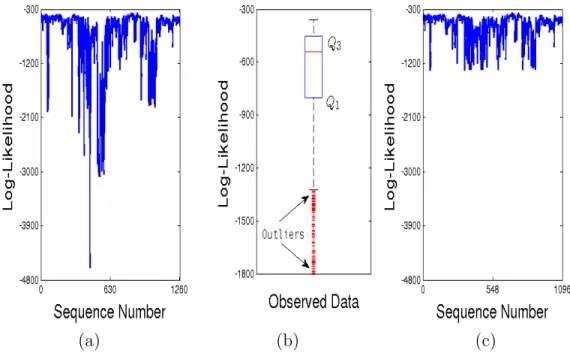
3.1 Log-Likelihoods – (a) before and (c) after outlier removal. (b) shows box-plot of the quartiles for this data and the outliers for w= 1.5 . . . 53
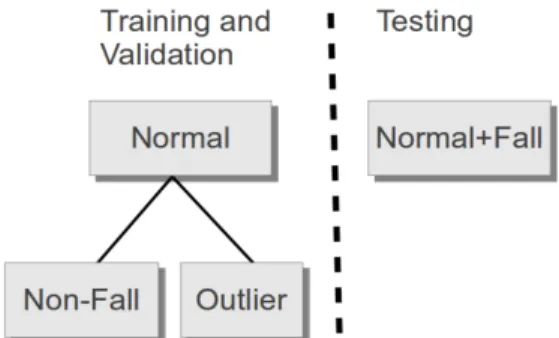
3.2 Cross Validation Scheme . . . 54
3.3 geometric mean (gmean) with error bars across all subjects for DLR, MF and COV datasets . . . 70
3.4 Mean values of the top 5 features for DLR dataset . . . 74
3.5 Mean values of the top 5 features for MF dataset . . . 75
3.6 Mean values of the top 5 features for COV dataset . . . 76
4.1 Effect of varying the amount of fall data in supervised learning on DLR dataset. The best performing X-Factor approaches is shown on the y-axis corresponding to zero training data (compared with Table 3.5b, Section 3.8). 92 4.2 Effect of varying the amount of fall data in supervised learning on MF dataset. The best performing X-Factor approach is shown on the y-axis corresponding to zero training data (compared with Table 3.6b, Section 3.8). 93 4.3 Effect of varying the amount of fall data in supervised learning on COV dataset. The best performing X-Factor approaches is shown on the y-axis corresponding to zero training data (compared with Table 3.7b, Section 3.8). 94 5.1 Decision surface for EUT and ML classifier. . . 112
5.2 Graphical representation of a fall detection. . . 113
5.3 Posterior probabilities of falls for each observation in the test set. . . 118
5.4 Typical total misclassification cost curves [167] . . . 120
5.5 mTh algorithm for finding the empirical threshold for the EUT case. . . . 123
5.6 Block Diagram of the mTh algorithm for the OCC case. . . 125
5.7 Regret between EUT and ML. Shaded regions show negative regret. . . 129
5.8 Comparison of Regret between EUT and ML for DLR dataset . . . 130
5.9 Comparison of Regret between EUT and ML for MF dataset . . . 131
5.10 Comparison of Regret between EUT and ML for COV dataset . . . 132
List of Tables
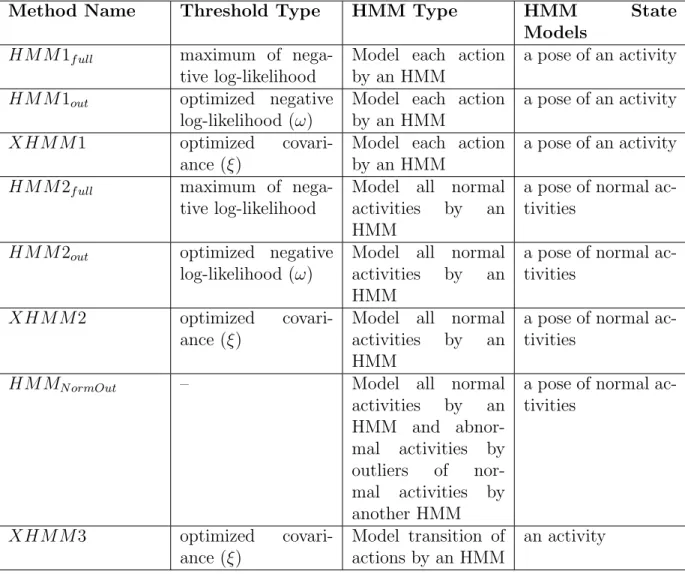
3.1 Summary of different fall detection methods . . . 51
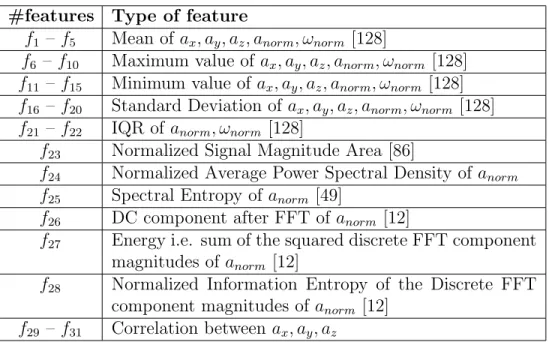
3.2 Extracted Features. . . 61
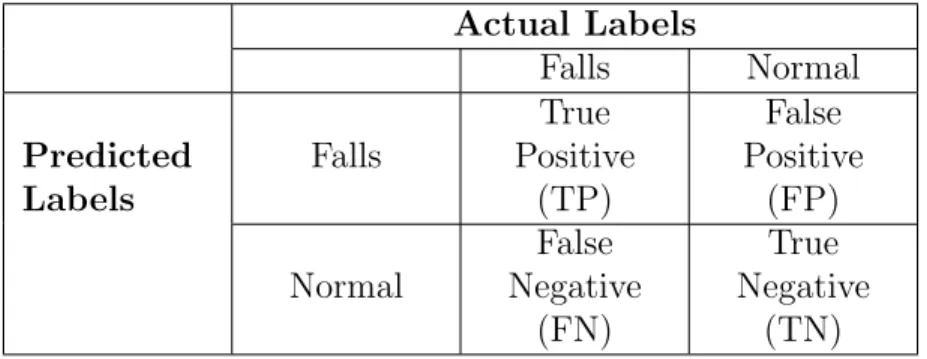
3.3 Confusion Matrix . . . 64
3.4 Performance Metrics . . . 64
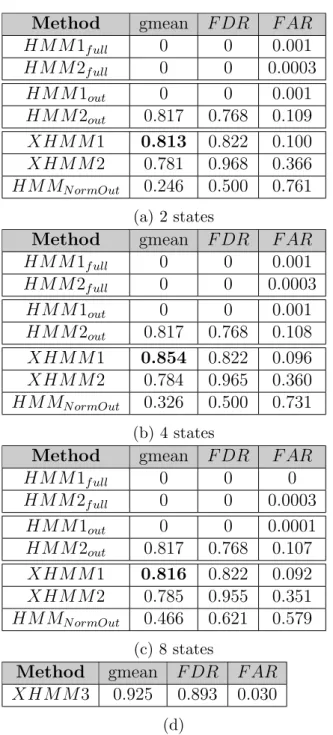
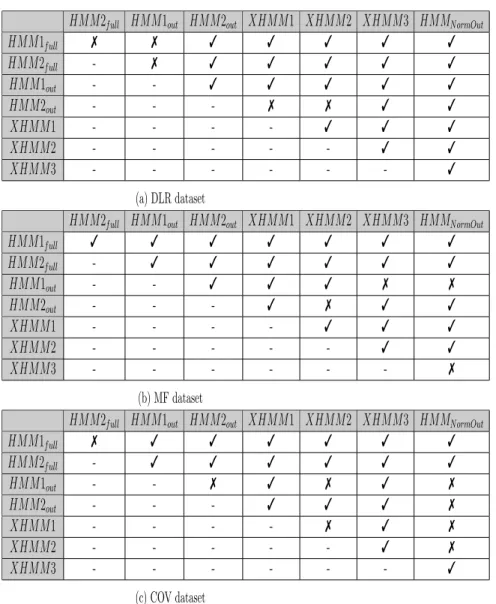
3.5 Performance of Fall Detection methods for DLR dataset for 2, 4 and 8 states. For XHMM3 (#states=#labelled activities + 1 state for fall). . . 66
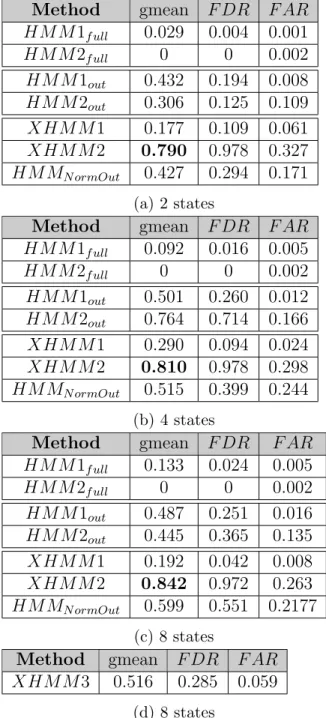
3.6 Performance of Fall Detection methods for MF dataset for 2, 4 and 8 states. For XHMM3 (#states=#labelled activities + 1 state for fall). . . 67
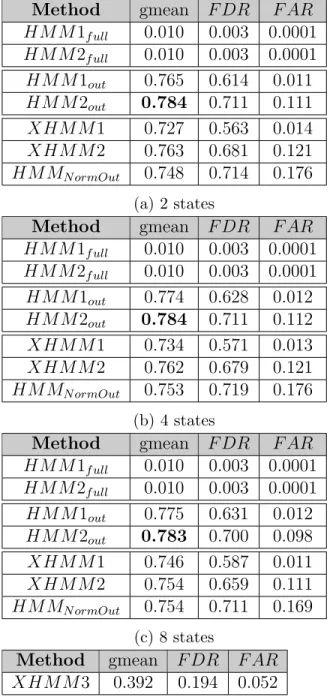
3.7 Performance of Fall Detection methods for COV dataset for 2, 4 and 8 states. For XHMM3 (#states=#labelled activities + 1 state for fall). . . 68
3.8 K-Fold Cross-Validated Paired t-Test . . . 72
3.9 Top 10/20 ranked features . . . 77
3.10 Performance of Fall Detection methods on reduced features for DLR dataset (Compare with Tables 3.5b and 3.5d) . . . 77
3.11 Performance of Fall Detection methods on reduced features for MF dataset (Compare with Tables 3.6b and 3.6d) . . . 78
3.12 Performance of Fall Detection methods on reduced features for COV dataset (Compare with Tables 3.7b and 3.7d) . . . 78
4.1 Supervised Fall Detection with full training data for falls and all normal activities for DLR dataset (compared with Table 3.5). . . 84
4.2 Supervised Fall Detection with full training data for falls and all normal activities for MF dataset (compared Table 3.6). . . 84
4.3 Supervised Fall Detection with full training data for falls and all normal activities for COV dataset (compared with Table 3.7). . . 84 4.4 Supervised Fall Detection with full training data for falls and all non-fall
activities for DLR dataset (compared with Table 3.5 and Table 4.1). . . 85 4.5 Supervised Fall Detection with full training data for falls and all non-fall
activities for MF dataset (compared with Table 3.6 and Table 4.2). . . 85 4.6 Supervised Fall Detection with full training data for falls and all non-fall
activities for COV dataset (compared with Table 3.7 and Table 4.3). . . 85 4.7 Relationship between ω and %age coverage . . . 87 4.8 Confusion Matrix and Rf(i) for DLR dataset. The alphabetical labels
and the activity correspondence is: A=Jumping, B=Running, C=Walking, D=Sitting, E=Standing, F=Lying, G=Falling. . . 88 4.9 Confusion Matrix andRf(i) for MF dataset. The alphabetical labels and the
activity correspondence is: A=Car-in, B=Car-out, C=Jogging, D=Jumping, E=Sitting, F=Standing, G=Stairs, H=Walking, I=Falling. . . 89 4.10 Confusion Matrix and Rf(i) for COV dataset. The alphabetical labels
and the activity correspondence is: A=Near Fall, B=Standing, C=Lying, D=Sitting, E=Walking, F=Crouching, G=Falling. . . 89 4.11 Supervised Fall Detection for MF dataset with full training data for a type
of fall and tested on all types of falls (compared with Tables 4.2, 3.6b and 3.6d). . . 98 4.12 Supervised Fall Detection for COV dataset with full training data for a type
of fall and tested on all types of falls (compared with Tables 4.3, 3.7b and 3.7d ). . . 99 4.13 Recall and Precision for MF dataset using supervised algorithms for
identi-fying different types of falls. . . 100 4.14 Recall and Precision for COV dataset using supervised algorithms for
iden-tifying different types of falls. . . 101 5.1 Utility Table. . . 109
Acronyms
ADLActivities of Daily Living.
CDCThe Centers for Disease Control and Prevention. EM Expectation Maximization.
EUTExpected Utility Theory. gmeangeometric mean.
GMMGaussian Mixture Model. HMMHidden Markov Model.
MEMSMicro-Electro-Mechanical System. ML Maximum Likelihood.
OCC One-Class Classification.
OSVMOne-Class Support Vector Machine. PTProspect Theory.
RFRandom Forest.
SVMSupport Vector Machine.
Chapter 1
Introduction
Activity Recognition [31] studies the actions, behaviours and goals of a subject and at-tempts to build systems to recognize them with an aim to provide some sort of assistance. Research in activity recognition has led to the successful realization of intelligent pervasive environments that can provide context, assistance, monitoring and analysis of a subject’s activities that are usually backed up by advanced machine learning and vision algorithms. Most of the research in activity recognition is either based on sensors [31] or computer vision [53]. A drawback with sensor-based methods is their intrusive nature; a person has to wear sensor-based gadgets all the time which may be uncomfortable to carry and may lead to refusal to wear them [162]. Vision-based system works well in an indoor setting; however, when a person leaves the premises, these systems cannot provide much help. Research in activity recognition using wearable or computer vision sensors is mostly centred around identifying normal Activities of Daily Living (ADL) such as walking, run-ning, standing, cycling, etc. and applied to monitor a subject’s movements, assess physical fitness and provide feedback. Though this research is meaningful, there can be scenarios where detection of unusual events becomes important, challenging and relevant. Missing out such unusual activities can impose health and safety risks on an individual. Falling is the most common type of unusual activity and the most studied [127, 74]. In real life, most falls are caused by sudden loss of balance due to an unexpected slip or trip, or loss of stability during movements such as turning, bending, or rising [156].
A fall can be defined in many ways depending upon the perspective of a health prac-titioner, carer, computer scientist / analyst or the subject himself. Most studies use a combination of topographical, biomechanical and behavioural components to define a fall [62] and using different fall definitions can influence the results of the study. The WHO report [139] defines a fall as
Definition “Fall: inadvertently coming to rest on the ground, floor or other lower level, excluding intentional change in position to rest on furniture, wall or other objects”
According to Prevention of Falls Network Europe’s definition [98],a fall is an unexpected event in which the participants come to rest on the ground, floor or lower level. A majority of activity recognition datasets that collect falls in controlled laboratory settings, may not glean falls in fully naturalistic settings i.e. inclusion of intention may be present in those datasets. This very fact makes these collected falls artificial and not true representatives of actual falls. This issue is further discussed in section 1.3.1 and highlighted in Chapters 3, 4 and 5.
In the following sections, we discuss the reasons why detecting falls is important, the challenges associated with detecting falls, the general description of the fall detection prob-lem and the associated practical issues. We then identify major research probprob-lems and present an outline of the contributions proposed in this thesis. The chapter concludes with a brief summary of the overall structure of the thesis along with a list of publications resulting so far from this research.
1.1
Why is Detecting Falls Important?
Falls are the major cause of both fatal and non-fatal injury among people and create a hindrance in living independently. According to the report by SMARTRISK [169], in Canada in 2004, falls constituted 25% of all the unintentional injuries besides transport injuries or suicides, resulting in 2225 deaths, 105,565 hospitalizations and 883,676 non-hospitalizations. The report also suggests that falls accounted for 50% of all injuries that resulted in hospitalization, and was the leading cause of permanent partial disability (47%) and total permanent disability (50%). Falls were the leading cause of overall injury costs in Canada in 2004, accounting for $6.2 billion or 31% of total costs besides other unintentional injuries. According to the WHO report [139], the frequency of falls increases with an increase in age and frailty i.e. older adults are more prone to falling than younger adults. Around 28−35% of people aged 65 and over fall each year and this increases to around 32−42% for those over 70 years of age. Older people living in nursing homes fall more often than those living in the community (around 30−50%) and 40% of them experience recurrent falls [139]. The reason is that most of the older adults living in the nursing homes are more frail and these facilities report fall incidences more accurately [159]. According to the Public Health Agency of Canada [136], older adults in Canada who were hospitalized due to a fall spent up to three weeks in the hospital, which is three
times more than the average hospital stay among other age groups. They also comment that half of falls leading to hospitalizations occurred at home and the number of deaths resulting from falls increased with each increase in age category.
Falls can impact a person both economically and psychologically. The economic impact can be categorized as either a Direct or Indirect cost [139]. Direct costs comprise of the health care costs, insurance, medications, surgery, treatment, rehabilitation [22] or long term care, whereas indirect costs include the loss of a job or income and productivity losses. Experiencing a fall may lead to a fear of falling [74], which in turn can result in lack of mobility, less productivity and can increase the risk of a fall. Fear of falling is identified as a major negative consequence associated with decline in physical and mental performance, progressive loss of mental health-related quality of life, decreased social contact and less physical activities [161, 193]. Boyd and Steven [16] conducted a study on 1709 adults aged 65 or older and found that more than one-third of them were moderately or very afraid of falling. An important factor in fall detection is the time spent unattended laying (on the floor) after incurring a fall as it is a key factor in determining the severity of a fall. Older adults, especially due to weakness and frailty, are unable to recover or get up from a fall if living on their own. This could lead to several other complications such as loss of consciousness, syncope, hypothermia, dehydration, broncho-pneumonia, pressure sores and even death [158, 122, 39]. Studies show that more than 20% of patients who were hospitalized because of a fall had been laying on the ground for an hour or more, and even though they had no direct injury resulting from a fall, their rate of morbidity was very high within the next 6 months [122].
To handle the issues discussed above, there is an imminent need for the development of robust fall detection methods. Ideally speaking, a robust fall detector must accurately detect and report falls immediately; however, in practice it may generate false alarms and can fail to report some falls. Both of these errors have different repercussions. Reporting excessive false alarms may lead a fall detector to be perceived as useless or ineffective and can result in rejection of the device. Failing to identify and report a fall could have life threatening consequences, causing a loss of confidence in the device, or increase in fear of falling. Successful design and implementation of efficient fall detection devices are necessary to reduce the response time for fall related injuries. These devices can also be helpful in reducing the economic burden on public health care resulting from the treatment, rehabilitation and longer stay of the patients at nursing homes due to falls.
1.2
Challenges and Issues
Falls can lead to economic, physical, social and psychological complications among individ-uals, and affects the elderly population more severely. Therefore, there is an imminent need for the development of intelligent pervasive systems that can accurately monitor a person’s activities and detect falls effectively. These types of systems form a major component of the overall goal of Assistive Technology [105] to help individuals to live independently and better integrate with the community.
Most of the studies on fall detection either use computer vision (cameras), ambient sensors or wearable devices to capture data and employ either thresholding or machine learning techniques [127, 74]. Computer vision-based fall detectors work better in indoor settings and are non-intrusive; however, multiple cameras may need to be fitted in a living compound that could raise privacy concerns and may lead to their rejection. Moreover, a camera-based fall detection system may not be effective when a person goes outdoors, beyond the field of vision or if the illumination changes significantly [135]. The advantage of wearable sensors is that they are cost-effective, easy to wear and operate, and work both indoors and outdoors. However, they can be considered invasive and intrusive. These sensors must be worn all the time, which can also lead to their rejection [162]. Modern smartphones are also equipped with built-in sensors (accelerometer, gyroscope and other ambient sensors) and are considered ubiquitous, as many people carry them without con-sidering them an additional gadget. Fall detection solutions based on smartphones may be ineffective in indoor settings as many people don’t keep them in their pockets or do not attach it to their body when inside their homes. Ambient sensing devices mostly use pressure sensors to detect falls and are cost effective and less intrusive. However, they can be highly sensitive to their surroundings, and can generate a lot more false alarms and may be considered ineffective by both the carer and user [127]. The data from both wearable and ambient devices can not be visually verified by a researcher or carer if the subject under observation is out of sight or outside the laboratory or care environment, and it is very hard to obtain labelled data for falls from the subject himself (e.g. noting the time of the day when a fall occurred) .
There exist several commercial products for detecting falls such as Philips Lifeline [145]), MobileHelp Fall ButtonTM[126], AlarmCare [4], Galaxy Fall Detection System [176], Vi-sonic Fall Detector [191] and Brickhouse Alert [20]1. Recently, several mobile applications for Android and iPhone platform have been developed that are capable of detecting falls such as iFall [172], Fade [50], Seizario [165], and CareBeacon [24]. Many of these products
or mobile applications use fixed thresholds to detect falls, may fail to identify different types of falls, can produce many false alarms and require manual intervention. Most of these products are wearable (on chest, neck, waist, or in the pocket), so there are dis-comfort and adaptability issues as well. Brownsell and Hawley [21] conducted a study to understand the feasibility of employing fall detectors among older adults (age group 60-74). Their research concludes that most of the users who wore fall detectors felt more confi-dent, independent and considered that a fall detector improved their safety. This study provides evidence of the importance of using fall detection systems in positively impacting the lives of people (older adults in this case). Noury et al. [135] mention that there is no wide scale deployment of fall detection devices in daily geriatric practice, largely due to their inadequate operations, ergonomics, high incidence of false alarms and the social stigmatization of the frailty of the older person. However, when the concept of detecting falls is presented to older adults they find great potential in it to improve their security, safety and well-being at home [74]. Therefore, there is a clear gap between the real utility and actual usability of fall detectors.
Igual et al. [74] and Habib et al. [58] present several challenges and issues for the design of fall detectors that could impede their wider usability and adaptability. Many of these challenges are inter-linked and are discussed below:
• Robustness– Many fall detection algorithms achieve high precision and recall under controlled laboratory settings; however, when applied to real-world situations their performance deteriorates [135]. Many studies collect human motion data for a few hours of ADLs, which is not sufficient to represent the actual activities carried out in the real world. Additionally, it is very difficult to run long-term studies to monitor the activities of people due to logistics, time, money, effort and the discomfort of the person. A major focus of developing fall detection systems is to help older adults; however, in most of the studies, young healthy individuals perform activities in their place as it is difficult to involve seniors in those studies due to ethics and health problems [140].
• Usability – Wearable devices aimed at fall detection can be uncomfortable to attach to the waist, chest or neck all the time. Smartphones offer a viable alternative due to their ubiquitous and pervasive nature; however, people keep smartphones in different places, orientations and often do not even carry them. Bad ergonomics, including the size, shape and weight of the device, can also impact the usability of such de-vices. Other factors that can affect the usability of these devices include manual intervention, a lack of interaction of the device with the user and a requirement of high technical skills to operate them.
• Acceptance – Acceptance of fall detection devices for the senior population is a challenge because they may not be technology savvy or inclined to learn about it. A study by Kurniawan [97] shows that older people are passive users of mobile phones, frightened of the consequences of using new and unfamiliar technology and find it difficult to grasp the complex designs of user interfaces (such as menus). Igual et al. [75] also find that people with intellectual disability face difficulty in navigating through the complicated interfaces of smartphones.
• Limitations of the devices – A major challenge for using smartphones or other wearable devices is their battery drain time, which can be more in a smartphone as it is generally loaded with other mobile applications that can consume energy faster. Smartphones were not originally designed for fall detection; therefore, issues related to their placement, orientation, sensing architecture, stability of sampling frequency of the accelerometer and gyroscope can be a bottleneck. The camera based devices have limitations in working outdoors and in different lighting conditions.
• Privacy Issues – Wearable devices can continuously and discreetly collect personal information, which when combined with other information such as geographical loca-tion, are enable to infer private information [153]. Context-aware systems including computer vision (or cameras) based fall detection methods are more prone to privacy concerns. Employing one or multiple cameras in a home environment may make the person feel surveilled or monitored round the clock. There have been several incidents of hacking into CCTV cameras at homes [77, 131], which can discourage a prospective user from installing such systems.
• Real and Simulated Falls– Most of the papers reviewed in several survey papers on fall detection [74, 58, 127] indicate that a majority of the researchers test their systems using data collected through simulated falls. Klenk et al. [92] perform an experiment with older and younger adults, who are asked to perform real and simulated falls, and find significant variations in the acceleration and maximum number of jerks between real and simulated falls. Kangas et al.[82] find that some characteristics of falls that are detectable in simulated falls are not detectable in real life falls. Huynh et al. [72] note that in their study young adults perform the ADLs for testing purposes instead of the elderly. Since they may not fully simulate the actual activities of seniors, such fall detection systems may require re-adjustments of classification thresholds to perform well for the elderly. Bagal`a et al. [11] compare thirteen existing fall detection algorithms, test them on real world fall data and observe that these algorithms perform better on simulated falls than real falls. The methods based on thresholding on acceleration signals perform worse because thresholds are mostly
calibrated on simulated falls and are not suitable for real falls. A fixed threshold may not be the optimal strategy compared to a subject-specific threshold; however, such thresholds are difficult to generalize. Furthermore, they note that real falls are fewer in number than normal ADLs and therefore traditional metrics to measure performance of such systems should be chosen with care.
1.3
General Description of the Problem
The role of a fall detection system is to identify falls and report them. Identification or classification of falls is primarily a supervised classification problem, whereas falls reporting is a decision-theoretic approach to report falls optimally using the probabilities and the utilities used for the system. When sufficient training data for both falls and non-falls is present, this can either be stated as:
• Classification Problem: In this case, the main challenge is to train the model for both falls and non-falls and compute likelihoods, given a fall or non-fall class and the prior probabilities to compute the posteriors i.e.
P r(f|o)∝P r(o|f)P r(f) P r( ¯f|o)∝P r(o|f)P r( ¯¯ f)
where O is a random variable that represents the observations and o ∈ O is an observation,P r(f|o) andP r( ¯f|o) are the posterior probabilities,P r(o|f) andP r(o|f)¯ are the likelihoods, andP r(f) andP r( ¯f) are the prior probabilities for falls and non-falls. The likelihoods can be calculated using a Maximum Likelihood (ML) approach, and the prior probabilities for falls and non-falls are generally computed as the ratio of falls and non-falls to the total training data. Normally, a decision is taken to classify a test sample as a fall or a non-fall based on posterior probabilities or likelihoods.
• Decision-Theoretic Problem: In this case, apart from the probabilities, subjective utilities of different states of the systems are also utilized. A decision to report or not-report an action as a fall is taken based on the value of the decision function that maximizes the expected utility for performing an action:
V(r|o) =P r(f|o)U(T P) +P r( ¯f|o)U(F P) V(¯r|o) = P r(f|o)U(M A) +P r( ¯f|o)U(T N)
where V(r|o) and V(¯r|o) are the value functions to report or not-report a fall given an observation o, U(.) is a utility function that defines the subjective utility of True Positives (T P), False Positives (F P), Missed Alarms (M A) and True Negatives (T N)2. We can define a normalized utility function (as shown in Table 5.1) s.t. U(T P) = p, U(F P) = q, U(M A) = 0 and U(T N) = 1. We can, then set V(r|o) = V(¯r|o), to get a theoretical decision function
P r(o|f) P r(o|f¯) =
P r( ¯f)(1−q)
P r(f)p (1.1)
and substituting P r(f|o) = 1−P r( ¯f|o), we get a theoretical threshold as
τ =P r(f|o) = 1
1 + 1−pq (1.2)
The theoretical threshold, τ, is used to report or not-report a test observationo as a fall or a non-fall. The theoretical threshold shown in Equation 1.2 guarantees optimal decision under uncertainty, given true models for both falls and non-falls.
The research question that is being asked by a fall detection and fall reporting system is also different. While a fall detection approach seeks to answer ‘Is an activity a fall?’, fall reporting seeks to answer ‘Is it good to report an activity as a fall?’.
1.3.1
Practical Issues
We now discuss some of the practical issues that can severely undermine the performance of a fall detection method in both the classification and decision-theoretic formulation.
Lack of Availability of fall data
A fall is an unusual event; therefore, the rarity of falls leads to a lack of sufficient data for them for training the classifiers. More than one type of fall may also occur and their unexpectedness make it difficult to model them in advance. Yin et al. [199] mention that due to the scarcity of abnormal activities (e.g. falls), it is a challenging problem to design a detection system that can reduce both the false positives and false negatives. Collecting
2In this thesis, we follow the convention of treating the falls class as the positive class and the normal
fall data can be cumbersome because it may require the person to actually undergo a real fall which may be harmful and unsafe. Alternatively, artificial fall data can be collected in controlled laboratory settings; however, that may not be the true representative of actual falls and can ‘include intention’, which contravenes the definition of a fall discussed in Section 1. Analyzing artificially induced fall data can be good from the perspective of understanding and developing insights into falls as an activity but it does not simplify the difficult problem of detecting falls. As the artificial falls do not represent actual falls, the classification models built with them are more likely to suffer from over-fitting on the artificial falls and may poorly generalize on actual falls. The approaches that exclusively collect fall data still suffer from their limited quantity and ethics clearances. In addition to very few or no labelled data, the diversity and types of falls further makes it difficult to model them efficiently. The Centers for Disease Control and Prevention (CDC), USA [56] suggests that on an average, nursing home residents incur 2.6 falls per person per year. If an experiment is to be set up to collect real falls and assuming an activity is monitored every second by a sensor, then we get around 31.55 million normal activities per year in comparison to only 2.6 falls. The data for real falls may collected by running long-term experiments in nursing homes or private dwelling using wearable sensors and/or video. The falls data generated from such experiments can be sufficient enough to train supervised classifiers; however it will still be skewed towards normal activities. Stone and Skubic [175] conducted a study to collect activities from 13 apartments that contains a combined nine years of continuous data. In total, they obtained 9 actual falls along with 454 artificial falls. This study was done in realistic settings and highlights the rarity of falls and the difficulty in obtaining sufficient data for falls. The order of the average number of actual falls obtained in this study is consistent with the CDC statistic of falls per person per year. This high skew in the training data for falls may result in learning imperfect models and it is difficult to develop generalizable classifiers to identify falls efficiently.
Lack of Understanding of Utilities and Costs
A typical fall detection system must correctly identify and report falls; however, it may report some false alarms and fail to report some falls. Correctly identifying falls is critical for ensuring the safety of an individual; missing to report a fall can be considered as the worst outcome of a fall detection system, but reporting too many false alarms is not a good outcome either. However, both of these errors must not be given the same cost because they both represent two different types of ‘worst’ outcomes with two different ‘magnitudes’. Even though reporting a fall correctly is considered the best outcome of a fall detection classifier there is still some associated cost because the person has actually fallen, which
can lead to a possible injury and its subsequent consequences; like emotional stress to the subject or family and money spent on the treatment. Most fall detection methods either give equal cost to both types of errors or attempt to find a cost matrix from the data itself (more discussion in Section 2.5). However, both ideas are flawed because neither these costs (or conversely utilities) are known well in advance nor easily understood. Additionally, the relationship between these various costs (or utilities) is not clear. Deducing costs from data is not a good idea because the costs should not be data-specific but rather domain-specific. However, these costs may either be unavailable, hard to compute or may come from a domain expert.
1.4
Problem Identification
We discussed in Section 1.3 that the classification or detection of a fall is the outcome of a ML classifier that takes one uncertain state of nature to make a decision, which may not be an optimal action to perform. Whereas reporting a fall uses decision theory such that different outcomes combine probability of every state with their subjective utilities and the outcome with maximum expected utility is guaranteed to be an optimal decision. However, a fall is an abnormal activity that occurs rarely, infrequently and in diverse ways; therefore, it is very difficult to collect sufficient training data for them [89]. In the absence of training data for falls, we are left with the following major challenges:
1. We don’t know exactly what a fall may look like, and
2. We don’t know exactly the costs incurred during and after a fall.
Without sufficient training data for falls, we may not build a model for them. For such cases,P r( ¯f|o) can be estimated but not P r(f|o); moreover, the prior probability for falls can not be directly estimated from the training data because it may not be available. Therefore, neither the traditional ML approach nor the decision-theoretic approach can be applied directly to classify or report falls that were not observed before. Now, we discuss two approaches that can be used to identify unseen falls:
(i) Setting Threshold on the Likelihood of Normal Activities
In traditional classification methods that treat a fall as an abnormal activity (i.e. no knowledge about the parameters of unseen falls), a model is trained and parameters learned from normal activities (θf¯) using an iterative method (such as Expectation
Maximization (EM)) by maximizing the likelihood (P r(O|f¯)) to obtain locally opti-mum parameters θ∗f¯ s.t.
θ∗f¯= argmax
θf¯
P r(O|θf¯) (1.3) Given the parameters θf∗¯, the likelihood of each instance of the training set is com-puted and a threshold is calculated from them. This threshold is generally chosen as the maximum of negative of log-likelihood that shows the maximum deviation for the likelihood of an observation belonging to normal activities class. Any test observation that lies beyond this threshold can be classified as ‘not-normal’ or as a ‘fall’. However, this approach can only be used from the classification perspective to identify falls but not in the decision-theoretic sense to report falls because it does not provide probability estimates for falls and does not incorporate utilities.
The value of such a threshold may be affected by the presence of spurious sensor readings or artifacts of the system. If a threshold is not set appropriately, then in the worst case, all falls may be classified as normal activities. To circumvent this problem, the threshold can be modified to be less sensitive to the noise in the sensor readings. That is, instead of setting the threshold as the maximum of negative of log-likelihood over the training set comprising of normal activities, the value of threshold is reduced. This modified threshold may reject some normal activities as ‘not-normal’ but it should be able to identify most of falls.
(ii) Modelling Unseen Falls
Instead of directly thresholding the log-likelihood computed from the training data containing normal activities, an alternative model for unseen falls can be built that can provide probability or likelihood estimates. The advantage of such a method is that it can be used both in the classification and decision-theoretic settings because it can provide probability estimates for both the classes. However, in the absence of training data for falls, this cannot be done directly. Quinn et al. [150] present a general framework to deal with unmodelled and unseen variations from the normal activities by proposing the ‘X-Factor approach’. In this method, the covariance of the normal dynamics is inflated to determine the regions with the highest likelihood that can be classified as ‘not-normal’. If the normal activities are assumed to follow a Gaussian distribution (or Gaussian Mixture Model (GMM)), then the parameters of the new distribution that represents ‘not-normal’ behaviour have the same mean as the normal activities model but different variance. The reason to vary only one parameter (i.e. variance or covariance) is to keep minimum assumptions about the
model for unseen falls. Figure 1.1 shows a 1-d Gaussian model for a normal activity class with zero mean and a corresponding X-factor that represents a ‘not-normal’ activity (or a fall class in our case) with the same mean but different variance. The data points that are at the extremes of the normal range are more likely to be classified as belonging to the X-factor (or falls) [150]. Therefore, using the X-Factor approach, the parameters of unseen falls can be estimated based on the parameters of normal activities. However, such a model may be imperfect and may not be expressive enough because it is an approximation for real falls.
x -5 0 5 Pr(x|model) 0 0.05 0.1 0.15 0.2 0.25 0.3 0.35 0.4 non-fall X-factor
Figure 1.1: X-Factor approach in 1 dimension [150].
By modelling unseen falls using the X-Factor approach, we can estimate the likelihood for a test observation that can be used for their classification. This can be further extended to report falls by using decision theory by incorporating costs in a fall detection system. However, the costs occurring in a fall detection system are hard to compute and mostly unknown. Nonetheless, we would still like to build fall detection systems that are able to detect and report falls and are able to help people. The method to compute likelihood for unseen falls depends on the underlying approach. Below, we briefly present two approaches to estimate the likelihoods for unseen falls:
(a) Maximum Likelihood Approach: In this approach, we train a model and learn the parameters (θf¯) from the normal activities using ML, and use the X-Factor ap-proach to compute the parameters for unseen falls (θf). As discussed earlier, the
parameters for both falls and non-falls only differ in their covariance. The scaling parameter for covariance can be found using cross-validation (see Chapter 3.6). The parameters θf can be used to compute the likelihood for unseen falls, P r(o|θf), for
the purpose of classification.
(b) Bayesian Approach: In the Bayesian approach, we parameterize the model for unseen falls with θf, choose a prior distribution over it (P r(θf)) and integrate over
all the possible values of θf to determine the expected likelihood for unseen falls, i.e.
EP r(θf)[P r(o|f, θf)] = Z
θf
P r(o|f, θf)P r(θf)
This expected likelihood for unseen falls can be combined with prior probabilities and costs to compute the expected value for reporting a fall. We present a particular case of using GMM with a specific prior and the X-factor approach within the decision-theoretic framework to compute expected likelihood for unseen falls in Chapter 5. In this thesis, we identify these issues in developing a fall detection system and present methods that
(i) Improve the traditional thresholding methods, and
(ii) Build models for falls in the absence of their training data.
1.5
Contributions
Based on the above issues, this thesis presents contributions on the development of fall detection methods that treats a fall as an abnormal activity and builds classification and decision theoretic models using only the normal activities. These contributions are sum-marized below:
1. In recent years, Hidden Markov Model (HMM) have been applied to model human actions and activities [95]. Normally, HMMs are used to model the temporal dynam-ics of normal activities, then a threshold is placed to detect unseen falls [89]. The
maximum of negative of log-likelihood on the training data is generally used as a threshold to identify falls in the test set. In this thesis, we show that this approach of choosing a threshold is ill-suited for the problem of fall detection. We propose improvements by computing an improved threshold by rejecting spurious sensor data from the normal activities and are able to identify most falls correctly. We then propose three different types of X-Factor Hidden Markov Model (XHMM) that can learn alternative models for falls in the absence of their training data and need only sufficient normal activities data. The XHMMs are similar to HMMs with the ex-ception that they have “inflated” output covariances in comparison to the models of the normal activities. To estimate the inflated covariances for the models of falls, we propose a novel cross-validation method that removes outliers from the observations of normal ADLs and uses them as a proxy for unseen falls, allowing the learning of XHMMs using only the data from the normal activities. These XHMMs are used to compute likelihoods for the unseen falls and help in their classification. In some cases, there may be few fall data to begin with; for such cases, we experimentally show that supervised classifiers perform poorly when the training data for falls is very limited in comparison to the XHMMs that require no training data for falls. 2. We present a decision theoretic framework for fall detection (dtFall) based on
Ex-pected Utility Theory (EUT) that introduces a global utility function to encode our prior knowledge about falls and normal activities, and utilities of reporting a fall/non-fall activity. We show that (a) the expected value of reporting/not-reporting a fall using EUT will always be larger or same as ML, and (b) the ML method is a special case of EUT. We also present a method to estimate the expected likelihood for unseen falls by parameterizing falls and integrating out the effect of the parameter for falls by using a prior distribution. We derive an expression for the theoretical threshold to report unseen falls and show the problems associated with it in reporting falls optimally. These problems arise because the probabilistic models learned for non-falls and falls may not represent their true distributions and may not be expressive enough due to limited or unclean training data, or underlying assumptions and parameters of the algorithm. To tackle this issue, we modify an empirical thresholding algorithms that can deduce a probabilistic threshold from the training data to ensure that the EUT method performs better than the ML based approach. We also developed an exploratory cost model, which is based on the sever-ity of falls, to estimate the parameters involved in deciding the utilities for a fall detection system.
1.6
Thesis Structure
In Chapter 2, we first survey the existing review papers on fall detection by presenting their major contributions and highlighting their limitations. Then we present a taxonomy for the study of fall detection based on the availability of fall data which is independent of the type of sensors used to capture human activities or the features extracted. We then present a comprehensive review of literature within each category identified by the proposed taxonomy. We conclude the chapter by proposing improvements in the existing research on fall detection.
Chapter 3 begins with a brief discussion about traditional HMMs and discusses the proposed approaches that uses XHMMs and improved threshold based HMM approaches for detecting falls when their training data is not present. The chapter also discusses differ-ent datasets used in the thesis, mechanisms for extracting features and selecting relevant features. A novel cross-validation method is presented next, to remove outliers from the normal activities and treat them as proxies for unseen falls to help in estimating the pa-rameters for the proposed XHMMs. We then show an experimental comparison between the traditional and improved threshold based HMM approaches and the XHMM methods and show the superior results of the proposed methods.
Chapter 4 extends and compares the methods and results from Chapter 3 by consid-ering supervised classification cases when some data for falls activity may be available for analysis. This chapter shows extensive experiments on situations when very few fall data are available, sufficient fall data are available or information on only one type of a fall is present that may be helpful for fall detection.
In Chapter 5, we shift focus from classification to a decision-theoretic approach for fall reporting in the absence of training data for falls and the utilities of taking decisions to report or not-report falls and non-falls. This chapter builds upon the concepts of EUT to design a decision-theoretic framework (dtFall) and shows its advantage over a ML classifier. We present a method to parameterize unseen falls to compute likelihood for unseen fall data using only the normal activities. We also provide a modification of a thresholding algorithm to adjust probability thresholds to take better decisions within thedtFall framework. The chapter further explores the concept of a new cost model that can be used in this framework to save cost in dollars. Results are shown for different activity recognition datasets and show the superiority of the proposed framework over a ML classifier.
Chapter 6 draws significant conclusions from this thesis, identifies and proposes future research directions for possible extensions of this research work in a real-world setting.
1.7
Publications
The work in this thesis resulted in the following publications:
1. dtFall - Decision Theoretic Fall Detection for Unseen Falls,Shehroz S. Khan and Jesse Hoey, Submitted to 10thEAI International Conference on Pervasive Computing Technologies for Healthcare, 2016.
2. Detecting falls with X-Factor HMMs when the training data for falls is not available, Shehroz S. Khan, Michelle E. Karg, Dana Kulic and Jesse Hoey, Under Review in IEEE Journal of Biomedical and Health Informatics, 2015.
3. X-Factor HMMs for detecting falls in the absence of fall-specific training data,Shehroz S. Khan, Michelle E. Karg, Dana Kulic and Jesse Hoey, 6th International Work-conference on Ambient Assisted Living (IWAAL 2014), Belfast, U.K., 2014.
4. Towards the Detection of Unusual Temporal Events during Activities Using HMMs, Shehroz S. Khan, Michelle E. Karg, Jesse Hoey and Dana Kulic, SAGAWARE: 2nd International Workshop on Situation, Activity and Goal Awareness, UbiComp,
Chapter 2
Literature Review
Detecting rare and abnormal human activities is a challenging task. The classification task becomes more difficult if their data is not present during the training phase or they did not occur earlier. Falling is one of the most notable abnormal activities that could result in life threatening consequences and partial or permanent disability. A fall is a short-term event and can occur in diverse ways, such as falls from walking or standing, falls from standing on supports, ladders, stairs, falls from sleeping or lying in the bed and falls from sitting on a chair [127]. However, falls from bed or a chair may last longer because the bed or chair may provide partial support to the falling person [203]. These different types of fall may bear similarities or can be significantly different from each other. A fall may also resemble some of the normal activities such as crouching, jumping [102, 130, 2], bending [113], sitting or lying down on the floor quickly [175] or suddenly stopping during running or walking [1].
As discussed in Chapter 1, a fall is a rare and infrequent activity and collecting data for falls is very difficult. Rigorous ethics clearances are required to set up experiments for fall detection and they can lead to injuries if proper precautions are not taken. To circumvent the issue of less availability of data for falls, researchers collect fall data either from semi-naturalistic settings [128], from artificial falls in controlled laboratory settings[189], or from induced falls by applying external force [137, 124]. Artificial falls may not be a true representative of actual falls; however, they may provide important insights into the mechanism behind the real falls.
In this chapter, we first survey the existing review papers on fall detection, present their contributions, highlight their limitations and draw a taxonomy for fall detection based on the availability of fall data. This taxonomy is independent of the type of sensors used to
capture human activities and specific type of feature extraction/selection methodologies. The taxonomy envisages the problem of fall detection from the point-of-view of learning models from human activities data by considering the problems associated in collecting falls data. We then present a comprehensive review of the current and significant research in the field of fall detection using the proposed taxonomy.
2.1
Survey of Existing Literature Review on Fall
De-tection
In the last decade, several review papers on fall detection have been published that discuss different aspects of fall detection problem involving various classification techniques and types of sensors. These review papers of existing research share several commonalities. In this section we survey major review papers on fall detection and highlight their focus of research, contributions and limitations.
Noury et al. [135] report a short review on fall detection with an emphasis on the physics behind a fall, methods used to detect a fall and evaluation criteria based on statistical analysis. They discuss several analytical methods to detect falls by incorporating thresholds on the velocity of sensor readings, detecting no-movements, intense inversion of the polarity of the acceleration vector resulting from impact shock and suggest that such methods will result in high false positive rates. They mentioned since falls are rare, unsupervised machine learning techniques are likely to fail to identify the first fall event because it was not observed earlier. Supervised algorithms can only classify ‘known classes’ on which they are trained and such techniques may label a rare activity, like a fall, as ‘Others’ along with other activities e.g. to stumble, to slip etc. Yu [203] presents a survey on approaches and principles of fall detection for elderly patients. Yu first identifies the characteristics of falls from sleeping, sitting and standing and categorizes fall detection methods based on wearable, computer vision and ambient devices. These approaches were further broken down into specific techniques such as falls detection based on motion analysis, posture analysis, proximity analysis, inactivity detection, body shape and 3D head motion analysis and their merits and demerits discussed. Yu mentions that a fall is a rare event and it is important to develop techniques to deal with such scenarios. Yu further addresses the need for generic fall detection algorithms and fusion of different sensors such as wearable and vision sensors for providing better fall detection solutions. Perry et al. [144] present a survey on real-time fall detection methods based on techniques that measure only the acceleration, techniques that combine acceleration with other methods, and techniques that do not measure acceleration. They conclude that the methods measuring acceleration
are good at detecting falls. They also comment that placement of a sensor at the right position on the body can impact the accuracy of fall detection techniques.
Hijaz et al. [68] present a survey on fall detection and monitoring ADL and catego-rize them into vision based, ambient-sensor based and kinematic-sensor based approaches. They identify kinematic-sensor based approaches that use accelerometer and/or gyroscopes as the best among them because of their cost effectiveness, portability, robustness and re-liability. Mubashir et al. [127] present another survey on fall detection methods with an emphasis on different systems for fall detection and their underlying algorithms. They categorize fall detection approaches into three main categories: wearable device based, ambience device based and vision based. Within each category they review literature on approaches using accelerometer data, posture analysis, audio and video analysis, vibra-tional data, spatio-temporal analysis, change of shape or posture. They conclude that wearable and ambient devices are cheap and easy to install; however, vision based devices are more robust for detecting falls. Delahoz and Labrador [40] present a review of the state-of-the-art in fall detection and fall prevention systems along with qualitative com-parisons among various studies. They categorize fall detection systems based on wearable devices and external sensors that includes vision based and ambient sensors. They also discuss general aspects of machine learning based fall detection systems such as feature extraction, feature construction and feature selection. They also summarize various classi-fication algorithms such as Decision Trees, Naive Bayes, K-Nearest Neighbour and SVM; compare their time complexities and discuss strategies for model evaluation. They further discuss several design issues for fall detection and prevention systems including obtrusive-ness, occlusion, multiple people in the scene, aging, privacy, computational costs, energy consumption, presence of noise, and defining appropriate thresholds. They also present a three-level taxonomy to describe the falling risks factors associated with a fall that in-cludes physical, psychological and environmental factors and review several fall detection methods in terms of design issues and other parameters. Schwickert et al. [163] present a systematic review of fall detection techniques using wearable sensors. A major focus of their survey is to determine if the prior studies on fall detection use artificially recorded falls in a laboratory environment or natural falls in real-world circumstances, and find out that around 94% of studies use simulated falls. This is an important finding because it highlights the difficulty in obtaining real fall data due to their rarity. They also discuss that accelerometers along with other sensors such as gyroscopes, photo-diodes or baromet-ric pressure sensors can help obtain better accuracy, and the placement of sensors on the body can be of importance in detecting falls.
Zhang et al. [208] present a survey of research papers that exclusively use vision sensors, where they introduce several public datasets on fall detection and categorize vision based
techniques that uses single or multiple RGB cameras and 3D depth cameras. Pannurat et al. [140] present another review for automatic fall detection by categorizing the existing platforms based on either wearable and ambient devices, and the classification methods are divided into rule-based and machine learning techniques. They present a detailed overview of different aspects of fall detection, including sensor types and placement, subject details, ADLs and fall protocols, extracting features, classification methods, and performance eval-uation. They also compare several fall detection products based on size, weight, sensor type, battery, transmission range and features and comment on future trends in the area of fall detection. Igual et al. [74] review 327 research papers on fall detection and categorize them as either context-aware systems or wearable devices (including smartphones). The context-aware systems are further categorized as based on cameras, floor sensors, infrared sensors, microphones and pressure sensors. They point out that despite the use of many feature extraction and machine learning techniques adopted by researchers, there is no standardized context-aware technique widely accepted by the research community in this field. The major contributions of their survey are the identification of emerging trends, ensuing challenges and outstanding issues in the field of fall detection. They point out that the limited availability of real life fall data is one of the significant issue which could hinder the system performance. Ward et al. [193] present a review of fall detection methods from the perspective of use and application of technology designed to detect falls and alert for help from end-user and health and social care staff. They categorize the technologies for fall detection based on manually operated devices, body worn automatic alarm systems and devices that detect changes which may increase the risk of falling. They also comment that the users of fall detection technologies are concerned with privacy, lack of human contact, user friendliness and appropriate training, but they identify the importance and benefits of such systems within the community. However, health and social care staff appear less informed and less convinced of the benefits of fall detection technologies. There are several other survey papers on fall detection [46, 65, 143, 171, 26, 96] that address similar ideas and issues already covered in the review papers discussed above.
In the past few years, smart phones have becomes very popular as they are non-invasive, easy to carry, work both indoors and outdoors and are equipped with sensors that are useful for activity recognition. A recent comScore report [34] suggests that in the US up to 60% of people use smart phone devices as opposed to desktops and this number is close to or more than 50% in Canada and the UK. There has been a considerable amount of research work done for general activity recognition and fall detection using smartphones. Luque et al. [111] present a review of comparison and characterization of fall detection systems based on android smart phones. They mention that most of the techniques for fall detection based on smart phones either use machine learning (pattern matching) techniques or fixed
threshold(s). They conduct experiments with simulated falls, compare them with several algorithms and observe that the accuracy of the accelerometer based techniques to identify falls depends strongly on falls patterns1. They also find difficulty in setting acceleration thresholds to get a good trade-off between false alarms and missed alarms. They further mention that the hardware limitations of the memory and real-time processing capabilities of the smart phones that may not support complex fall detection algorithms. Another major problem raised is the rate of battery consumption when mobile application for continuous monitoring are used. Casilari et al. [25] present another survey on analysis of android based smart phones solutions for fall detection. They systematically classify and compare many algorithms from the literature taking into account different criteria such as the system architecture, the employed sensors, the detection algorithms and the response in case of false alarms. Their study emphasizes the analysis of the evaluation methods that are employed to assess the effectiveness of the detection process.
2.1.1
Analysis
We observe several recurring themes that consistently appear among all the review papers we discussed previously:
• There exists no standard methodology for fall detection in terms of type of sensors, feature engineering or machine learning techniques that supersedes other methods or perform consistently better than others.
• It is noted in many of the above survey papers that techniques based on fixed thresh-olds on sensor readings, though simple to implement and computationally inexpen-sive, are very hard to generalize across different people and do not provide a good trade-off between false positive and false negatives [11, 74].
• Many of these survey papers reveal the complete lack of a reference framework, publicly available datasets and almost no access to real fall data to validate and compare to other methods.
• Most of the above discussed survey papers review research on fall detection that assume sufficient data for falls and or adequate prior knowledge and understanding of falls. A fall is a rare event that can occur in diverse ways [39]; therefore, collecting
1A fall pattern is characterized by a sudden decrease in acceleration and upon impact with the ground
there is a sudden increase in the acceleration. This pattern is important to identify falls; however, different types of falls may lead to different values of accelerations.
sufficient fall data is very difficult. A long term experiment is required to glean real falls; however, such an experiment may only result in very few samples for real falls [175].
• Some of the review papers we discussed above acknowledge the rarity of real falls and the difficulty in generalizing results obtained from artificial or simulated falls; however, they did not review techniques that may be capable of identifying falls when their training data is very limited or not present.
• Since most of the above discussed research papers assume sufficient falls collected from laboratories, we could not get useful insights about setting up long term exper-iments for collecting real falls data. By running long-term experexper-iments, some data for real falls may be collected. However, recruiting the right target participants is a major challenge. Other challenges include ethics approvals and ensuring the safety of the participants. Since the data from these experiments will still be highly imbal-anced, machine learning techniques that can handle this type of skewed data (such as cost-sensitive learning) needs to be studied and developed.
2.2
Taxonomy for Studying Fall Detection
Based on the inferences drawn from the recent review work on fall detection, we present a taxonomy for the study of fall detection methods that depends on the availability of training data for falls (see Figure 2.1). This taxonomy is independent of the type of sensors used to capture human motions and specific feature engineering methods employed to tackle this problem.
The taxonomy has two high level categories: (I) and (II). The category (I) of the taxonomy shows the case when sufficient data for falls is available. In this category, due to the presence of sufficient falls and normal ADL data, different machine learning and heuristic based algorithms can be used such as threshold based, supervised classification and one-class classifiers (trained on sufficient fall data). However, in a real world scenario, this may not be the case as either we have too few fall data or none to begin with. Sometimes we may have few fall data along with a lot of unlabelled data. In these highly skewed data scenarios, heuristic and traditional supervised classification algorithms will not work and other classification frameworks based on One-Class Classification (OCC), outlier detection and cost-sensitive learning are needed; these techniques are mentioned in category (II) of the taxonomy. The approaches in category (I) attempt to detect the
![Figure 1.1: X-Factor approach in 1 dimension [150].](https://thumb-us.123doks.com/thumbv2/123dok_us/1288203.2672846/29.918.263.681.410.740/figure-x-factor-approach-in-dimension.webp)